
Total Maximum Daily Loads TMDLs An Overview of

- Slides: 34
Total Maximum Daily Loads (TMDLs): An Overview of TMDLs in Texas 2017 EPA Region 6 Stormwater Conference San Antonio, Texas Roger Miranda, P. G. Total Maximum Daily Load Program Texas Commission on Environmental Quality September 18, 2017
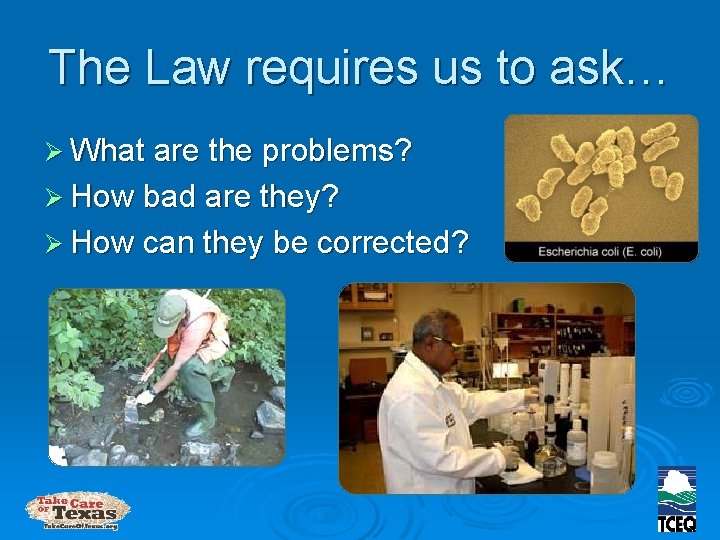
The Law requires us to ask… Ø What are the problems? Ø How bad are they? Ø How can they be corrected?
Texas TMDL Program Ø Texas is required under Section 303(d) of the federal Clean Water Act to list impaired waters and to take action to restore them. Ø Impaired waters are identified every two years on the Texas Integrated Report of Surface Water Quality. Ø A surface water body is considered impaired if it does not meet the criteria for support of one or more of its beneficial uses, as defined in the Texas Surface Water Quality Standards (307. 10 TAC).
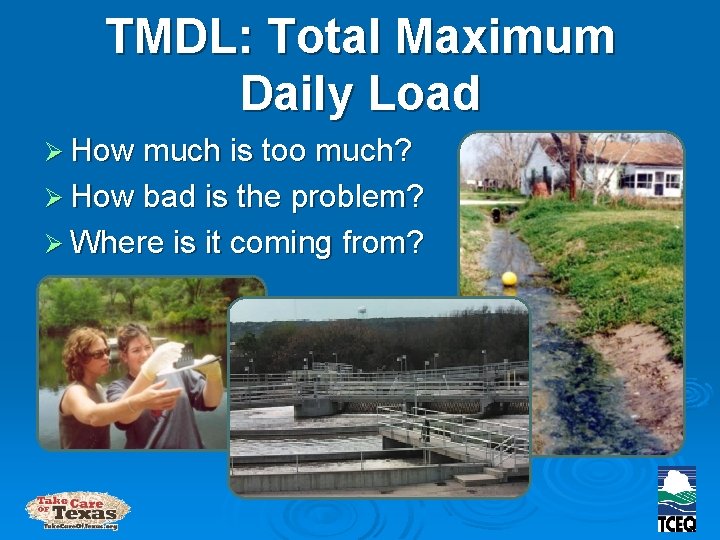
TMDL: Total Maximum Daily Load Ø How much is too much? Ø How bad is the problem? Ø Where is it coming from?
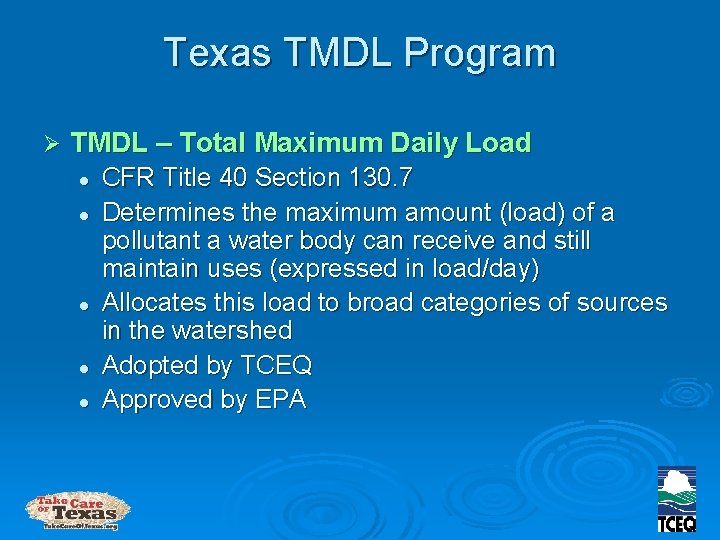
Texas TMDL Program Ø TMDL – Total Maximum Daily Load l l l CFR Title 40 Section 130. 7 Determines the maximum amount (load) of a pollutant a water body can receive and still maintain uses (expressed in load/day) Allocates this load to broad categories of sources in the watershed Adopted by TCEQ Approved by EPA
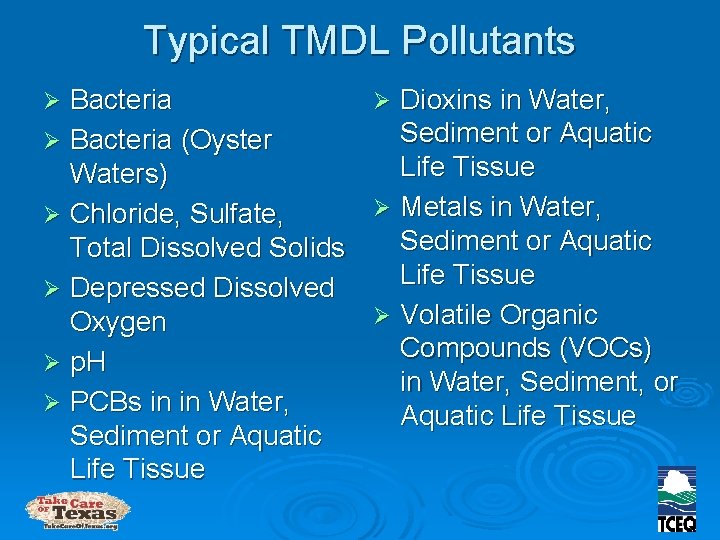
Typical TMDL Pollutants Bacteria Ø Bacteria (Oyster Waters) Ø Chloride, Sulfate, Total Dissolved Solids Ø Depressed Dissolved Oxygen Ø p. H Ø PCBs in in Water, Sediment or Aquatic Life Tissue Ø Dioxins in Water, Sediment or Aquatic Life Tissue Ø Metals in Water, Sediment or Aquatic Life Tissue Ø Volatile Organic Compounds (VOCs) in Water, Sediment, or Aquatic Life Tissue Ø
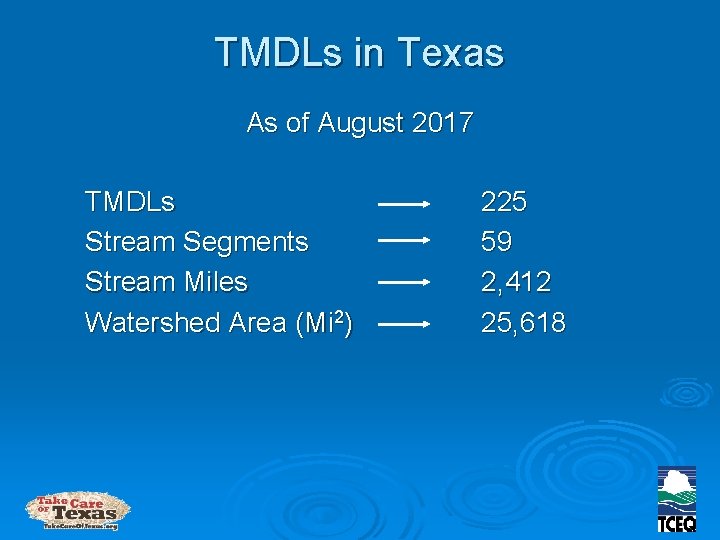
TMDLs in Texas As of August 2017 TMDLs Stream Segments Stream Miles Watershed Area (Mi 2) 225 59 2, 412 25, 618
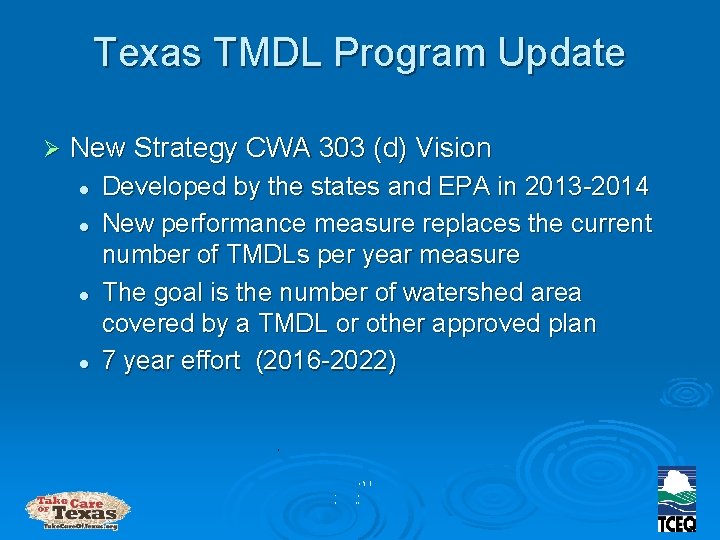
Texas TMDL Program Update Ø New Strategy CWA 303 (d) Vision l l Developed by the states and EPA in 2013 -2014 New performance measure replaces the current number of TMDLs per year measure The goal is the number of watershed area covered by a TMDL or other approved plan 7 year effort (2016 -2022)
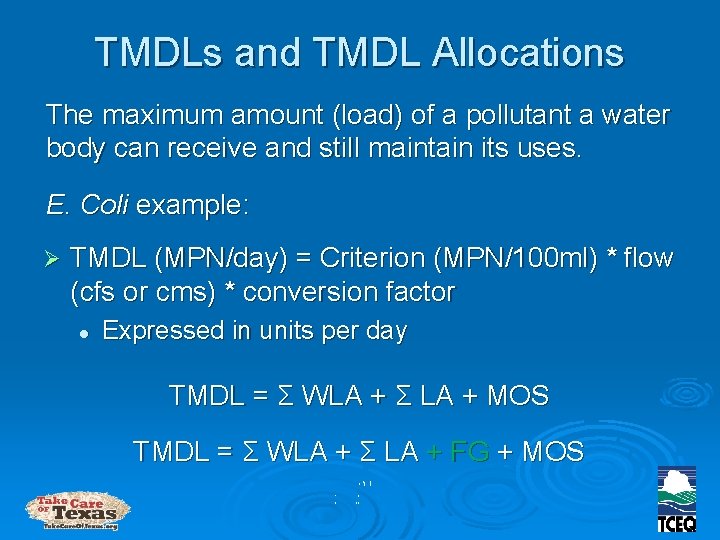
TMDLs and TMDL Allocations The maximum amount (load) of a pollutant a water body can receive and still maintain its uses. E. Coli example: Ø TMDL (MPN/day) = Criterion (MPN/100 ml) * flow (cfs or cms) * conversion factor l Expressed in units per day TMDL = Σ WLA + Σ LA + MOS TMDL = Σ WLA + Σ LA + FG + MOS
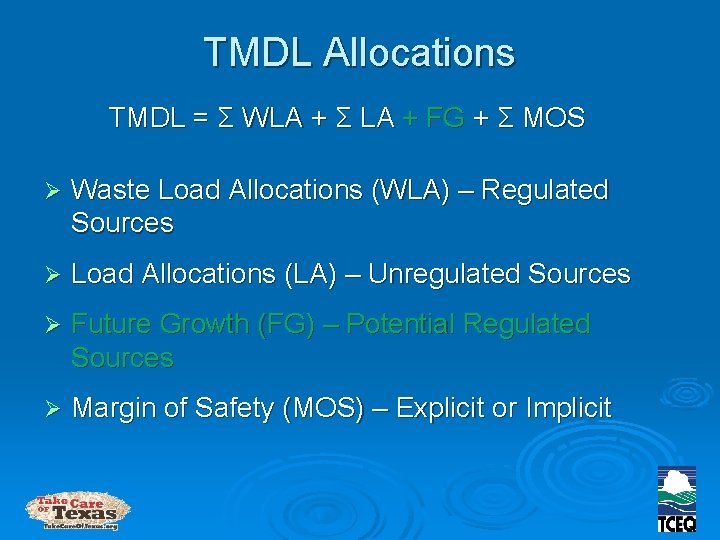
TMDL Allocations TMDL = Σ WLA + Σ LA + FG + Σ MOS Ø Waste Load Allocations (WLA) – Regulated Sources Ø Load Allocations (LA) – Unregulated Sources Ø Future Growth (FG) – Potential Regulated Sources Ø Margin of Safety (MOS) – Explicit or Implicit
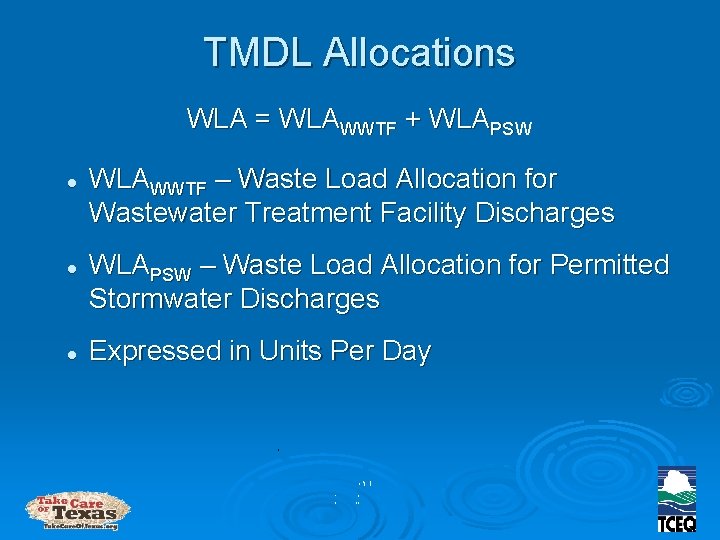
TMDL Allocations WLA = WLAWWTF + WLAPSW l l l WLAWWTF – Waste Load Allocation for Wastewater Treatment Facility Discharges WLAPSW – Waste Load Allocation for Permitted Stormwater Discharges Expressed in Units Per Day
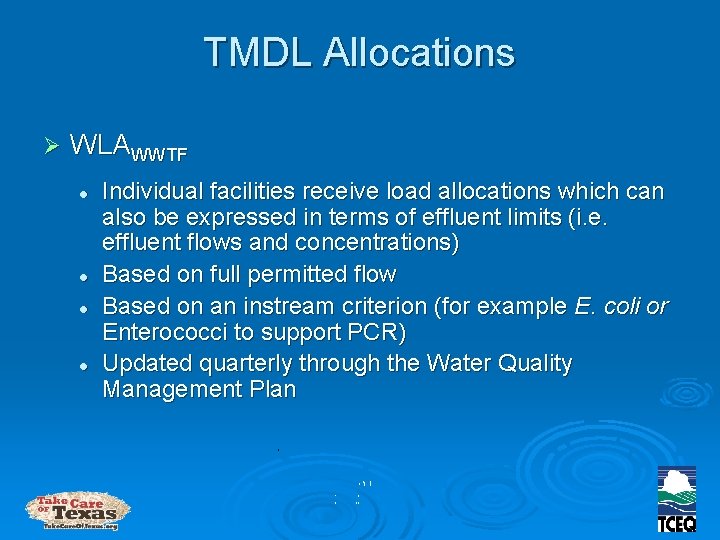
TMDL Allocations Ø WLAWWTF l l Individual facilities receive load allocations which can also be expressed in terms of effluent limits (i. e. effluent flows and concentrations) Based on full permitted flow Based on an instream criterion (for example E. coli or Enterococci to support PCR) Updated quarterly through the Water Quality Management Plan
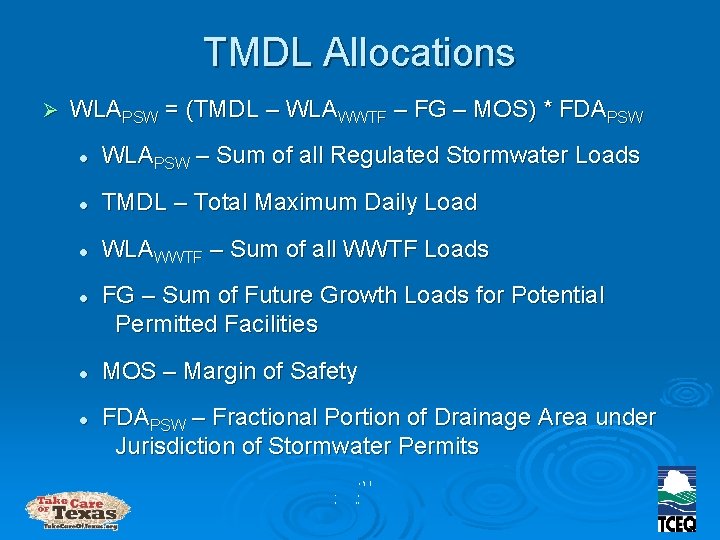
TMDL Allocations Ø WLAPSW = (TMDL – WLAWWTF – FG – MOS) * FDAPSW l WLAPSW – Sum of all Regulated Stormwater Loads l TMDL – Total Maximum Daily Load l WLAWWTF – Sum of all WWTF Loads l l l FG – Sum of Future Growth Loads for Potential Permitted Facilities MOS – Margin of Safety FDAPSW – Fractional Portion of Drainage Area under Jurisdiction of Stormwater Permits
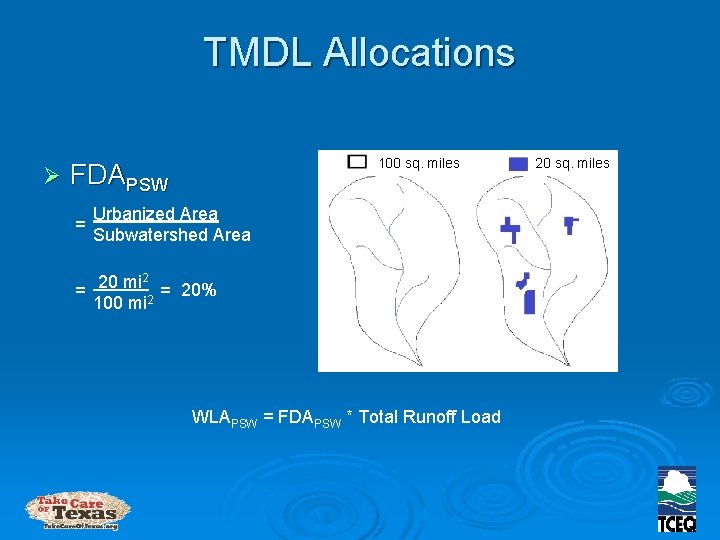
TMDL Allocations Ø 100 sq. miles FDAPSW = Urbanized Area Subwatershed Area 20 mi 2 = 20% = 100 mi 2 WLAPSW = FDAPSW * Total Runoff Load 20 sq. miles
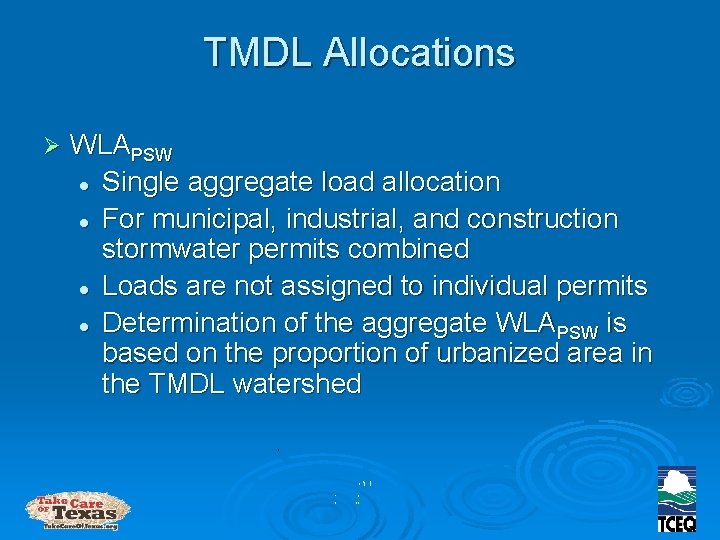
TMDL Allocations Ø WLAPSW l Single aggregate load allocation l For municipal, industrial, and construction stormwater permits combined l Loads are not assigned to individual permits l Determination of the aggregate WLAPSW is based on the proportion of urbanized area in the TMDL watershed
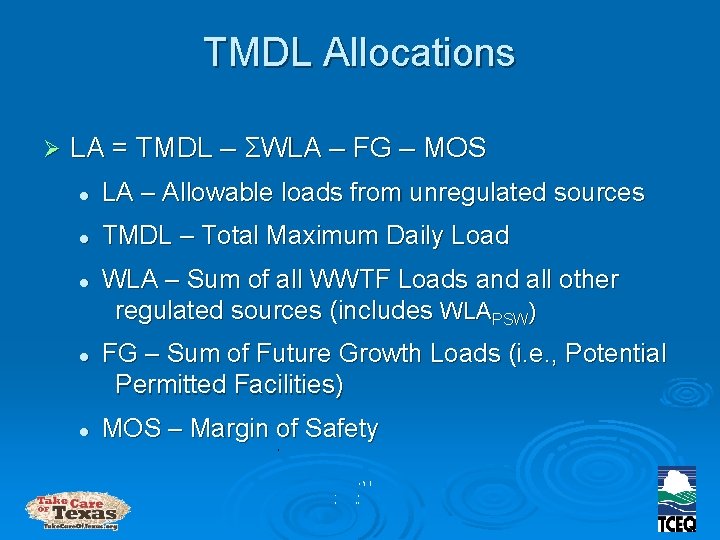
TMDL Allocations Ø LA = TMDL – ΣWLA – FG – MOS l LA – Allowable loads from unregulated sources l TMDL – Total Maximum Daily Load l l l WLA – Sum of all WWTF Loads and all other regulated sources (includes WLAPSW) FG – Sum of Future Growth Loads (i. e. , Potential Permitted Facilities) MOS – Margin of Safety
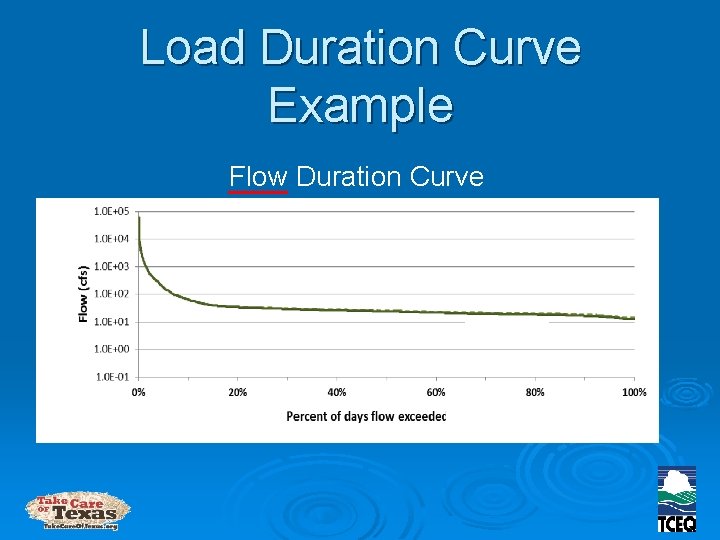
Load Duration Curve Example Flow Duration Curve
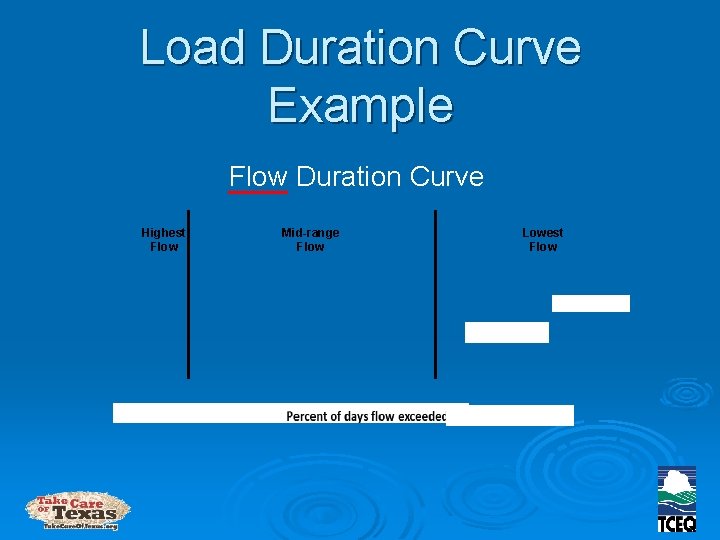
Load Duration Curve Example Flow Duration Curve Highest Flow Mid-range Flow Lowest Flow
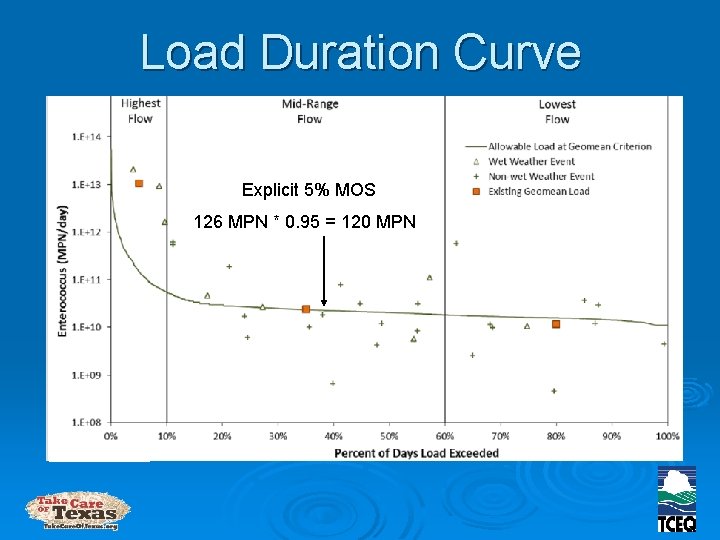
Load Duration Curve Explicit 5% MOS 126 MPN * 0. 95 = 120 MPN
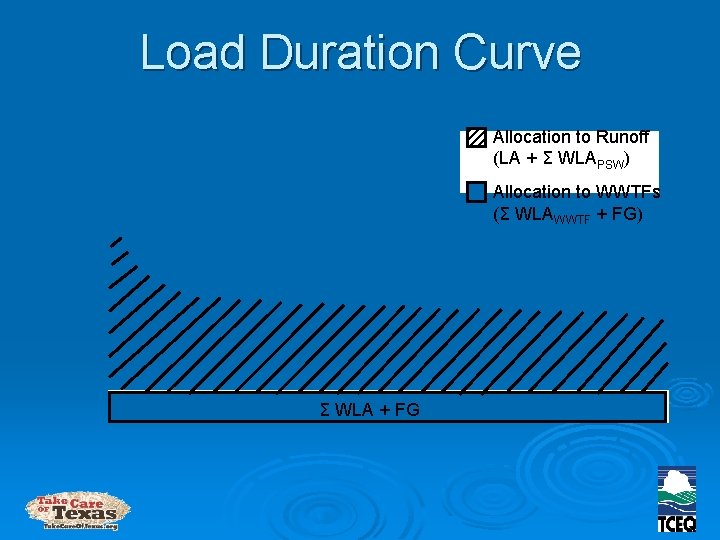
Load Duration Curve Allocation to Runoff (LA + Σ WLAPSW) Allocation to WWTFs (Σ WLAWWTF + FG) Σ WLA + FG
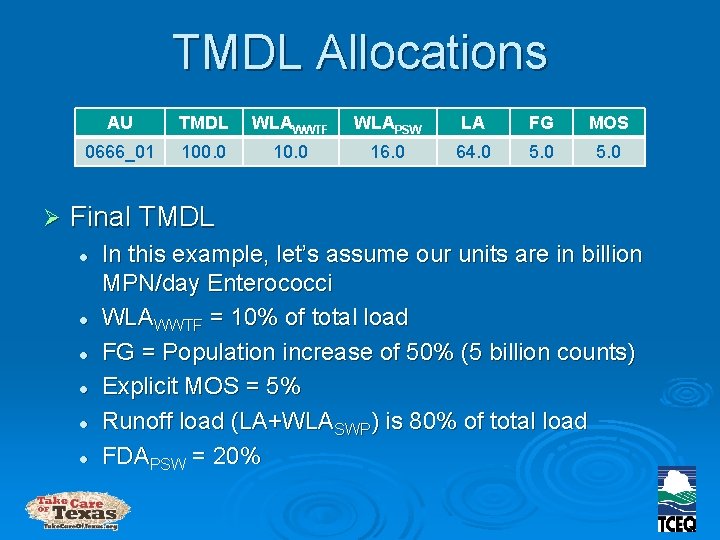
TMDL Allocations Ø AU TMDL WLAWWTF WLAPSW LA FG MOS 0666_01 100. 0 16. 0 64. 0 5. 0 Final TMDL l l l In this example, let’s assume our units are in billion MPN/day Enterococci WLAWWTF = 10% of total load FG = Population increase of 50% (5 billion counts) Explicit MOS = 5% Runoff load (LA+WLASWP) is 80% of total load FDAPSW = 20%
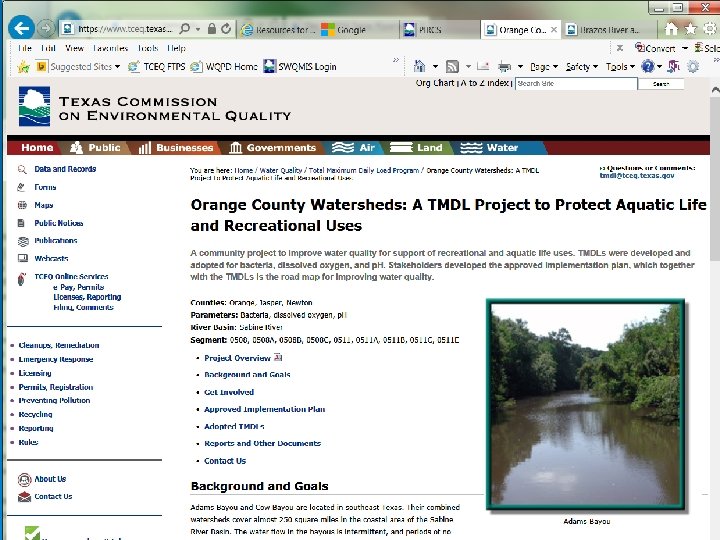
TMDL Implementation Plans (I-Plans) Ø Designed to satisfy the TMDL regulatory requirements for “reasonable assurance” of implementation Determines what will be required to manage the loads from all sources, including stormwater Ø Describe the activities that will be implemented over a specific time period by the stakeholders to improve water quality Ø
I-Plans (continued) Ø Developed by stakeholders in the affected watershed with support and guidance from the TCEQ Ø Collaborative effort involving a wide variety of stakeholders in a TMDL watershed l l l Citizens, watershed interest groups State, local, and federal agencies Regulated organizations
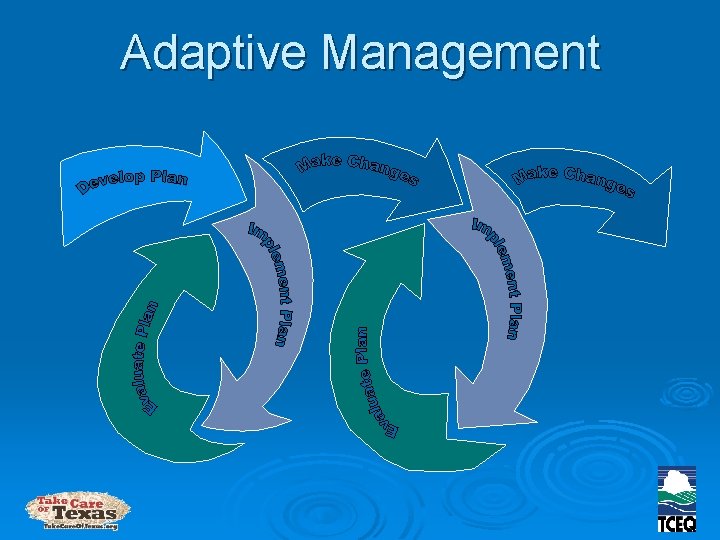
I-Plans (continued) Ø General Strategy for Development l l Ø Establish a Coordination Committee Identify and organize Work Groups Develop a Water Quality Improvement Plan Promote Plan to gain support and cooperation in the watershed Strategy for continuing the effort is also crucial l Stakeholders meet annually to review progress l The stakeholders revise the plan as needed
I-Plans (continued) Ø Establishes requirements for WWTFs that are “consistent” with the TMDL Ø Permitted municipal stormwater requirements agreed upon in the Implementation Plan may be submitted as part of a Stormwater Management Program for an MS 4 Ø Industrial Stormwater Permits and Construction Stormwater Permits may also be affected
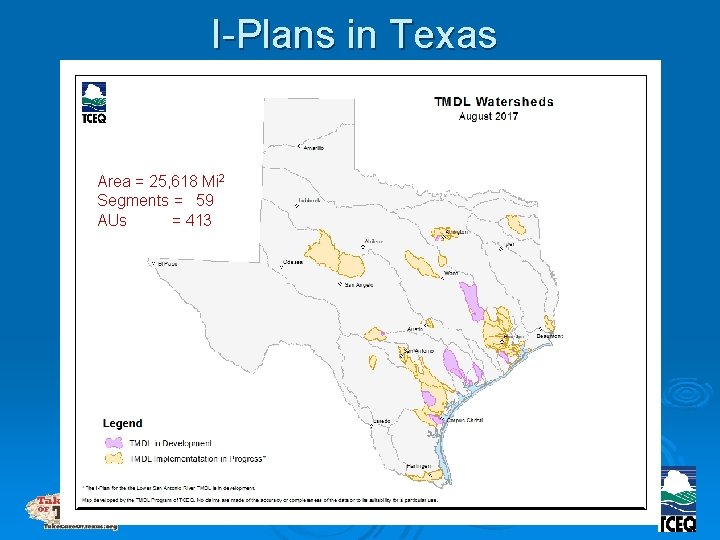
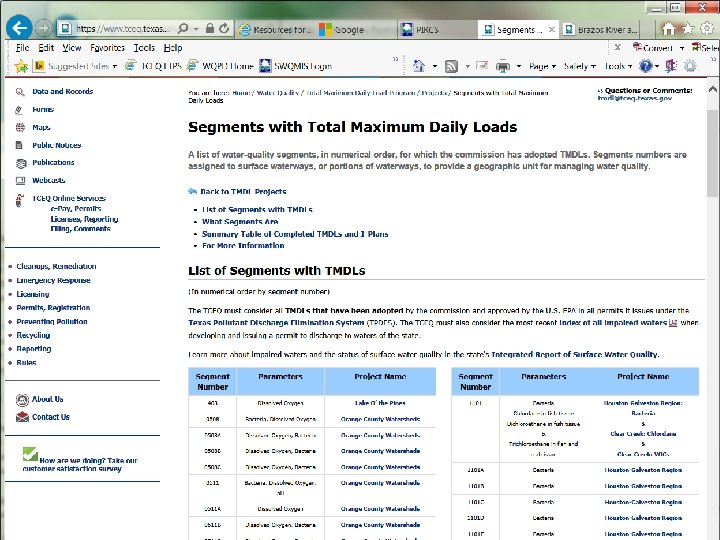
I-Plans in Texas Area = 25, 618 Mi 2 Segments = 59 AUs = 413
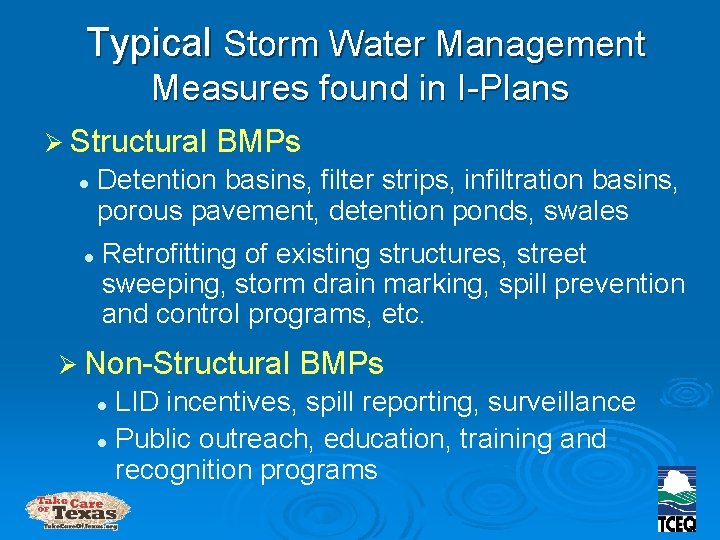
Typical Storm Water Management Measures found in I-Plans Ø Structural l l BMPs Detention basins, filter strips, infiltration basins, porous pavement, detention ponds, swales Retrofitting of existing structures, street sweeping, storm drain marking, spill prevention and control programs, etc. Ø Non-Structural BMPs LID incentives, spill reporting, surveillance l Public outreach, education, training and recognition programs l
Adaptive Management
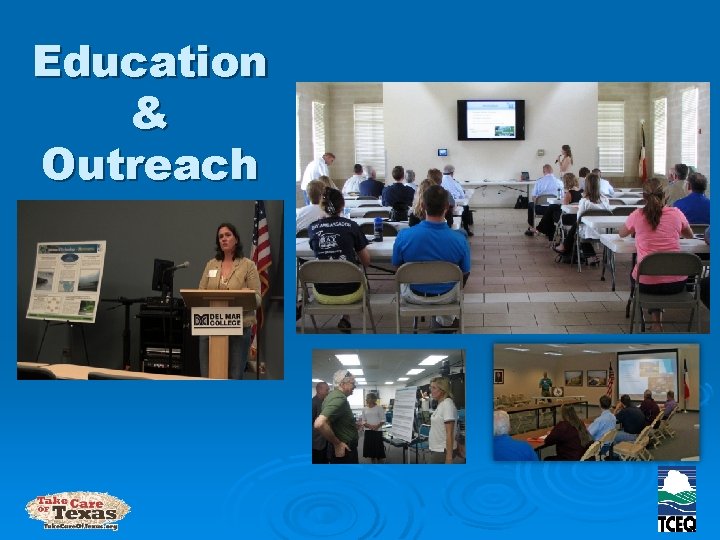
Education & Outreach
Water Quality Educational Events & Exhibits
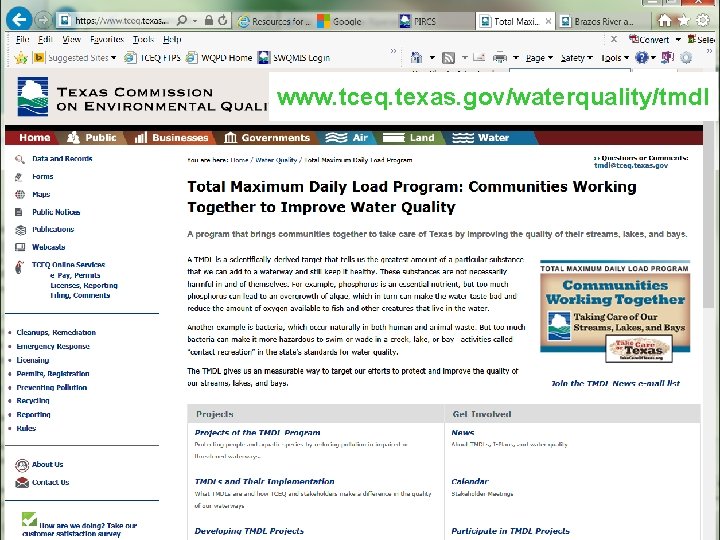
www. tceq. texas. gov/waterquality/tmdl
For More Information on TMDLs TCEQ TMDL Program Website: http: //www. tceq. texas. gov/waterquality/tmdl/ Roger Miranda roger. miranda@tceq. texas. gov (512) 239 -6278