
TOTAL HIP ARTHROPLASTY BY DR NEHA MUKKAMALA Objectives
TOTAL HIP ARTHROPLASTY BY DR NEHA MUKKAMALA
Objectives The student at the end of the session will be able to �Enumerate the indications, contraindications of total hip arthroplasty �Differentiate the different surgical approaches �List the principles of assessment and management of THR
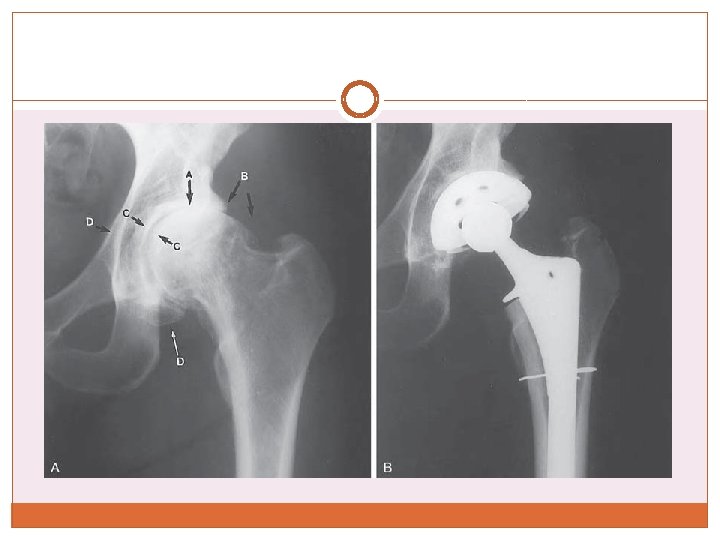
�Arthroplasty=Replacement of joint �THR/THA=Total Hip Replacement/Arthroplasty Replacement of Acetabular as well as Femoral components �Hemiarthroplasty=Replacement of only the femoral component
Indications �Severe hip pain with motion and weight bearing �Nonunion fracture, instability or deformity of the hip �Bone tumors �Failure of conservative management or previous joint reconstruction procedures (osteotomy, resurfacing arthroplasty, femoral stem hemiarthroplasty, total hip replacement)
Background �Sir John Charnley is credited with the initial research and clinical application of THA in early 1960’s, �Implants are composed of an inert metal (cobaltchrome and titanium) modular femoral component and a high-density polyethylene acetabular component. �Other designs in use are metal-on-metal systems and systems that utilize ceramic surfaces in the design.
Cemented versus cementless fixation. �Use of acrylic cement, methylmethacrylate, for prosthetic fixation. �Cement fixation allows very early postoperative weight bearing and shortens the period of rehabilitation �A significant postoperative complication, identified was aseptic (biomechanical) loosening of the prosthetic components at the bone–cement interface.
�Mechanical loosening, most often the acetabular component, gave rise to the development and use of cementless (biological) fixation. �Cementless fixation is achieved either by use of porous-coated prostheses that allow osseous ingrowth into the beaded or mesh-like surfaces of an implant or by a cementless press-fit technique.
�Ingrowth of bony tissue occurs over a 3 - to 6 - month period with continued bone remodeling beyond that time period. �Cement fixation is routinely used for patients with osteoporosis and poor bone stock and typically with elderly patients. �Cementless fixation is the choice for the patient under 60 years of age who is physically active and has good bone quality.
�low rate of loosening of cemented femoral implants but loosening of cemented acetabular components, gave rise to the use of a hybrid procedure with a noncemented acetabular component and a cemented femoral prosthesis.
Contraindications �Absolute • Active joint infection • Systemic infection or sepsis • Chronic osteomyelitis • Significant loss of bone after resection of a malignant tumor or inadequate bone stock that prevents sufficient implant fixation • Neuropathic hip joint • Severe paralysis of the muscles surrounding the joint
�Relative • Localized infection, such as bladder or skin • Insufficient function of the gluteus medius muscle • Progressive neurological disorder • Highly compromised/insufficient femoral or acetabular bone stock associated with progressive bone disease • Patients requiring extensive dental work—dental surgery should be completed before arthroplasty • Young patients who must or are most likely to participate in high-demand (high-load, high-impact) activities
Pre-operative Assessment & Management �Preoperative patient education �Preoperative assessment and documentation of a patient’s status �patient education about the procedure and what to expect during the early postoperative period
Pre-operative Assessment & Management �Examination and evaluation of pain, ROM, muscle strength, balance, ambulatory status, leg lengths, gait characteristics, use of assistive devices, general level of function, perceived level of disability �Information for patients and their families about joint disease and the operative procedure in nonmedical terms
�Postoperative precautions and their rationale including positioning and weight bearing �Functional training for early postoperative days including bed mobility, transfers, gait training with assistive devices �Early postoperative exercises �Criteria for discharge from the hospital
Surgical Approaches
�Posterior (or posterolateral), �lateral, �and anterior (or anterolateral).
Posterolateral approach �Most frequently used approach for primary THA. �Gluteus maximus is split in line with the muscle fibers. �The short external rotator tendons are transected near their insertion. �Trochanteric osteotomy is not necessary. �The capsule is incised posteriorly in preparation for posterior dislocation of the hip. �Disadvantage : associated with the highest incidence of postoperative joint instability and resulting subluxation or dislocation of the hip. �Posterior capsulorrhaphy advocated
Direct lateral approach �Requires longitudinal division of the tensor fasciae latae, release of up to one-half of the proximal insertion of the gluteus medius, and longitudinal splitting of the vastus lateralis. The gluteus minimus also is partially detached from the trochanter. �A lateral approach may, but typically does not, involve a trochanteric osteotomy. �Disruption of the abductor mechanism is associated with postoperative weakness and gait abnormalities (positive Trendelenburg sign).
Anterolateral approach �Most often reserved for revision arthroplasty. �Also indicated for patients with muscle imbalances associated with stroke or cerebral palsy. �It provides excellent stability of the hip postoperatively but involves detachment and subsequent repair of the gluteus medius muscle, or it may necessitate an osteotomy of the greater trochanter for adequate exposure of the hip joint.
Anterolateral approach �In addition to the gluteus medius, soft tissues disturbed in an anterolateral approach include the gluteus minimus, tensor fasciae latae, iliopsoas, rectus femoris, and vastus lateralis muscles as well as the anterior capsule. �If a trochanteric osteotomy is performed, the trochanter must be reattached and wired in place to stabilize the osteotomy site until bone healing occurs. �Complications associated with trochanteric osteotomy include nonunion, abductor muscle weakness, and greater than usual soft tissue irritation and pain from a considerable amount of internal fixation.
Complications �The incidence is relatively low. Intraoperative complications: �malpositioning of the prosthetic components, �femoral fracture, �and nerve injury
In addition to medical complications, such as infection, DVT, or pneumonia that can occur after any surgery, postoperative complications that may occur during the early period of recovery (before 6 weeks or up to 2 to 3 months) include �wound healing problems, �Dislocation of the prosthetic joint, most frequently during the first 2 to 3 months post-op �disruption of a bone graft site before sufficient bone healing has occurred, �and leg length discrepancy.
Late complications include �dislocation, Most dislocations are nontraumatic and occur in a posterior direction, but not always associated with a posterior surgical approach. Dislocation also occurs after anterior/anterolateral and direct lateral approaches �mechanical loosening of either implant at the bone– cement or bone–implant interface, �polyethylene wear, �and in rare instances heterotopic ossification
�Inequality of leg lengths �Asymmetry of the pelvis and trunk may be the result of muscle spasm, muscle weakness (particularly the gluteus medius), and residual contracture of hip muscles. A true leg length discrepancy, associated with low back and hip pain or hip dislocation, may be the result of malpositioning of the prosthetic implants (usually the acetabular component).
Management of hip arthroplasty
Postoperative Management �Immobilization �No need for immobilization of the operated hip. Postoperative rehabilitation emphasizes early movement. �Depending on the type of surgical approach used and the stability of the prosthetic hip, the operated limb may need to remain in a position of slight abduction and neutral rotation when the patient is lying in bed in the supine position. An abduction pillow or wedge typically is sufficient to maintain the position.
�Weight-Bearing Considerations �After cemented THA, patients are permitted to bear as much weight as tolerated almost immediately after surgery. �With cementless or hybrid THA, it is often necessary to limit weight bearing on the operated limb. Recommendations vary from partial weight bearing (toe-touch or touch-down) for at least 6 weeks to weight bearing as tolerated (no restrictions) immediately after surgery
�The rationale for restricting weight bearing in cementless and hybrid THA: early, excesssive loading of the operated limb could cause micromovement at the bone–implant interface, thereby jeopardizing the initial stability of the implant(s), interfering with osseous ingrowth, and contributing to eventual loosening of the prosthetic implants. �The benefits of early weight bearing after THA are reduction of bone demineralization from decreased weight bearing and the earlier recovery of functional mobility
�Use of bone grafts. Non-weight-bearing or restricted weight bearing during bone healing. �Poor quality of patient’s bone. Extended restrictions so as not to jeopardize the stability of the prosthetic implants.
� Effects of immediate weight bearing as tolerated during ambulation and other functional activities after cementless or hybrid arthroplasty were compared with the effects of restricted weight bearing.
Exercise: Maximum Protection Phase After Traditional THA (0 -4 weeks) �Common impairments: pain secondary to the surgical procedure �decreased ROM �muscle guarding and weakness �impaired postural stability and balance �diminished functional mobility (transfers and ambulation activities) �The emphasis of this phase rehabilitation is on patient education to reduce the risk of early postoperative complications, in particular dislocation of the operated hip.
�All patients are asked to limit flexion of the hip to 90 degree and rotation to 45 for about 6 weeks regardless of the approach used. �The frequency of treatment by a therapist is often twice a day until the patient is discharged from the hospital, typically by 3 to 4 days postoperatively. �Ideally, the prescribed exercises are performed hourly by the patient.
Goals and interventions. Prevent vascular and pulmonary complications. • Ankle pumping exercise • Deep breathing exercise and bronchial hygiene to prevent postoperative atelectasis or pneumonia Prevent postoperative dislocation or subluxation of the operated hip. • Patient and caregiver education about motion restrictions, safe bed mobility, transfers, and precautions during other ADL • Monitor the patient for signs and symptoms of dislocation, like shortening of the operated lower extremity
�Achieve independent functional mobility prior to discharge. • Bed mobility and transfer training, integrating weight bearing and motion restrictions. • Ambulation with an assistive device (usually a walker or two crutches) immediately after surgery, adhering to weight-bearing restrictions and gait-related ADL precautions.
�Maintain a functional level of strength and muscular endurance in the upper extremities and unoperated lower extremity. • Active-resistive exercises in functional movement patterns, targeting muscle groups used during transfers and ambulation with assistive devices. �Prevent reflex inhibition and atrophy of musculature in the operated limb. • Submaximal muscle-setting exercises of the quadriceps, hip extensor, and hip abductor muscles —just enough to elicit a muscle contraction.
�Regain active mobility and control of the operated extremity. • While in bed, active-assistive (A-AROM) exercises of the hip within protected ranges. • Active knee flexion and extension exercises while seated in a chair, emphasizing terminal extension progressing to active hip and knee flexion (heel slides), gravityeliminated hip abduction and active rotation between external rotation or internal rotation to neutral depending on the surgical approach. • Active hip exercises in the standing position with hands on a stable surface to maintain balance. • Closed-chain hip flexion and extension, placing only the allowable amount of weight on the operated extremity.
�Prevent a flexion contracture of the operated hip. • Avoid use of a pillow under the knee of the operated extremity
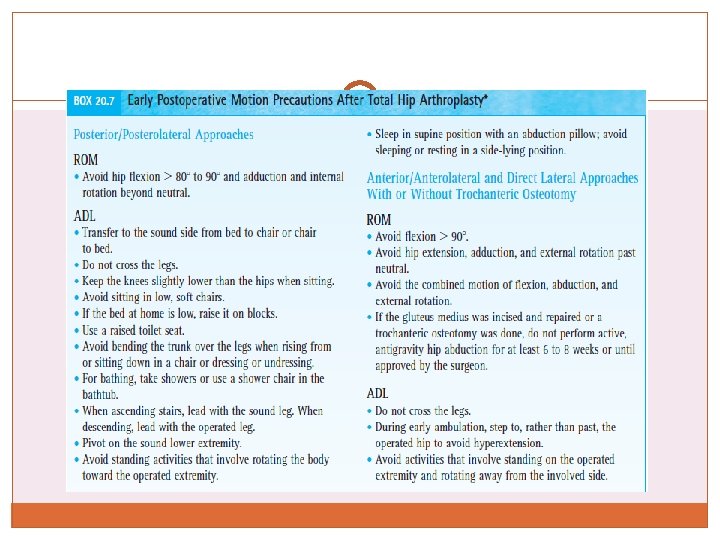
Precautions �Arising from a low chair produces loads approximately eight times body weight. If the posterior capsule was incised the involved hip is at a high risk of posterior dislocation until soft tissues around the hip joint have healed sufficiently (at least 6 weeks) or until the surgeon indicates �If a trochanteric osteotomy was performed, avoid even low-intensity isometric contractions of the hip abductors
Moderate and Minimum Protection Phases (4 -12 weeks) � Full healing of soft tissue and bone continues for up to a year after surgery. � The exercises usually are a part of a home program. Exercises and functional training focus on restoration of strength, postural stability and balance, muscular and cardiopulmonary endurance, and ROM to functional levels and gradual resumption and necessary modification of functional activities. � Postoperative precautions during ADL are continued for at least 12 weeks. � Patient education continues throughout these phases of rehabilitation. Return to a full level of functional activities may take 6 to 8 months. � To prolong the life of the prosthesis, particularly in patients under 50 to 60 years of age, patients are routinely advised to refrain from highimpact sports and recreational activities. � If a patient’s employment involves heavy labor, vocational retraining or an adjustment in work-related activities is advised.
Goals and interventions � Regain strength and muscular endurance. • Open-chain exercises in the operated leg against light resistance. Emphasize increasing the number of repetitions rather than the resistance to improve muscular endurance. • Bilateral closed-chain exercises such as mini-squats against light-grade elastic resistance or while holding light weights in both hands when unsupported standing is permitted. • Unilateral closed-chain exercises such as forward and lateral step-ups (to a low step) and partial lunges with the involved foot forward when full weight bearing is permitted on the operated lower extremity. • Resistive exercises to other involved areas in order to improve function. � Improve cardiopulmonary endurance. • Nonimpact aerobic conditioning program, such as progressive stationary cycling, swimming, or water aerobics.
�Reduce contractures while adhering to motion precautions. • Gravity-assisted supine stretch to neutral in the Thomas test position. Pull the uninvolved knee to the chest while relaxing the operated hip. (At least 10 of hip extension beyond neutral is needed for a normal gait pattern. ) • Resting in a prone position for a prolonged passive stretch of the hip flexor muscles when rolling to prone-lying is permissible and is also tolerable. • Integrate gained ROM into functional activities.
� Improve postural stability, balance, and gait. • Emphasize use of a cane (in the hand contralateral to the operated hip) and progressive weight bearing on the operated limb. • While using a cane, walk over uneven and soft surfaces to challenge the balance system. • Integrate posture training during ambulation, emphasizing an erect trunk, vertical alignment, equal step lengths, and a neutral symmetrical position of the legs. • Continue cane use until weight-bearing restrictions are discontinued or if the patient exhibits gait deviations, such as a positive Trendelenburg sign on the operated lower extremity, indicating gluteus medius weakness. Cane use is also recommended during extended periods of ambulation to decrease muscle fatigue
�Prepare for a full level of functional activities. • Continue to avoid applying high loads during exercise. Strengthen hip and knee musculature with functional activities such as ascending and descending stairs step over step. • Progressively increase the length of time and distance of a low-intensity walking program 2 to 4 days a week. • When walking and carrying a heavy object in one hand, suggest that the patient hold it on the same side as the operated hip. Theoretically, this reduces the amount of stress imposed over time on the prosthetic hip replacement.
Focus on evidence �The results of research suggest that the forces imposed on the abductor muscles of the prosthetic hip, as measured by EMG, are significantly lower when a load is carried in the arm on the same side as the prosthetic hip compared to when the load is carried in the contralateral arm.
Clinical query �Will Physical exercises have any effect on postoperative outcome after THR �P- Patients with THR �I- Exercise Program �C-Nil �O-Physical functioning, ADLs
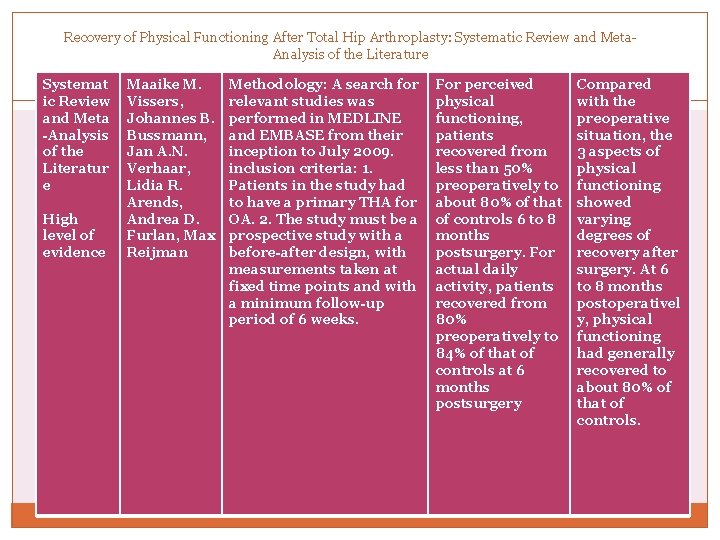
Recovery of Physical Functioning After Total Hip Arthroplasty: Systematic Review and Meta. Analysis of the Literature Systemat ic Review and Meta -Analysis of the Literatur e High level of evidence Maaike M. Vissers, Johannes B. Bussmann, Jan A. N. Verhaar, Lidia R. Arends, Andrea D. Furlan, Max Reijman Methodology: A search for relevant studies was performed in MEDLINE and EMBASE from their inception to July 2009. inclusion criteria: 1. Patients in the study had to have a primary THA for OA. 2. The study must be a prospective study with a before-after design, with measurements taken at fixed time points and with a minimum follow-up period of 6 weeks. For perceived physical functioning, patients recovered from less than 50% preoperatively to about 80% of that of controls 6 to 8 months postsurgery. For actual daily activity, patients recovered from 80% preoperatively to 84% of that of controls at 6 months postsurgery Compared with the preoperative situation, the 3 aspects of physical functioning showed varying degrees of recovery after surgery. At 6 to 8 months postoperativel y, physical functioning had generally recovered to about 80% of that of controls.
Clinical query �Will exercises have any effect on physical functioning after THR �P- Patients with THR �I- Exercise Program �C-No exercises �O-Physical functioning, ADLs
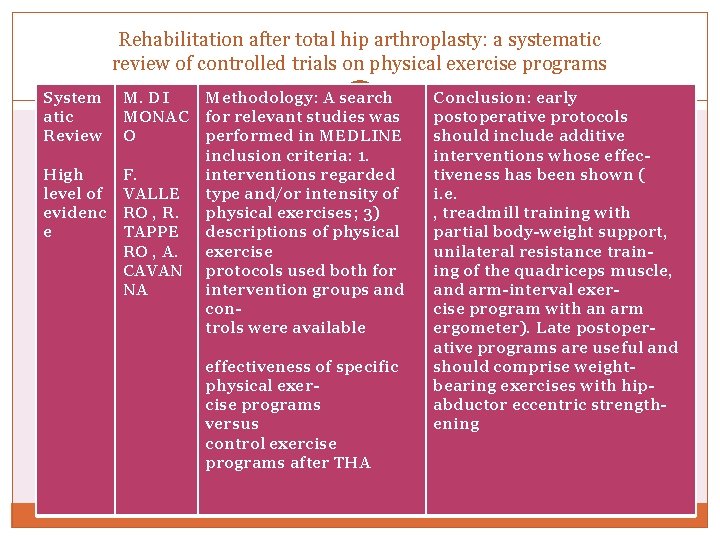
Rehabilitation after total hip arthroplasty: a systematic review of controlled trials on physical exercise programs System atic Review M. DI MONAC O High level of evidenc e F. VALLE RO , R. TAPPE RO , A. CAVAN NA Methodology: A search for relevant studies was performed in MEDLINE inclusion criteria: 1. interventions regarded type and/or intensity of physical exercises; 3) descriptions of physical exercise protocols used both for intervention groups and controls were available effectiveness of specific physical exercise programs versus control exercise programs after THA Conclusion: early postoperative protocols should include additive interventions whose effectiveness has been shown ( i. e. , treadmill training with partial body-weight support, unilateral resistance training of the quadriceps muscle, and arm-interval exercise program with an arm ergometer). Late postoperative programs are useful and should comprise weightbearing exercises with hipabductor eccentric strengthening
MCQs 1. In Posterolateral approach _____ dislocation is common a. Anterior b. Posterior 2. Hip flexion above 90 degree should be avoided after THR a. True b. False
3. Sitting on a low stool should be encouraged in a patient who has undergone THR a. True b. False 4. Emphasize increasing the ___ rather than the ____ to improve muscular endurance in the early phase of THR a. resistance, number of repetitions b. number of Repetitions, resistance
5. Emphasize use of a cane in the hand _____ to the operated hip a. Ipsilateral b. Contralateral
- Slides: 53