
Total hemivertebra resection by posterior approach in congenital
Total hemivertebra resection by posterior approach in congenital scoliosis and Kyphoscoliosis : results with 7 years mean follow up Marco Crostelli, Osvaldo Mazza, Massimo Mariani, Dario Mascello Spine Disease Unit Ospedale Pediatrico Bambino Gesù Roma
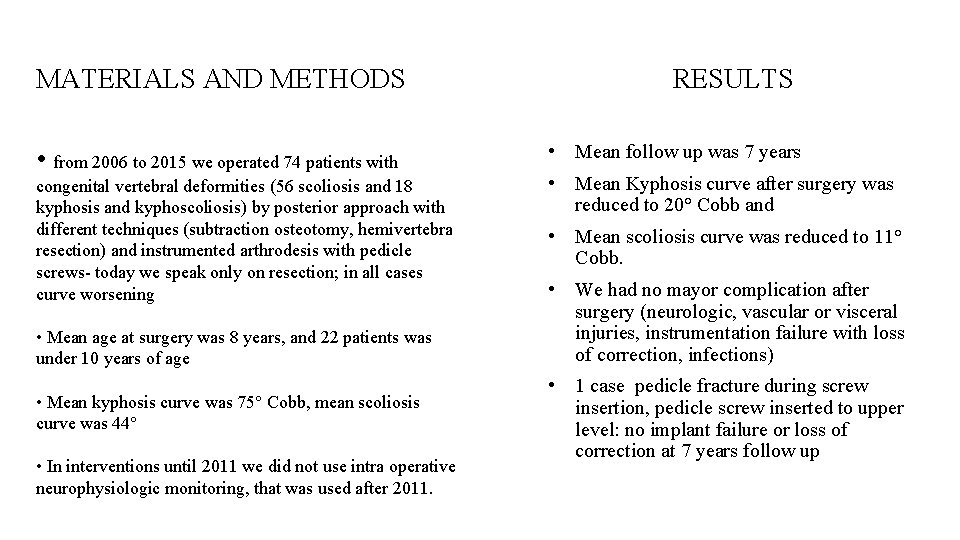
MATERIALS AND METHODS RESULTS • from 2006 to 2015 we operated 74 patients with • Mean follow up was 7 years congenital vertebral deformities (56 scoliosis and 18 kyphosis and kyphoscoliosis) by posterior approach with different techniques (subtraction osteotomy, hemivertebra resection) and instrumented arthrodesis with pedicle screws- today we speak only on resection; in all cases curve worsening • Mean scoliosis curve was reduced to 11° Cobb. • Mean age at surgery was 8 years, and 22 patients was under 10 years of age • Mean kyphosis curve was 75° Cobb, mean scoliosis curve was 44° • In interventions until 2011 we did not use intra operative neurophysiologic monitoring, that was used after 2011. • Mean Kyphosis curve after surgery was reduced to 20° Cobb and • We had no mayor complication after surgery (neurologic, vascular or visceral injuries, instrumentation failure with loss of correction, infections) • 1 case pedicle fracture during screw insertion, pedicle screw inserted to upper level: no implant failure or loss of correction at 7 years follow up
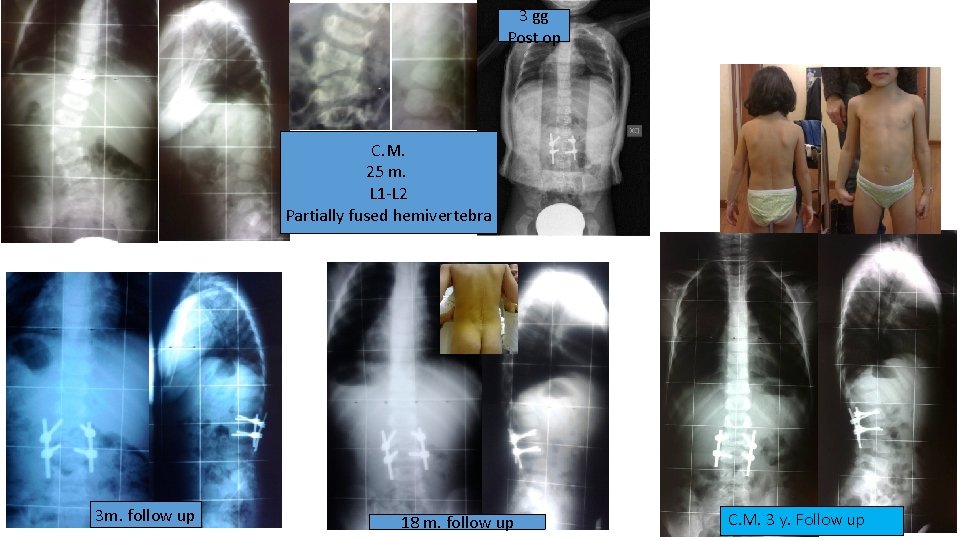
3 gg Post op C. M. 25 m. L 1 -L 2 Partially fused hemivertebra 3 m. follow up 18 m. follow up C. M. 3 y. Follow up
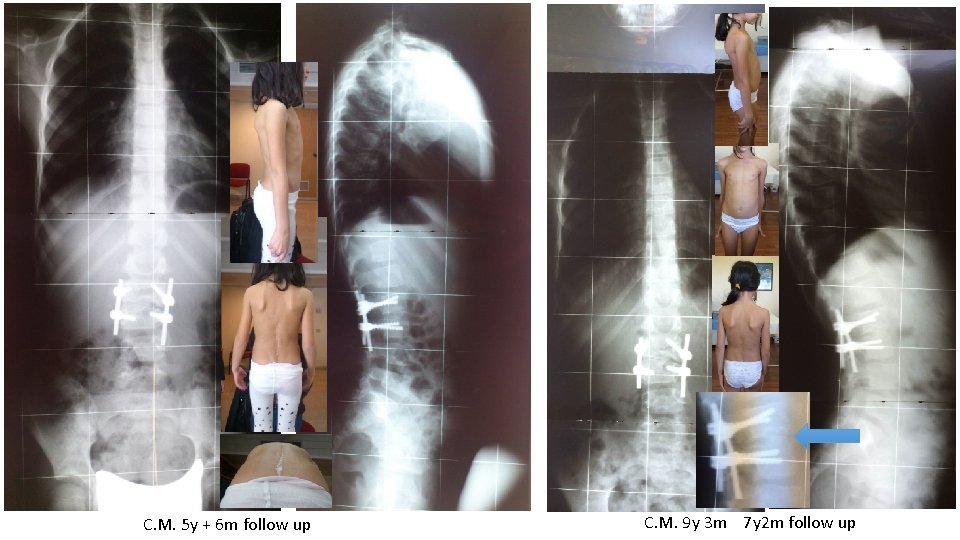
C. M. 5 y + 6 m follow up C. M. 9 y 3 m 7 y 2 m follow up
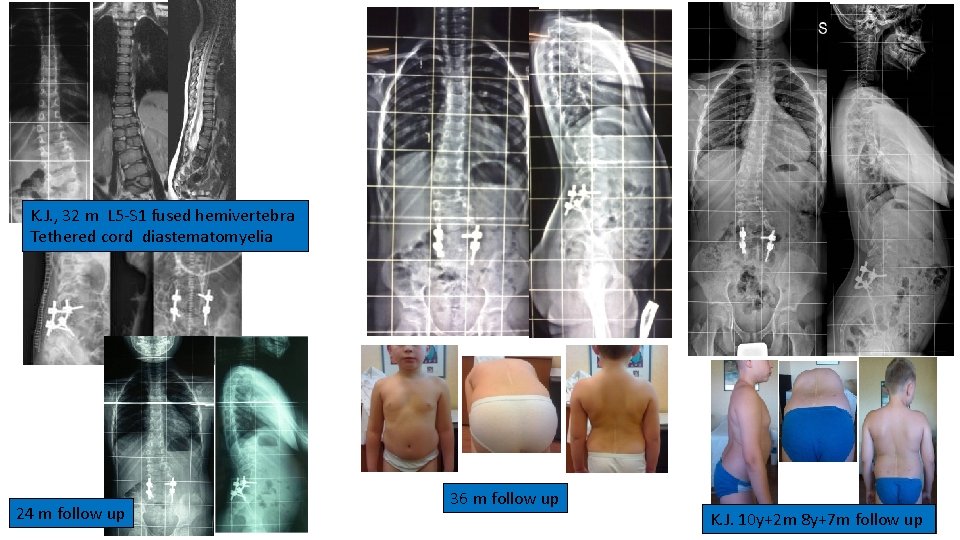
K. J. , 32 m L 5 -S 1 fused hemivertebra Tethered cord diastematomyelia 24 m follow up 36 m follow up K. J. 10 y+2 m 8 y+7 m follow up
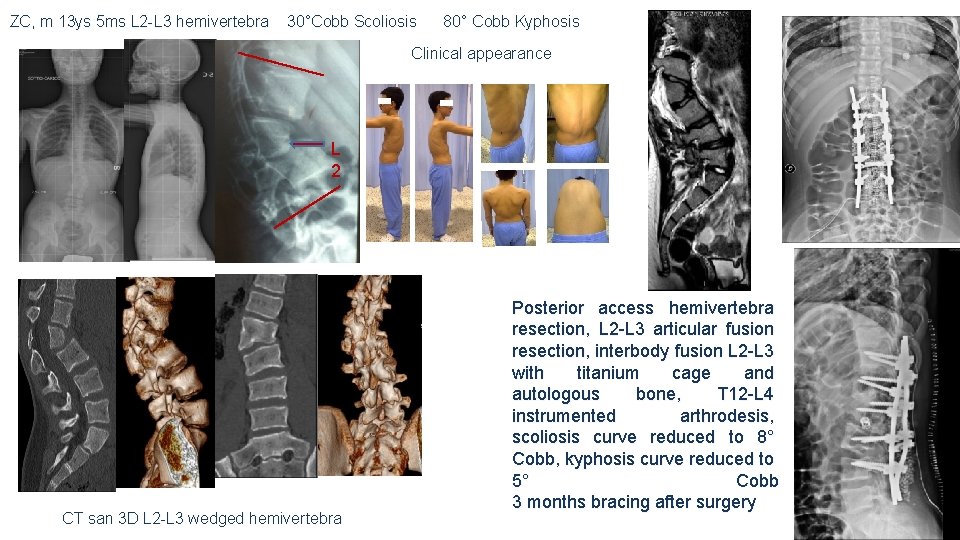
ZC, m 13 ys 5 ms L 2 -L 3 hemivertebra 30°Cobb Scoliosis 80° Cobb Kyphosis Clinical appearance L 2 CT san 3 D L 2 -L 3 wedged hemivertebra Posterior access hemivertebra resection, L 2 -L 3 articular fusion resection, interbody fusion L 2 -L 3 with titanium cage and autologous bone, T 12 -L 4 instrumented arthrodesis, scoliosis curve reduced to 8° Cobb, kyphosis curve reduced to 5° Cobb 3 months bracing after surgery
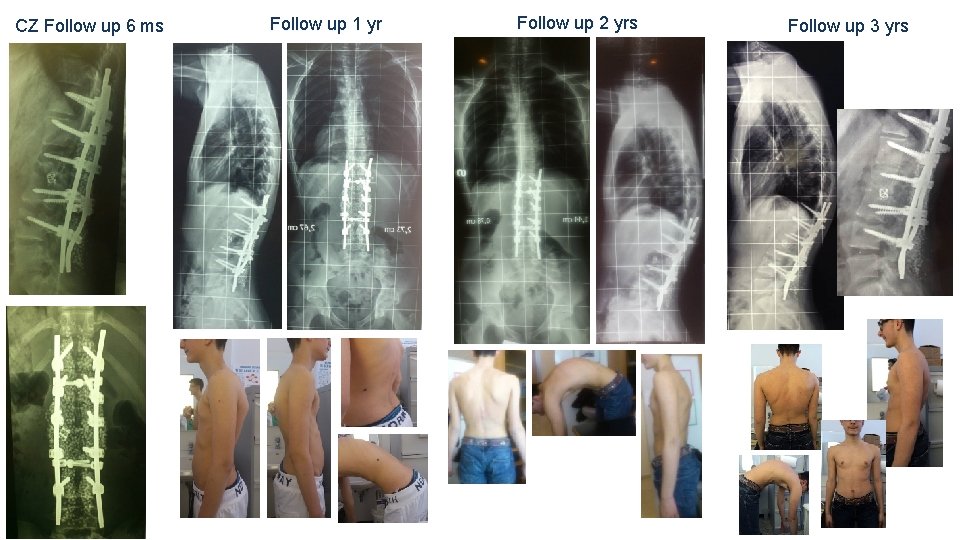
CZ Follow up 6 ms Follow up 1 yr Follow up 2 yrs Follow up 3 yrs
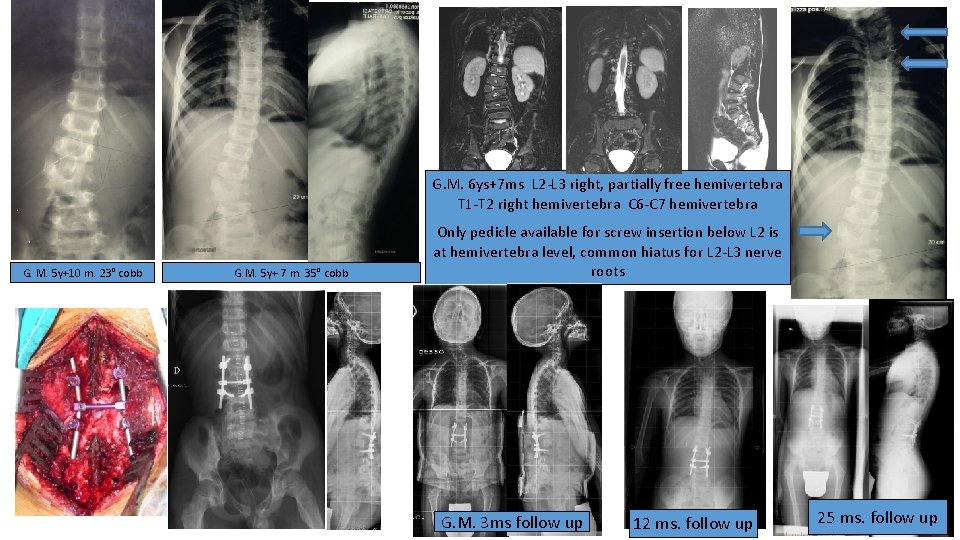
G. M. 6 ys+7 ms L 2 -L 3 right, partially free hemivertebra T 1 -T 2 right hemivertebra C 6 -C 7 hemivertebra G. M. 5 y+10 m. 23° cobb G. M. 5 y+ 7 m. 35° cobb Only pedicle available for screw insertion below L 2 is at hemivertebra level, common hiatus for L 2 -L 3 nerve roots G. M. 3 ms follow up 12 ms. follow up 25 ms. follow up
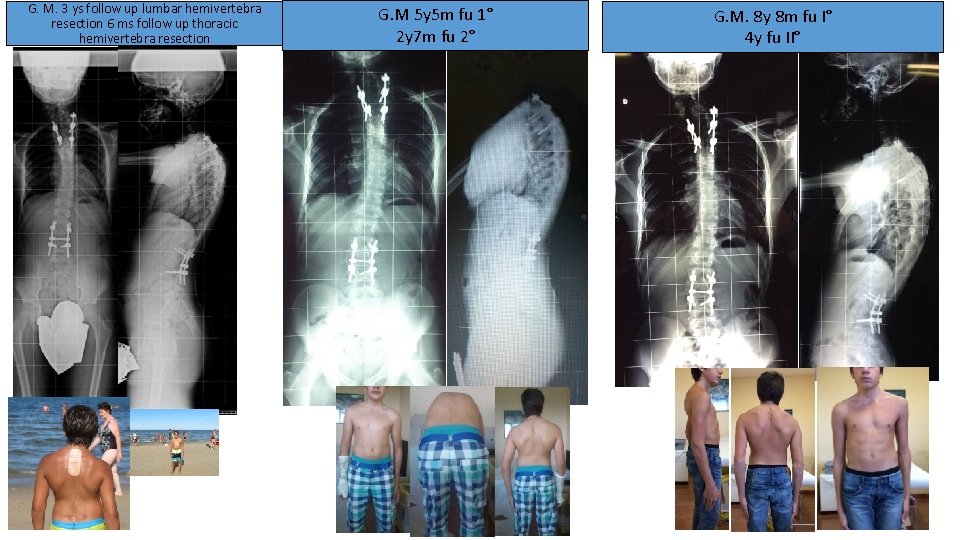
G. M. 3 ys follow up lumbar hemivertebra resection 6 ms follow up thoracic hemivertebra resection G. M 5 y 5 m fu 1° 2 y 7 m fu 2° G. M. 8 y 8 m fu I° 4 y fu II°
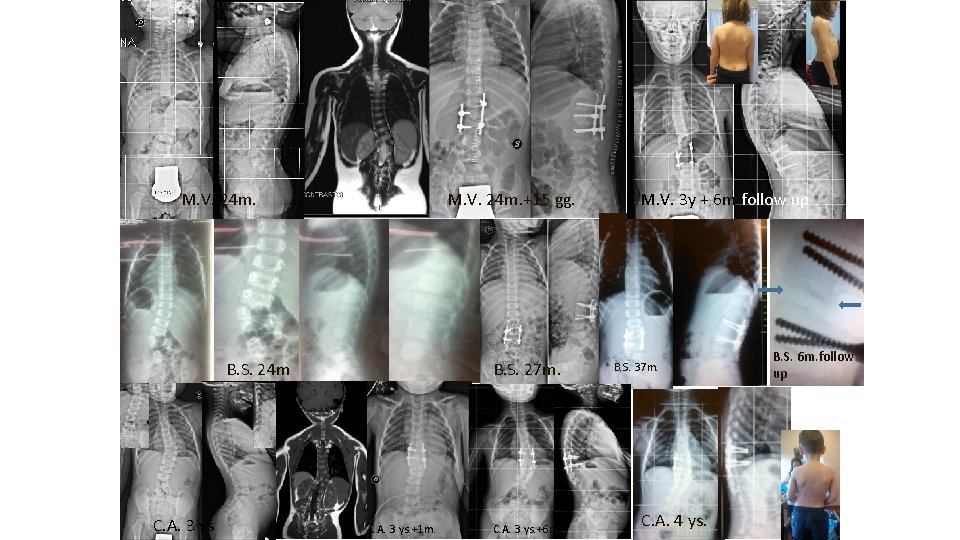
M. V. 24 m. +15 gg. B. S. 24 m C. A. 3 ys B. S. 27 m. C. A. 3 ys. +1 m. C. A. 3 ys. +6 m. M. V. 3 y + 6 m follow up B. S. 37 m. C. A. 4 ys. B. S. 6 m. follow up
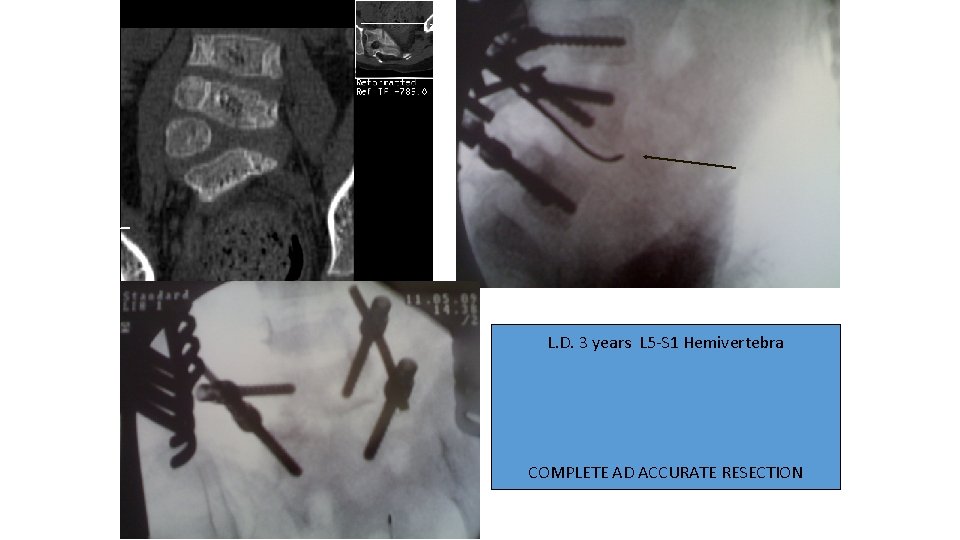
L. D. 3 years L 5 -S 1 Hemivertebra COMPLETE AD ACCURATE RESECTION
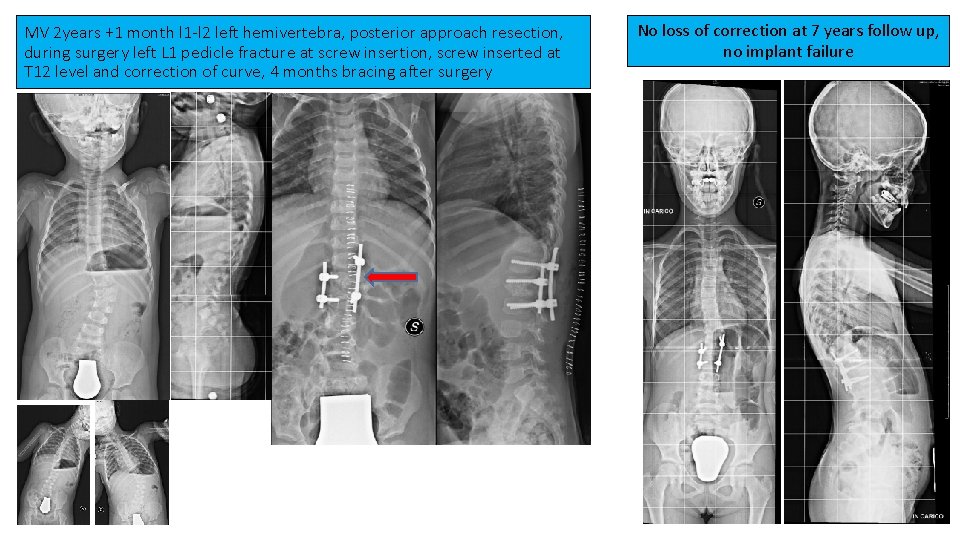
MV 2 years +1 month l 1 -l 2 left hemivertebra, posterior approach resection, during surgery left L 1 pedicle fracture at screw insertion, screw inserted at T 12 level and correction of curve, 4 months bracing after surgery No loss of correction at 7 years follow up, no implant failure
FOLLOW UP CURVE PROGRESSION AFTER SURGERY • In contrast with results reported by other • We experienced 5 cases (8% of our authors (Ruf 2003, Zhu 2014, Ansari 2015, patients) of curve progression on Guo 2015*) we had just 1 complications risk frontal or sagittal plane after surgery construct/implant related in our series of 70 patients, even in patients under 5 years of age • Progression could be caused by and with bisegmental fusions mistakes in deformity curve cover by • 5% pedicle screws implanted in suboptimal implant positioning , due to small anatomy , but • “Memory” of the curve? Not only without nervous complications, implant loosening or loss of correction at follow up primary curve, but secondary curves too mantain «deformity memory» • All patients cast bracing for 3 -4 months, we think initial imobilization reduce after correction instrumentation failure risks * • Guo J, Zhang J, Wang S, Wang H et al Risk factors for construct/implant related complications following primary posterior hemivertebra resection: study on 116 cases with more than 2 years ‘ follow-up in one medical center BMC Musuloskeletal Disorders (2016) 17: 380 • Zhu X, Wei X, Chen J et al Posterior hemivertebra resection and monosegmental fusion in the treatment of congenital scoliosis Ann R Coll Surg Engl 2014; 96(1): 41 -44 • Ruf M, Harms J. Posterior hemivertebra resection with transpedicular instrumentation: early correction in children aged 1 to 6 Years Spine 2003; 28(18): 2132 -8 • Ansari SF, Rodgers RB, Fulkerson DH. Dorsal midline hemivertebra at the lumbosacral junction: report of 2 cases. J Neurosurg Spine 2015; 22(1): 84 -89
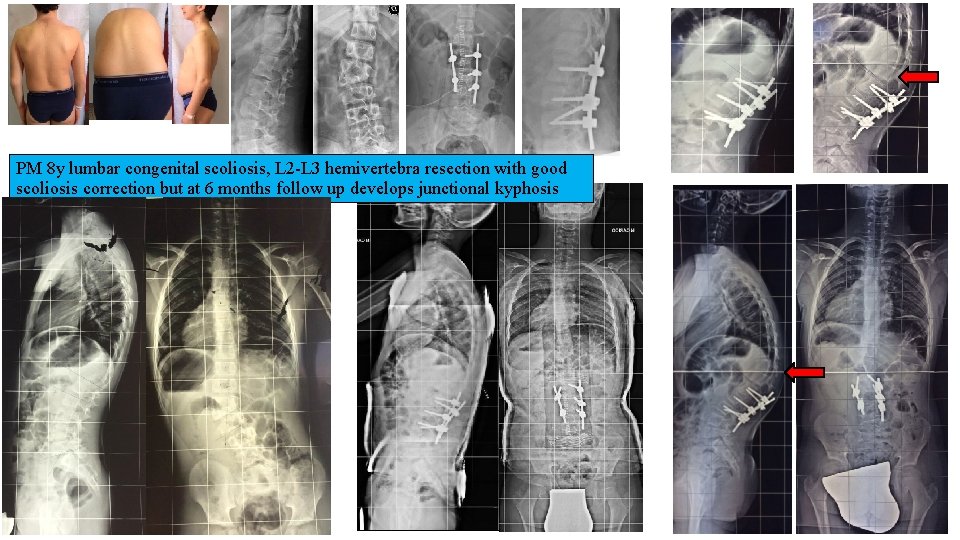
PM 8 y lumbar congenital scoliosis, L 2 -L 3 hemivertebra resection with good scoliosis correction but at 6 months follow up develops junctional kyphosis
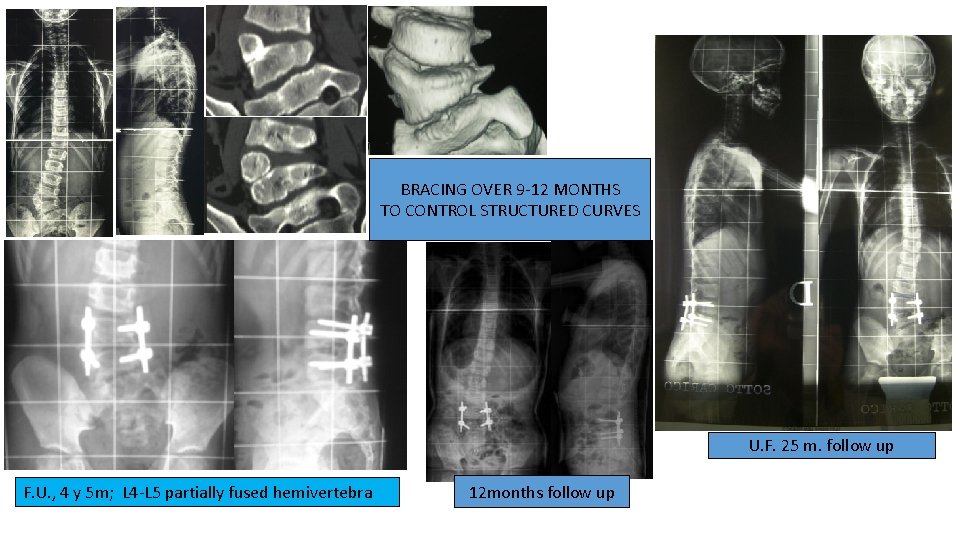
BRACING OVER 9 -12 MONTHS TO CONTROL STRUCTURED CURVES U. F. 25 m. follow up F. U. , 4 y 5 m; L 4 -L 5 partially fused hemivertebra 12 months follow up
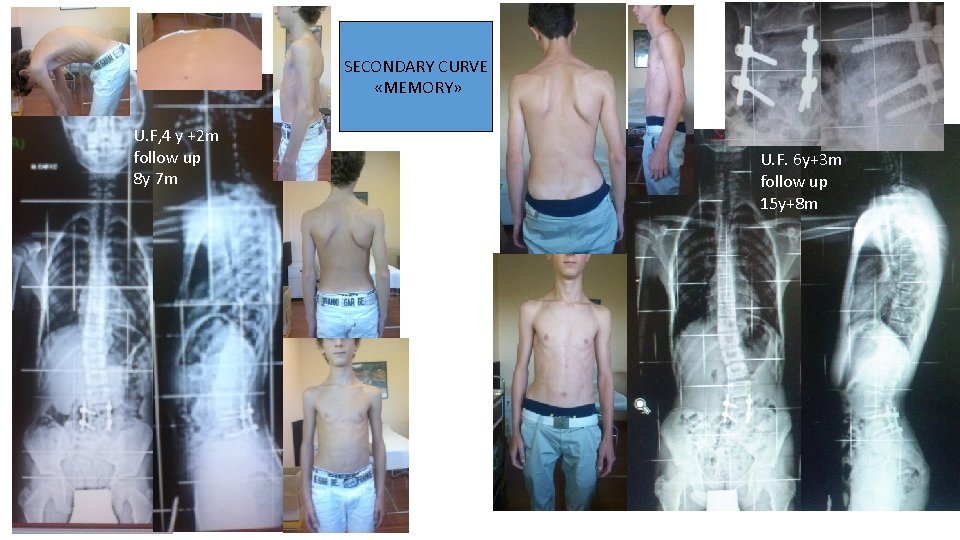
SECONDARY CURVE «MEMORY» U. F, 4 y +2 m follow up 8 y 7 m U. F. 6 y+3 m follow up 15 y+8 m
• Discussion and conclusions: • posterior approach interventions with pedicle screws instrumentation are less invasive than combined anterior – posterior approach interventions and they are well tolerated even by very young patients. • Pedicle screws obtain important corrections that can be maintained filling the resulting gaps by bone obtained by osteotomy/resection. • If intervention is performed early, before secondary curves are structured, arthrodesis area can be maintained short. • We think that posterior approach procedures obtain excellent deformity correction in both frontal and sagittal plane, optimal stability, low risk of nervous injury.
- Slides: 17