
Total Absorption Spectroscopy and Its Influence on Decay
Total Absorption Spectroscopy and Its Influence on Decay Heat and Predicted Reactor ne Fluxes B. C. Rasco JINPA/ORNL/UTK September 28, 2016 1
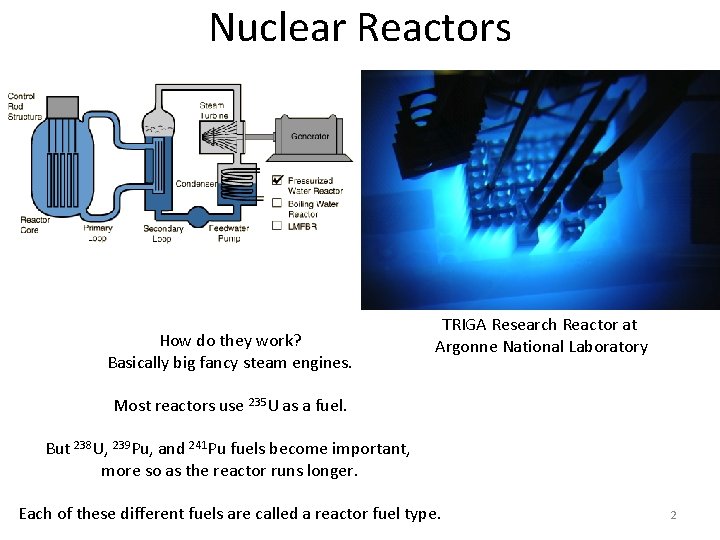
Nuclear Reactors How do they work? Basically big fancy steam engines. TRIGA Research Reactor at Argonne National Laboratory Most reactors use 235 U as a fuel. But 238 U, 239 Pu, and 241 Pu fuels become important, more so as the reactor runs longer. Each of these different fuels are called a reactor fuel type. 2
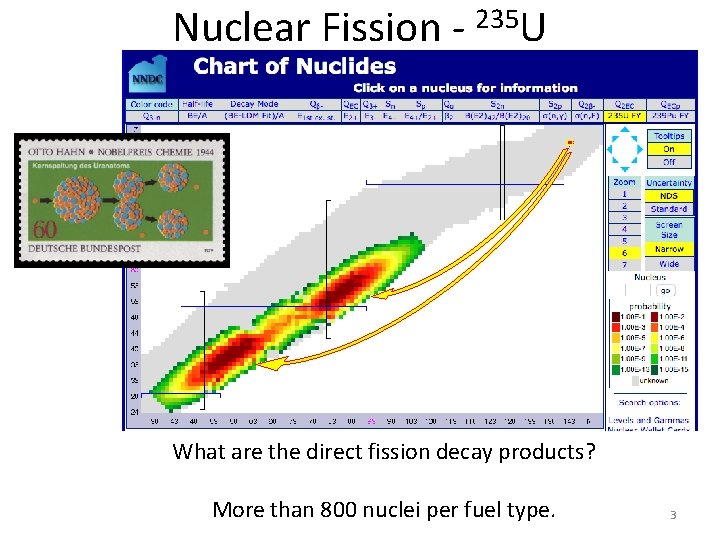
Nuclear Fission - 235 U What are the direct fission decay products? More than 800 nuclei per fuel type. 3
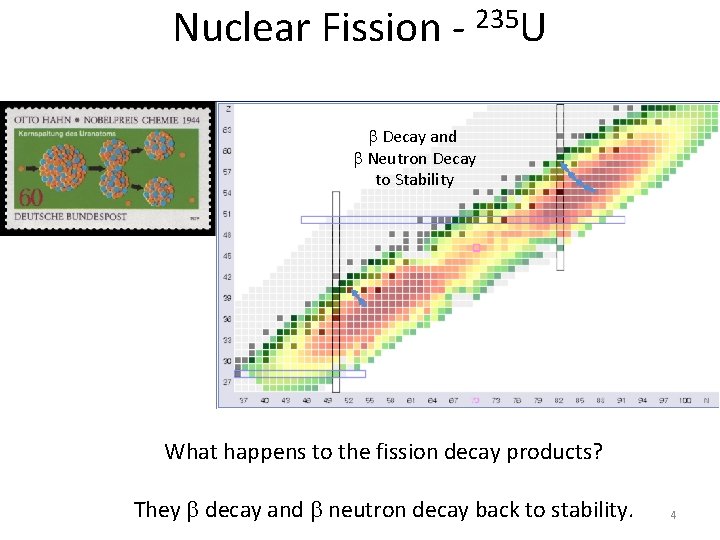
Nuclear Fission - 235 U b Decay and b Neutron Decay to Stability What happens to the fission decay products? They b decay and b neutron decay back to stability. 4
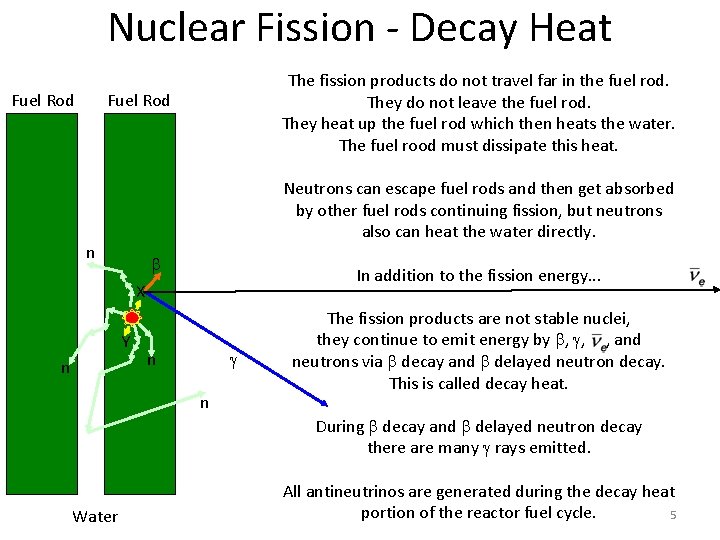
Nuclear Fission - Decay Heat Fuel Rod The fission products do not travel far in the fuel rod. They do not leave the fuel rod. They heat up the fuel rod which then heats the water. The fuel rood must dissipate this heat. Fuel Rod Neutrons can escape fuel rods and then get absorbed by other fuel rods continuing fission, but neutrons also can heat the water directly. n b In addition to the fission energy. . . X Y n n n The fission products are not stable nuclei, they continue to emit energy by b, , , and neutrons via b decay and b delayed neutron decay. This is called decay heat. During b decay and b delayed neutron decay there are many rays emitted. Water All antineutrinos are generated during the decay heat portion of the reactor fuel cycle. 5
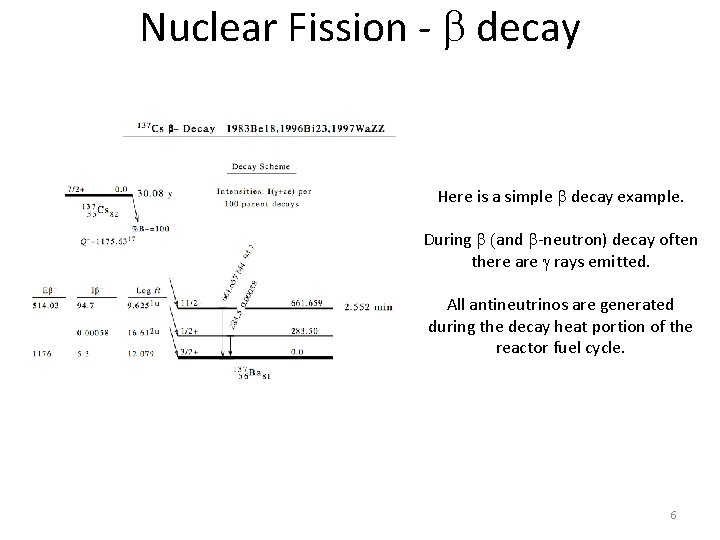
Nuclear Fission - b decay Here is a simple b decay example. During b (and b-neutron) decay often there are rays emitted. All antineutrinos are generated during the decay heat portion of the reactor fuel cycle. 6
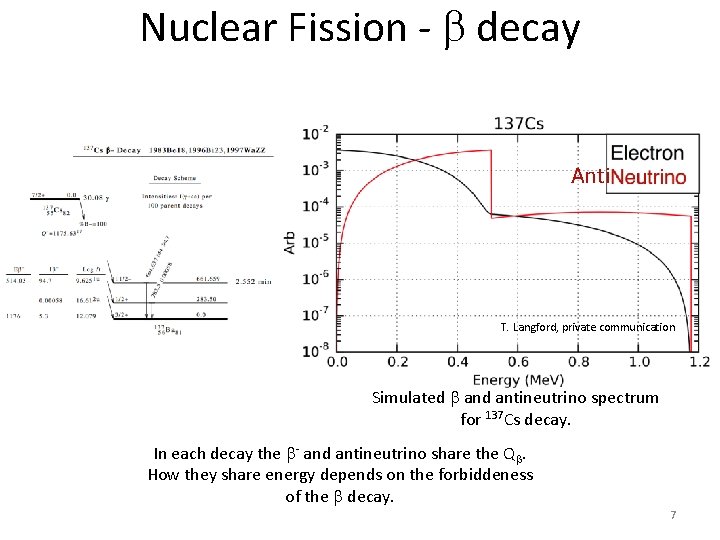
Nuclear Fission - b decay Anti T. Langford, private communication Simulated b and antineutrino spectrum for 137 Cs decay. In each decay the b- and antineutrino share the Qb. How they share energy depends on the forbiddeness of the b decay. 7
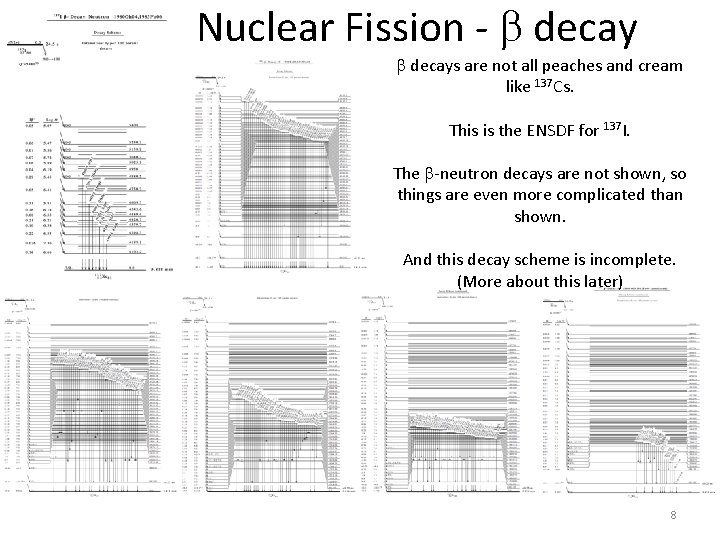
Nuclear Fission - b decays are not all peaches and cream like 137 Cs. This is the ENSDF for 137 I. The b-neutron decays are not shown, so things are even more complicated than shown. And this decay scheme is incomplete. (More about this later) 8
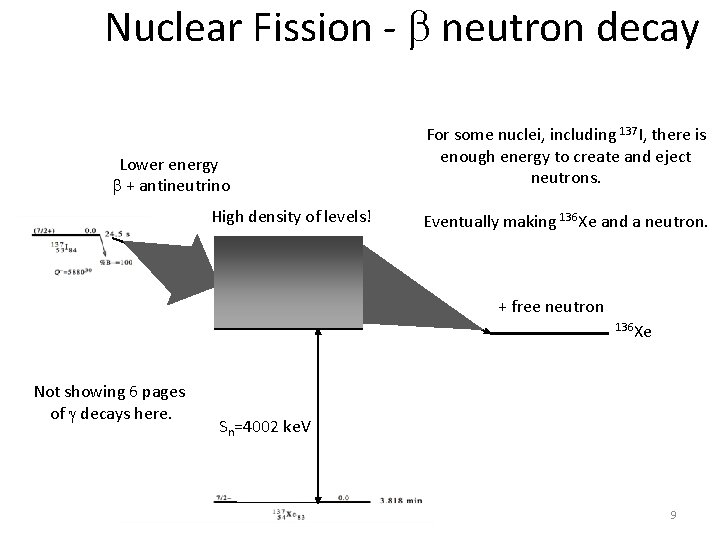
Nuclear Fission - b neutron decay Lower energy b + antineutrino High density of levels! For some nuclei, including 137 I, there is enough energy to create and eject neutrons. Eventually making 136 Xe and a neutron. + free neutron 136 Xe Not showing 6 pages of decays here. Sn=4002 ke. V 9
Reactor Decay Heat Nuclear Fuel Cycle* To improve our knowledge on the energy release ( , b, n, n) from fission products produced during the nuclear fuel cycle: operation safety (loss-of-cooling accident), operation efficiency, reactor material science, and nuclear waste transportation and storage. While reactor is on, approximately 7% of total reactor energy is in decay heat. Important b decays are ranked from priority 1 -3 in [*] and these rankings are referenced in this presentation. 100% of antineutrinos are emitted by decay heat. Nuclear Structure To determine true b-decay intensities. This helps to identify their origin and contributes to the verification and improvements of b-strength predictions. Astrophysical Interest: b half-life extrapolations and b-neutron decay branching fractions for r-process analysis. *T. Yoshida and A. L. Nichols, Assessment of Fission Product Decay Data for Decay Heat Calculations: A report by the Working Party on International Evaluation Co-operation of the Nuclear Energy Agency Nuclear Science Committee (Nuclear Energy 10 Agency, Organization for Economic Co-operation and Development, Paris, France, 2007), ISBN 9789264990340.
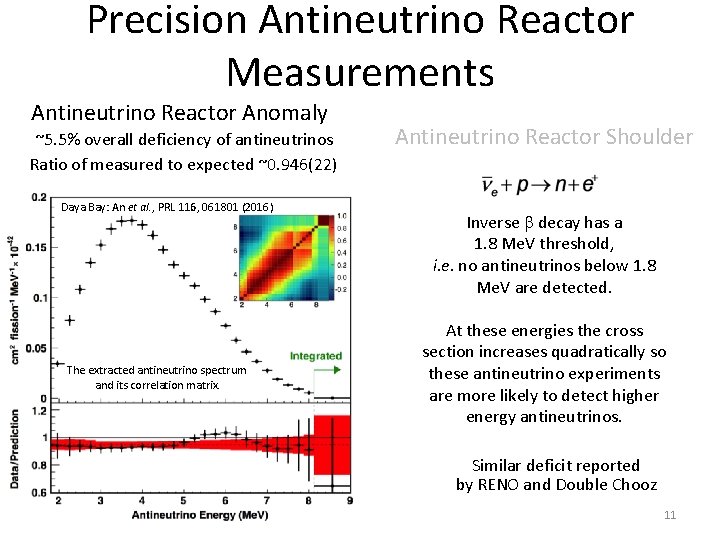
Precision Antineutrino Reactor Measurements Antineutrino Reactor Anomaly ~5. 5% overall deficiency of antineutrinos Ratio of measured to expected ~0. 946(22) Daya Bay: An et al. , PRL 116, 061801 (2016) The extracted antineutrino spectrum and its correlation matrix. Antineutrino Reactor Shoulder Inverse b decay has a 1. 8 Me. V threshold, i. e. no antineutrinos below 1. 8 Me. V are detected. At these energies the cross section increases quadratically so these antineutrino experiments are more likely to detect higher energy antineutrinos. Similar deficit reported by RENO and Double Chooz 11
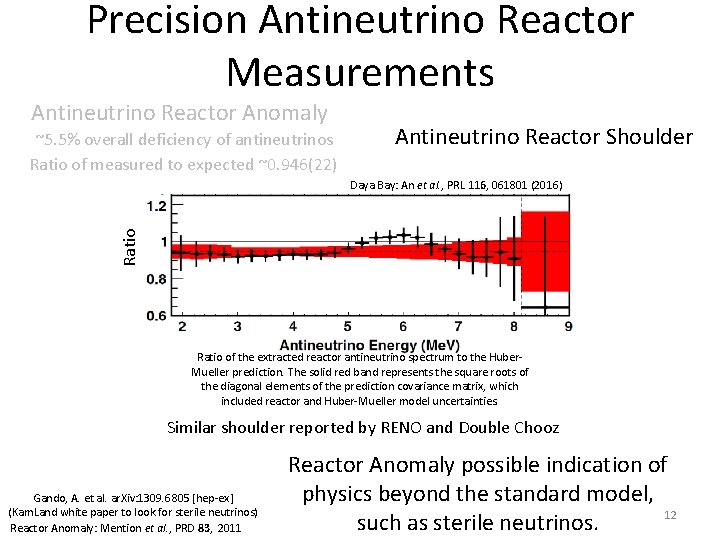
Precision Antineutrino Reactor Measurements Antineutrino Reactor Anomaly ~5. 5% overall deficiency of antineutrinos Ratio of measured to expected ~0. 946(22) Antineutrino Reactor Shoulder Ratio Daya Bay: An et al. , PRL 116, 061801 (2016) Ratio of the extracted reactor antineutrino spectrum to the Huber. Mueller prediction. The solid red band represents the square roots of the diagonal elements of the prediction covariance matrix, which included reactor and Huber-Mueller model uncertainties. Similar shoulder reported by RENO and Double Chooz Gando, A. et al. ar. Xiv: 1309. 6805 [hep-ex] (Kam. Land white paper to look for sterile neutrinos) Reactor Anomaly: Mention et al. , PRD 83, 2011 Reactor Anomaly possible indication of physics beyond the standard model, 12 such as sterile neutrinos.
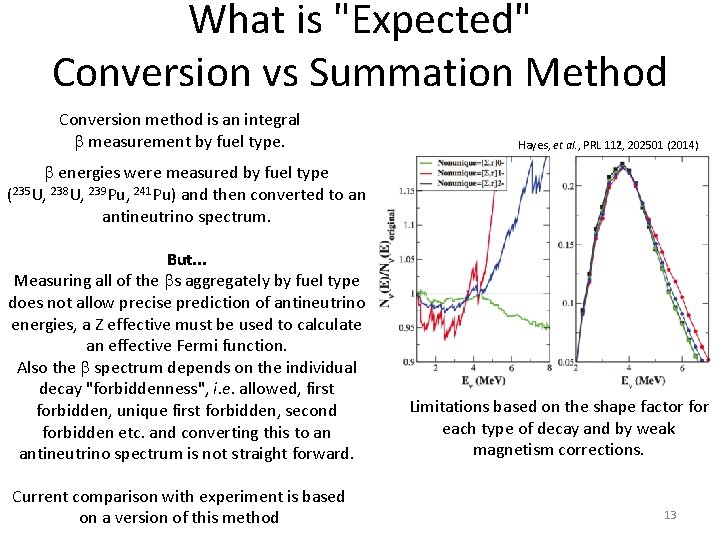
What is "Expected" Conversion vs Summation Method Conversion method is an integral b measurement by fuel type. Hayes, et al. , PRL 112, 202501 (2014) b energies were measured by fuel type (235 U, 238 U, 239 Pu, 241 Pu) and then converted to an antineutrino spectrum. But. . . Measuring all of the bs aggregately by fuel type does not allow precise prediction of antineutrino energies, a Z effective must be used to calculate an effective Fermi function. Also the b spectrum depends on the individual decay "forbiddenness", i. e. allowed, first forbidden, unique first forbidden, second forbidden etc. and converting this to an antineutrino spectrum is not straight forward. Current comparison with experiment is based on a version of this method Limitations based on the shape factor for each type of decay and by weak magnetism corrections. 13
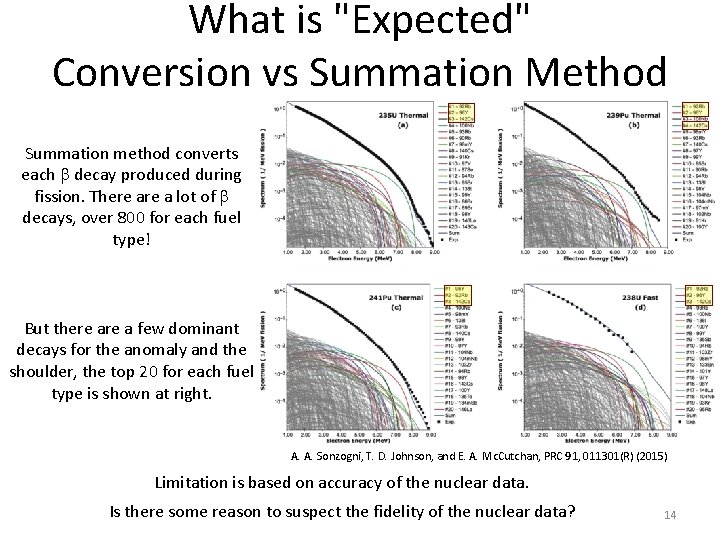
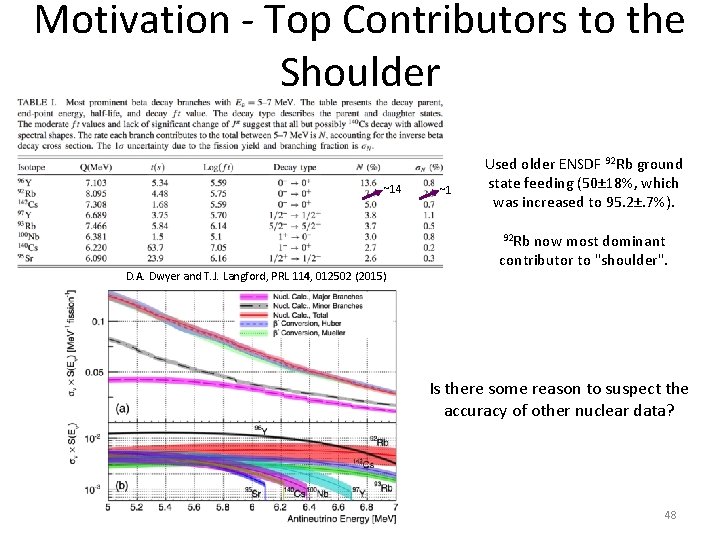
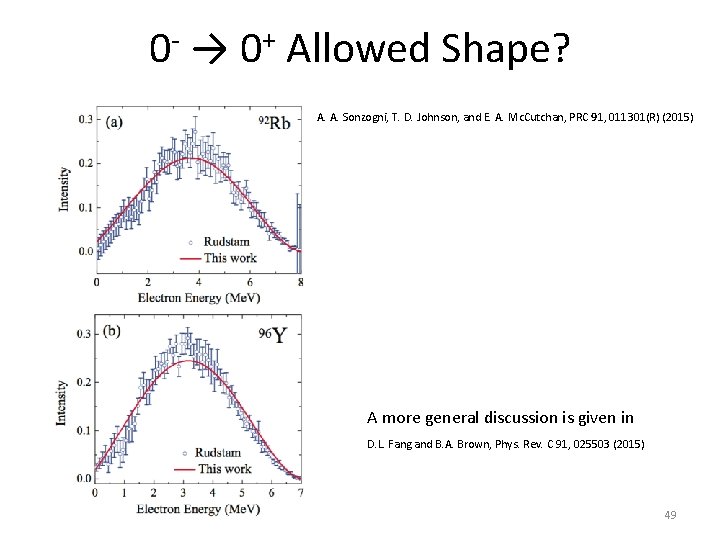
What is "Expected" Conversion vs Summation Method Summation method converts each b decay produced during fission. There a lot of b decays, over 800 for each fuel type! But there a few dominant decays for the anomaly and the shoulder, the top 20 for each fuel type is shown at right. A. A. Sonzogni, T. D. Johnson, and E. A. Mc. Cutchan, PRC 91, 011301(R) (2015) Limitation is based on accuracy of the nuclear data. Is there some reason to suspect the fidelity of the nuclear data? 14
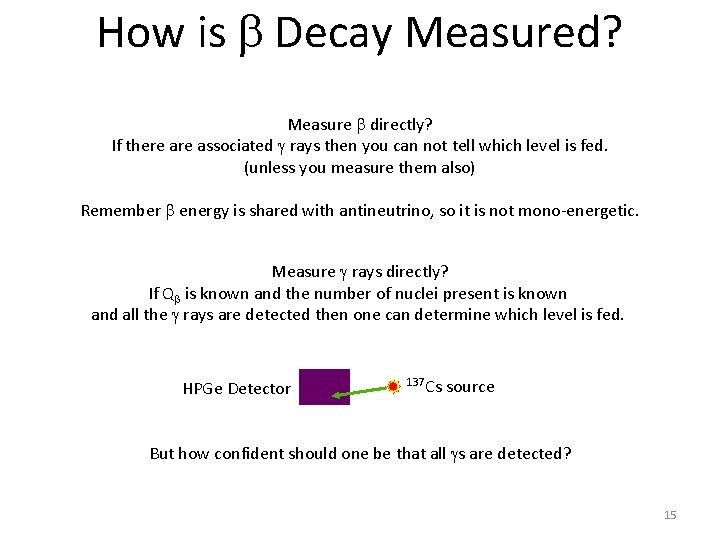
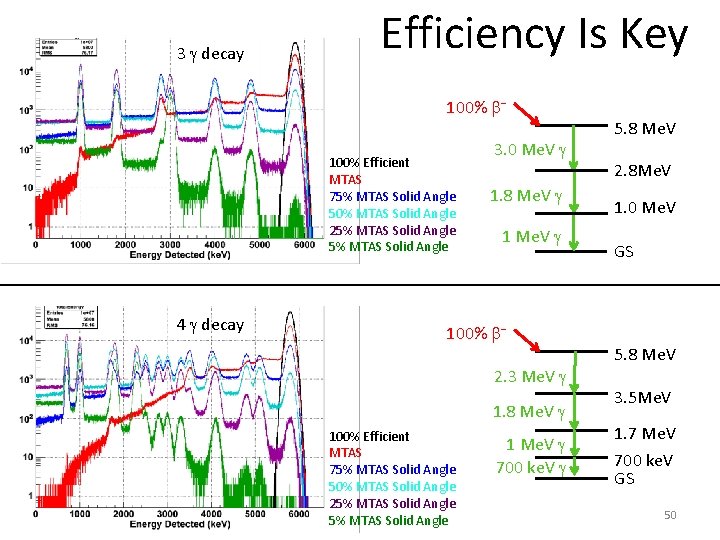
How is b Decay Measured? Measure b directly? If there associated rays then you can not tell which level is fed. (unless you measure them also) Remember b energy is shared with antineutrino, so it is not mono-energetic. Measure rays directly? If Qb is known and the number of nuclei present is known and all the rays are detected then one can determine which level is fed. HPGe Detector 137 Cs source But how confident should one be that all s are detected? 15
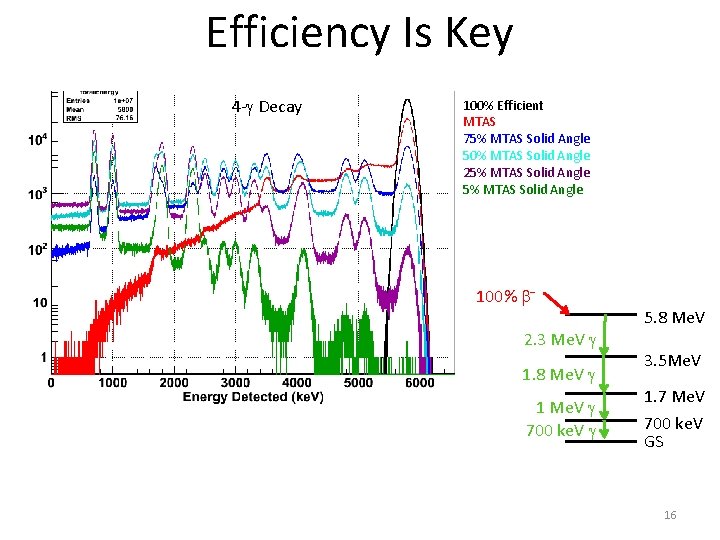
Efficiency Is Key 4 - Decay 100% Efficient MTAS 75% MTAS Solid Angle 50% MTAS Solid Angle 25% MTAS Solid Angle 100% b 2. 3 Me. V 1. 8 Me. V 1 Me. V 700 ke. V 5. 8 Me. V 3. 5 Me. V 1. 7 Me. V 700 ke. V GS 16
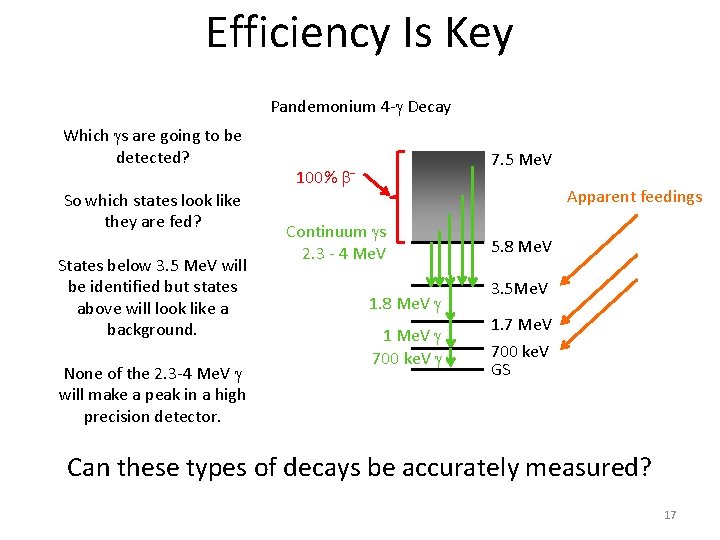
Efficiency Is Key Pandemonium 4 - Decay Which s are going to be detected? So which states look like they are fed? States below 3. 5 Me. V will be identified but states above will look like a background. None of the 2. 3 -4 Me. V will make a peak in a high precision detector. 100% 7. 5 Me. V b- Apparent feedings Continuum s 2. 3 - 4 Me. V 1. 8 Me. V 1 Me. V 700 ke. V 5. 8 Me. V 3. 5 Me. V 1. 7 Me. V 700 ke. V GS Can these types of decays be accurately measured? 17

Pandemonium Effect N-RICH PARENT (Z, N) Pandemonium Effect β - transitions For high-precision, low efficiency detectors, the combination of low efficiency with a high density of states fed by b decay means many multi- decays will be misinterpreted as direct b feeding to lower energy levels. Hardy et al, PL B 71, 1977 Greenwood et al. , 1997, Algora et al. , 2010, Zakari-Issoufou et al. , 2015 DAUGHTER (Z+1, N-1) Pandemonium Effect General Trends in Average Energy by Particle Type: Can the Pandemonium Effect be overcome? 18
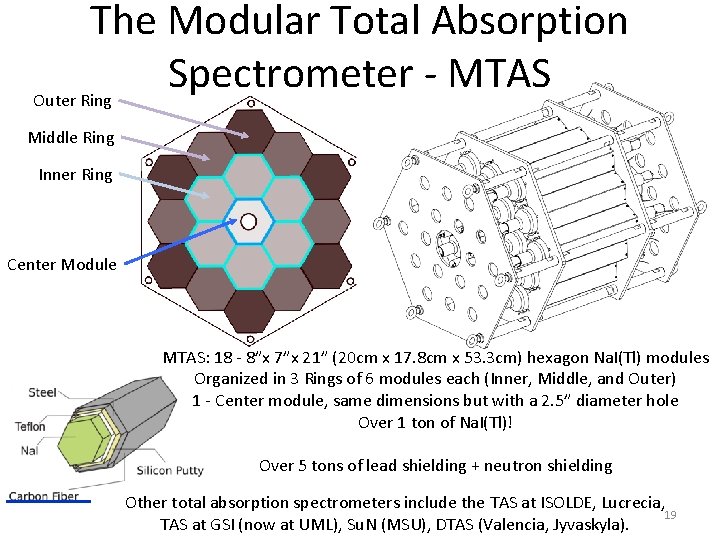
The Modular Total Absorption Spectrometer MTAS Outer Ring Middle Ring Inner Ring Center Module MTAS: 18 - 8”x 7”x 21” (20 cm x 17. 8 cm x 53. 3 cm) hexagon Na. I(Tl) modules Organized in 3 Rings of 6 modules each (Inner, Middle, and Outer) 1 - Center module, same dimensions but with a 2. 5” diameter hole Over 1 ton of Na. I(Tl)! Over 5 tons of lead shielding + neutron shielding Other total absorption spectrometers include the TAS at ISOLDE, Lucrecia, 19 TAS at GSI (now at UML), Su. N (MSU), DTAS (Valencia, Jyvaskyla).
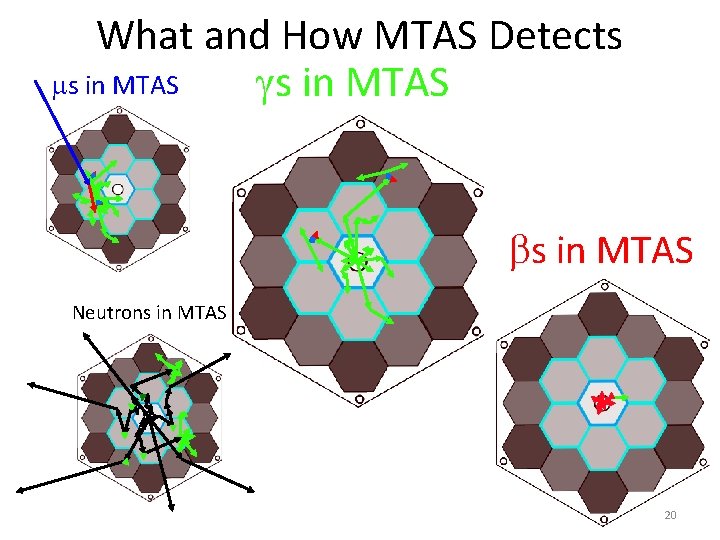
What and How MTAS Detects ms in MTAS bs in MTAS Neutrons in MTAS 20
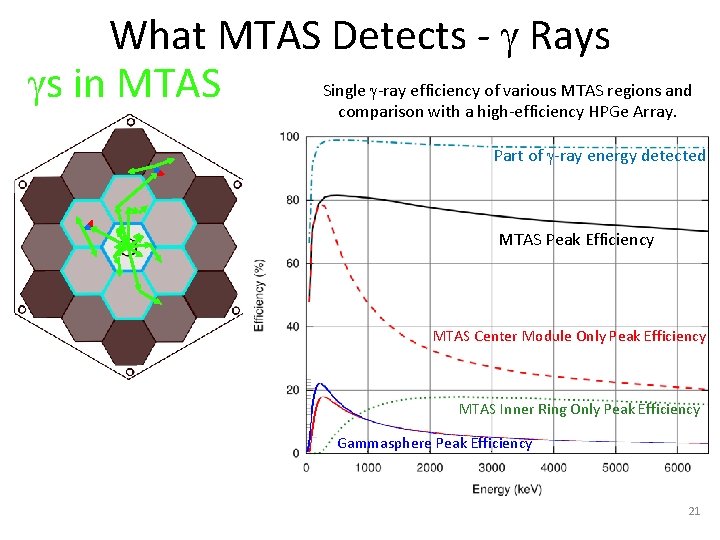
What MTAS Detects - Rays Single -ray efficiency of various MTAS regions and s in MTAS comparison with a high-efficiency HPGe Array. Part of -ray energy detected MTAS Peak Efficiency MTAS Center Module Only Peak Efficiency MTAS Inner Ring Only Peak Efficiency Gammasphere Peak Efficiency 21
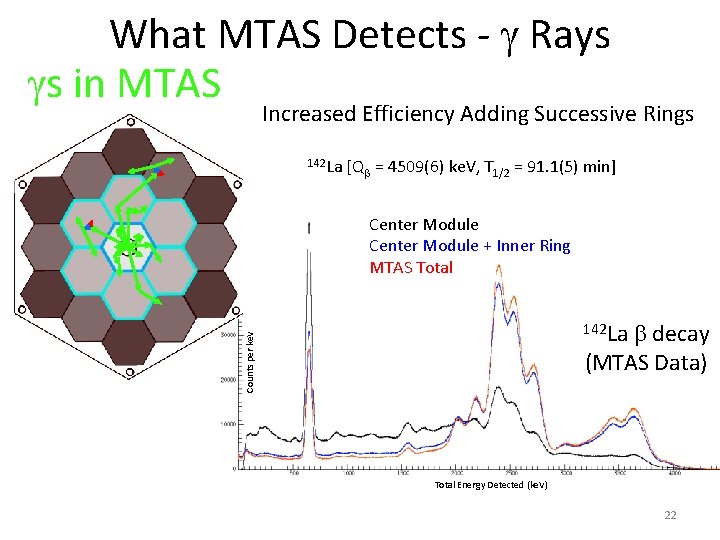
What MTAS Detects - Rays s in MTAS Increased Efficiency Adding Successive Rings 142 La [Qb = 4509(6) ke. V, T 1/2 = 91. 1(5) min] Center Module + Inner Ring MTAS Total b decay (MTAS Data) Counts per ke. V 142 La Total Energy Detected (ke. V) 22
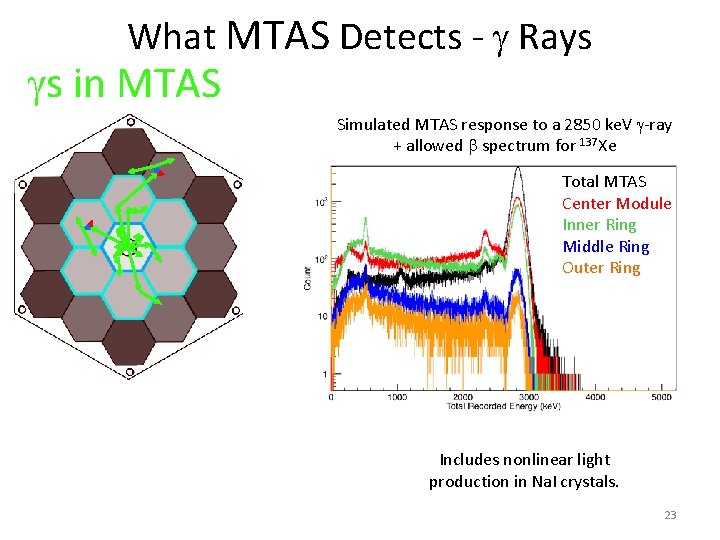
What MTAS Detects - Rays s in MTAS Simulated MTAS response to a 2850 ke. V -ray + allowed b spectrum for 137 Xe Total MTAS Center Module Inner Ring Middle Ring Outer Ring Includes nonlinear light production in Na. I crystals. 23
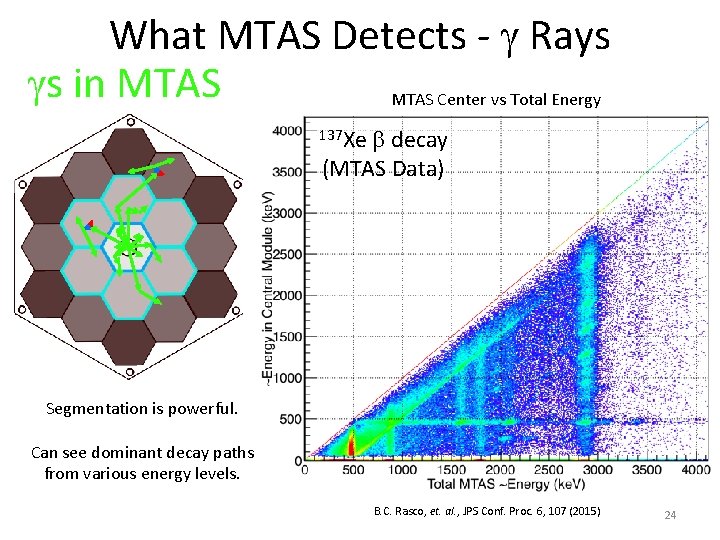
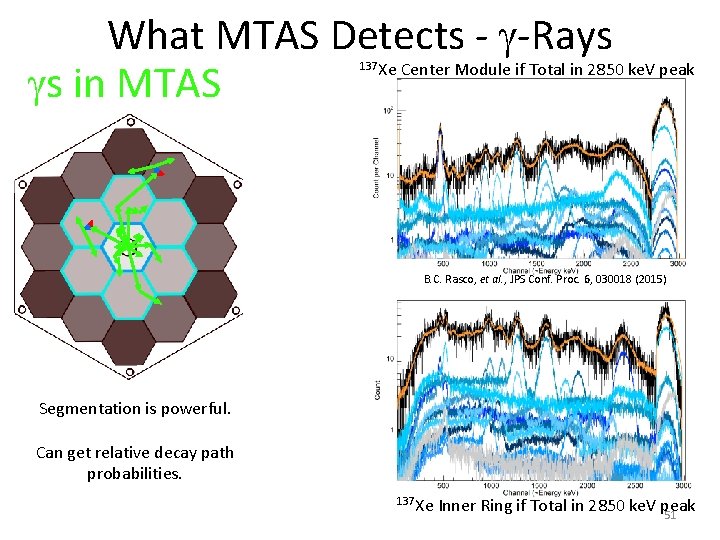
What MTAS Detects - Rays s in MTAS Center vs Total Energy b decay (MTAS Data) 137 Xe Segmentation is powerful. Can see dominant decay paths from various energy levels. B. C. Rasco, et. al. , JPS Conf. Proc. 6, 107 (2015) 24
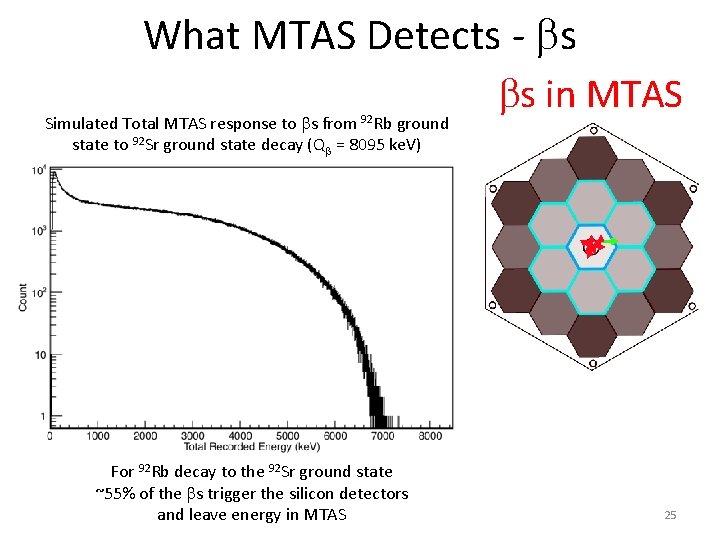
What MTAS Detects - bs Simulated Total MTAS response to bs from 92 Rb ground state to 92 Sr ground state decay (Qb = 8095 ke. V) For 92 Rb decay to the 92 Sr ground state ~55% of the bs trigger the silicon detectors and leave energy in MTAS bs in MTAS 25
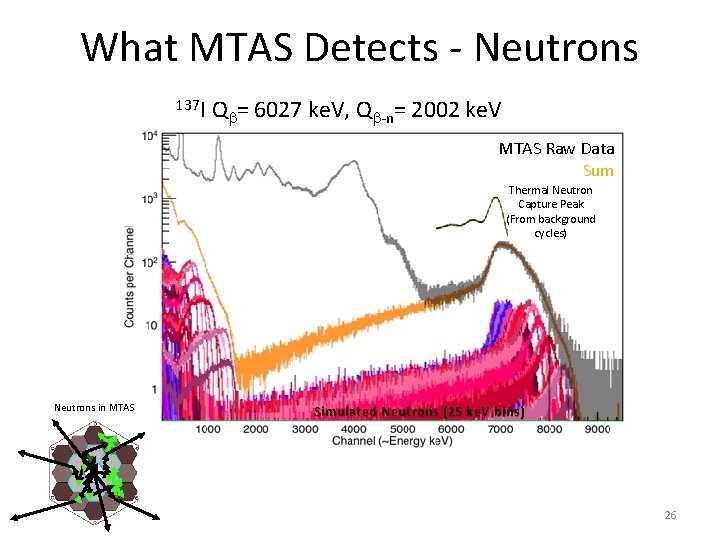
What MTAS Detects - Neutrons 137 I Qb= 6027 ke. V, Qb-n= 2002 ke. V MTAS Raw Data Sum Thermal Neutron Capture Peak (From background cycles) Neutrons in MTAS Simulated Neutrons (25 ke. V bins) 26
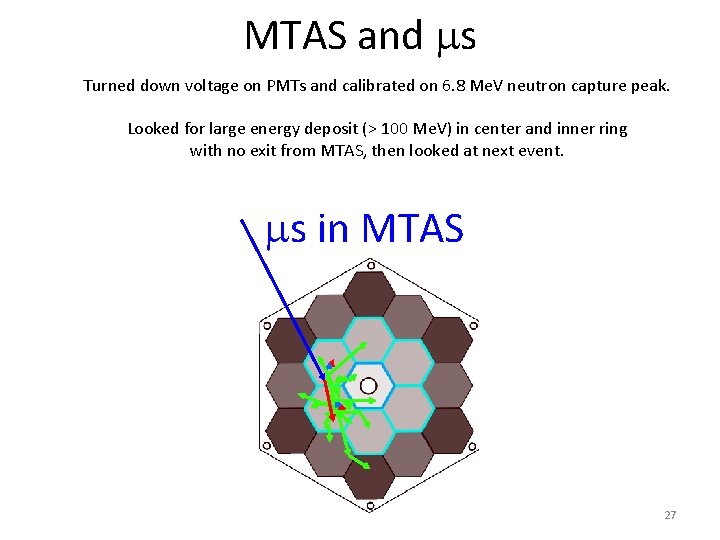
MTAS and ms Turned down voltage on PMTs and calibrated on 6. 8 Me. V neutron capture peak. Looked for large energy deposit (> 100 Me. V) in center and inner ring with no exit from MTAS, then looked at next event. ms in MTAS 27
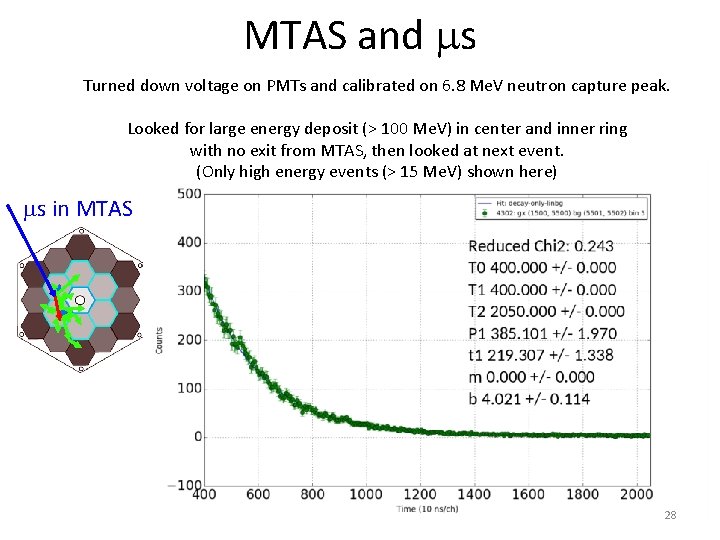
MTAS and ms Turned down voltage on PMTs and calibrated on 6. 8 Me. V neutron capture peak. Looked for large energy deposit (> 100 Me. V) in center and inner ring with no exit from MTAS, then looked at next event. (Only high energy events (> 15 Me. V) shown here) ms in MTAS 28
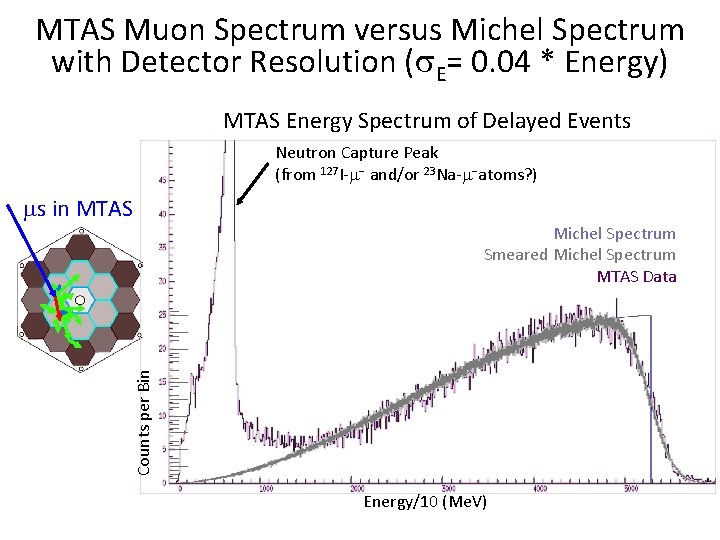
MTAS Muon Spectrum versus Michel Spectrum with Detector Resolution (s. E= 0. 04 * Energy) MTAS Energy Spectrum of Delayed Events Neutron Capture Peak (from 127 I-m- and/or 23 Na-m-atoms? ) Michel Spectrum Smeared Michel Spectrum MTAS Data Counts per Bin ms in MTAS Energy/10 (Me. V)
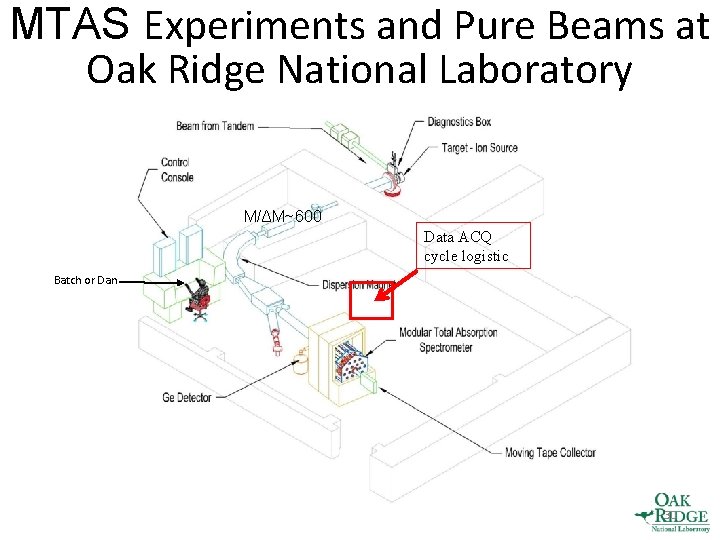
MTAS Experiments and Pure Beams at Oak Ridge National Laboratory M/ΔM~600 Data ACQ cycle logistic Batch or Dan 30
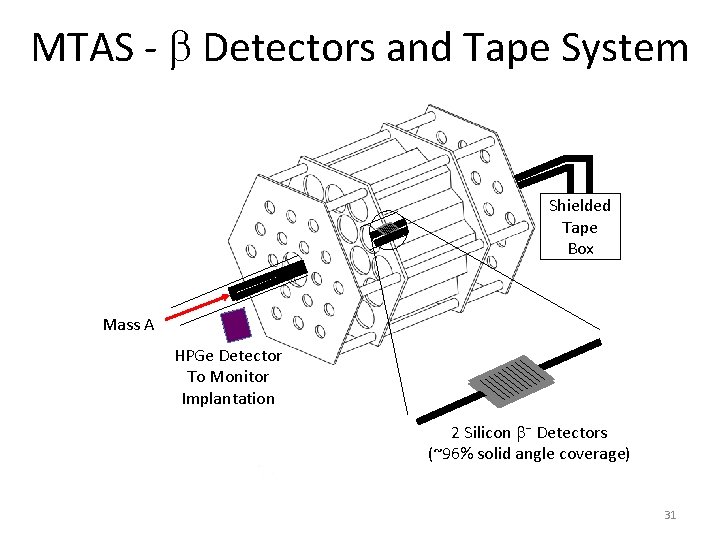
MTAS - b Detectors and Tape System Shielded Tape Box Mass A HPGe Detector To Monitor Implantation 2 Silicon b- Detectors (~96% solid angle coverage) 31
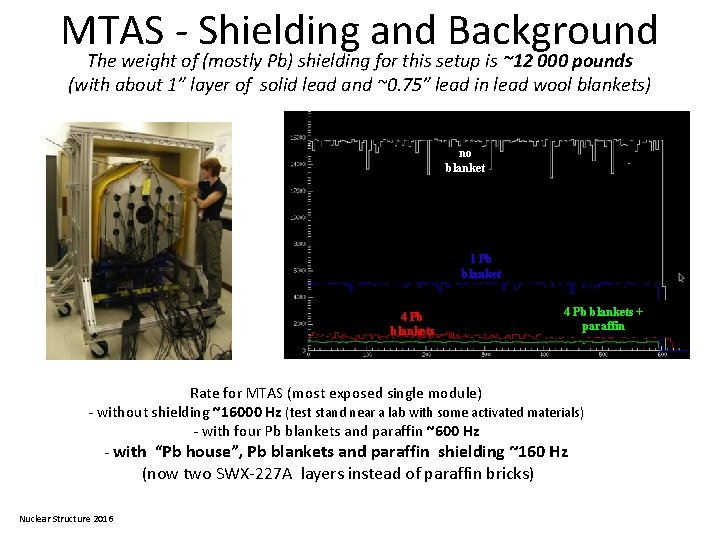
MTAS - Shielding and Background The weight of (mostly Pb) shielding for this setup is ~12 000 pounds (with about 1” layer of solid lead and ~0. 75” lead in lead wool blankets) no blanket 1 Pb blanket 4 Pb blankets + paraffin Rate for MTAS (most exposed single module) - without shielding ~16000 Hz (test stand near a lab with some activated materials) - with four Pb blankets and paraffin ~600 Hz - with “Pb house”, Pb blankets and paraffin shielding ~160 Hz (now two SWX-227 A layers instead of paraffin bricks) Nuclear Structure 2016
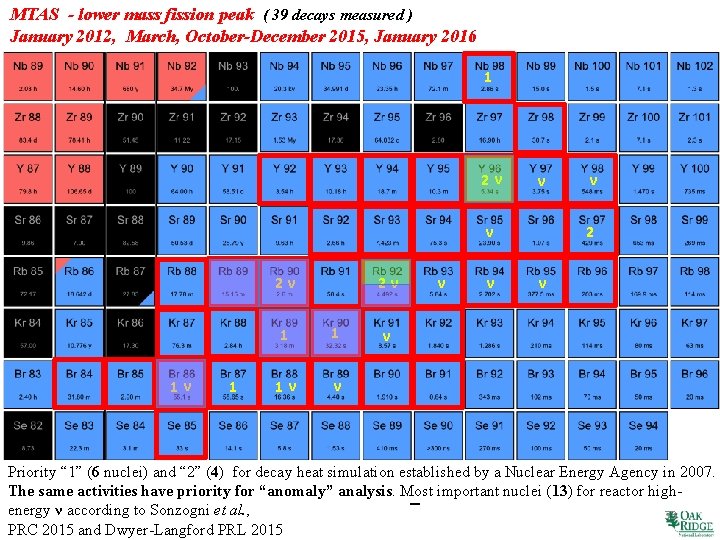
MTAS - lower mass fission peak ( 39 decays measured ) January 2012, March, October-December 2015, January 2016 1 2ν ν ν 2ν 1ν 1 2ν 1 1 1ν ν ν 2 ν ν Priority “ 1” (6 nuclei) and “ 2” (4) for decay heat simulation established by a Nuclear Energy Agency in 2007. The same activities have priority for “anomaly” analysis. Most important nuclei (13) for reactor highenergy ν according to Sonzogni et al. , 33 PRC 2015 and Dwyer-Langford PRL 2015
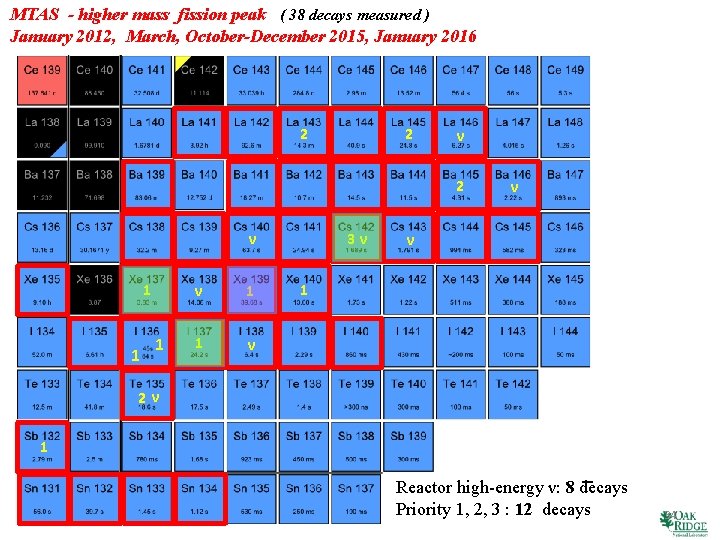
MTAS - higher mass fission peak ( 38 decays measured ) January 2012, March, October-December 2015, January 2016 2 2 ν 2 3ν ν 1 1 1 ν ν ν 1 2ν 1 Reactor high-energy ν: 8 decays Priority 1, 2, 3 : 12 decays 34
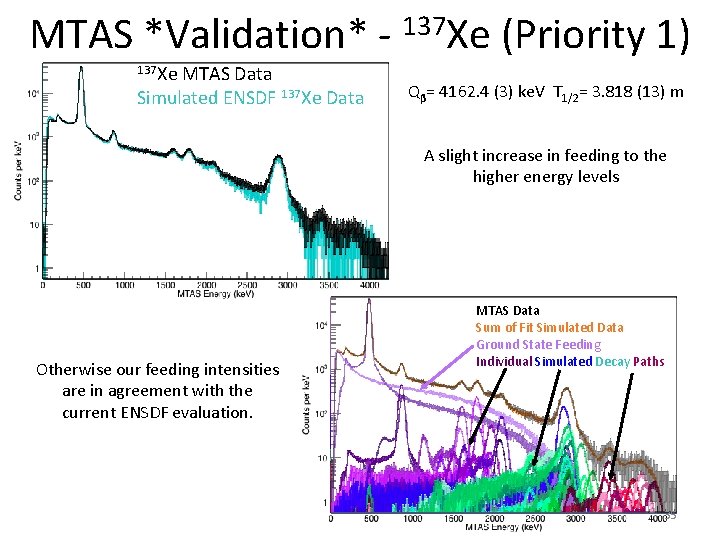
MTAS *Validation* 137 Xe MTAS Data Simulated ENSDF 137 Xe Data 137 Xe (Priority 1) Qβ= 4162. 4 (3) ke. V T 1/2= 3. 818 (13) m A slight increase in feeding to the higher energy levels Otherwise our feeding intensities are in agreement with the current ENSDF evaluation. MTAS Data Sum of Fit Simulated Data Ground State Feeding Individual Simulated Decay Paths 35
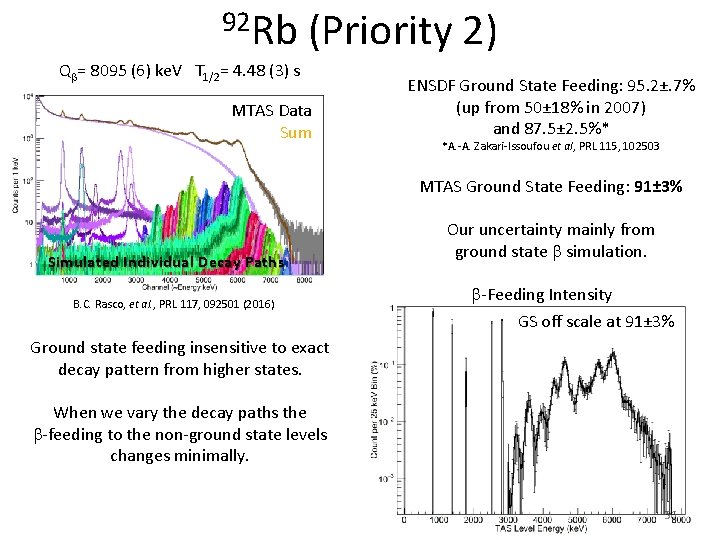
92 Rb (Priority 2) Qb= 8095 (6) ke. V T 1/2= 4. 48 (3) s MTAS Data Sum ENSDF Ground State Feeding: 95. 2±. 7% (up from 50± 18% in 2007) and 87. 5± 2. 5%* *A. -A. Zakari-Issoufou et al, PRL 115, 102503 MTAS Ground State Feeding: 91± 3% Simulated Individual Decay Paths B. C. Rasco, et al. , PRL 117, 092501 (2016) Our uncertainty mainly from ground state b simulation. b-Feeding Intensity GS off scale at 91± 3% Ground state feeding insensitive to exact decay pattern from higher states. When we vary the decay paths the b-feeding to the non-ground state levels changes minimally. 36
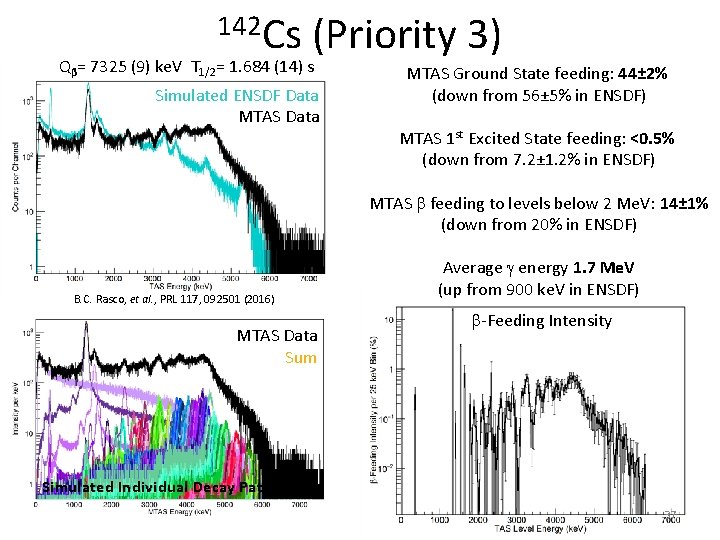
142 Cs (Priority 3) Qβ= 7325 (9) ke. V T 1/2= 1. 684 (14) s Simulated ENSDF Data MTAS Ground State feeding: 44± 2% (down from 56± 5% in ENSDF) MTAS 1 st Excited State feeding: <0. 5% (down from 7. 2± 1. 2% in ENSDF) MTAS b feeding to levels below 2 Me. V: 14± 1% (down from 20% in ENSDF) B. C. Rasco, et al. , PRL 117, 092501 (2016) MTAS Data Sum Average energy 1. 7 Me. V (up from 900 ke. V in ENSDF) b-Feeding Intensity Simulated Individual Decay Paths 37
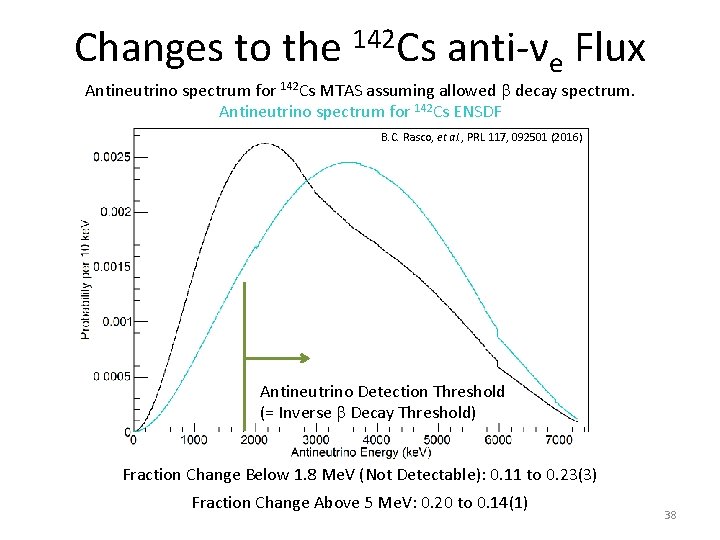
Changes to the 142 Cs anti-νe Flux Antineutrino spectrum for 142 Cs MTAS assuming allowed b decay spectrum. Antineutrino spectrum for 142 Cs ENSDF B. C. Rasco, et al. , PRL 117, 092501 (2016) Antineutrino Detection Threshold (= Inverse b Decay Threshold) Fraction Change Below 1. 8 Me. V (Not Detectable): 0. 11 to 0. 23(3) Fraction Change Above 5 Me. V: 0. 20 to 0. 14(1) 38
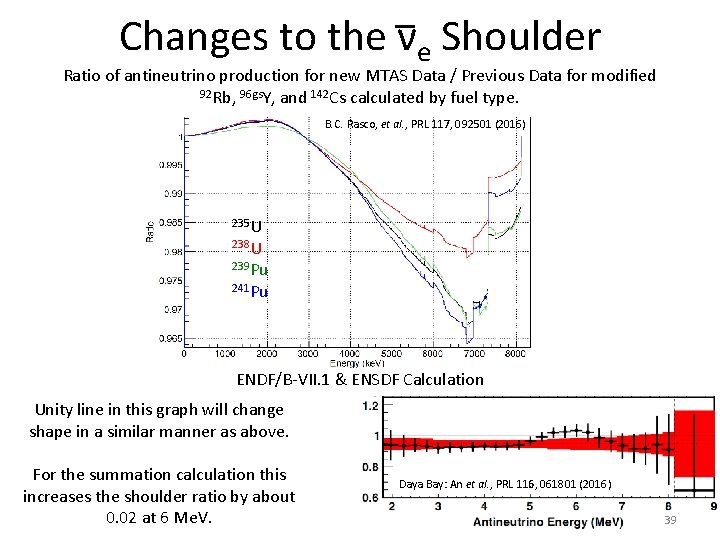
Changes to the νe Shoulder Ratio of antineutrino production for new MTAS Data / Previous Data for modified 92 Rb, 96 gs. Y, and 142 Cs calculated by fuel type. B. C. Rasco, et al. , PRL 117, 092501 (2016) 235 U 238 U 239 Pu 241 Pu ENDF/B-VII. 1 & ENSDF Calculation Unity line in this graph will change shape in a similar manner as above. For the summation calculation this increases the shoulder ratio by about 0. 02 at 6 Me. V. Daya Bay: An et al. , PRL 116, 061801 (2016) 39
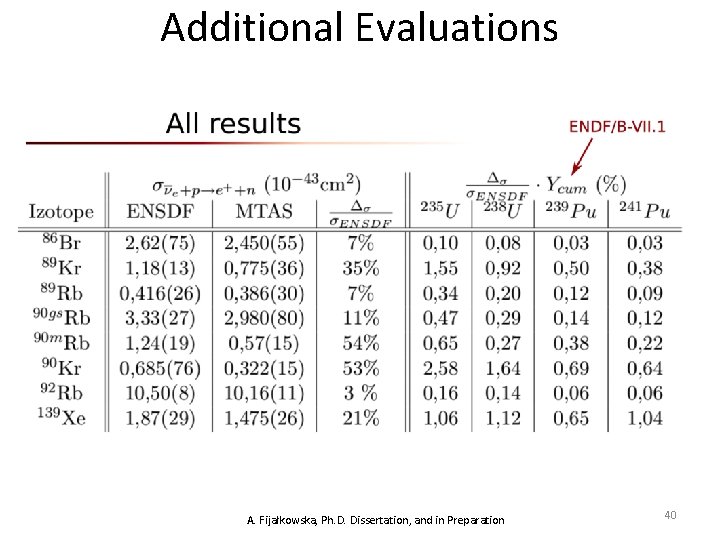
Additional Evaluations A. Fijałkowska, Ph. D. Dissertation, and in Preparation 40
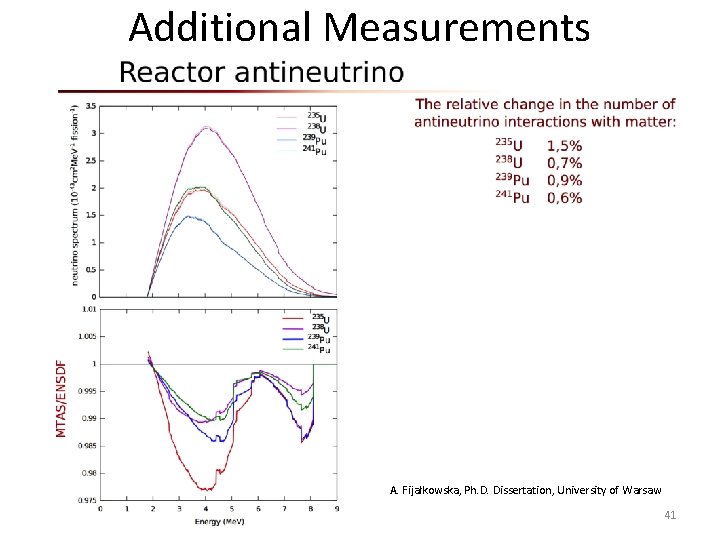
Additional Measurements A. Fijałkowska, Ph. D. Dissertation, University of Warsaw 41
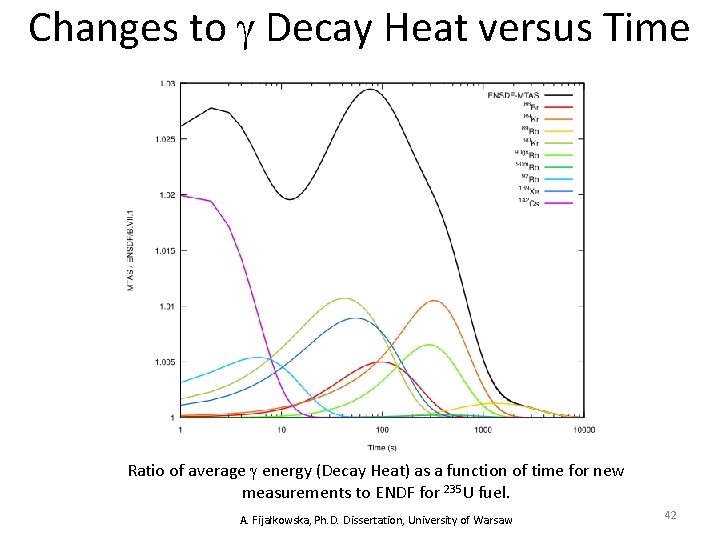
Changes to Decay Heat versus Time Ratio of average energy (Decay Heat) as a function of time for new measurements to ENDF for 235 U fuel. A. Fijałkowska, Ph. D. Dissertation, University of Warsaw 42
Summary We have measured 22 Priority 1, 2, and 3 b decays that are relevant for nuclear decay heat and antineutrino anomaly. Evaluated cases (~10) average decay heat increases by up to ~3% over the first 1000 seconds. We have measured 21 b-decays that are relevant for high energy antineutrino (antineutrino shoulder) produced in nuclear reactors. Evaluated cases (~10) alter the neutrino anomaly ratio from 0. 95(2) to 0. 97(2) ratio is getting close to 1. 00 which means no anomaly. (Which makes high energy physics sad) Antineutrino shoulder grows from 0. 10 to 0. 12 (Which makes high energy physics happy) Nuclear Structure implications are a work in progress. 43
Collaborators K. P. Rykaczewski, B. C. Rasco, D. Stracener, N. Brewer, C. J. Gross, J. Matta Oak Ridge National Laboratory A. Fijałkowska, M. Karny, K. Miernik, M. Wolińska-Cichocka University of Warszawa K. C. Goetz , R. K. Grzywacz, S. Paulauskas, M. Madurga, T. King University of Tennessee E. Zganjar, J. C. Blackmon Louisiana State University J. C. Batchelder University of California, Berkeley M. M. Rajabali Tennessee Technological University J. A. Winger Mississippi State University J. Hamilton, et al. Vanderbilt University This work was supported by the US DOE by award no. DE-FG 02 - 96 ER 40978 and by US DOE, Office of Nuclear Physics 44

Thank You 45

Backup Slides 46
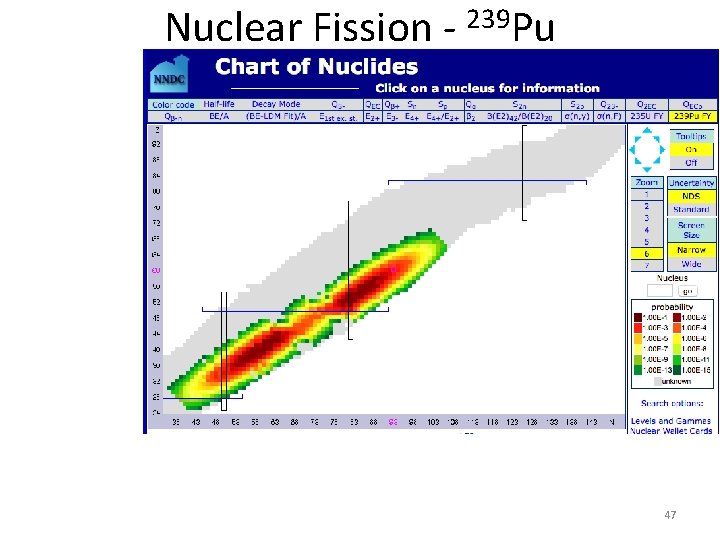
Nuclear Fission - 239 Pu 47
Motivation - Top Contributors to the Shoulder ~14 ~1 Used older ENSDF 92 Rb ground state feeding (50± 18%, which was increased to 95. 2±. 7%). 92 Rb D. A. Dwyer and T. J. Langford, PRL 114, 012502 (2015) now most dominant contributor to "shoulder". Is there some reason to suspect the accuracy of other nuclear data? 48
0 - → 0+ Allowed Shape? A. A. Sonzogni, T. D. Johnson, and E. A. Mc. Cutchan, PRC 91, 011301(R) (2015) A more general discussion is given in D. L. Fang and B. A. Brown, Phys. Rev. C 91, 025503 (2015) 49
3 decay Efficiency Is Key 100% b 100% Efficient MTAS 75% MTAS Solid Angle 50% MTAS Solid Angle 25% MTAS Solid Angle 4 decay 3. 0 Me. V 1. 8 Me. V 100% b 2. 3 Me. V 1. 8 Me. V 100% Efficient MTAS 75% MTAS Solid Angle 50% MTAS Solid Angle 25% MTAS Solid Angle 1 Me. V 700 ke. V 5. 8 Me. V 2. 8 Me. V 1. 0 Me. V GS 5. 8 Me. V 3. 5 Me. V 1. 7 Me. V 700 ke. V GS 50
What MTAS Detects - -Rays Xe Center Module if Total in 2850 ke. V peak s in MTAS 137 B. C. Rasco, et al. , JPS Conf. Proc. 6, 030018 (2015) Segmentation is powerful. Can get relative decay path probabilities. 137 Xe Inner Ring if Total in 2850 ke. V peak 51
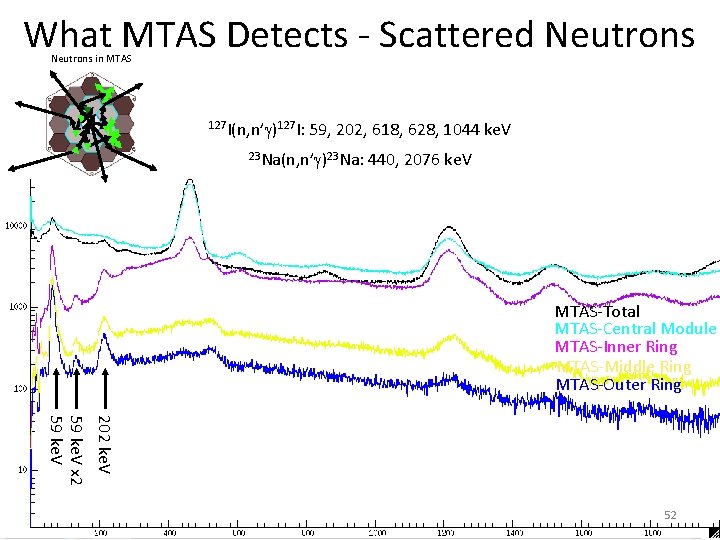
What MTAS Detects - Scattered Neutrons in MTAS 127 I(n, n’ )127 I: 59, 202, 618, 628, 1044 ke. V 23 Na(n, n’ )23 Na: 440, 2076 ke. V MTAS-Total MTAS-Central Module MTAS-Inner Ring MTAS-Middle Ring MTAS-Outer Ring 202 ke. V 59 ke. V x 2 59 ke. V 52
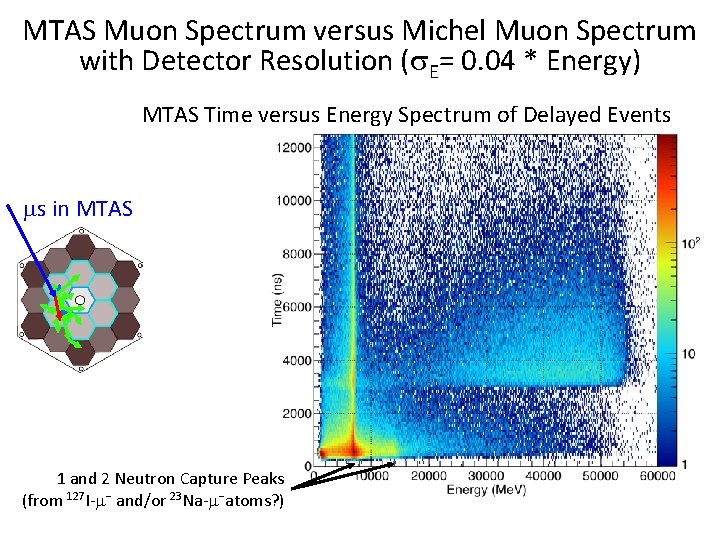
MTAS Muon Spectrum versus Michel Muon Spectrum with Detector Resolution (s. E= 0. 04 * Energy) MTAS Time versus Energy Spectrum of Delayed Events ms in MTAS 1 and 2 Neutron Capture Peaks (from 127 I-m- and/or 23 Na-m-atoms? )
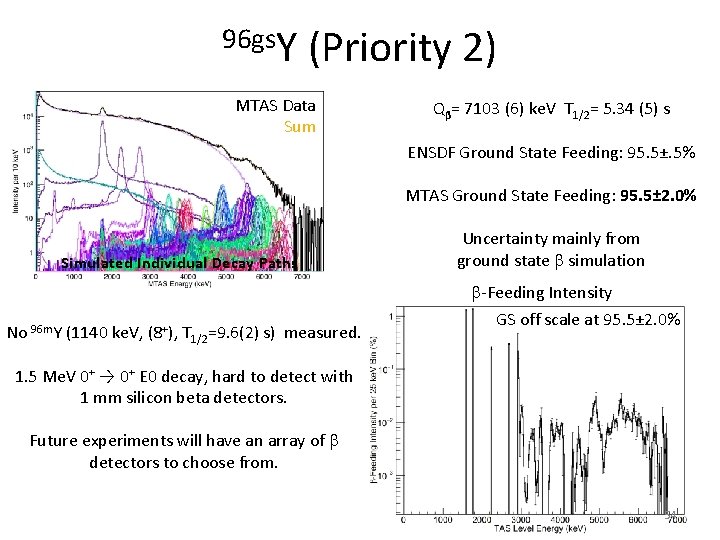
96 gs. Y (Priority 2) MTAS Data Sum Qβ= 7103 (6) ke. V T 1/2= 5. 34 (5) s ENSDF Ground State Feeding: 95. 5±. 5% MTAS Ground State Feeding: 95. 5± 2. 0% Simulated Individual Decay Paths No 96 m. Y (1140 ke. V, (8+), T 1/2=9. 6(2) s) measured. Uncertainty mainly from ground state b simulation b-Feeding Intensity GS off scale at 95. 5± 2. 0% 1. 5 Me. V 0+ → 0+ E 0 decay, hard to detect with 1 mm silicon beta detectors. Future experiments will have an array of b detectors to choose from. 54
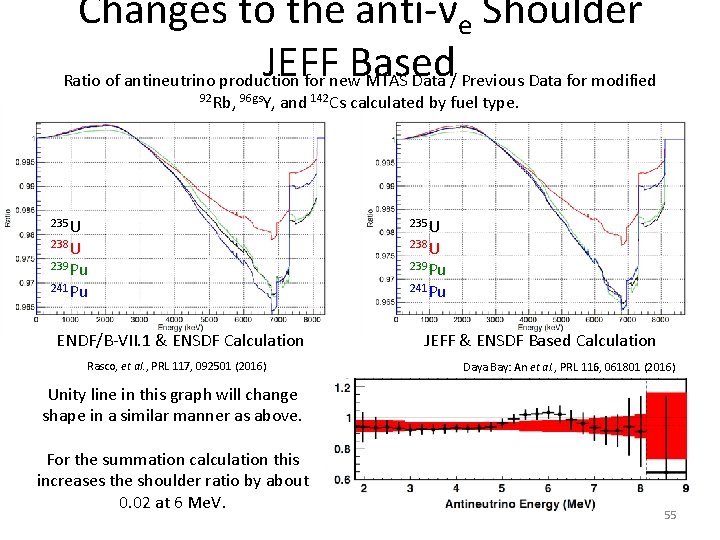
Changes to the anti-νe Shoulder JEFF Based Ratio of antineutrino production for new MTAS Data / Previous Data for modified 92 Rb, 96 gs. Y, and 142 Cs calculated by fuel type. 235 U 239 Pu 238 U 241 Pu ENDF/B-VII. 1 & ENSDF Calculation Rasco, et al. , PRL 117, 092501 (2016) 238 U 241 Pu JEFF & ENSDF Based Calculation Daya Bay: An et al. , PRL 116, 061801 (2016) Unity line in this graph will change shape in a similar manner as above. For the summation calculation this increases the shoulder ratio by about 0. 02 at 6 Me. V. 55
- Slides: 55