
TORTORA FUNKE CASE Microbiology AN INTRODUCTION EIGHTH EDITION
TORTORA • FUNKE • CASE Microbiology AN INTRODUCTION EIGHTH EDITION B. E Pruitt & Jane J. Stein Chapter 10 Classification of Microorganisms Power. Point® Lecture Slide Presentation prepared by Christine L. Case Copyright © 2004 Pearson Education, Inc. , publishing as Benjamin Cummings
Taxonomy • The science of classifying organisms • Provides universal names for organisms • Provides a reference for identifying organisms Copyright © 2004 Pearson Education, Inc. , publishing as Benjamin Cummings
Taxonomy • Systematics or phylogeny • The study of the evolutionary history of organisms • All Species Inventory (2001 -2025) • To identify all species of life on Earth Copyright © 2004 Pearson Education, Inc. , publishing as Benjamin Cummings
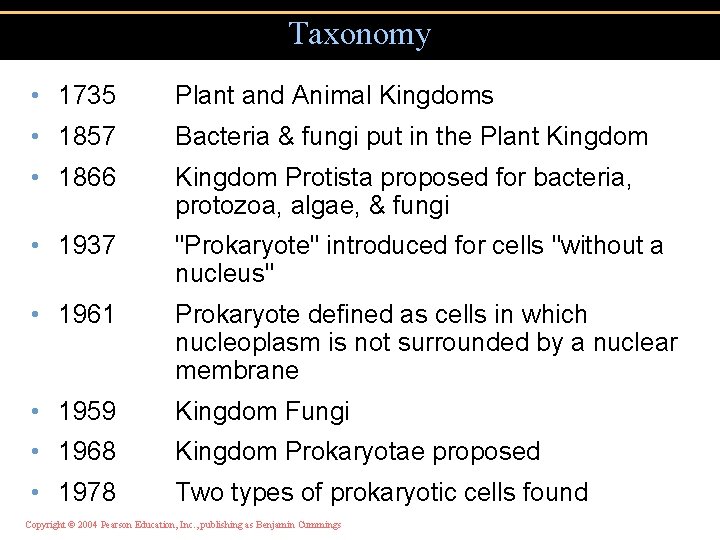
Taxonomy • 1735 Plant and Animal Kingdoms • 1857 Bacteria & fungi put in the Plant Kingdom • 1866 Kingdom Protista proposed for bacteria, protozoa, algae, & fungi • 1937 "Prokaryote" introduced for cells "without a nucleus" • 1961 Prokaryote defined as cells in which nucleoplasm is not surrounded by a nuclear membrane • 1959 Kingdom Fungi • 1968 Kingdom Prokaryotae proposed • 1978 Two types of prokaryotic cells found Copyright © 2004 Pearson Education, Inc. , publishing as Benjamin Cummings
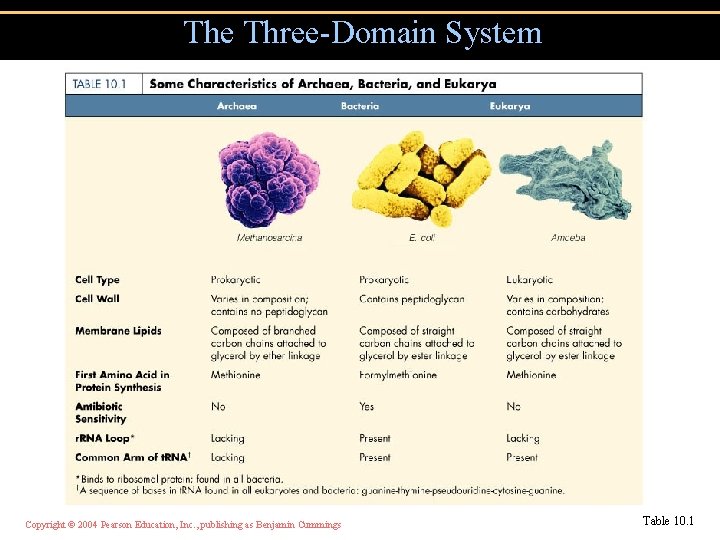
The Three-Domain System Copyright © 2004 Pearson Education, Inc. , publishing as Benjamin Cummings Table 10. 1

The Three-Domain System Copyright © 2004 Pearson Education, Inc. , publishing as Benjamin Cummings Figure 10. 1
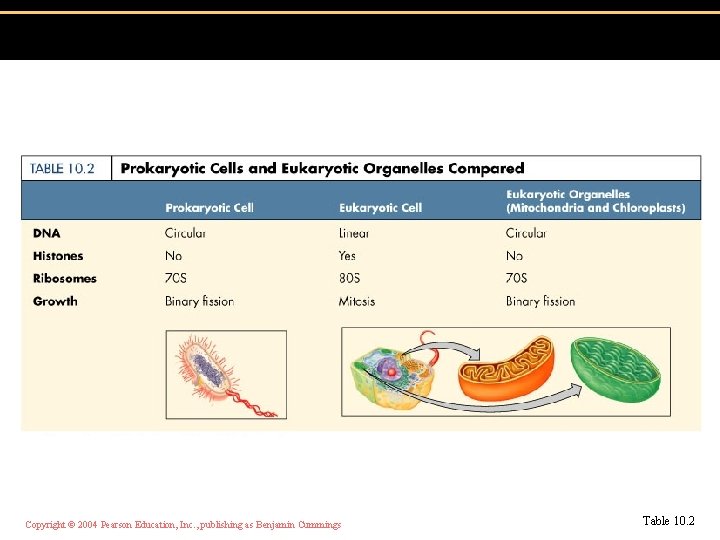
Copyright © 2004 Pearson Education, Inc. , publishing as Benjamin Cummings Table 10. 2
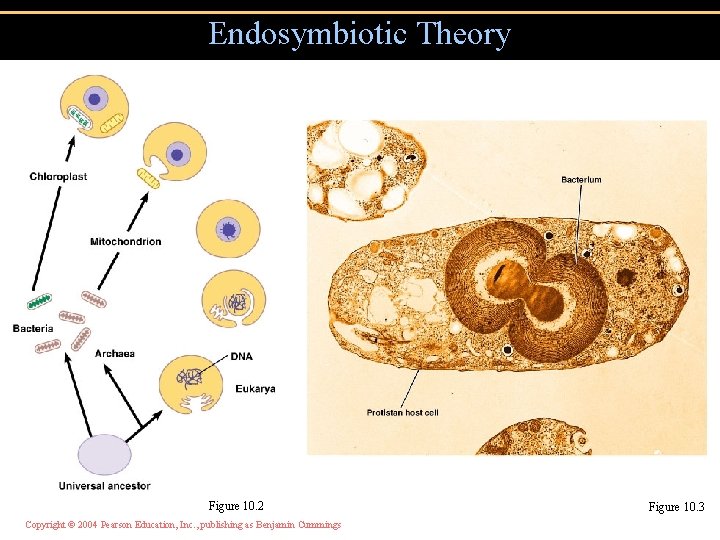
Endosymbiotic Theory Figure 10. 2 Copyright © 2004 Pearson Education, Inc. , publishing as Benjamin Cummings Figure 10. 3
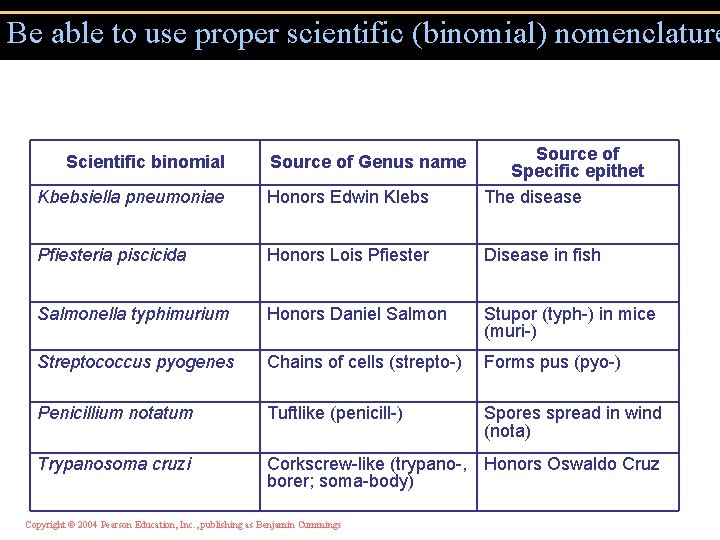
Be able to use proper scientific (binomial) nomenclature Kbebsiella pneumoniae Honors Edwin Klebs Source of Specific epithet The disease Pfiesteria piscicida Honors Lois Pfiester Disease in fish Salmonella typhimurium Honors Daniel Salmon Stupor (typh-) in mice (muri-) Streptococcus pyogenes Chains of cells (strepto-) Forms pus (pyo-) Penicillium notatum Tuftlike (penicill-) Spores spread in wind (nota) Trypanosoma cruzi Corkscrew-like (trypano-, Honors Oswaldo Cruz borer; soma-body) Scientific binomial Source of Genus name Copyright © 2004 Pearson Education, Inc. , publishing as Benjamin Cummings
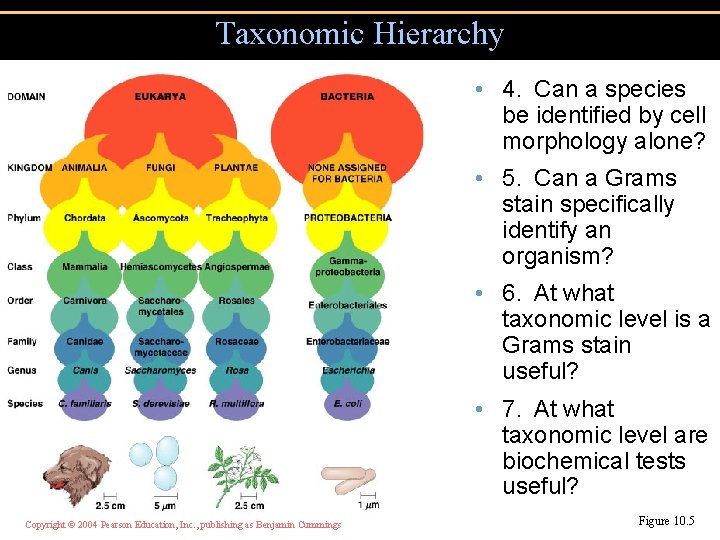
Taxonomic Hierarchy • 4. Can a species be identified by cell morphology alone? • 5. Can a Grams stain specifically identify an organism? • 6. At what taxonomic level is a Grams stain useful? • 7. At what taxonomic level are biochemical tests useful? Copyright © 2004 Pearson Education, Inc. , publishing as Benjamin Cummings Figure 10. 5
Species Definition • Eukaryotic species: • A group of closely related organisms that breed among themselves • Prokaryotic species: • A population of cells with similar characteristics • Clone: Population of cells derived from a single cell • Strain: Genetically different cells within a clone • Viral species: • Population of viruses with similar characteristics that occupies a particular ecological niche Copyright © 2004 Pearson Education, Inc. , publishing as Benjamin Cummings
Domain Eukarya • Animalia: Multicellular; no cell walls; chemoheterotrophic • Plantae: Multicellular; cellulose cell walls; usually photoautotrophic • Fungi: Chemoheterotrophic; unicellular or multicellular; cell walls of chitin; develop from spores or hyphal fragments • Protista: A catchall for eukaryotic organisms that do not fit other kingdoms Copyright © 2004 Pearson Education, Inc. , publishing as Benjamin Cummings
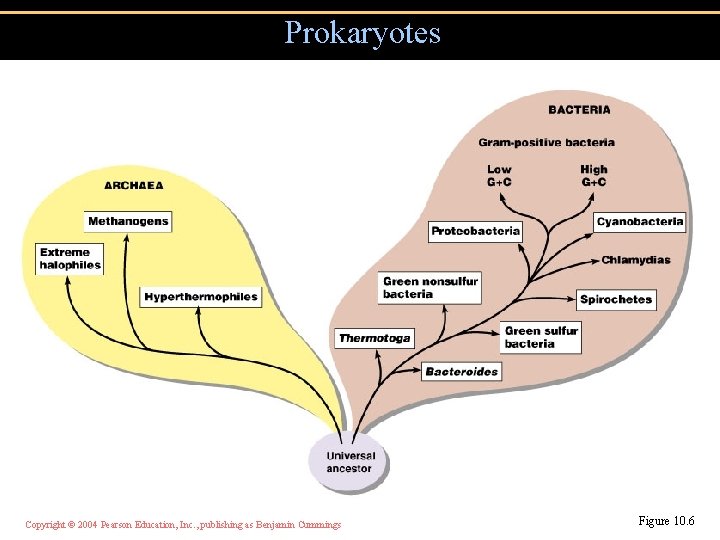
Prokaryotes Copyright © 2004 Pearson Education, Inc. , publishing as Benjamin Cummings Figure 10. 6
• 2. How does classification differ from identification of microorganisms? • 3. How is morphology used to identify a species? Copyright © 2004 Pearson Education, Inc. , publishing as Benjamin Cummings
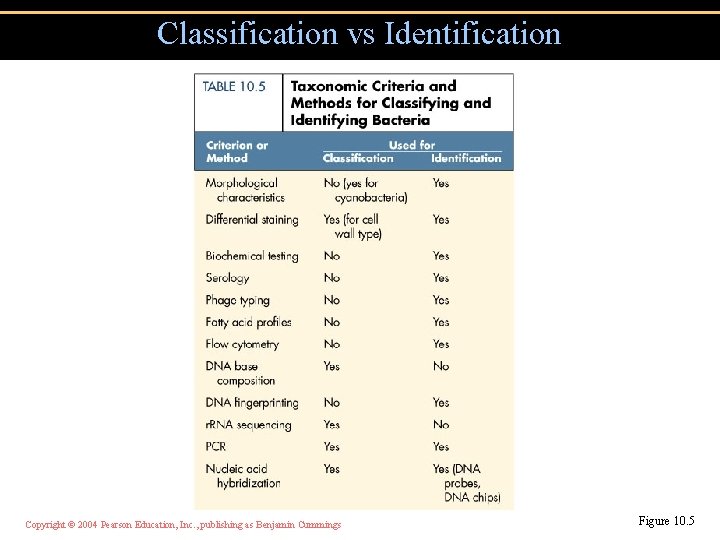
Classification vs Identification Copyright © 2004 Pearson Education, Inc. , publishing as Benjamin Cummings Figure 10. 5
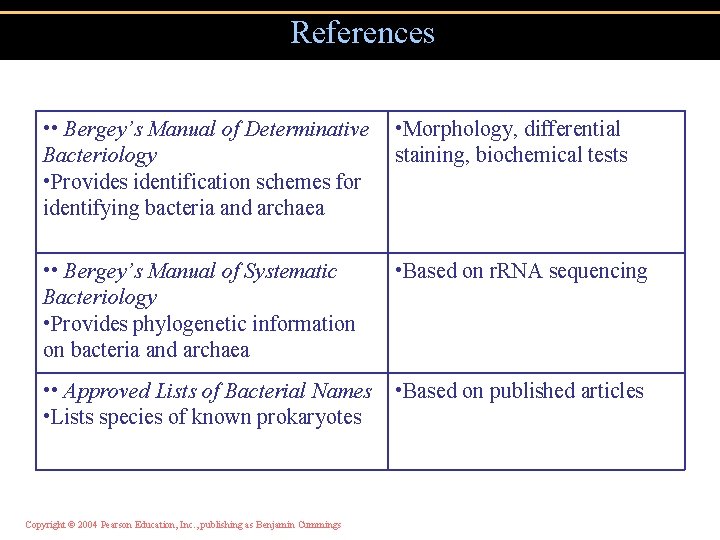
References • • Bergey’s Manual of Determinative • Morphology, differential Bacteriology staining, biochemical tests • Provides identification schemes for identifying bacteria and archaea • • Bergey’s Manual of Systematic Bacteriology • Provides phylogenetic information on bacteria and archaea • Based on r. RNA sequencing • • Approved Lists of Bacterial Names • Lists species of known prokaryotes • Based on published articles Copyright © 2004 Pearson Education, Inc. , publishing as Benjamin Cummings
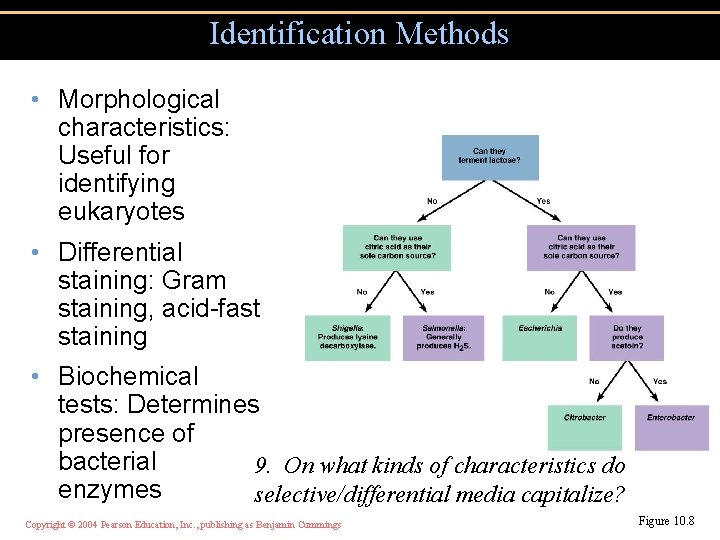
Identification Methods • Morphological characteristics: Useful for identifying eukaryotes • Differential staining: Gram staining, acid-fast staining • Biochemical tests: Determines presence of bacterial 9. On what kinds of characteristics do enzymes selective/differential media capitalize? Copyright © 2004 Pearson Education, Inc. , publishing as Benjamin Cummings Figure 10. 8
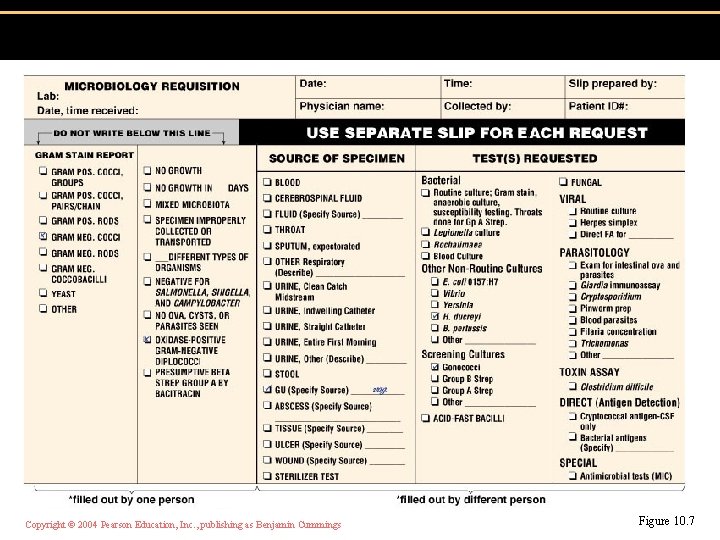
Copyright © 2004 Pearson Education, Inc. , publishing as Benjamin Cummings Figure 10. 7
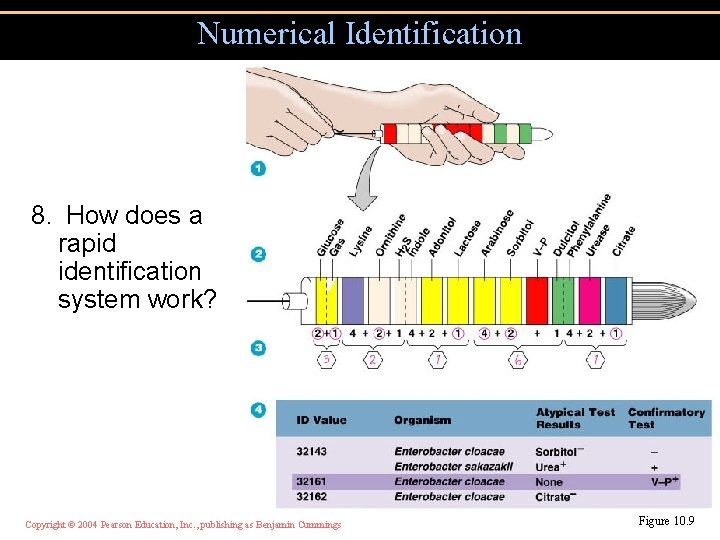
Numerical Identification 8. How does a rapid identification system work? Copyright © 2004 Pearson Education, Inc. , publishing as Benjamin Cummings Figure 10. 9
• 10. From what is antisera produced? • 11. How does a slide agglutination test work? Copyright © 2004 Pearson Education, Inc. , publishing as Benjamin Cummings
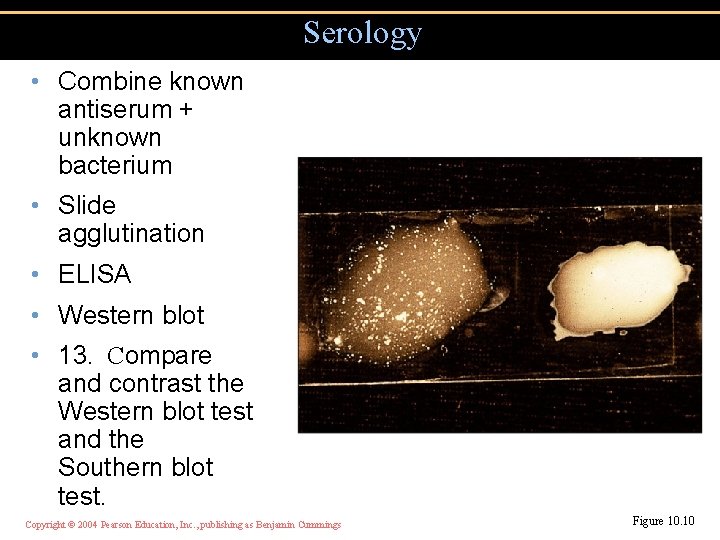
Serology • Combine known antiserum + unknown bacterium • Slide agglutination • ELISA • Western blot • 13. Compare and contrast the Western blot test and the Southern blot test. Copyright © 2004 Pearson Education, Inc. , publishing as Benjamin Cummings Figure 10. 10
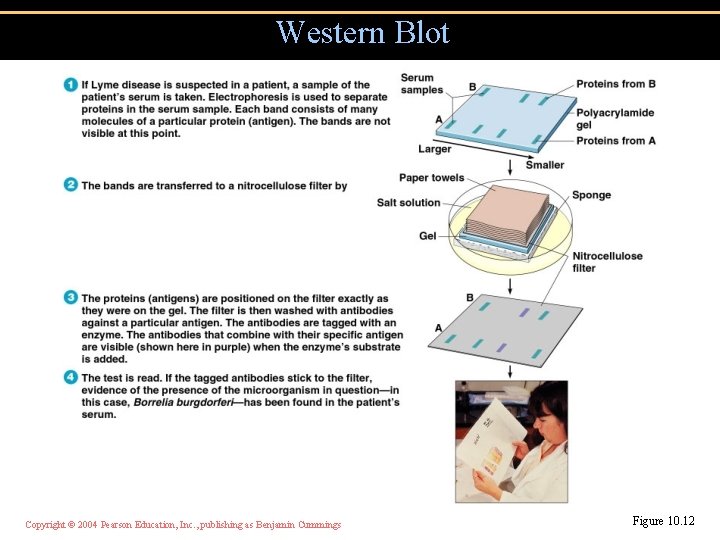
Western Blot Copyright © 2004 Pearson Education, Inc. , publishing as Benjamin Cummings Figure 10. 12
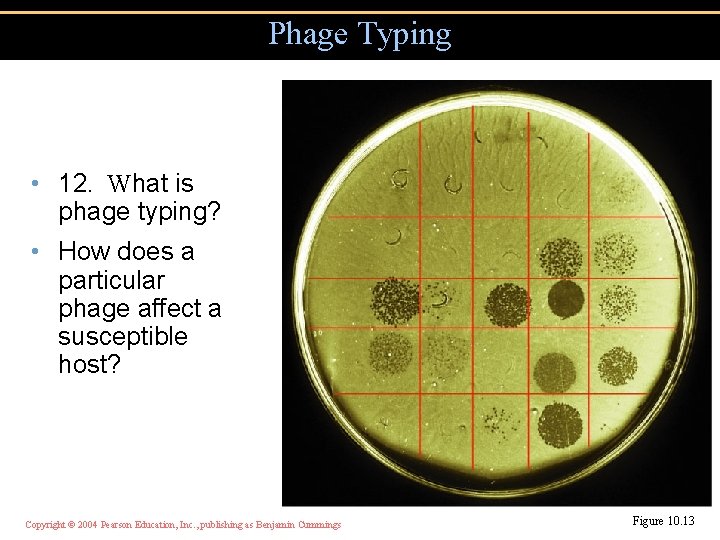
Phage Typing • 12. What is phage typing? • How does a particular phage affect a susceptible host? Copyright © 2004 Pearson Education, Inc. , publishing as Benjamin Cummings Figure 10. 13
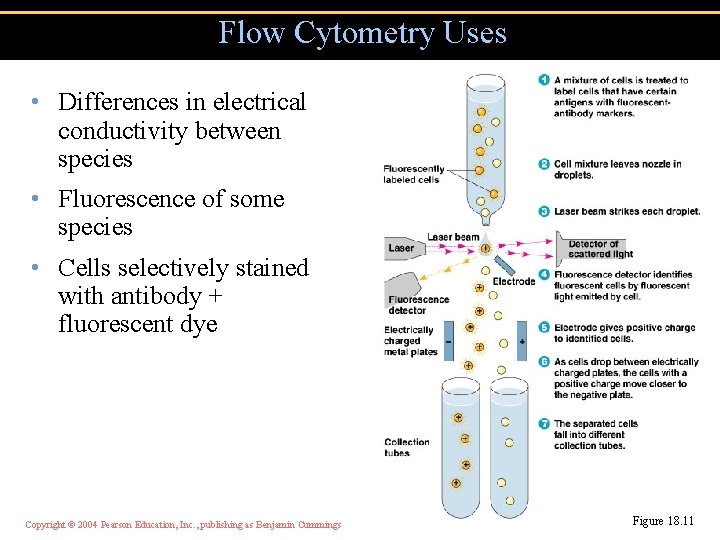
Flow Cytometry Uses • Differences in electrical conductivity between species • Fluorescence of some species • Cells selectively stained with antibody + fluorescent dye Copyright © 2004 Pearson Education, Inc. , publishing as Benjamin Cummings Figure 18. 11
• 14. How does the G+C content of a cell help its identification? • 15. What is the principle behind DNA fingerprinting? Copyright © 2004 Pearson Education, Inc. , publishing as Benjamin Cummings
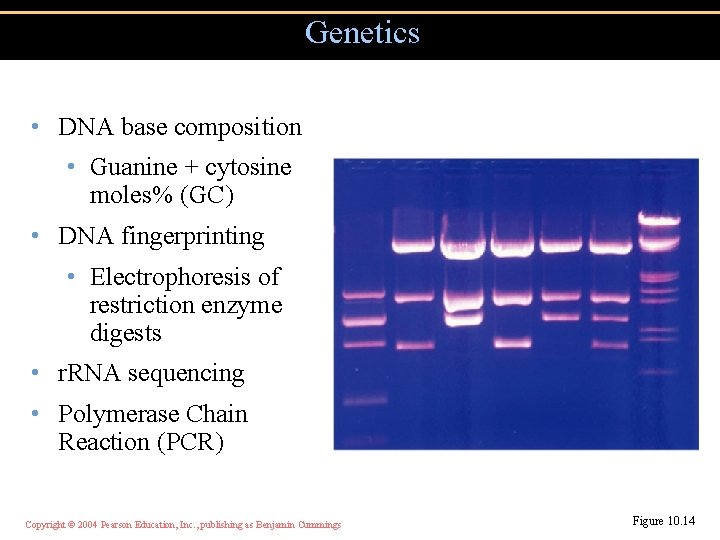
Genetics • DNA base composition • Guanine + cytosine moles% (GC) • DNA fingerprinting • Electrophoresis of restriction enzyme digests • r. RNA sequencing • Polymerase Chain Reaction (PCR) Copyright © 2004 Pearson Education, Inc. , publishing as Benjamin Cummings Figure 10. 14
• 16. How does nucleic acid hybridization help relate two organisms? • How does it relate to DNA “chips” Copyright © 2004 Pearson Education, Inc. , publishing as Benjamin Cummings
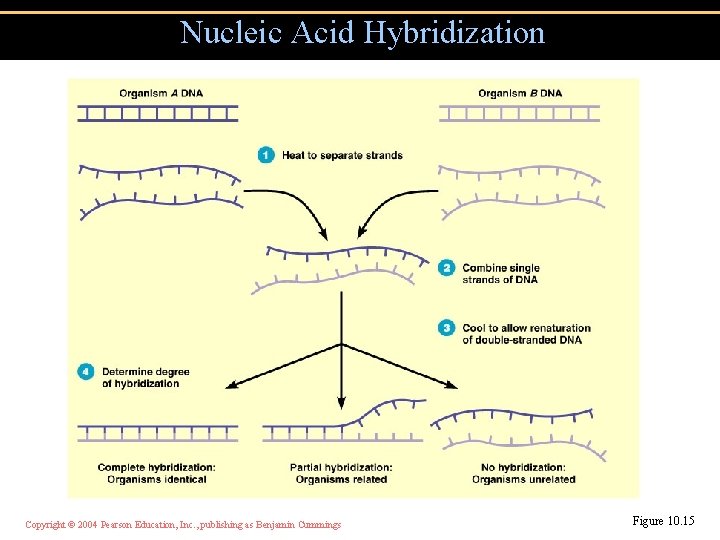
Nucleic Acid Hybridization Copyright © 2004 Pearson Education, Inc. , publishing as Benjamin Cummings Figure 10. 15
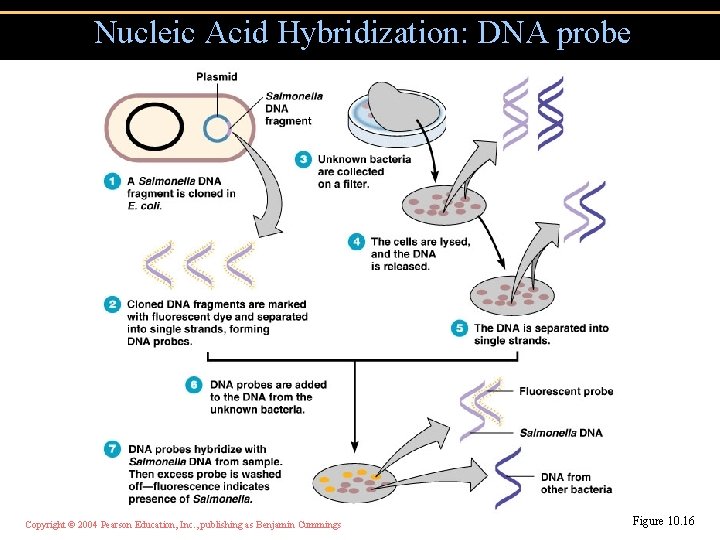
Nucleic Acid Hybridization: DNA probe Copyright © 2004 Pearson Education, Inc. , publishing as Benjamin Cummings Figure 10. 16
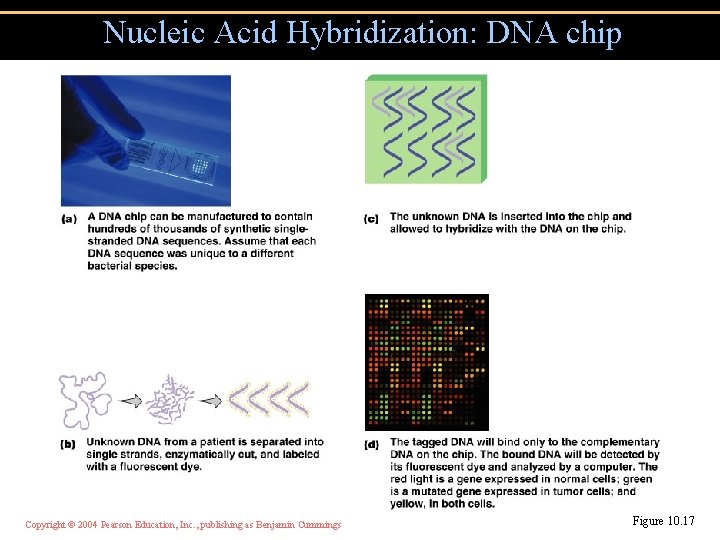
Nucleic Acid Hybridization: DNA chip Copyright © 2004 Pearson Education, Inc. , publishing as Benjamin Cummings Figure 10. 17
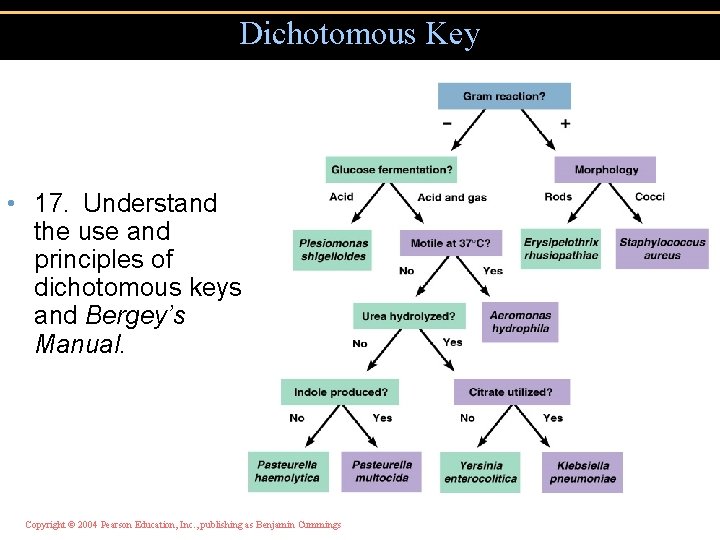
Dichotomous Key • 17. Understand the use and principles of dichotomous keys and Bergey’s Manual. Copyright © 2004 Pearson Education, Inc. , publishing as Benjamin Cummings
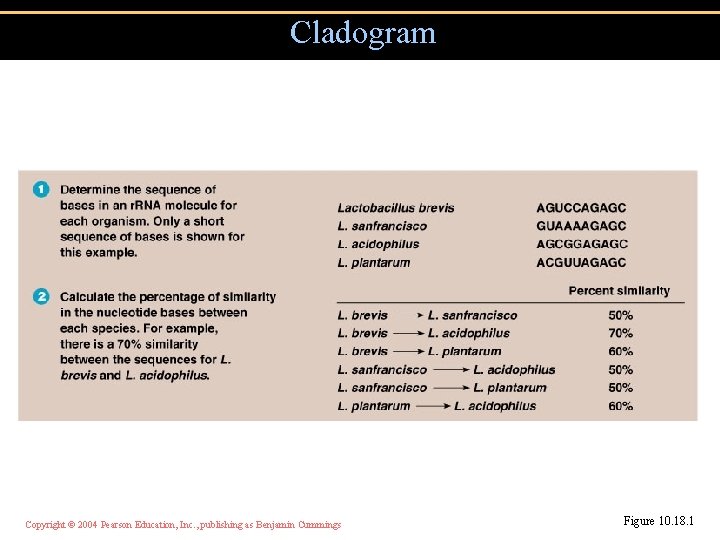
Cladogram Copyright © 2004 Pearson Education, Inc. , publishing as Benjamin Cummings Figure 10. 18. 1
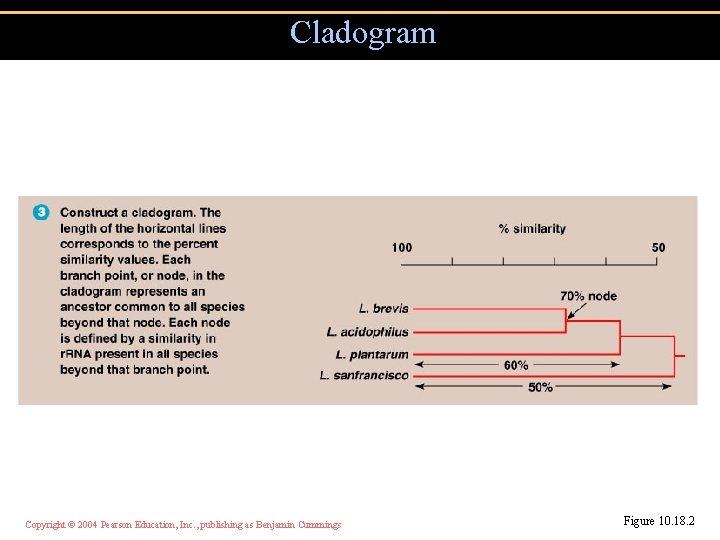
Cladogram Copyright © 2004 Pearson Education, Inc. , publishing as Benjamin Cummings Figure 10. 18. 2
- Slides: 33