
Tort Law Contents 01 Definition Classification Case Exercises

- Slides: 47
Tort Law
Contents 01 Definition Classification Case Exercises 03 02
Definition Tort A wrong; a private or civil wrong or injury resulting from a breach of a legal duty that exists by virtue of society’s expectations regarding interpersonal conduct, rather than by contractor other private relationship.
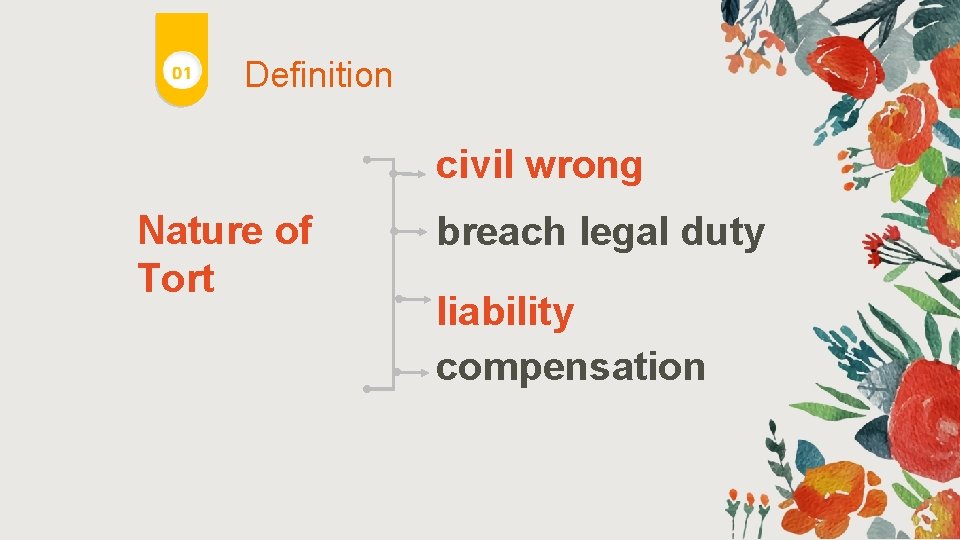
Definition civil wrong Nature of Tort breach legal duty liability compensation
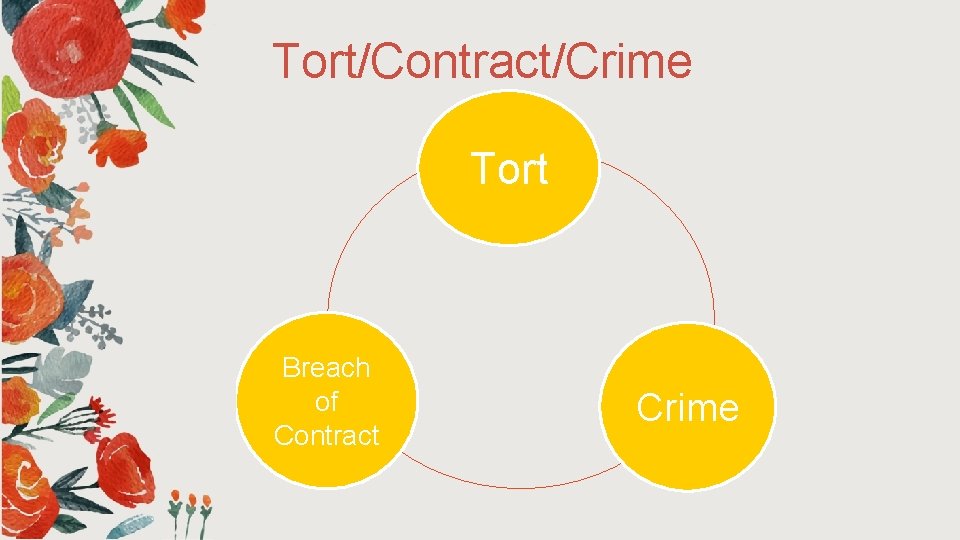
Tort/Contract/Crime Tort Breach of Contract Crime
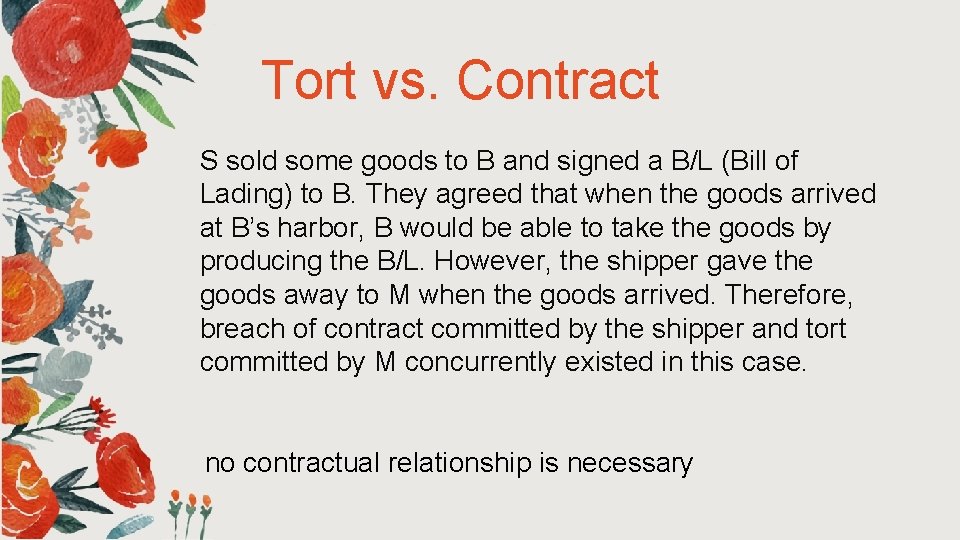
Tort vs. Contract S sold some goods to B and signed a B/L (Bill of Lading) to B. They agreed that when the goods arrived at B’s harbor, B would be able to take the goods by producing the B/L. However, the shipper gave the goods away to M when the goods arrived. Therefore, breach of contract committed by the shipper and tort committed by M concurrently existed in this case. no contractual relationship is necessary
Tort vs. Crime A person who punches (用拳击打) another person commits both a tort and a crime. The puncher will be liable to the punchee for compensatory damages for pain and suffering and possibly for punitive damages as well. The puncher will also be subject to arrest and conviction for the crime of assult and may be sentenced to jail or have to pay a fine. All for the same punch.
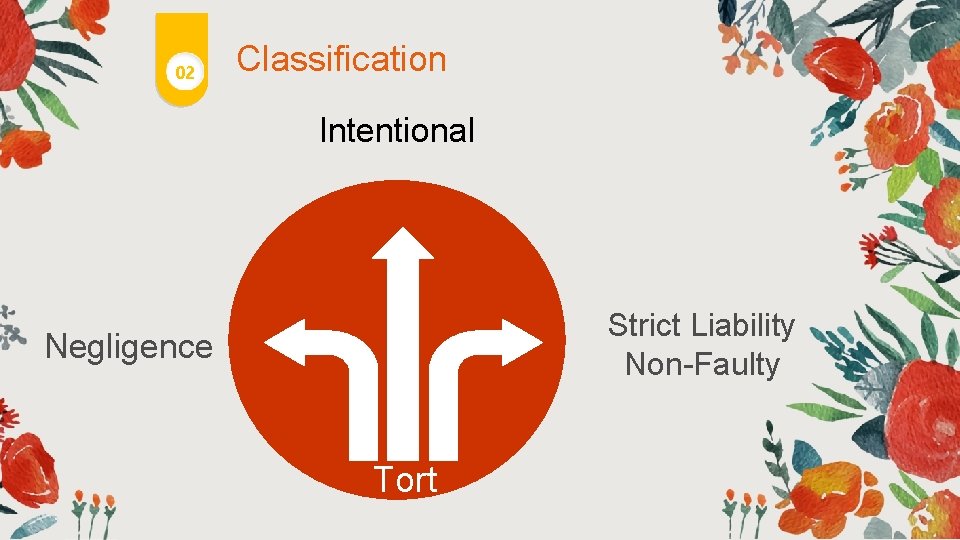
02 Classification Intentional Strict Liability Non-Faulty Negligence Tort
Intentional Torts Definition An intentional tort is a tort resulting from an intentional act on the part of the tortfeasor. Intentional person property dignity
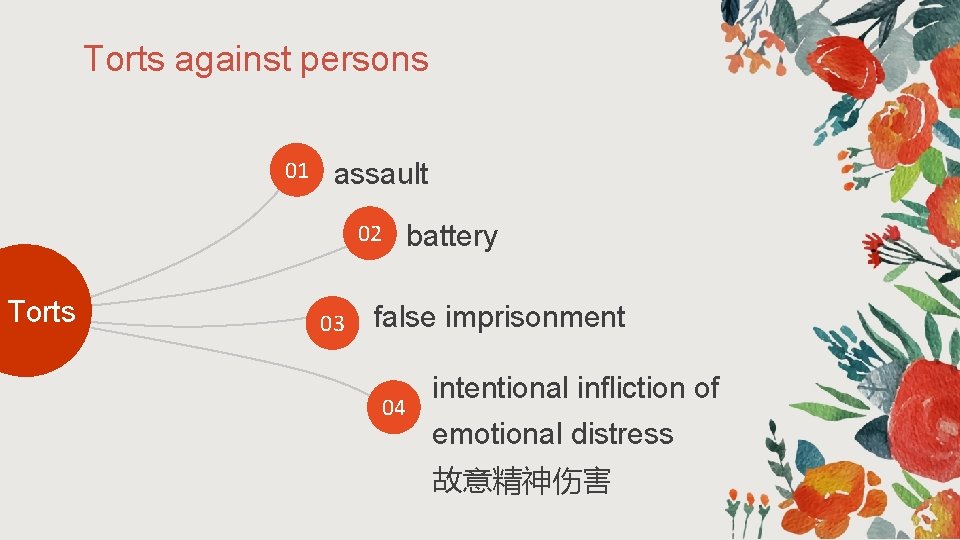
Torts against persons 01 assault 02 Torts 03 battery false imprisonment 04 intentional infliction of emotional distress 故意精神伤害
Torts against persons assault-In tort law, an assault refers to an 01 attempt or threat of violence – not actual violence itself. This may surprise people. Torts Examples: Ø swinging a baseball bat at someone Ø holding a rock and threatening to throw it at someone Ø pointing a gun at someone Ø pointing a realistic toy gun at someone
Torts against persons battery-an intentional act that 02 causes a harmful or offensive contact The elements of civil battery are: Torts Intent (not criminal intent to cause injury, necessarily, but intent to commit the act) Contact (non-consensual contact with the individual or his/her effects, such as clothing) Harm/Damages (the battery caused actual injuries, not limited to just physical harm)
assault and battery: This refers to situation where both an assault (attempting to injure or threatening to injure) and a battery (actually touching someone) occur in the same incident. Example: Clyde Cooch, a prominent judge, lived next door to Lester Biggs. Recently Judge Cooch had sentenced Lester Biggs‘ son, Dopey, to six months in prison on a narcotics charge. One afternoon while judge Cooch was mowing his lawn,Lester decided to avenge his son’s conviction.Lester set up his water sprinkler (洒水器) behind some shrubbery (灌木丛) separating their adjoining properties. As the judge was mowing his lawn and came within reach of the water sprinkler, Lester turned on the sprinkling device, and doused the judge with water. Judge Cooch would be able to recover against Lester for which of the following tort(s): (A) negligence (B) battery (C) assault and battery (D) battery and trespass
Torts against persons false imprisonment-the detention of a 03 person in a bounded area without justification or consent Examples of false imprisonment may include: Torts A person locking another person in a room without their permission A person holding something of value to another person with the intent to make the person stay in a certain place, and without the consent of the person whose valuables are being held A person grabbing onto another person without their consent, and holding them so that they cannot leave A security guard or store owner who detains you for an unreasonable amount of time based on the way you look or dress
Torts against persons 04 intentional infliction of emotional distressintentional conduct that results in extreme emotional distress Torts Example:A person sent a letter to another falsely informing him that a close family member of his had been killed in an accident.
Torts against property 01 Torts trespass to land 02 trespass to personal property (chattels) 03 conversion of property -非法强占变更
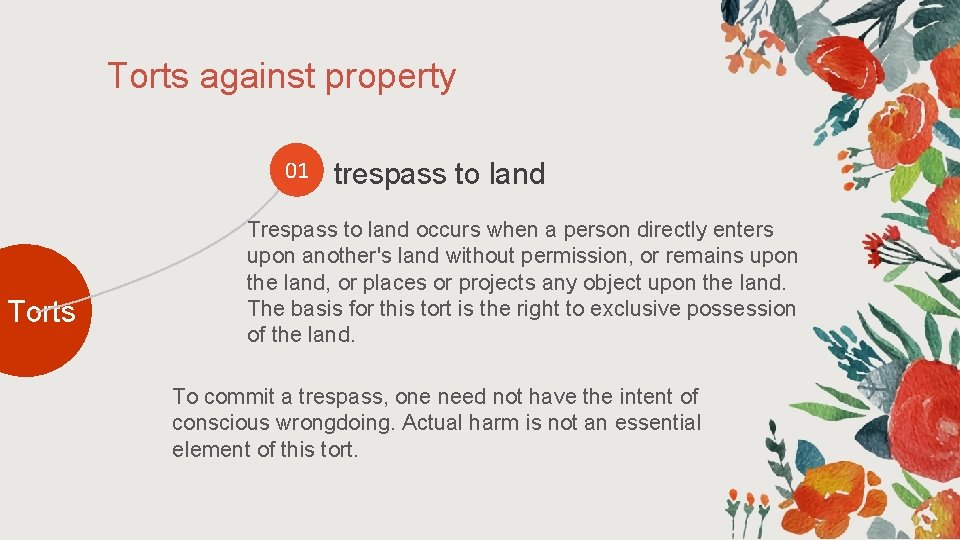
Torts against property 01 Torts trespass to land Trespass to land occurs when a person directly enters upon another's land without permission, or remains upon the land, or places or projects any object upon the land. The basis for this tort is the right to exclusive possession of the land. To commit a trespass, one need not have the intent of conscious wrongdoing. Actual harm is not an essential element of this tort.
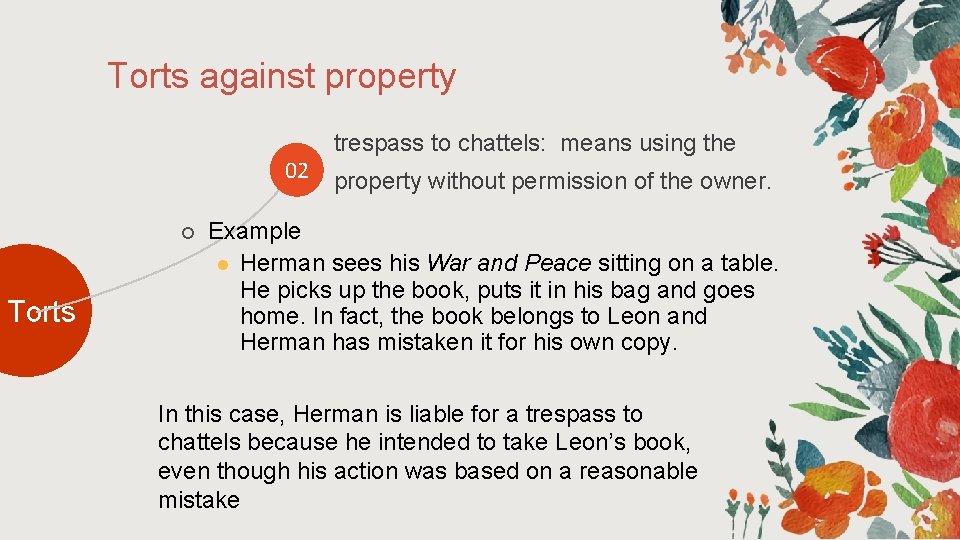
Torts against property 02 ¡ Torts trespass to chattels: means using the property without permission of the owner. Example l Herman sees his War and Peace sitting on a table. He picks up the book, puts it in his bag and goes home. In fact, the book belongs to Leon and Herman has mistaken it for his own copy. In this case, Herman is liable for a trespass to chattels because he intended to take Leon’s book, even though his action was based on a reasonable mistake
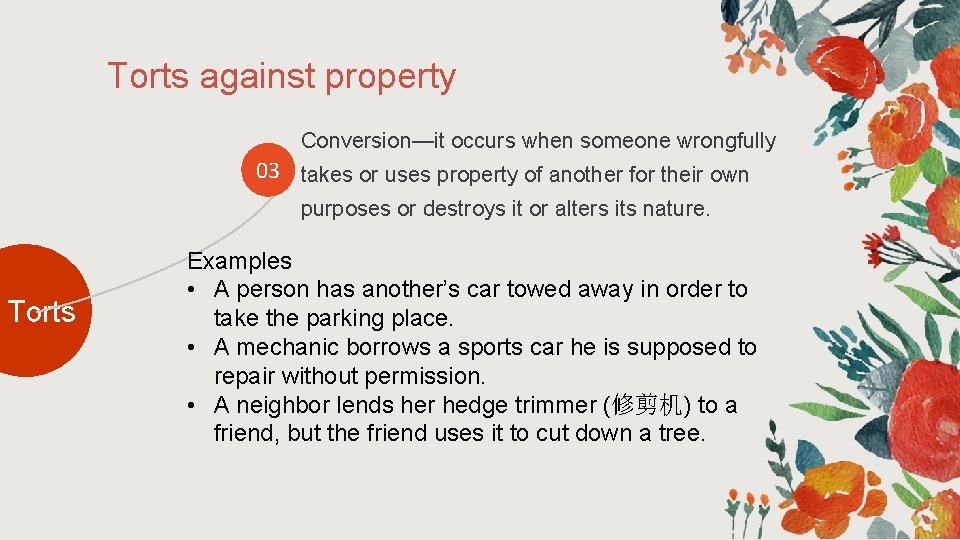
Torts against property Conversion—it occurs when someone wrongfully 03 takes or uses property of another for their own purposes or destroys it or alters its nature. Torts Examples • A person has another’s car towed away in order to take the parking place. • A mechanic borrows a sports car he is supposed to repair without permission. • A neighbor lends her hedge trimmer (修剪机) to a friend, but the friend uses it to cut down a tree.
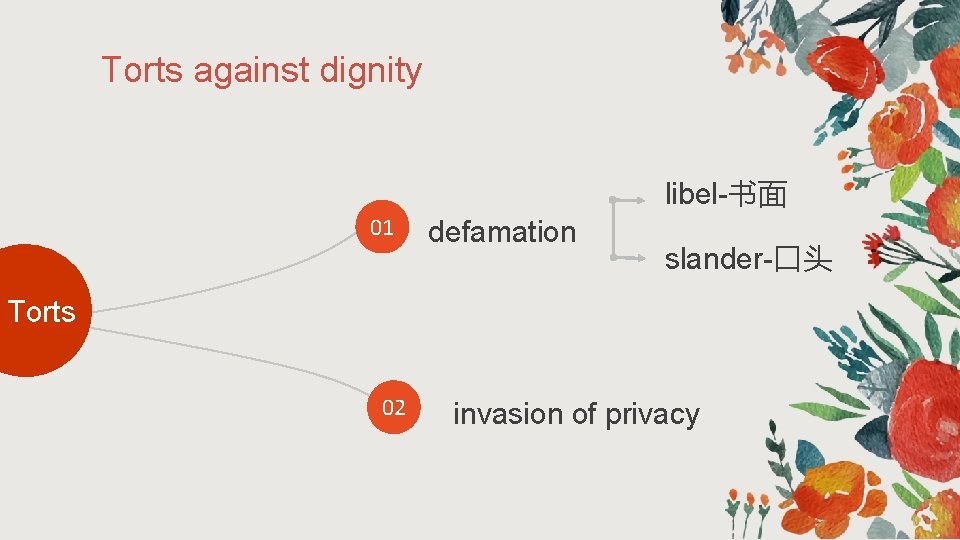
Torts against dignity libel-书面 01 defamation slander-口头 Torts 02 invasion of privacy
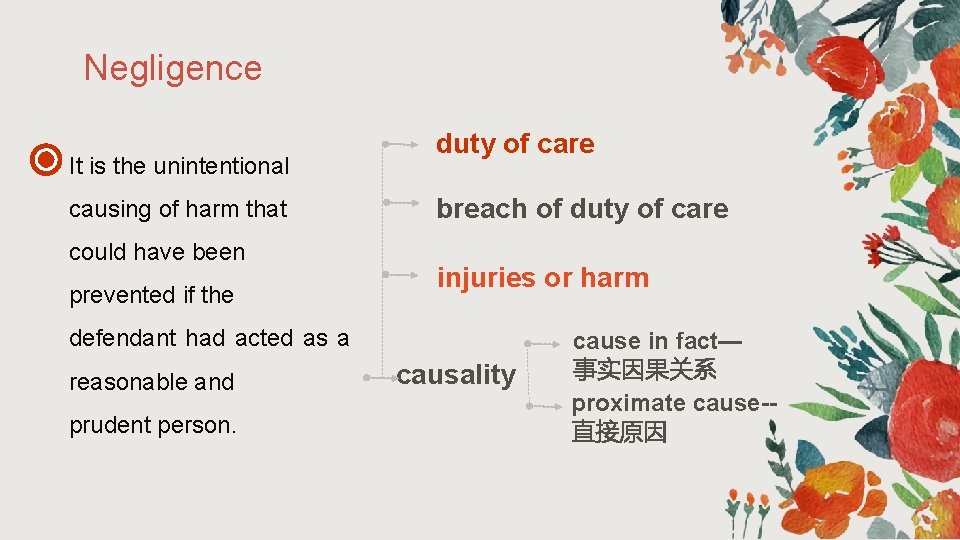
Negligence It is the unintentional causing of harm that could have been prevented if the duty of care breach of duty of care injuries or harm defendant had acted as a reasonable and prudent person. causality cause in fact— 事实因果关系 proximate cause-直接原因
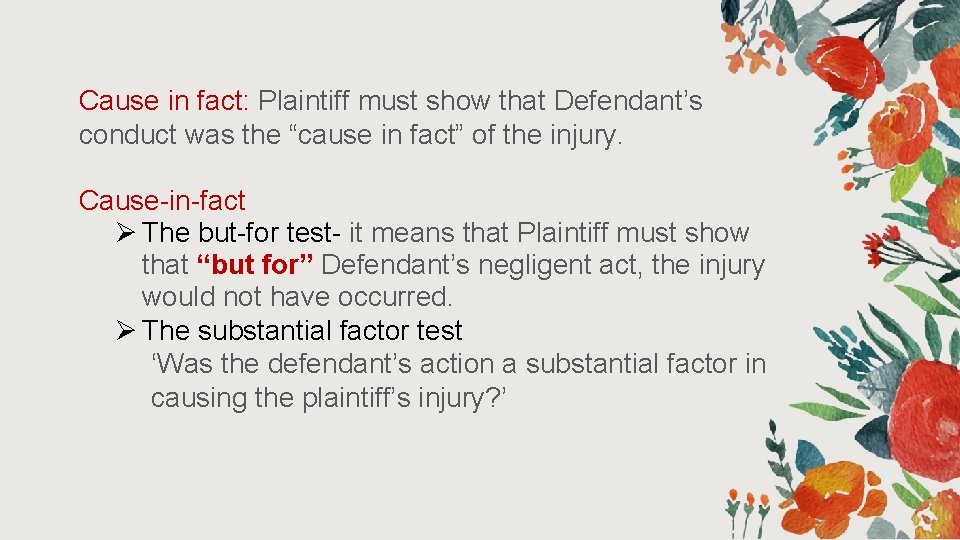
Cause in fact: Plaintiff must show that Defendant’s conduct was the “cause in fact” of the injury. Cause-in-fact Ø The but-for test- it means that Plaintiff must show that “but for” Defendant’s negligent act, the injury would not have occurred. Ø The substantial factor test ‘Was the defendant’s action a substantial factor in causing the plaintiff’s injury? ’
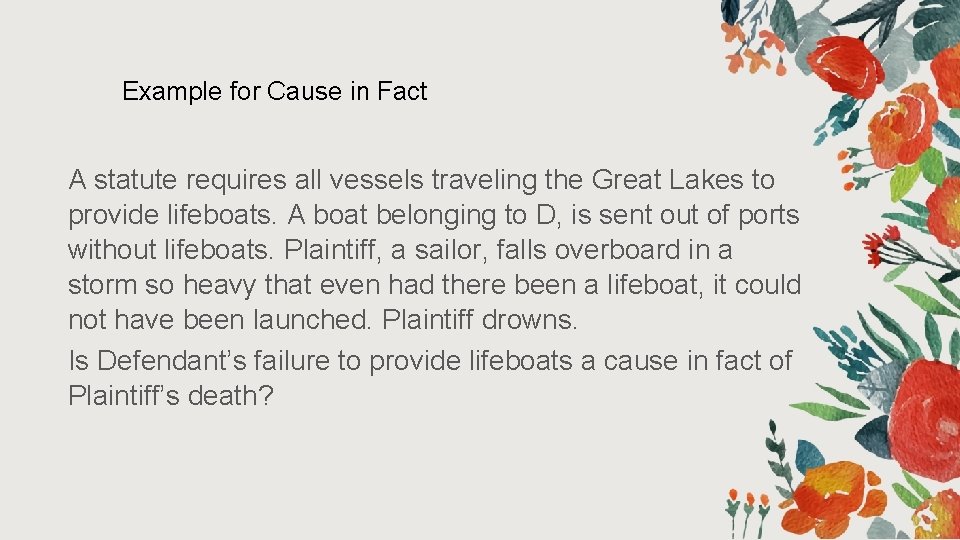
Example for Cause in Fact A statute requires all vessels traveling the Great Lakes to provide lifeboats. A boat belonging to D, is sent out of ports without lifeboats. Plaintiff, a sailor, falls overboard in a storm so heavy that even had there been a lifeboat, it could not have been launched. Plaintiff drowns. Is Defendant’s failure to provide lifeboats a cause in fact of Plaintiff’s death?
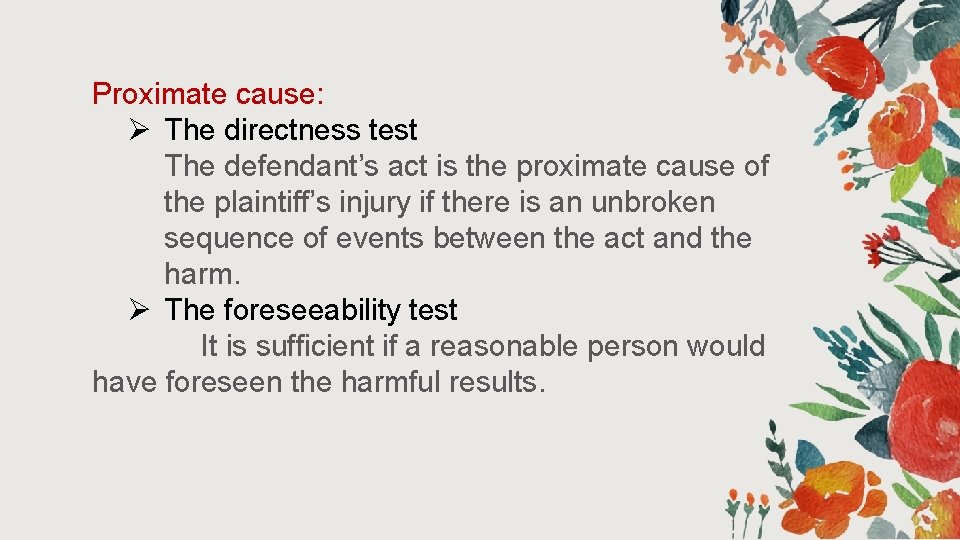
Proximate cause: Ø The directness test The defendant’s act is the proximate cause of the plaintiff’s injury if there is an unbroken sequence of events between the act and the harm. Ø The foreseeability test It is sufficient if a reasonable person would have foreseen the harmful results.
Example for Proximate Cause P is a passenger in a car driven by D 1. On a stormy night, the car crashes into an unlit truck which has been parked in the middle of the road by D 2. There is evidence that D 1 was negligent in not seeing the truck, and that D 2 was negligent in leaving it parked where and how he did. Should D 2 be liable?
Palsgraf v. Long Island Railroad A man running to board the defendant’s train seemed about to fall; a guard, one of the defendant’s employees, attempting to push him onto the train from behind, dislodged a package from the passenger’s arms. The package, unbeknown to anyone contained fireworks, which exploded when they fell. The shock of the explosion made some scales at the other end of the platform fall down, hitting the plaintiff.
Palsgraf sued the railroad, claiming her injury resulted from negligent acts of the employee. The trial court and the intermediate appeals court found for Palsgraf by verdict from a jury, Long Island Rail Road appealed the judgment. Should the defendant be liable for the plaintiff’s injury?
The court wrote that "there was nothing in the situation to suggest to the most cautious mind that the parcel wrapped in newspaper would spread wreckage through the station. If the guard had thrown it down knowingly and willfully, he would not have threatened the plaintiff's safety, so far as appearances could warn him. " Without any perception that one's actions could harm someone, there could be no duty towards that person, and therefore no negligence for which to impose liability.
Dissenting opinion The three-judge dissent, written by Judge Andrews and joined by Judges Frederick Crane and John F. O'Brien, by contrast, saw the case as a matter of proximate cause—Palsgraf's injury could be immediately traced to the wrong committed by the guard, and the fact of the wrong and the fact of the injury should be enough to find negligence (unlike duty, proximate cause is a matter of fact to be determined by a jury; therefore, the dissent would have upheld the jury's verdict for the plaintiff).
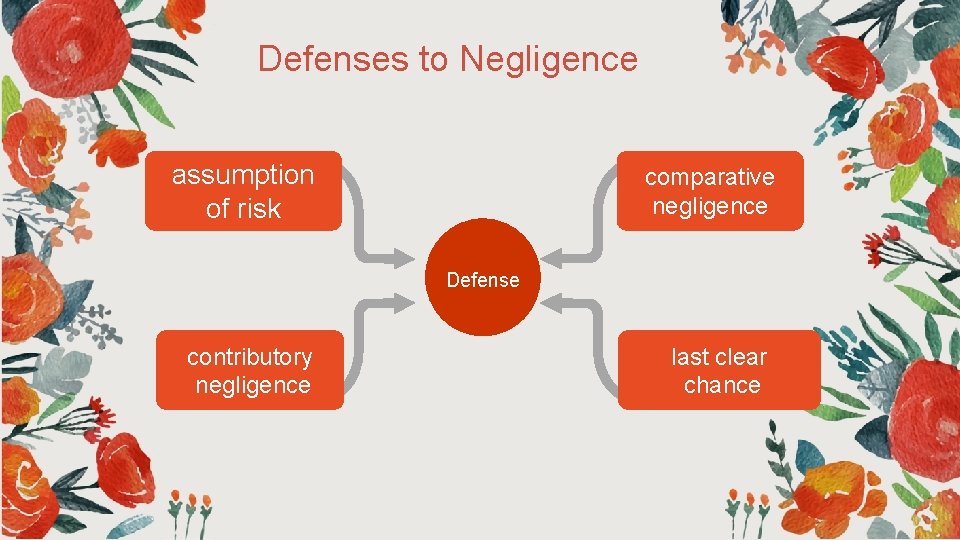
Defenses to Negligence assumption of risk comparative negligence Defense contributory negligence last clear chance
assumption of risk自甘冒险,风险自负 Definition a defense that bars a plaintiff from recovery against a negligent tortfeasor if the plaintiff voluntarily and knowingly assumed the risks inherent to the activity in which he participated Rationale Upon assumption of the risk, there is no longer a duty of care running from the defendant to the plaintiff.
assumption of risk Example Joe broke his arm when he fell into a manhole (井盖 )while walking down the street in a town. The area where the manhole was had been roped off and large signs posted warning pedestrians to avoid it. In its defense, the town may raise the doctrine of assumption of risk.
contributory negligence-共 同过失 The doctrine provides that a plaintiff who is negligent, and whose negligence is a proximate cause of his injuries, is totally barred from recovery. Butterfield v. Forrester
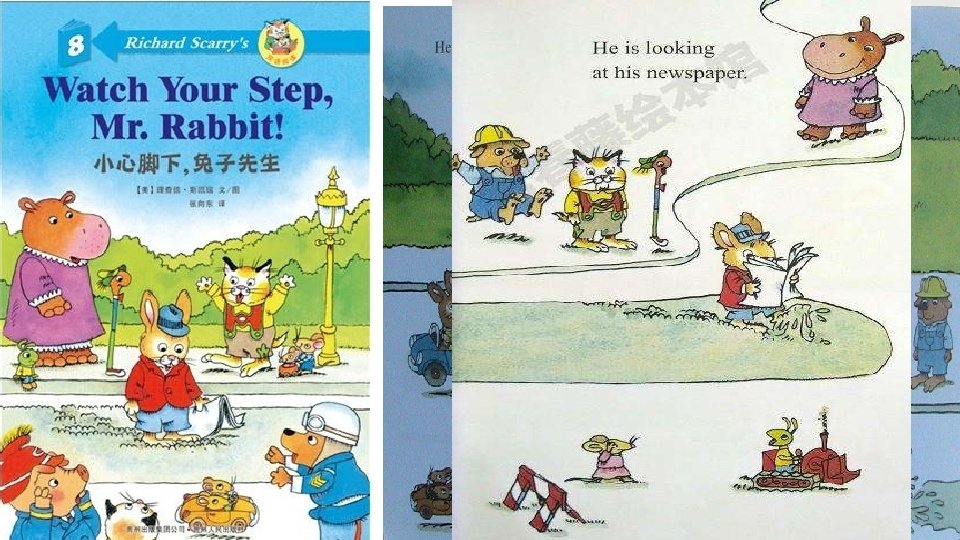
contributory negligence The defendant had blocked part of a road with a pole; the plaintiff, riding his horse rapidly at twilight, ran into the pole. The court held that plaintiff was barred from recovery, since had he been riding at a reasonable speed and looking out with reasonable care, he would have seen the obstruction and avoided it.
contributory negligence Disadvantage It is often regarded as unfair because under the doctrine a victim who is at fault to any degree, including only 1% at fault, will be denied compensation entirely. Result It has been deleted as a defense from the vast majority of statutes and replaced with comparative negligence.
comparative negligence比较过失 a defense that reduces the amount of damages that a plaintiff can recover in a negligence-based claim based upon the degree to which the plaintiff's own negligence contributed to the injury
comparative negligence D, while speeding, collides with a car driven by P. P is not wearing his seat belt. P suffers a fractured leg, which leads to $20, 000 of total damages. P also suffers a brain injury when his head slams into the steering wheel; this results in $80, 000 worth of damages. Evidence shows that if P had worn a seat belt, he still would have suffered the fractured leg, but would not have suffered the brain injury.
last clear chance 明显最后机会 This doctrine can excuse the effect of a plaintiff’s contributory negligence when the defendant who has an opportunity to avoid injuring the plaintiff missed the opportunity. If applicable, the last clear chance rule allows the plaintiff to recover full damages despite the failure to exercise care. However, the adoption of the comparative negligence rule has effectively abolished this doctrine.
Strict Liability & Non-Faulty Strict liability finds persons liable even if their conduct was unintentional or non-negligent. It was first applied in the U. S. to the keeping of dangerous animals such as lions, tigers, elephants and wolves. Owners of those animals who injure another are strictly liable.
Strict Liability & Non-Faulty Another group of cases of strict liability hold people accountable for any damages connected with abnormally dangerous activities, such as blasting at a construction site, even when they were not at fault.
Strict Liability & Non-Faulty Recently a great deal of attention has been given to cases involving products liability. When applied to these cases, the doctrine of strict liability holds one liable for injuries caused by a defective, unreasonably dangerous product that he has placed on the market.
《侵权责任法》 第七条 行为人损害他人民事权益,不论行 为人有无过错,法律规定应当承担侵权责任 的,依照其规定。 Article 7 One who shall assume the tort liability for infringing upon a civil right or interest of another person, whether at fault or not, as provided for by law, shall be subject to such legal provisions.
第七十八条 饲养的动物造成他人损害的,动物饲 养人或者管理人应当承担侵权责任,但能够证明损 害是因被侵权人故意或者重大过失造成的,可以不 承担或者减轻责任。 Article 78 Where a domestic animal causes any harm to another person, the keeper or manager of the animal shall assume the tort liability, but may assume no liability or assume mitigated liability, if it can prove that the harm is caused by the victim intentionally or by the gross negligence of the victim.
03 Case Exercises 1. P,a four-year-old girl, climbs on the back of Toby, a dog owned by D. P pulls the dog’s ears, and the dog snaps at her nose. P sues for damages for the bite. D contends that under local law, P may not recover for P was a trespasser to his chattels. Can P recover the damages?
2. D, driving carelessly, collides with a car driven by X. Unbeknown to D, the car contains dynamite( 炸药), which explodes. Ten blocks away, a nurse who is carrying P, an infant, is startled by the explosion, and drops him. Would D be held liable for P’s injury?