
Torque Equilibrium AP Physics End Slide Pivot Point

Torque & Equilibrium AP Physics

End Slide Pivot Point • Turning or twisting effects due to a force • The product of force and perpendicular distance from pivot point (a. k. a. level arm) • Can produce changes in rotation •

End Slide •

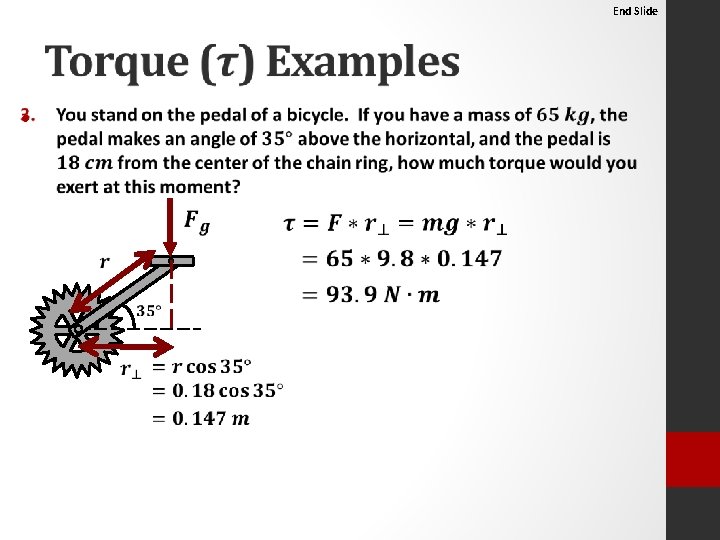
End Slide •
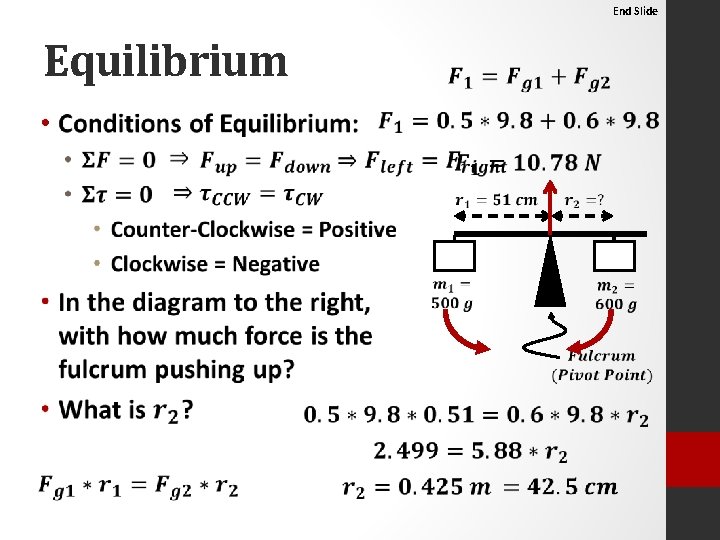
End Slide Equilibrium •

End Slide Equilibrium •
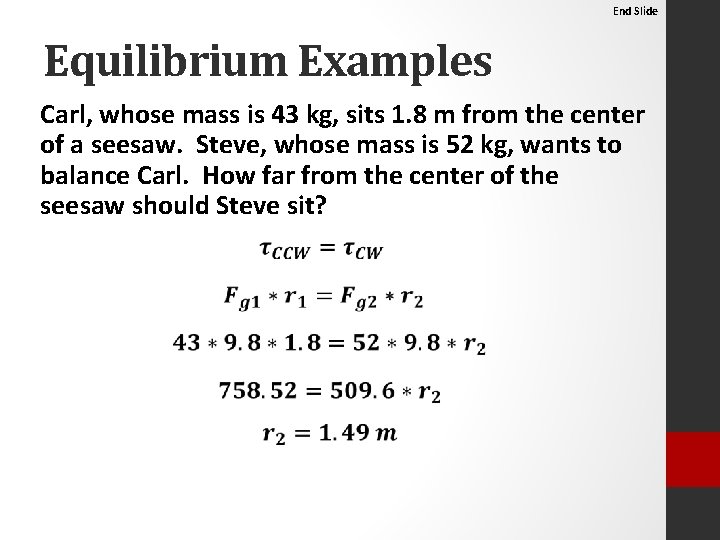
End Slide Equilibrium Examples Carl, whose mass is 43 kg, sits 1. 8 m from the center of a seesaw. Steve, whose mass is 52 kg, wants to balance Carl. How far from the center of the seesaw should Steve sit?
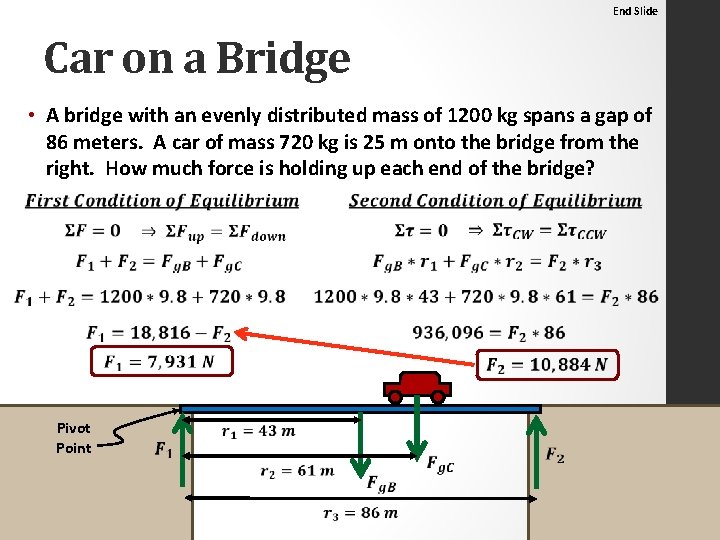
End Slide Car on a Bridge • A bridge with an evenly distributed mass of 1200 kg spans a gap of 86 meters. A car of mass 720 kg is 25 m onto the bridge from the right. How much force is holding up each end of the bridge? Pivot Point
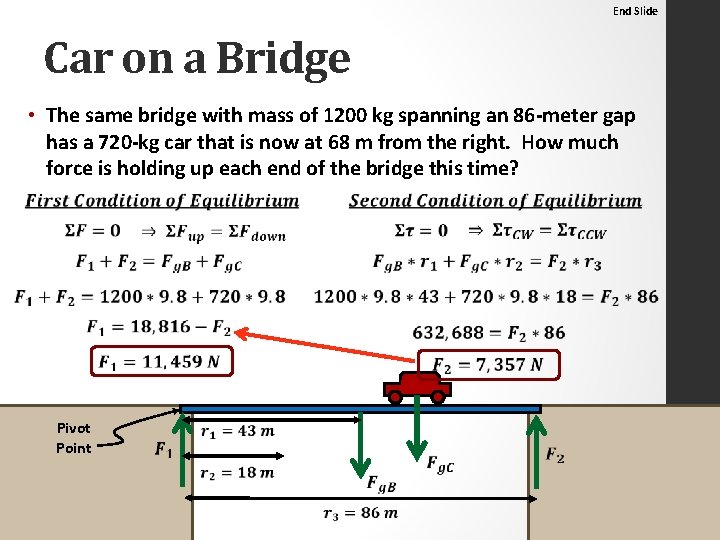
End Slide Car on a Bridge • The same bridge with mass of 1200 kg spanning an 86 -meter gap has a 720 -kg car that is now at 68 m from the right. How much force is holding up each end of the bridge this time? Pivot Point
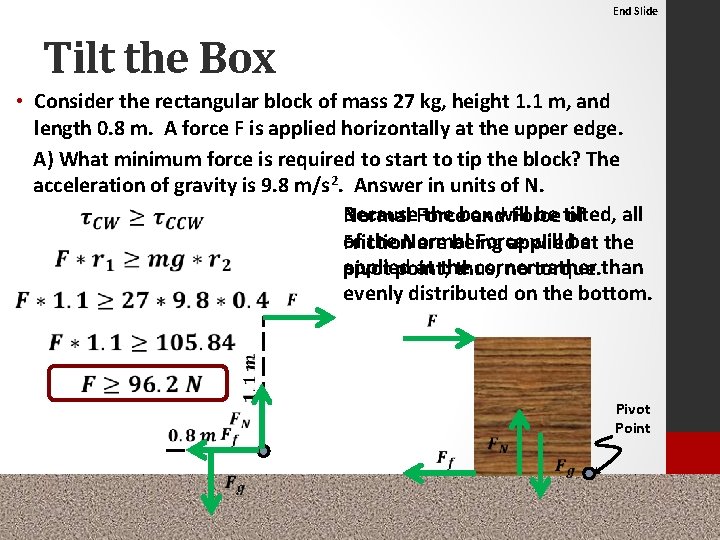
End Slide Tilt the Box • Consider the rectangular block of mass 27 kg, height 1. 1 m, and length 0. 8 m. A force F is applied horizontally at the upper edge. A) What minimum force is required to start to tip the block? The acceleration of gravity is 9. 8 m/s 2. Answer in units of N. Because. Force the box be tilted, all Normal andwill Force of of the Normal Force will beat the Friction are being applied at the corner rather than pivot point; thus, no torque. evenly distributed on the bottom. Pivot Point
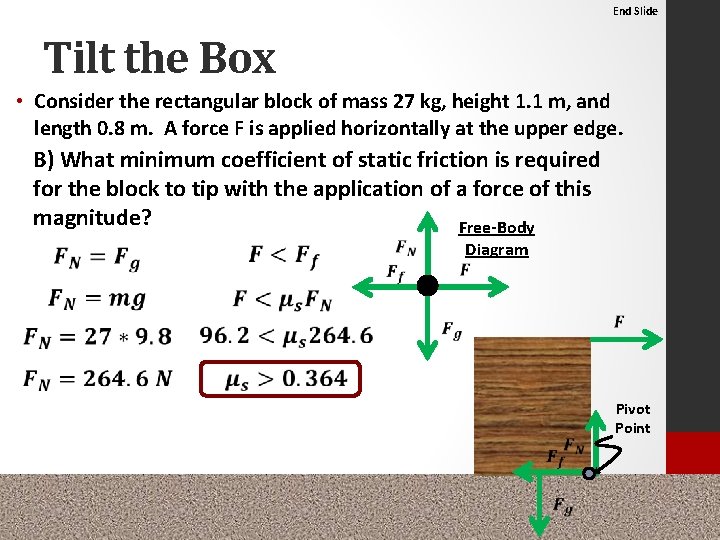
End Slide Tilt the Box • Consider the rectangular block of mass 27 kg, height 1. 1 m, and length 0. 8 m. A force F is applied horizontally at the upper edge. B) What minimum coefficient of static friction is required for the block to tip with the application of a force of this magnitude? Free-Body Diagram Pivot Point
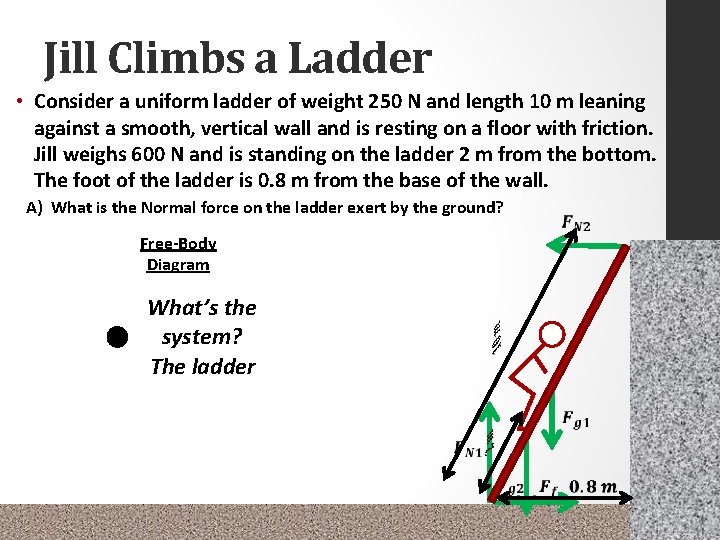
Jill Climbs a Ladder • Consider a uniform ladder of weight 250 N and length 10 m leaning against a smooth, vertical wall and is resting on a floor with friction. Jill weighs 600 N and is standing on the ladder 2 m from the bottom. The foot of the ladder is 0. 8 m from the base of the wall. A) What is the Normal force on the ladder exert by the ground? Free-Body Diagram What’s the system? The ladder
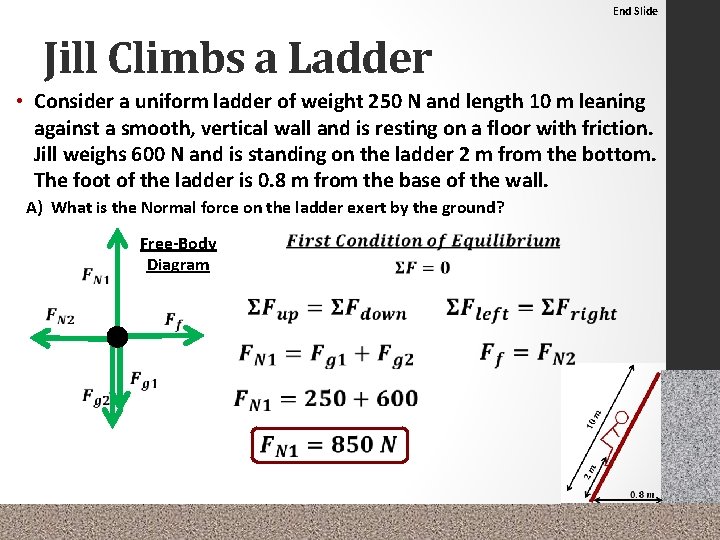
End Slide Jill Climbs a Ladder • Consider a uniform ladder of weight 250 N and length 10 m leaning against a smooth, vertical wall and is resting on a floor with friction. Jill weighs 600 N and is standing on the ladder 2 m from the bottom. The foot of the ladder is 0. 8 m from the base of the wall. A) What is the Normal force on the ladder exert by the ground? Free-Body Diagram
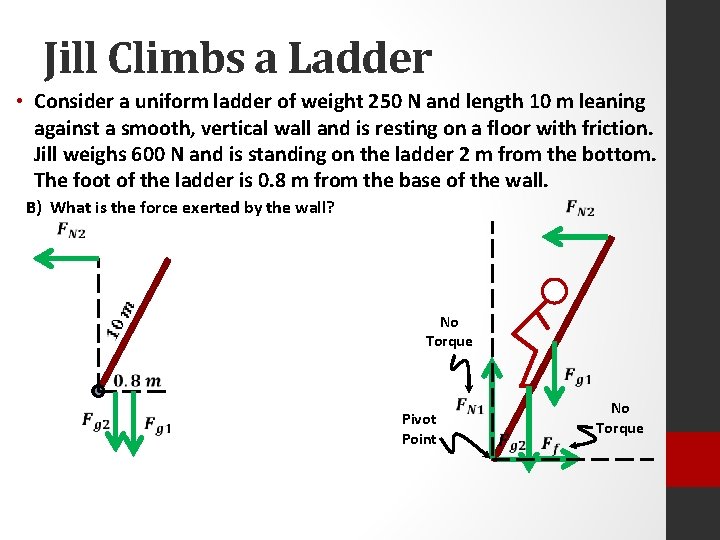
Jill Climbs a Ladder • Consider a uniform ladder of weight 250 N and length 10 m leaning against a smooth, vertical wall and is resting on a floor with friction. Jill weighs 600 N and is standing on the ladder 2 m from the bottom. The foot of the ladder is 0. 8 m from the base of the wall. B) What is the force exerted by the wall? No Torque Pivot Point No Torque
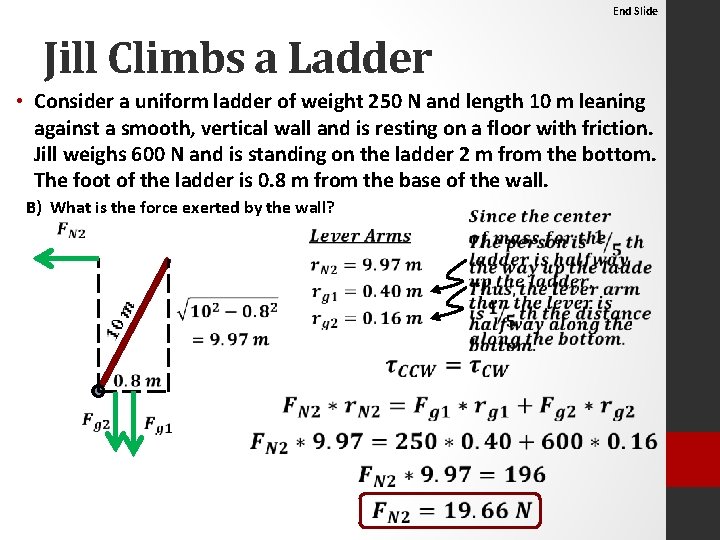
End Slide Jill Climbs a Ladder • Consider a uniform ladder of weight 250 N and length 10 m leaning against a smooth, vertical wall and is resting on a floor with friction. Jill weighs 600 N and is standing on the ladder 2 m from the bottom. The foot of the ladder is 0. 8 m from the base of the wall. B) What is the force exerted by the wall?
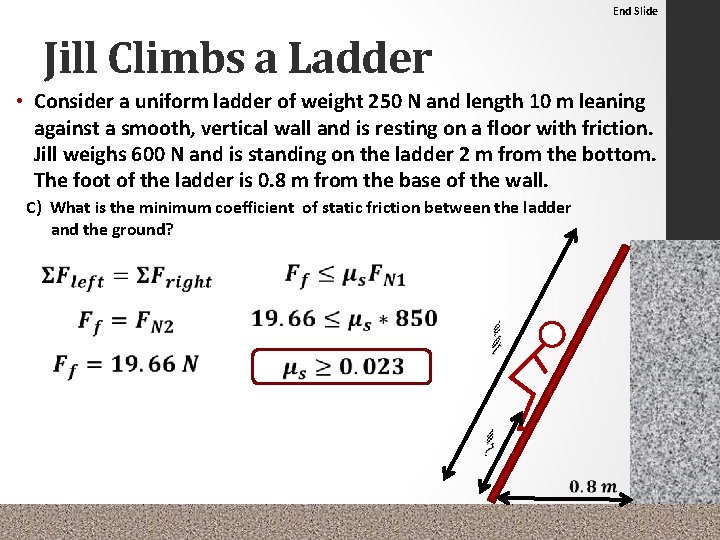
End Slide Jill Climbs a Ladder • Consider a uniform ladder of weight 250 N and length 10 m leaning against a smooth, vertical wall and is resting on a floor with friction. Jill weighs 600 N and is standing on the ladder 2 m from the bottom. The foot of the ladder is 0. 8 m from the base of the wall. C) What is the minimum coefficient of static friction between the ladder and the ground?
- Slides: 17