
Torque and RPM of Gears 1 DISCLAIMER USAGE

- Slides: 8
Torque and RPM of Gears 1
DISCLAIMER & USAGE • The content of this presentation is for informational purposes only and is intended for students attending Louisiana Tech University only. • The authors of this information do not make any claims as to the validity or accuracy of the information or methods presented. • Any procedures demonstrated here are potentially dangerous and could result in damage and injury. boosting application-focused learning through student ownership of learning platforms • Louisiana Tech University, its officers, employees, agents and volunteers, are not liable or responsible for any injuries, illness, damage or losses which may result from your using the materials or ideas, or from your performing the experiments or procedures depicted in this presentation. • The Living with the Lab logos should remain attached to each slide, and the work should be attributed to Louisiana Tech University. • If you do not agree, then please do not view this content. 2
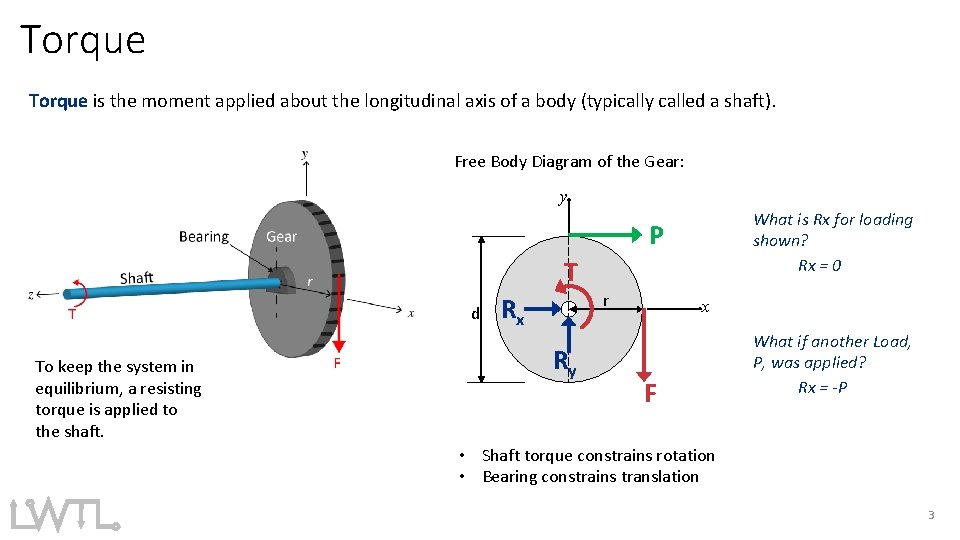
Torque is the moment applied about the longitudinal axis of a body (typically called a shaft). Free Body Diagram of the Gear: y What is Rx for loading shown? Rx = 0 P T d To keep the system in equilibrium, a resisting torque is applied to the shaft. r Rx Ry x F What if another Load, P, was applied? Rx = -P • Shaft torque constrains rotation • Bearing constrains translation 3
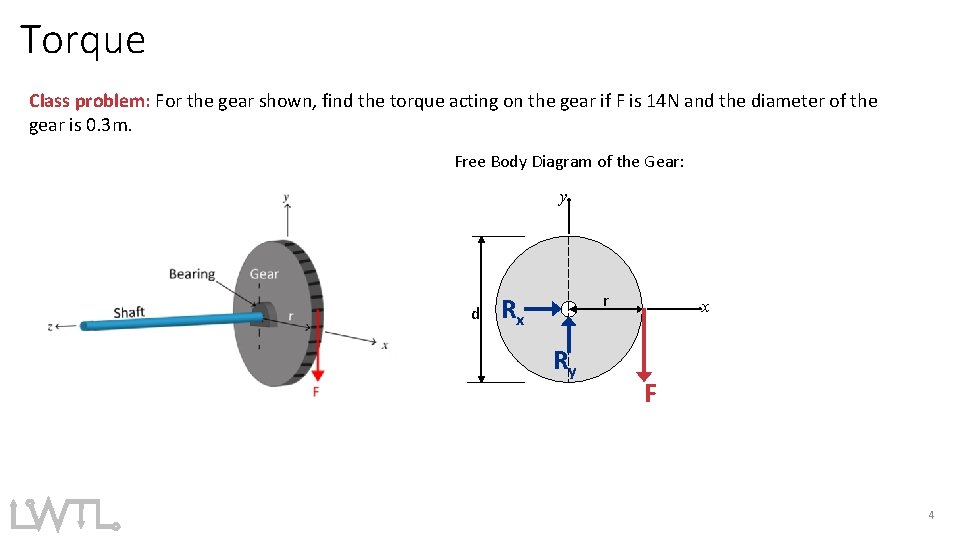
Torque Class problem: For the gear shown, find the torque acting on the gear if F is 14 N and the diameter of the gear is 0. 3 m. Free Body Diagram of the Gear: y d r Rx Ry x F 4
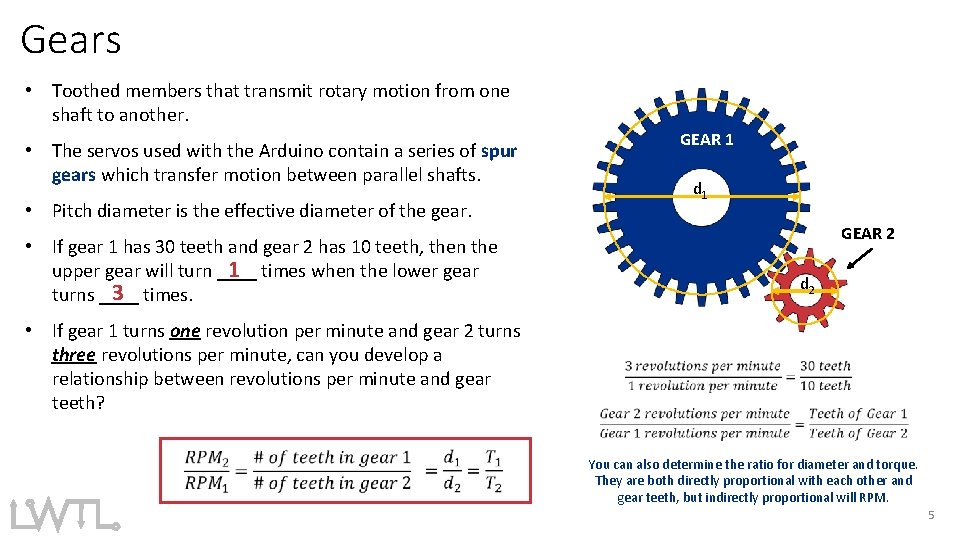
Gears • Toothed members that transmit rotary motion from one shaft to another. • The servos used with the Arduino contain a series of spur gears which transfer motion between parallel shafts. • Pitch diameter is the effective diameter of the gear. • If gear 1 has 30 teeth and gear 2 has 10 teeth, then the upper gear will turn ____ 1 times when the lower gear 3 times. turns ____ GEAR 1 d 1 GEAR 2 d 2 • If gear 1 turns one revolution per minute and gear 2 turns three revolutions per minute, can you develop a relationship between revolutions per minute and gear teeth? You can also determine the ratio for diameter and torque. They are both directly proportional with each other and gear teeth, but indirectly proportional will RPM. 5
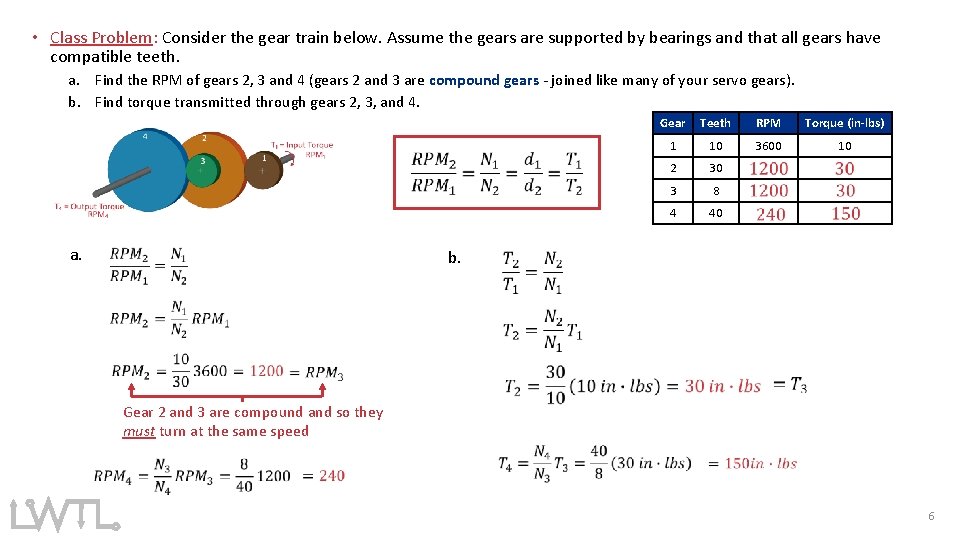
• Class Problem: Consider the gear train below. Assume the gears are supported by bearings and that all gears have compatible teeth. a. Find the RPM of gears 2, 3 and 4 (gears 2 and 3 are compound gears - joined like many of your servo gears). b. Find torque transmitted through gears 2, 3, and 4. a. Gear Teeth RPM Torque (in-lbs) 1 10 3600 10 2 30 3 8 4 40 b. Gear 2 and 3 are compound and so they must turn at the same speed 6
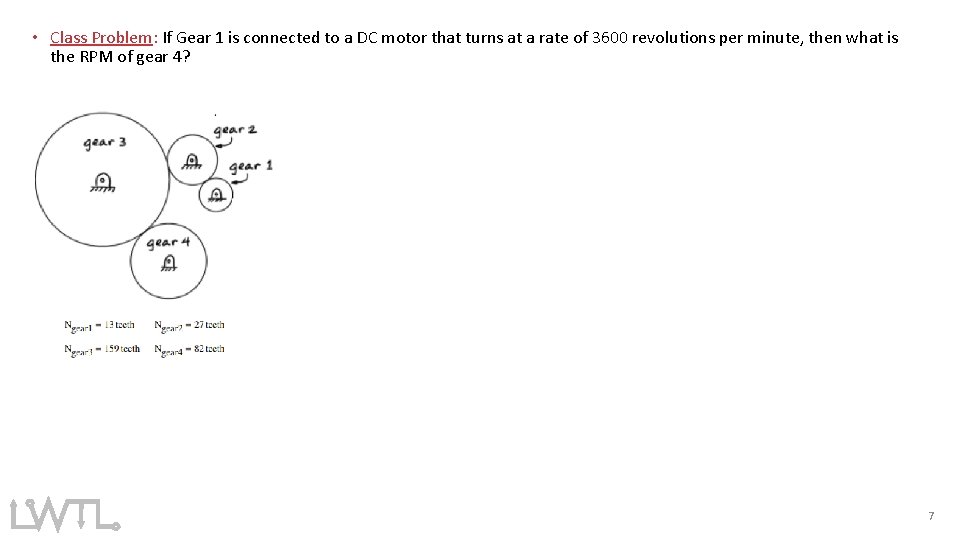
• Class Problem: If Gear 1 is connected to a DC motor that turns at a rate of 3600 revolutions per minute, then what is the RPM of gear 4? 7
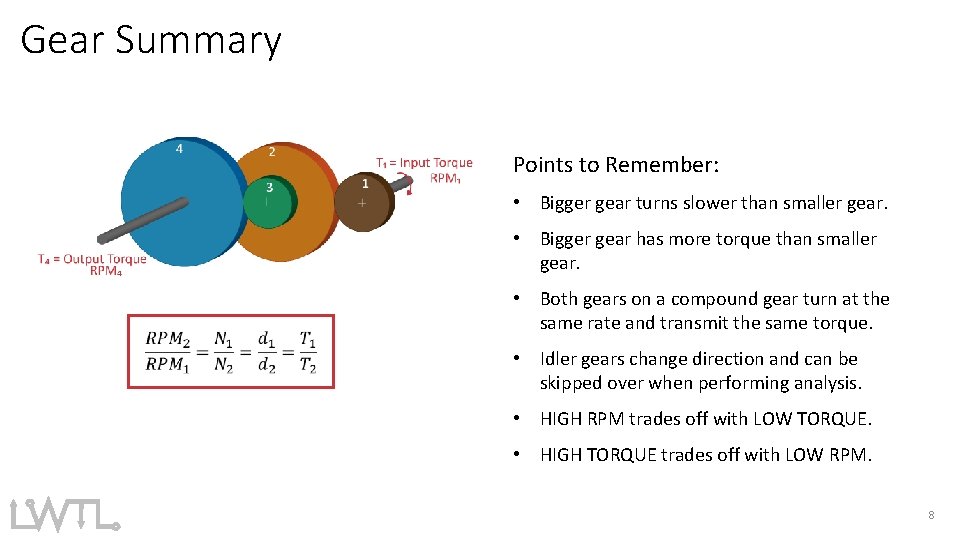
Gear Summary 1 Points to Remember: • Bigger gear turns slower than smaller gear. • Bigger gear has more torque than smaller gear. • Both gears on a compound gear turn at the same rate and transmit the same torque. • Idler gears change direction and can be skipped over when performing analysis. • HIGH RPM trades off with LOW TORQUE. • HIGH TORQUE trades off with LOW RPM. 8