
Toronto Shelter Network Weekly COVID 19 Member Meeting
Toronto Shelter Network Weekly COVID 19 Member Meeting June 10, 2020
HR Legal Issues During COVID-19 Summary: refusal to work must be based on legitimate Health and Safety or Human Rights considerations: Human Rights: • Having COVID-19, including asymptomatic positive test - protected disability • Health conditions that increase risk of severe COVID - protected disability. • You can require some documentation from a doctor of their health risks, but not demand a diagnosis - legal advice recommended • Employees with childcare responsibility, especially for single parents or people with essential worker spouse - protected based on family status
HR Legal Issues During COVID-19 Refusal due to Health and Safety concerns about working conditions: • If shelter takes safety precautions following Ministry of Labour and safe workplace association guidance, employee generally can’t refuse on this basis • Worker complaints must be specific and based on guidance and/or science (recognizing that science is evolving) • Mo. L is rarely upholding health/safety-based refusals during COVID
HR Legal Issues During COVID-19 Safety comes first - lawyer’s position is that under OSHA employers can: • • • Screen staff, including temperature checks Require mask-wearing - unless worker can’t for a disability reason Not allow staff to work if working at another shelter or similar site* *Under new ESA regulation, this would probably be infectious disease emergency leave, not a lay-off More HR law questions? Let us know, and we’ll follow up with lawyers
Mobile Testing & Health • As of June 7 there were 216 active cases across 9 sites • There have been a total of 556 positive cases in the shelter system • 158 COVID positive people are at the recovery site • Over the next 6 to 8 weeks, onsite testing will be expanded to all shelters/respites and likely other congregate living sites • Sites are identified by SSHA, TPH and Toronto Region LHIN, usually on Fridays • Would anyone like to share onsite testing experience?
Coordinated Youth Housing Strategy • Youth sector is meeting to develop a strategy to increase their capacity to support youth to access housing • Concrete next step: letter to the city to increase # of housing subsidies allocated specifically for youth and to enhance the subsidy so that it covers the rent gap for youth • Other ideas: • Pursue opportunities to create new transitional housing for youth • Strengthen the wrap around supports available to youth across all shelters/hotels (employment, mental health, etc. ) • Strategy for better supporting and connecting Indigenous youth and black youth and connecting youth to culture and community
Shelter Recovery Task Force • TSN is representing our members at the Shelter Recovery Task Force, developed by SSHA and The United Way • Currently, COVID is costing the system $4 million more per week than budgeted. Currently no promise of additional funds from the provincial or federal governments • The task force has 6 weeks to put forward priorities for a plan and/or back up plan to City Council for the next 12 months as COVID recovery process continues • Three Pillars: • Infection Control and Health Sector Integration • Housing • Shelter Capacity
June 3 - Health Sector Integration and Infection Prevention Where do we want to be in 12 months • Equitable access to healthcare; every shelter linked to primary care + clear pathway to health supports • Defined service model with services are embedded at every location • Greater collaboration with health sector, especially when it comes to addressing mental health issues What is happening now we want to do more of? • Collaboration and mutual accountability with health and shelter sectors (i. e. , IPAC, other health issues) • Shelters and supports outside the downtown core • Transportation coordination programs to move clients from shelters to housing for social distancing/isolation • Regular testing shelter staff and residents • Harm reduction approach in hotel settings • More robust IPAC and public health resources tailored to the homelessness service sector
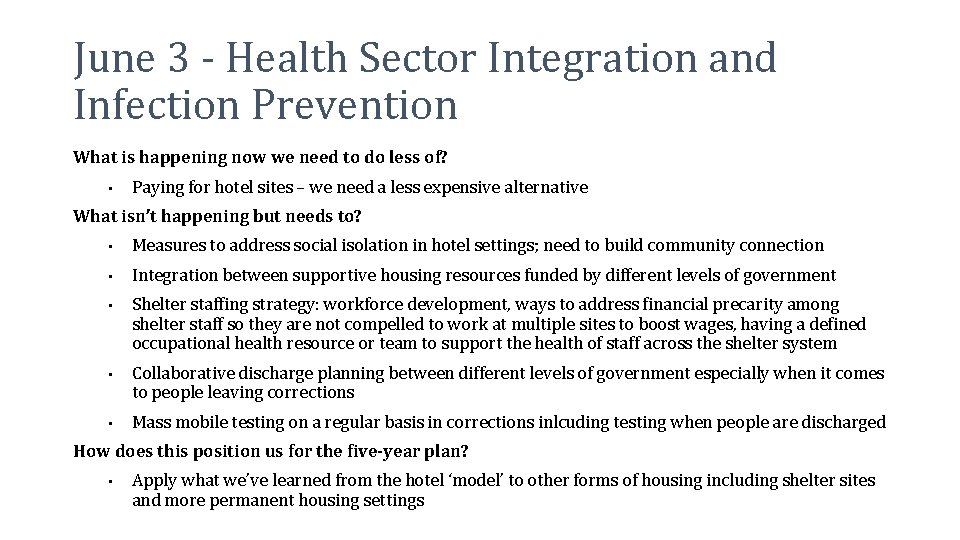
June 3 - Health Sector Integration and Infection Prevention What is happening now we need to do less of? • Paying for hotel sites – we need a less expensive alternative What isn’t happening but needs to? • Measures to address social isolation in hotel settings; need to build community connection • Integration between supportive housing resources funded by different levels of government • • • Shelter staffing strategy: workforce development, ways to address financial precarity among shelter staff so they are not compelled to work at multiple sites to boost wages, having a defined occupational health resource or team to support the health of staff across the shelter system Collaborative discharge planning between different levels of government especially when it comes to people leaving corrections Mass mobile testing on a regular basis in corrections inlcuding testing when people are discharged How does this position us for the five-year plan? • Apply what we’ve learned from the hotel ‘model’ to other forms of housing including shelter sites and more permanent housing settings
June 10 – Housing Opportunities • June 10 (today) focused on identifying housing opportunities and strategies for immediate, and longer term housing solutions
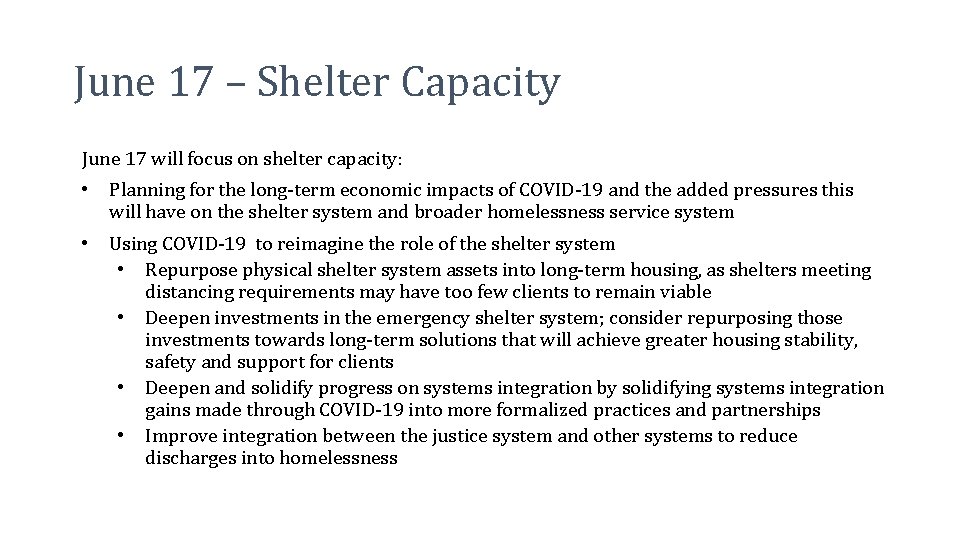
June 17 – Shelter Capacity June 17 will focus on shelter capacity: • Planning for the long-term economic impacts of COVID-19 and the added pressures this will have on the shelter system and broader homelessness service system • Using COVID-19 to reimagine the role of the shelter system • Repurpose physical shelter system assets into long-term housing, as shelters meeting distancing requirements may have too few clients to remain viable • Deepen investments in the emergency shelter system; consider repurposing those investments towards long-term solutions that will achieve greater housing stability, safety and support for clients • Deepen and solidify progress on systems integration by solidifying systems integration gains made through COVID-19 into more formalized practices and partnerships • Improve integration between the justice system and other systems to reduce discharges into homelessness
June 17 – Shelter Capacity Questions: • What do you want TSN to put forward as key priorities for SSHA to be considering as it is developing and putting forward its plan for the next 12 months? • What needs to be retained? • What can we do without? • What needs to change? • Other?
Transforming the Shelter System Project Update • • Project started in June 2019 in partnership with 2 Spirited People of the 1 st Nations, The 519, Sistering, Fred Victor, YMCA, Youth. Link, City of Toronto Project has two overarching goals: • • Address and reduce systemic barriers that limit safe access for two spirited, trans, and gender diverse people To create safer and accessible spaces for two spirited, trans, and gender diverse people
Transforming the Shelter System Project Update: Interviews • Faelix Kayn (Project Coordinator) started to reach to complete interviews • • • Trying to capture your thoughts, perspectives, and experiences in regards to working with two spirited, trans, and gender diverse clients within your agency. Interviewing any shelter, respite, or 24 -hour women’s drop-in staff Interviews will range from 30 to 60 minutes and will be done over Zoom, telephone, or Google chat Faelix will be conducting the interviews Either connect with Faelix fkayn. tsn@gmail. com or Lindsay if you are interested in being interviewed
Communication • A Way Home Canada and the Canadian Observatory on Homelessness are hosting a webinar to discuss the Youth Reconnect Program Model Guide • • • Discuss how communities can implement and adapt YR to meet their needs leveraging the support of key partners such as schools, and why an early intervention and prevention response —like YR—is relevant in light of COVID 19. Connect with Lindsay to get the registration link Thursday June 18 th, 1 pm to 2 pm • Homelessness Services Association of BC developed a resource that outlines steps to take should you need to respond to an overdose incident while minimizing the risk of COVID-19 transmission
Personal Protective Equipment • A church group wants to donate 1000 masks to the sector. Want to ensure sites that are in need receive the masks. • • Please get in touch with Lindsay if you need masks May require pick-up downtown
The Floor is Open • Any additional questions? • Anything you would like feedback/advice on?
Thank you! Thank you for your input and tireless work.
- Slides: 18