
Toronto Hydros Digital Transformation Anshul Srivastava Director ITS


- Slides: 32
Toronto Hydro’s Digital Transformation Anshul Srivastava, Director IT&S Governance & Business Solutions Mike Walker, General Manager, IT&S Session ID # ASUG 84114 May 7 – 9, 2019
About the Speakers Anshul Srivastava • Director, IT&S Governance & Business Solutions, Toronto Hydro • 16+ years experience in various roles in utilities industry Mike Walker • General Manager, IT&S • Program Director on Project • 31+ years experience at Toronto Hydro in various roles
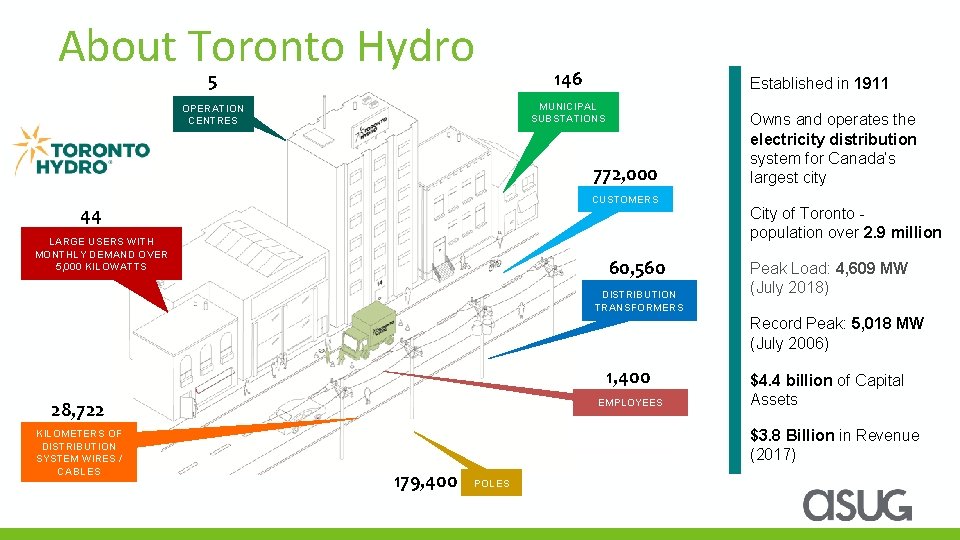
About Toronto Hydro 5 146 OPERATION CENTRES MUNICIPAL SUBSTATIONS Established in 1911 772, 000 CUSTOMERS 44 LARGE USERS WITH MONTHLY DEMAND OVER 5, 000 KILOWATTS 60, 560 DISTRIBUTION TRANSFORMERS Owns and operates the electricity distribution system for Canada’s largest city City of Toronto population over 2. 9 million Peak Load: 4, 609 MW (July 2018) Record Peak: 5, 018 MW (July 2006) 1, 400 28, 722 KILOMETERS OF DISTRIBUTION SYSTEM WIRES / CABLES EMPLOYEES GROCERIES $4. 4 billion of Capital Assets $3. 8 Billion in Revenue (2017) 179, 400 POLES
Key Outcomes/Objectives 1. Roadmap for Successful Green Field Implementation of SAP Suite (ECC 6. 0, Success. Factors & Ariba). 2. Tips and trick for Project Governance. 3. Key to Successful Adoption.
Agenda • • Project Facts Roadmap Project Phases & Governance Change Management
Project Facts • 21 month implementation • Scope: SAP ECC 6. 0, Success. Factors, Ariba, Mobility (“SAP Suite”) • Team of 200+ (including internal, SI local and offshore resources) • Project went live October 1, 2018 – On-time, on scope, within approved budget
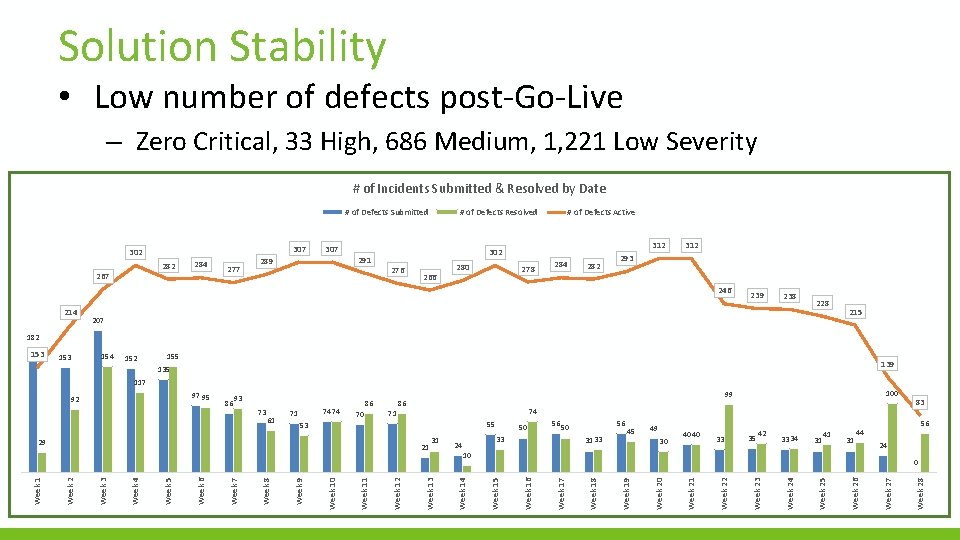
Solution Stability • Low number of defects post-Go-Live – Zero Critical, 33 High, 686 Medium, 1, 221 Low Severity # of Incidents Submitted & Resolved by Date # of Defects Submitted 307 302 282 267 284 277 307 289 291 # of Defects Resolved # of Defects Active 312 302 276 266 280 278 284 282 312 293 246 214 239 238 228 207 215 182 153 154 152 155 139 135 117 55 56 50 33 31 33 45 49 30 40 40 33 35 42 33 34 31 41 31 83 56 44 10 24 Week 28 Week 26 Week 25 Week 24 Week 23 Week 22 0 Week 21 24 56 Week 20 31 Week 13 Week 12 Week 11 Week 10 Week 9 Week 8 Week 7 Week 6 Week 5 Week 4 Week 3 Week 2 21 50 Week 27 53 29 Week 1 74 71 Week 19 70 Week 18 61 74 74 71 100 99 86 Week 17 73 86 Week 16 93 Week 15 86 Week 14 97 95 92
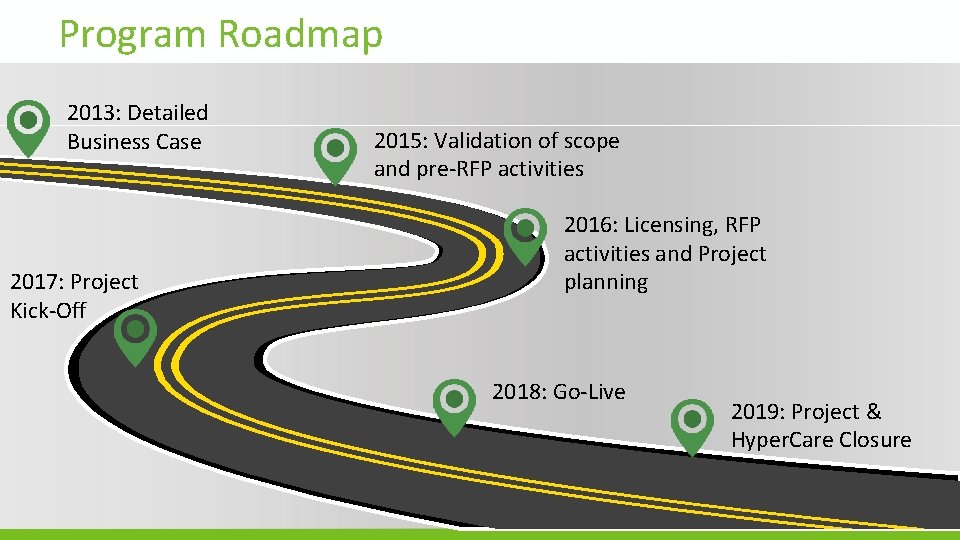
Program Roadmap 2013: Detailed Business Case 2017: Project Kick-Off 2015: Validation of scope and pre-RFP activities 2016: Licensing, RFP activities and Project planning 2018: Go-Live 2019: Project & Hyper. Care Closure
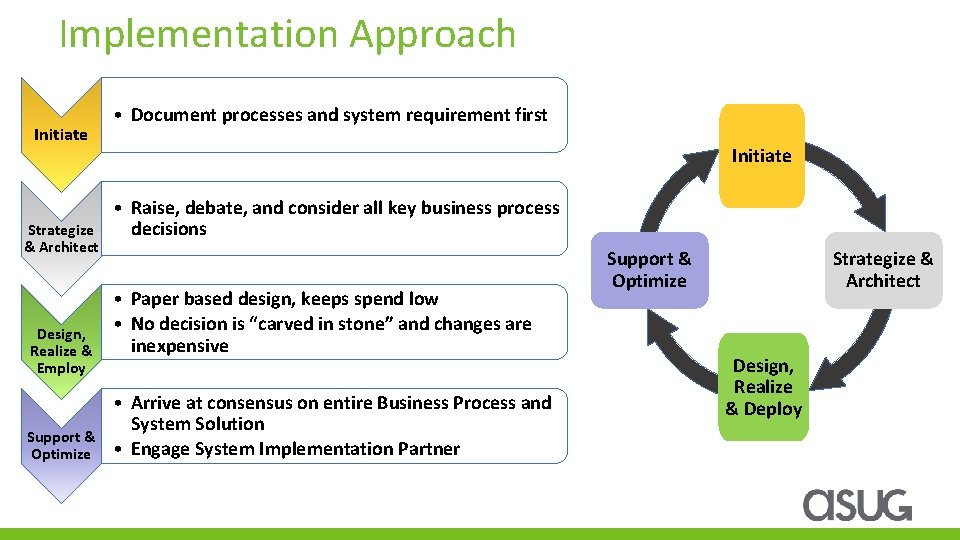
Implementation Approach Initiate Strategize & Architect Design, Realize & Employ Support & Optimize • Document processes and system requirement first Initiate • Raise, debate, and consider all key business process decisions • Paper based design, keeps spend low • No decision is “carved in stone” and changes are inexpensive • Arrive at consensus on entire Business Process and System Solution • Engage System Implementation Partner Support & Optimize Strategize & Architect Design, Realize & Deploy
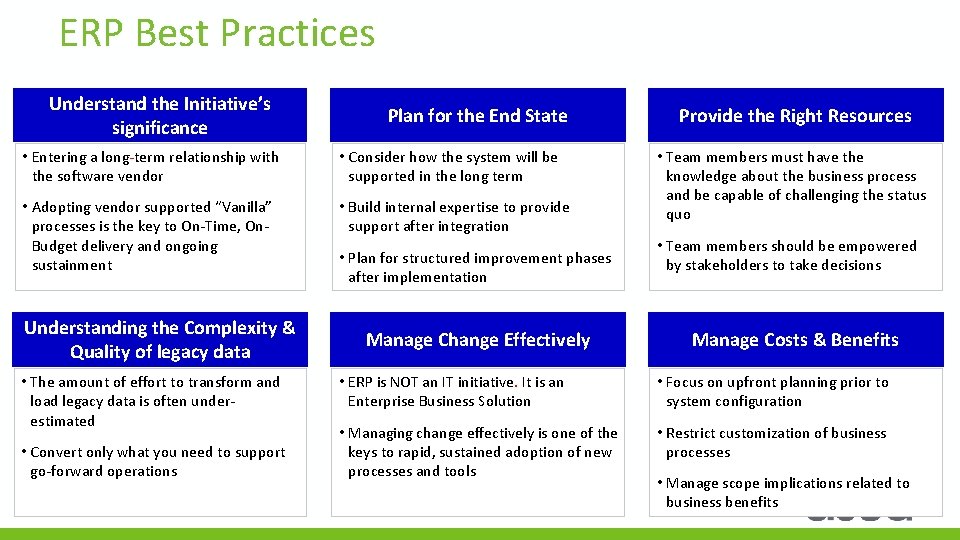
ERP Best Practices Understand the Initiative’s significance Plan for the End State • Entering a long-term relationship with the software vendor • Consider how the system will be supported in the long term • Adopting vendor supported “Vanilla” processes is the key to On-Time, On. Budget delivery and ongoing sustainment • Build internal expertise to provide support after integration Understanding the Complexity & Quality of legacy data • The amount of effort to transform and load legacy data is often underestimated • Convert only what you need to support go-forward operations • Plan for structured improvement phases after implementation Manage Change Effectively Provide the Right Resources • Team members must have the knowledge about the business process and be capable of challenging the status quo • Team members should be empowered by stakeholders to take decisions Manage Costs & Benefits • ERP is NOT an IT initiative. It is an Enterprise Business Solution • Focus on upfront planning prior to system configuration • Managing change effectively is one of the keys to rapid, sustained adoption of new processes and tools • Restrict customization of business processes • Manage scope implications related to business benefits
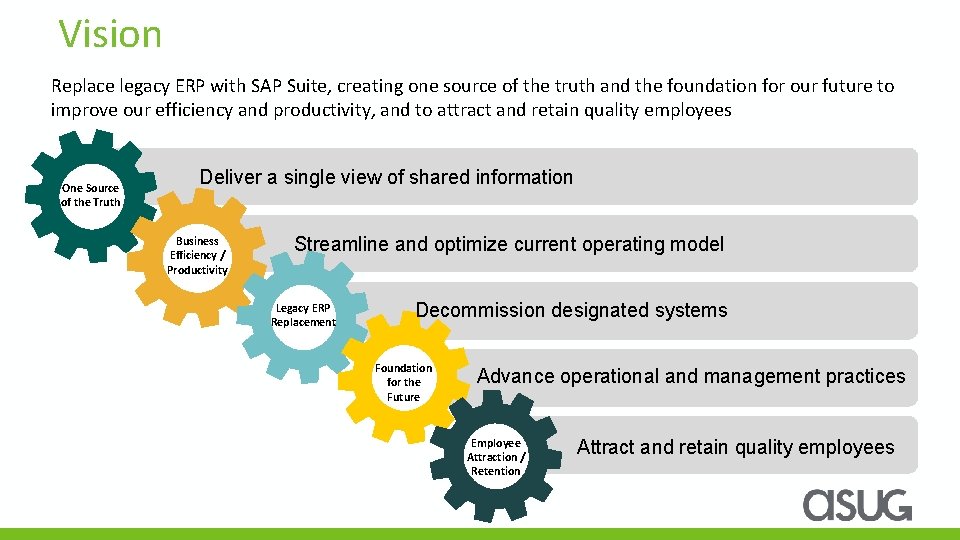
Vision Replace legacy ERP with SAP Suite, creating one source of the truth and the foundation for our future to improve our efficiency and productivity, and to attract and retain quality employees One Source of the Truth Deliver a single view of shared information Business Efficiency / Productivity Streamline and optimize current operating model Legacy ERP Replacement Decommission designated systems Foundation for the Future Advance operational and management practices Employee Attraction / Retention Attract and retain quality employees
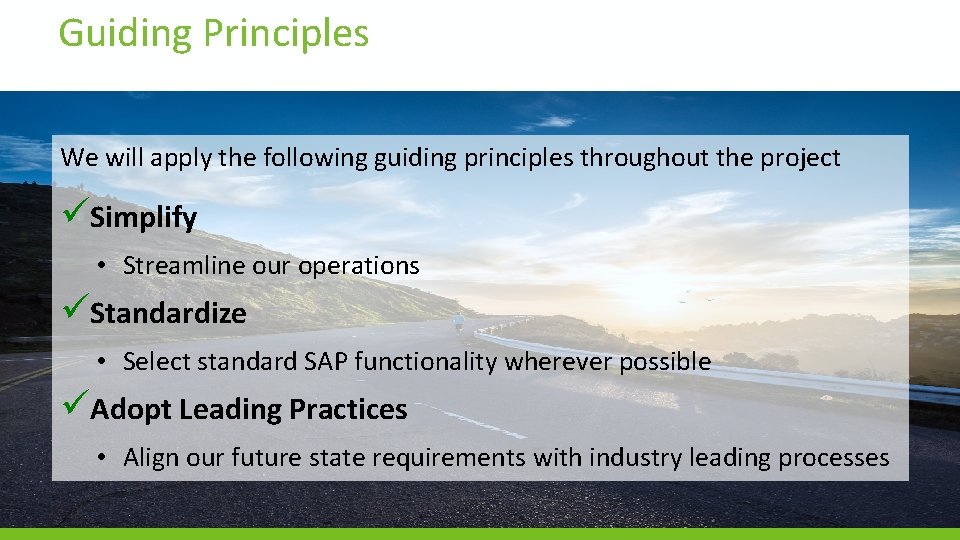
Guiding Principles We will apply the following guiding principles throughout the project üSimplify • Streamline our operations üStandardize • Select standard SAP functionality wherever possible üAdopt Leading Practices • Align our future state requirements with industry leading processes
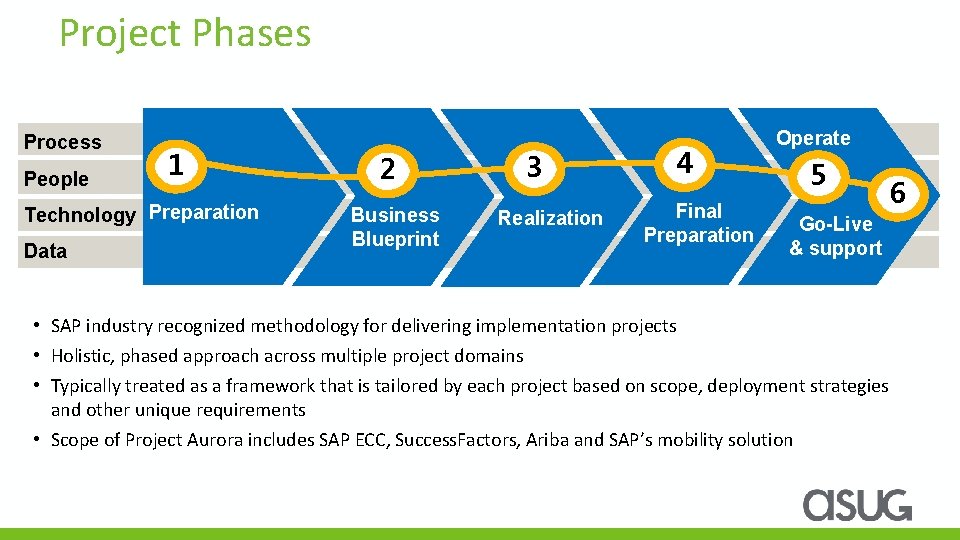
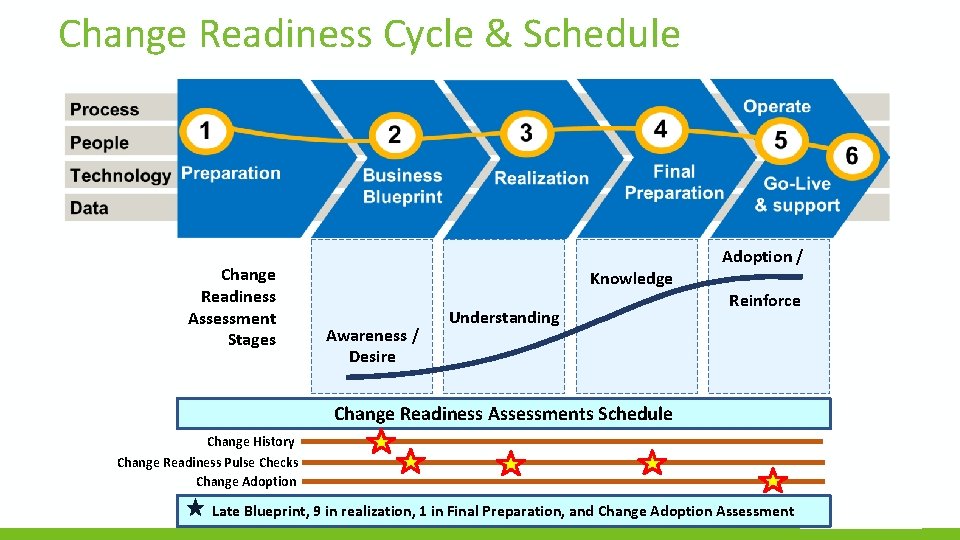
Project Phases Process People 1 Technology Preparation Data 2 Business Blueprint 3 Realization 4 Final Preparation Operate 5 6 Go-Live & support • SAP industry recognized methodology for delivering implementation projects • Holistic, phased approach across multiple project domains • Typically treated as a framework that is tailored by each project based on scope, deployment strategies and other unique requirements • Scope of Project Aurora includes SAP ECC, Success. Factors, Ariba and SAP’s mobility solution
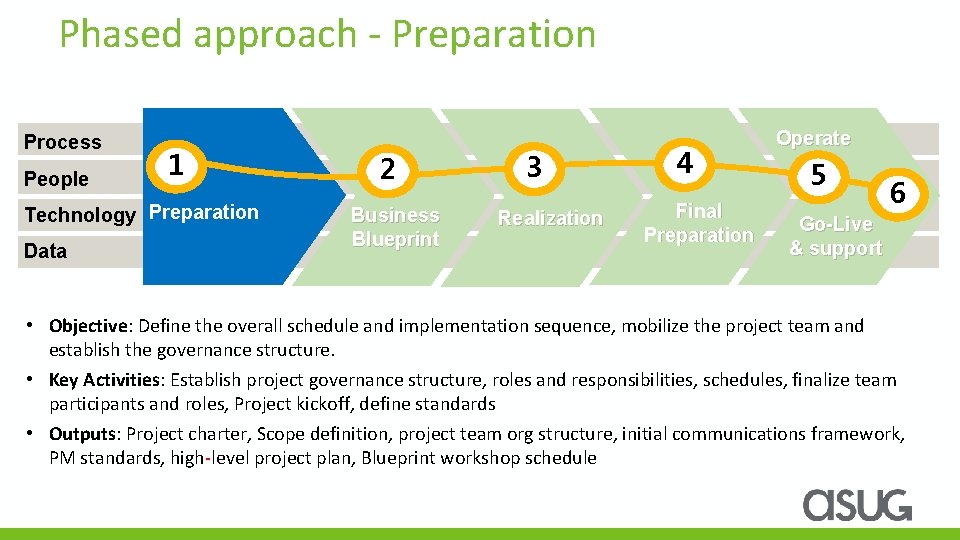
Phased approach - Preparation Process People 1 Technology Preparation Data 2 Business Blueprint 3 Realization 4 Final Preparation Operate 5 6 Go-Live & support • Objective: Define the overall schedule and implementation sequence, mobilize the project team and establish the governance structure. • Key Activities: Establish project governance structure, roles and responsibilities, schedules, finalize team participants and roles, Project kickoff, define standards • Outputs: Project charter, Scope definition, project team org structure, initial communications framework, PM standards, high-level project plan, Blueprint workshop schedule
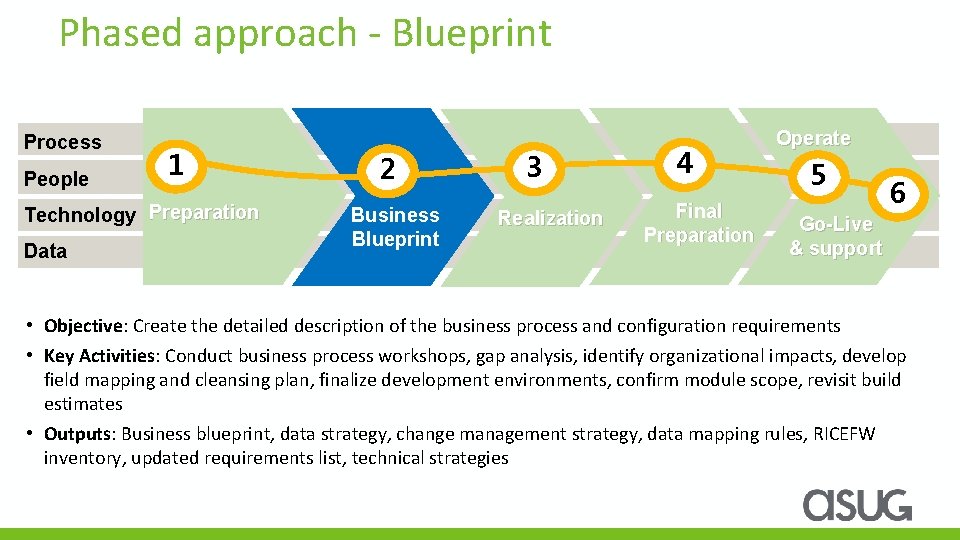
Phased approach - Blueprint Process People 1 Technology Preparation Data 2 Business Blueprint 3 Realization 4 Final Preparation Operate 5 6 Go-Live & support • Objective: Create the detailed description of the business process and configuration requirements • Key Activities: Conduct business process workshops, gap analysis, identify organizational impacts, develop field mapping and cleansing plan, finalize development environments, confirm module scope, revisit build estimates • Outputs: Business blueprint, data strategy, change management strategy, data mapping rules, RICEFW inventory, updated requirements list, technical strategies
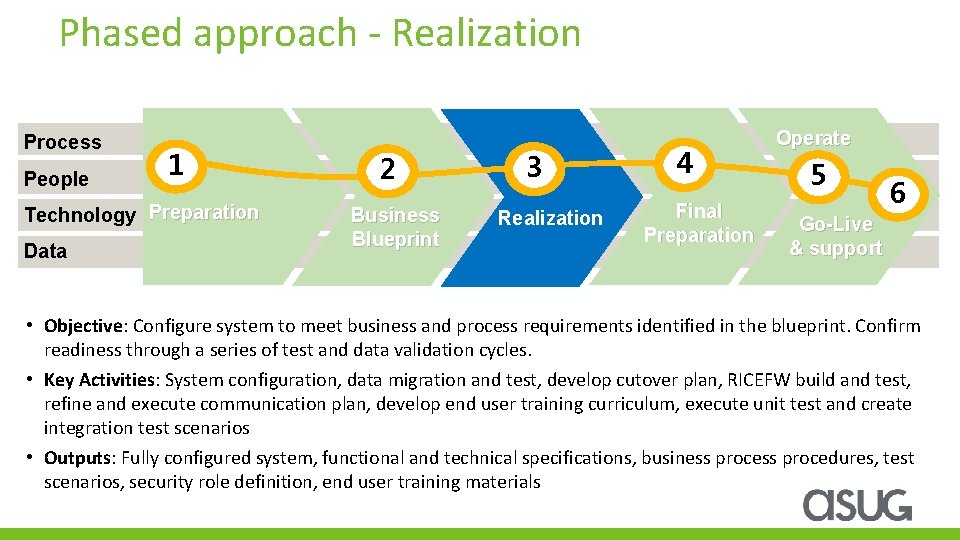
Phased approach - Realization Process People 1 Technology Preparation Data 2 Business Blueprint 3 Realization 4 Final Preparation Operate 5 6 Go-Live & support • Objective: Configure system to meet business and process requirements identified in the blueprint. Confirm readiness through a series of test and data validation cycles. • Key Activities: System configuration, data migration and test, develop cutover plan, RICEFW build and test, refine and execute communication plan, develop end user training curriculum, execute unit test and create integration test scenarios • Outputs: Fully configured system, functional and technical specifications, business procedures, test scenarios, security role definition, end user training materials
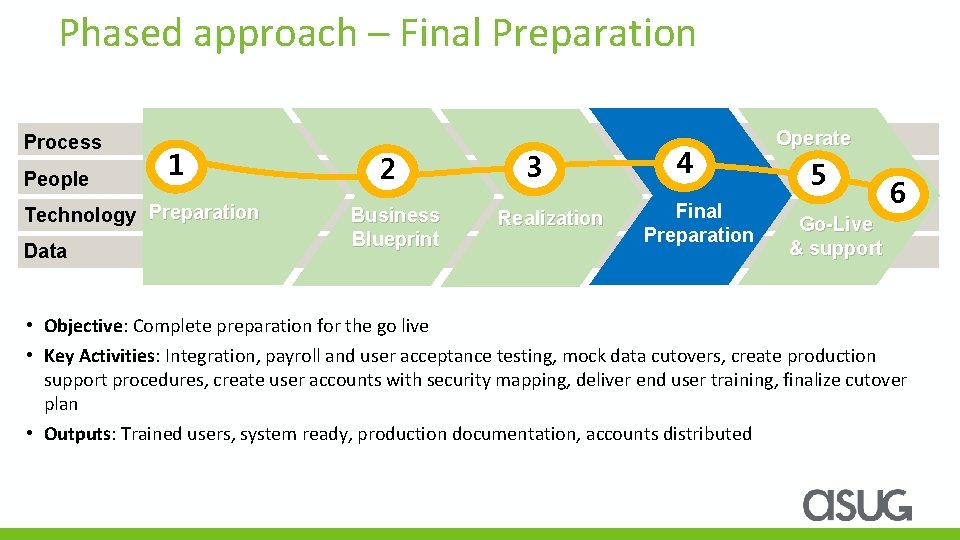
Phased approach – Final Preparation Process People 1 Technology Preparation Data 2 Business Blueprint 3 Realization 4 Final Preparation Operate 5 6 Go-Live & support • Objective: Complete preparation for the go live • Key Activities: Integration, payroll and user acceptance testing, mock data cutovers, create production support procedures, create user accounts with security mapping, deliver end user training, finalize cutover plan • Outputs: Trained users, system ready, production documentation, accounts distributed
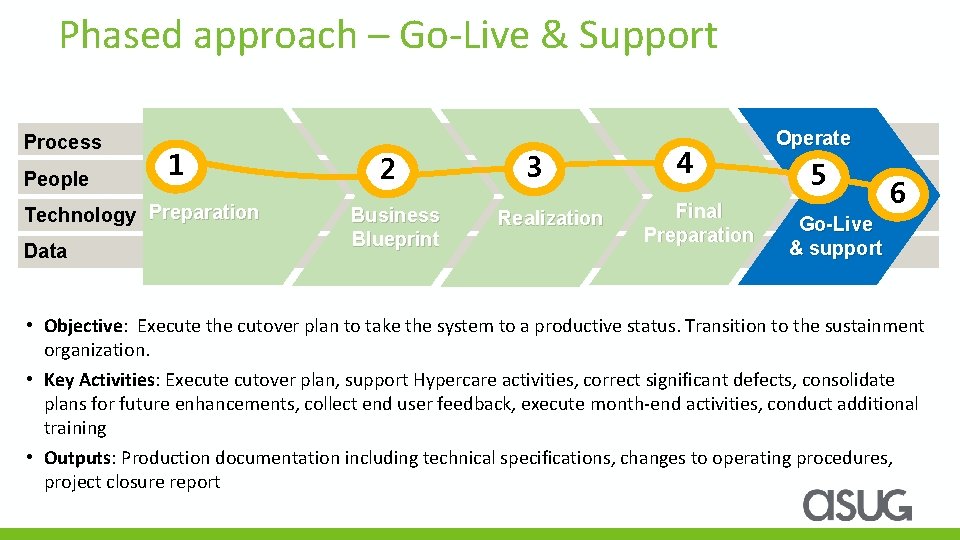
Phased approach – Go-Live & Support Process People 1 Technology Preparation Data 2 Business Blueprint 3 Realization 4 Final Preparation Operate 5 6 Go-Live & support • Objective: Execute the cutover plan to take the system to a productive status. Transition to the sustainment organization. • Key Activities: Execute cutover plan, support Hypercare activities, correct significant defects, consolidate plans for future enhancements, collect end user feedback, execute month-end activities, conduct additional training • Outputs: Production documentation including technical specifications, changes to operating procedures, project closure report
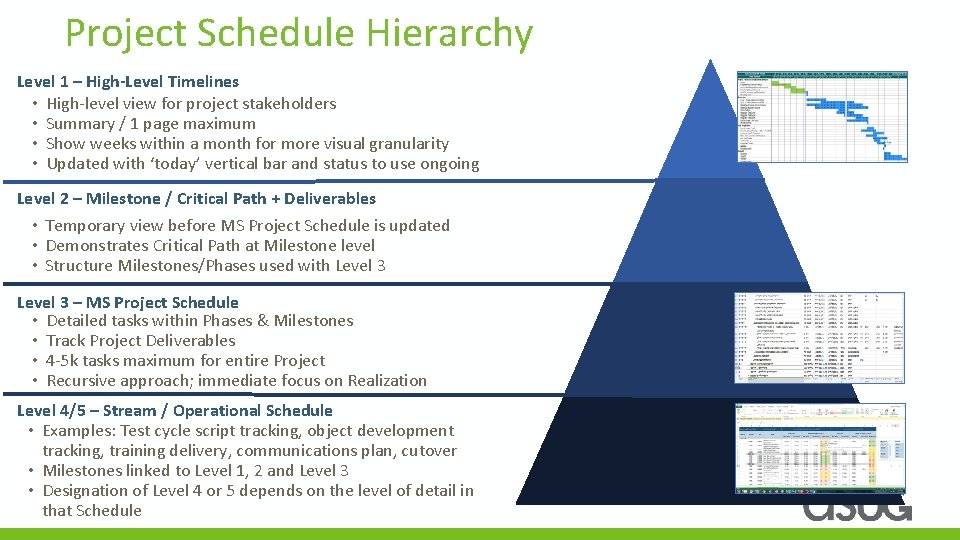
Project Schedule Hierarchy Level 1 – High-Level Timelines • High-level view for project stakeholders • Summary / 1 page maximum • Show weeks within a month for more visual granularity • Updated with ‘today’ vertical bar and status to use ongoing Level 2 – Milestone / Critical Path + Deliverables • Temporary view before MS Project Schedule is updated • Demonstrates Critical Path at Milestone level • Structure Milestones/Phases used with Level 3 – MS Project Schedule • Detailed tasks within Phases & Milestones • Track Project Deliverables • 4 -5 k tasks maximum for entire Project • Recursive approach; immediate focus on Realization Level 4/5 – Stream / Operational Schedule • Examples: Test cycle script tracking, object development tracking, training delivery, communications plan, cutover • Milestones linked to Level 1, 2 and Level 3 • Designation of Level 4 or 5 depends on the level of detail in that Schedule
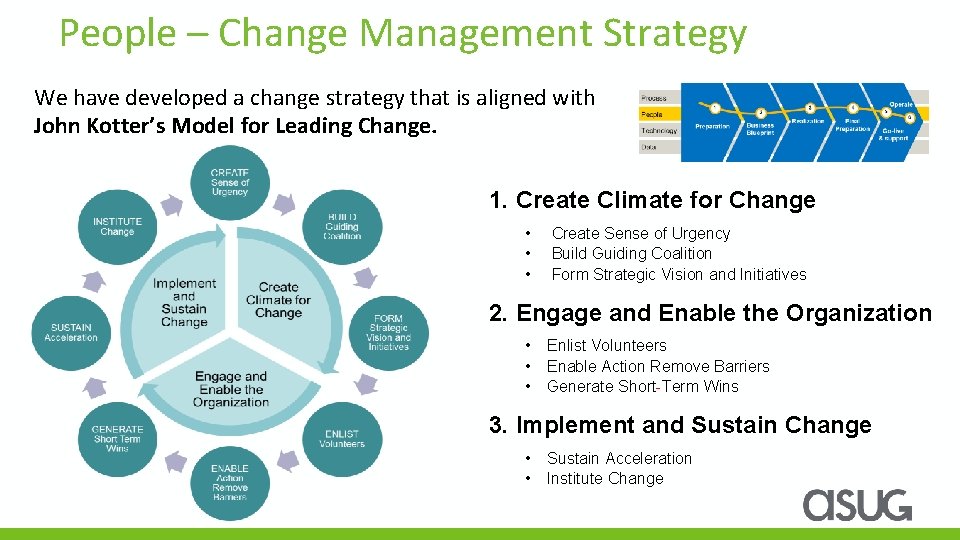
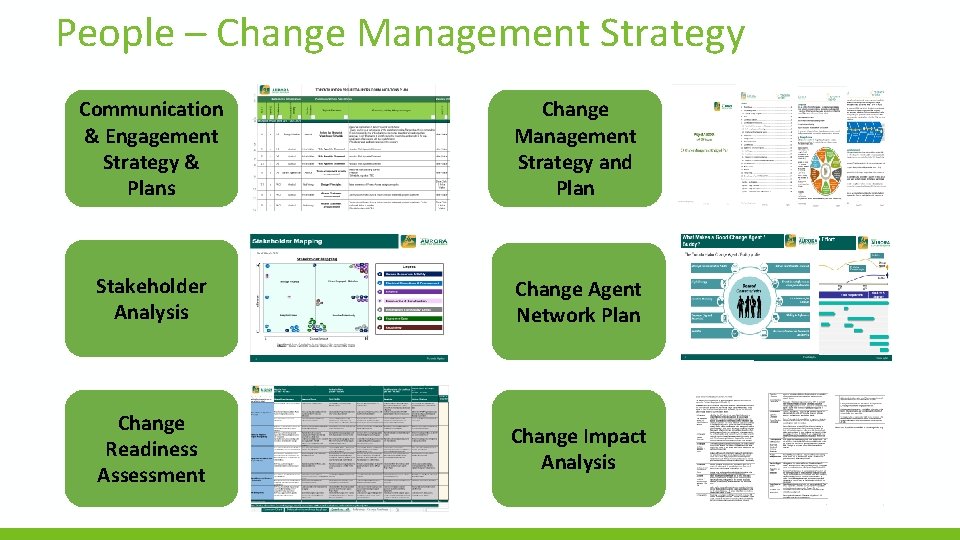
People – Change Management Strategy We have developed a change strategy that is aligned with John Kotter’s Model for Leading Change. 1. Create Climate for Change • • • Create Sense of Urgency Build Guiding Coalition Form Strategic Vision and Initiatives 2. Engage and Enable the Organization • • • Enlist Volunteers Enable Action Remove Barriers Generate Short-Term Wins 3. Implement and Sustain Change • • Sustain Acceleration Institute Change
People – Change Management Strategy Communication & Engagement Strategy & Plans Change Management Strategy and Plan Stakeholder Analysis Change Agent Network Plan Change Readiness Assessment Change Impact Analysis
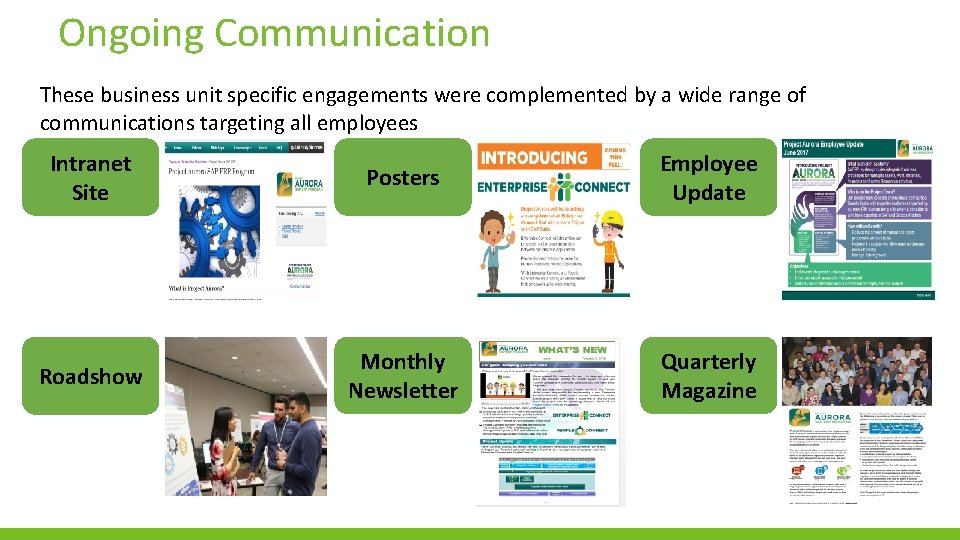
Ongoing Communication These business unit specific engagements were complemented by a wide range of communications targeting all employees Intranet Site Posters Employee Update Roadshow Monthly Newsletter Quarterly Magazine
Change Readiness Cycle & Schedule Change Readiness Assessment Stages Knowledge Awareness / Desire Understanding Adoption / Reinforce Change Readiness Assessments Schedule Change History Change Readiness Pulse Checks Change Adoption Late Blueprint, 9 in realization, 1 in Final Preparation, and Change Adoption Assessment
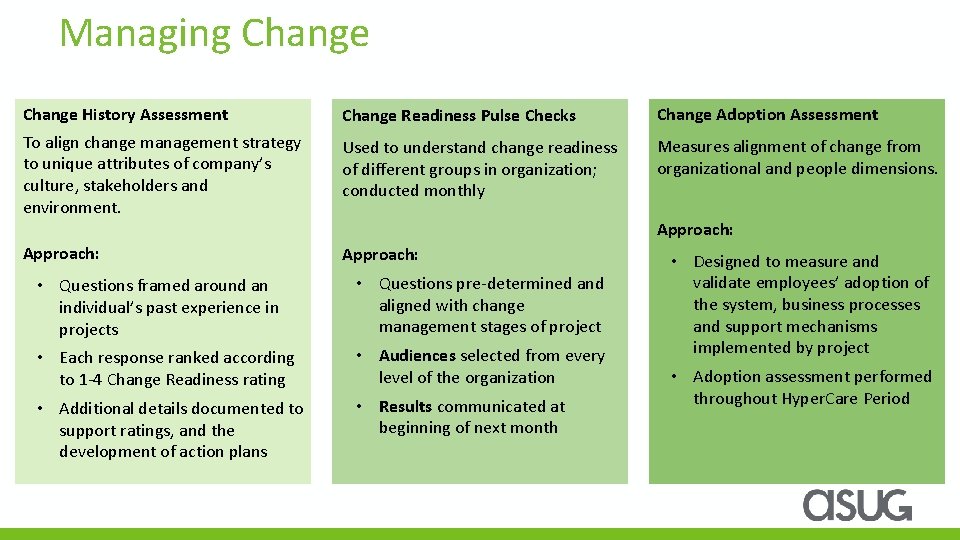
Managing Change History Assessment Change Readiness Pulse Checks Change Adoption Assessment To align change management strategy to unique attributes of company’s culture, stakeholders and environment. Used to understand change readiness of different groups in organization; conducted monthly Measures alignment of change from organizational and people dimensions. Approach: • Questions framed around an individual’s past experience in projects • Questions pre-determined and aligned with change management stages of project • Each response ranked according to 1 -4 Change Readiness rating • Audiences selected from every level of the organization • Additional details documented to support ratings, and the development of action plans • Results communicated at beginning of next month • Designed to measure and validate employees’ adoption of the system, business processes and support mechanisms implemented by project • Adoption assessment performed throughout Hyper. Care Period
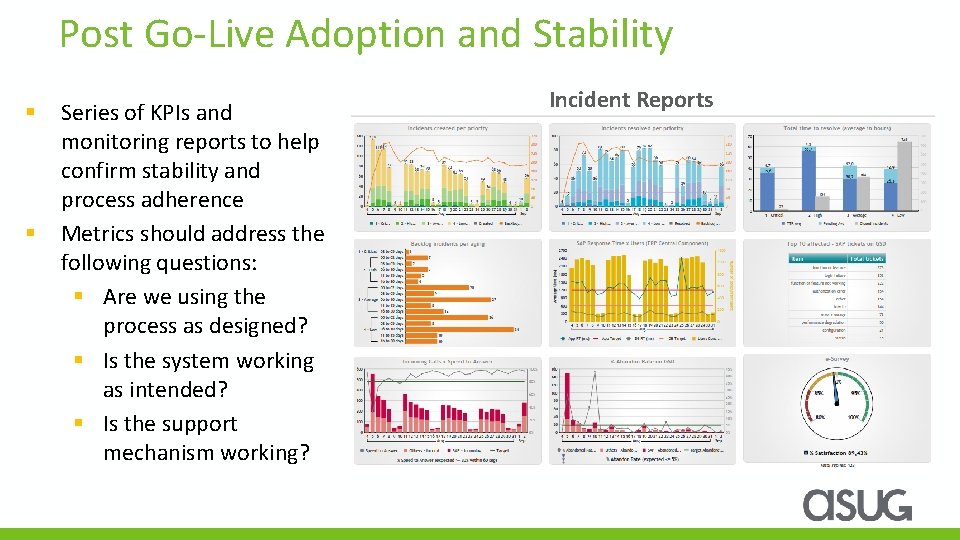
Post Go-Live Adoption and Stability § § Series of KPIs and monitoring reports to help confirm stability and process adherence Metrics should address the following questions: § Are we using the process as designed? § Is the system working as intended? § Is the support mechanism working? Incident Reports
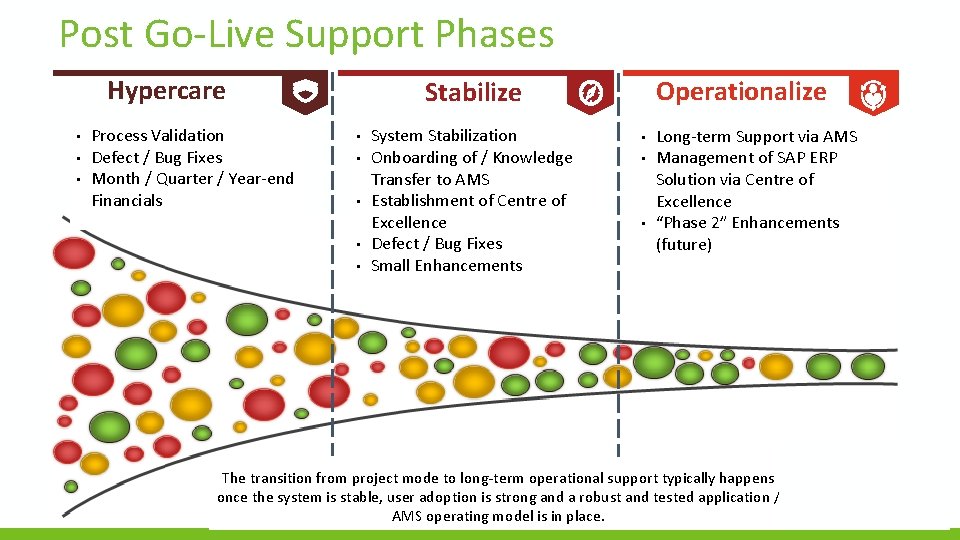
Post Go-Live Support Phases Hypercare • • • Process Validation Defect / Bug Fixes Month / Quarter / Year-end Financials Operationalize Stabilize • • • System Stabilization Onboarding of / Knowledge Transfer to AMS Establishment of Centre of Excellence Defect / Bug Fixes Small Enhancements • • • Long-term Support via AMS Management of SAP ERP Solution via Centre of Excellence “Phase 2” Enhancements (future) The transition from project mode to long-term operational support typically happens once the system is stable, user adoption is strong and a robust and tested application / AMS operating model is in place.
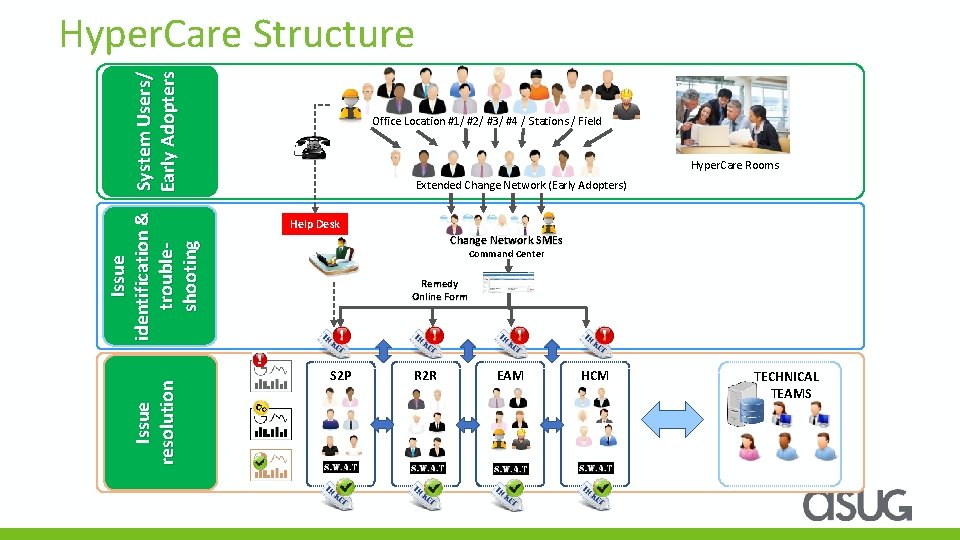
Issue resolution Issue identification & System Users/ trouble. Early Adopters shooting Hyper. Care Structure Office Location #1/ #2/ #3/ #4 / Stations / Field Hyper. Care Rooms Extended Change Network (Early Adopters) Help Desk Change Network SMEs Command Center Remedy Online Form S 2 P R 2 R EAM HCM TECHNICAL TEAMS
Disclaimer The information in these materials is based on information currently available to Toronto Hydro Corporation and its affiliates (together hereinafter referred to as “Toronto Hydro”), and is provided for information purposes only. Toronto Hydro does not warrant the accuracy, reliability, completeness or timeliness of the information and undertakes no obligation to revise or update these materials. Toronto Hydro (including its directors, officers, employees, agents and subcontractors) hereby waives any and all liability for damages of whatever kind and nature which may occur or be suffered as a result of the use of these materials or reliance on the information therein. These materials may also contain forward-looking information within the meaning of applicable securities laws in Canada ("Forward-Looking Information"). The purpose of the Forward-Looking Information is to provide Toronto Hydro’s expectations about future results of operations, performance, business prospects and opportunities and may not be appropriate for other purposes. All Forward-Looking Information is given pursuant to the "safe harbour" provisions of applicable Canadian securities legislation. The words "anticipates", "believes", "budgets", "could", "estimates", "expects", "forecasts", "intends", "may", "might", "plans", "projects", "schedule", "should", "will", "would" and similar expressions are often intended to identify Forward-Looking Information, although not all Forward-Looking Information contains these identifying words. The Forward-Looking Information reflects the current beliefs of, and is based on information currently available to, Toronto Hydro’s management. The Forward-Looking Information in these materials includes, but is not limited to, statements regarding Toronto Hydro’s future results of operations, performance, business prospects and opportunities. The statements that make up the Forward-Looking Information are based on assumptions that include, but are not limited to, the future course of the economy and financial markets, the receipt of applicable regulatory approvals and requested rate orders, the receipt of favourable judgments, the level of interest rates, Toronto Hydro’s ability to borrow, and the fair market value of Toronto Hydro’s investments. The Forward-Looking Information is subject to risks, uncertainties and other factors that could cause actual results to differ materially from historical results or results anticipated by the Forward-Looking Information. The factors which could cause results or events to differ from current expectations include, but are not limited to, the timing and amount of future cash flows generated by Toronto Hydro's investments, market liquidity and the quality of the underlying assets and financial instruments, the timing and extent of changes in prevailing interest rates, inflation levels, legislative, judicial and regulatory developments that could affect revenues, and the results of borrowing efforts. Toronto Hydro cautions that this list of factors is not exclusive. All Forward-Looking Information in these materials is qualified in its entirety by the above cautionary statements and, except as required by law, Toronto Hydro undertakes no obligation to revise or update any Forward-Looking Information as a result of new information, future events or otherwise after the date hereof.
Take the Session Survey. We want to hear from you! Be sure to complete the session evaluation on the SAPPHIRE NOW and ASUG Annual Conference mobile app.
Presentation Materials Access the slides from 2019 ASUG Annual Conference here: http: //info. asug. com/2019 -ac-slides
Q&A For questions after this session, contact us at ASrivastava@torontohydro. com and MWalker@torontohydro. com
Let’s Be Social. Stay connected. Share your SAP experiences anytime, anywhere. Join the ASUG conversation on social media: @ASUG 365 #ASUG