
Toronto Community Housing Integrated Housing Management Solution Request

- Slides: 32
Toronto Community Housing Integrated Housing Management Solution Request for Vendor Qualification # 17112 April 5 th, 2017
Agenda • TCHC Overview • ITS Overview • Current State • Proposed Future State • RFVQ Procurement Process • Questions 2
Who we are We are Canada’s largest social housing provider and the second largest in North America • We own and manage two-thirds of Toronto’s social housing units (there are over 230 other social housing providers in Toronto) • We have 2, 100 buildings that are home to nearly 60, 000 households and about 110, 000 tenants • Our homes represent a $9 -billion public asset • Through our revitalization projects, we are one of the largest residential developers in Canada
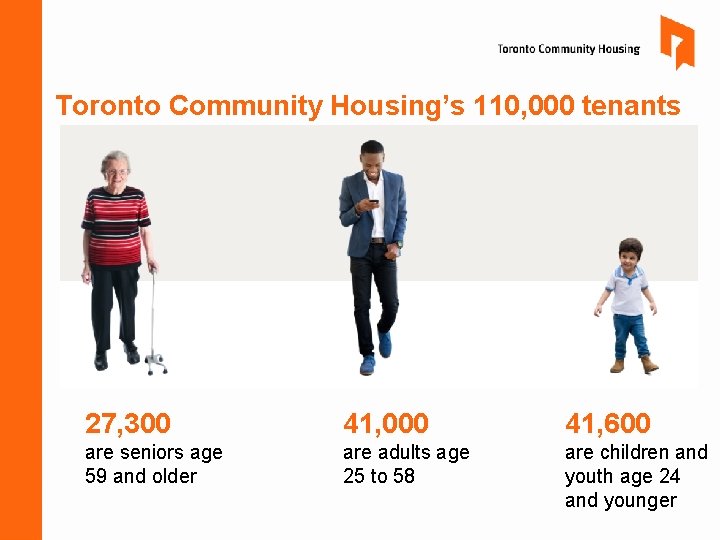
Toronto Community Housing’s 110, 000 tenants 27, 300 41, 000 41, 600 are seniors age 59 and older are adults age 25 to 58 are children and youth age 24 and younger
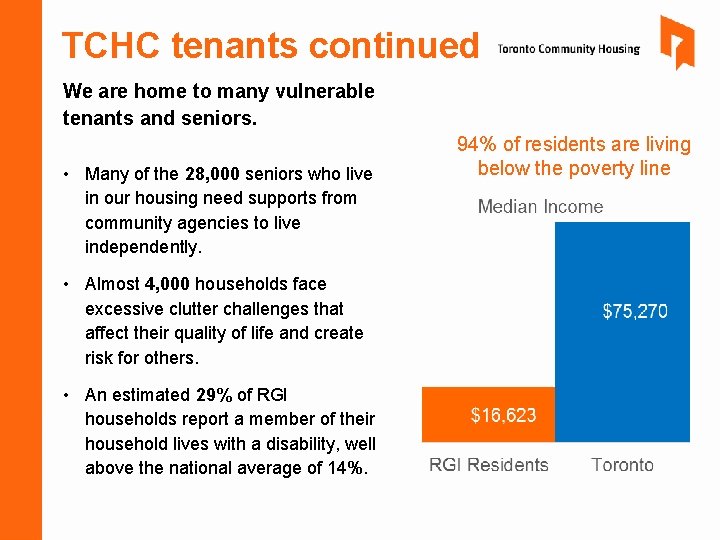
TCHC tenants continued We are home to many vulnerable tenants and seniors. • Many of the 28, 000 seniors who live in our housing need supports from community agencies to live independently. • Almost 4, 000 households face excessive clutter challenges that affect their quality of life and create risk for others. • An estimated 29% of RGI households report a member of their household lives with a disability, well above the national average of 14%. 94% of residents are living below the poverty line
What services we provide Our core business is to provide safe, clean, wellmaintained, affordable homes. To support that mandate, we: • Maintain, repair, build and renovate buildings • Collect rent and manage tenancies We also go beyond the duties of a regular landlord to: • Make sure that tenants’ have a say in decisions that affect them • Connect vulnerable tenants to supports • Deliver community safety programs • Provide opportunities for children and youth
What we do Over 1, 600 people work at Toronto Community Housing. An estimated 15 per cent of our employees are either current or former residents of social housing. Our employees work in: • Property management Day-to-day building maintenance and cleaning • Tenancy administration Rent collection, vacancy management, rent subsidy administration • Capital repairs and demand maintenance Project planning, design and delivery • Revitalization and residential development Overseeing revitalization and new construction projects • Resident engagement Local engagement, resident-led initiatives, and programs for residents
What we do Our employees work in: • Resident support Supporting residents to maintain tenancies and independent living • Community safety Delivering safety programs and patrolling communities • Commercial property management Management, leasing and maintenance of commercial real estate • Corporate services For example, human resources, finance, and information technology services
Facilities Management Focuses on buildings, systems and components, capital planning and capital construction delivery • Long-term capital maintenance and repairs of buildings • Preventative maintenance programs • Current capital repair program (a 10 -year plan approved by City Council) • Smart Buildings and Energy Management • “Re. Set” program • Client Care Centre and maintenance dispatch
Resident and Community Services Focuses on communities and is responsible for: • Resident access and support services, to connect vulnerable residents to services and supports in the community where needed • Resident engagement and community development services • Programs for specific resident populations, such as youth and seniors • Tenancy issues arising out of vulnerability
Development Leads on all replacement housing design, construction and turnover. Responsible for: • • Value creation in our property assets All community revitalization work across the portfolio Private sector partnerships All aspects of achieving approved anchor business plan financial returns • Master planning, design, official plan amendments, rezoning • Commercial property management
Commissioner of Housing Equity (OCHE) • An independent accountability office that reports directly to the Board of Directors at TCHC • Works with senior and vulnerable residents who are in arrears of rent or have lost their RGI subsidy • Mandate is eviction prevention and housing stabilization Work of the OCHE • Engages with residents in the field and addresses underlying issues to remove barriers from paying the rent • Solves complex files that TCHC staff have been unable to resolve • Audits TCH compliance with defined arrears collections processes
Asset Management Focuses on delivering services that impact tenants’ day -to-day experience living within social housing • Day-to-day building operation – maintenance and cleaning services • Tenancy administration – Rent collection/arrears management – Vacancy management (including transfers) – Rent subsidy calculation – Administrative customer service – Centrally delivered programs such as pest management, unit turnover and accessibility modifications
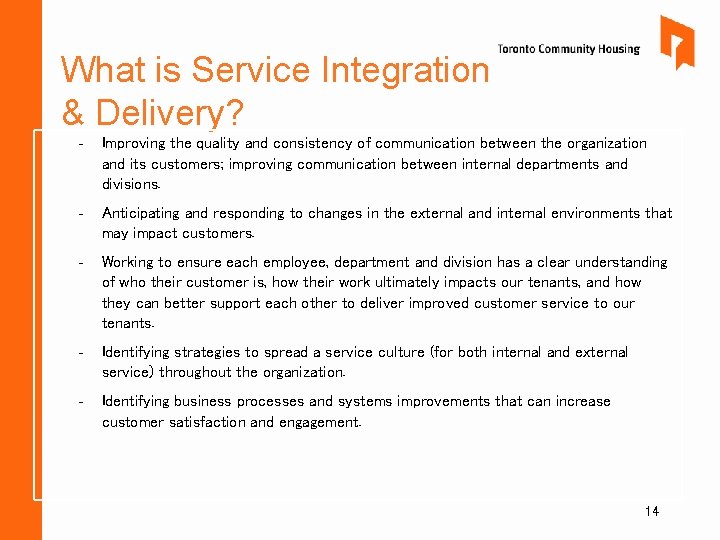
What is Service Integration & Delivery? - Improving the quality and consistency of communication between the organization and its customers; improving communication between internal departments and divisions. - Anticipating and responding to changes in the external and internal environments that may impact customers. - Working to ensure each employee, department and division has a clear understanding of who their customer is, how their work ultimately impacts our tenants, and how they can better support each other to deliver improved customer service to our tenants. - Identifying strategies to spread a service culture (for both internal and external service) throughout the organization. - Identifying business processes and systems improvements that can increase customer satisfaction and engagement. 14
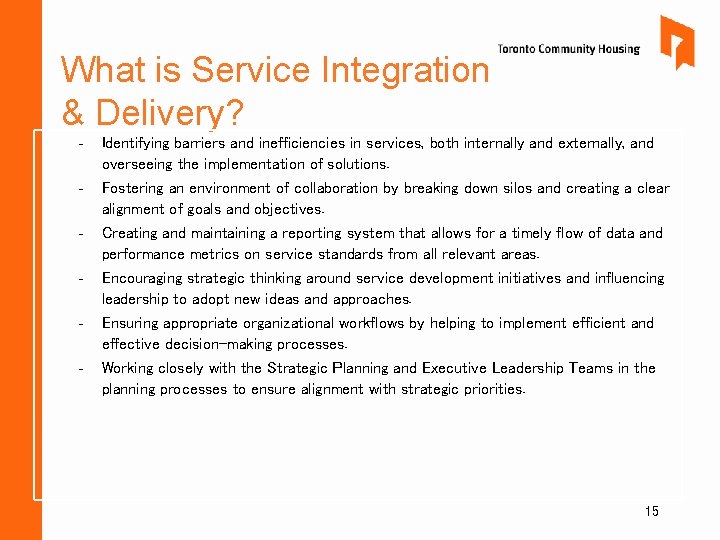
What is Service Integration & Delivery? - Identifying barriers and inefficiencies in services, both internally and externally, and overseeing the implementation of solutions. - Fostering an environment of collaboration by breaking down silos and creating a clear alignment of goals and objectives. - Creating and maintaining a reporting system that allows for a timely flow of data and performance metrics on service standards from all relevant areas. - Encouraging strategic thinking around service development initiatives and influencing leadership to adopt new ideas and approaches. - Ensuring appropriate organizational workflows by helping to implement efficient and effective decision-making processes. - Working closely with the Strategic Planning and Executive Leadership Teams in the planning processes to ensure alignment with strategic priorities. 15
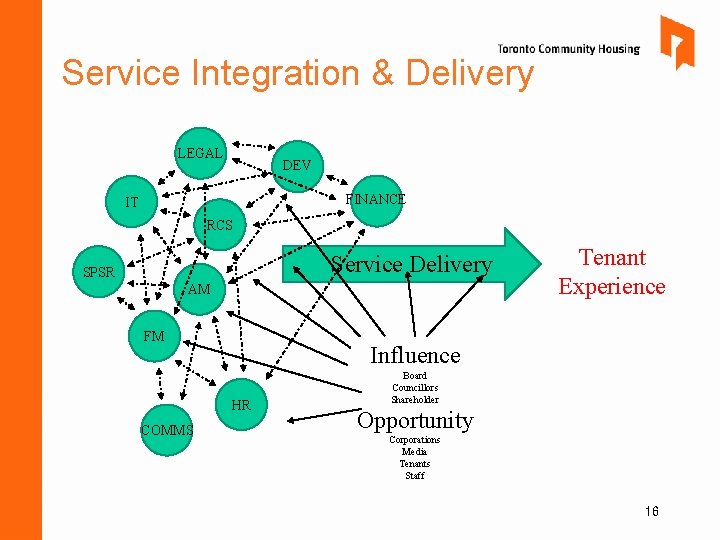
Service Integration & Delivery LEGAL DEV FINANCE IT RCS Service Delivery SPSR AM FM Influence HR COMMS Tenant Experience Board Councillors Shareholder Opportunity Corporations Media Tenants Staff 16
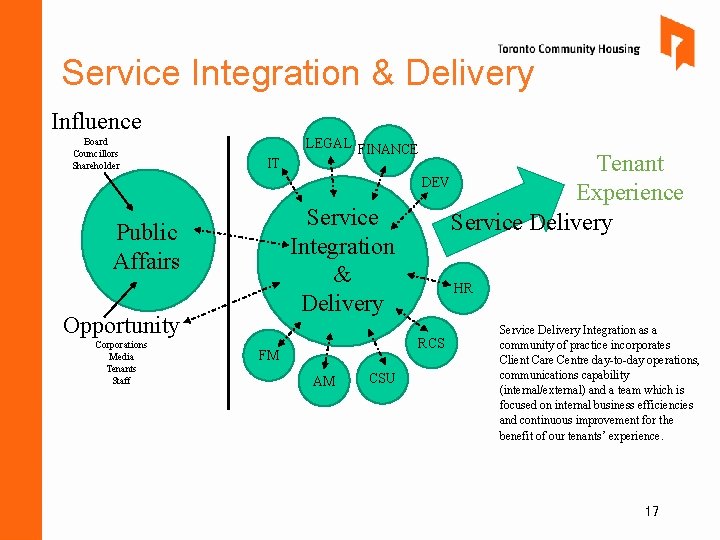
Service Integration & Delivery Influence Board Councillors Shareholder IT Service Integration & Delivery Public Affairs Opportunity Corporations Media Tenants Staff LEGAL FINANCE Tenant DEV Experience Service Delivery HR RCS FM AM CSU Service Delivery Integration as a community of practice incorporates Client Care Centre day-to-day operations, communications capability (internal/external) and a team which is focused on internal business efficiencies and continuous improvement for the benefit of our tenants’ experience. 17
PART 1: ITS OVERVIEW
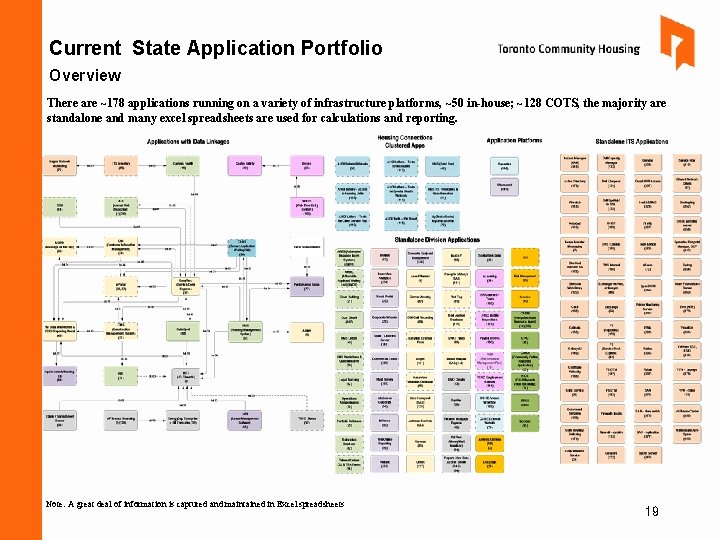
Current State Application Portfolio Overview There are ~178 applications running on a variety of infrastructure platforms, ~50 in-house; ~128 COTS, the majority are standalone and many excel spreadsheets are used for calculations and reporting. Note: A great deal of information is captured and maintained in Excel spreadsheets 19
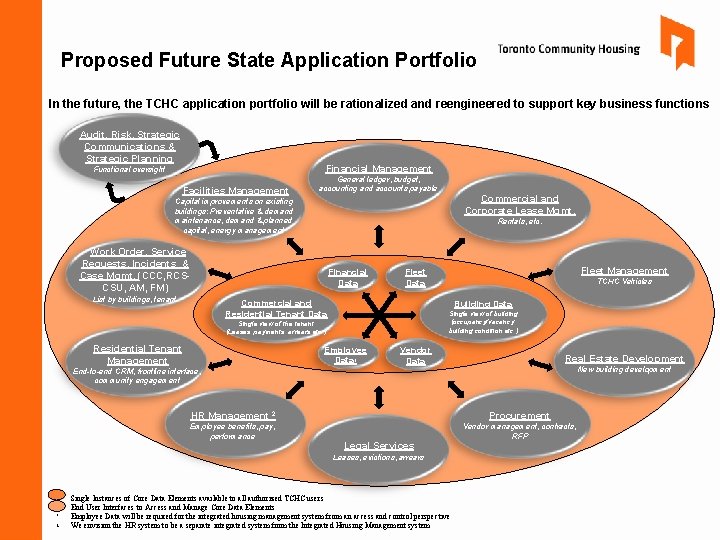
Proposed Future State Application Portfolio In the future, the TCHC application portfolio will be rationalized and reengineered to support key business functions Audit, Risk, Strategic Communications & Strategic Planning Financial Management Functional oversight Facilities Management General ledger, budget, accounting and accounts payable Commercial and Corporate Lease Mgmt. Capital improvements on existing buildings: Preventative & demand maintenance, demand & planned capital, energy management Rentals, etc. Work Order, Service Requests, Incidents & Case Mgmt. (CCC, RCSCSU, AM, FM) List by buildings, tenant Financial Data Commercial and Residential Tenant Data TCHC Vehicles Building Data Single view of building (occupancy/vacancy, building condition etc. ) Single view of the tenant (Leases, payments, arrears etc. ) Residential Tenant Management Fleet Data Employee Data 1 Vendor Data Real Estate Development New building development End-to-end CRM, frontline interface, community engagement HR Management 2 Procurement Employee benefits, pay, performance Vendor management, contracts, RFP Legal Services Leases, evictions, arrears 1 2 Single Instances of Core Data Elements available to all authorized TCHC users End User Interfaces to Access and Manage Core Data Elements Employee Data will be required for the integrated housing management system from an access and control perspective We envision the HR system to be a separate integrated system from the Integrated Housing Management system
21
PART 2: RFVQ (PROCUREMENT) PROCESS
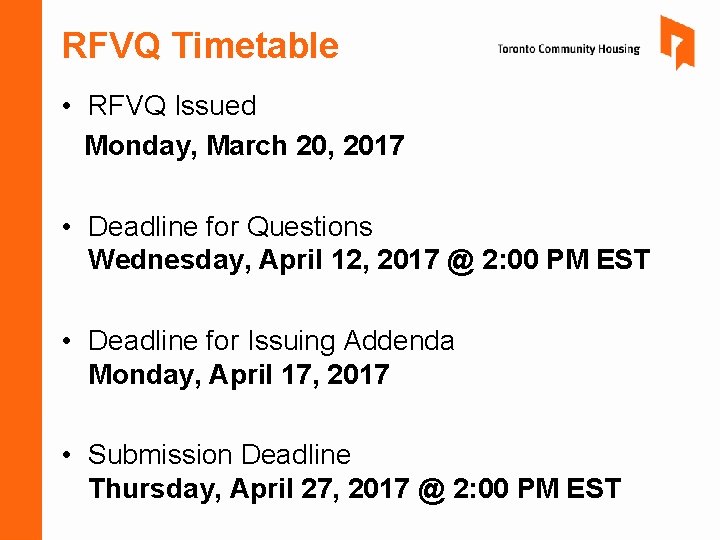
RFVQ Timetable • RFVQ Issued Monday, March 20, 2017 • Deadline for Questions Wednesday, April 12, 2017 @ 2: 00 PM EST • Deadline for Issuing Addenda Monday, April 17, 2017 • Submission Deadline Thursday, April 27, 2017 @ 2: 00 PM EST
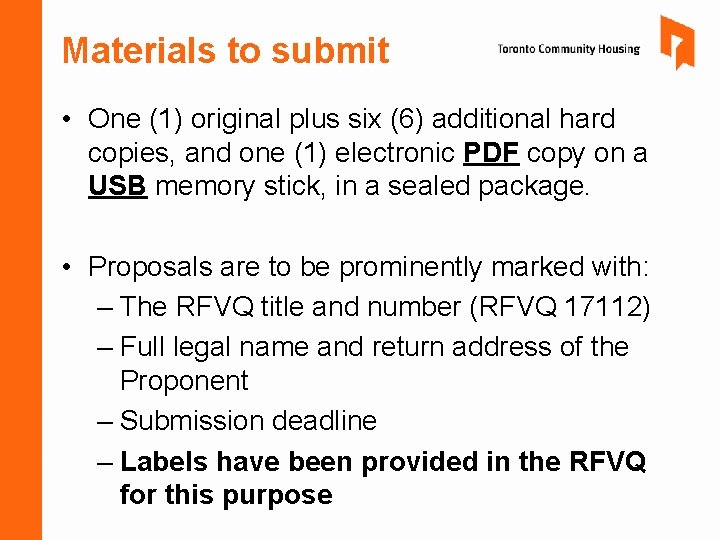
Materials to submit • One (1) original plus six (6) additional hard copies, and one (1) electronic PDF copy on a USB memory stick, in a sealed package. • Proposals are to be prominently marked with: – The RFVQ title and number (RFVQ 17112) – Full legal name and return address of the Proponent – Submission deadline – Labels have been provided in the RFVQ for this purpose
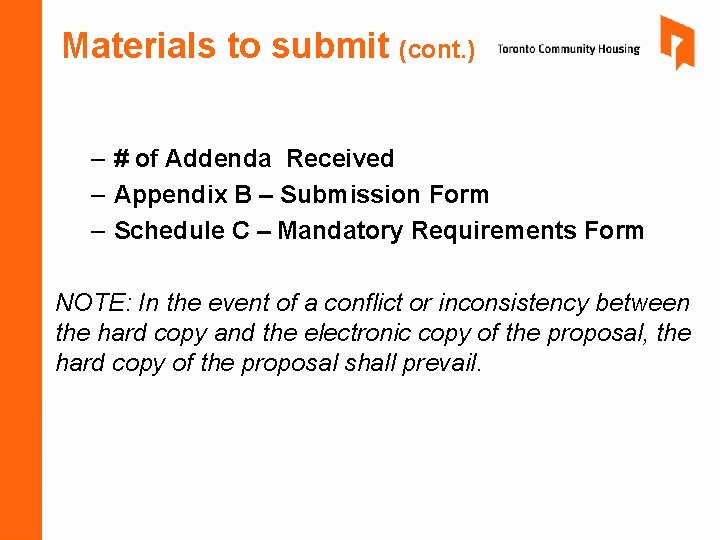
Materials to submit (cont. ) – # of Addenda Received – Appendix B – Submission Form – Schedule C – Mandatory Requirements Form NOTE: In the event of a conflict or inconsistency between the hard copy and the electronic copy of the proposal, the hard copy of the proposal shall prevail.
Submission Proposals should be submitted to: Strategic Procurement Toronto Community Housing 35 Carl Hall Rd, #1 Toronto, Ontario M 3 K 2 B 6 Attn. : Nitin Mahendro Submissions should be made NO LATER than 2 p. m. EST on Thursday, April 27, 2017 without exception. All questions should be submitted via email only to; • Nitin. Mahendro@torontohousing. ca • TCHProcurement@torontohousing. ca
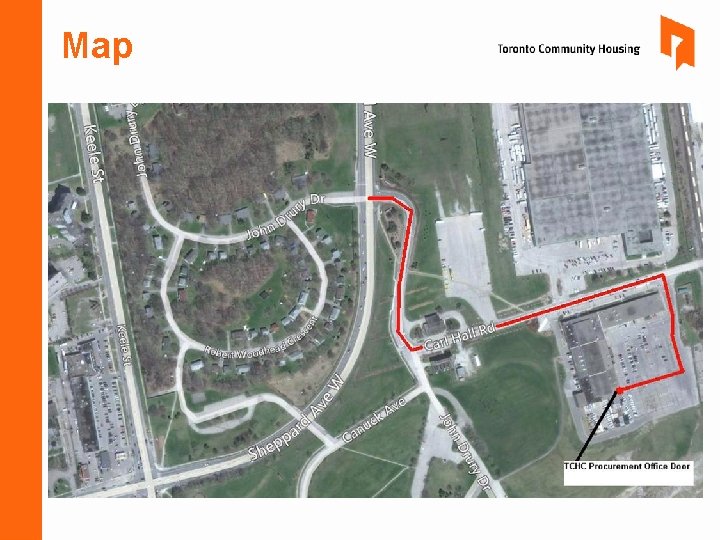
Map
Stage I: Mandatory Requirements • Stage I will consist of a review to determine which responses comply with all of the mandatory requirements. Responses failing to satisfy the mandatory requirements as of the Submission Deadline will be provided an opportunity to rectify any deficiencies. Responses failing to satisfy the mandatory requirements within the Rectification Period will be excluded from further consideration. The Rectification Period will begin to run from the date and time that the TCHC issues its rectification notice to the proponent.
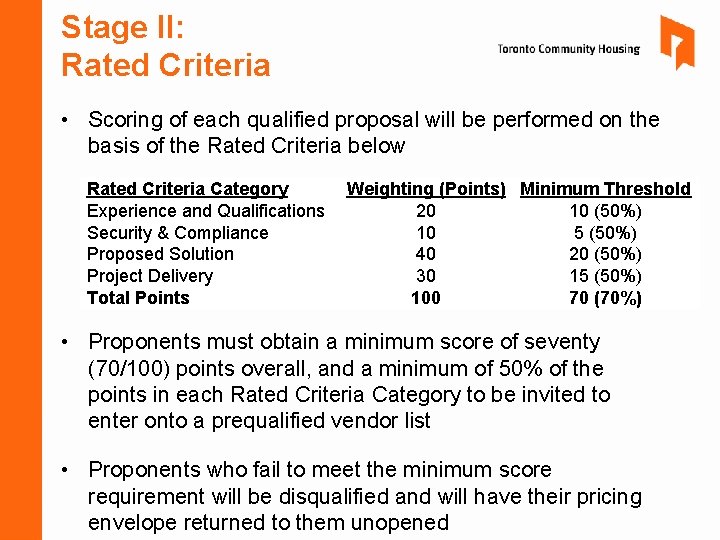
Stage II: Rated Criteria • Scoring of each qualified proposal will be performed on the basis of the Rated Criteria below Rated Criteria Category Experience and Qualifications Security & Compliance Proposed Solution Project Delivery Total Points Weighting (Points) Minimum Threshold 20 10 (50%) 10 5 (50%) 40 20 (50%) 30 15 (50%) 100 70 (70%) • Proponents must obtain a minimum score of seventy (70/100) points overall, and a minimum of 50% of the points in each Rated Criteria Category to be invited to enter onto a prequalified vendor list • Proponents who fail to meet the minimum score requirement will be disqualified and will have their pricing envelope returned to them unopened
Stage III: Proof of Concept • The top three (3) rated proponents from Stage II will qualify to participate in Stage III (Po. C) • At that time, the selected proponents will be provided with: – instructions on TCHC requirements for the proof of concept; – instructions on how to access key TCHC staff to get more information related to TCHC’s IT needs; and, – the scoring criteria for the second competitive stage of the RFVQ. • The selected proponents will be given approximately three (3) months to complete the proof of concept.
Please… • • • Make sure you have downloaded ALL documents Check daily for addendums Read all documents carefully Re-read all documents carefully Make sure you submit everything that is required AND in the proper format
Questions?