
Toroidal Fusion Shielding Design Project Final Presentation by
Toroidal Fusion Shielding Design Project Final Presentation by: Matt Franzi Andrew Stach Andrew Haefner Ian Rittersdorf
Overview • • Fusion Power Goals Materials Design MCNP Simulations Results and Analysis Conclusions
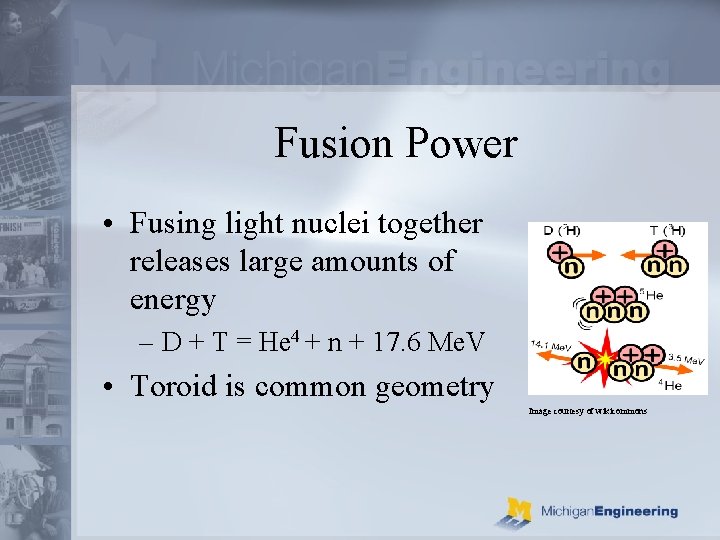
Fusion Power • Fusing light nuclei together releases large amounts of energy – D + T = He 4 + n + 17. 6 Me. V • Toroid is common geometry Image courtesy of wikicommons

Toroid Fusion Reactor • Plasma contained in toroid vacuum with magnets • Wall of toroid – Lithium blanket • Energy of neutrons transferred • Li Reactions – 6 Li – + n = 4 He + T + 4. 86 Me. V 7 Li + n = 4 He + T – 2. 5 Me. V • Tritium is extracted from Li and inserted in plasma
Two Primary Goals • Tritium production – Tritium breeding ratio = tritium production flux/ neutron flux – Ideally keep this above unity • Energy deposition in the blanket
Approach • Slab model – Initial simple model to get benchmark numbers • Toriod model – Ideal toroid model to effectively balance goals • Energy deposition • Tritium production
Materials • Lithium – Tritium production reactions with neutrons • Beryllium – reflective properties – (n, 2 n) reaction • Tungsten – Will not contaminate plasma
Slab model • Simplify walls to slabs to test: – material placement – Material thickness
Slab model results • 6 cm Tungsten layer first • Lithium layer
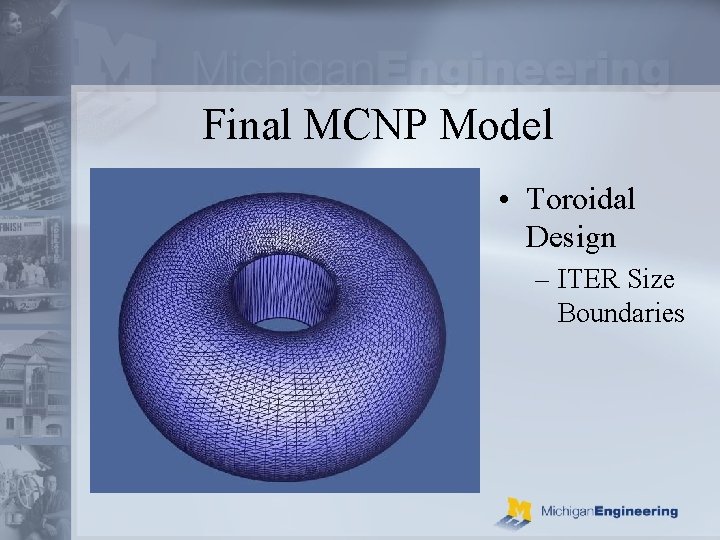
Final MCNP Model • Toroidal Design – ITER Size Boundaries
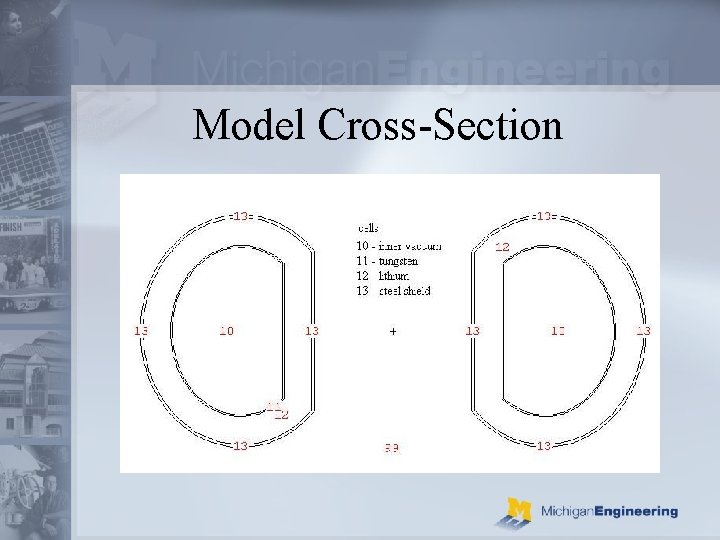
Model Cross-Section
Neutron Multiplication • More Neutrons = More Power = More $$ – Find a way to produce more neutrons • Layers of Neutron Multipliers – Capitalize on the (n, 2 n) reaction
Multiplication Layers • Sheets of non-lithium material • Absorbs a higher energy neutron • Produces two thermal neutrons – Is this trade off worth it? • Lithum-6 reaction with thermal neutron produces 4. 8 Me. V
Multiple Layers
Simulation Results
- Slides: 15