
Topup injection schemes M Aiba Sa Hernndez PSI
Top-up injection schemes M. Aiba, Á. Sáa Hernández, PSI With input from B. Goddard, K. Oide, Y. Papaphillipou, D. Shwartz, F. Zimmermann FCCee Week, Rome 14. 04. 2016
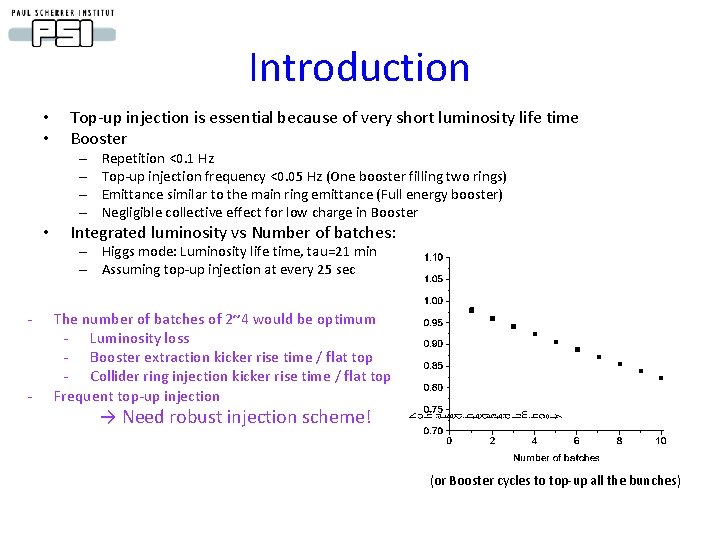
Introduction • • Top-up injection is essential because of very short luminosity life time Booster – – • Repetition <0. 1 Hz Top-up injection frequency <0. 05 Hz (One booster filling two rings) Emittance similar to the main ring emittance (Full energy booster) Negligible collective effect for low charge in Booster Integrated luminosity vs Number of batches: – Higgs mode: Luminosity life time, tau=21 min – Assuming top-up injection at every 25 sec - - The number of batches of 2~4 would be optimum - Luminosity loss - Booster extraction kicker rise time / flat top - Collider ring injection kicker rise time / flat top Frequent top-up injection → Need robust injection scheme! (or Booster cycles to top-up all the bunches)
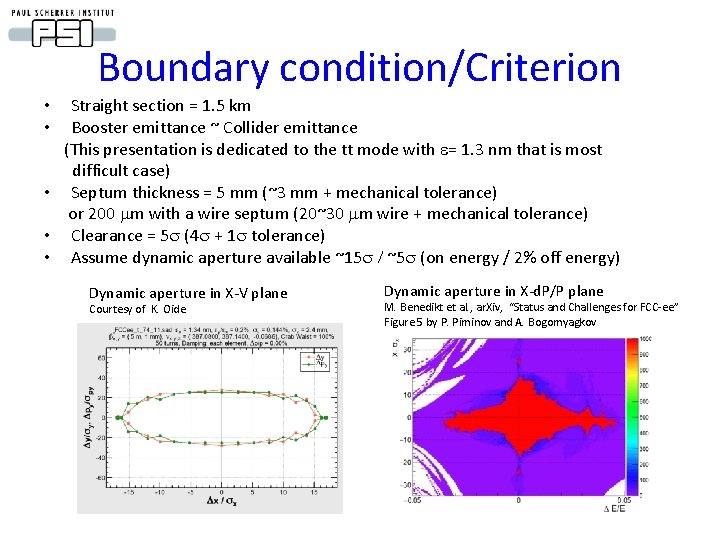
Boundary condition/Criterion • Straight section = 1. 5 km • Booster emittance ~ Collider emittance (This presentation is dedicated to the tt mode with e= 1. 3 nm that is most difficult case) • Septum thickness = 5 mm (~3 mm + mechanical tolerance) or 200 mm with a wire septum (20~30 mm wire + mechanical tolerance) • Clearance = 5 s (4 s + 1 s tolerance) • Assume dynamic aperture available ~15 s / ~5 s (on energy / 2% off energy) Dynamic aperture in X-V plane Courtesy of K. Oide Dynamic aperture in X-d. P/P plane M. Benedikt et al. , ar. Xiv, “Status and Challenges for FCC-ee” Figure 5 by P. Piminov and A. Bogomyagkov
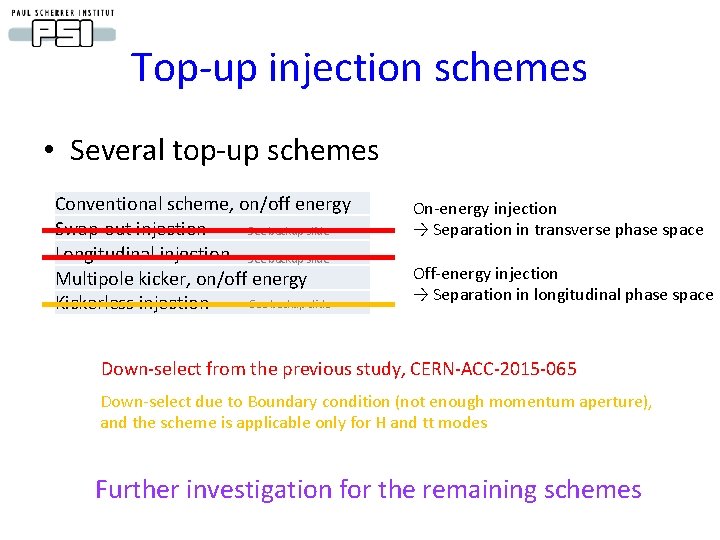
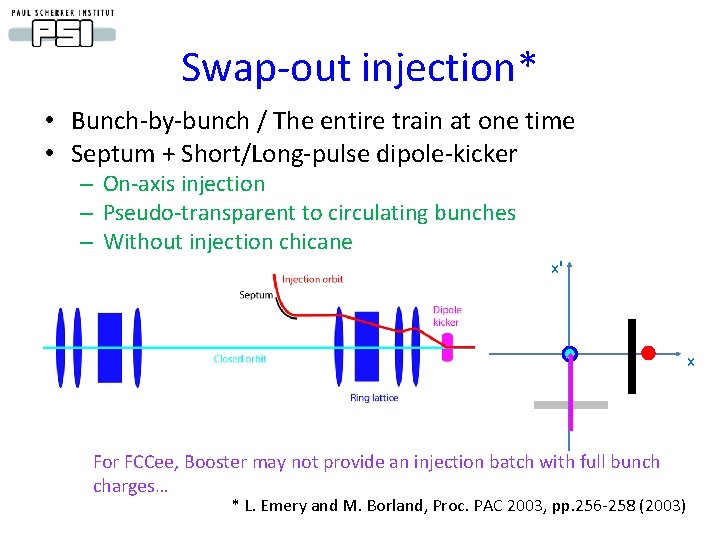
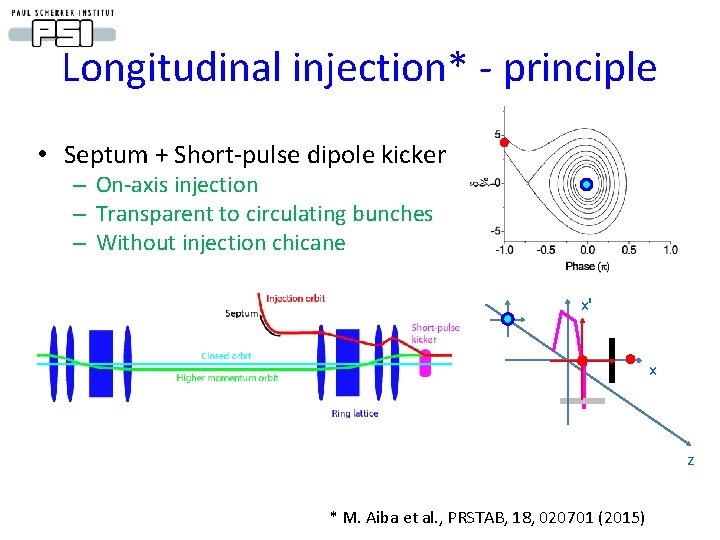
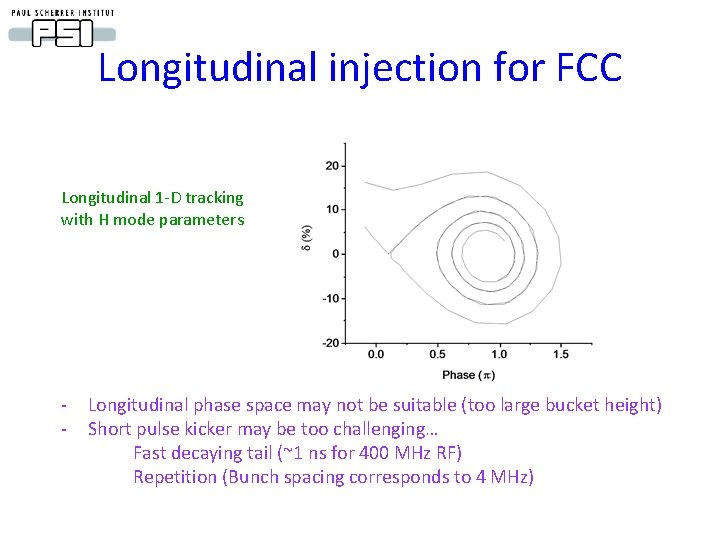
Top-up injection schemes • Several top-up schemes Conventional scheme, on/off energy See backup slide Swap-out injection Longitudinal injection See backup slide Multipole kicker, on/off energy See backup slide Kickerless injection On-energy injection → Separation in transverse phase space Off-energy injection → Separation in longitudinal phase space Down-select from the previous study, CERN-ACC-2015 -065 Down-select due to Boundary condition (not enough momentum aperture), and the scheme is applicable only for H and tt modes Further investigation for the remaining schemes
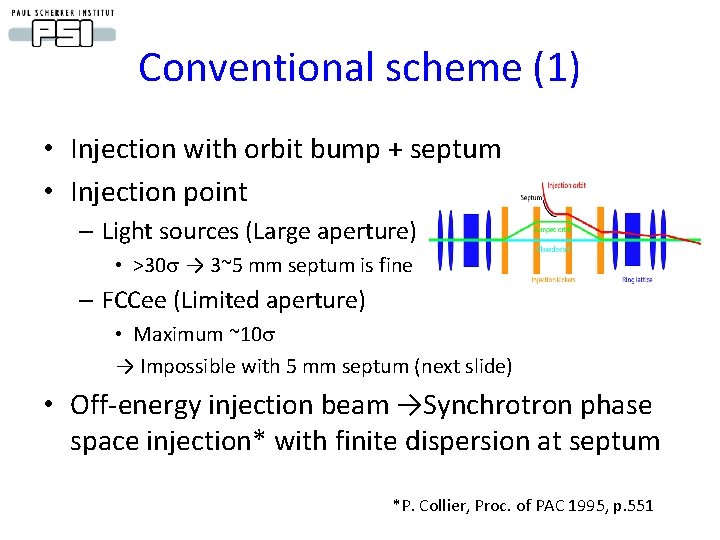
Conventional scheme (1) • Injection with orbit bump + septum • Injection point – Light sources (Large aperture) • >30 s → 3~5 mm septum is fine – FCCee (Limited aperture) • Maximum ~10 s → Impossible with 5 mm septum (next slide) • Off-energy injection beam →Synchrotron phase space injection* with finite dispersion at septum *P. Collier, Proc. of PAC 1995, p. 551
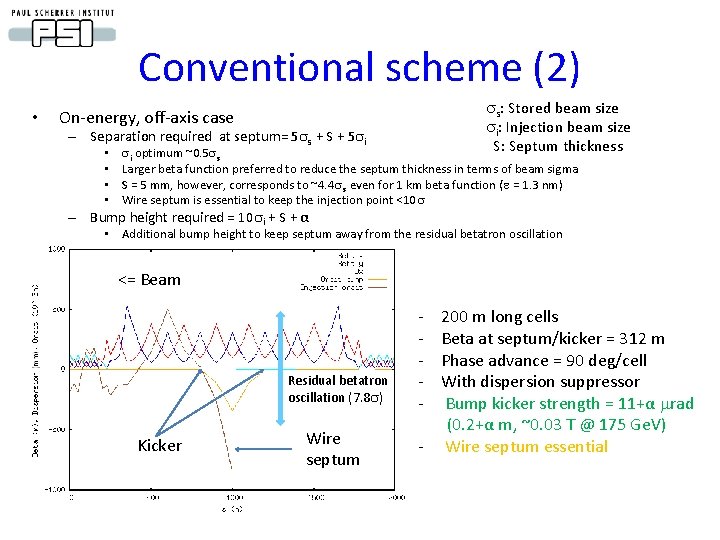
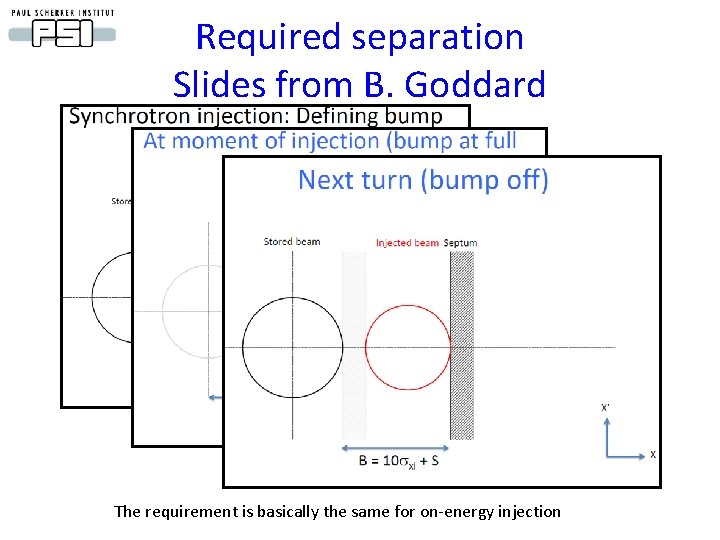
Conventional scheme (2) • On-energy, off-axis case – Separation required at septum= 5 ss + S + 5 si • • ss: Stored beam size si: Injection beam size S: Septum thickness si optimum ~0. 5 ss Larger beta function preferred to reduce the septum thickness in terms of beam sigma S = 5 mm, however, corresponds to ~4. 4 ss even for 1 km beta function (e = 1. 3 nm) Wire septum is essential to keep the injection point <10 s – Bump height required = 10 si + S + α • Additional bump height to keep septum away from the residual betatron oscillation <= Beam Residual betatron oscillation (7. 8 s) Kicker Wire septum - 200 m long cells - Beta at septum/kicker = 312 m - Phase advance = 90 deg/cell - With dispersion suppressor - Bump kicker strength = 11+α mrad (0. 2+α m, ~0. 03 T @ 175 Ge. V) - Wire septum essential

Conventional scheme (3) • Off-energy, on-axis case – Separation required at septum, 5 ss + S + 5 si < Dx di • Requirements for dispersion and energy offset (di) are determined as well • si optimum = ss (Very limited aperture for the off-energy beam) • ss /i are increased due to the energy spread (0. 19/0. 14%) of the stored/injection beam – Bump height required = 10 si + S <= Beam Kicker Wire septum - 200 m long cells - Beta at septum/kicker = 312 m - Phase advance = 90 deg/cell - Dispersion at septum = 0. 8 m (Difficult to increase Dx…) - Bump kicker strength = 44 mrad (0. 8 m, ~0. 03 T @ 175 Ge. V) - di=-2. 46% to meet 5 ss + S + 5 si < Dx di with 5 mm septum - di=-1. 86% to meet 5 ss + S + 5 si < Dx di with a wire septum (200 mm) - Wire septum essential
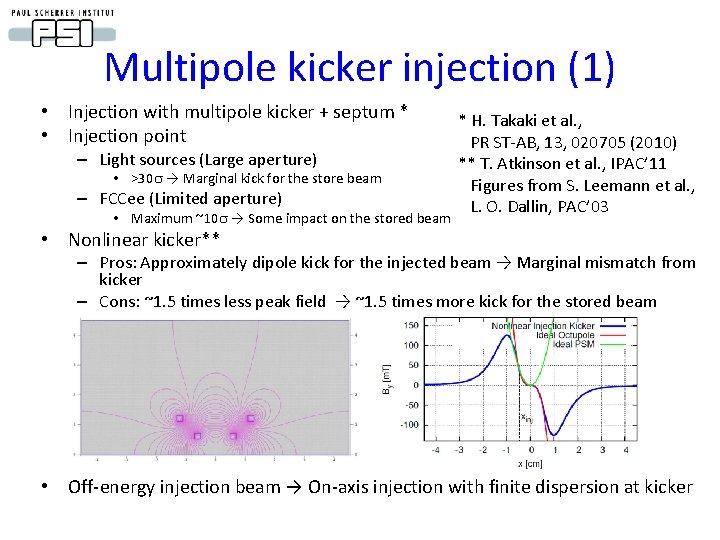
Multipole kicker injection (1) • Injection with multipole kicker + septum * • Injection point – Light sources (Large aperture) • >30 s → Marginal kick for the store beam – FCCee (Limited aperture) • Maximum ~10 s → Some impact on the stored beam * H. Takaki et al. , PR ST-AB, 13, 020705 (2010) ** T. Atkinson et al. , IPAC’ 11 Figures from S. Leemann et al. , L. O. Dallin, PAC’ 03 • Nonlinear kicker** – Pros: Approximately dipole kick for the injected beam → Marginal mismatch from kicker – Cons: ~1. 5 times less peak field → ~1. 5 times more kick for the stored beam • Off-energy injection beam → On-axis injection with finite dispersion at kicker
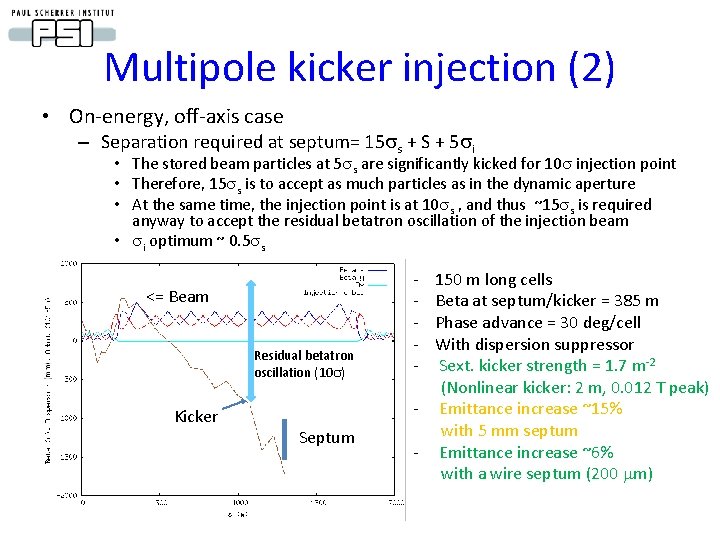
Multipole kicker injection (2) • On-energy, off-axis case – Separation required at septum= 15 ss + S + 5 si • The stored beam particles at 5 ss are significantly kicked for 10 s injection point • Therefore, 15 ss is to accept as much particles as in the dynamic aperture • At the same time, the injection point is at 10 ss , and thus ~15 ss is required anyway to accept the residual betatron oscillation of the injection beam • si optimum ~ 0. 5 ss <= Beam Residual betatron oscillation (10 s) Kicker Septum - 150 m long cells - Beta at septum/kicker = 385 m - Phase advance = 30 deg/cell - With dispersion suppressor - Sext. kicker strength = 1. 7 m-2 (Nonlinear kicker: 2 m, 0. 012 T peak) - Emittance increase ~15% with 5 mm septum - Emittance increase ~6% with a wire septum (200 mm)
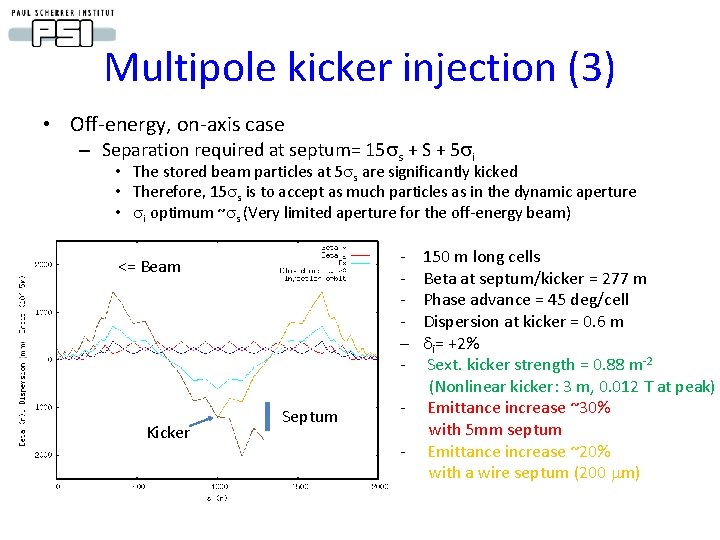
Multipole kicker injection (3) • Off-energy, on-axis case – Separation required at septum= 15 ss + S + 5 si • The stored beam particles at 5 ss are significantly kicked • Therefore, 15 ss is to accept as much particles as in the dynamic aperture • si optimum ~ss (Very limited aperture for the off-energy beam) <= Beam Kicker Septum - 150 m long cells - Beta at septum/kicker = 277 m - Phase advance = 45 deg/cell - Dispersion at kicker = 0. 6 m - di= +2% - Sext. kicker strength = 0. 88 m-2 (Nonlinear kicker: 3 m, 0. 012 T at peak) - Emittance increase ~30% with 5 mm septum - Emittance increase ~20% with a wire septum (200 mm)
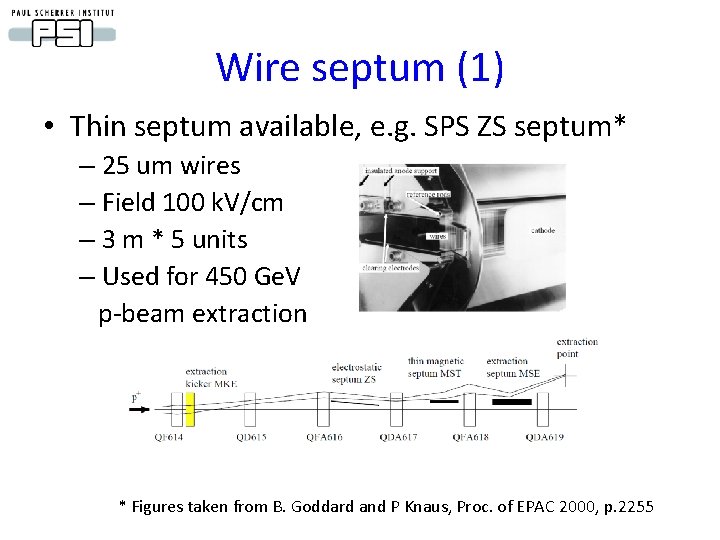
Wire septum (1) • Thin septum available, e. g. SPS ZS septum* – 25 um wires – Field 100 k. V/cm – 3 m * 5 units – Used for 450 Ge. V p-beam extraction * Figures taken from B. Goddard and P Knaus, Proc. of EPAC 2000, p. 2255
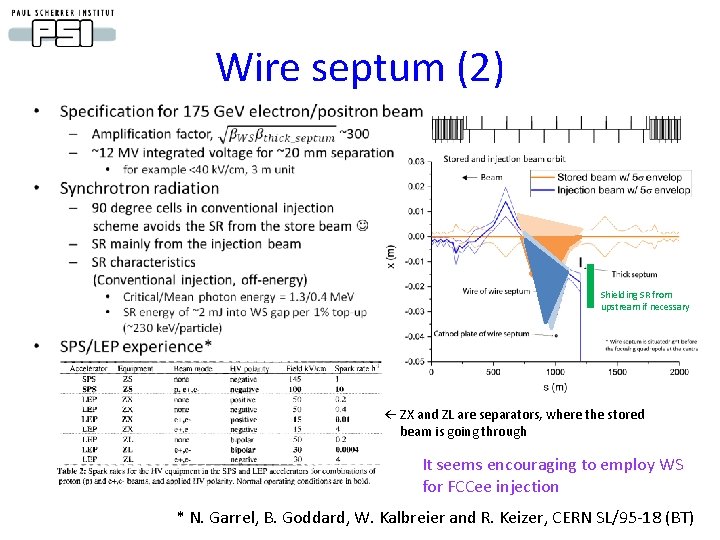
Wire septum (2) • Shielding SR from upstream if necessary ← ZX and ZL are separators, where the stored beam is going through It seems encouraging to employ WS for FCCee injection * N. Garrel, B. Goddard, W. Kalbreier and R. Keizer, CERN SL/95 -18 (BT)
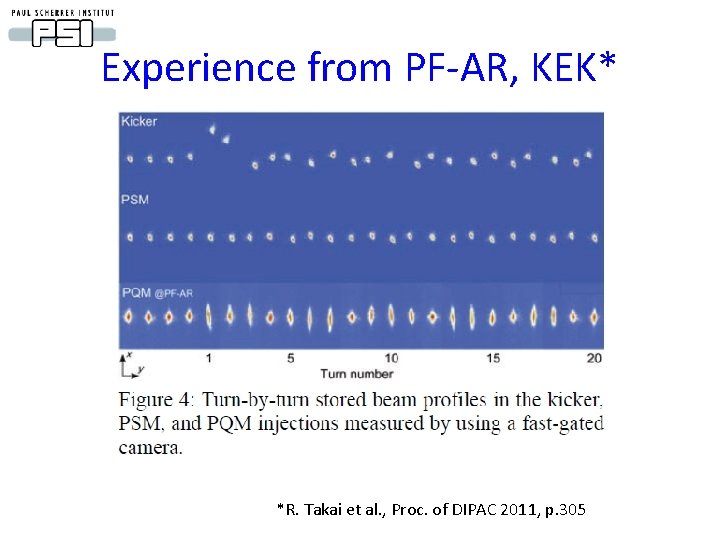
Experience from PF-AR, KEK* *R. Takai et al. , Proc. of DIPAC 2011, p. 305
Open issues • Beam-beam effects – Residual betatron/synchrotron oscillation of the injection beam is problematic though the injection beam charge is a few %? – Preferably off-energy (on-axis) injection? Higher inj. efficiency and less background at LEP. – A few % charge difference between e- and e+ colliding over one booster cycle. Acceptable? – Beam disturbance in Conventional injection needs to be evaluated. – How much emittance growth in Multipole kicker injection is acceptable? • Filling scheme – Number of batches/bunches per booster cycle? – Timing: Ratio of Booster length to Collider length should be NB/NC with integer numbers? – Filling pattern feedback?

Summary • Conventional scheme and Multipole injection are further investigated for the tt mode – Both schemes (and both on- and off-energy) may be feasible – Possible optics presented – Very thin septum (Wire septum) • Essential for the conventional scheme (on- and off-energy) – However, much relaxed specification w. r. t. SPS ZS septum • Preferable for Multipole injection scheme (on- and off-energy) – Injection is easier for the operation modes other than tt • Detailed study of beam-beam effects is necessary to decide the suitable injection scheme
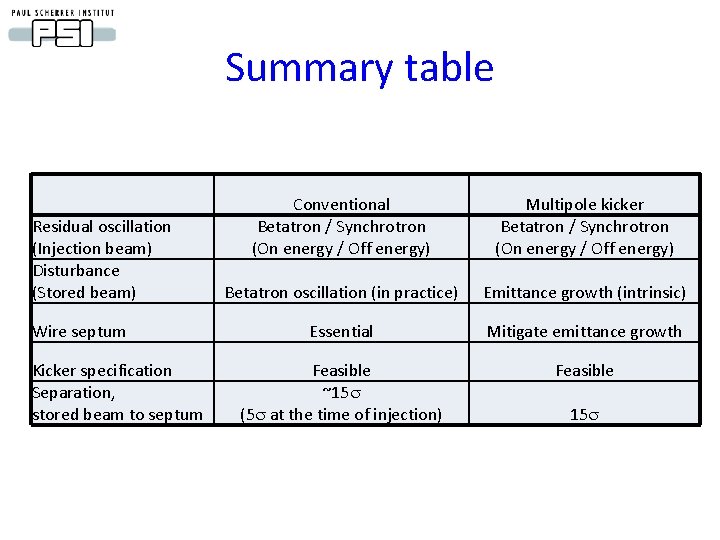
Summary table Residual oscillation (Injection beam) Disturbance (Stored beam) Wire septum Kicker specification Separation, stored beam to septum Conventional Betatron / Synchrotron (On energy / Off energy) Multipole kicker Betatron / Synchrotron (On energy / Off energy) Betatron oscillation (in practice) Emittance growth (intrinsic) Essential Mitigate emittance growth Feasible ~15 s (5 s at the time of injection) Feasible 15 s
Backup slides
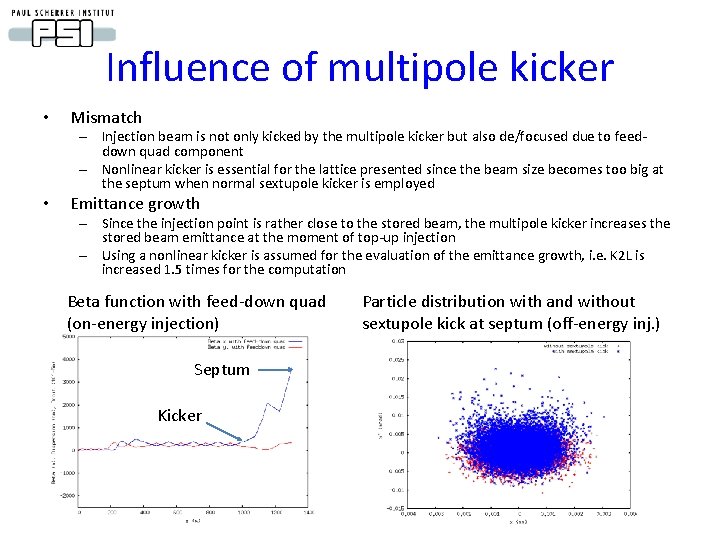
Influence of multipole kicker • Mismatch – Injection beam is not only kicked by the multipole kicker but also de/focused due to feeddown quad component – Nonlinear kicker is essential for the lattice presented since the beam size becomes too big at the septum when normal sextupole kicker is employed • Emittance growth – Since the injection point is rather close to the stored beam, the multipole kicker increases the stored beam emittance at the moment of top-up injection – Using a nonlinear kicker is assumed for the evaluation of the emittance growth, i. e. K 2 L is increased 1. 5 times for the computation Beta function with feed-down quad (on-energy injection) Septum Kicker Particle distribution with and without sextupole kick at septum (off-energy inj. )
Required separation Slides from B. Goddard The requirement is basically the same for on-energy injection
Swap-out injection* • Bunch-by-bunch / The entire train at one time • Septum + Short/Long-pulse dipole-kicker – On-axis injection – Pseudo-transparent to circulating bunches – Without injection chicane x' x For FCCee, Booster may not provide an injection batch with full bunch charges… * L. Emery and M. Borland, Proc. PAC 2003, pp. 256 -258 (2003)
Longitudinal injection* - principle • Septum + Short-pulse dipole kicker – On-axis injection – Transparent to circulating bunches – Without injection chicane x' x z * M. Aiba et al. , PRSTAB, 18, 020701 (2015)
Longitudinal injection for FCC Longitudinal 1 -D tracking with H mode parameters - Longitudinal phase space may not be suitable (too large bucket height) Short pulse kicker may be too challenging… Fast decaying tail (~1 ns for 400 MHz RF) Repetition (Bunch spacing corresponds to 4 MHz)
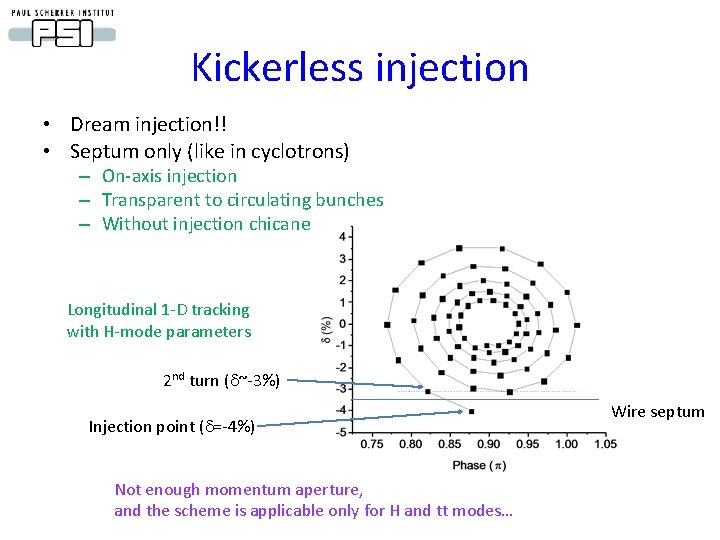
Kickerless injection • Dream injection!! • Septum only (like in cyclotrons) – On-axis injection – Transparent to circulating bunches – Without injection chicane Longitudinal 1 -D tracking with H-mode parameters 2 nd turn (d~-3%) Injection point (d=-4%) Not enough momentum aperture, and the scheme is applicable only for H and tt modes… Wire septum
- Slides: 23