
Topological Quantum Phenomena and Gauge Theories Kyoto University
- Slides: 45
Topological Quantum Phenomena and Gauge Theories Kyoto University, YITP, Masatoshi SATO 1
In collaboration with • Mahito Kohmoto (University of Tokyo, ISSP) • Yong-Shi Wu (Utah University) 1. “Braid Group, Gauge Invariance, and Topological Order”, MS. M. Kohmoto, and Y. -S. Wu, Phys. Rev. Lett. 97, 010601 (06) 2. “Topological Discrete Algebra, Ground-State Degeneracy, and Quark Confinement in QCD”, MS. Phys. Rev. D 77, 0457013 (08) Review paper on Topological Quantum Phenomena Y. Tanaka, MS, N. Nagaosa, “Symmetry and Topology in SCs” JPSJ 81 (12) 011013 T. Mizushima, Tsutsumi, MS, Machida, “Symmetry Protected TSF 3 He-B” ar. Xiv: 1409. 6094 2
Outline Part 1. What is topological phase/order 1. General idea of topological phase/order 2. Topological insulators/superconductors Part 2. deconfinement as a topological order 3
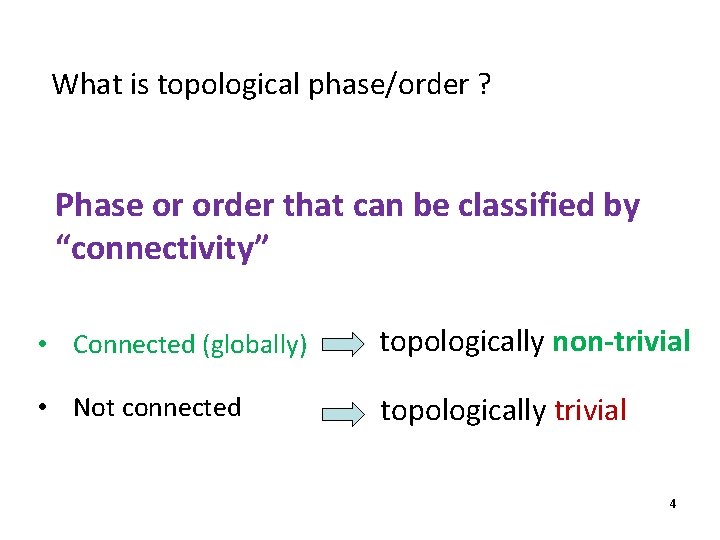
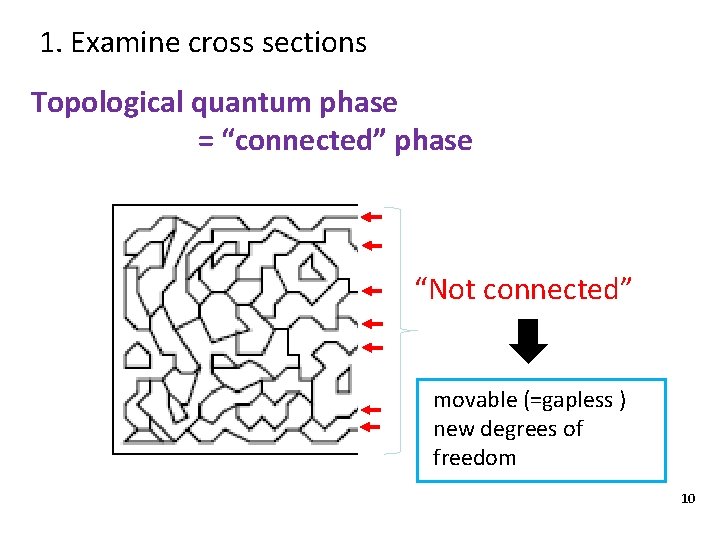
What is topological phase/order ? Phase or order that can be classified by “connectivity” • Connected (globally) topologically non-trivial • Not connected topologically trivial 4
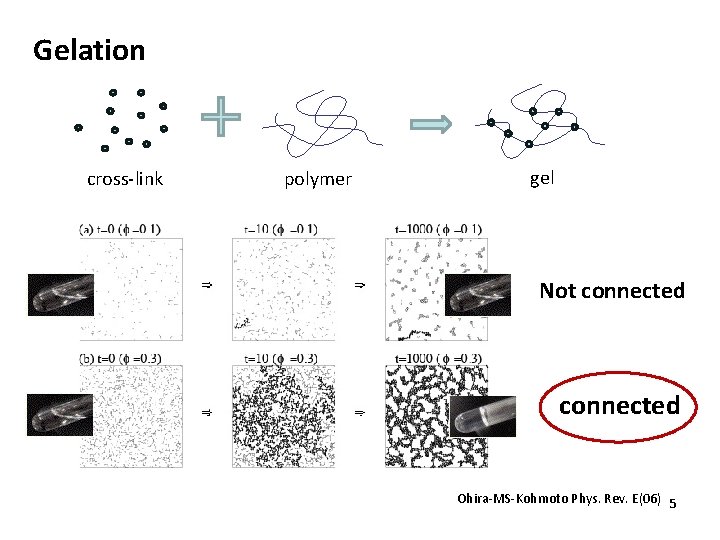
Gelation cross-link polymer gel Not connected Ohira-MS-Kohmoto Phys. Rev. E(06) 5
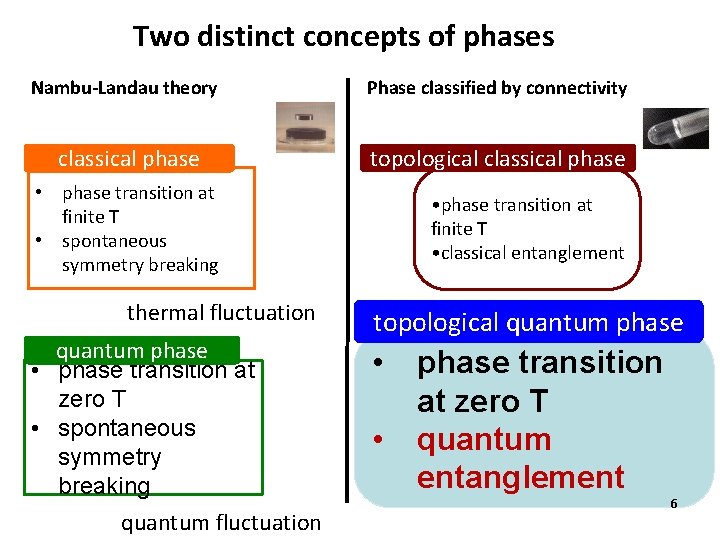
Two distinct concepts of phases Nambu-Landau theory Phase classified by connectivity classical phase topological classical phase • phase transition at finite T • spontaneous symmetry breaking thermal fluctuation quantum phase • phase transition at zero T • spontaneous symmetry breaking quantum fluctuation • phase transition at finite T • classical entanglement topological quantum phase • • phase transition at zero T quantum entanglement 6
What is quantum entanglement ? 7
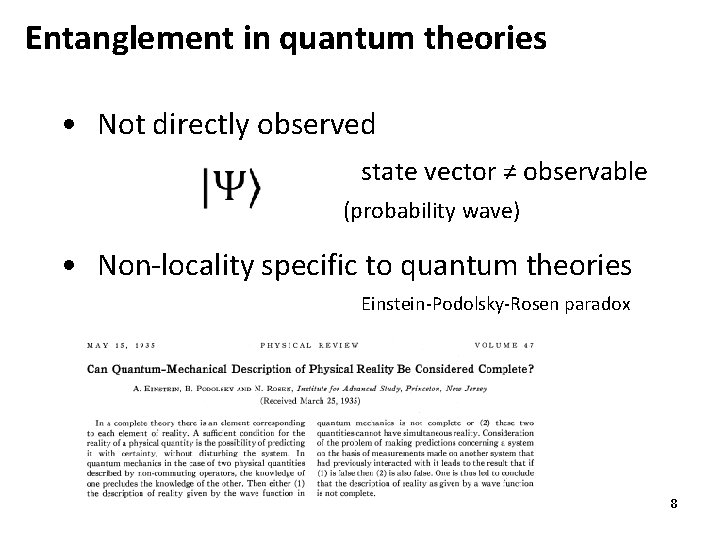
Entanglement in quantum theories • Not directly observed state vector ≠ observable (probability wave) • Non-locality specific to quantum theories Einstein-Podolsky-Rosen paradox 8
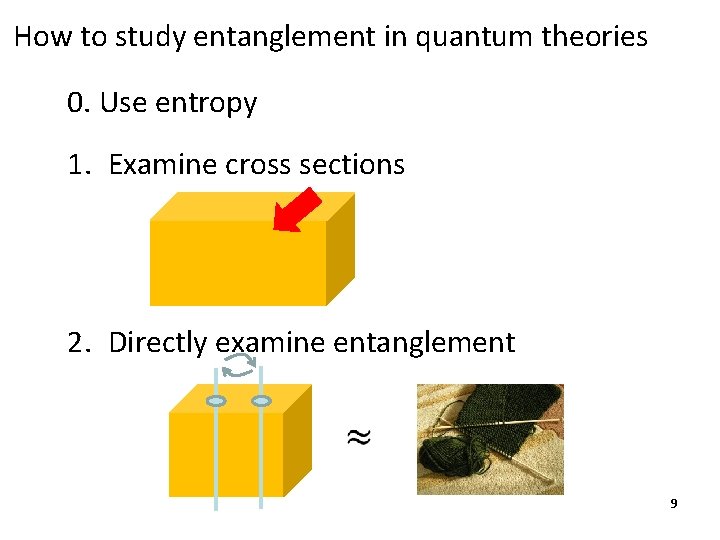
How to study entanglement in quantum theories 0. Use entropy 1. Examine cross sections 2. Directly examine entanglement 9
1. Examine cross sections Topological quantum phase = “connected” phase “Not connected” movable (=gapless ) new degrees of freedom 10
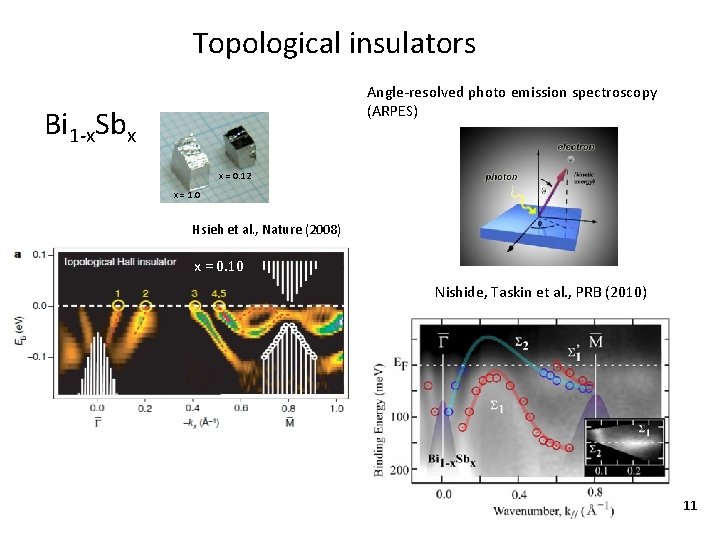
Topological insulators Angle-resolved photo emission spectroscopy (ARPES) Bi 1 -x. Sbx x = 0. 12 x = 1. 0 Hsieh et al. , Nature (2008) x = 0. 10 Nishide, Taskin et al. , PRB (2010) 11
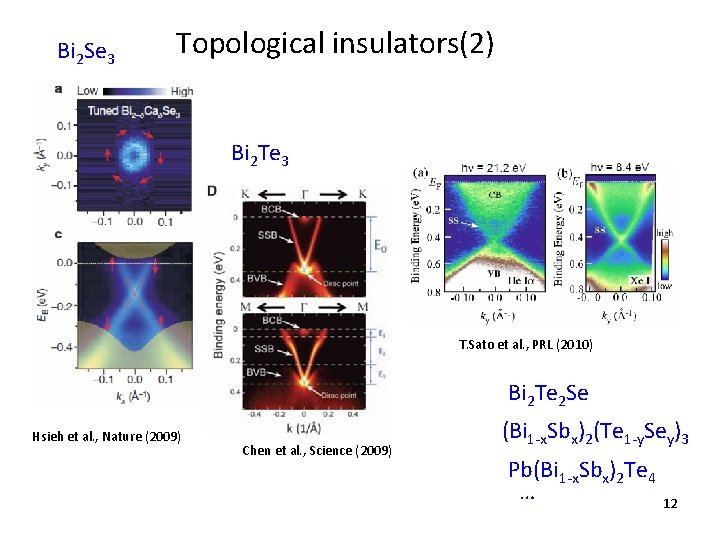
Bi 2 Se 3 Topological insulators(2) Bi 2 Te 3 T. Sato et al. , PRL (2010) Bi 2 Te 2 Se Hsieh et al. , Nature (2009) Chen et al. , Science (2009) (Bi 1 -x. Sbx)2(Te 1 -y. Sey)3 Pb(Bi 1 -x. Sbx)2 Te 4 … 12
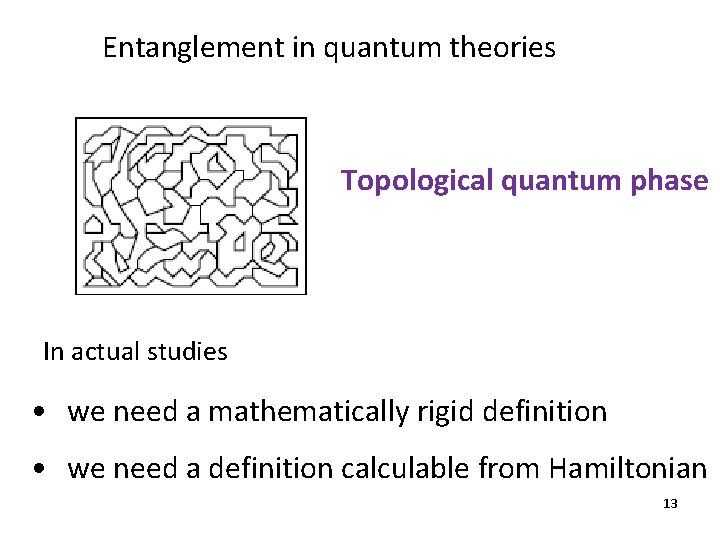
Entanglement in quantum theories Topological quantum phase In actual studies • we need a mathematically rigid definition • we need a definition calculable from Hamiltonian 13
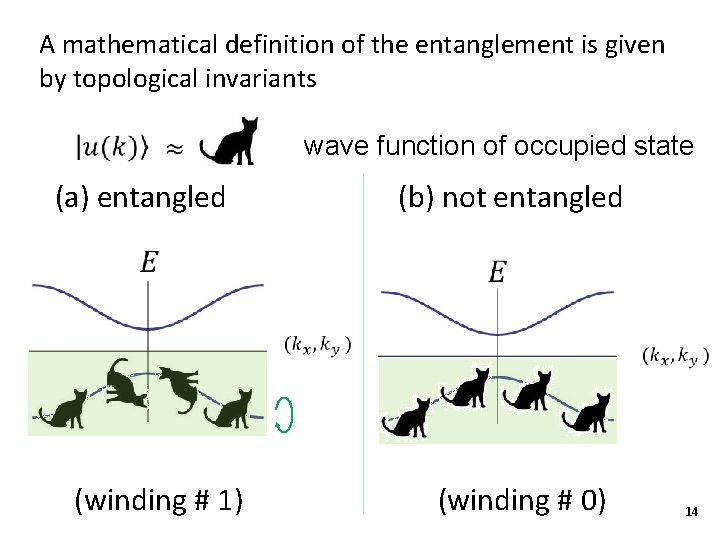
A mathematical definition of the entanglement is given by topological invariants wave function of occupied state (a) entangled (b) not entangled (winding # 1) (winding # 0) 14
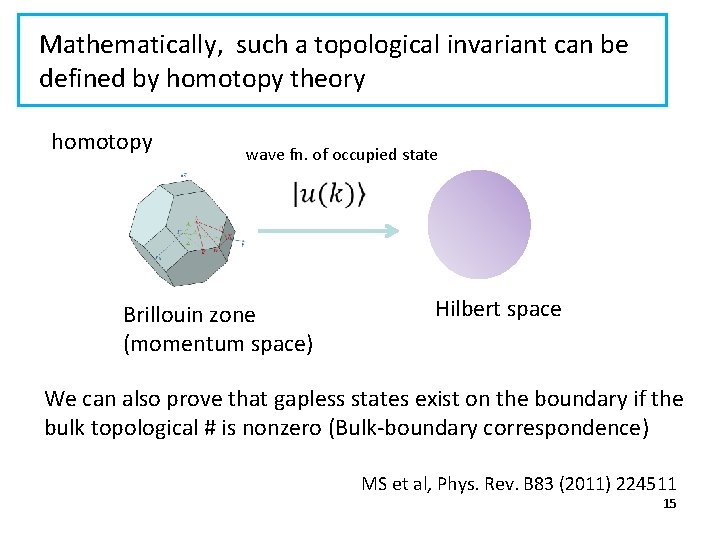
Mathematically, such a topological invariant can be defined by homotopy theory homotopy wave fn. of occupied state Brillouin zone (momentum space) Hilbert space We can also prove that gapless states exist on the boundary if the bulk topological # is nonzero (Bulk-boundary correspondence) MS et al, Phys. Rev. B 83 (2011) 224511 15
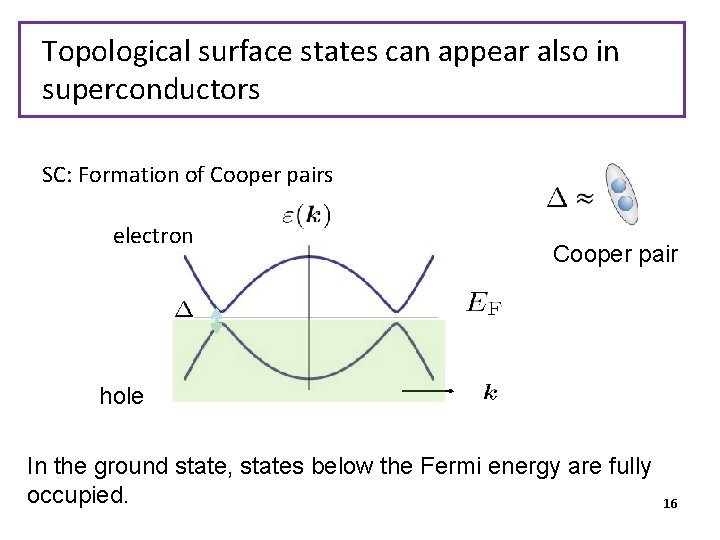
Topological surface states can appear also in superconductors SC: Formation of Cooper pairs electron Cooper pair hole In the ground state, states below the Fermi energy are fully occupied. 16
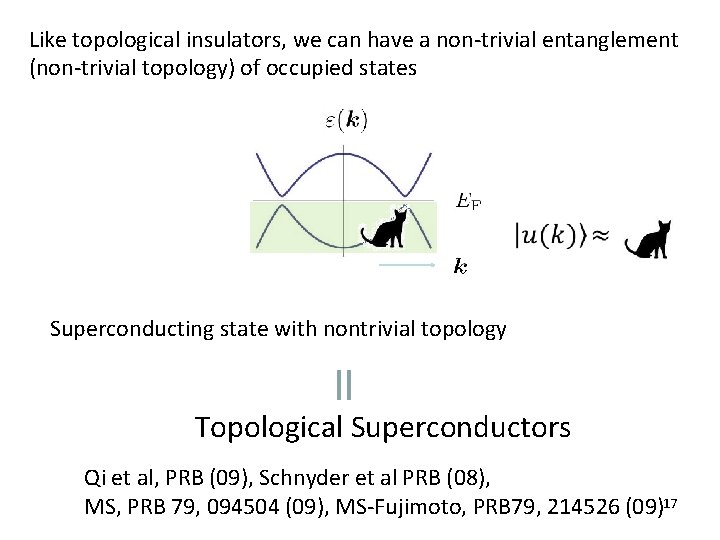
Like topological insulators, we can have a non-trivial entanglement (non-trivial topology) of occupied states Superconducting state with nontrivial topology Topological Superconductors Qi et al, PRB (09), Schnyder et al PRB (08), MS, PRB 79, 094504 (09), MS-Fujimoto, PRB 79, 214526 (09) 17
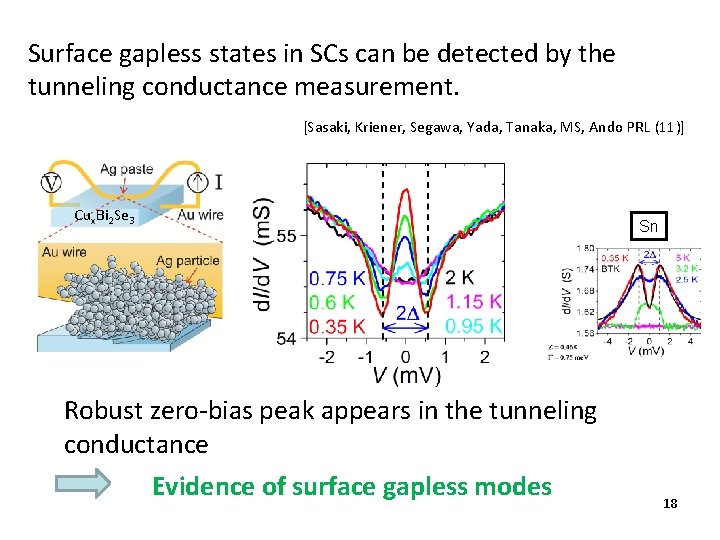
Surface gapless states in SCs can be detected by the tunneling conductance measurement. [Sasaki, Kriener, Segawa, Yada, Tanaka, MS, Ando PRL (11)] Cux. Bi 2 Se 3 Robust zero-bias peak appears in the tunneling conductance Evidence of surface gapless modes Sn 18
Summary (part 1) • There exist a class of phases that cannot be well-described by the Nambu-Landau theory. Such a class of phases are called as topological quantum phase. • One of characterizations of the topological phase is a nontrivial topological number of the occupied states. In this case, we have characteristic gapless states on the boundary. 19
Part 2. deconfinement as a topological phase 20
Question Does any topologically entangled phase have gapless surface states? No We need a different method to study topological phase 21
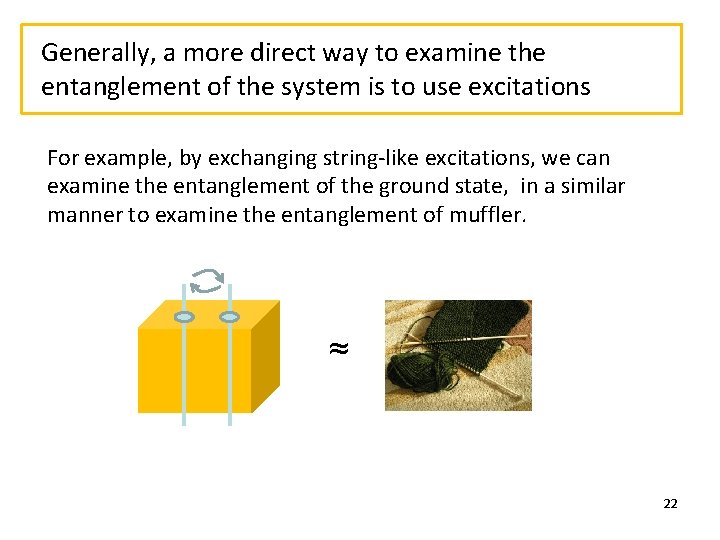
Generally, a more direct way to examine the entanglement of the system is to use excitations For example, by exchanging string-like excitations, we can examine the entanglement of the ground state, in a similar manner to examine the entanglement of muffler. ≈ 22
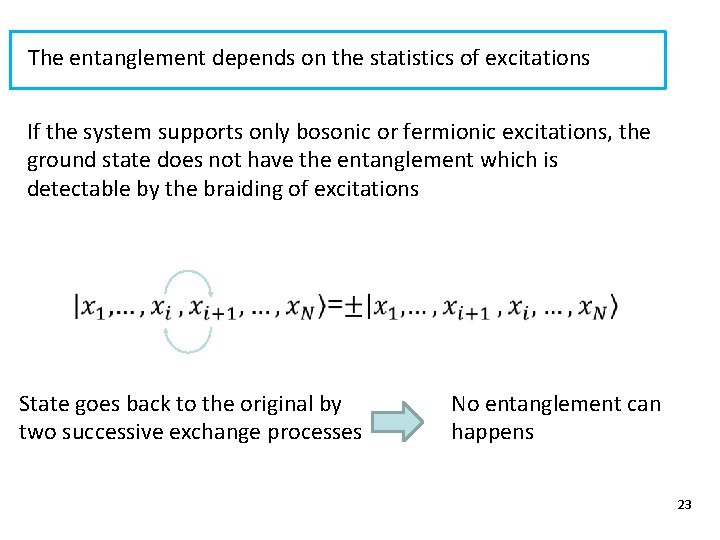
The entanglement depends on the statistics of excitations If the system supports only bosonic or fermionic excitations, the ground state does not have the entanglement which is detectable by the braiding of excitations State goes back to the original by two successive exchange processes No entanglement can happens 23
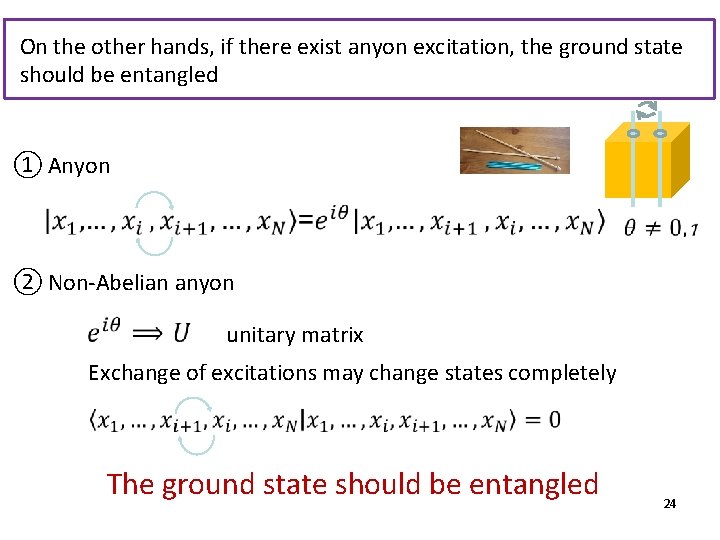
On the other hands, if there exist anyon excitation, the ground state should be entangled ① Anyon ② Non-Abelian anyon unitary matrix Exchange of excitations may change states completely The ground state should be entangled 24
A stronger statement In general, we can say that if we have a non-trivial Aharanov. Bohm phase by exchanging excitations, so we can expect the entanglement of the ground states. Charge fractionalization is a manifestation of topological phases 25
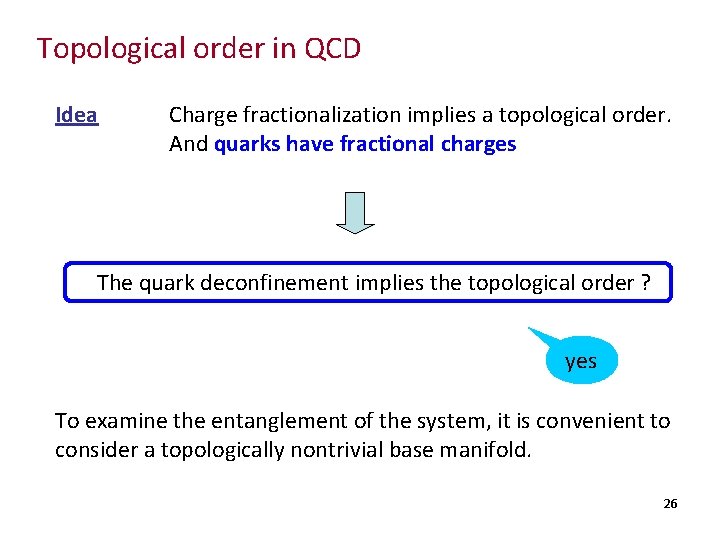
Topological order in QCD Idea Charge fractionalization implies a topological order. And quarks have fractional charges The quark deconfinement implies the topological order ? yes To examine the entanglement of the system, it is convenient to consider a topologically nontrivial base manifold. 26
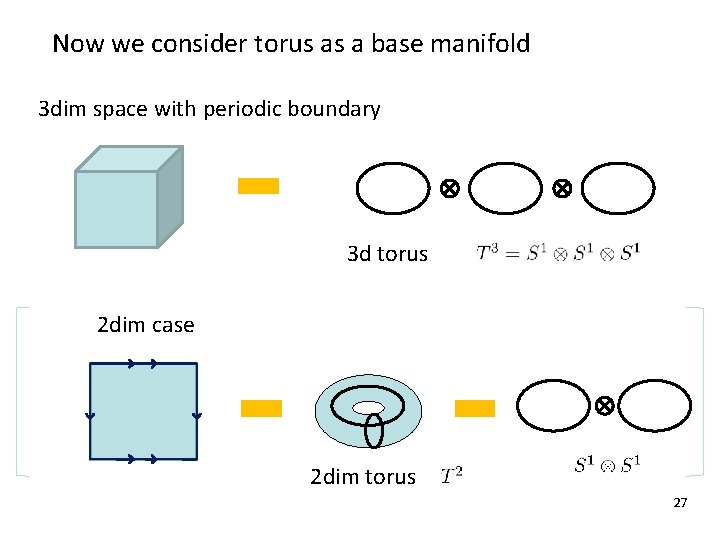
Now we consider torus as a base manifold 3 dim space with periodic boundary 3 d torus 2 dim case 2 dim torus 27
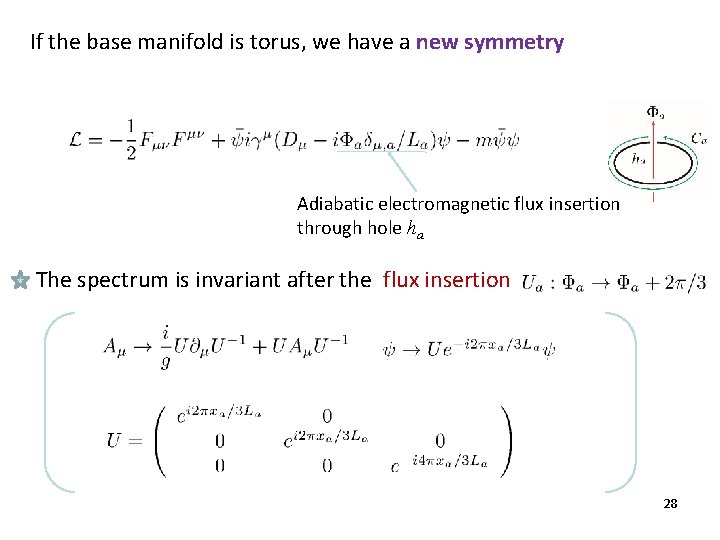
If the base manifold is torus, we have a new symmetry Adiabatic electromagnetic flux insertion through hole ha The spectrum is invariant after the flux insertion 28
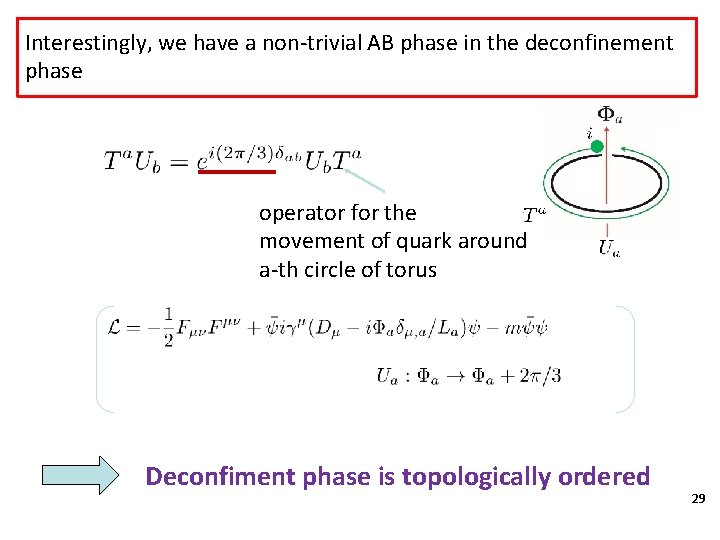
Interestingly, we have a non-trivial AB phase in the deconfinement phase operator for the movement of quark around a-th circle of torus Deconfiment phase is topologically ordered 29
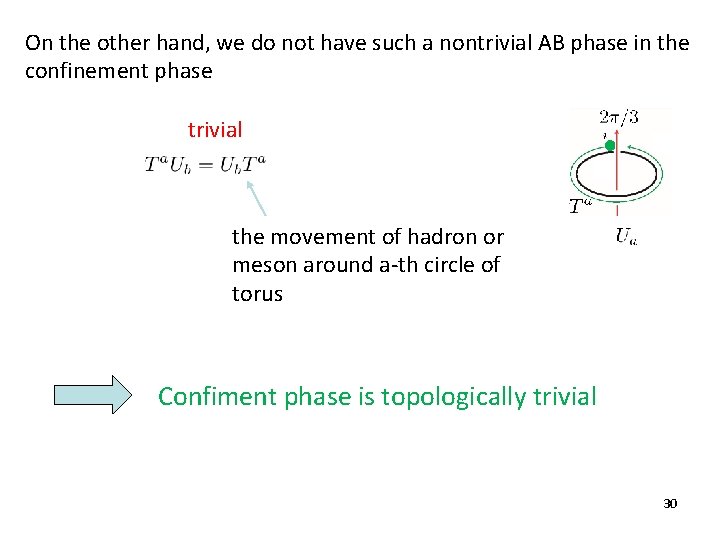
On the other hand, we do not have such a nontrivial AB phase in the confinement phase trivial the movement of hadron or meson around a-th circle of torus Confiment phase is topologically trivial 30
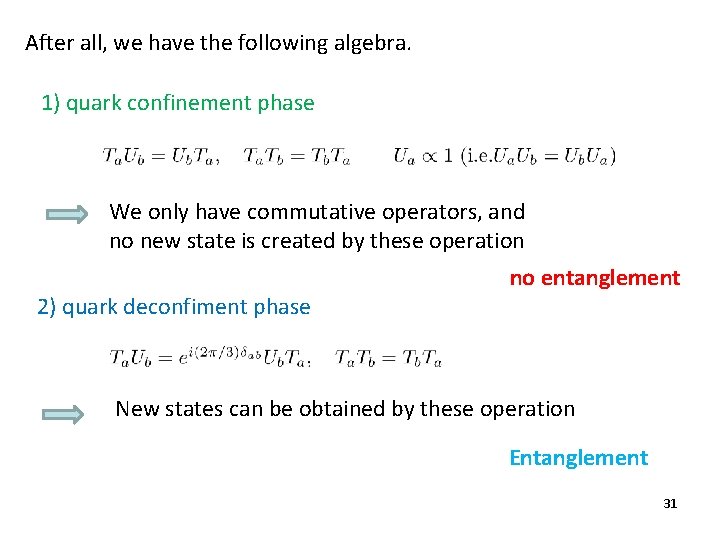
After all, we have the following algebra. 1) quark confinement phase We only have commutative operators, and no new state is created by these operation 2) quark deconfiment phase no entanglement New states can be obtained by these operation Entanglement 31
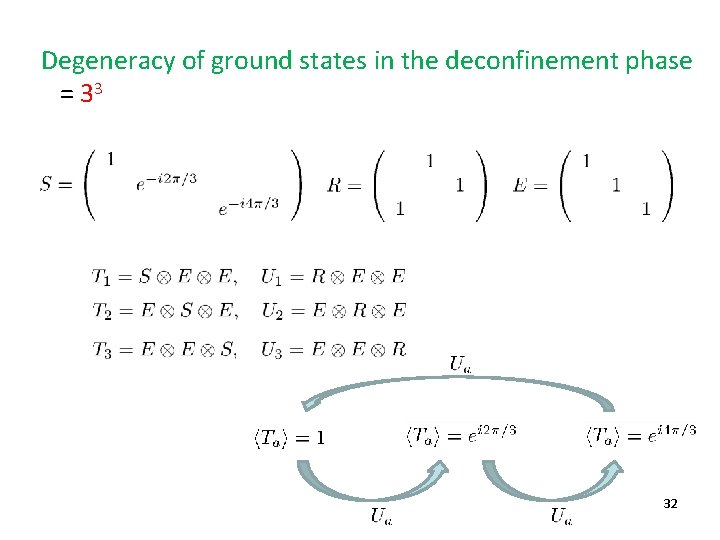
Degeneracy of ground states in the deconfinement phase = 33 32
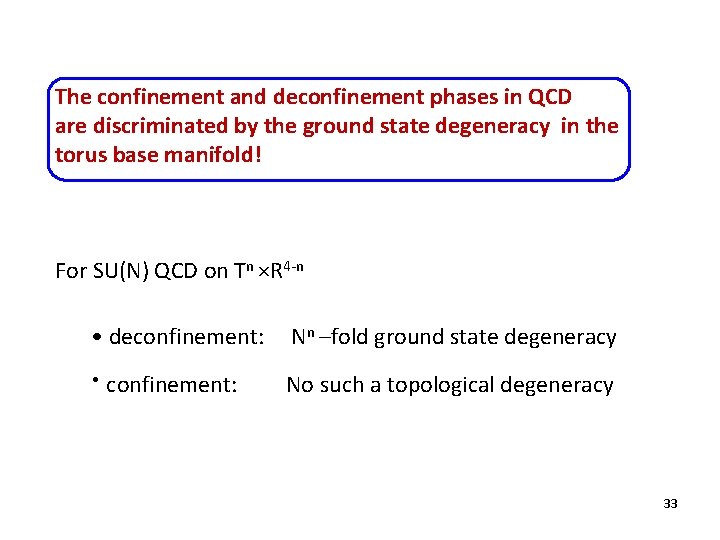
The confinement and deconfinement phases in QCD are discriminated by the ground state degeneracy in the torus base manifold! For SU(N) QCD on Tn ×R 4 -n • deconfinement: Nn –fold ground state degeneracy • confinement: No such a topological degeneracy 33
To confirm the idea of topological order, I have performed the following consistency checks l comparison with the Wilson’s criteria in the heavy quark limit l perturbative calculation of the topological ground state degeneracy l consistency check with Fradkin-Shenker’s phase diagram l comparison with Witten index 34
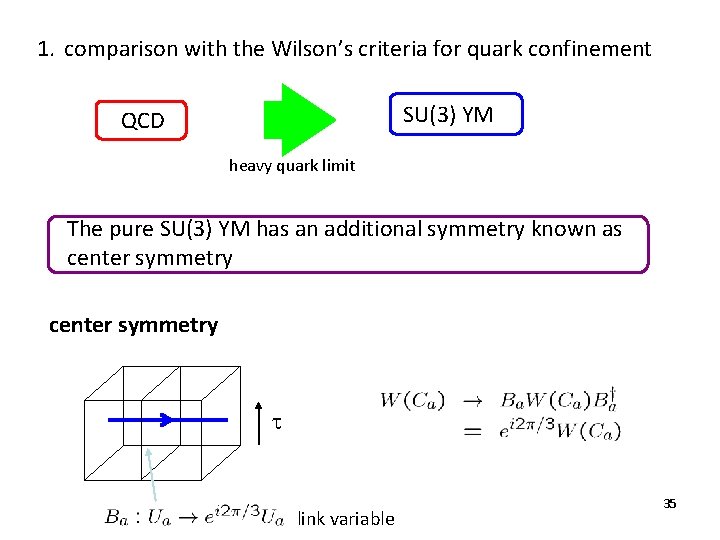
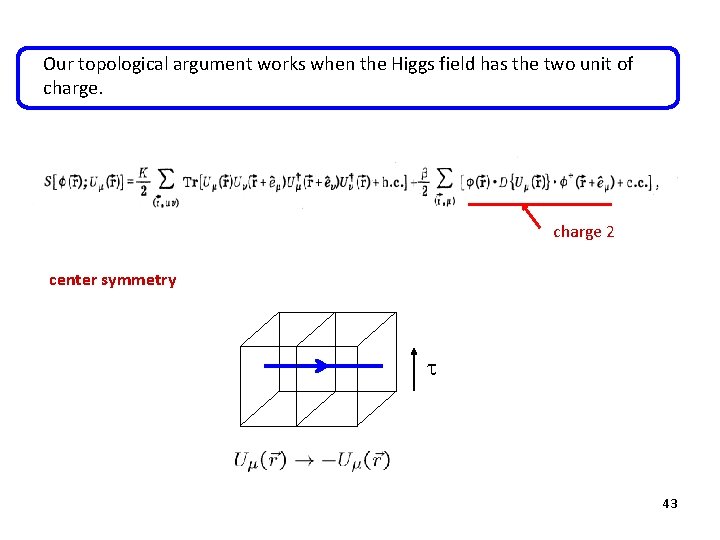
1. comparison with the Wilson’s criteria for quark confinement SU(3) YM QCD heavy quark limit The pure SU(3) YM has an additional symmetry known as center symmetry t link variable 35
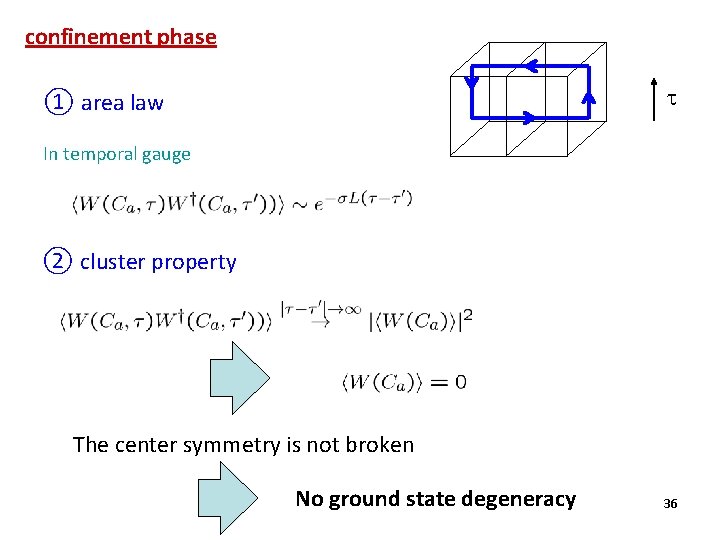
confinement phase t ① area law In temporal gauge ② cluster property The center symmetry is not broken No ground state degeneracy 36
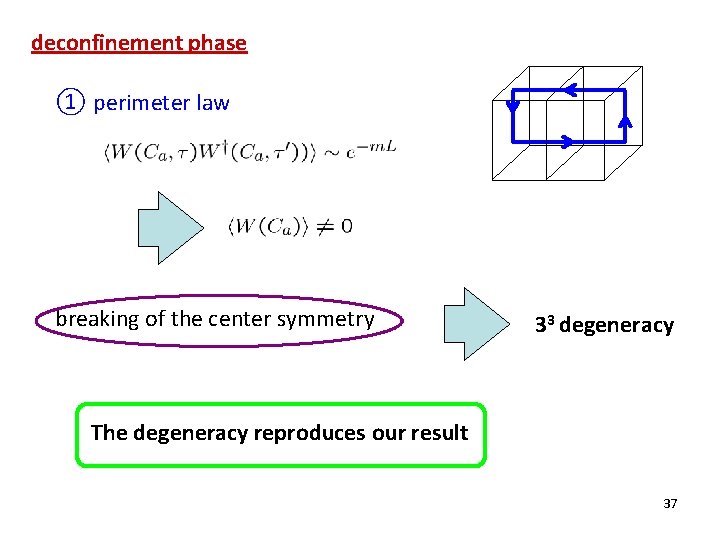
deconfinement phase ① perimeter law breaking of the center symmetry 33 degeneracy The degeneracy reproduces our result 37
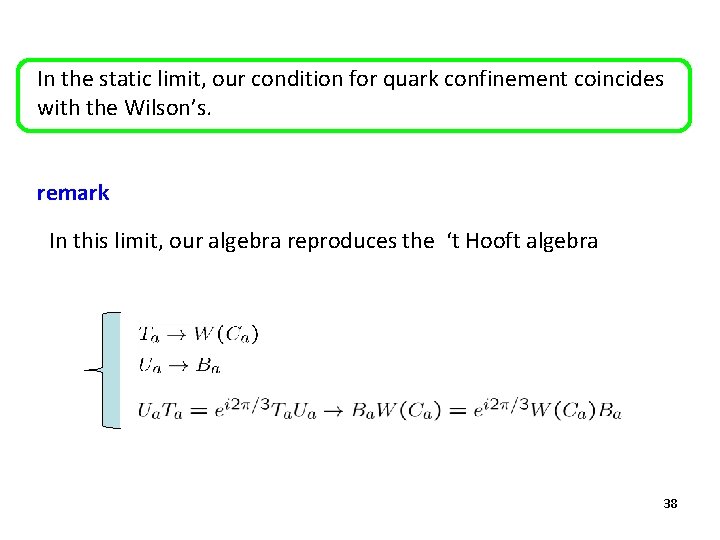
In the static limit, our condition for quark confinement coincides with the Wilson’s. remark In this limit, our algebra reproduces the ‘t Hooft algebra 38
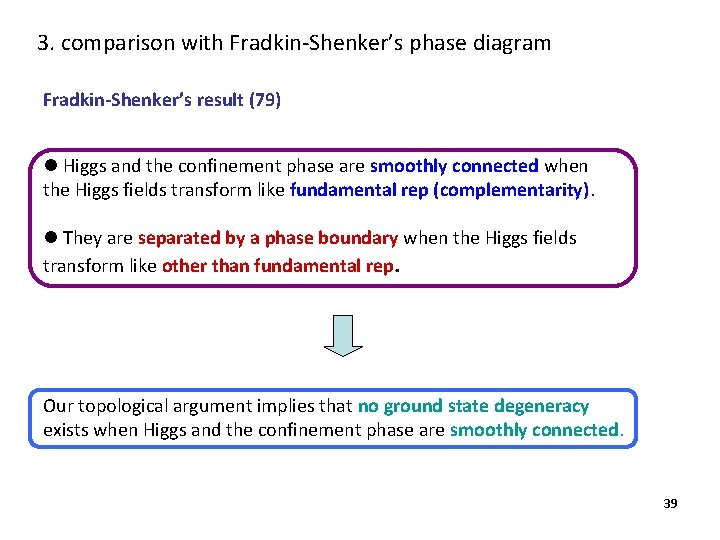
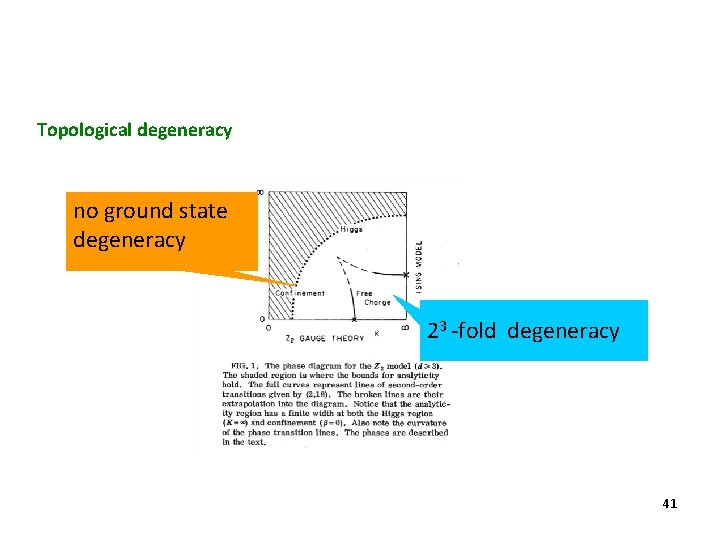
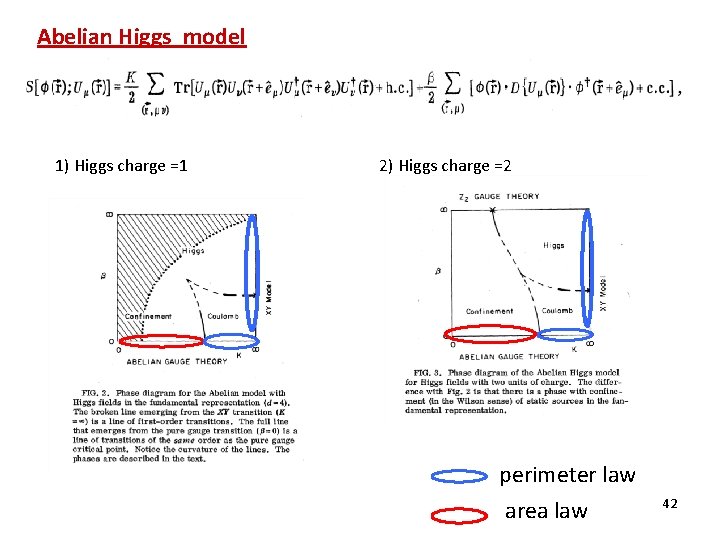
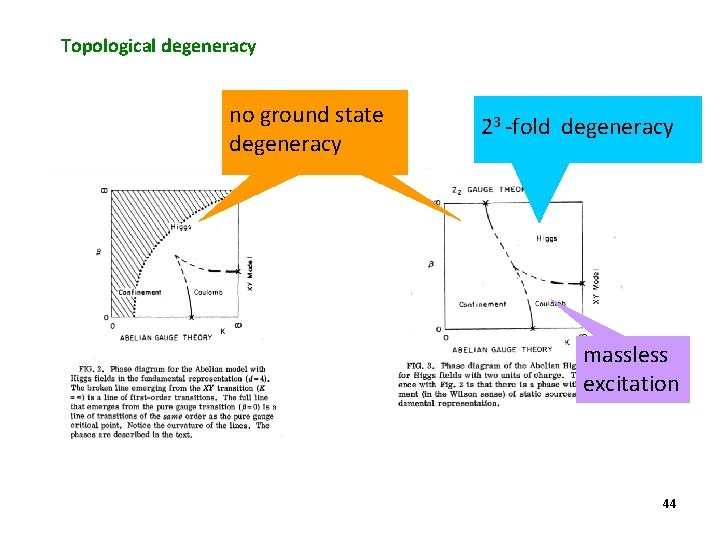
3. comparison with Fradkin-Shenker’s phase diagram Fradkin-Shenker’s result (79) l Higgs and the confinement phase are smoothly connected when the Higgs fields transform like fundamental rep (complementarity). l They are separated by a phase boundary when the Higgs fields transform like other than fundamental rep. Our topological argument implies that no ground state degeneracy exists when Higgs and the confinement phase are smoothly connected. 39
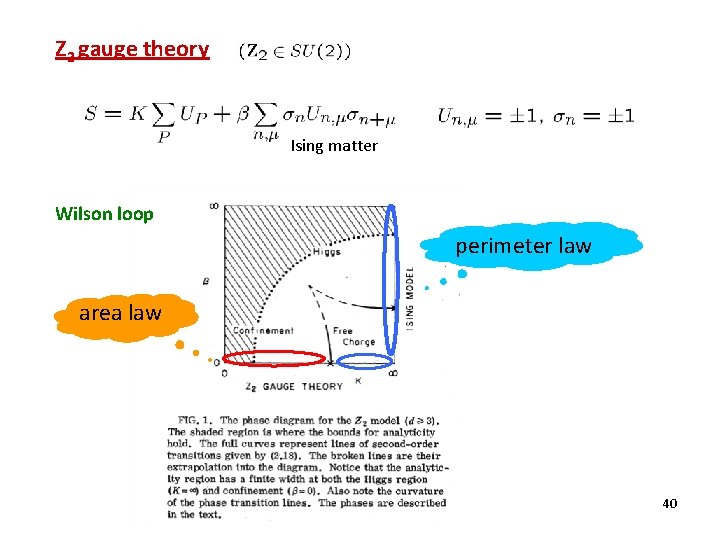
Z 2 gauge theory Ising matter Wilson loop perimeter law area law 40
Topological degeneracy no ground state degeneracy 23 -fold degeneracy 41
Abelian Higgs model 1) Higgs charge =1 2) Higgs charge =2 perimeter law area law 42
Our topological argument works when the Higgs field has the two unit of charge 2 center symmetry t 43
Topological degeneracy no ground state degeneracy 23 -fold degeneracy massless excitation 44
Summary • Generally, excitations can be used to examine the entanglement of the system directly. • If we have a non-trivial Aharanov-Bohm phase by exchanging excitations, we can expect the entanglement of the ground states • The concept of topological phase is useful to characteraize the quark confinement phase even in the presence of the dynamical quarks. 45