
Topological Band Theory I II Introduction Insulating State
Topological Band Theory I. II. Introduction - Insulating State, Topology and Band Theory Band Topology in One Dimension - Berry phase and electric polarization - Su Schrieffer Heeger model : domain wall states and Jackiw Rebbi problem - Thouless Charge Pump III. Band Topology in Two Dimensions - Integer quantum Hall effect - TKNN invariant - Edge States, chiral Dirac fermions IV. Symmetry Protected topological band insulators. - Z 2 Topological Insulators - Topological Superconductors - Ten fold way
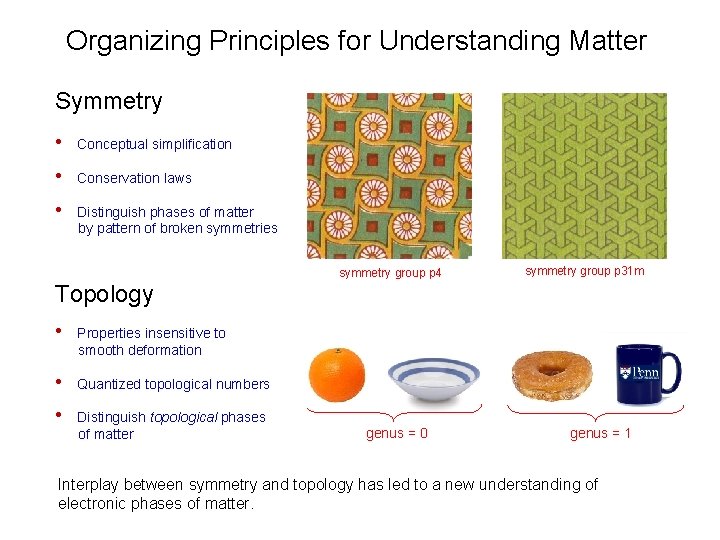
Organizing Principles for Understanding Matter Symmetry • Conceptual simplification • Conservation laws • Distinguish phases of matter by pattern of broken symmetries symmetry group p 4 symmetry group p 31 m Topology • Properties insensitive to smooth deformation • Quantized topological numbers • Distinguish topological phases of matter genus = 0 genus = 1 Interplay between symmetry and topology has led to a new understanding of electronic phases of matter.
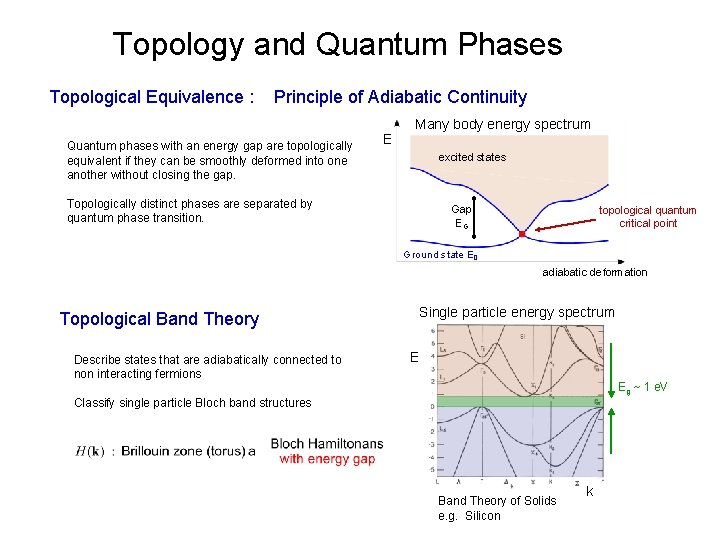
Topology and Quantum Phases Topological Equivalence : Principle of Adiabatic Continuity Quantum phases with an energy gap are topologically equivalent if they can be smoothly deformed into one another without closing the gap. E Many body energy spectrum excited states Topologically distinct phases are separated by quantum phase transition. Gap EG topological quantum critical point Ground state E 0 adiabatic deformation Topological Band Theory Describe states that are adiabatically connected to non interacting fermions Single particle energy spectrum E Eg ~ 1 e. V Classify single particle Bloch band structures Band Theory of Solids e. g. Silicon k
Topological Electronic Phases Many examples of topological band phenomena States adiabatically connected to independent electrons: - Quantum Hall (Chern) insulators - Topological insulators - Weak topological insulators - Topological crystalline insulators - Topological (Fermi, Weyl and Dirac) semimetals …. . Many real materials and experiments Topological Superconductivity Proximity induced topological superconductivity Majorana bound states, quantum information Tantalizing recent experimental progress Beyond Band Theory: Strongly correlated states State with intrinsic topological order - fractional quantum numbers - topological ground state degeneracy - quantum information - Symmetry protected topological states - Surface topological order …… Much recent conceptual progress, but theory is still far from the real electrons
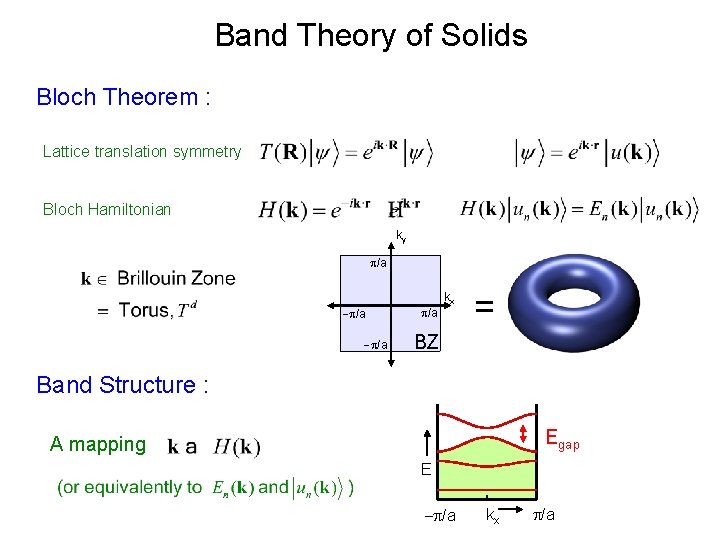
Band Theory of Solids Bloch Theorem : Lattice translation symmetry Bloch Hamiltonian ky p/a -p/a kx = BZ Band Structure : Egap A mapping E -p/a kx p/a
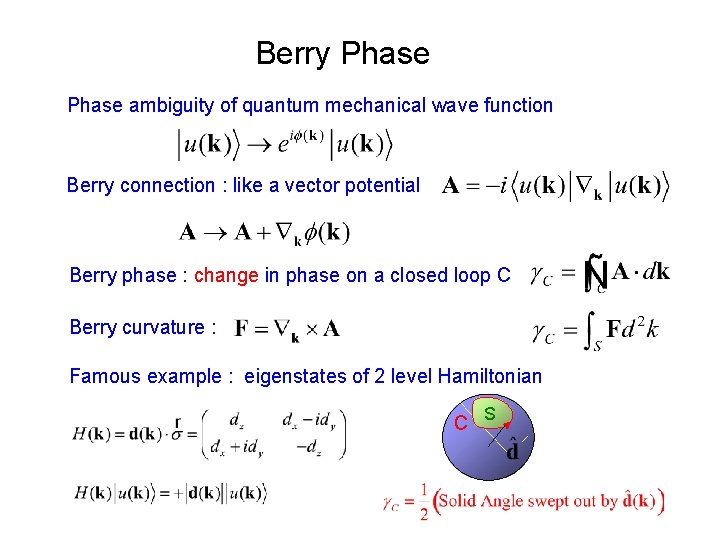
Berry Phase ambiguity of quantum mechanical wave function Berry connection : like a vector potential Berry phase : change in phase on a closed loop C Berry curvature : Famous example : eigenstates of 2 level Hamiltonian C S
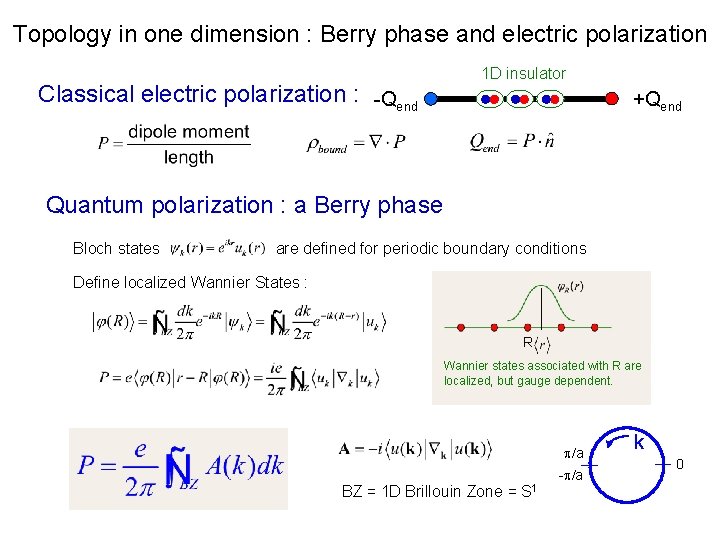
Topology in one dimension : Berry phase and electric polarization Classical electric polarization : -Qend 1 D insulator +Qend Quantum polarization : a Berry phase Bloch states are defined for periodic boundary conditions Define localized Wannier States : R Wannier states associated with R are localized, but gauge dependent. p/a BZ = 1 D Brillouin Zone = S 1 -p/a k 0
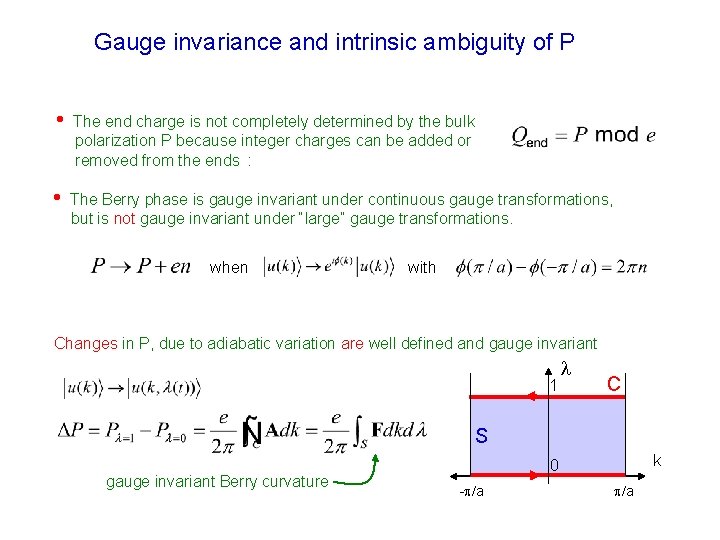
Gauge invariance and intrinsic ambiguity of P • The end charge is not completely determined by the bulk polarization P because integer charges can be added or removed from the ends : • The Berry phase is gauge invariant under continuous gauge transformations, but is not gauge invariant under “large” gauge transformations. when with Changes in P, due to adiabatic variation are well defined and gauge invariant 1 l C S gauge invariant Berry curvature k 0 -p/a
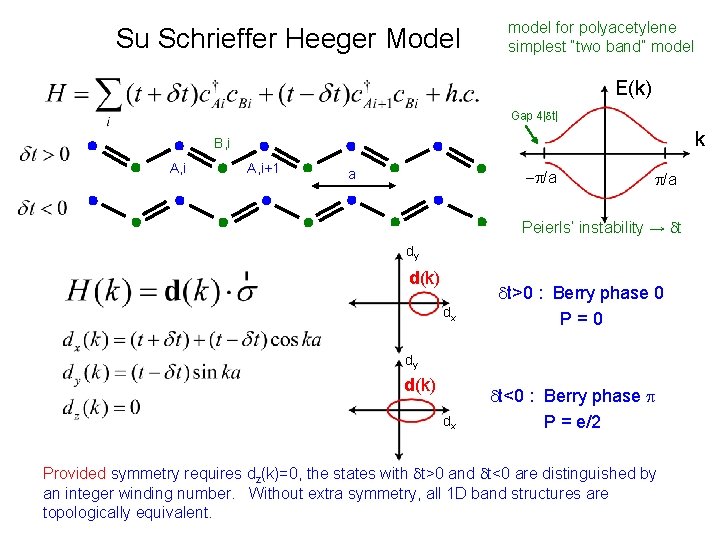
Su Schrieffer Heeger Model model for polyacetylene simplest “two band” model E(k) Gap 4|dt| k B, i A, i+1 a -p/a Peierls’ instability → dt dy d(k) dx dt>0 : Berry phase 0 P=0 dy d(k) dx dt<0 : Berry phase p P = e/2 Provided symmetry requires dz(k)=0, the states with dt>0 and dt<0 are distinguished by an integer winding number. Without extra symmetry, all 1 D band structures are topologically equivalent.
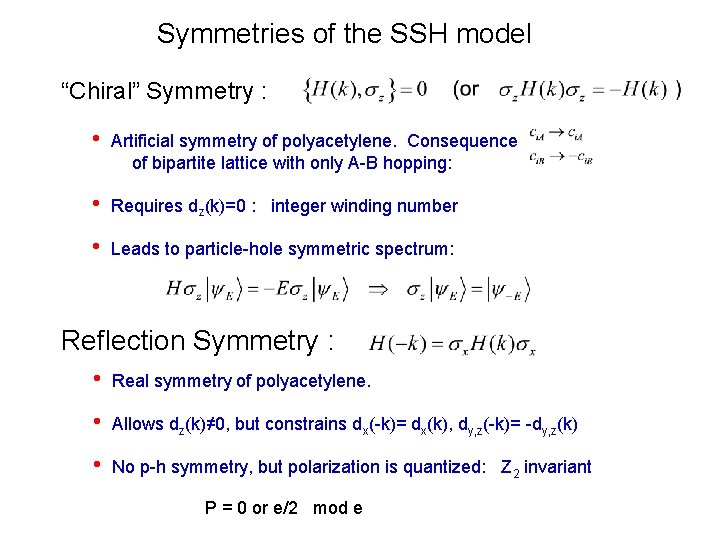
Symmetries of the SSH model “Chiral” Symmetry : • Artificial symmetry of polyacetylene. Consequence of bipartite lattice with only A-B hopping: • Requires dz(k)=0 : integer winding number • Leads to particle-hole symmetric spectrum: Reflection Symmetry : • Real symmetry of polyacetylene. • Allows dz(k)≠ 0, but constrains dx(-k)= dx(k), dy, z(-k)= -dy, z(k) • No p-h symmetry, but polarization is quantized: Z 2 invariant P = 0 or e/2 mod e
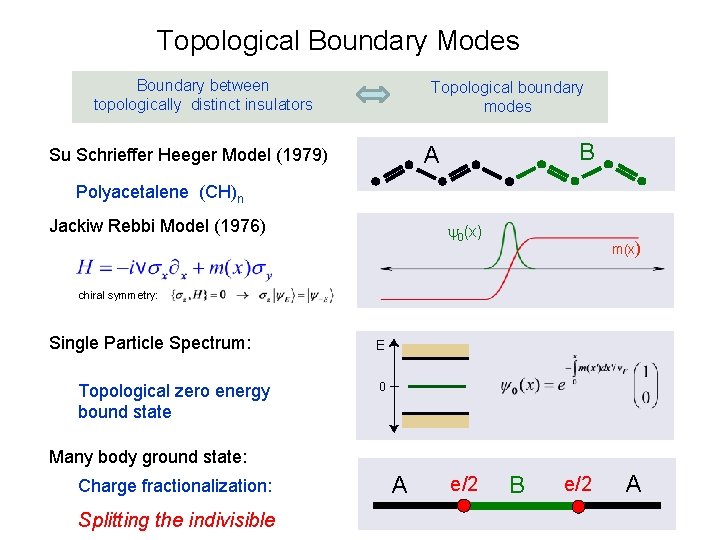
Topological Boundary Modes Boundary between topologically distinct insulators Topological boundary modes B A Su Schrieffer Heeger Model (1979) Polyacetalene (CH)n Jackiw Rebbi Model (1976) y 0(x) m(x) chiral symmetry: Single Particle Spectrum: Topological zero energy bound state E 0 Many body ground state: Charge fractionalization: Splitting the indivisible A e/2 B e/2 A
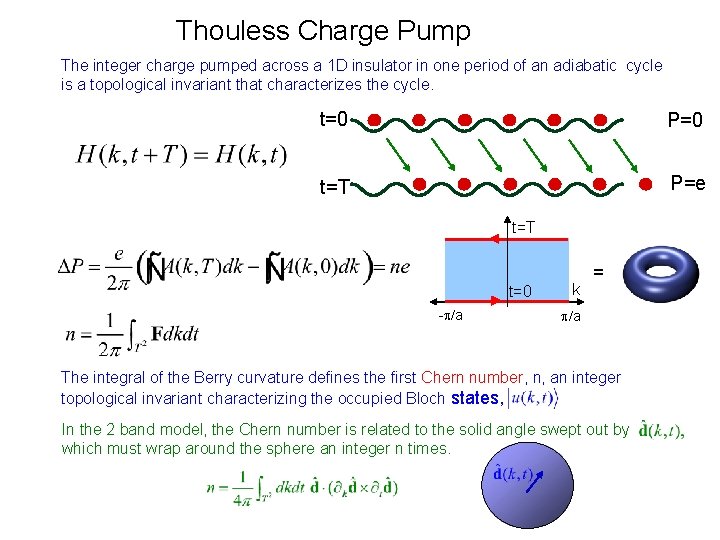
Thouless Charge Pump The integer charge pumped across a 1 D insulator in one period of an adiabatic cycle is a topological invariant that characterizes the cycle. t=0 P=0 t=T P=e t=T t=0 -p/a k = p/a The integral of the Berry curvature defines the first Chern number, n, an integer topological invariant characterizing the occupied Bloch states, In the 2 band model, the Chern number is related to the solid angle swept out by which must wrap around the sphere an integer n times.
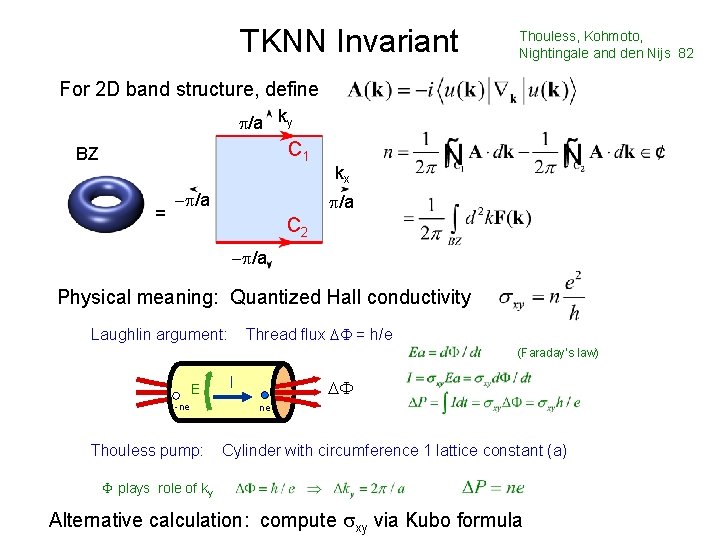
TKNN Invariant Thouless, Kohmoto, Nightingale and den Nijs 82 For 2 D band structure, define p/a ky C 1 BZ = -p/a kx p/a C 2 -p/a Physical meaning: Quantized Hall conductivity Thread flux DF = h/e Laughlin argument: (Faraday’s law) E -ne Thouless pump: I DF ne Cylinder with circumference 1 lattice constant (a) F plays role of ky Alternative calculation: compute sxy via Kubo formula
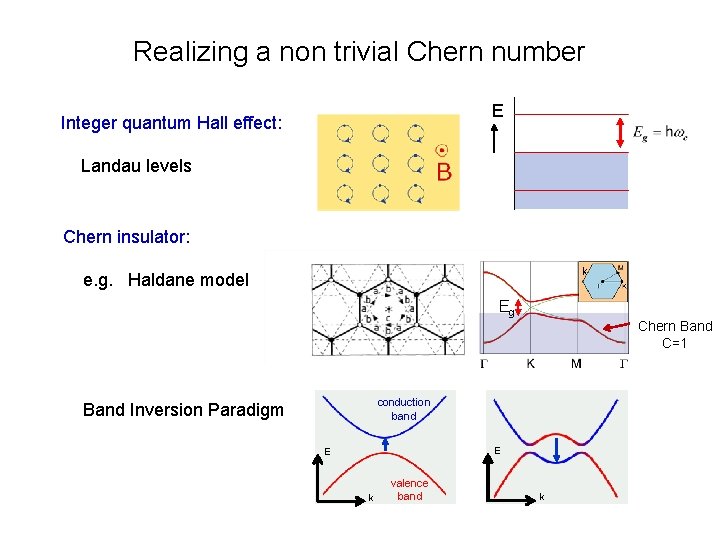
Realizing a non trivial Chern number E Integer quantum Hall effect: Landau levels Chern insulator: k e. g. Haldane model Eg Chern Band C=1 conduction band Band Inversion Paradigm E E k valence band k
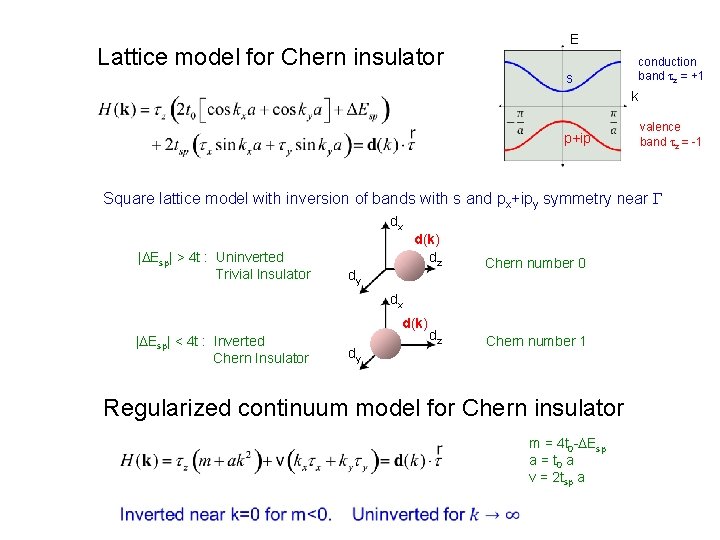
Lattice model for Chern insulator E conduction band tz = +1 s k p+ip valence band tz = -1 Square lattice model with inversion of bands with s and px+ipy symmetry near G dx |DEsp| > 4 t : Uninverted Trivial Insulator dy d(k) dz Chern number 0 dx d(k) |DEsp| < 4 t : Inverted Chern Insulator dy dz Chern number 1 Regularized continuum model for Chern insulator m = 4 t 0 -DEsp a = t 0 a v = 2 tsp a
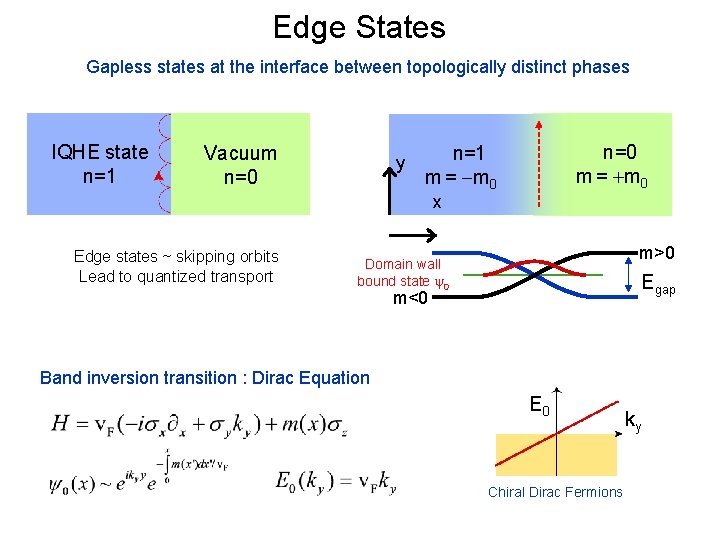
Edge States Gapless states at the interface between topologically distinct phases IQHE state n=1 Vacuum n=0 y n=0 m = +m 0 n=1 m = -m 0 x Edge states ~ skipping orbits Lead to quantized transport m>0 Domain wall bound state y 0 Egap m<0 Band inversion transition : Dirac Equation E 0 Chiral Dirac Fermions ky
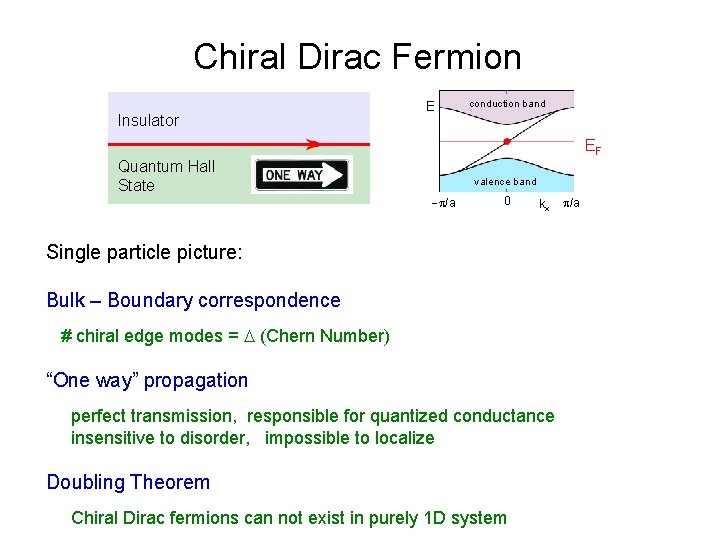
Chiral Dirac Fermion Insulator E conduction band EF Quantum Hall State valence band -p/a 0 kx Single particle picture: Bulk – Boundary correspondence # chiral edge modes = D (Chern Number) “One way” propagation perfect transmission, responsible for quantized conductance insensitive to disorder, impossible to localize Doubling Theorem Chiral Dirac fermions can not exist in purely 1 D system p/a
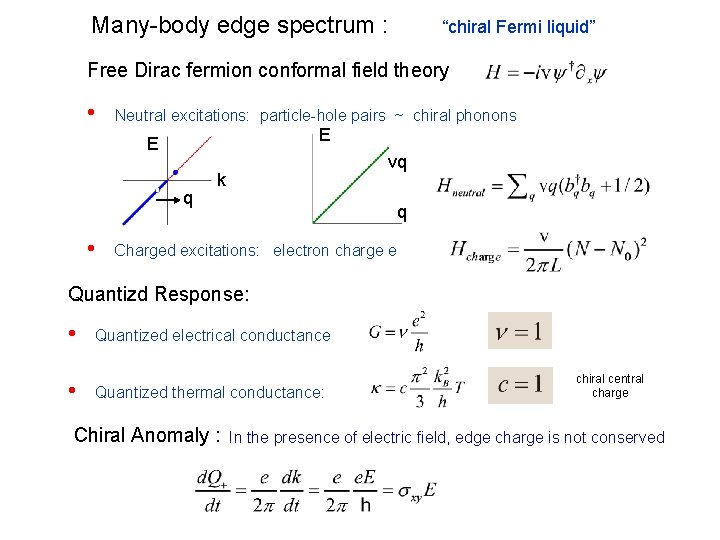
Many-body edge spectrum : “chiral Fermi liquid” Free Dirac fermion conformal field theory • Neutral excitations: particle-hole pairs ~ chiral phonons E E q • vq k q Charged excitations: electron charge e Quantizd Response: • • Quantized electrical conductance Quantized thermal conductance: Chiral Anomaly : chiral central charge In the presence of electric field, edge charge is not conserved
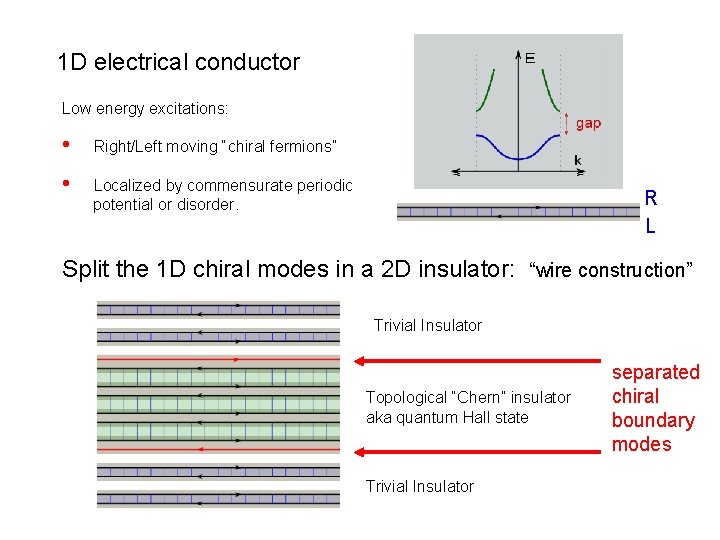
1 D electrical conductor Low energy excitations: • Right/Left moving “chiral fermions” • Localized by commensurate periodic potential or disorder. R L Split the 1 D chiral modes in a 2 D insulator: “wire construction” Trivial Insulator Topological “Chern” insulator aka quantum Hall state Trivial Insulator separated chiral boundary modes
Symmetry Protected Topological Band Insulators The presence of symmetry can rule out some topological states, but can also introduce new ones Time Reversal Symmetry Chern number n=0 Z 2 topological insulator in d=2, 3 Superconductivity: particle-hole symmetry of Bd. G Hamiltonian Z 2 topological superconductor d=1 Z topological superconductor d=2 Crystal symmetry translation : weak topological insulator reflection : topological crystalline insulator rotation non symmorphic glides, screws
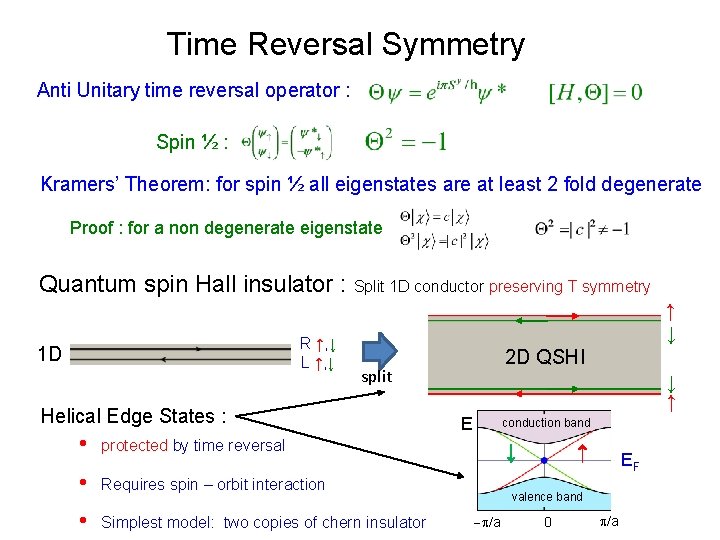
Time Reversal Symmetry Anti Unitary time reversal operator : Spin ½ : Kramers’ Theorem: for spin ½ all eigenstates are at least 2 fold degenerate Proof : for a non degenerate eigenstate Quantum spin Hall insulator : Split 1 D conductor preserving T symmetry R ↑, ↓ L ↑, ↓ 1 D ↑ ↓ 2 D QSHI split Helical Edge States : • protected by time reversal • Requires spin – orbit interaction • Simplest model: two copies of chern insulator ↓ ↑ E conduction band ↓ ↑ EF valence band -p/a 0 p/a
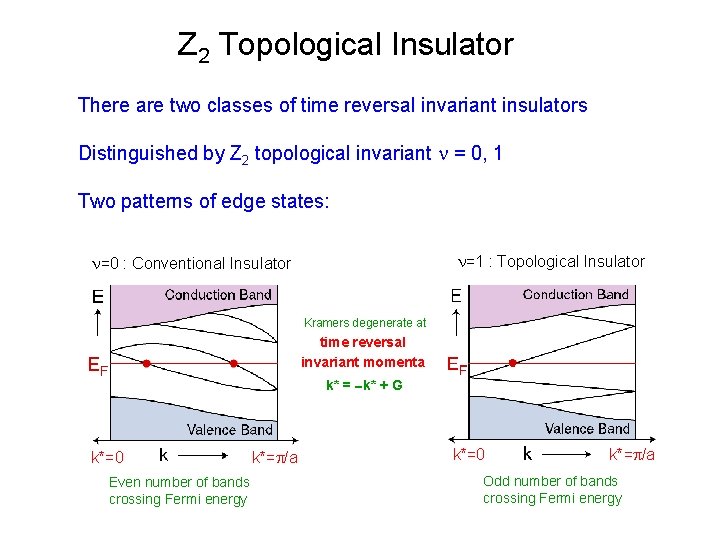
Z 2 Topological Insulator There are two classes of time reversal invariant insulators Distinguished by Z 2 topological invariant n = 0, 1 Two patterns of edge states: n=1 : Topological Insulator n=0 : Conventional Insulator Kramers degenerate at time reversal invariant momenta k* = -k* + G k*=0 Even number of bands crossing Fermi energy k*=p/a k*=0 k*=p/a Odd number of bands crossing Fermi energy
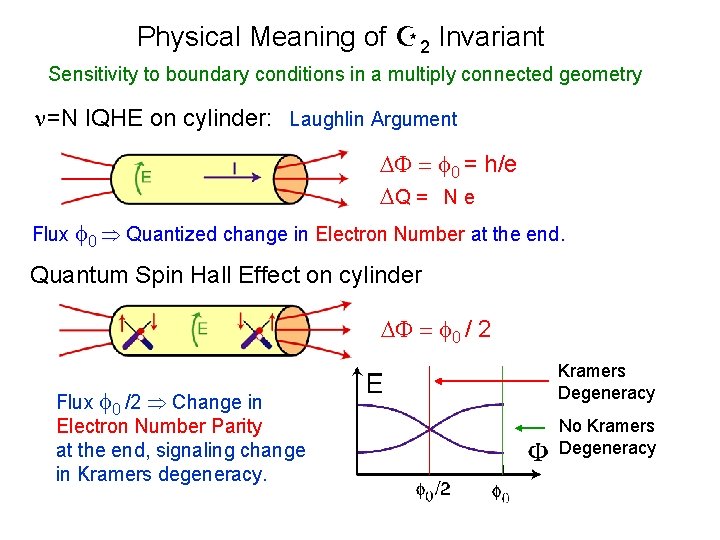
Physical Meaning of 2 Invariant Sensitivity to boundary conditions in a multiply connected geometry n=N IQHE on cylinder: Laughlin Argument DF = f 0 = h/e DQ = N e Flux f 0 Quantized change in Electron Number at the end. Quantum Spin Hall Effect on cylinder DF = f 0 / 2 Flux f 0 /2 Change in Electron Number Parity at the end, signaling change in Kramers degeneracy. Kramers Degeneracy No Kramers Degeneracy
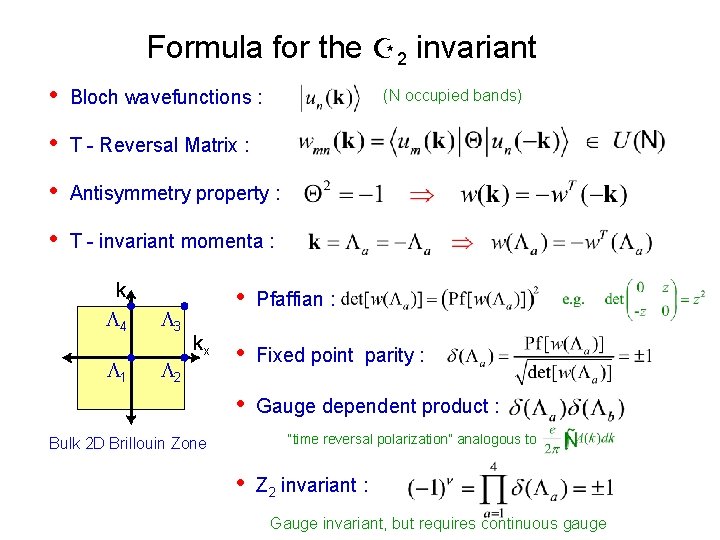
Formula for the 2 invariant • Bloch wavefunctions : • T - Reversal Matrix : • Antisymmetry property : • T - invariant momenta : ky L 4 L 1 L 3 L 2 kx (N occupied bands) • Pfaffian : • Fixed point parity : • Gauge dependent product : “time reversal polarization” analogous to Bulk 2 D Brillouin Zone • Z 2 invariant : Gauge invariant, but requires continuous gauge
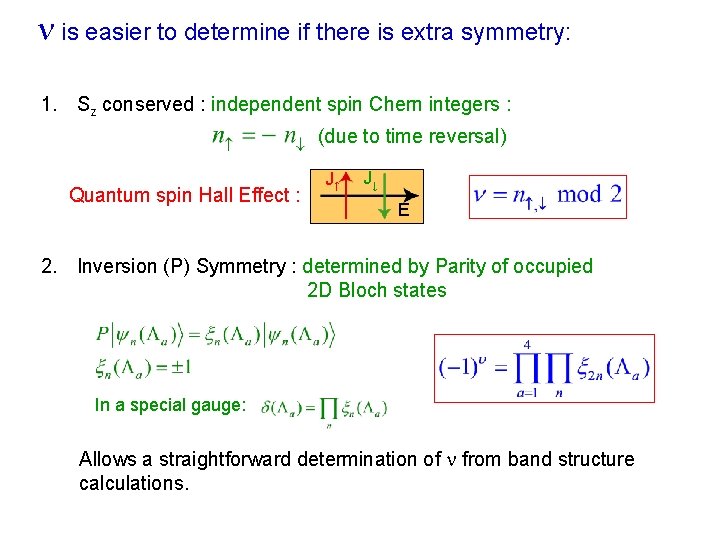
n is easier to determine if there is extra symmetry: 1. Sz conserved : independent spin Chern integers : (due to time reversal) Quantum spin Hall Effect : J↑ J↓ E 2. Inversion (P) Symmetry : determined by Parity of occupied 2 D Bloch states In a special gauge: Allows a straightforward determination of n from band structure calculations.
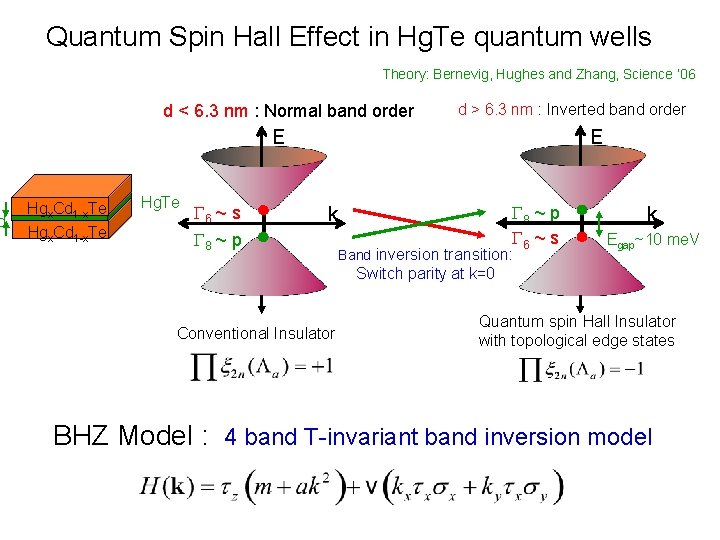
d Quantum Spin Hall Effect in Hg. Te quantum wells Theory: Bernevig, Hughes and Zhang, Science ‘ 06 d < 6. 3 nm : Normal band order d > 6. 3 nm : Inverted band order E E Hgx. Cd 1 -x. Te Hg. Te G 6 ~ s G 8 ~ p G 6 ~ s k G 8 ~ p Band inversion transition: k Egap~10 me. V Switch parity at k=0 Conventional Insulator Quantum spin Hall Insulator with topological edge states BHZ Model : 4 band T-invariant band inversion model
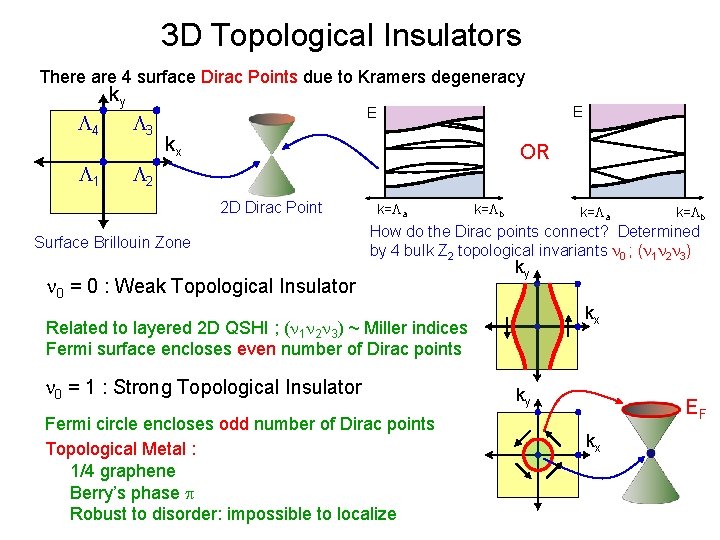
3 D Topological Insulators There are 4 surface Dirac Points due to Kramers degeneracy ky L 4 L 1 L 3 E E kx OR L 2 2 D Dirac Point Surface Brillouin Zone k=La k=Lb How do the Dirac points connect? Determined by 4 bulk Z 2 topological invariants n 0 ; (n 1 n 2 n 3) n 0 = 0 : Weak Topological Insulator ky kx Related to layered 2 D QSHI ; (n 1 n 2 n 3) ~ Miller indices Fermi surface encloses even number of Dirac points n 0 = 1 : Strong Topological Insulator Fermi circle encloses odd number of Dirac points Topological Metal : 1/4 graphene Berry’s phase p Robust to disorder: impossible to localize ky EF kx
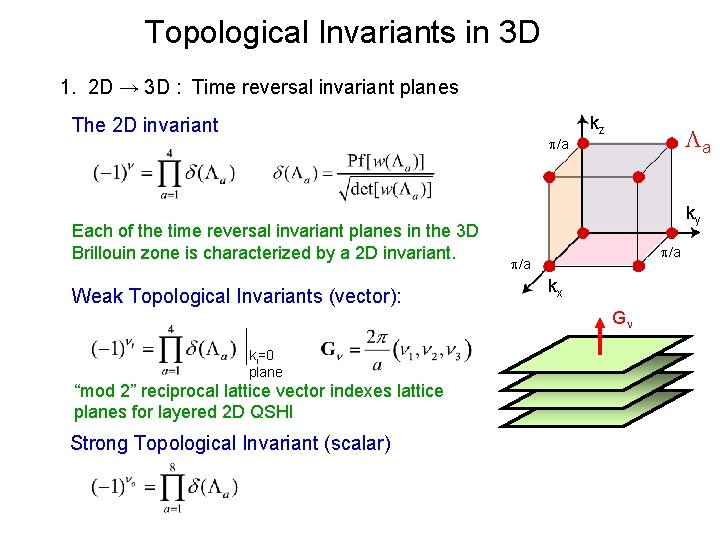
Topological Invariants in 3 D 1. 2 D → 3 D : Time reversal invariant planes The 2 D invariant p/a Each of the time reversal invariant planes in the 3 D Brillouin zone is characterized by a 2 D invariant. Weak Topological Invariants (vector): kz La ky p/a kx Gn ki=0 plane “mod 2” reciprocal lattice vector indexes lattice planes for layered 2 D QSHI Strong Topological Invariant (scalar)
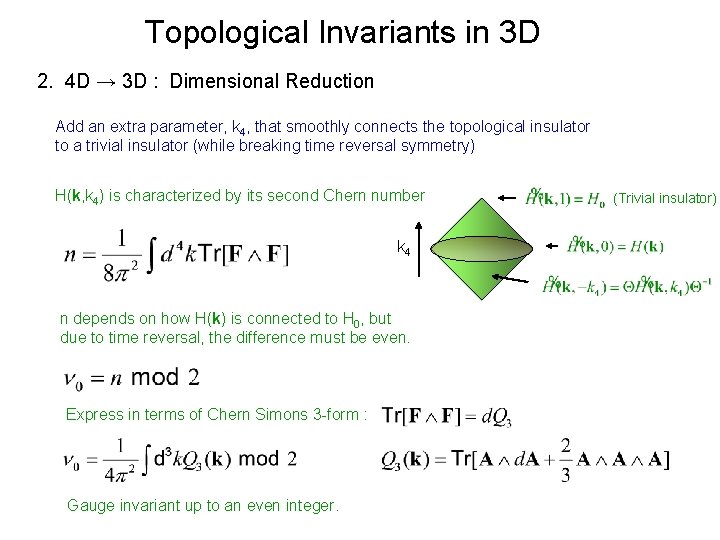
Topological Invariants in 3 D 2. 4 D → 3 D : Dimensional Reduction Add an extra parameter, k 4, that smoothly connects the topological insulator to a trivial insulator (while breaking time reversal symmetry) H(k, k 4) is characterized by its second Chern number k 4 n depends on how H(k) is connected to H 0, but due to time reversal, the difference must be even. Express in terms of Chern Simons 3 -form : Gauge invariant up to an even integer. (Trivial insulator)
- Slides: 29