
Topographic Maps Lab 2 Concepts n n n
Topographic Maps Lab 2
Concepts n n n Map projections Map scale Topographic maps n n Contour lines Topographic profiles Basic map elements “map”: a representation, usually on a flat surface, of features on the earth showing respective forms, sizes, and spatial relationships
Map Projections n Why “projections”? n n A globe is the only true representation of the Earth Have many methods of transforming the 3 D Earth’s features onto a 2 D flat surface Flat maps cannot exist without a projection Projections distort features in one of the following ways: § § Size Shape Direction Distance
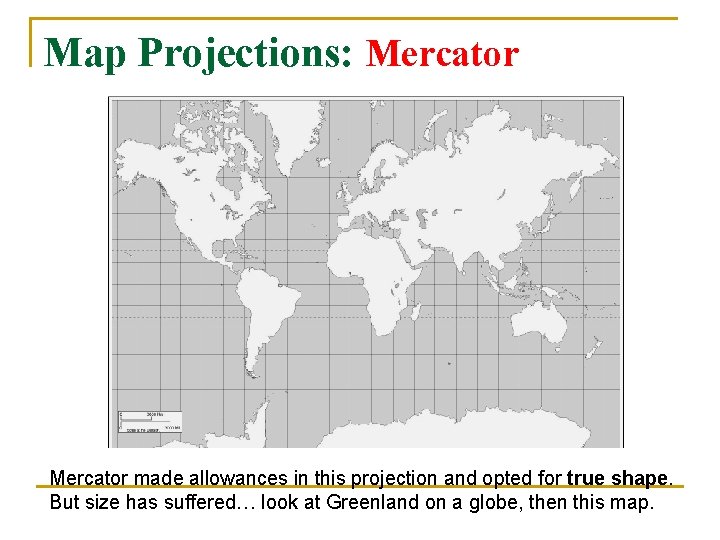
Map Projections: Mercator made allowances in this projection and opted for true shape. But size has suffered… look at Greenland on a globe, then this map.
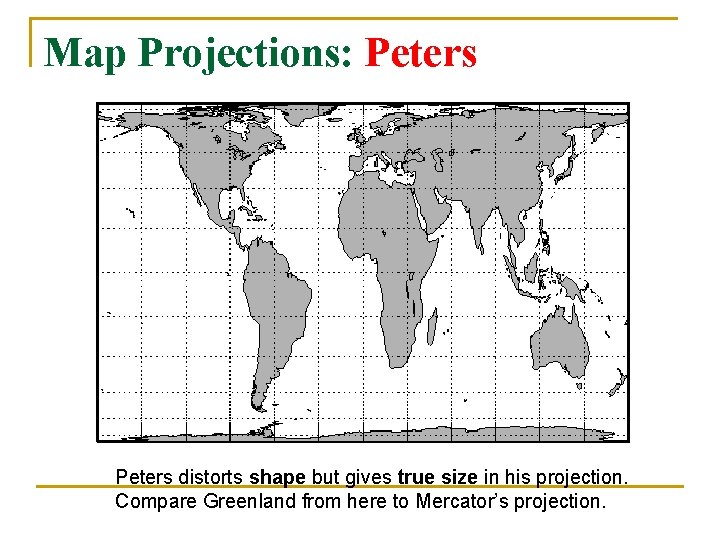
Map Projections: Peters distorts shape but gives true size in his projection. Compare Greenland from here to Mercator’s projection.
Mercator vs Peters – who is right? n n No single projection is ideal for all purposes. Depending on the use of your map, choose the projection carefully. n Learn more about projections here: http: //erg. usgs. gov/isb/pubs/Map. Projections/projections. html
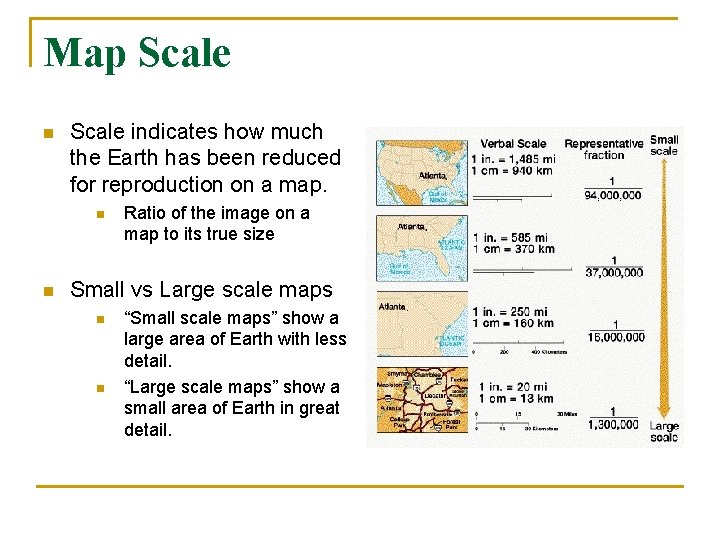
Map Scale n Scale indicates how much the Earth has been reduced for reproduction on a map. n n Ratio of the image on a map to its true size Small vs Large scale maps n n “Small scale maps” show a large area of Earth with less detail. “Large scale maps” show a small area of Earth in great detail.
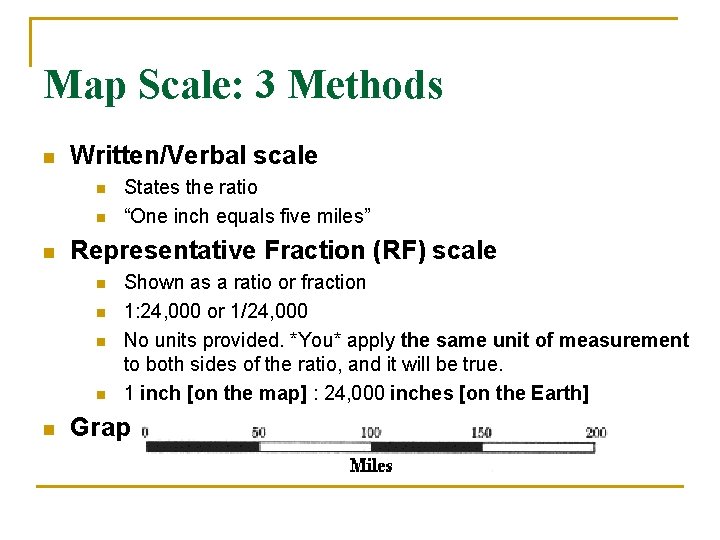
Map Scale: 3 Methods n Written/Verbal scale n n n Representative Fraction (RF) scale n n n States the ratio “One inch equals five miles” Shown as a ratio or fraction 1: 24, 000 or 1/24, 000 No units provided. *You* apply the same unit of measurement to both sides of the ratio, and it will be true. 1 inch [on the map] : 24, 000 inches [on the Earth] Graphic scale
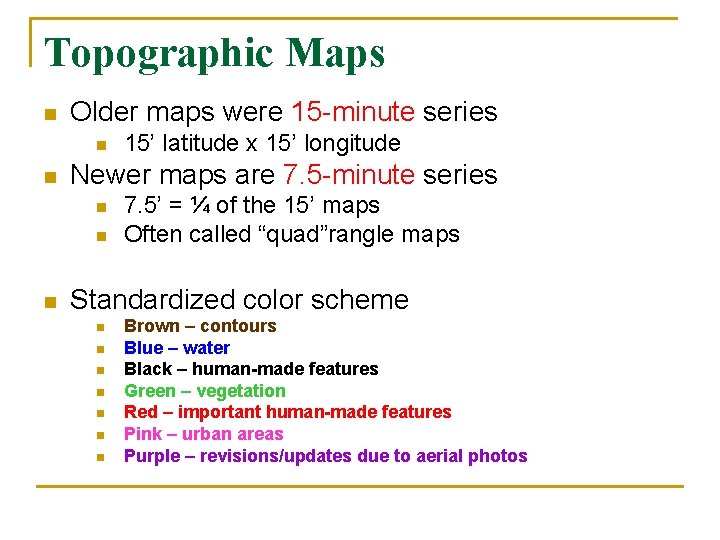
Topographic Maps n Older maps were 15 -minute series n n Newer maps are 7. 5 -minute series n n n 15’ latitude x 15’ longitude 7. 5’ = ¼ of the 15’ maps Often called “quad”rangle maps Standardized color scheme n n n n Brown – contours Blue – water Black – human-made features Green – vegetation Red – important human-made features Pink – urban areas Purple – revisions/updates due to aerial photos

Topographic Maps: Contours n Topographic maps show the lay of the land using isolines called “contours” n n n Isoline = line connecting points of equal value Contours connect points of equal elevation A datum is a reference point from which all elevations are measured. n On topo maps, what do you think is the reference point (“zero datum”)?
Topographic Maps: Contours n Rules of Contour Lines n n n Contours are drawn at regular intervals (e. g. , every 10 feet of elevation). Called “Contour Interval. ” Contours are always closed loops, though they usually travel beyond the margins of the map. Contours never cross each other. Where contours are close together, they show a rapid change in elevation. Where they are far apart, they show a gradual change. Values inside a closed contour line are higher than outside the contour line. See other rules on page 59 of your lab manual.
Topographic Maps: Contours CONTOUR INTERVAL INDEX CONTOUR n Spacing between each n Every 5 th contour line n Indicated by a heavier n This will be a line. consistent number. n Helps draw your eye n Watch for the unit of to certain intervals. measurement n Allows the mapmaker associated with the to simplify the map – contour interval. may only label index contours instead of every line.
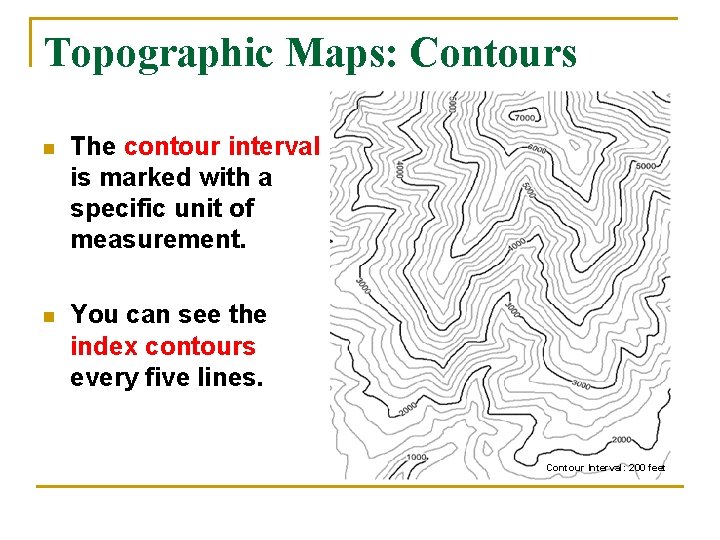
Topographic Maps: Contours n The contour interval is marked with a specific unit of measurement. n You can see the index contours every five lines. Contour Interval: 200 feet
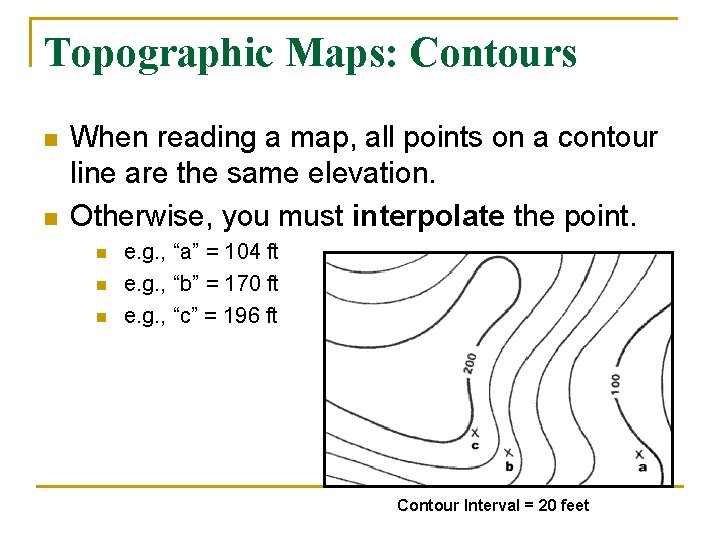
Topographic Maps: Contours n n When reading a map, all points on a contour line are the same elevation. Otherwise, you must interpolate the point. n n n e. g. , “a” = 104 ft e. g. , “b” = 170 ft e. g. , “c” = 196 ft Contour Interval = 20 feet
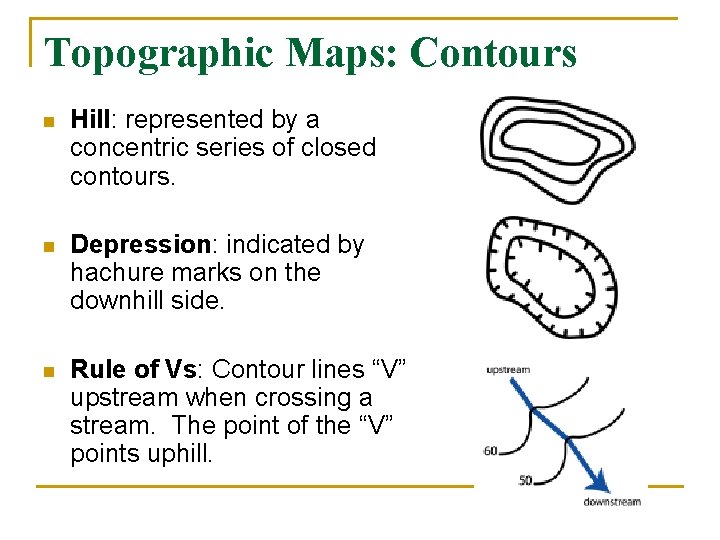
Topographic Maps: Contours n Hill: represented by a concentric series of closed contours. n Depression: indicated by hachure marks on the downhill side. n Rule of Vs: Contour lines “V” upstream when crossing a stream. The point of the “V” points uphill.
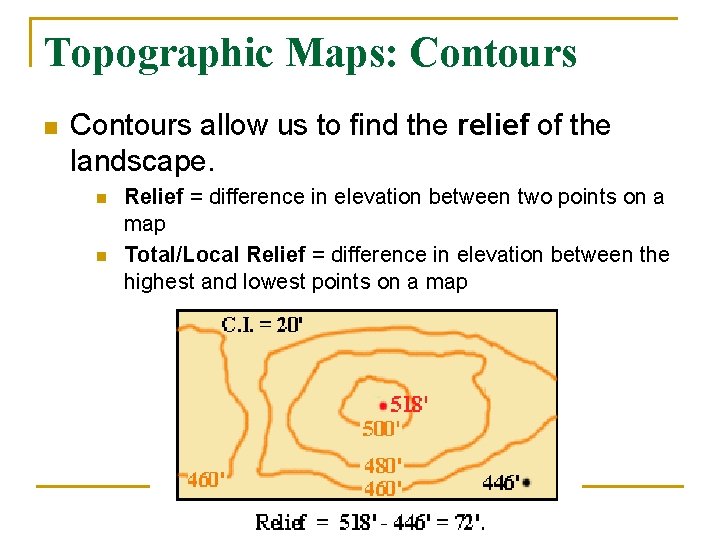
Topographic Maps: Contours n Contours allow us to find the relief of the landscape. n n Relief = difference in elevation between two points on a map Total/Local Relief = difference in elevation between the highest and lowest points on a map
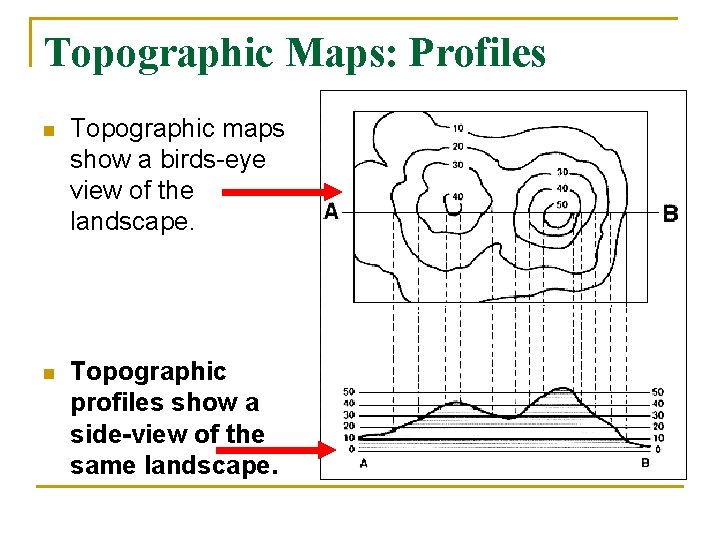
Topographic Maps: Profiles n Topographic maps show a birds-eye view of the landscape. n Topographic profiles show a side-view of the same landscape.
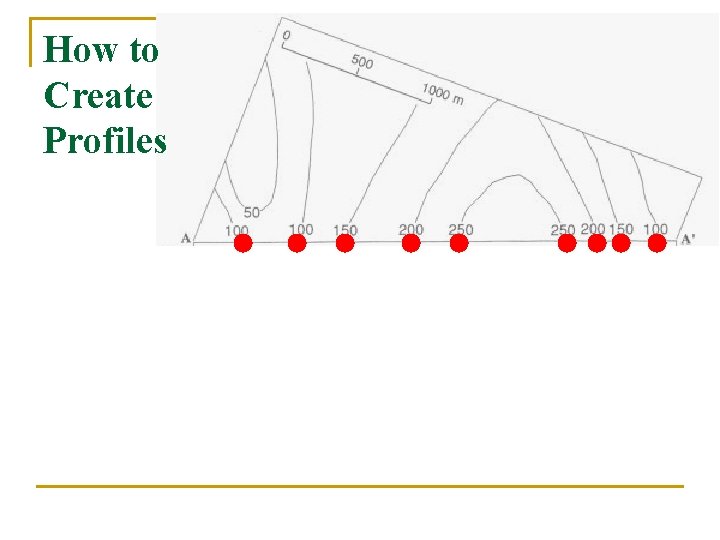
How to Create Profiles
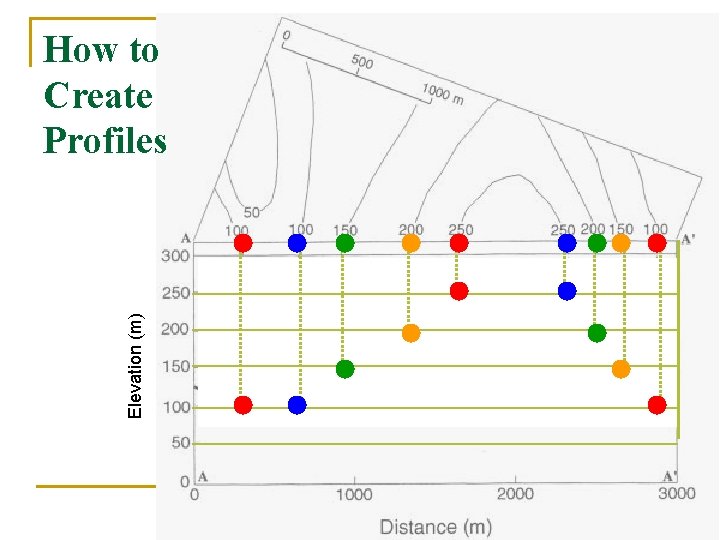
Elevation (m) How to Create Profiles
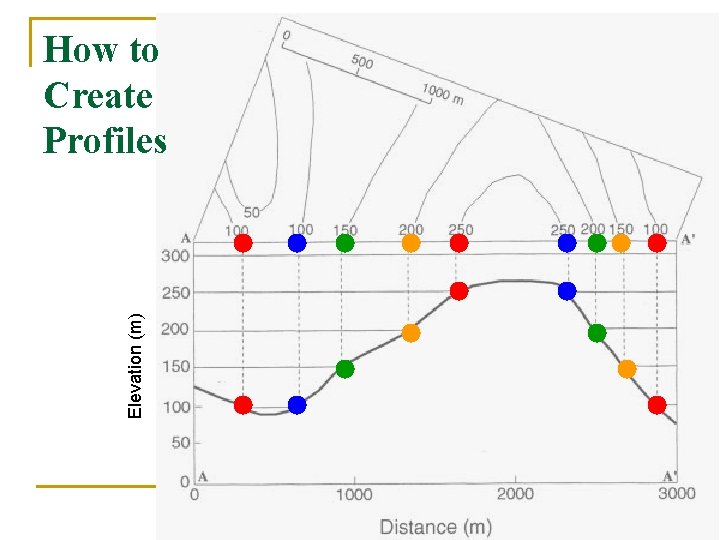
Elevation (m) How to Create Profiles
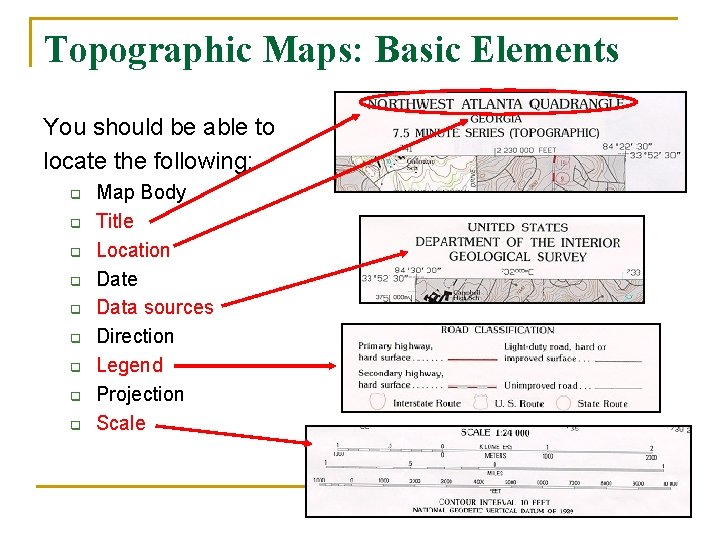
Topographic Maps: Basic Elements You should be able to locate the following: q q q q q Map Body Title Location Date Data sources Direction Legend Projection Scale
- Slides: 21