
Topographic Maps Developed by the National Emergency Services
Topographic Maps Developed by the National Emergency Services Academy Topo. Maps. PPT LAST REVISED: 9 JULY 2008 Citizens Serving Communities 1
Maps • A map is a graphic representation of a portion of the earth's surface drawn to scale, as seen from above • It uses colors, symbols, and labels to represent features found on the ground. – Cartography is the art and science of expressing the known physical features of the earth graphically by maps and charts. Topo. Maps. PPT LAST REVISED: 9 JULY 2008 Citizens Serving Communities 2
Purpose of Maps • A map provides information on the existence, the location of, and the distance between ground features, such as populated places and routes of travel and communication. • It also indicates variations in terrain, heights of natural features, and the extent of vegetation cover. Topo. Maps. PPT LAST REVISED: 9 JULY 2008 Citizens Serving Communities 3
Topographic Map • A topographic map is a representation of a three-dimensional surface on a flat piece of paper. • The word is derived from two Greek words—"topo, " meaning "place, " and "graphos, " meaning "drawn or written. “ • Symbols on maps may vary- so always check the legend Topo. Maps. PPT LAST REVISED: 9 JULY 2008 Citizens Serving Communities 4
Map Care • Maps are documents printed on paper and require protection from water, mud, and tearing. • Whenever possible, a map should be carried in a waterproof case, in a pocket, or in some other place where it is handy for use but still protected – Care must also be taken when using a map since it may have to last a long time. Topo. Maps. PPT LAST REVISED: 9 JULY 2008 Citizens Serving Communities 5
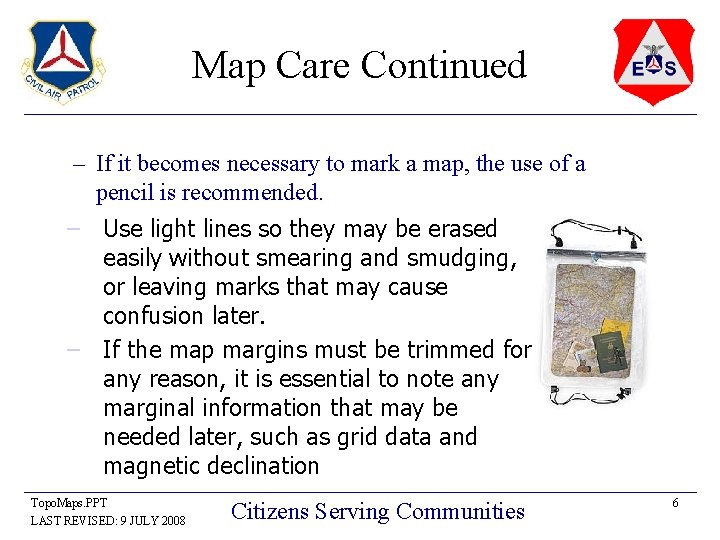
Map Care Continued – If it becomes necessary to mark a map, the use of a pencil is recommended. – Use light lines so they may be erased easily without smearing and smudging, or leaving marks that may cause confusion later. – If the map margins must be trimmed for any reason, it is essential to note any marginal information that may be needed later, such as grid data and magnetic declination Topo. Maps. PPT LAST REVISED: 9 JULY 2008 Citizens Serving Communities 6
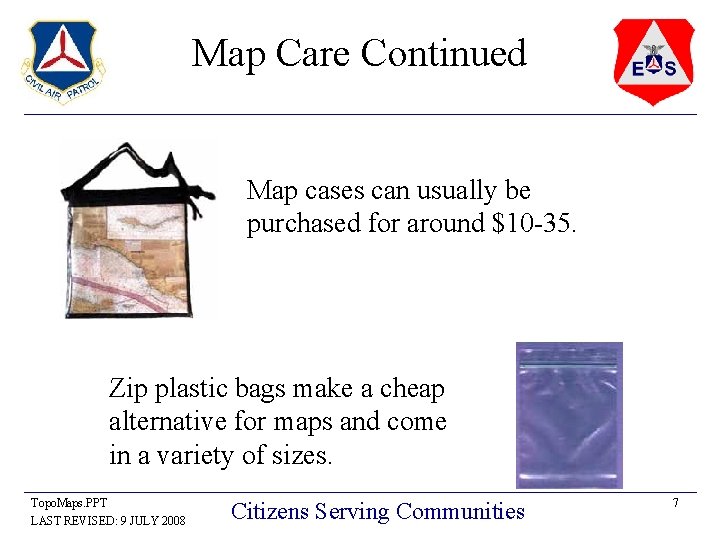
Map Care Continued Map cases can usually be purchased for around $10 -35. Zip plastic bags make a cheap alternative for maps and come in a variety of sizes. Topo. Maps. PPT LAST REVISED: 9 JULY 2008 Citizens Serving Communities 7
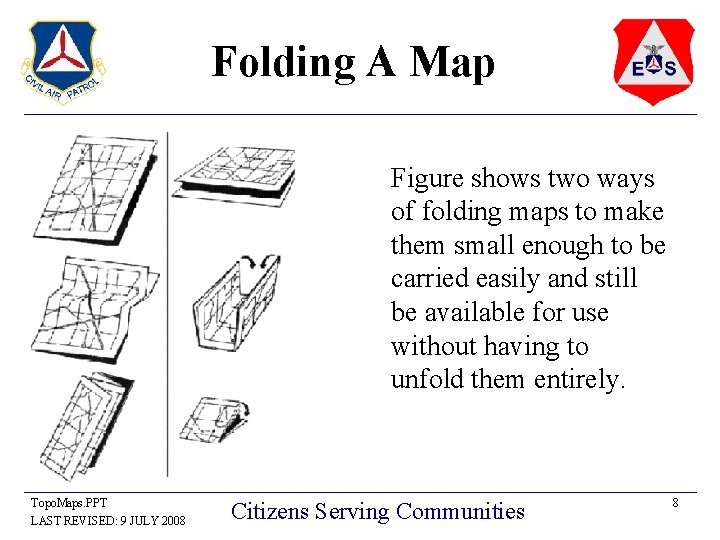
Folding A Map Figure shows two ways of folding maps to make them small enough to be carried easily and still be available for use without having to unfold them entirely. Topo. Maps. PPT LAST REVISED: 9 JULY 2008 Citizens Serving Communities 8

Map Scale • Simply defined, scale is the relationship between distance on the map and distance on the ground. A map scale usually is given as a fraction or a ratio— 1/10, 000 or 1: 10, 000. These "representative fraction" scales mean that 1 unit of measurement on the map— 1 inch or 1 centimeter— represents 10, 000 of the same units on the ground. Topo. Maps. PPT LAST REVISED: 9 JULY 2008 Citizens Serving Communities 9
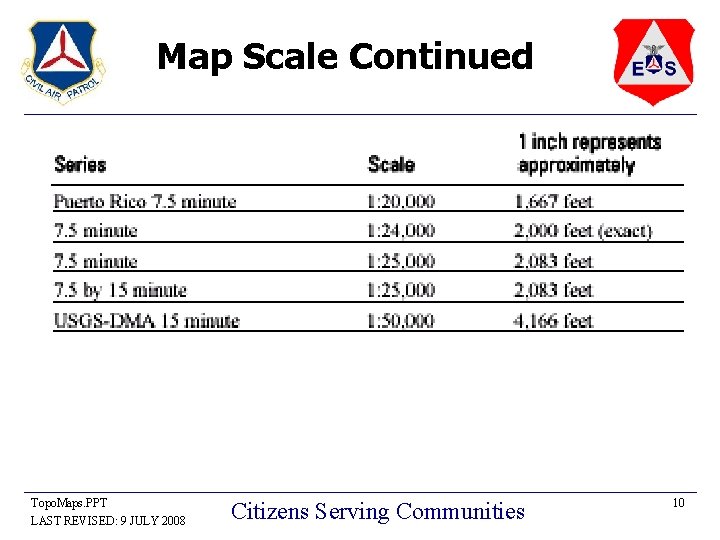
Map Scale Continued Topo. Maps. PPT LAST REVISED: 9 JULY 2008 Citizens Serving Communities 10
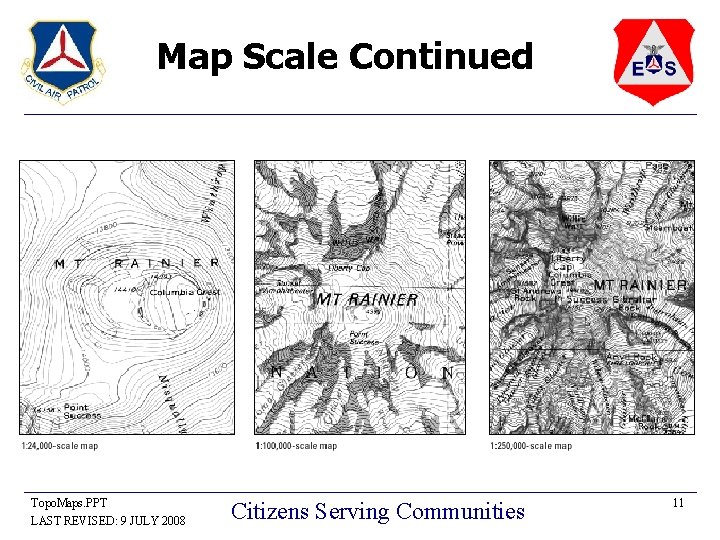
Map Scale Continued Topo. Maps. PPT LAST REVISED: 9 JULY 2008 Citizens Serving Communities 11
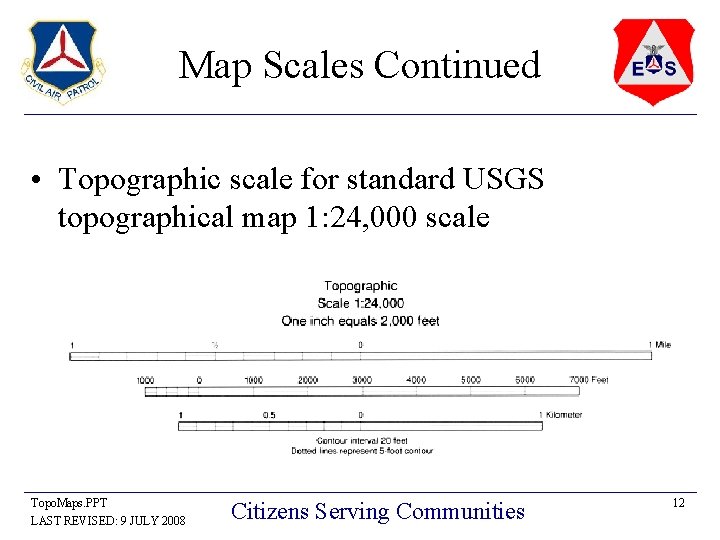
Map Scales Continued • Topographic scale for standard USGS topographical map 1: 24, 000 scale Topo. Maps. PPT LAST REVISED: 9 JULY 2008 Citizens Serving Communities 12
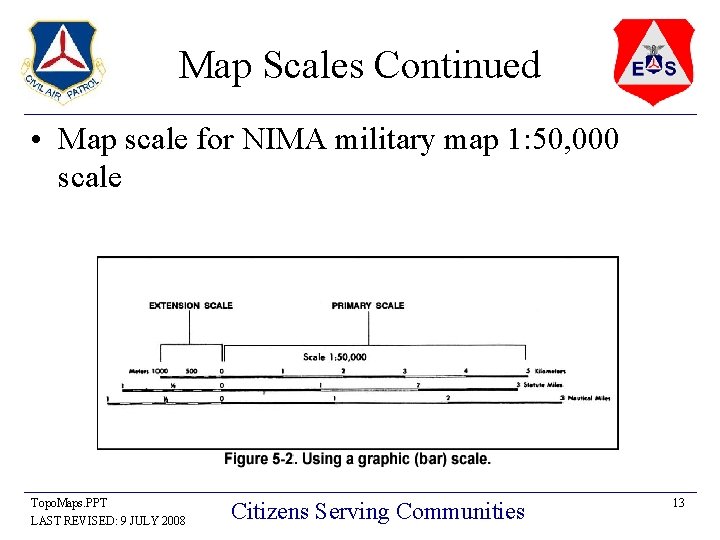
Map Scales Continued • Map scale for NIMA military map 1: 50, 000 scale Topo. Maps. PPT LAST REVISED: 9 JULY 2008 Citizens Serving Communities 13
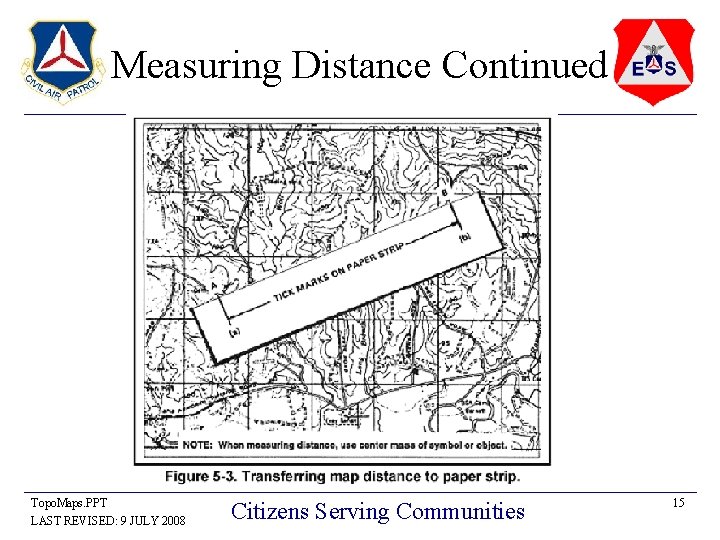
Measuring Distance • To determine straight-line distance between two points on a map, lay a straight-edged piece of paper on the map so that the edge of the paper touches both points and extends past them. • Make a tick mark on the edge of the paper at each point Topo. Maps. PPT LAST REVISED: 9 JULY 2008 Citizens Serving Communities 14
Measuring Distance Continued Topo. Maps. PPT LAST REVISED: 9 JULY 2008 Citizens Serving Communities 15

Measuring Distance Continued • To convert the map distance to ground distance, move the paper down to the graphic bar scale, and align the right tick mark (b) with a printed number in the primary scale so that the left tick mark (a) is in the extension scale Topo. Maps. PPT LAST REVISED: 9 JULY 2008 Citizens Serving Communities 16
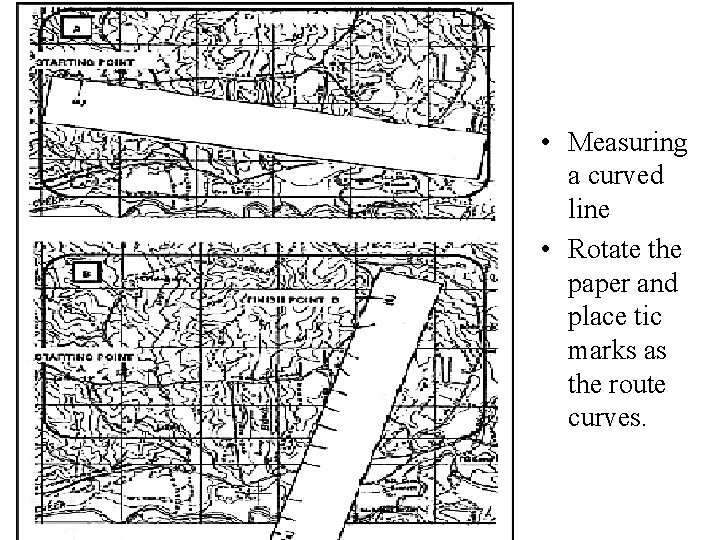
• Measuring a curved line • Rotate the paper and place tic marks as the route curves.
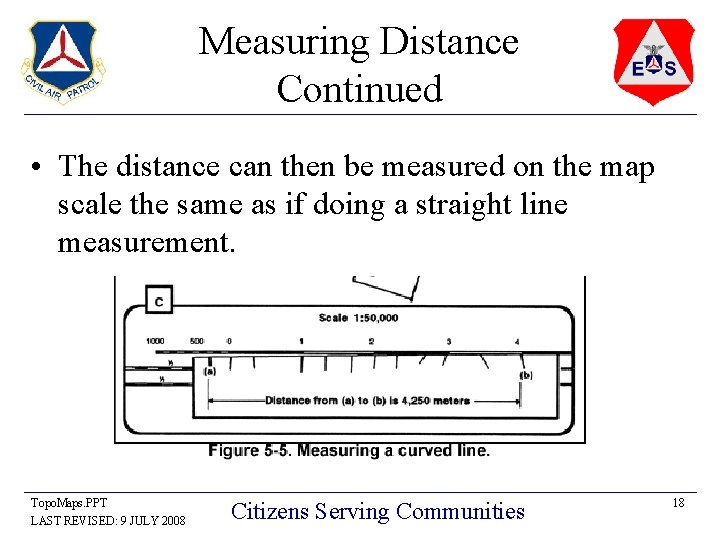
Measuring Distance Continued • The distance can then be measured on the map scale the same as if doing a straight line measurement. Topo. Maps. PPT LAST REVISED: 9 JULY 2008 Citizens Serving Communities 18
Measuring Distance Continued • Another technique that may be used to determine exact distance between two points when the edge of the paper exceeds the bar scale is to slide the edge of the paper to the right until tick mark (a) is aligned with the edge of the extension scale. Make a tick mark on the paper, in line with the 2, 000 -meter mark (c) Topo. Maps. PPT LAST REVISED: 9 JULY 2008 Citizens Serving Communities 19
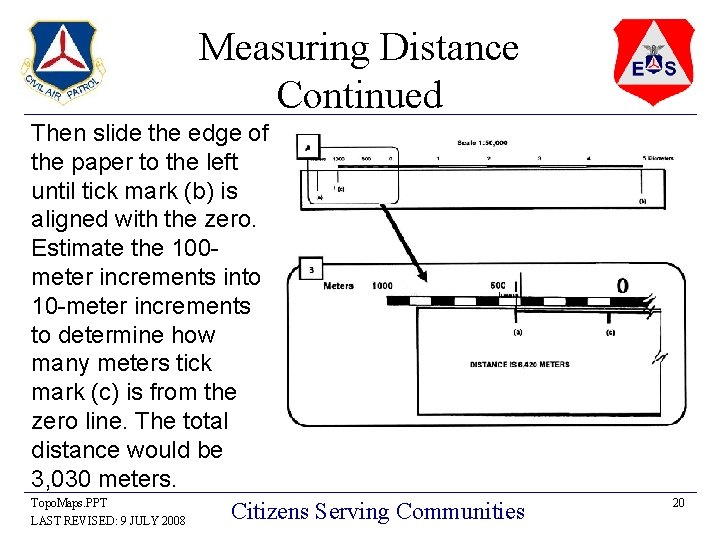
Measuring Distance Continued Then slide the edge of the paper to the left until tick mark (b) is aligned with the zero. Estimate the 100 meter increments into 10 -meter increments to determine how many meters tick mark (c) is from the zero line. The total distance would be 3, 030 meters. Topo. Maps. PPT Citizens Serving Communities LAST REVISED: 9 JULY 2008 20
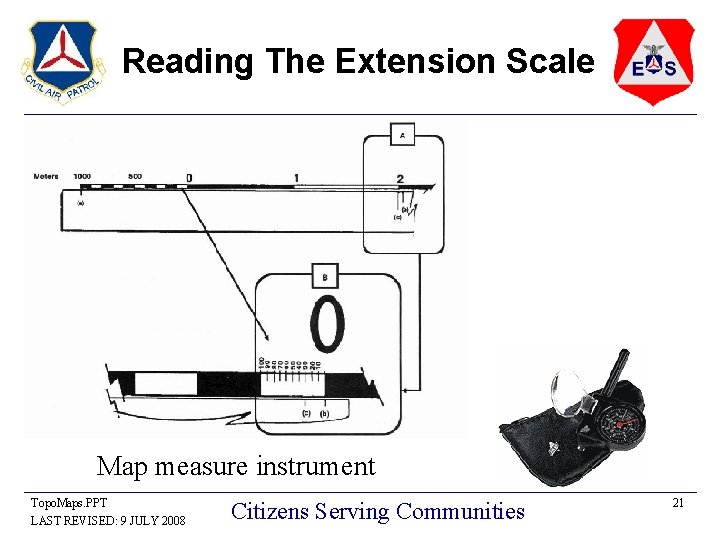
Reading The Extension Scale Map measure instrument Topo. Maps. PPT LAST REVISED: 9 JULY 2008 Citizens Serving Communities 21
Elevation & Relief • Elevation of a point on the earth’s surface is the vertical distance it is above or below mean sea level. • Relief is the representation (as depicted by the mapmaker) of the shapes of hills, valleys, streams, or terrain features on the earth's surface. Topo. Maps. PPT LAST REVISED: 9 JULY 2008 Citizens Serving Communities 22
Contour Lines • Contour lines are the most common method of showing relief and elevation on a standard topographic map. • A contour line represents an imaginary line on the ground, above or below sea level. • All points on the contour line are at the same elevation. • Contour interval may vary from different maps. Topo. Maps. PPT LAST REVISED: 9 JULY 2008 Citizens Serving Communities 23
Contour Lines Continued • Three types of contour lines- Index, Intermediate, and Supplementary. • Index. Starting at zero elevation or mean sea level, every fifth contour line is a heavier line. These are known as index contour lines. Normally, each index contour line is numbered at some point. This number is the elevation of that line. Topo. Maps. PPT LAST REVISED: 9 JULY 2008 Citizens Serving Communities 24
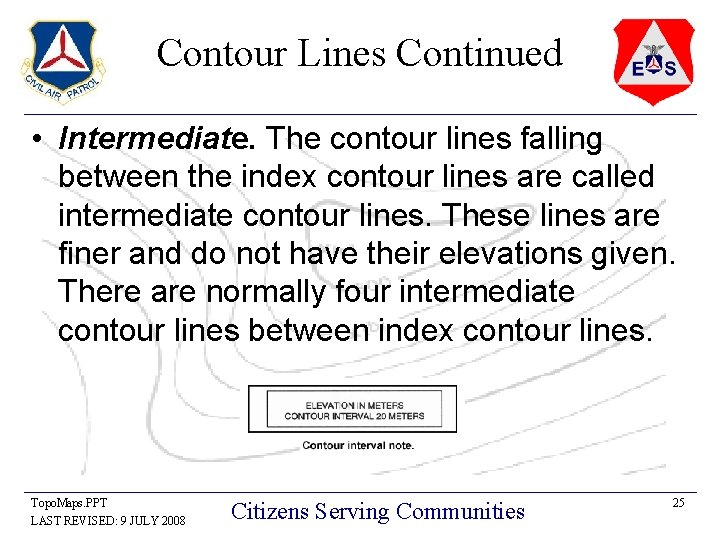
Contour Lines Continued • Intermediate. The contour lines falling between the index contour lines are called intermediate contour lines. These lines are finer and do not have their elevations given. There are normally four intermediate contour lines between index contour lines. Topo. Maps. PPT LAST REVISED: 9 JULY 2008 Citizens Serving Communities 25
Contour Lines Continued • Supplementary. These contour lines resemble dashes. They show changes in elevation of at least one-half the contour interval. These lines are normally found where there is very little change in elevation, such as on fairly level terrain. • Before the elevation of any point on the map can be determined, the user must know the contour interval for the map he is using. Topo. Maps. PPT LAST REVISED: 9 JULY 2008 Citizens Serving Communities 26
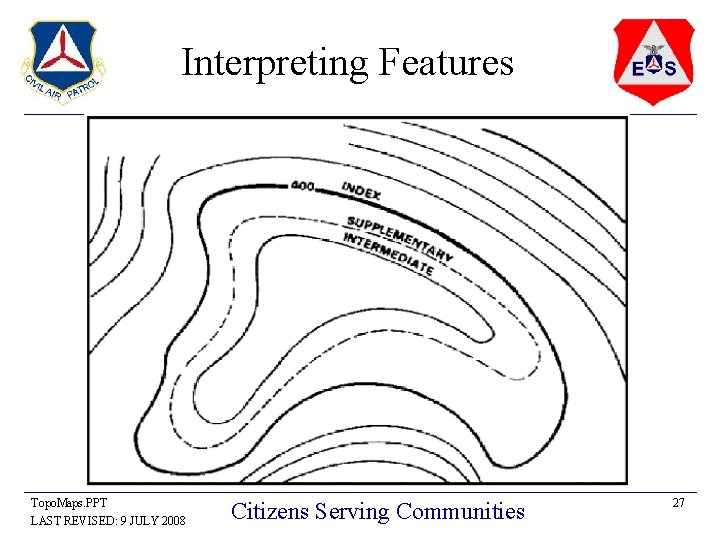
Interpreting Features Topo. Maps. PPT LAST REVISED: 9 JULY 2008 Citizens Serving Communities 27
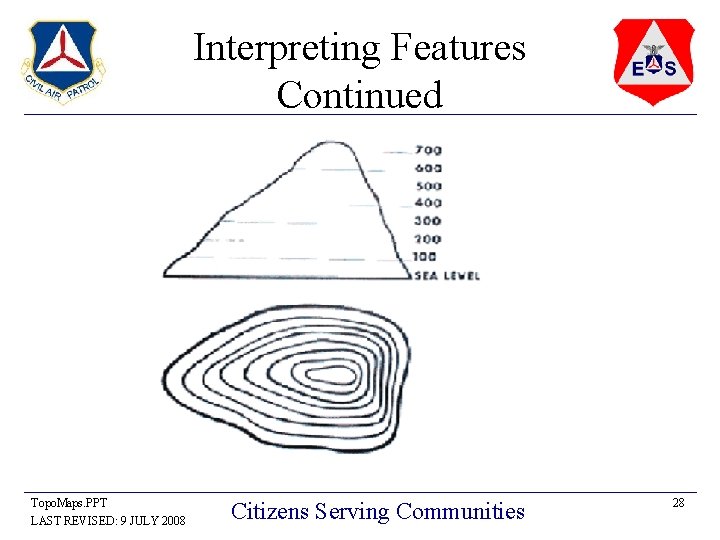
Interpreting Features Continued Topo. Maps. PPT LAST REVISED: 9 JULY 2008 Citizens Serving Communities 28
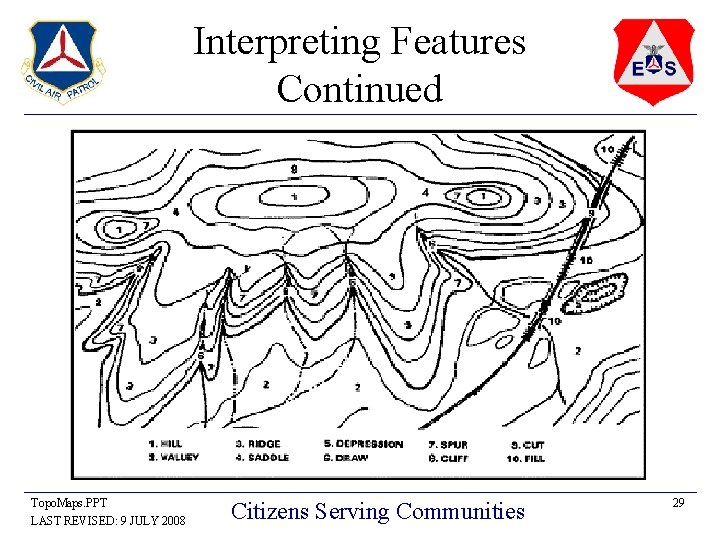
Interpreting Features Continued Topo. Maps. PPT LAST REVISED: 9 JULY 2008 Citizens Serving Communities 29
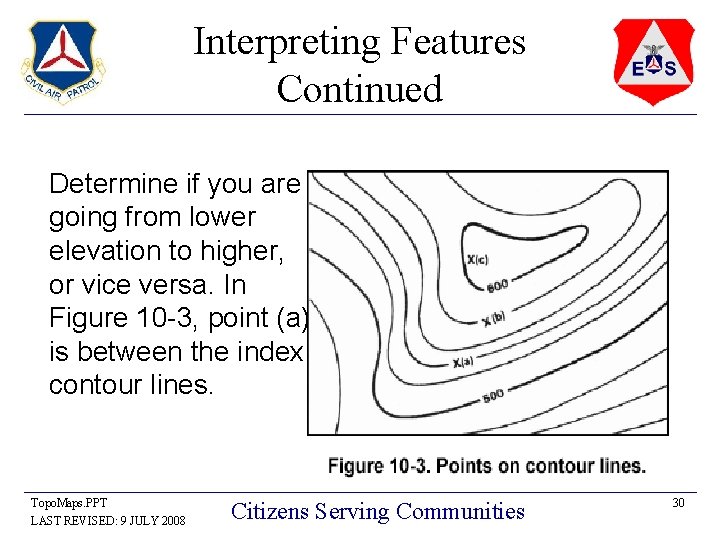
Interpreting Features Continued Determine if you are going from lower elevation to higher, or vice versa. In Figure 10 -3, point (a) is between the index contour lines. Topo. Maps. PPT LAST REVISED: 9 JULY 2008 Citizens Serving Communities 30
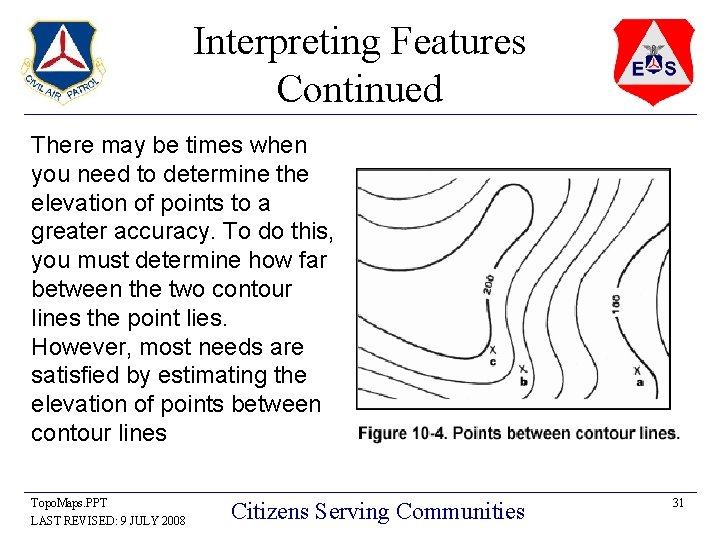
Interpreting Features Continued There may be times when you need to determine the elevation of points to a greater accuracy. To do this, you must determine how far between the two contour lines the point lies. However, most needs are satisfied by estimating the elevation of points between contour lines Topo. Maps. PPT LAST REVISED: 9 JULY 2008 Citizens Serving Communities 31
Interpreting Features Continued Topo. Maps. PPT LAST REVISED: 9 JULY 2008 Citizens Serving Communities 32
Interpreting Features Continued Topo. Maps. PPT LAST REVISED: 9 JULY 2008 Citizens Serving Communities 33
Interpreting Features Continued Topo. Maps. PPT LAST REVISED: 9 JULY 2008 Citizens Serving Communities 34
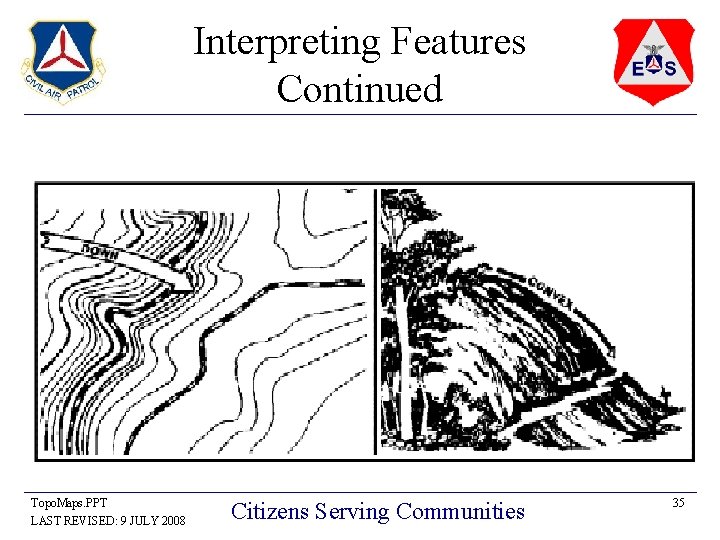
Interpreting Features Continued Topo. Maps. PPT LAST REVISED: 9 JULY 2008 Citizens Serving Communities 35
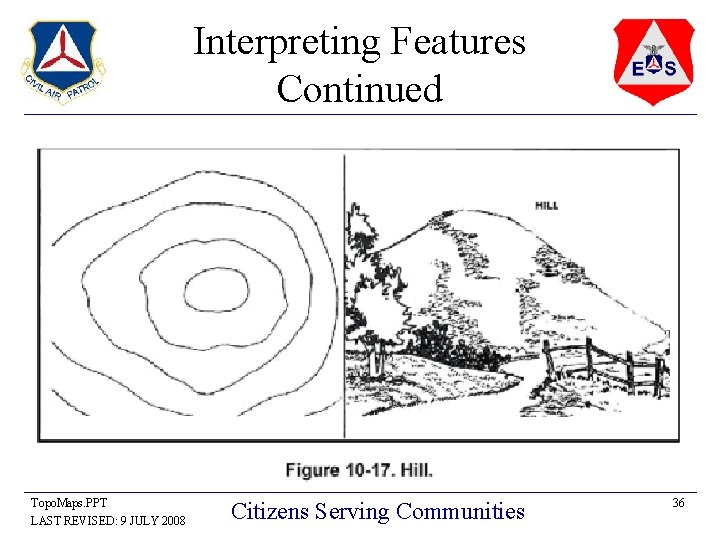
Interpreting Features Continued Topo. Maps. PPT LAST REVISED: 9 JULY 2008 Citizens Serving Communities 36
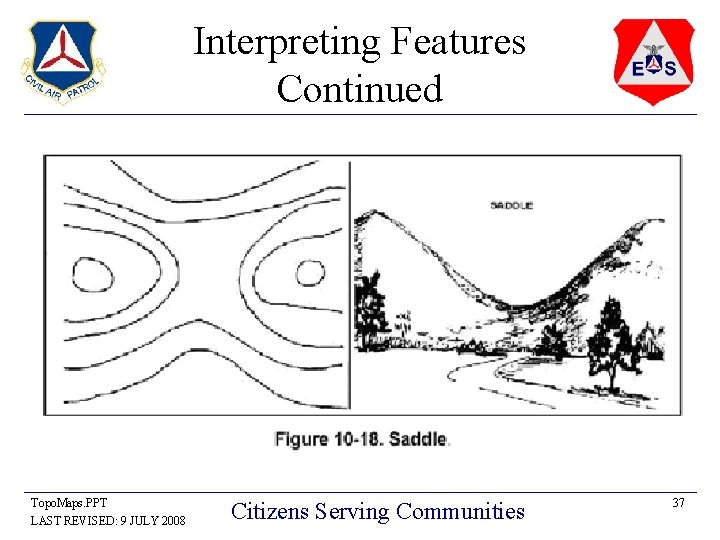
Interpreting Features Continued Topo. Maps. PPT LAST REVISED: 9 JULY 2008 Citizens Serving Communities 37
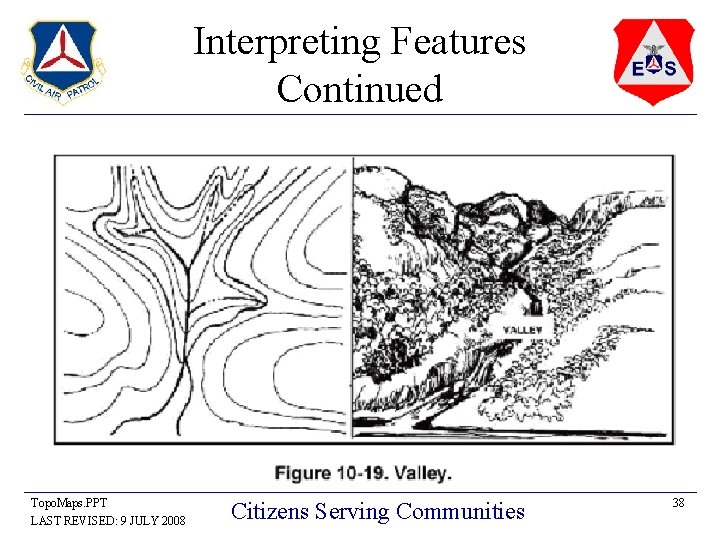
Interpreting Features Continued Topo. Maps. PPT LAST REVISED: 9 JULY 2008 Citizens Serving Communities 38
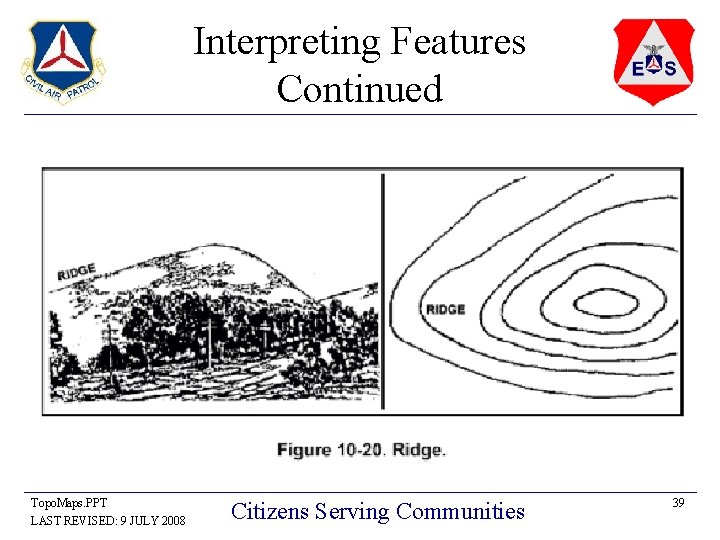
Interpreting Features Continued Topo. Maps. PPT LAST REVISED: 9 JULY 2008 Citizens Serving Communities 39
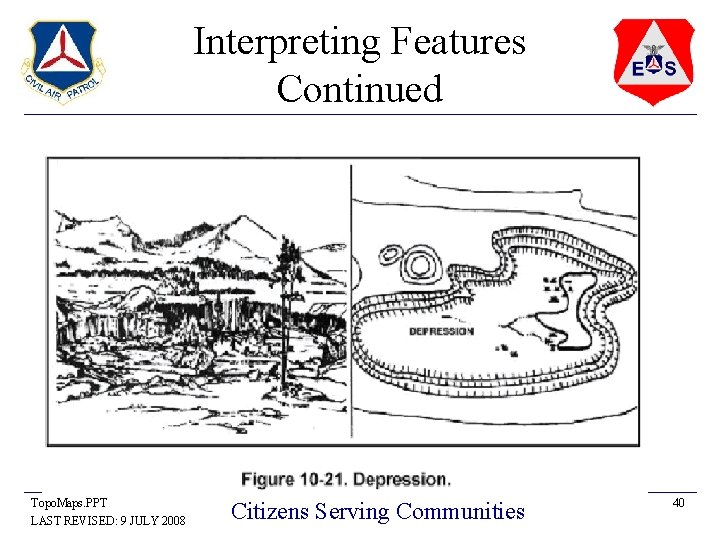
Interpreting Features Continued Topo. Maps. PPT LAST REVISED: 9 JULY 2008 Citizens Serving Communities 40
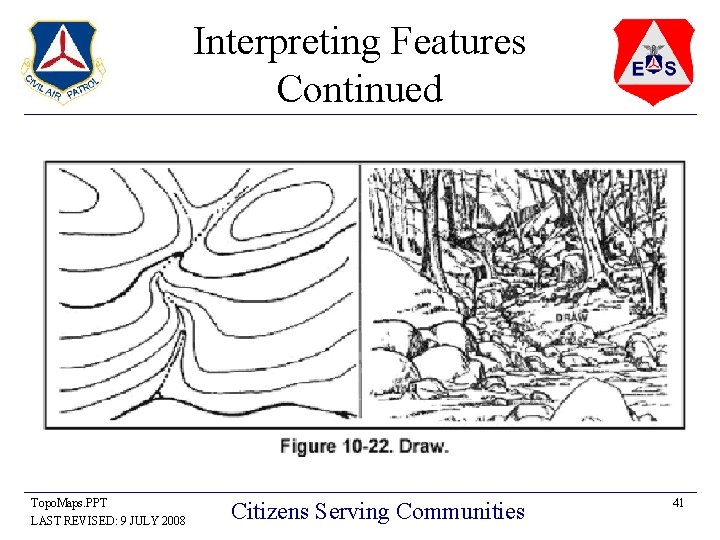
Interpreting Features Continued Topo. Maps. PPT LAST REVISED: 9 JULY 2008 Citizens Serving Communities 41
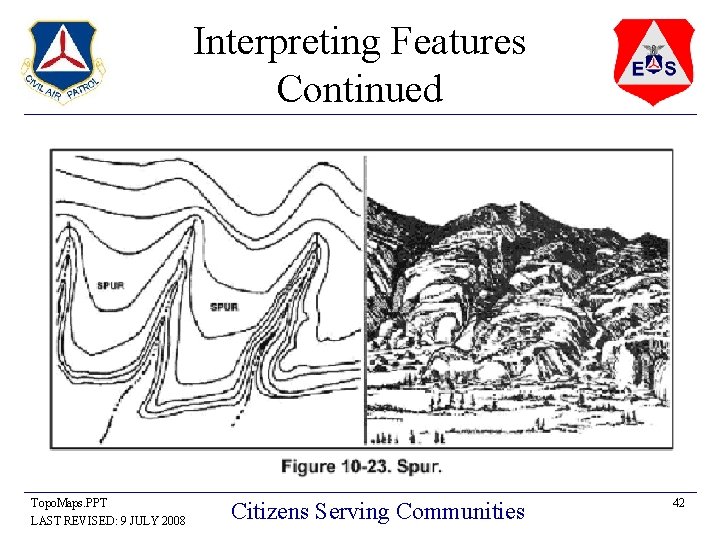
Interpreting Features Continued Topo. Maps. PPT LAST REVISED: 9 JULY 2008 Citizens Serving Communities 42
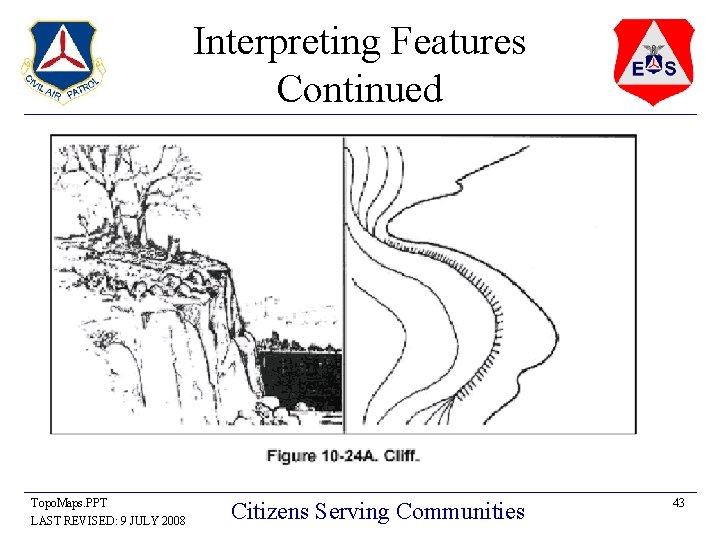
Interpreting Features Continued Topo. Maps. PPT LAST REVISED: 9 JULY 2008 Citizens Serving Communities 43
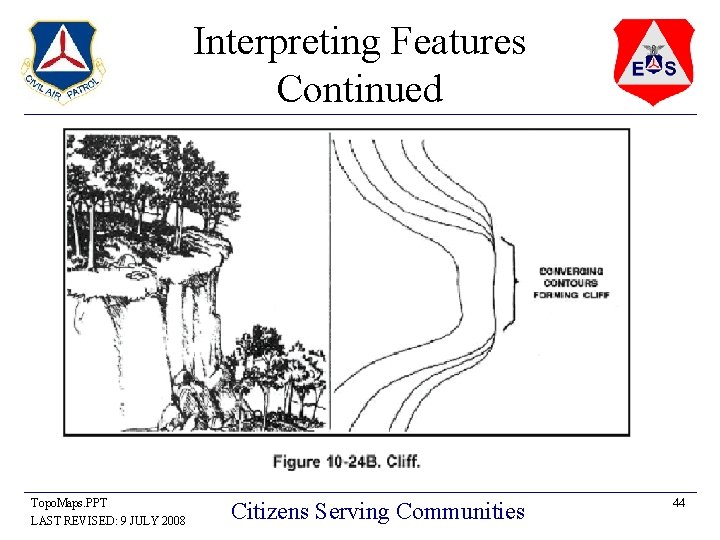
Interpreting Features Continued Topo. Maps. PPT LAST REVISED: 9 JULY 2008 Citizens Serving Communities 44
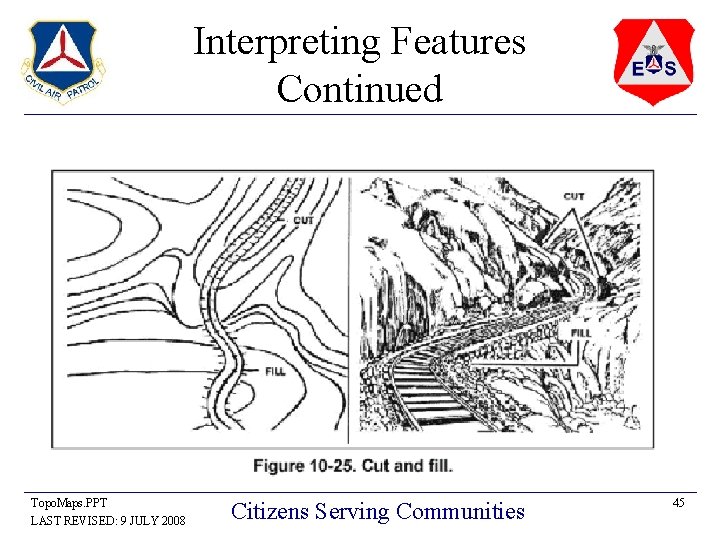
Interpreting Features Continued Topo. Maps. PPT LAST REVISED: 9 JULY 2008 Citizens Serving Communities 45
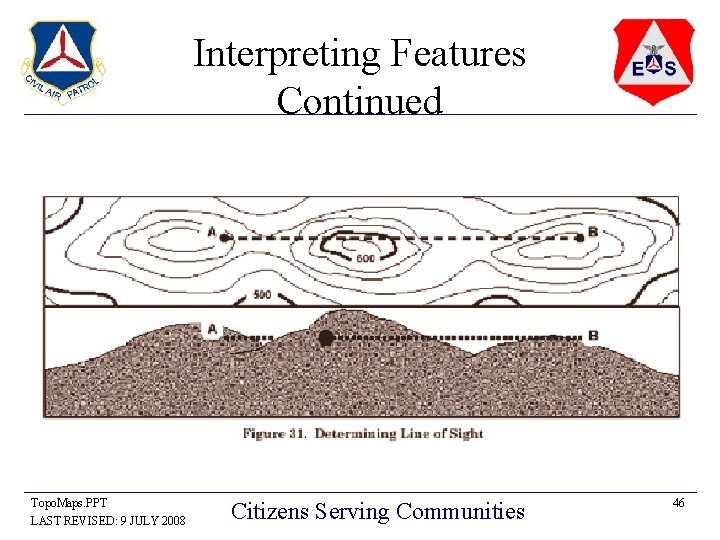
Interpreting Features Continued Topo. Maps. PPT LAST REVISED: 9 JULY 2008 Citizens Serving Communities 46
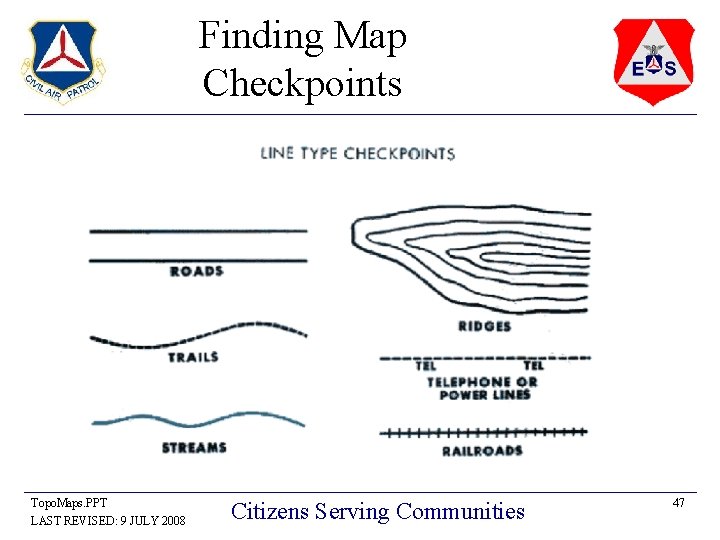
Finding Map Checkpoints Topo. Maps. PPT LAST REVISED: 9 JULY 2008 Citizens Serving Communities 47
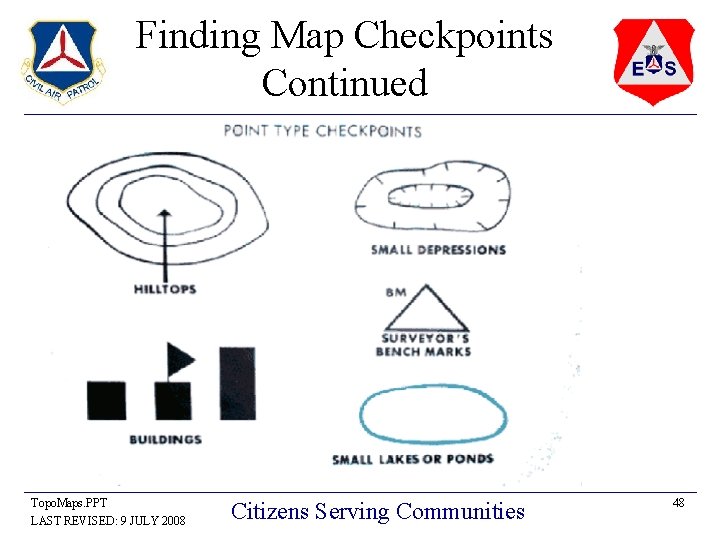
Finding Map Checkpoints Continued Topo. Maps. PPT LAST REVISED: 9 JULY 2008 Citizens Serving Communities 48
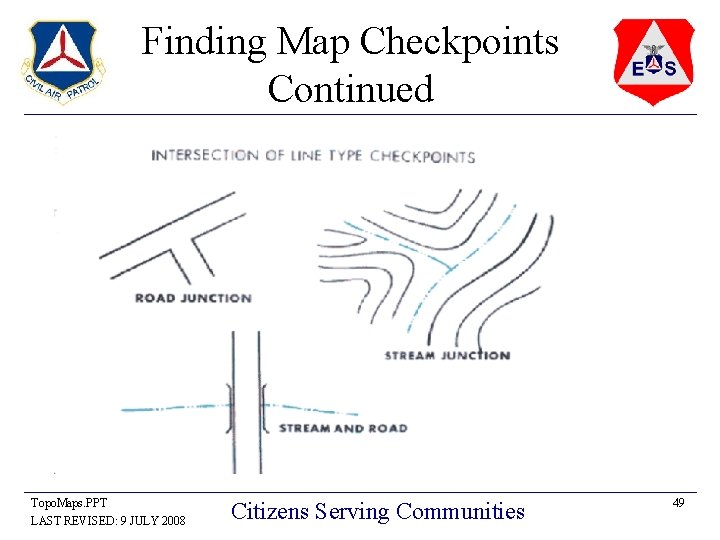
Finding Map Checkpoints Continued Topo. Maps. PPT LAST REVISED: 9 JULY 2008 Citizens Serving Communities 49
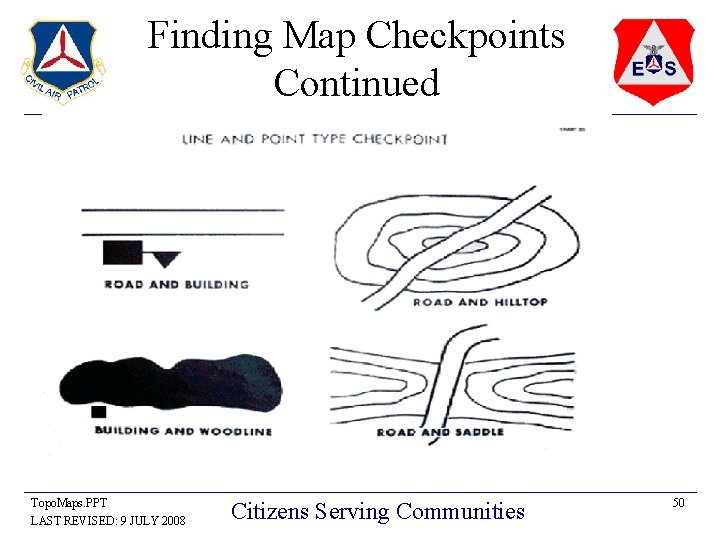
Finding Map Checkpoints Continued Topo. Maps. PPT LAST REVISED: 9 JULY 2008 Citizens Serving Communities 50
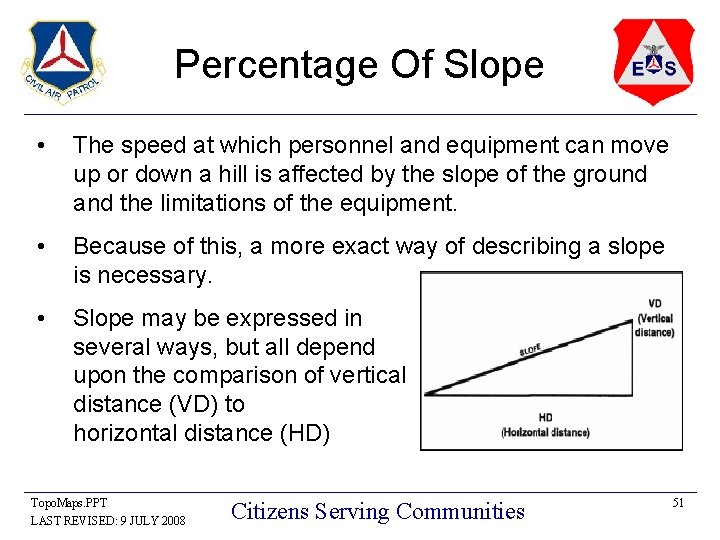
Percentage Of Slope • The speed at which personnel and equipment can move up or down a hill is affected by the slope of the ground and the limitations of the equipment. • Because of this, a more exact way of describing a slope is necessary. • Slope may be expressed in several ways, but all depend upon the comparison of vertical distance (VD) to horizontal distance (HD) Topo. Maps. PPT LAST REVISED: 9 JULY 2008 Citizens Serving Communities 51
Topo. Maps. PPT LAST REVISED: 9 JULY 2008 Citizens Serving Communities 52
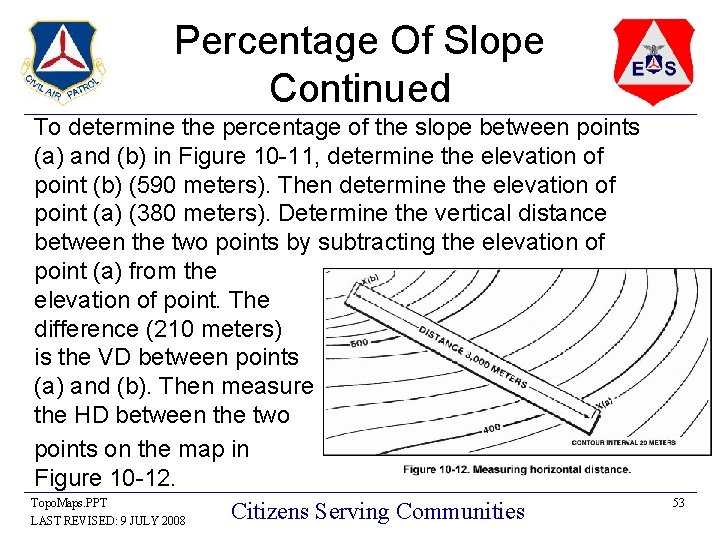
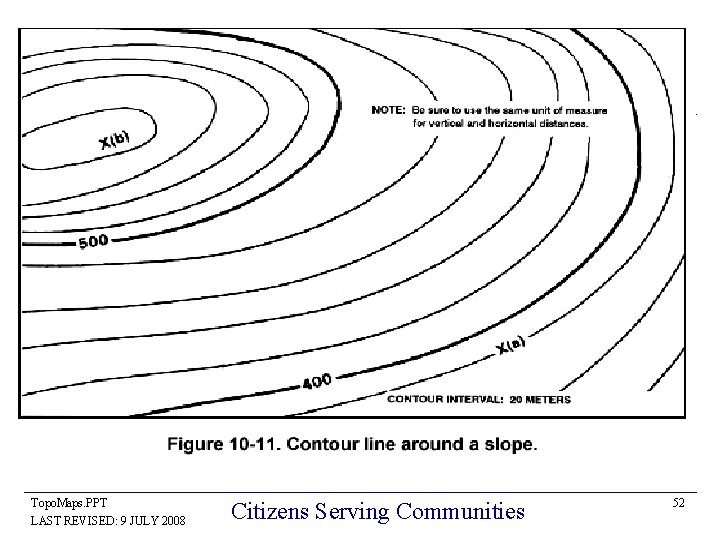
Percentage Of Slope Continued To determine the percentage of the slope between points (a) and (b) in Figure 10 -11, determine the elevation of point (b) (590 meters). Then determine the elevation of point (a) (380 meters). Determine the vertical distance between the two points by subtracting the elevation of point (a) from the elevation of point. The difference (210 meters) is the VD between points (a) and (b). Then measure the HD between the two points on the map in Figure 10 -12. Topo. Maps. PPT Citizens Serving Communities LAST REVISED: 9 JULY 2008 53
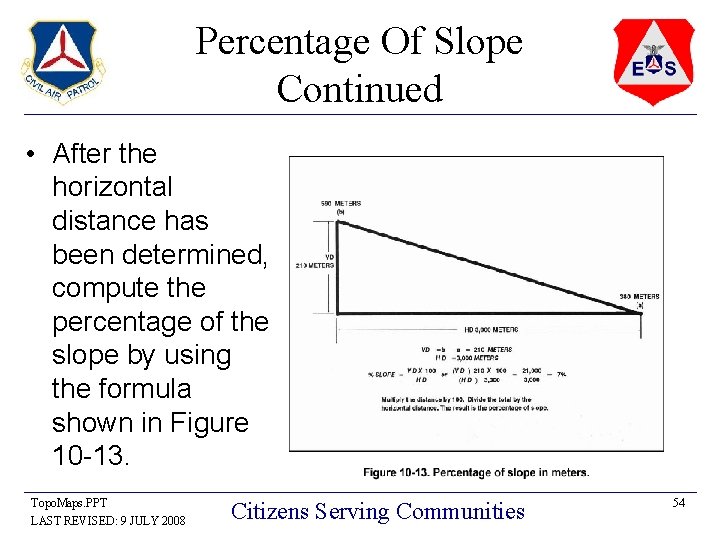
Percentage Of Slope Continued • After the horizontal distance has been determined, compute the percentage of the slope by using the formula shown in Figure 10 -13. Topo. Maps. PPT LAST REVISED: 9 JULY 2008 Citizens Serving Communities 54
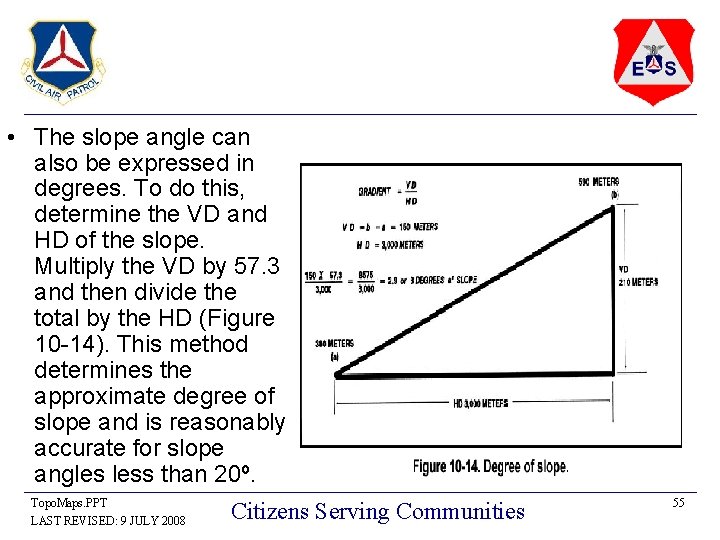
• The slope angle can also be expressed in degrees. To do this, determine the VD and HD of the slope. Multiply the VD by 57. 3 and then divide the total by the HD (Figure 10 -14). This method determines the approximate degree of slope and is reasonably accurate for slope angles less than 20º. Topo. Maps. PPT LAST REVISED: 9 JULY 2008 Citizens Serving Communities 55
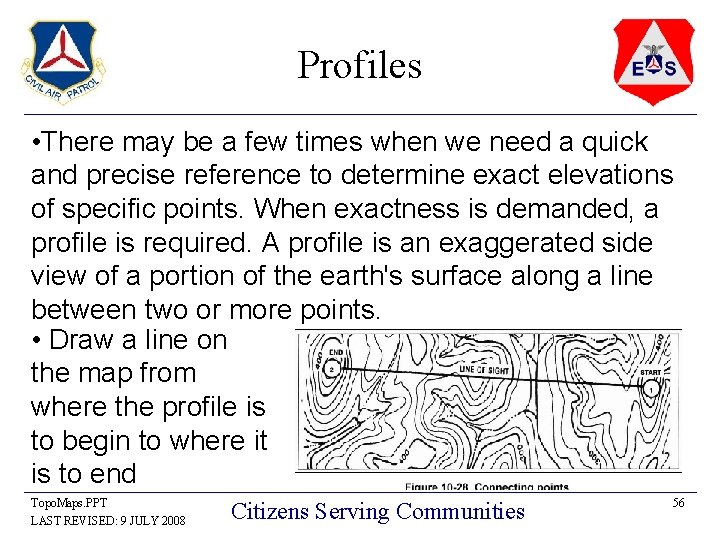
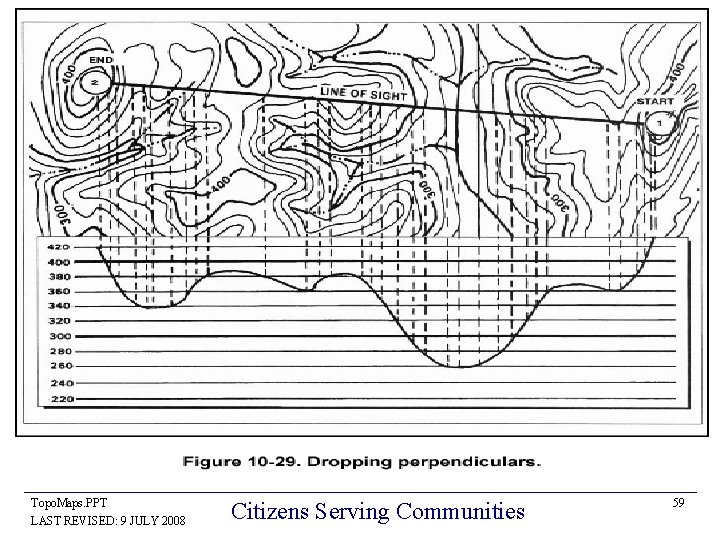
Profiles • There may be a few times when we need a quick and precise reference to determine exact elevations of specific points. When exactness is demanded, a profile is required. A profile is an exaggerated side view of a portion of the earth's surface along a line between two or more points. • Draw a line on the map from where the profile is to begin to where it is to end Topo. Maps. PPT LAST REVISED: 9 JULY 2008 Citizens Serving Communities 56
Profiles Continued • Find the value of the highest and lowest contour lines that cross or touch the profile line. Add one contour value above the highest and one below the lowest to take care of hills and valleys. • Select a piece of lined notebook paper with as many lines as was determined above. The standard green pocket notebook or any other paper with 1/4 -inch lines is ideal. Wider lines, up to 5/8 -inch, may be used. If lined paper is not available, draw equally spaced horizontal lines on a blank sheet of paper. Topo. Maps. PPT LAST REVISED: 9 JULY 2008 Citizens Serving Communities 57
Profiles Continued • Number the top line with the highest value and the bottom line with the lowest value • From every point on the profile line where a contour line, stream, intermittent stream, or other body of water crosses or touches, drop a perpendicular line to the line having the same value. • The profile drawn may be exaggerated. The spacing between the lines drawn on the sheet of paper determines the amount of exaggeration and may be varied to suit any purpose. Topo. Maps. PPT LAST REVISED: 9 JULY 2008 Citizens Serving Communities 58
Topo. Maps. PPT LAST REVISED: 9 JULY 2008 Citizens Serving Communities 59
MAP SYMBOLS Topo. Maps. PPT LAST REVISED: 9 JULY 2008 Citizens Serving Communities 60
Map Symbols Continued Topo. Maps. PPT LAST REVISED: 9 JULY 2008 Citizens Serving Communities 61
Map Symbols Continued Topo. Maps. PPT LAST REVISED: 9 JULY 2008 Citizens Serving Communities 62
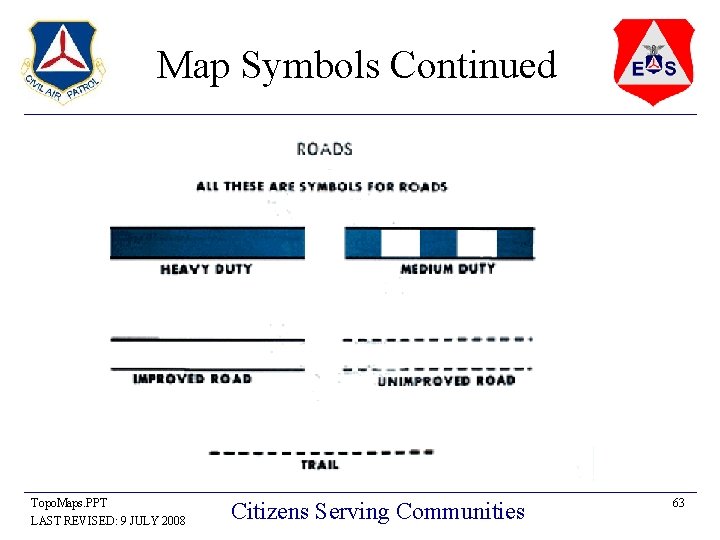
Map Symbols Continued Topo. Maps. PPT LAST REVISED: 9 JULY 2008 Citizens Serving Communities 63
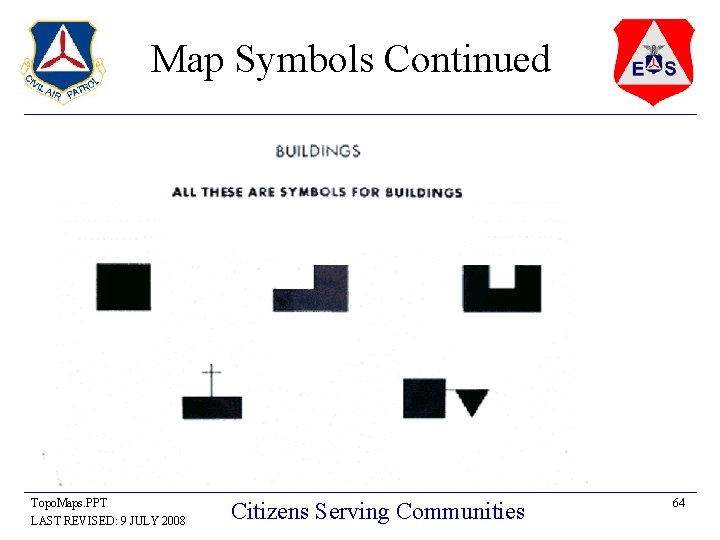
Map Symbols Continued Topo. Maps. PPT LAST REVISED: 9 JULY 2008 Citizens Serving Communities 64
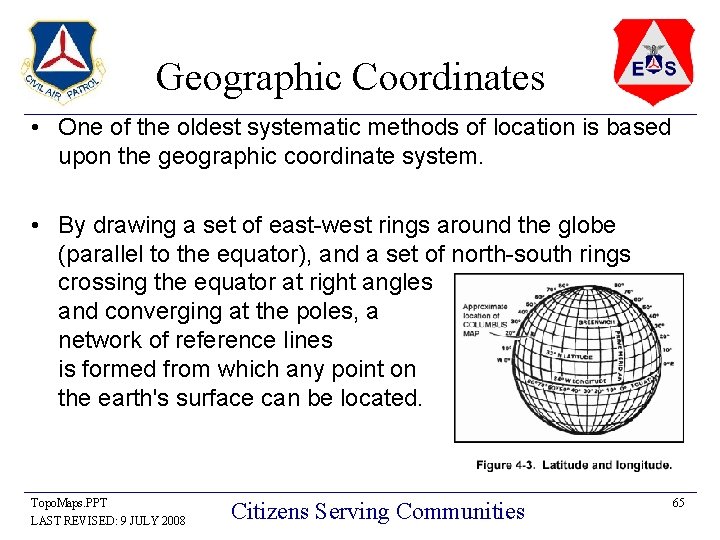
Geographic Coordinates • One of the oldest systematic methods of location is based upon the geographic coordinate system. • By drawing a set of east-west rings around the globe (parallel to the equator), and a set of north-south rings crossing the equator at right angles and converging at the poles, a network of reference lines is formed from which any point on the earth's surface can be located. Topo. Maps. PPT LAST REVISED: 9 JULY 2008 Citizens Serving Communities 65
Geographical Coordinates Continued • Geographic coordinates appear on most maps; on some they may be the only method of locating and referencing a specific point. • The four lines that enclose the body of the map (neatlines) are latitude and longitude lines. • Their values are given in degrees and minutes at each of the four corners. Topo. Maps. PPT LAST REVISED: 9 JULY 2008 Citizens Serving Communities 66
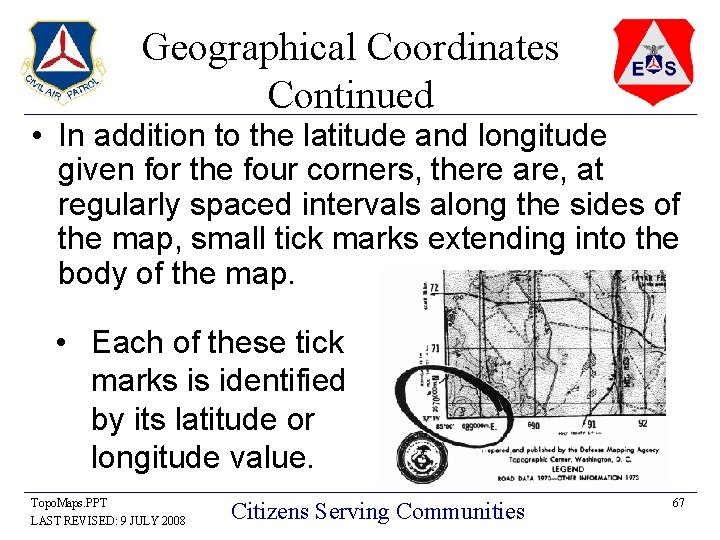
Geographical Coordinates Continued • In addition to the latitude and longitude given for the four corners, there are, at regularly spaced intervals along the sides of the map, small tick marks extending into the body of the map. • Each of these tick marks is identified by its latitude or longitude value. Topo. Maps. PPT LAST REVISED: 9 JULY 2008 Citizens Serving Communities 67
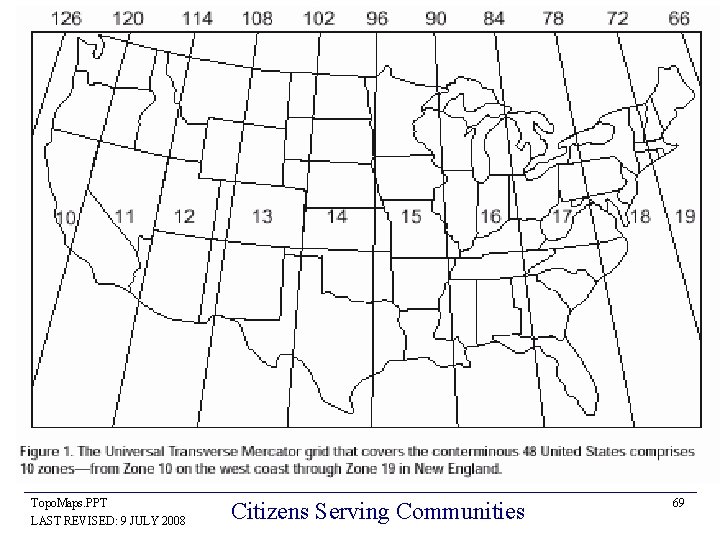
Grid Reference • • The National Imagery and Mapping Agency (NIMA) (formerly the Defense Mapping Agency) adopted a special grid for military use throughout the world called the Universal Transverse Mercator (UTM) grid. The UTM grid is shown on all quadrangle maps prepared by the U. S. Geological Survey (USGS). On 7. 5 -minute quadrangle maps (1: 24, 000 and 1: 25, 000 scale) and 15 -minute quadrangle maps Topo. Maps. PPT LAST REVISED: 9 JULY 2008 Citizens Serving Communities 68
Topo. Maps. PPT LAST REVISED: 9 JULY 2008 Citizens Serving Communities 69
Topo. Maps. PPT LAST REVISED: 9 JULY 2008 Citizens Serving Communities 70
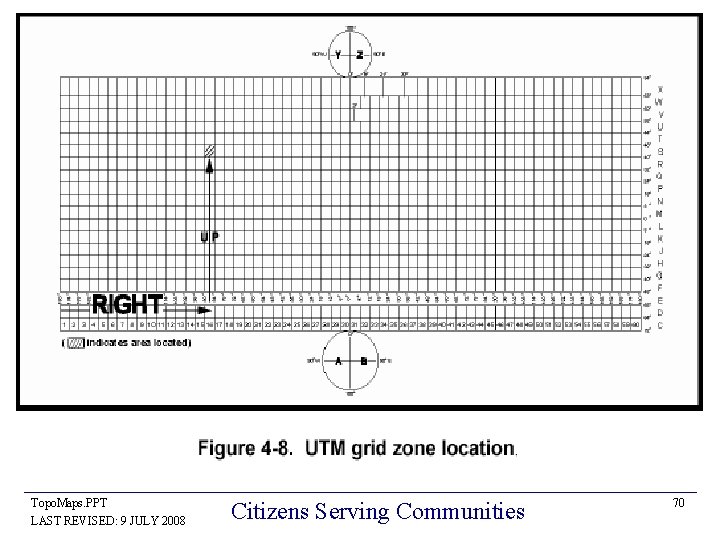
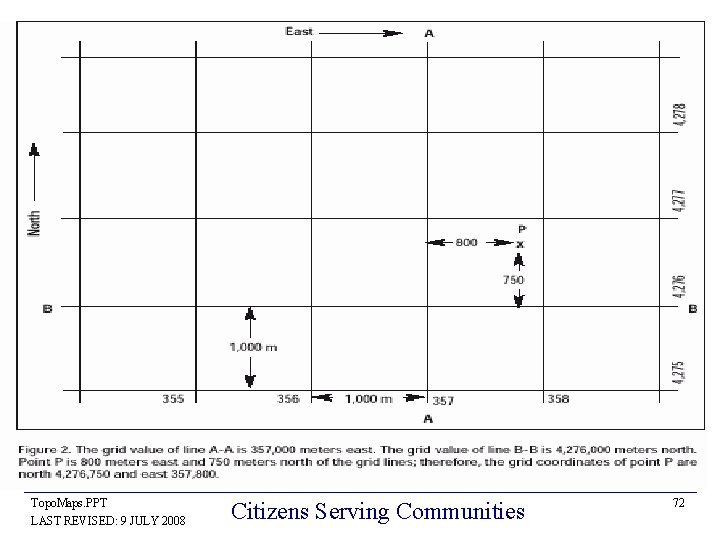
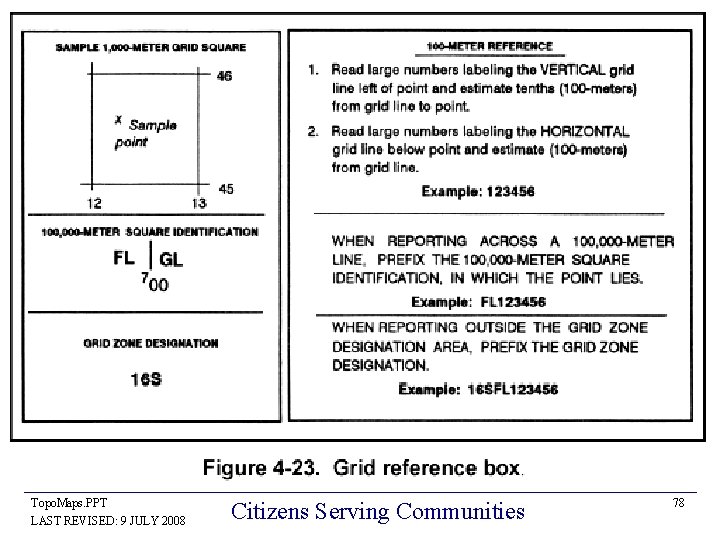
Grid Reference Cont. • UTM grid lines are indicated at intervals of 1, 000 meters, either by blue ticks in the margins of the map or with full grid lines. • To use the UTM grid, you can place a transparent grid overlay on the map to subdivide the grid, or you can draw lines on the map connecting corresponding ticks on opposite edges. Topo. Maps. PPT LAST REVISED: 9 JULY 2008 Citizens Serving Communities 71
Topo. Maps. PPT LAST REVISED: 9 JULY 2008 Citizens Serving Communities 72
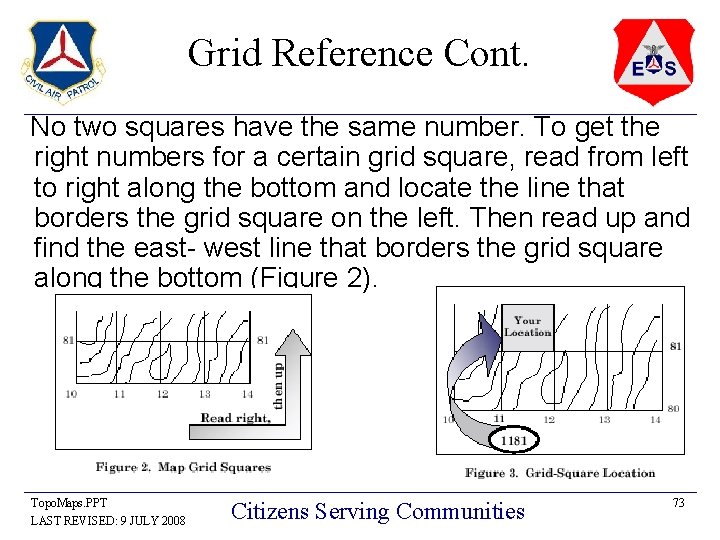
Grid Reference Cont. No two squares have the same number. To get the right numbers for a certain grid square, read from left to right along the bottom and locate the line that borders the grid square on the left. Then read up and find the east- west line that borders the grid square along the bottom (Figure 2). Topo. Maps. PPT LAST REVISED: 9 JULY 2008 Citizens Serving Communities 73
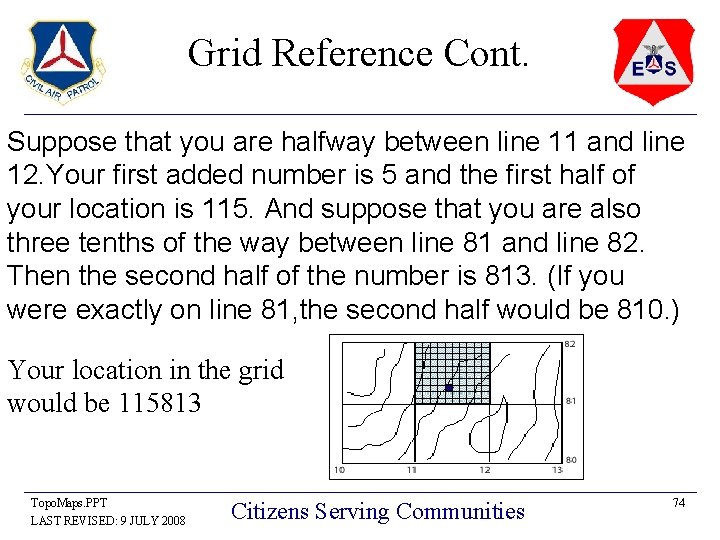
Grid Reference Cont. Suppose that you are halfway between line 11 and line 12. Your first added number is 5 and the first half of your location is 115. And suppose that you are also three tenths of the way between line 81 and line 82. Then the second half of the number is 813. (If you were exactly on line 81, the second half would be 810. ) Your location in the grid would be 115813 Topo. Maps. PPT LAST REVISED: 9 JULY 2008 Citizens Serving Communities 74
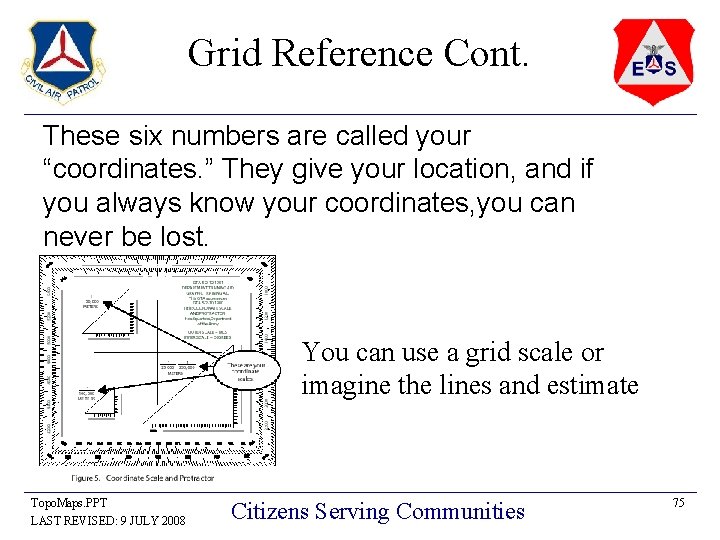
Grid Reference Cont. These six numbers are called your “coordinates. ” They give your location, and if you always know your coordinates, you can never be lost. You can use a grid scale or imagine the lines and estimate Topo. Maps. PPT LAST REVISED: 9 JULY 2008 Citizens Serving Communities 75
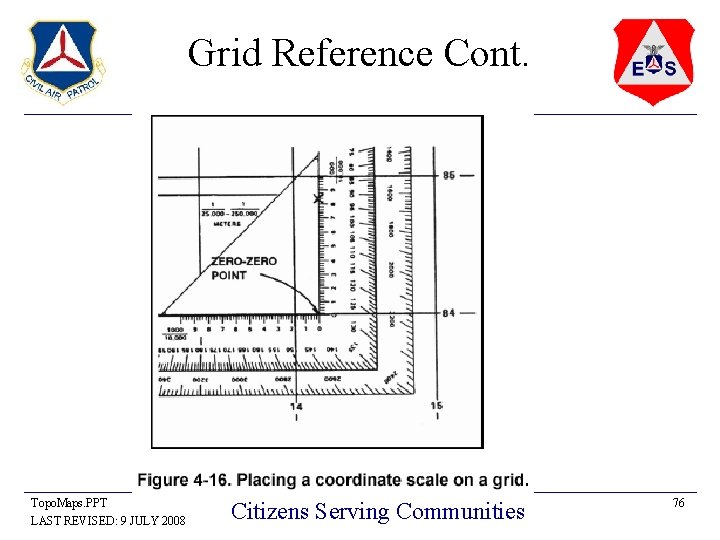
Grid Reference Cont. Topo. Maps. PPT LAST REVISED: 9 JULY 2008 Citizens Serving Communities 76
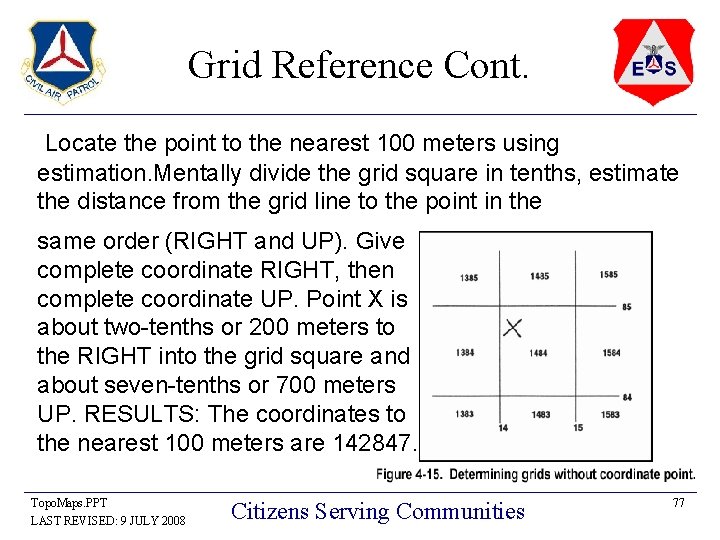
Grid Reference Cont. Locate the point to the nearest 100 meters using estimation. Mentally divide the grid square in tenths, estimate the distance from the grid line to the point in the same order (RIGHT and UP). Give complete coordinate RIGHT, then complete coordinate UP. Point X is about two-tenths or 200 meters to the RIGHT into the grid square and about seven-tenths or 700 meters UP. RESULTS: The coordinates to the nearest 100 meters are 142847. Topo. Maps. PPT LAST REVISED: 9 JULY 2008 Citizens Serving Communities 77
Topo. Maps. PPT LAST REVISED: 9 JULY 2008 Citizens Serving Communities 78
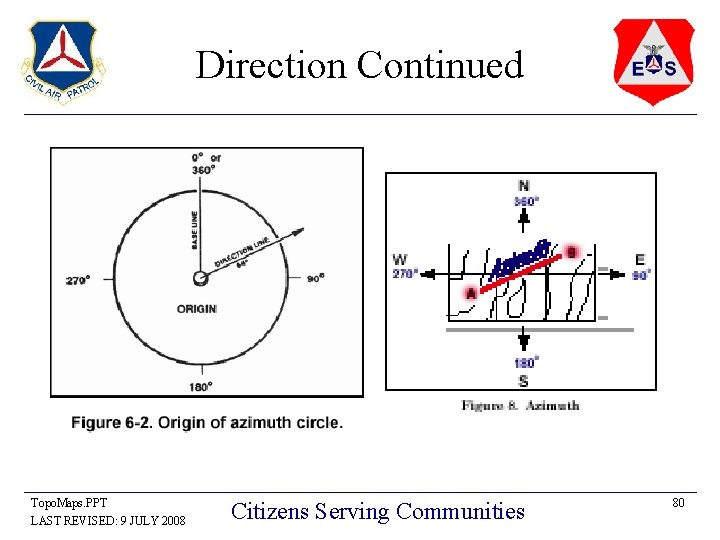
Direction AZIMUTHS: An azimuth is defined as a horizontal angle measured clockwise from a north base line. This north base line could be true north, magnetic north, or grid north. The azimuth is the most common military method to express direction. When using an azimuth, the point from which the azimuth originates is the center of an imaginary circle. This circle is divided into 360 degrees Topo. Maps. PPT LAST REVISED: 9 JULY 2008 Citizens Serving Communities 79
Direction Continued Topo. Maps. PPT LAST REVISED: 9 JULY 2008 Citizens Serving Communities 80
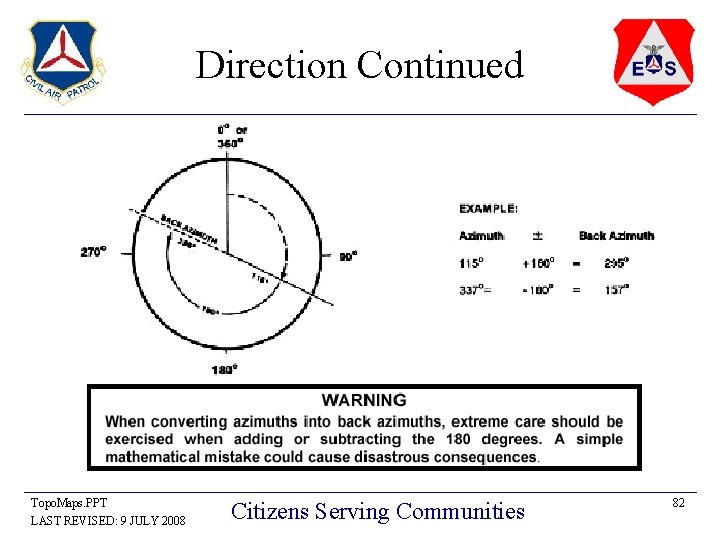
Direction Continued Back Azimuth. A back azimuth is the opposite direction of an azimuth. It is comparable to doing “about face. ” To obtain a back azimuth from an azimuth, add 180 degrees if the azimuth is 180 degrees or less, or subtract 180 degrees if the azimuth is 180 degrees or more. The back azimuth of 180 degrees may be stated as 0 degrees or 360 degrees. Topo. Maps. PPT LAST REVISED: 9 JULY 2008 Citizens Serving Communities 81
Direction Continued Topo. Maps. PPT LAST REVISED: 9 JULY 2008 Citizens Serving Communities 82
Direction Continued • PROTRACTOR There are several types of protractors—full circle, half circle, square, and rectangular. All of them divide the circle into units of angular measure, and each has a scale around the outer edge and an index mark. The index mark is the center of the protractor circle from which all directions are measured. Topo. Maps. PPT LAST REVISED: 9 JULY 2008 Citizens Serving Communities 83
Topo. Maps. PPT LAST REVISED: 9 JULY 2008 Citizens Serving Communities 84
To obtain an accurate reading with the protractor (to the nearest degree), there are two techniques to check that the base line of the protractor is parallel to a northsouth grid line. Topo. Maps. PPT LAST REVISED: 9 JULY 2008 Citizens Serving Communities 85
Direction Finding (1) Place the protractor index where the azimuth line cuts a north-south grid line, aligning the base line of the protractor directly over the intersection of the azimuth line with the north-south grid line. The user should be able to determine whether the initial azimuth reading was correct. (2) The user should re-read the azimuth between the azimuth and north-south grid line to check the initial azimuth. (3) Note that the protractor is cut at both the top and bottom by the same north-south grid line. Count the number of degrees from the 0 -degree mark at the top of the protractor to this north-south grid line and then count the number of degrees from the 180 -degree mark at the bottom of the protractor to this same grid line. If the two counts are equal, the protractor is properly aligned. Topo. Maps. PPT LAST REVISED: 9 JULY 2008 Citizens Serving Communities 86
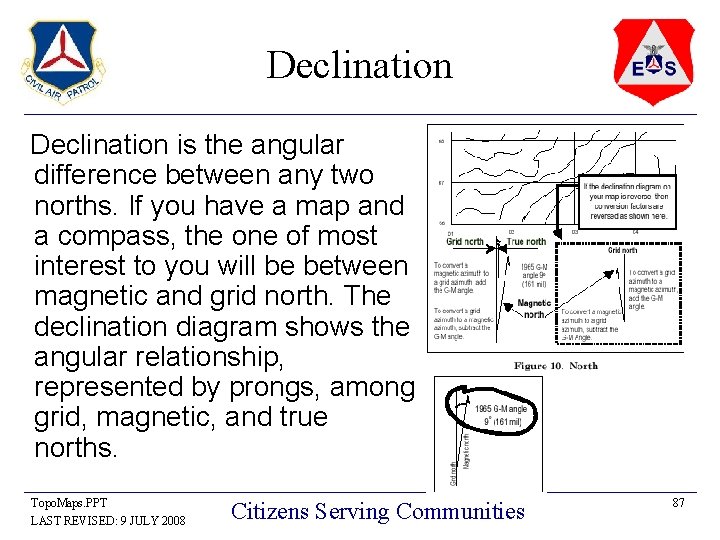
Declination is the angular difference between any two norths. If you have a map and a compass, the one of most interest to you will be between magnetic and grid north. The declination diagram shows the angular relationship, represented by prongs, among grid, magnetic, and true norths. Topo. Maps. PPT LAST REVISED: 9 JULY 2008 Citizens Serving Communities 87
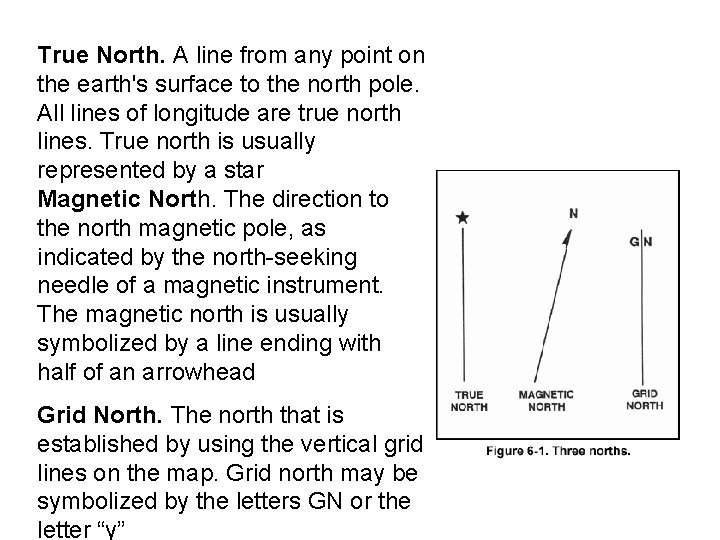
True North. A line from any point on the earth's surface to the north pole. All lines of longitude are true north lines. True north is usually represented by a star Magnetic North. The direction to the north magnetic pole, as indicated by the north-seeking needle of a magnetic instrument. The magnetic north is usually symbolized by a line ending with half of an arrowhead Grid North. The north that is established by using the vertical grid lines on the map. Grid north may be symbolized by the letters GN or the letter “y”
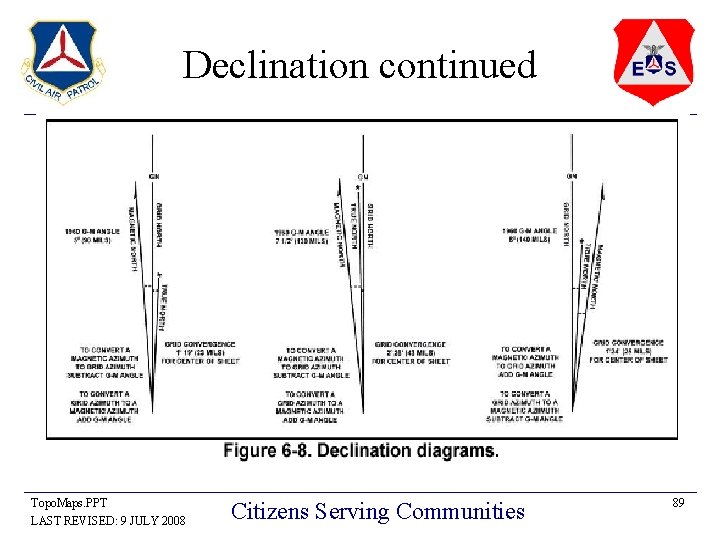
Declination continued Topo. Maps. PPT LAST REVISED: 9 JULY 2008 Citizens Serving Communities 89
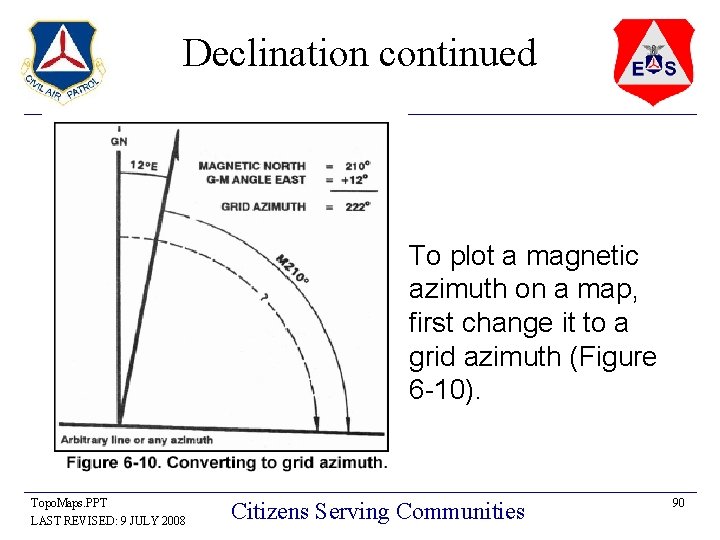
Declination continued To plot a magnetic azimuth on a map, first change it to a grid azimuth (Figure 6 -10). Topo. Maps. PPT LAST REVISED: 9 JULY 2008 Citizens Serving Communities 90
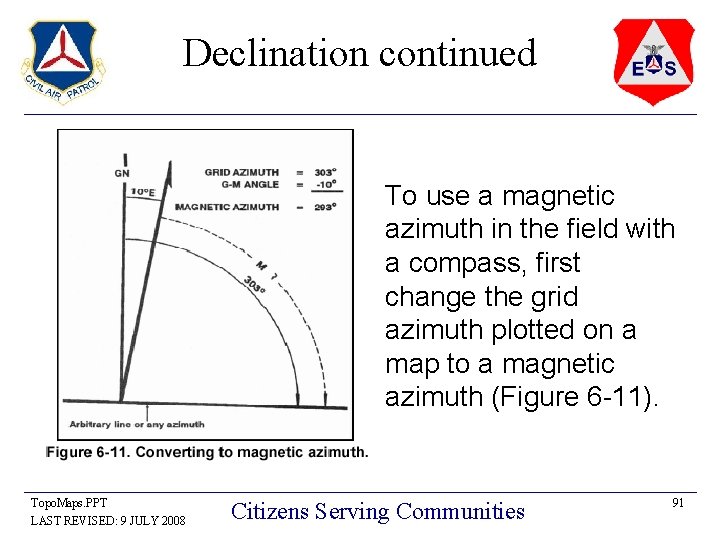
Declination continued To use a magnetic azimuth in the field with a compass, first change the grid azimuth plotted on a map to a magnetic azimuth (Figure 6 -11). Topo. Maps. PPT LAST REVISED: 9 JULY 2008 Citizens Serving Communities 91
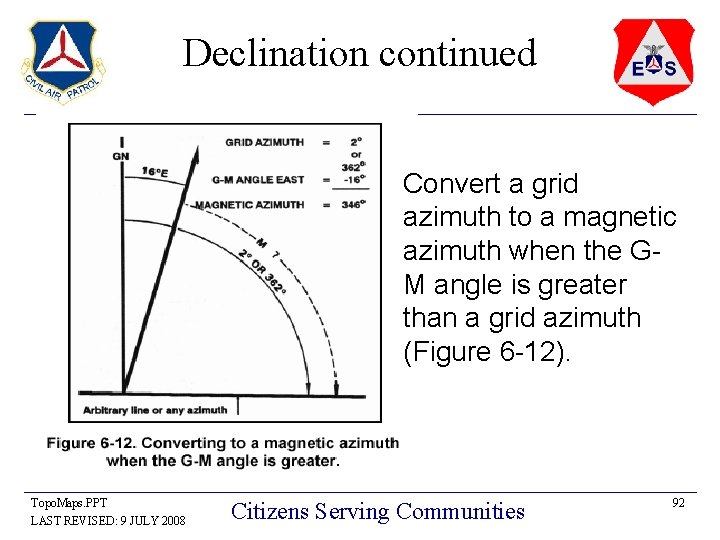
Declination continued Convert a grid azimuth to a magnetic azimuth when the GM angle is greater than a grid azimuth (Figure 6 -12). Topo. Maps. PPT LAST REVISED: 9 JULY 2008 Citizens Serving Communities 92
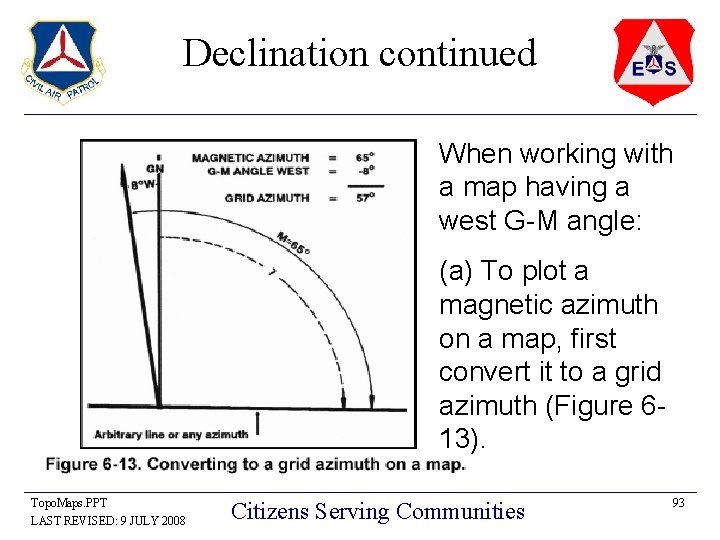
Declination continued When working with a map having a west G-M angle: (a) To plot a magnetic azimuth on a map, first convert it to a grid azimuth (Figure 613). Topo. Maps. PPT LAST REVISED: 9 JULY 2008 Citizens Serving Communities 93
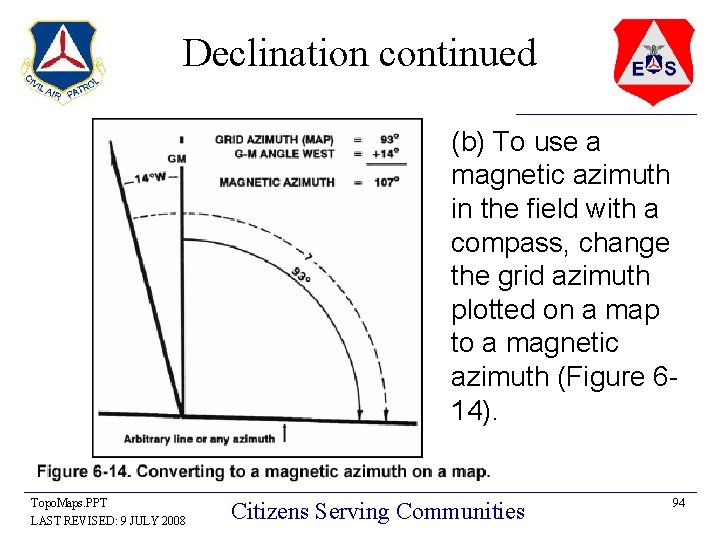
Declination continued (b) To use a magnetic azimuth in the field with a compass, change the grid azimuth plotted on a map to a magnetic azimuth (Figure 614). Topo. Maps. PPT LAST REVISED: 9 JULY 2008 Citizens Serving Communities 94
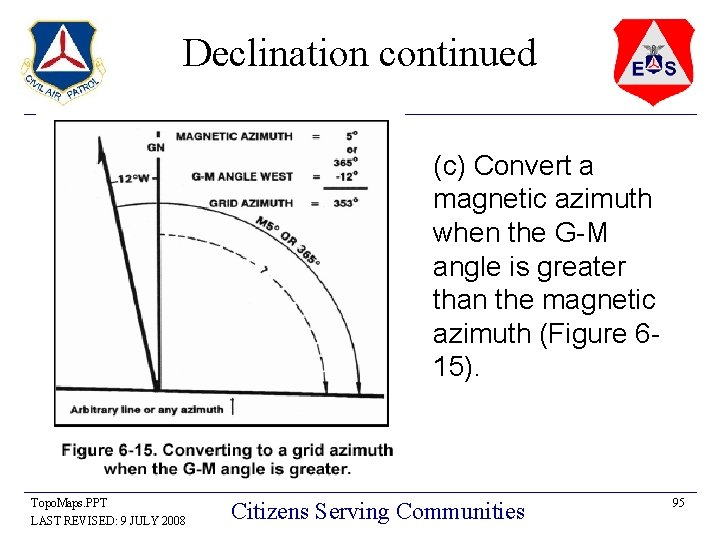
Declination continued (c) Convert a magnetic azimuth when the G-M angle is greater than the magnetic azimuth (Figure 615). Topo. Maps. PPT LAST REVISED: 9 JULY 2008 Citizens Serving Communities 95
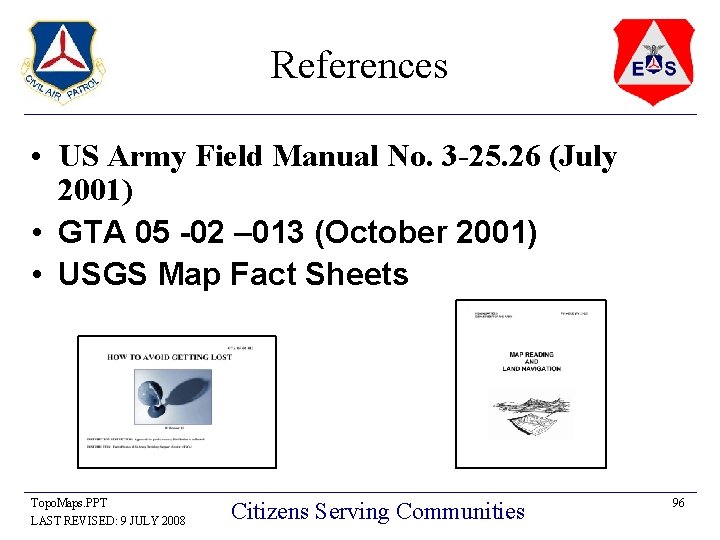
References • US Army Field Manual No. 3 -25. 26 (July 2001) • GTA 05 -02 – 013 (October 2001) • USGS Map Fact Sheets Topo. Maps. PPT LAST REVISED: 9 JULY 2008 Citizens Serving Communities 96
• These presentations were made by the National Emergency Services Academy for the purpose of advancing, refreshing, or reviewing information for search and rescue training. • Products shown are for illustration purposes only. The National Emergency Services Academy, Civil Air Patrol, or the United States Air Force does not endorse, guarantee, or recommend any specific company, service, business, or product. • Presentations are designed to be used with qualified instructors familiar with your local area. Topo. Maps. PPT LAST REVISED: 9 JULY 2008 Citizens Serving Communities 97
QUESTIONS? THINK SAFETY! Topo. Maps. PPT LAST REVISED: 9 JULY 2008 Citizens Serving Communities 98
- Slides: 98