
Topk Query Processing Optimal aggregation algorithms for middleware


- Slides: 28
Top-k Query Processing Optimal aggregation algorithms for middleware Ronald Fagin, Amnon Lotem, and Moni Naor + Sushruth P. + Arjun Dasgupta
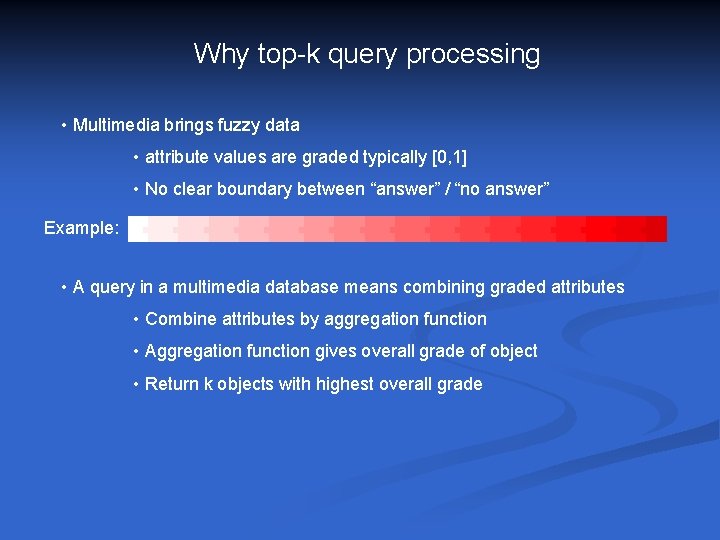
Why top-k query processing • Multimedia brings fuzzy data • attribute values are graded typically [0, 1] • No clear boundary between “answer” / “no answer” Example: • A query in a multimedia database means combining graded attributes • Combine attributes by aggregation function • Aggregation function gives overall grade of object • Return k objects with highest overall grade
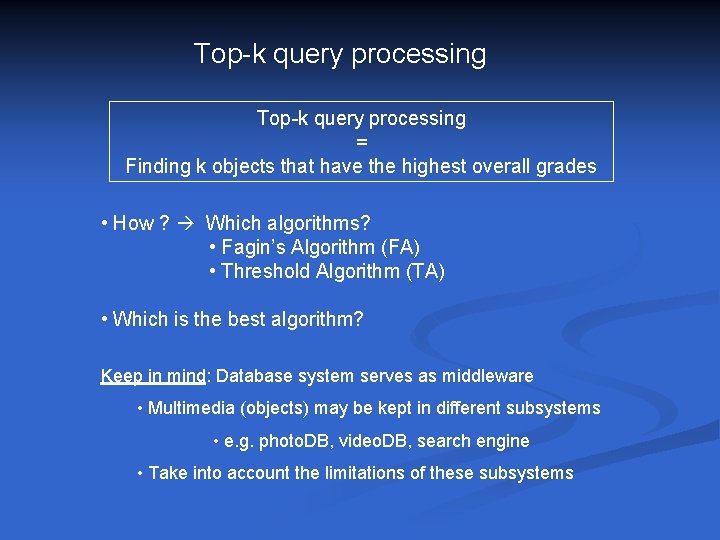
Top-k query processing = Finding k objects that have the highest overall grades • How ? Which algorithms? • Fagin’s Algorithm (FA) • Threshold Algorithm (TA) • Which is the best algorithm? Keep in mind: Database system serves as middleware • Multimedia (objects) may be kept in different subsystems • e. g. photo. DB, video. DB, search engine • Take into account the limitations of these subsystems
Example • Simple database model • Simple query • Explaining Fagin’s Algorithm (FA) • Finding top-k with FA • Explaining Threshold Algortihm (TA) • Finding top-k with TA
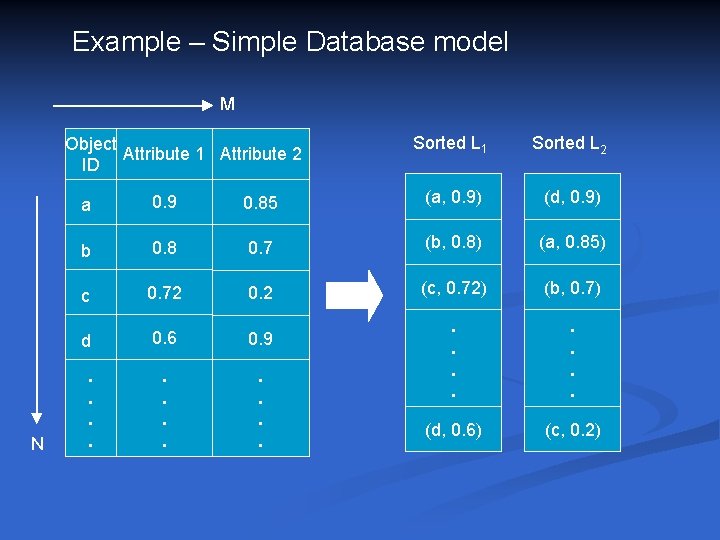
Example – Simple Database model M Object Attribute 1 Attribute 2 ID N Sorted L 1 Sorted L 2 a 0. 9 0. 85 (a, 0. 9) (d, 0. 9) b 0. 8 0. 7 (b, 0. 8) (a, 0. 85) c 0. 72 0. 2 (c, 0. 72) (b, 0. 7) d 0. 6 0. 9 . . (d, 0. 6) (c, 0. 2)
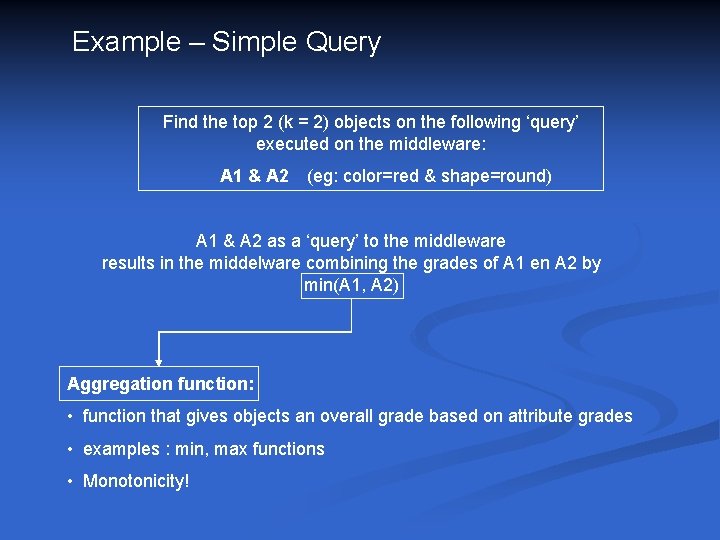
Example – Simple Query Find the top 2 (k = 2) objects on the following ‘query’ executed on the middleware: A 1 & A 2 (eg: color=red & shape=round) A 1 & A 2 as a ‘query’ to the middleware results in the middelware combining the grades of A 1 en A 2 by min(A 1, A 2) Aggregation function: • function that gives objects an overall grade based on attribute grades • examples : min, max functions • Monotonicity!
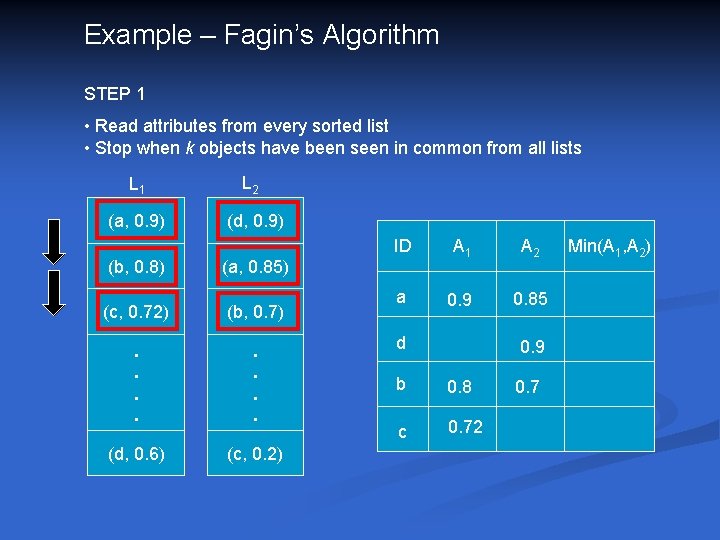
Example – Fagin’s Algorithm STEP 1 • Read attributes from every sorted list • Stop when k objects have been seen in common from all lists L 1 L 2 (a, 0. 9) (d, 0. 9) (b, 0. 8) ID A 1 A 2 a 0. 9 0. 85 (a, 0. 85) (c, 0. 72) (b, 0. 7) . . . . (d, 0. 6) (c, 0. 2) d 0. 9 b 0. 8 c 0. 72 0. 7 Min(A 1, A 2)
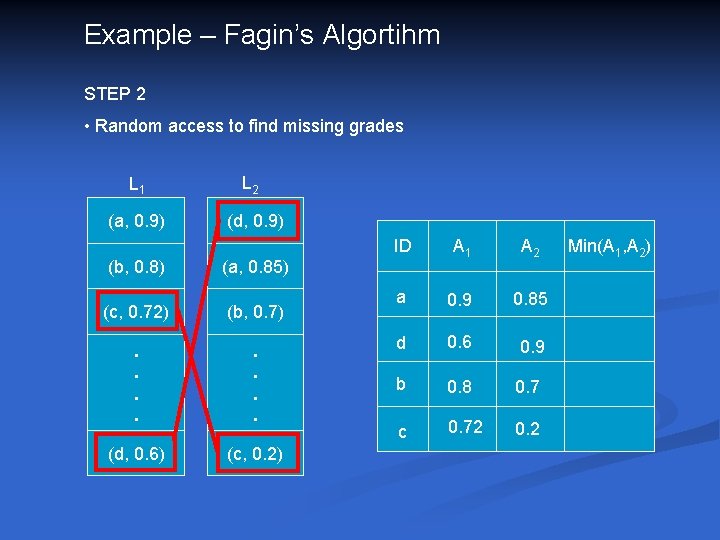
Example – Fagin’s Algortihm STEP 2 • Random access to find missing grades L 1 L 2 (a, 0. 9) (d, 0. 9) (b, 0. 8) ID A 1 A 2 a 0. 9 0. 85 d 0. 6 0. 9 b 0. 8 0. 7 c 0. 72 0. 2 (a, 0. 85) (c, 0. 72) (b, 0. 7) . . . . (d, 0. 6) (c, 0. 2) Min(A 1, A 2)
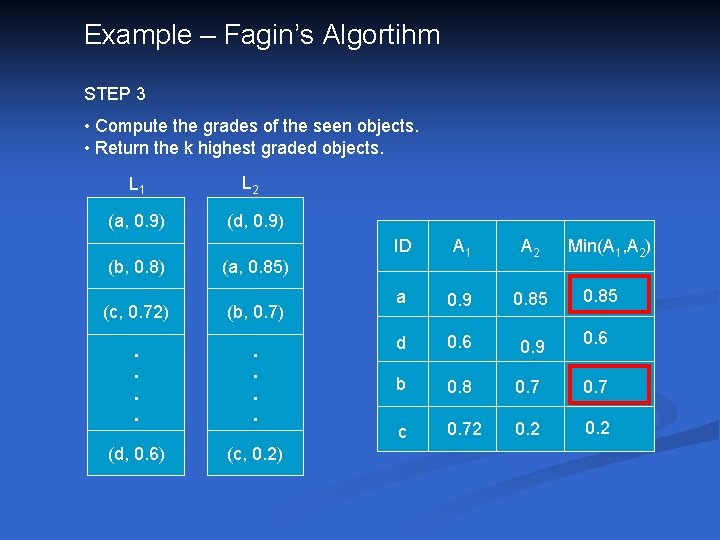
Example – Fagin’s Algortihm STEP 3 • Compute the grades of the seen objects. • Return the k highest graded objects. L 1 L 2 (a, 0. 9) (d, 0. 9) (b, 0. 8) ID A 1 A 2 a 0. 9 0. 85 d 0. 6 0. 9 0. 6 b 0. 8 0. 7 c 0. 72 0. 2 (a, 0. 85) (c, 0. 72) (b, 0. 7) . . . . (d, 0. 6) (c, 0. 2) Min(A 1, A 2)
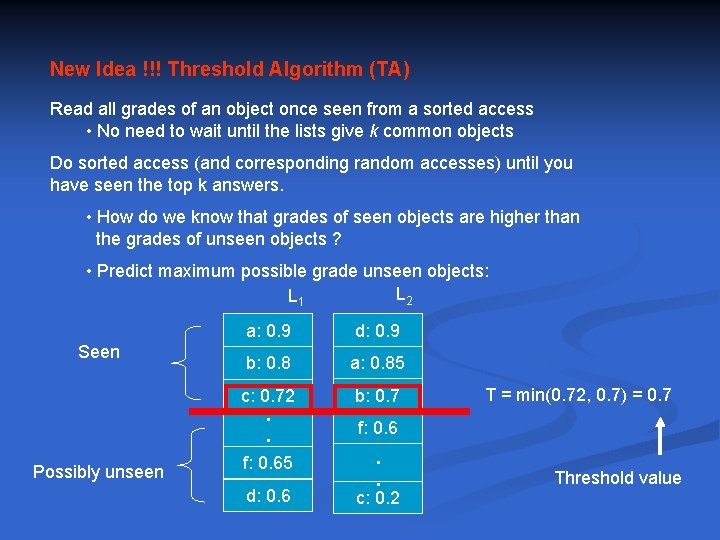
New Idea !!! Threshold Algorithm (TA) Read all grades of an object once seen from a sorted access • No need to wait until the lists give k common objects Do sorted access (and corresponding random accesses) until you have seen the top k answers. • How do we know that grades of seen objects are higher than the grades of unseen objects ? • Predict maximum possible grade unseen objects: L 2 L 1 Seen Possibly unseen a: 0. 9 d: 0. 9 b: 0. 8 a: 0. 85 c: 0. 72. . . f: 0. 65. d: 0. 6 b: 0. 7. f: 0. 6. . . c: 0. 2 T = min(0. 72, 0. 7) = 0. 7 Threshold value
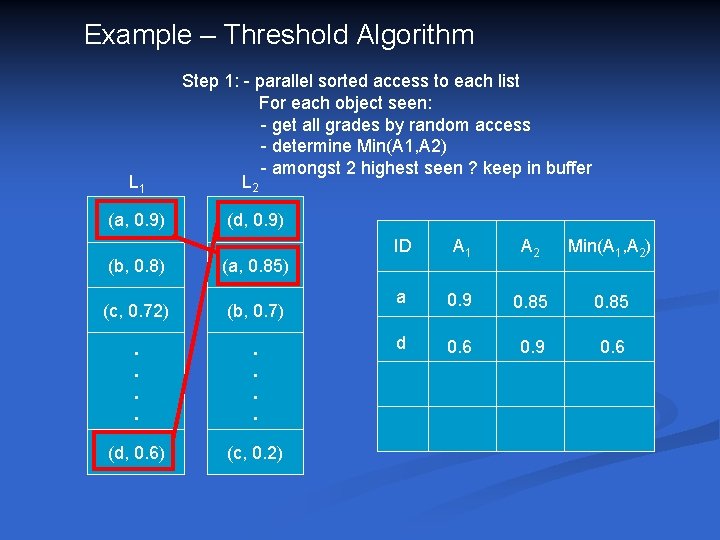
Example – Threshold Algorithm L 1 (a, 0. 9) (b, 0. 8) Step 1: - parallel sorted access to each list For each object seen: - get all grades by random access - determine Min(A 1, A 2) - amongst 2 highest seen ? keep in buffer L 2 (d, 0. 9) (a, 0. 85) (c, 0. 72) (b, 0. 7) . . . . (d, 0. 6) (c, 0. 2) ID A 1 A 2 Min(A 1, A 2) a 0. 9 0. 85 d 0. 6 0. 9 0. 6
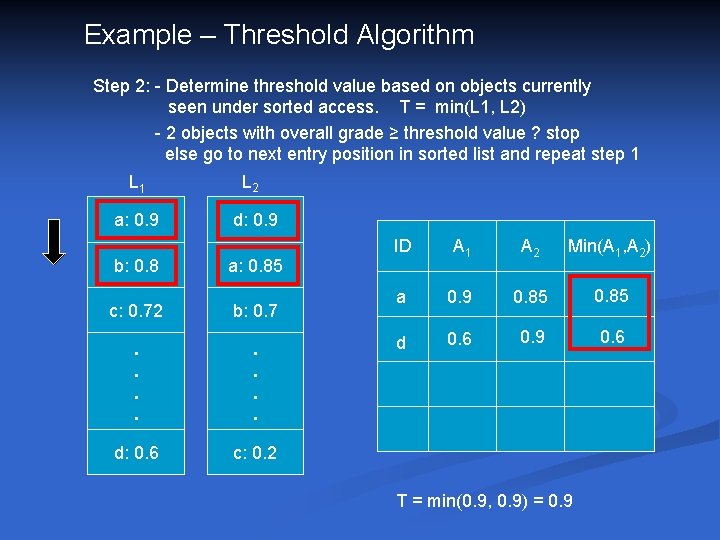
Example – Threshold Algorithm Step 2: - Determine threshold value based on objects currently seen under sorted access. T = min(L 1, L 2) - 2 objects with overall grade ≥ threshold value ? stop else go to next entry position in sorted list and repeat step 1 L 2 a: 0. 9 d: 0. 9 b: 0. 8 a: 0. 85 c: 0. 72 b: 0. 7 . . . . d: 0. 6 c: 0. 2 ID A 1 A 2 Min(A 1, A 2) a 0. 9 0. 85 d 0. 6 0. 9 0. 6 T = min(0. 9, 0. 9) = 0. 9
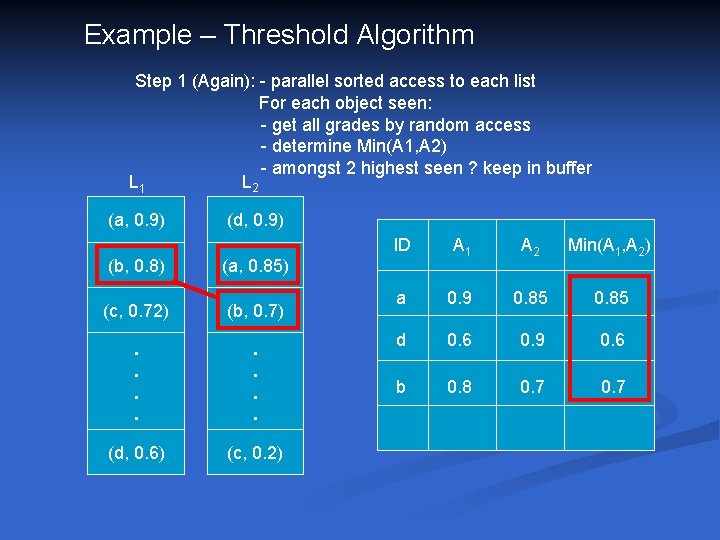
Example – Threshold Algorithm Step 1 (Again): - parallel sorted access to each list For each object seen: - get all grades by random access - determine Min(A 1, A 2) - amongst 2 highest seen ? keep in buffer L L 1 2 (a, 0. 9) (d, 0. 9) (b, 0. 8) (a, 0. 85) (c, 0. 72) (b, 0. 7) . . . . (d, 0. 6) (c, 0. 2) ID A 1 A 2 Min(A 1, A 2) a 0. 9 0. 85 d 0. 6 0. 9 0. 6 b 0. 8 0. 7
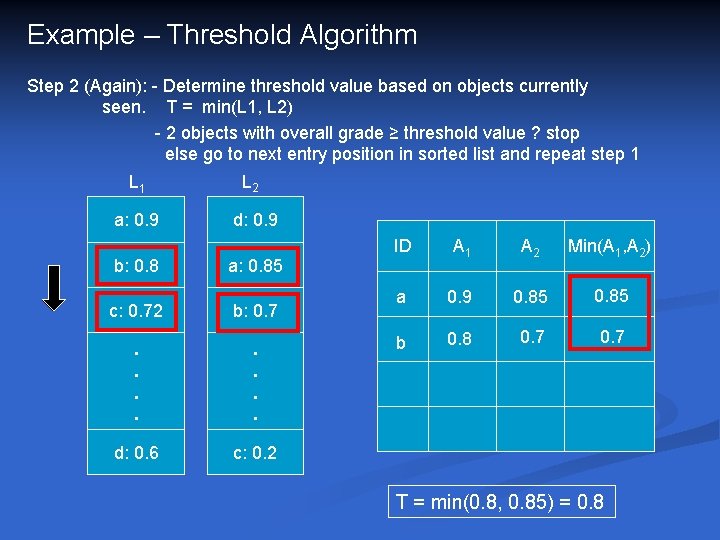
Example – Threshold Algorithm Step 2 (Again): - Determine threshold value based on objects currently seen. T = min(L 1, L 2) - 2 objects with overall grade ≥ threshold value ? stop else go to next entry position in sorted list and repeat step 1 L 2 a: 0. 9 d: 0. 9 b: 0. 8 a: 0. 85 c: 0. 72 b: 0. 7 . . . . d: 0. 6 c: 0. 2 ID A 1 A 2 Min(A 1, A 2) a 0. 9 0. 85 b 0. 8 0. 7 T = min(0. 8, 0. 85) = 0. 8
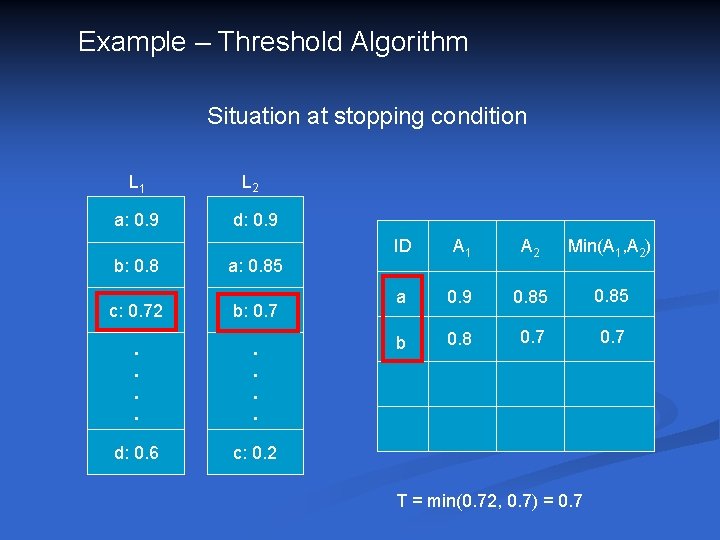
Example – Threshold Algorithm Situation at stopping condition L 1 L 2 a: 0. 9 d: 0. 9 b: 0. 8 a: 0. 85 c: 0. 72 b: 0. 7 . . . . d: 0. 6 c: 0. 2 ID A 1 A 2 Min(A 1, A 2) a 0. 9 0. 85 b 0. 8 0. 7 T = min(0. 72, 0. 7) = 0. 7
Comparison of Fagin’s and Threshold Algorithm • TA sees less objects than FA • TA stops at least as early as FA • When we have seen k objects in common in FA, their grades are higher or equal than the threshold in TA. • TA may perform more random accesses than FA • In TA, (m-1) random accesses for each object • In FA, Random accesses are done at the end, only for missing grades • TA requires only bounded buffer space (k) • At the expense of more random seeks • FA makes use of unbounded buffers
The best algorithm Which algorithm is the best: TA, FA? ? • Define “best” • middleware cost • concept of instance optimality • Consider: • wild guesses • aggregation functions characteristics • Monotone, strictly monotone, strict • database restrictions • distinctness property
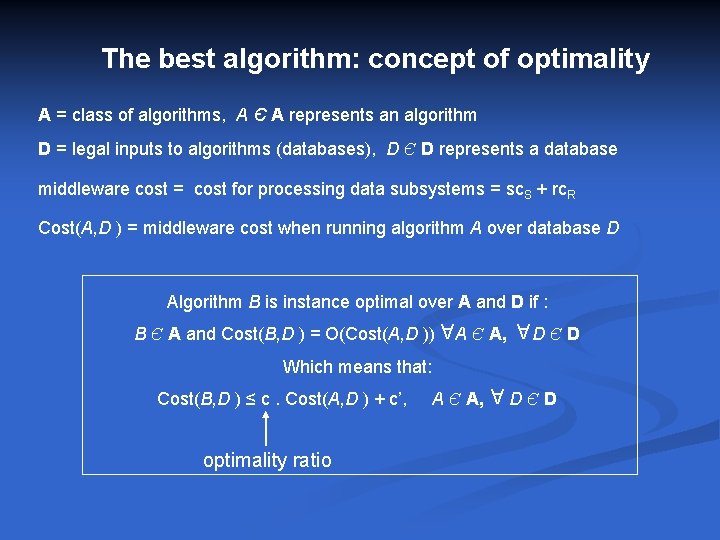
The best algorithm: concept of optimality A = class of algorithms, A Є A represents an algorithm D = legal inputs to algorithms (databases), D Є D represents a database middleware cost = cost for processing data subsystems = sc. S + rc. R Cost(A, D ) = middleware cost when running algorithm A over database D Algorithm B is instance optimal over A and D if : A Є A, A A B Є A and Cost(B, D ) = O(Cost(A, D )) DЄD Which means that: optimality ratio A Є A, A Cost(B, D ) ≤ c. Cost(A, D ) + c’, DЄD
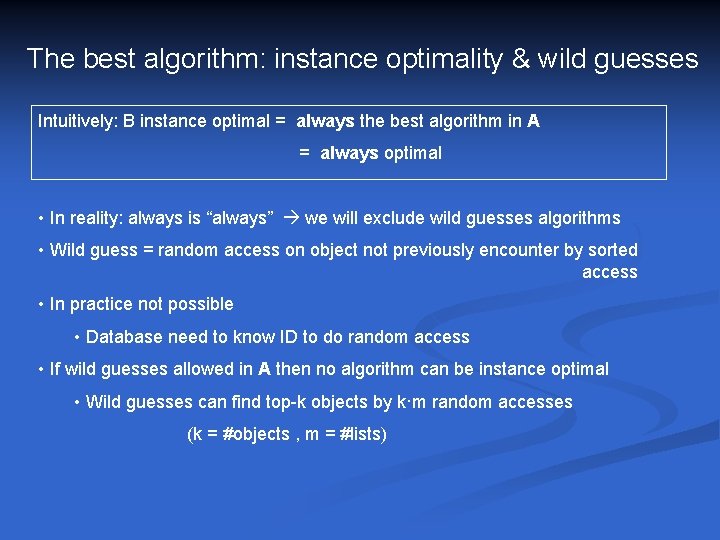
The best algorithm: instance optimality & wild guesses Intuitively: B instance optimal = always the best algorithm in A = always optimal • In reality: always is “always” we will exclude wild guesses algorithms • Wild guess = random access on object not previously encounter by sorted access • In practice not possible • Database need to know ID to do random access • If wild guesses allowed in A then no algorithm can be instance optimal • Wild guesses can find top-k objects by k·m random accesses (k = #objects , m = #lists)
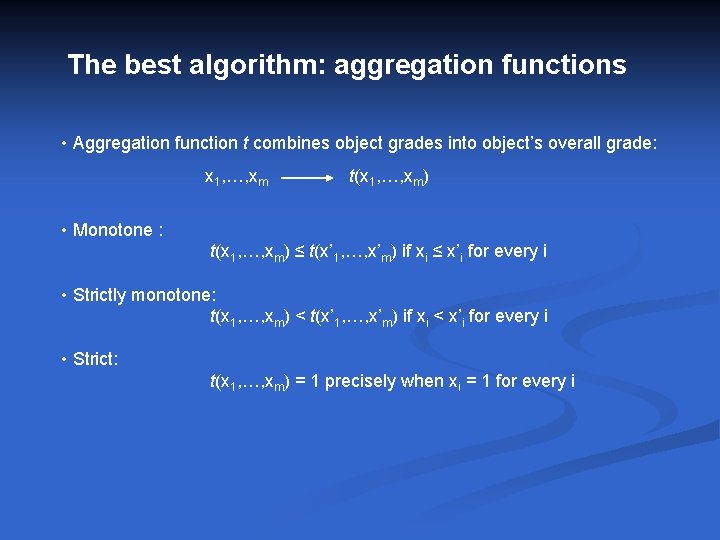
The best algorithm: aggregation functions • Aggregation function t combines object grades into object’s overall grade: x 1, …, xm t(x 1, …, xm) • Monotone : t(x 1, …, xm) ≤ t(x’ 1, …, x’m) if xi ≤ x’i for every i • Strictly monotone: t(x 1, …, xm) < t(x’ 1, …, x’m) if xi < x’i for every i • Strict: t(x 1, …, xm) = 1 precisely when xi = 1 for every i
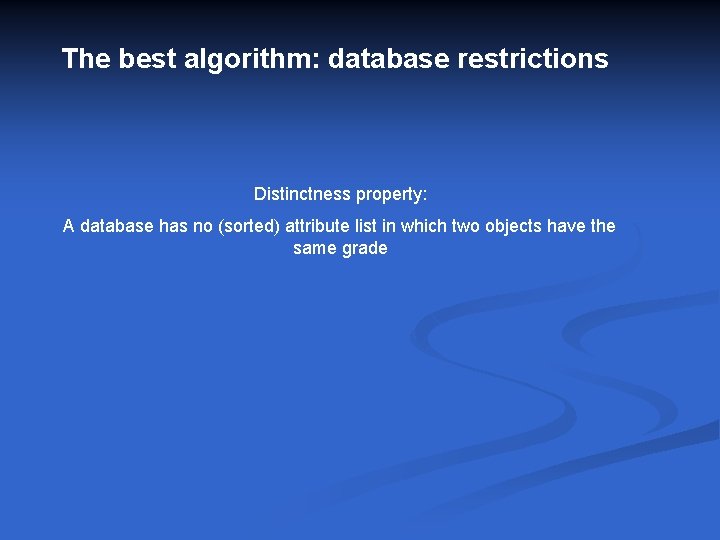
The best algorithm: database restrictions Distinctness property: A database has no (sorted) attribute list in which two objects have the same grade
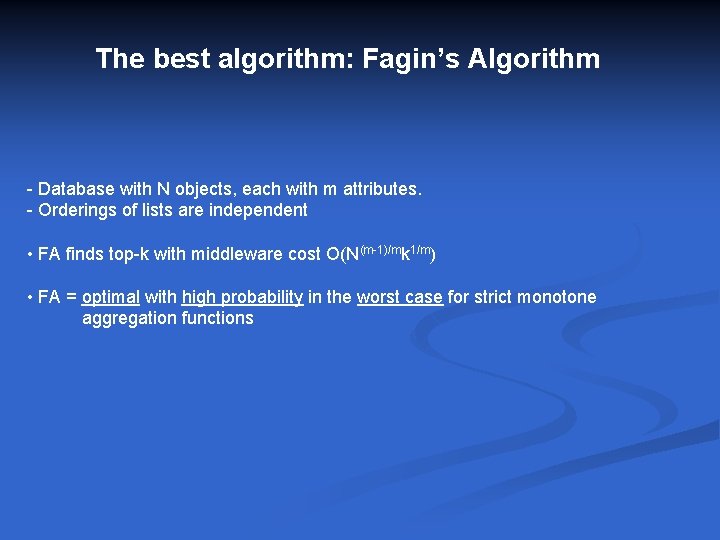
The best algorithm: Fagin’s Algorithm - Database with N objects, each with m attributes. - Orderings of lists are independent • FA finds top-k with middleware cost O(N(m-1)/mk 1/m) • FA = optimal with high probability in the worst case for strict monotone aggregation functions
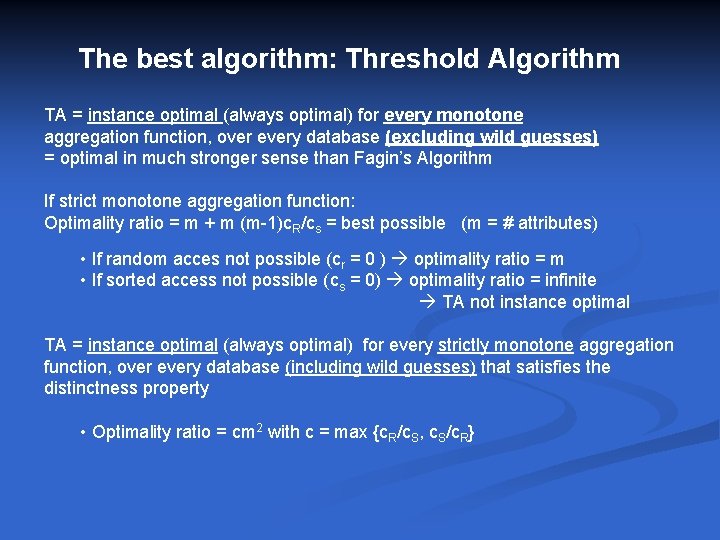
The best algorithm: Threshold Algorithm TA = instance optimal (always optimal) for every monotone aggregation function, over every database (excluding wild guesses) = optimal in much stronger sense than Fagin’s Algorithm If strict monotone aggregation function: Optimality ratio = m + m (m-1)c. R/cs = best possible (m = # attributes) • If random acces not possible (cr = 0 ) optimality ratio = m • If sorted access not possible (cs = 0) optimality ratio = infinite TA not instance optimal TA = instance optimal (always optimal) for every strictly monotone aggregation function, over every database (including wild guesses) that satisfies the distinctness property • Optimality ratio = cm 2 with c = max {c. R/c. S, c. S/c. R}
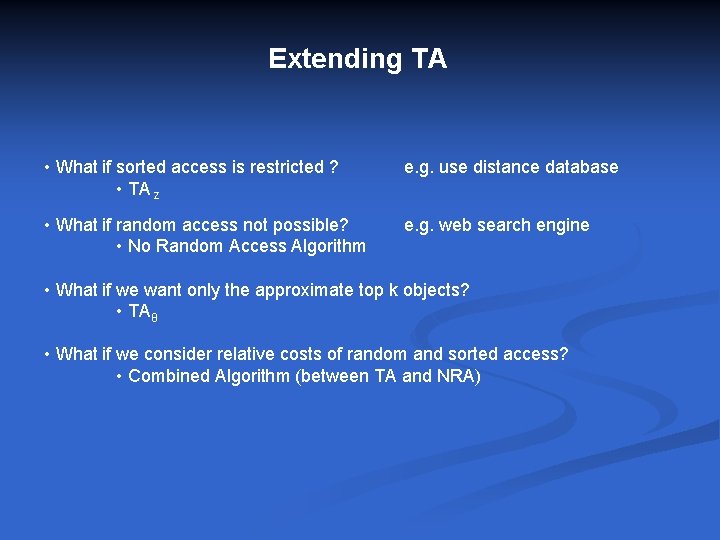
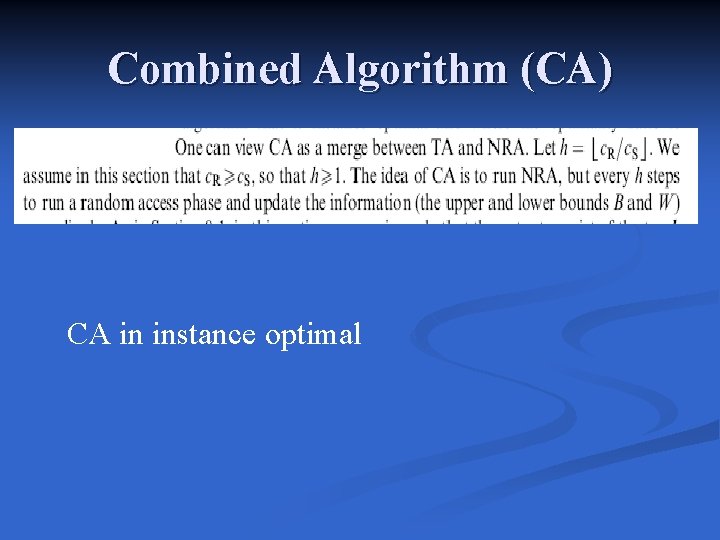
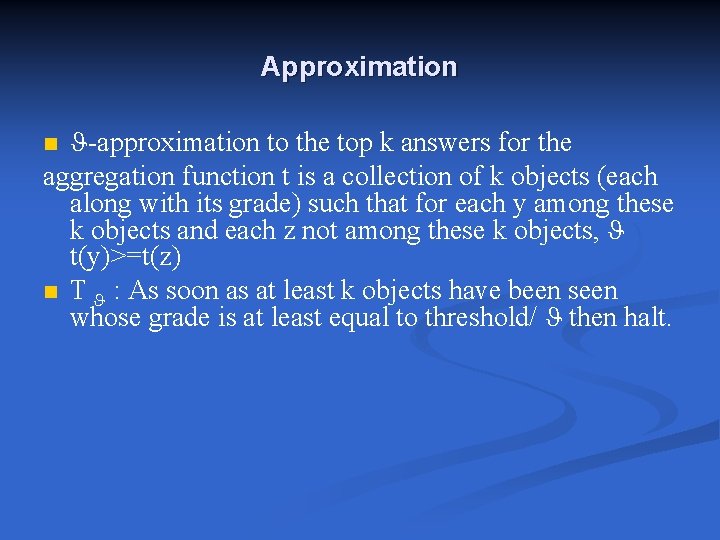
Extending TA • What if sorted access is restricted ? • TA z e. g. use distance database • What if random access not possible? • No Random Access Algorithm e. g. web search engine • What if we want only the approximate top k objects? • TAθ • What if we consider relative costs of random and sorted access? • Combined Algorithm (between TA and NRA)
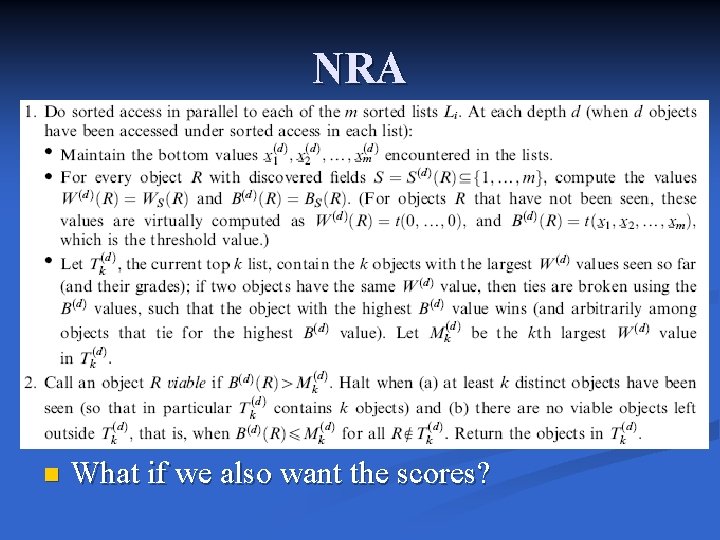
NRA n What if we also want the scores?
Combined Algorithm (CA) CA in instance optimal
Approximation -approximation to the top k answers for the aggregation function t is a collection of k objects (each along with its grade) such that for each y among these k objects and each z not among these k objects, t(y)>=t(z) n T : As soon as at least k objects have been seen whose grade is at least equal to threshold/ then halt. n