
Topics Types of extreme environments present on Earth
- Slides: 35
Topics: § Types of extreme environments present on Earth § Adaptations to cell structures required for survival in extreme environments § Residents of extreme cold environments § Residents of hydrothermal environments § Residents of acidic environments § Residents of high salt environments § Residents of alkaline environments § Survival under conditions of high-level radiation exposure § Importance of extremophiles
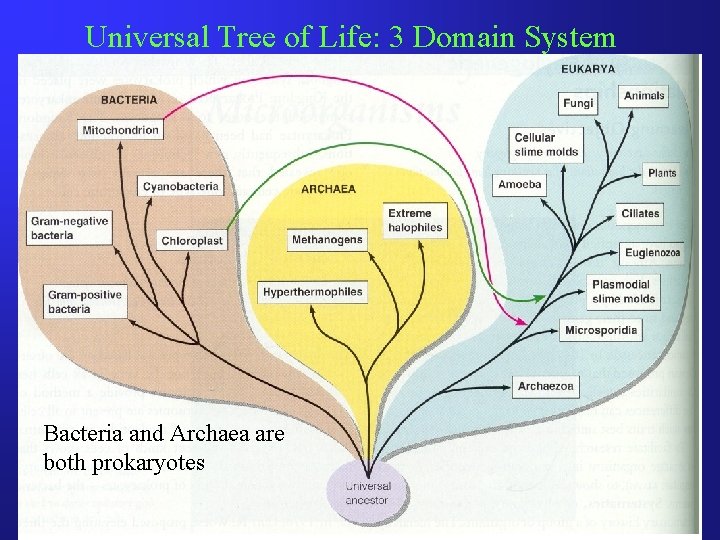
Universal Tree of Life: 3 Domain System Bacteria and Archaea are both prokaryotes
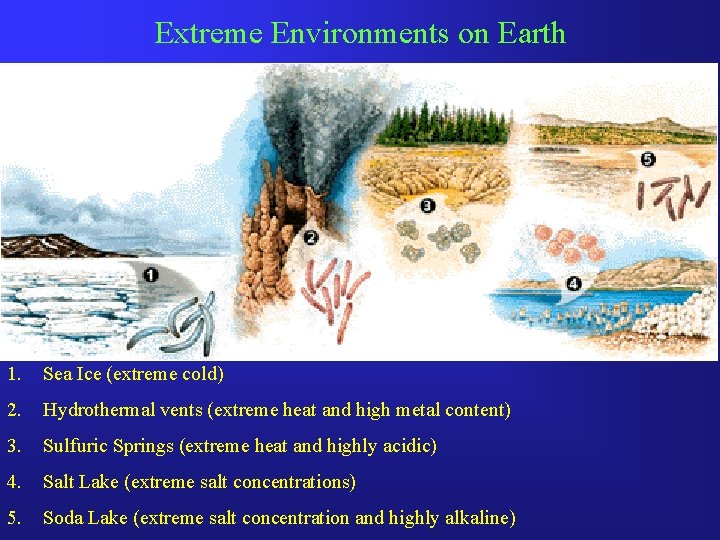
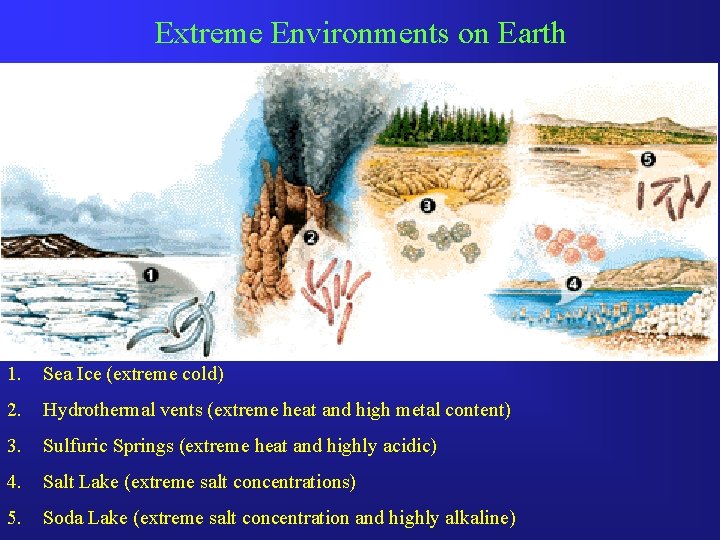
Extreme Environments on Earth 1. Sea Ice (extreme cold) 2. Hydrothermal vents (extreme heat and high metal content) 3. Sulfuric Springs (extreme heat and highly acidic) 4. Salt Lake (extreme salt concentrations) 5. Soda Lake (extreme salt concentration and highly alkaline)
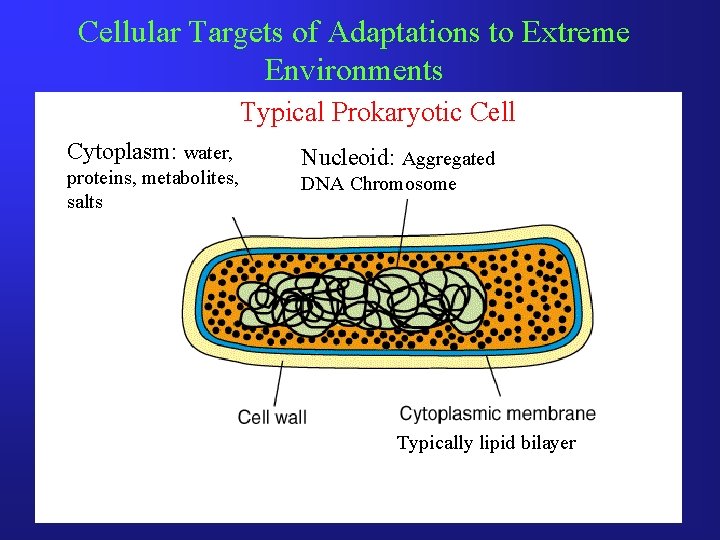
Cellular Targets of Adaptations to Extreme Environments Typical Prokaryotic Cell Cytoplasm: water, proteins, metabolites, salts Nucleoid: Aggregated DNA Chromosome Typically lipid bilayer
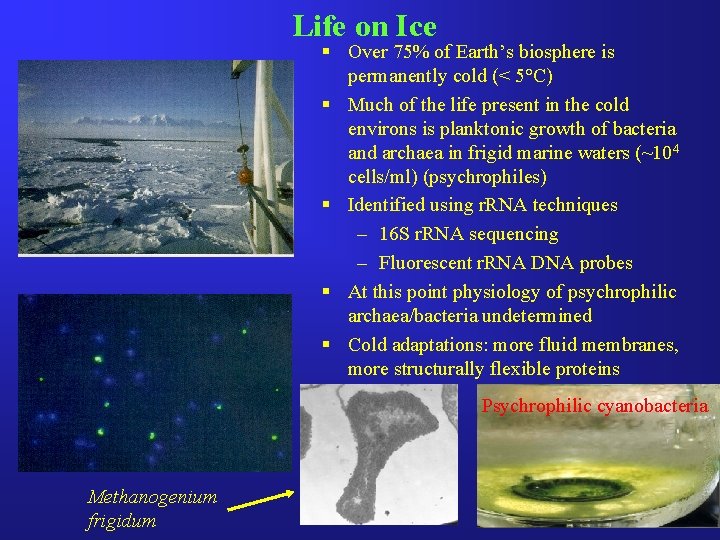
Life on Ice § Over 75% of Earth’s biosphere is permanently cold (< 5°C) § Much of the life present in the cold environs is planktonic growth of bacteria and archaea in frigid marine waters (~104 cells/ml) (psychrophiles) § Identified using r. RNA techniques – 16 S r. RNA sequencing – Fluorescent r. RNA DNA probes § At this point physiology of psychrophilic archaea/bacteria undetermined § Cold adaptations: more fluid membranes, more structurally flexible proteins Psychrophilic cyanobacteria Methanogenium frigidum
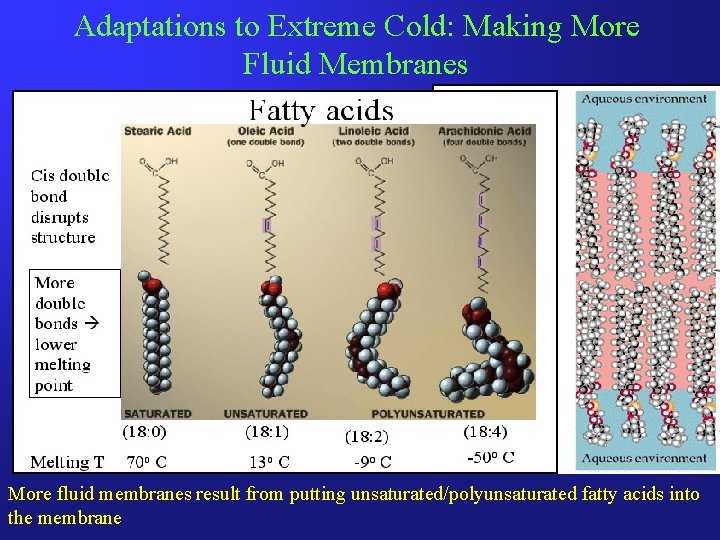
Adaptations to Extreme Cold: Making More Fluid Membranes More fluid membranes result from putting unsaturated/polyunsaturated fatty acids into the membrane
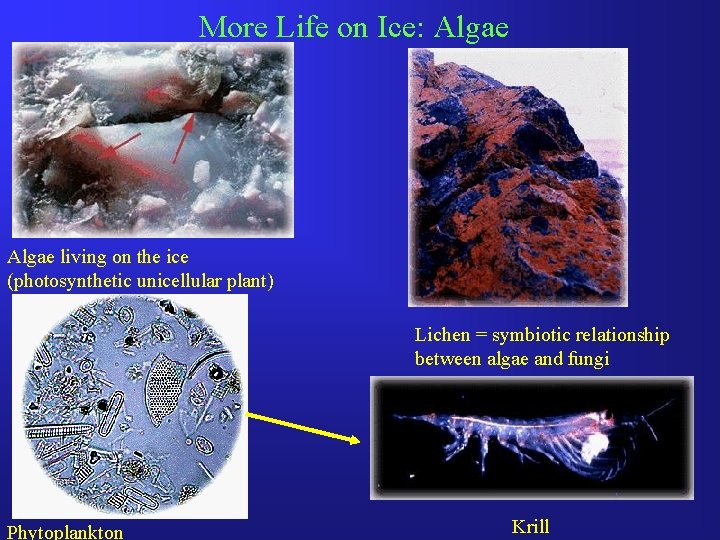
More Life on Ice: Algae living on the ice (photosynthetic unicellular plant) Lichen = symbiotic relationship between algae and fungi Phytoplankton Krill
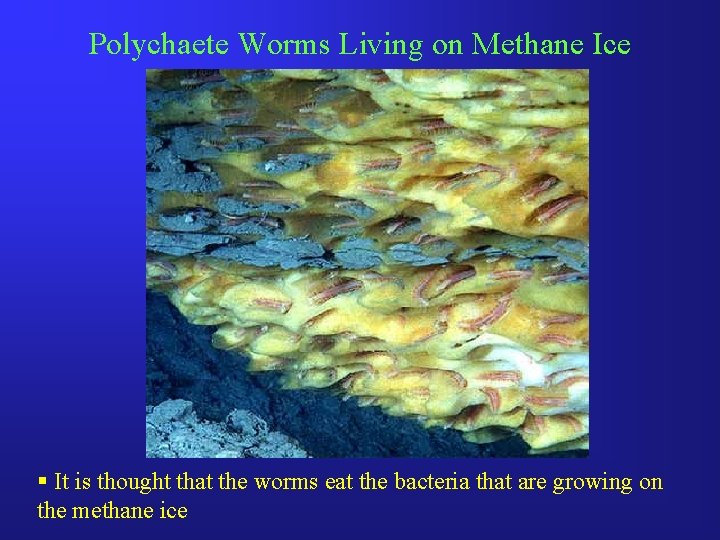
Polychaete Worms Living on Methane Ice § It is thought that the worms eat the bacteria that are growing on the methane ice
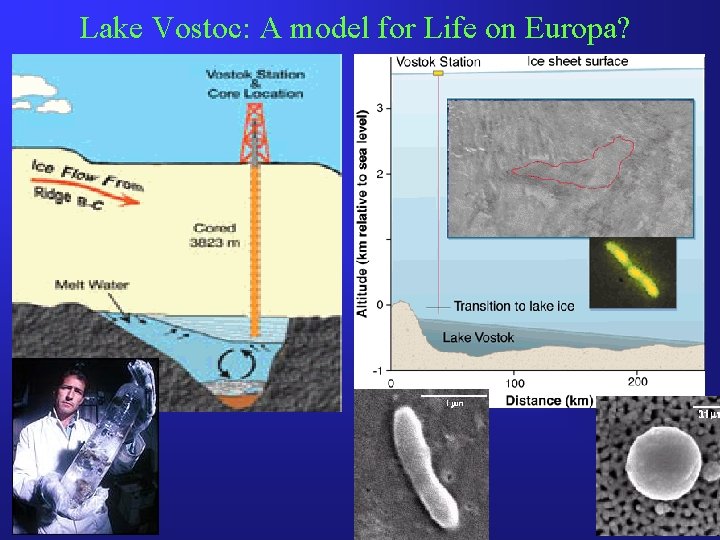
Lake Vostoc: A model for Life on Europa?
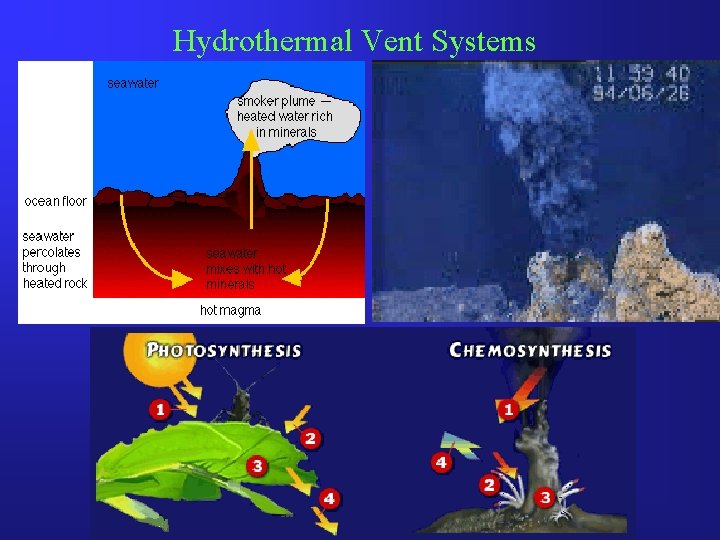
Hydrothermal Vent Systems
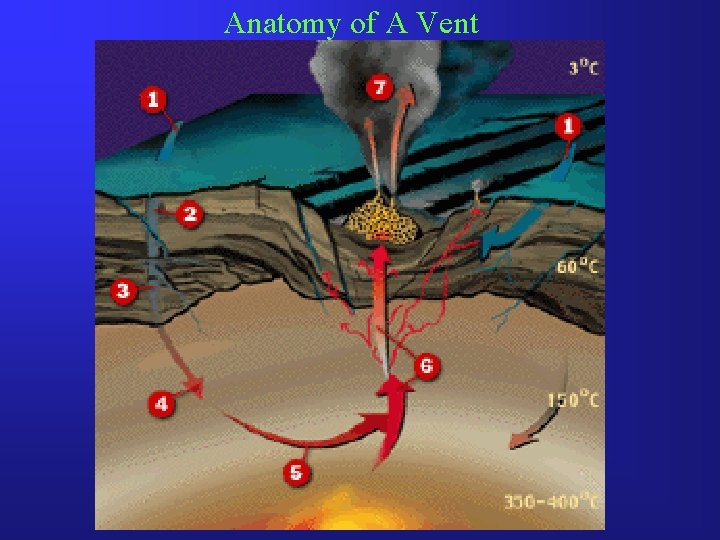
Anatomy of A Vent
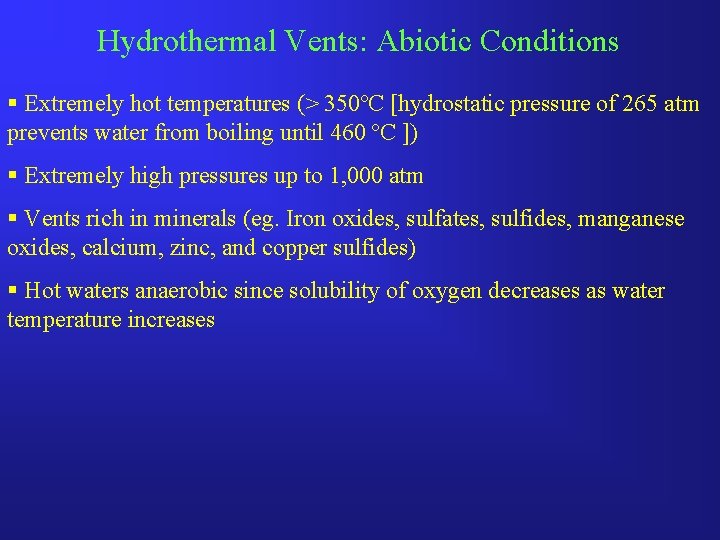
Hydrothermal Vents: Abiotic Conditions § Extremely hot temperatures (> 350ºC [hydrostatic pressure of 265 atm prevents water from boiling until 460 ºC ]) § Extremely high pressures up to 1, 000 atm § Vents rich in minerals (eg. Iron oxides, sulfates, sulfides, manganese oxides, calcium, zinc, and copper sulfides) § Hot waters anaerobic since solubility of oxygen decreases as water temperature increases
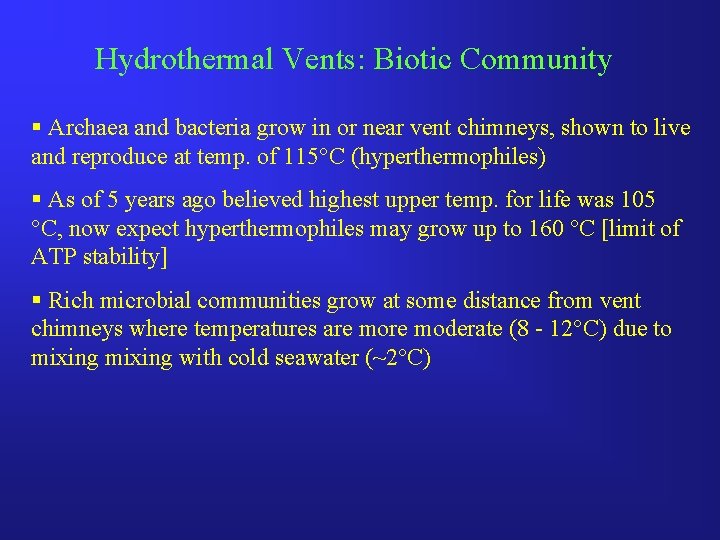
Hydrothermal Vents: Biotic Community § Archaea and bacteria grow in or near vent chimneys, shown to live and reproduce at temp. of 115°C (hyperthermophiles) § As of 5 years ago believed highest upper temp. for life was 105 °C, now expect hyperthermophiles may grow up to 160 °C [limit of ATP stability] § Rich microbial communities grow at some distance from vent chimneys where temperatures are moderate (8 - 12°C) due to mixing with cold seawater (~2°C)
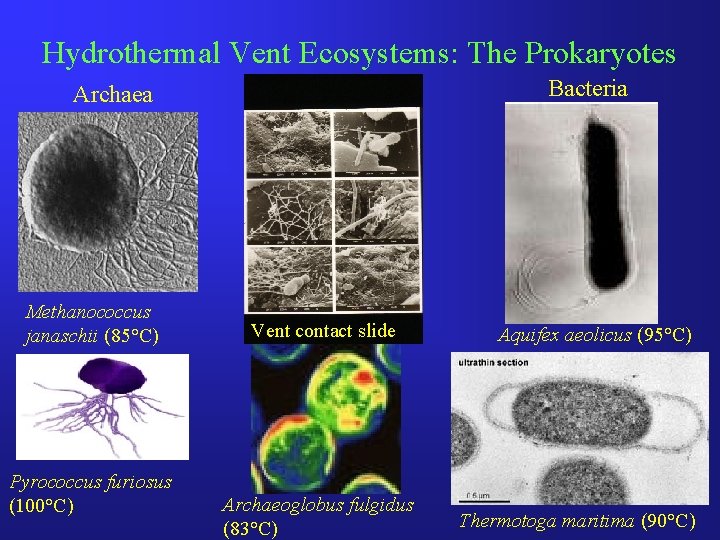
Hydrothermal Vent Ecosystems: The Prokaryotes Bacteria Archaea Methanococcus janaschii (85°C) Pyrococcus furiosus (100°C) Vent contact slide Archaeoglobus fulgidus (83°C) Aquifex aeolicus (95°C) Thermotoga maritima (90°C)
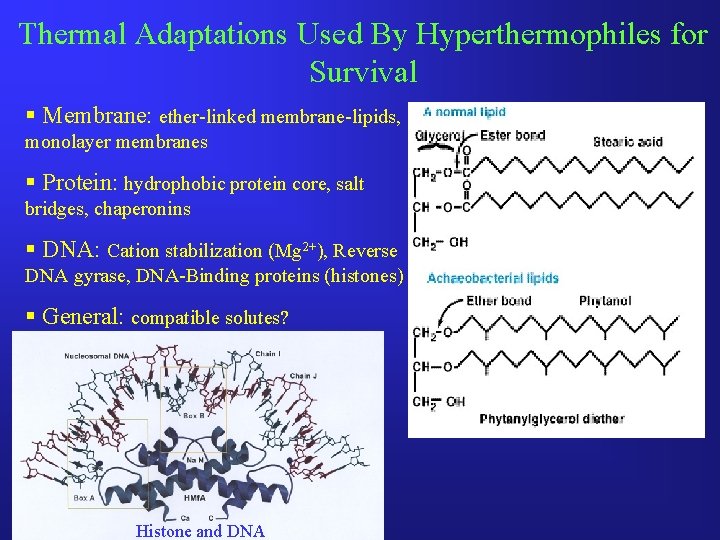
Thermal Adaptations Used By Hyperthermophiles for Survival § Membrane: ether-linked membrane-lipids, monolayer membranes § Protein: hydrophobic protein core, salt bridges, chaperonins § DNA: Cation stabilization (Mg 2+), Reverse DNA gyrase, DNA-Binding proteins (histones) § General: compatible solutes? Histone and DNA
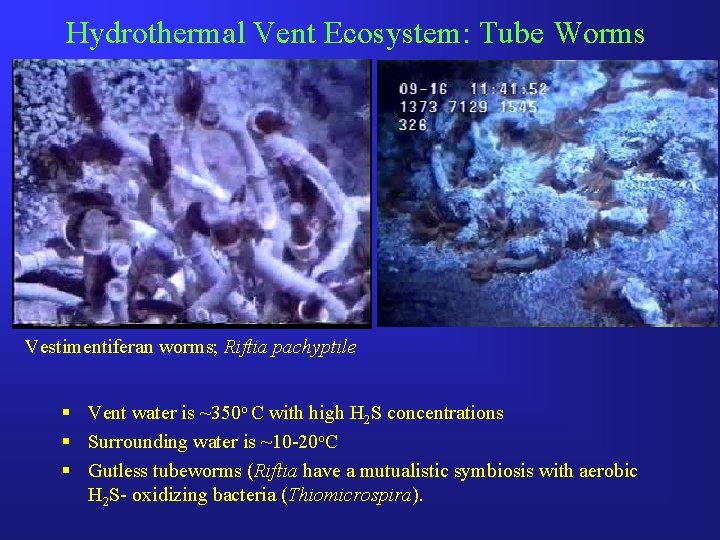
Hydrothermal Vent Ecosystem: Tube Worms Vestimentiferan worms; Riftia pachyptile § Vent water is ~350 o C with high H 2 S concentrations § Surrounding water is ~10 -20 o. C § Gutless tubeworms (Riftia have a mutualistic symbiosis with aerobic H 2 S- oxidizing bacteria (Thiomicrospira).
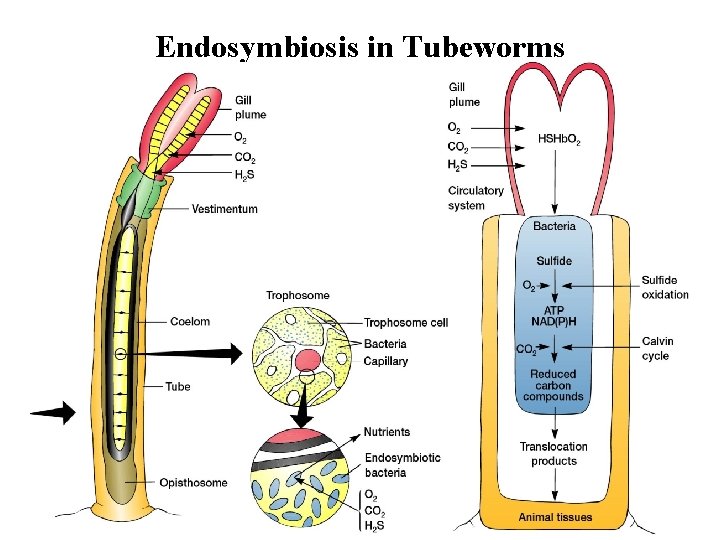
Endosymbiosis in Tubeworms
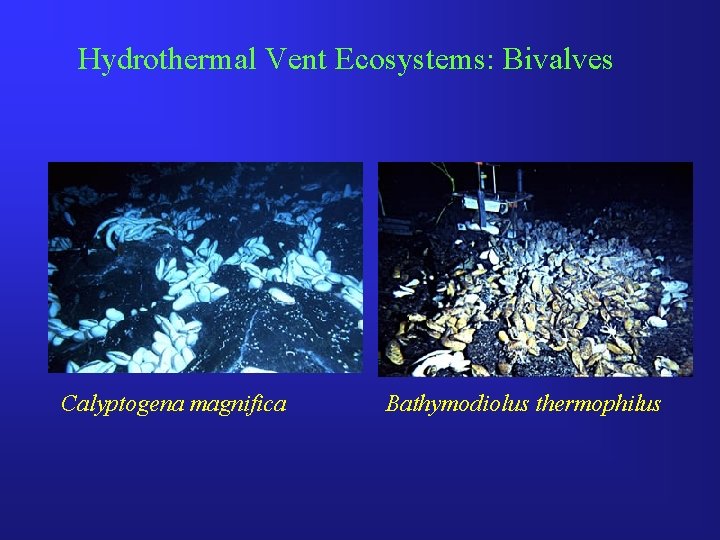
Hydrothermal Vent Ecosystems: Bivalves Calyptogena magnifica Bathymodiolus thermophilus
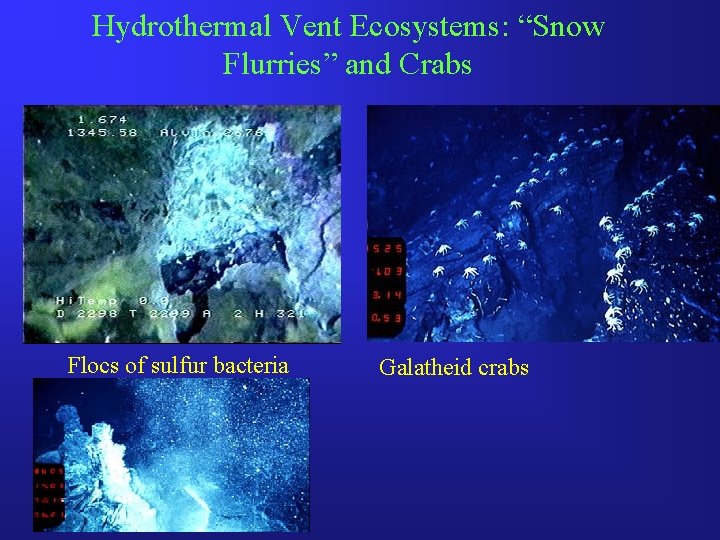
Hydrothermal Vent Ecosystems: “Snow Flurries” and Crabs Flocs of sulfur bacteria Galatheid crabs
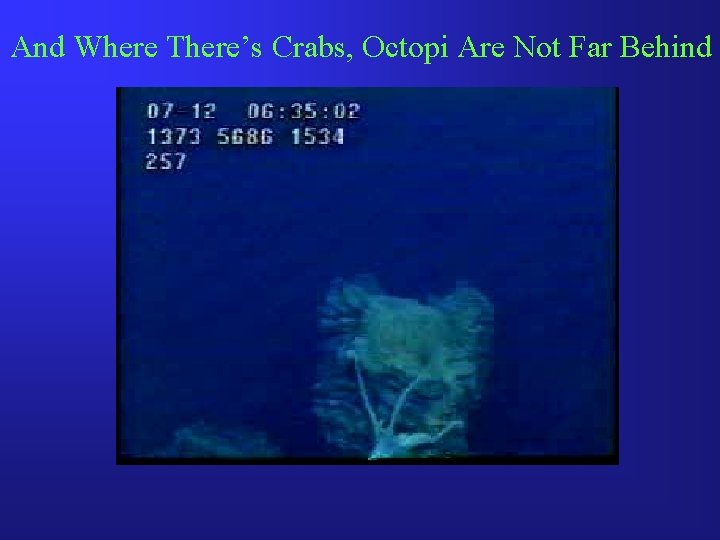
And Where There’s Crabs, Octopi Are Not Far Behind
Continued
Topics: § Types of extreme environments present on Earth § Adaptations to cell structures required for survival in extreme environments § Residents of extreme cold environments § Residents of hydrothermal environments § Residents of acidic environments § Residents of high salt environments § Residents of alkaline environments § Survival under conditions of high-level radiation exposure §Importance of extremophiles
Extreme Environments on Earth 1. Sea Ice (extreme cold) 2. Hydrothermal vents (extreme heat and high metal content) 3. Sulfuric Springs (extreme heat and highly acidic) 4. Salt Lake (extreme salt concentrations) 5. Soda Lake (extreme salt concentration and highly alkaline)
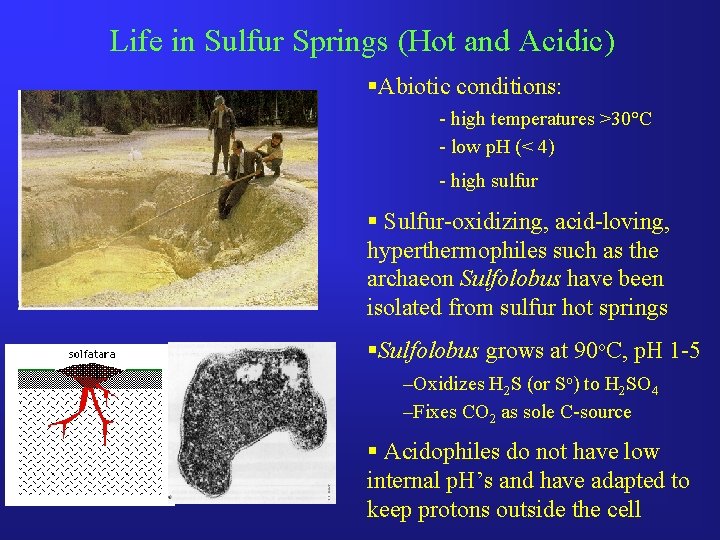
Life in Sulfur Springs (Hot and Acidic) §Abiotic conditions: - high temperatures >30°C - low p. H (< 4) - high sulfur § Sulfur-oxidizing, acid-loving, hyperthermophiles such as the archaeon Sulfolobus have been isolated from sulfur hot springs §Sulfolobus grows at 90 o. C, p. H 1 -5 –Oxidizes H 2 S (or So) to H 2 SO 4 –Fixes CO 2 as sole C-source § Acidophiles do not have low internal p. H’s and have adapted to keep protons outside the cell
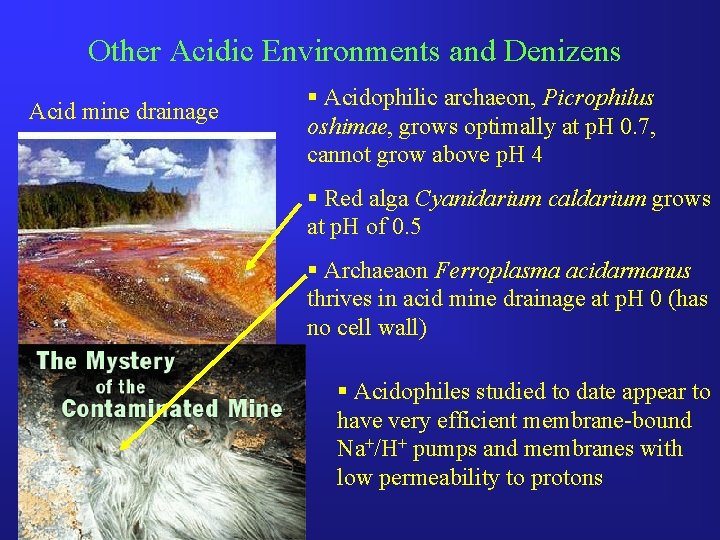
Other Acidic Environments and Denizens Acid mine drainage § Acidophilic archaeon, Picrophilus oshimae, grows optimally at p. H 0. 7, cannot grow above p. H 4 § Red alga Cyanidarium caldarium grows at p. H of 0. 5 § Archaeaon Ferroplasma acidarmanus thrives in acid mine drainage at p. H 0 (has no cell wall) § Acidophiles studied to date appear to have very efficient membrane-bound Na+/H+ pumps and membranes with low permeability to protons
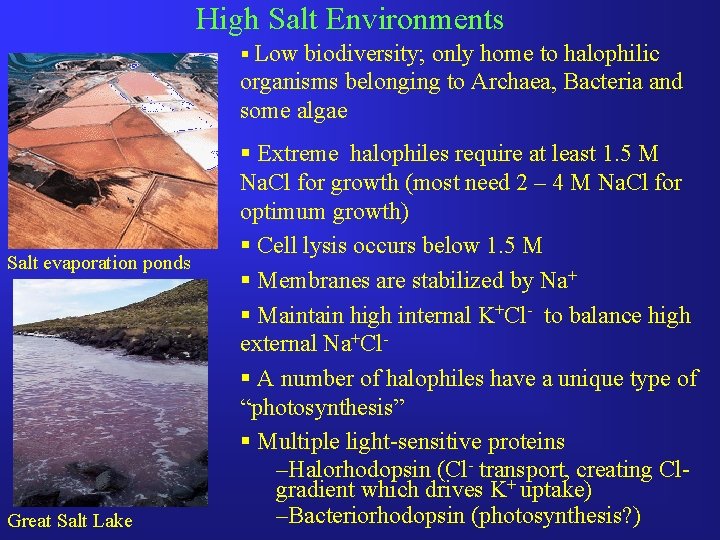
High Salt Environments § Low biodiversity; only home to halophilic organisms belonging to Archaea, Bacteria and some algae Salt evaporation ponds Great Salt Lake § Extreme halophiles require at least 1. 5 M Na. Cl for growth (most need 2 – 4 M Na. Cl for optimum growth) § Cell lysis occurs below 1. 5 M § Membranes are stabilized by Na+ § Maintain high internal K+Cl- to balance high external Na+Cl§ A number of halophiles have a unique type of “photosynthesis” § Multiple light-sensitive proteins –Halorhodopsin (Cl- transport, creating Clgradient which drives K+ uptake) –Bacteriorhodopsin (photosynthesis? )
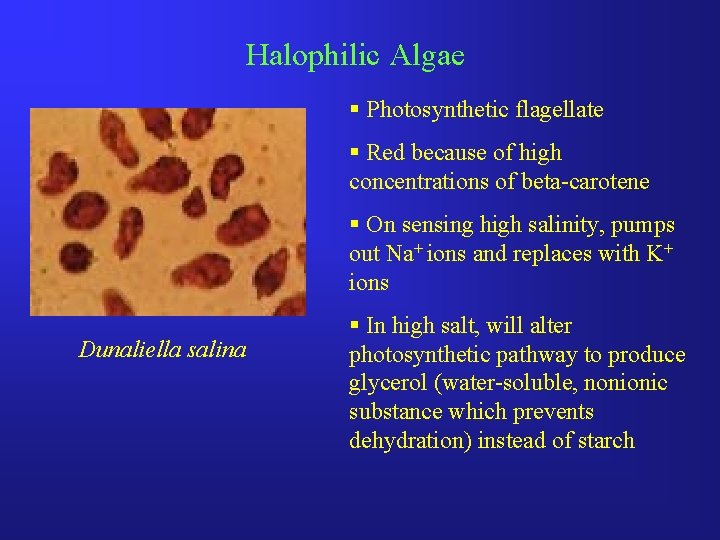
Halophilic Algae § Photosynthetic flagellate § Red because of high concentrations of beta-carotene § On sensing high salinity, pumps out Na+ ions and replaces with K+ ions Dunaliella salina § In high salt, will alter photosynthetic pathway to produce glycerol (water-soluble, nonionic substance which prevents dehydration) instead of starch
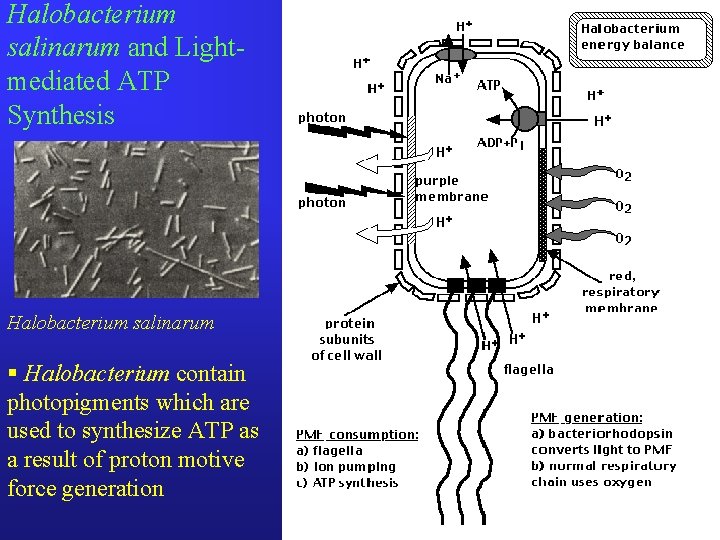
Halobacterium salinarum and Lightmediated ATP Synthesis Halobacterium salinarum § Halobacterium contain photopigments which are used to synthesize ATP as a result of proton motive force generation
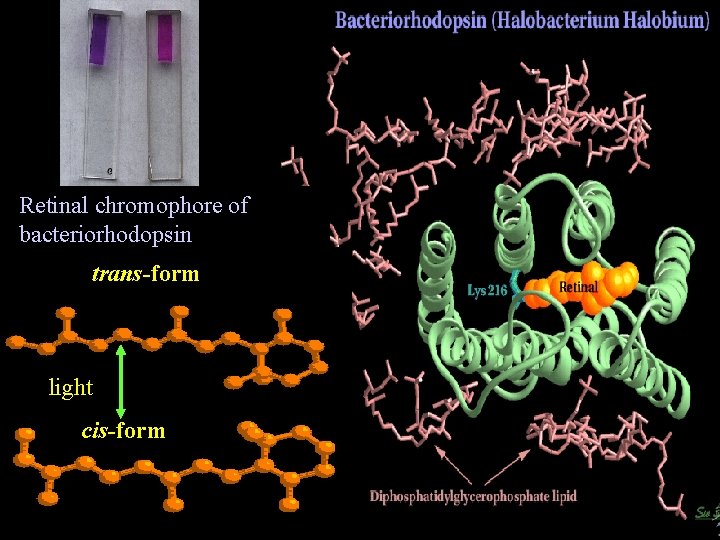
Retinal chromophore of bacteriorhodopsin trans-form light cis-form
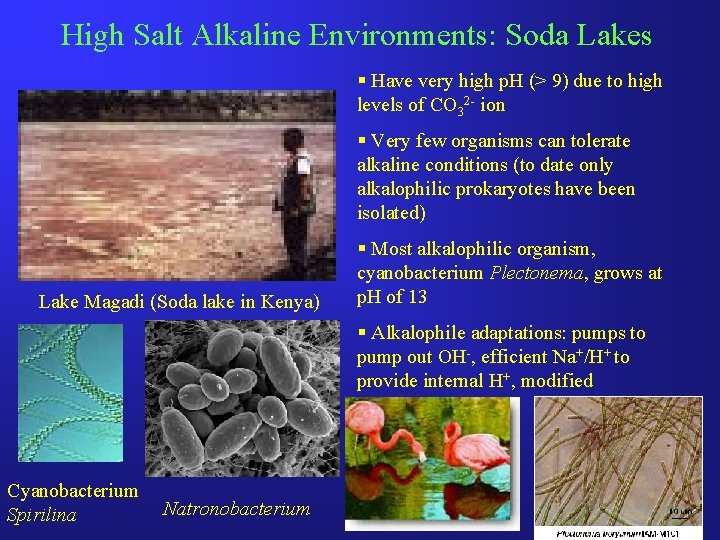
High Salt Alkaline Environments: Soda Lakes § Have very high p. H (> 9) due to high levels of CO 32 - ion § Very few organisms can tolerate alkaline conditions (to date only alkalophilic prokaryotes have been isolated) Lake Magadi (Soda lake in Kenya) § Most alkalophilic organism, cyanobacterium Plectonema, grows at p. H of 13 § Alkalophile adaptations: pumps to pump out OH-, efficient Na+/H+ to provide internal H+, modified membranes Cyanobacterium Spirilina Natronobacterium
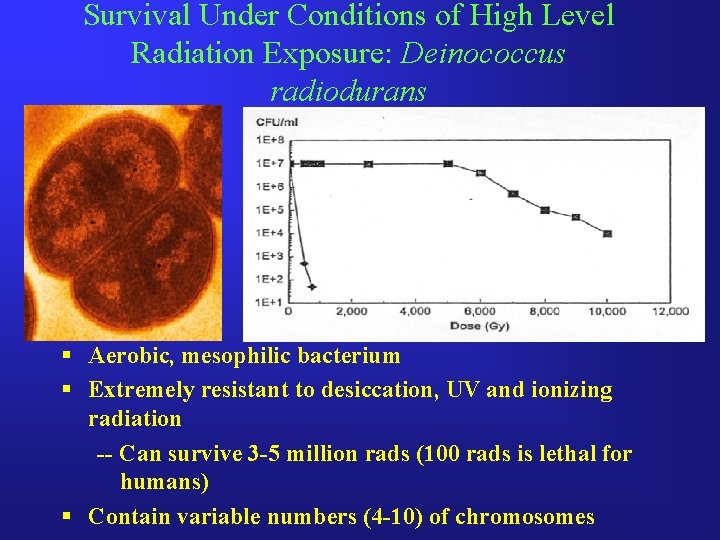
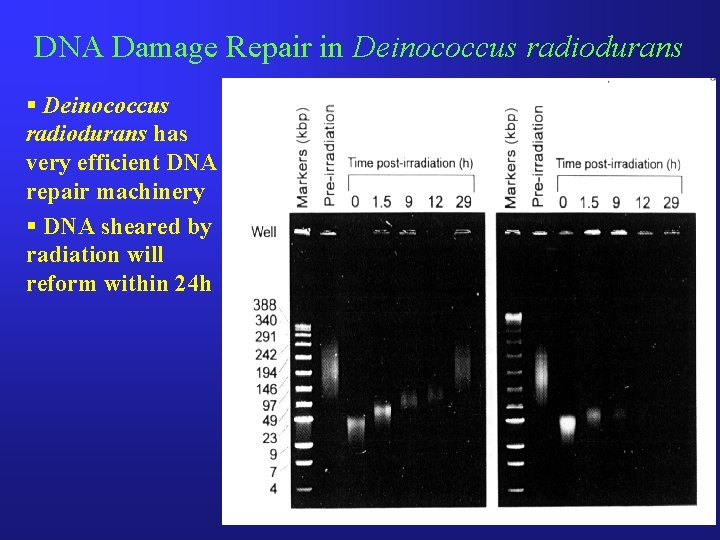
Survival Under Conditions of High Level Radiation Exposure: Deinococcus radiodurans § Aerobic, mesophilic bacterium § Extremely resistant to desiccation, UV and ionizing radiation -- Can survive 3 -5 million rads (100 rads is lethal for humans) § Contain variable numbers (4 -10) of chromosomes
DNA Damage Repair in Deinococcus radiodurans § Deinococcus radiodurans has very efficient DNA repair machinery § DNA sheared by radiation will reform within 24 h
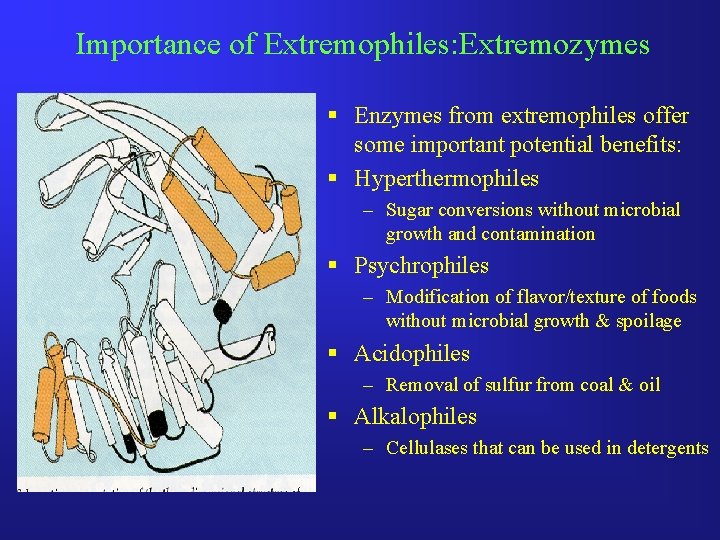
Importance of Extremophiles: Extremozymes § Enzymes from extremophiles offer some important potential benefits: § Hyperthermophiles – Sugar conversions without microbial growth and contamination § Psychrophiles – Modification of flavor/texture of foods without microbial growth & spoilage § Acidophiles – Removal of sulfur from coal & oil § Alkalophiles – Cellulases that can be used in detergents
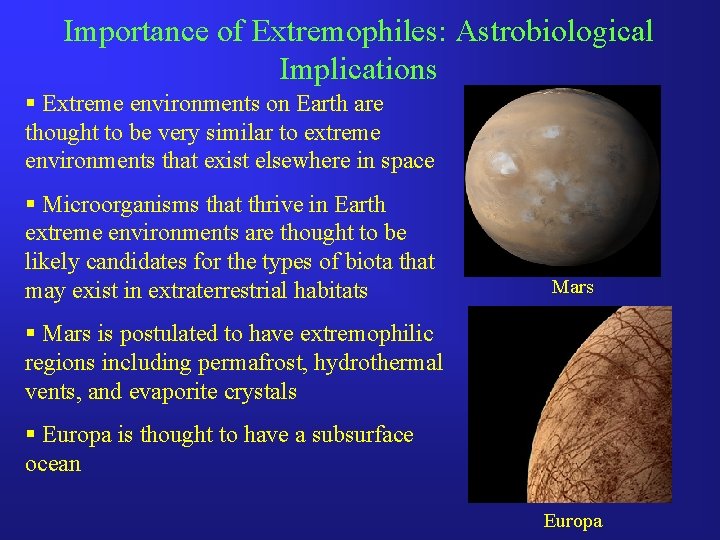
Importance of Extremophiles: Astrobiological Implications § Extreme environments on Earth are thought to be very similar to extreme environments that exist elsewhere in space § Microorganisms that thrive in Earth extreme environments are thought to be likely candidates for the types of biota that may exist in extraterrestrial habitats Mars § Mars is postulated to have extremophilic regions including permafrost, hydrothermal vents, and evaporite crystals § Europa is thought to have a subsurface ocean Europa