
Topics Taxonomy Kingdoms and Evolution 2007 TEK 7
- Slides: 25
Topics: Taxonomy, Kingdoms and Evolution 2007
TEK 7 A • Identify characteristics of kingdoms including archeabacteria, eubacteria, protist, fungi, plants and animals
• Taxonomy is the method used by scientists to categorize and name living things. • We give all organisms a scientific name which is 2 names. • Scientific names are in Latin, written in italics or underlined and the first name is capitalized and the second name is lower case. • EX: Canis familiaris (dog)
• We sort organisms into large categories and further sort them into smaller and smaller categories, getting more specific as we go. • The more categories two organisms share the more closely related they are: • Classification system is hierarchical…goes from large to small Domain Kingdom Phylum Class Order Family Genus Species • Note!!! The genus and species are the 2 names of the scientific name
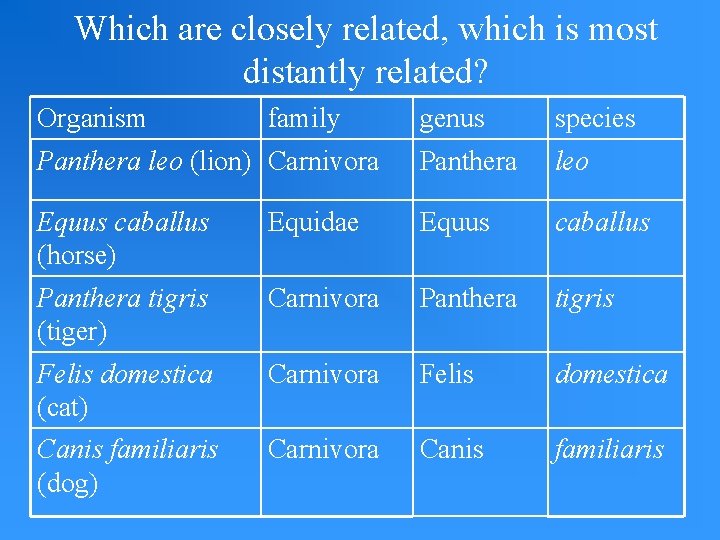
Which are closely related, which is most distantly related? Organism family genus species Panthera leo (lion) Carnivora Panthera leo Equus caballus (horse) Equidae Equus caballus Panthera tigris (tiger) Carnivora Panthera tigris Felis domestica (cat) Carnivora Felis domestica Canis familiaris (dog) Carnivora Canis familiaris
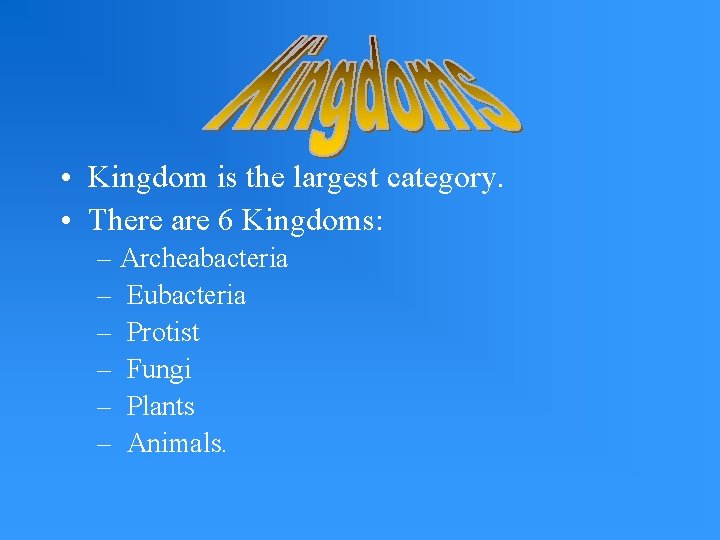
• Kingdom is the largest category. • There are 6 Kingdoms: – Archeabacteria – Eubacteria – Protist – Fungi – Plants – Animals.
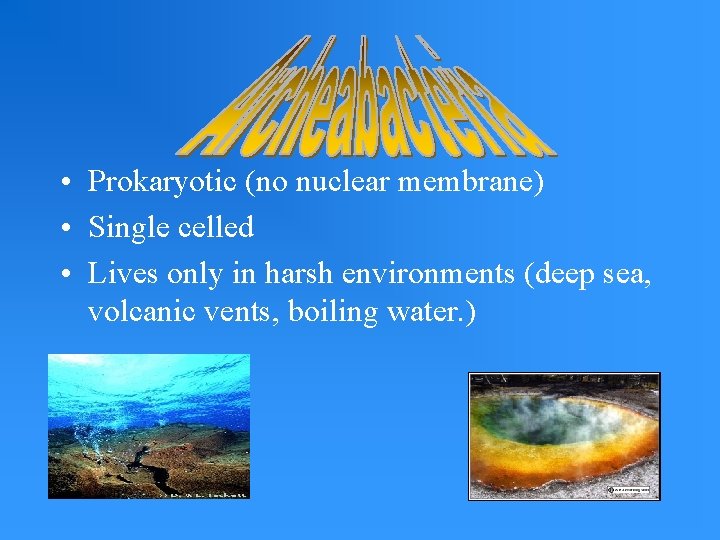
• Prokaryotic (no nuclear membrane) • Single celled • Lives only in harsh environments (deep sea, volcanic vents, boiling water. )
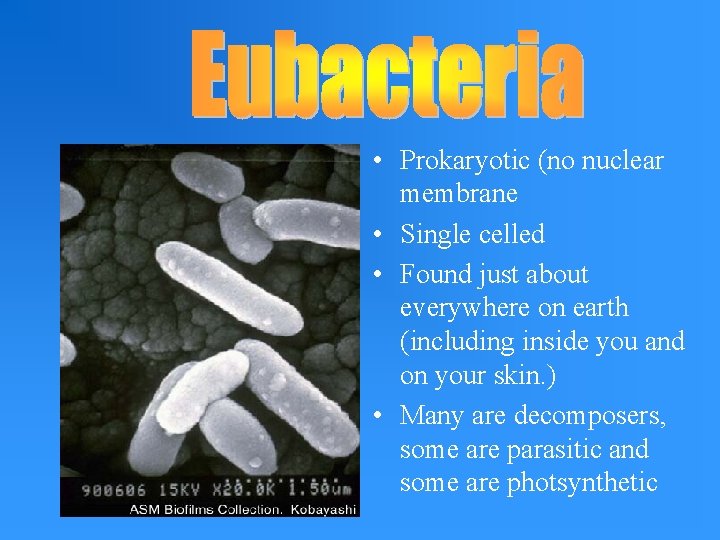
• Prokaryotic (no nuclear membrane • Single celled • Found just about everywhere on earth (including inside you and on your skin. ) • Many are decomposers, some are parasitic and some are photsynthetic
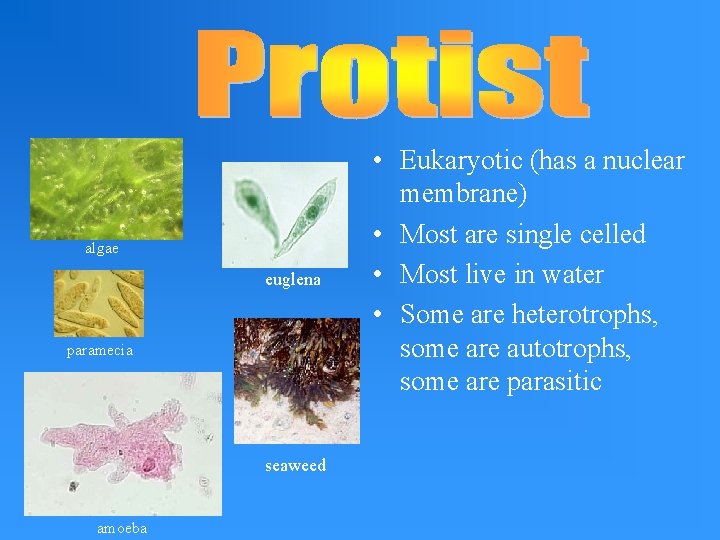
algae euglena paramecia seaweed amoeba • Eukaryotic (has a nuclear membrane) • Most are single celled • Most live in water • Some are heterotrophs, some are autotrophs, some are parasitic
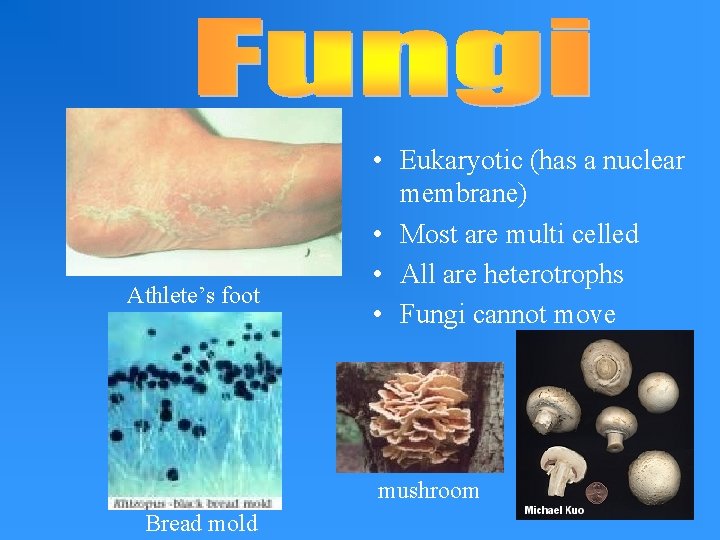
Athlete’s foot • Eukaryotic (has a nuclear membrane) • Most are multi celled • All are heterotrophs • Fungi cannot move mushroom Bread mold
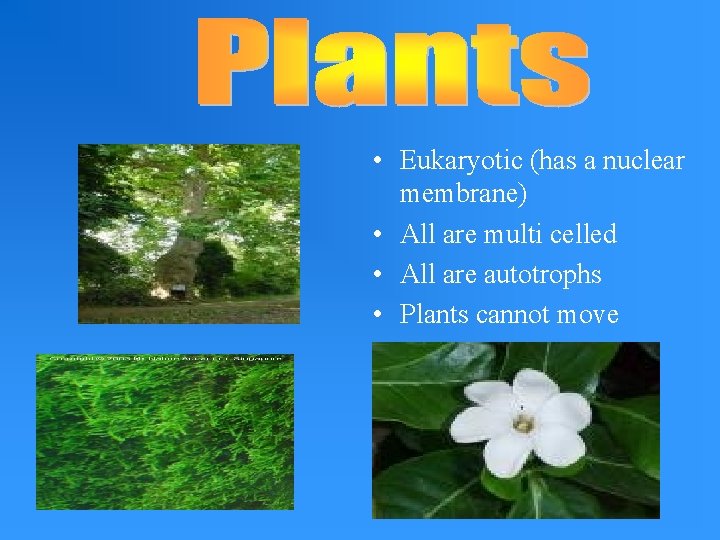
• Eukaryotic (has a nuclear membrane) • All are multi celled • All are autotrophs • Plants cannot move
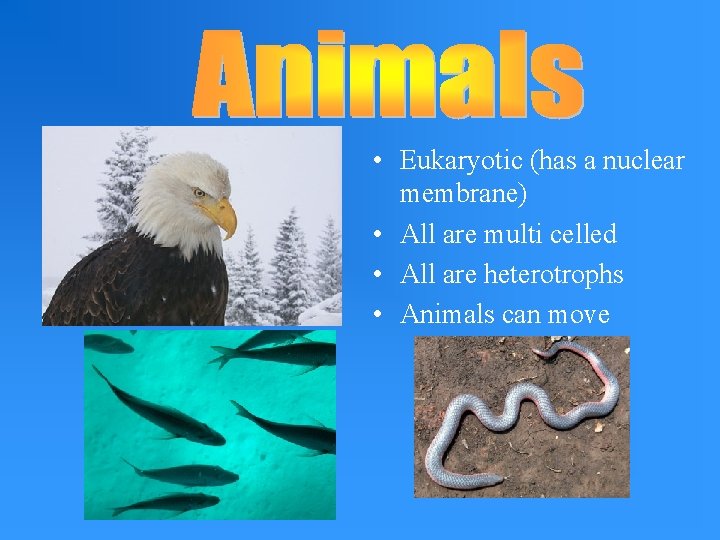
• Eukaryotic (has a nuclear membrane) • All are multi celled • All are heterotrophs • Animals can move
Unicellular eukaryotes that are usually mobile and obtain food from other organisms probably belong to the kingdom -- • • A. B. C. D. Plantae Fungi Animalia Protista
TEKS 7 A • Identify evidence of change in species using fossils, DNA sequences, anatomical similarities, physiological similarities and embryology
TEKS 7 B • Illustrate the results of natural selection in speciation, diversity, phylogeny, adaptation behavior and extinction
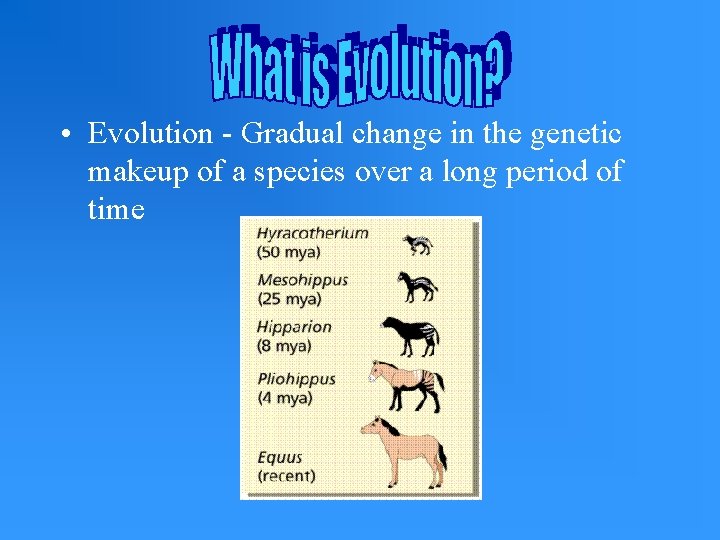
• Evolution - Gradual change in the genetic makeup of a species over a long period of time
Natural Selection • Also called “Survival of the Fittest” • Organisms best suited for an environment live to pass that trait on
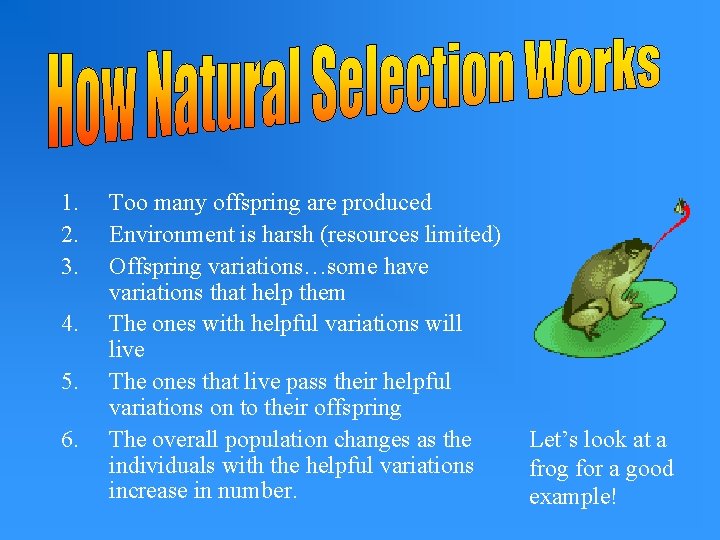
1. 2. 3. 4. 5. 6. Too many offspring are produced Environment is harsh (resources limited) Offspring variations…some have variations that help them The ones with helpful variations will live The ones that live pass their helpful variations on to their offspring The overall population changes as the individuals with the helpful variations increase in number. Let’s look at a frog for a good example!
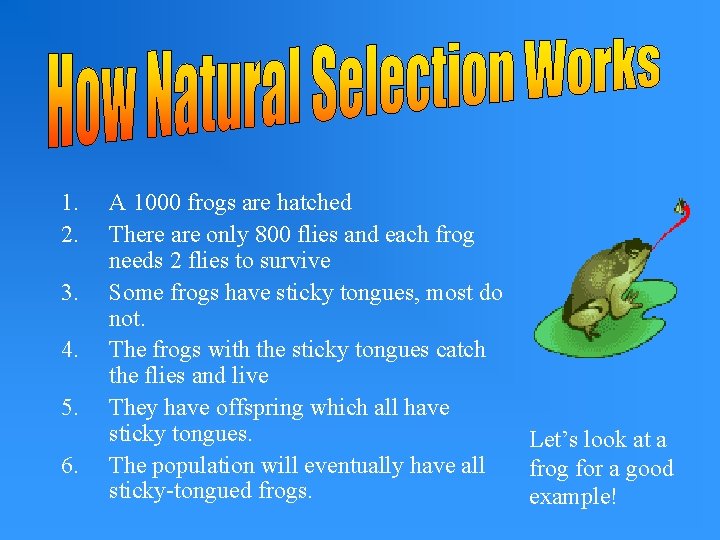
1. 2. 3. 4. 5. 6. A 1000 frogs are hatched There are only 800 flies and each frog needs 2 flies to survive Some frogs have sticky tongues, most do not. The frogs with the sticky tongues catch the flies and live They have offspring which all have sticky tongues. The population will eventually have all sticky-tongued frogs. Let’s look at a frog for a good example!
• Five major points that we use to support theory of evolution: 1. Fossil Record 2. Homologous Structures 3. Vestigial Organs 4. Amino Acid sequences 5. Embryology
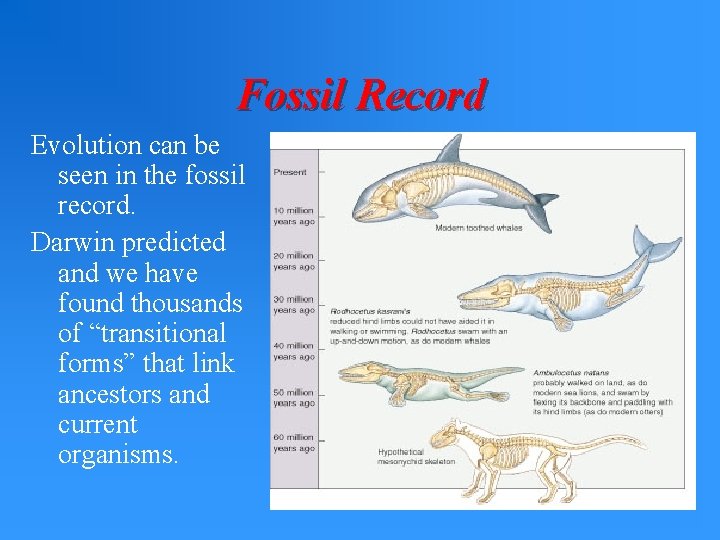
Fossil Record Evolution can be seen in the fossil record. Darwin predicted and we have found thousands of “transitional forms” that link ancestors and current organisms. •
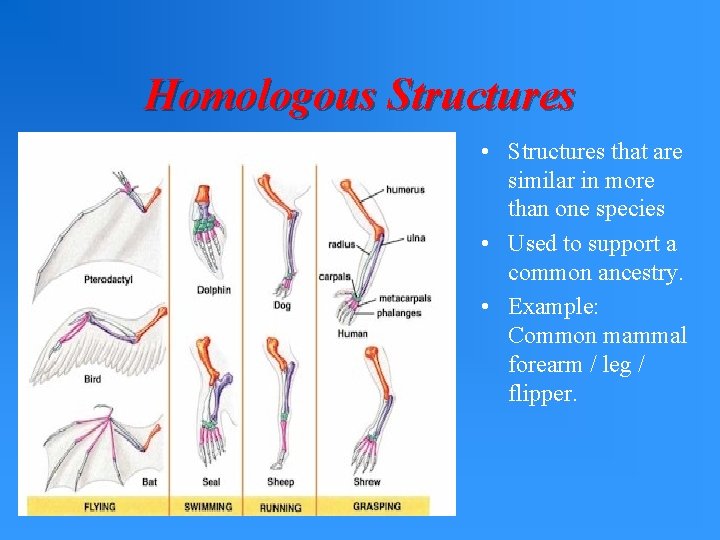
Homologous Structures • Structures that are similar in more than one species • Used to support a common ancestry. • Example: Common mammal forearm / leg / flipper.
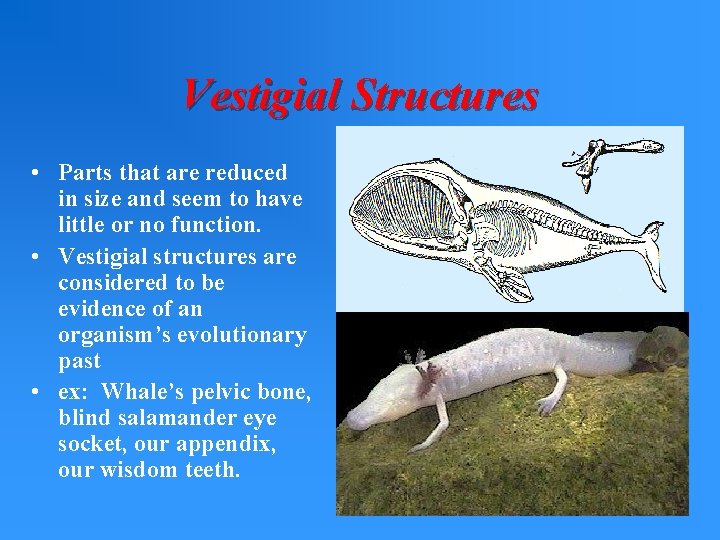
Vestigial Structures • Parts that are reduced in size and seem to have little or no function. • Vestigial structures are considered to be evidence of an organism’s evolutionary past • ex: Whale’s pelvic bone, blind salamander eye socket, our appendix, our wisdom teeth.
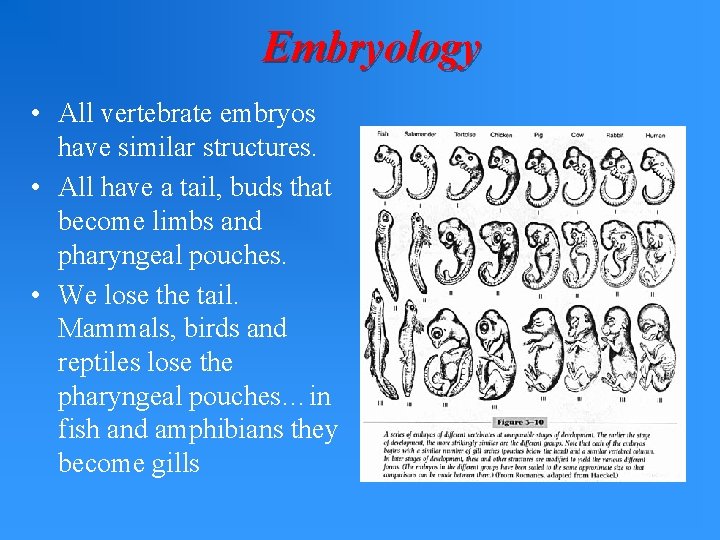
Embryology • All vertebrate embryos have similar structures. • All have a tail, buds that become limbs and pharyngeal pouches. • We lose the tail. Mammals, birds and reptiles lose the pharyngeal pouches…in fish and amphibians they become gills
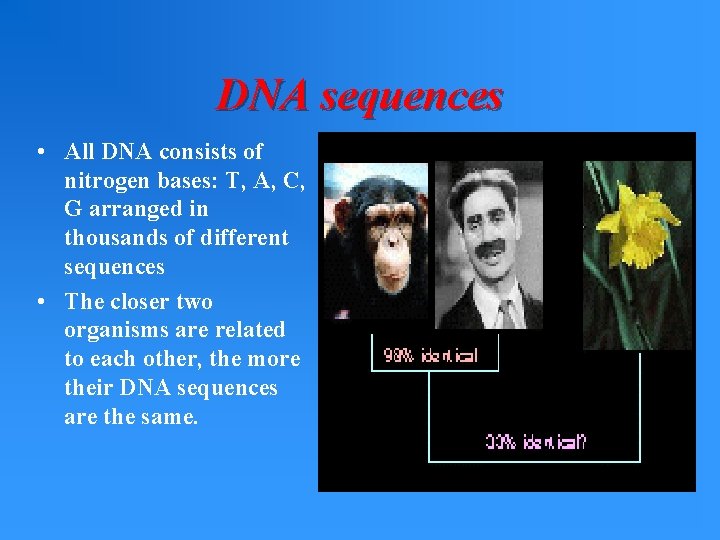
DNA sequences • All DNA consists of nitrogen bases: T, A, C, G arranged in thousands of different sequences • The closer two organisms are related to each other, the more their DNA sequences are the same.