
Topics Introduction Belt Drive Terminology Types of VBelts
Topics • • • Introduction Belt Drive Terminology Types of V-Belts Synchronous Belt Sheaves • Please read Chapter 10 in the text. MECH 1200
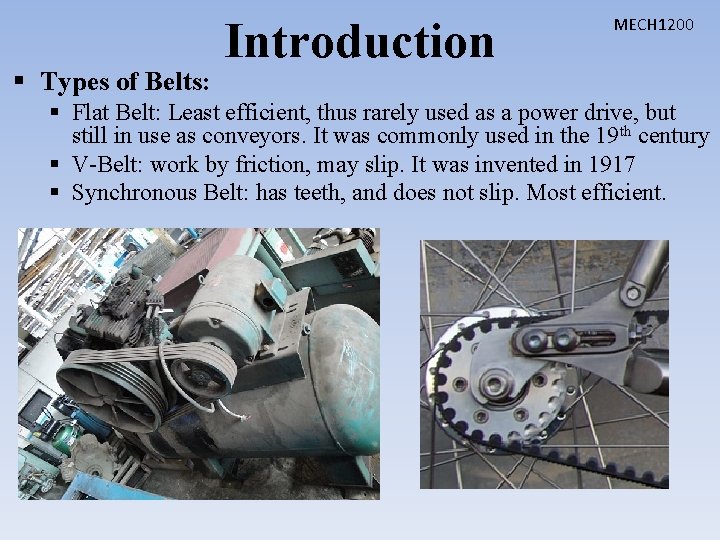
§ Types of Belts: Introduction MECH 1200 § Flat Belt: Least efficient, thus rarely used as a power drive, but still in use as conveyors. It was commonly used in the 19 th century § V-Belt: work by friction, may slip. It was invented in 1917 § Synchronous Belt: has teeth, and does not slip. Most efficient.
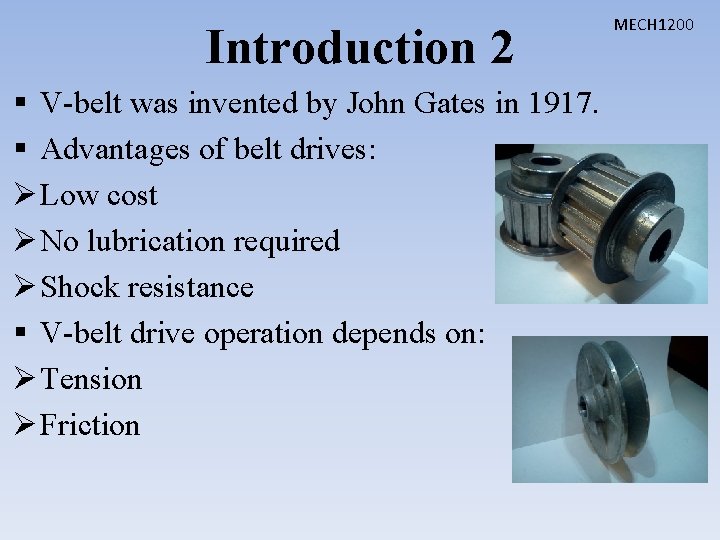
Introduction 2 § V-belt was invented by John Gates in 1917. § Advantages of belt drives: Ø Low cost Ø No lubrication required Ø Shock resistance § V-belt drive operation depends on: Ø Tension Ø Friction MECH 1200
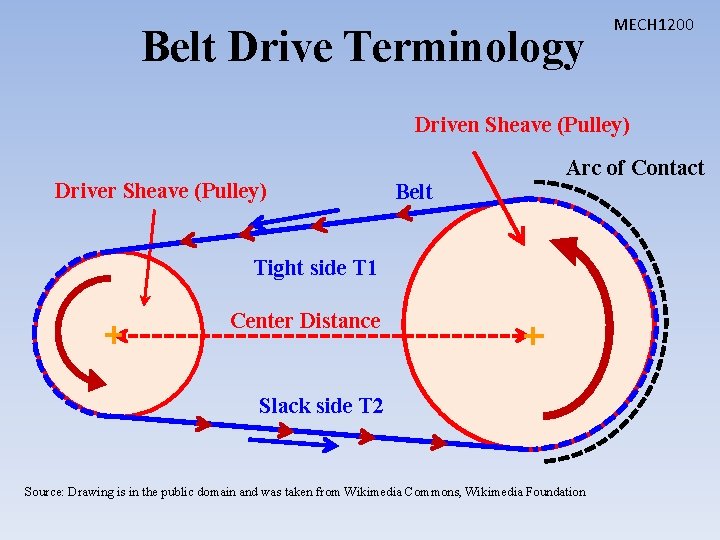
Belt Drive Terminology MECH 1200 Driven Sheave (Pulley) Driver Sheave (Pulley) Arc of Contact Belt Tight side T 1 Center Distance Slack side T 2 Source: Drawing is in the public domain and was taken from Wikimedia Commons, Wikimedia Foundation
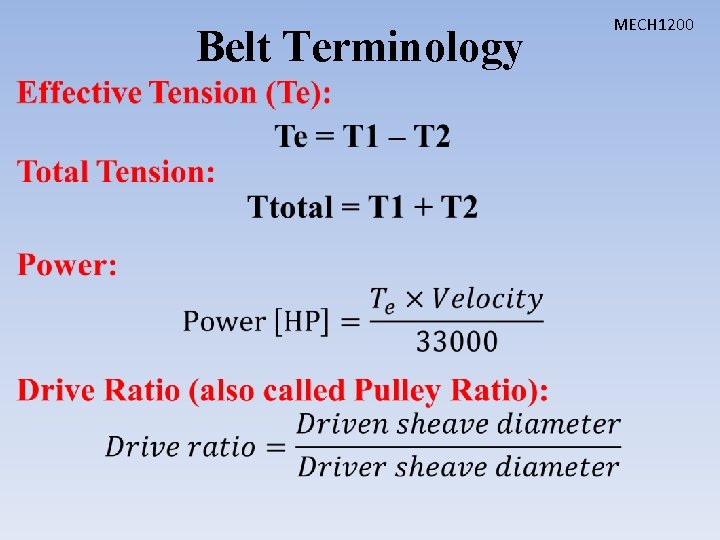
Belt Terminology • MECH 1200
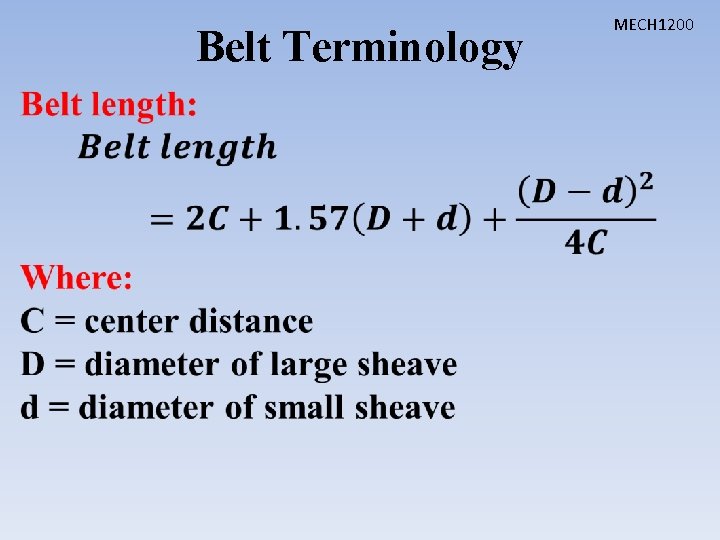
Belt Terminology • MECH 1200
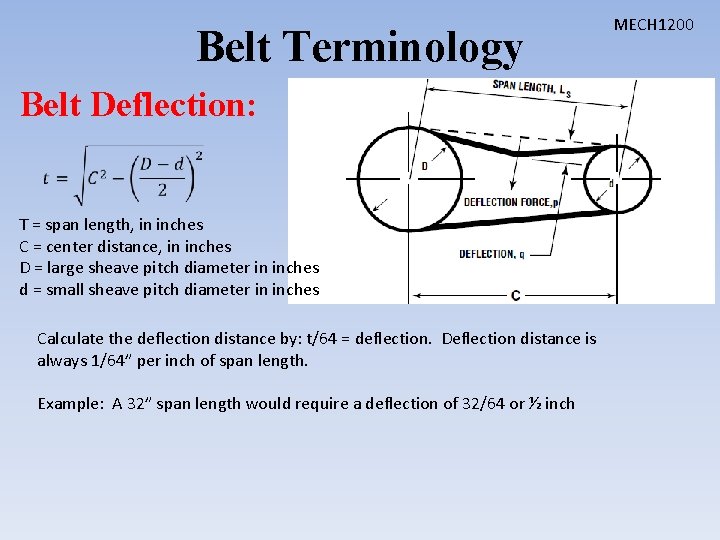
Belt Terminology Belt Deflection: T = span length, in inches C = center distance, in inches D = large sheave pitch diameter in inches d = small sheave pitch diameter in inches Calculate the deflection distance by: t/64 = deflection. Deflection distance is always 1/64” per inch of span length. Example: A 32” span length would require a deflection of 32/64 or ½ inch MECH 1200
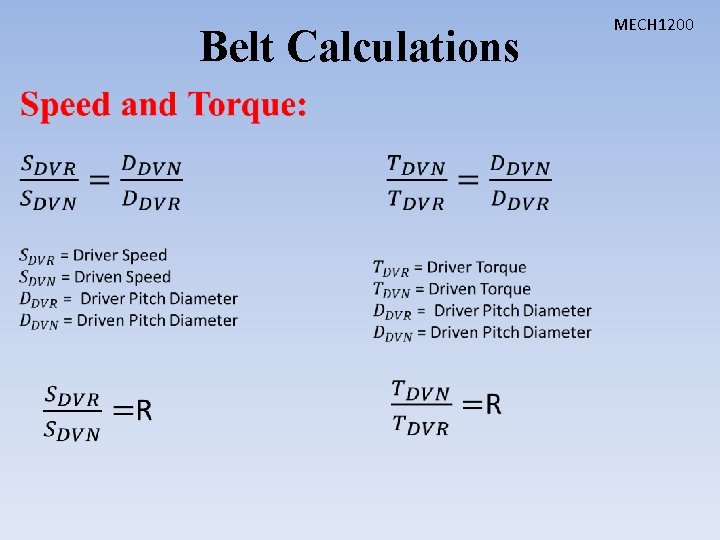
Belt Calculations • MECH 1200
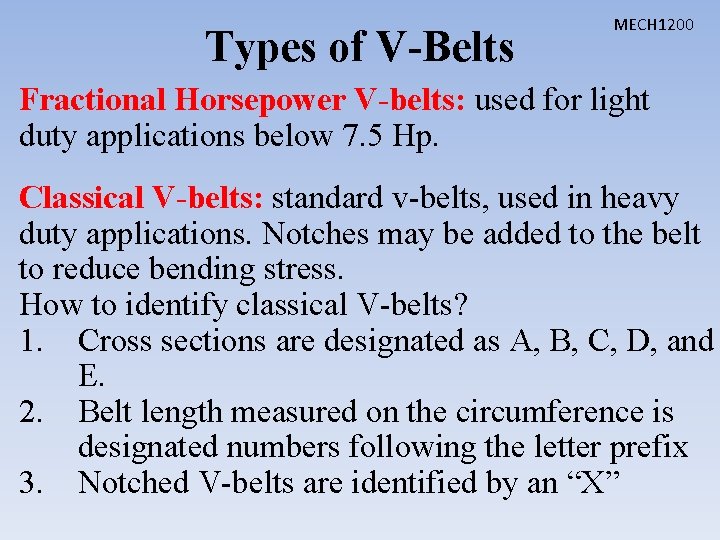
Types of V-Belts MECH 1200 Fractional Horsepower V-belts: used for light duty applications below 7. 5 Hp. Classical V-belts: standard v-belts, used in heavy duty applications. Notches may be added to the belt to reduce bending stress. How to identify classical V-belts? 1. Cross sections are designated as A, B, C, D, and E. 2. Belt length measured on the circumference is designated numbers following the letter prefix 3. Notched V-belts are identified by an “X”
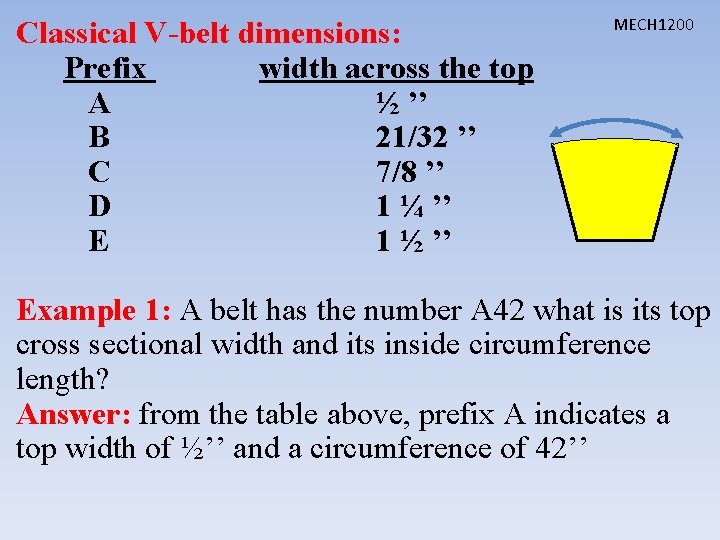
Classical V-belt dimensions: Prefix width across the top A ½ ’’ B 21/32 ’’ C 7/8 ’’ D 1 ¼ ’’ E 1 ½ ’’ MECH 1200 Example 1: A belt has the number A 42 what is its top cross sectional width and its inside circumference length? Answer: from the table above, prefix A indicates a top width of ½’’ and a circumference of 42’’
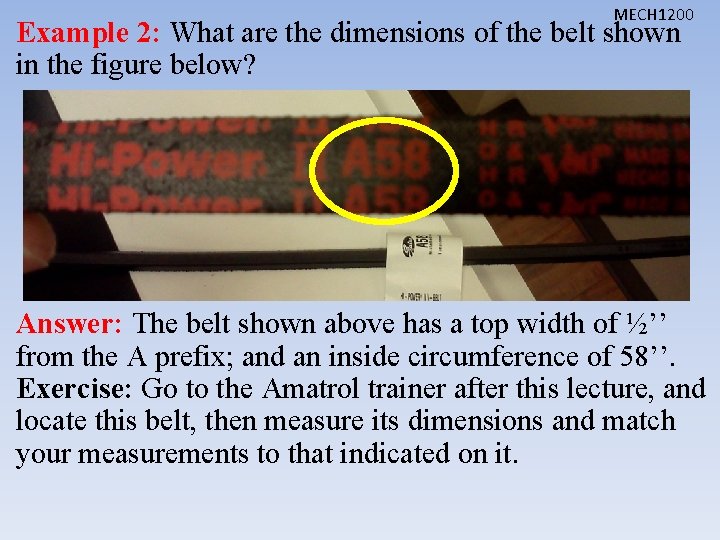
MECH 1200 Example 2: What are the dimensions of the belt shown in the figure below? Answer: The belt shown above has a top width of ½’’ from the A prefix; and an inside circumference of 58’’. Exercise: Go to the Amatrol trainer after this lecture, and locate this belt, then measure its dimensions and match your measurements to that indicated on it.
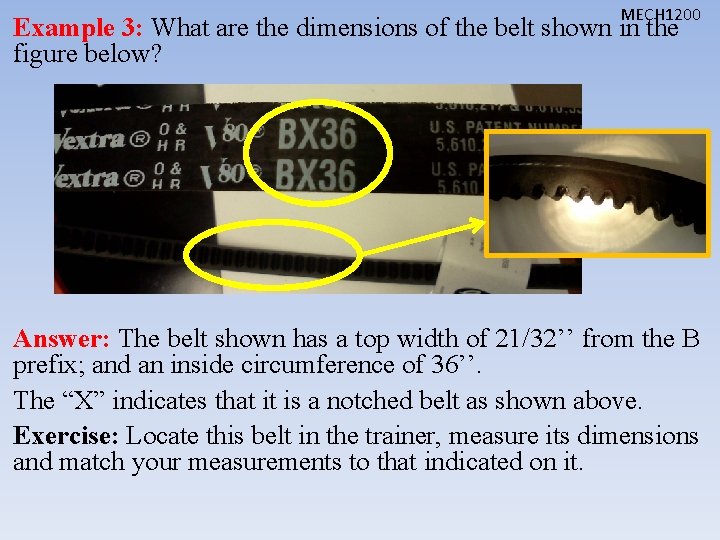
MECH 1200 Example 3: What are the dimensions of the belt shown in the figure below? Answer: The belt shown has a top width of 21/32’’ from the B prefix; and an inside circumference of 36’’. The “X” indicates that it is a notched belt as shown above. Exercise: Locate this belt in the trainer, measure its dimensions and match your measurements to that indicated on it.
MECH 1200 Types of V-Belts (continued) Narrow Section V-Belts: Also called Wedge belts, cross sections are narrower than the classical belts. Used for high duty applications (up to 500 Hp) Banded V-belt: a matched set of V-belts joined together at the top by a permanent band. Double Angle V-Belts: to allow for use in serpentine drives. Identified by a double letter as AA, BB, CC. Open End Belts: for tension adjustment V-Ribbed Belt: has longitudinal ribs, runs smoothly, for high speed applications. Designated by the letters J, L, and M. see figure on page 248. Variable Speed Belt: see page 248 -249
Synchronous Belts MECH 1200 • Also called Timing Belts, positive drive belts, and gear belts. • Slip is not allowed in synchronous belt drives • If jamming occurs the V-belt will slip, but the synchronous belt will shear off. • Synchronous Belt Dimensions: See code on page 256 in the text. Example 4: What is the length, pitch, and width of the synchronous belt specified as 200 XL 025? Answer: length is 200 tenths of inches = 20 inches, XL indicates a pitch of 1/5’’ and the width is 0. 25 inch = ¼’’
MECH 1200 Example 5: What is the length, pitch, and width of the synchronous belt specified as 500 H 150? Answer: length is 500 tenths of inches = 50 inches, H indicates a pitch of 1/2’’ and the width is 1. 50 inch = 1 ½’’
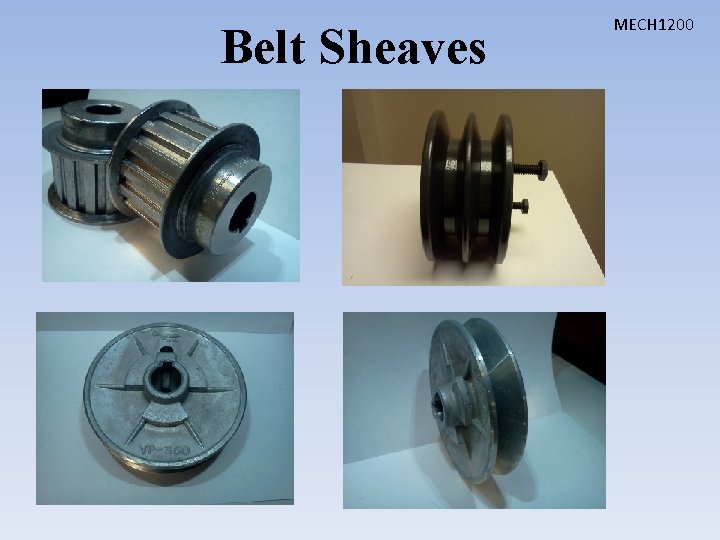
Belt Sheaves MECH 1200
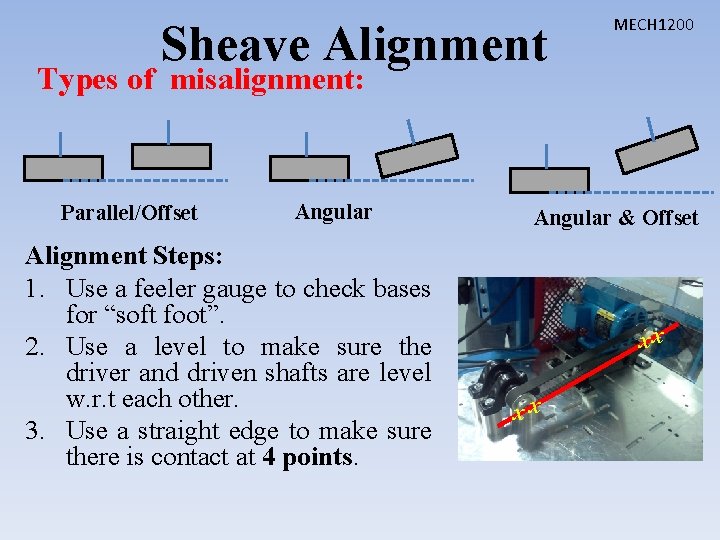
Sheave Alignment MECH 1200 Types of misalignment: Parallel/Offset Angular Alignment Steps: 1. Use a feeler gauge to check bases for “soft foot”. 2. Use a level to make sure the driver and driven shafts are level w. r. t each other. 3. Use a straight edge to make sure there is contact at 4 points. Angular & Offset xx xx
Questions MECH 1200 1. What are the positive drive belts? a) b) c) d) e) The Open end V-belts A type of the narrow section V-belts The double angle V-belts The synchronous belts Banded V-belts 2. What is another name for a sheave? Pulley 3. Which do you think will cause a higher overhung load on the shaft, the V-belt or the timing belt of a similar rating? The V-belt, because it only relies on friction and tension, but the timing belt has teeth on it.
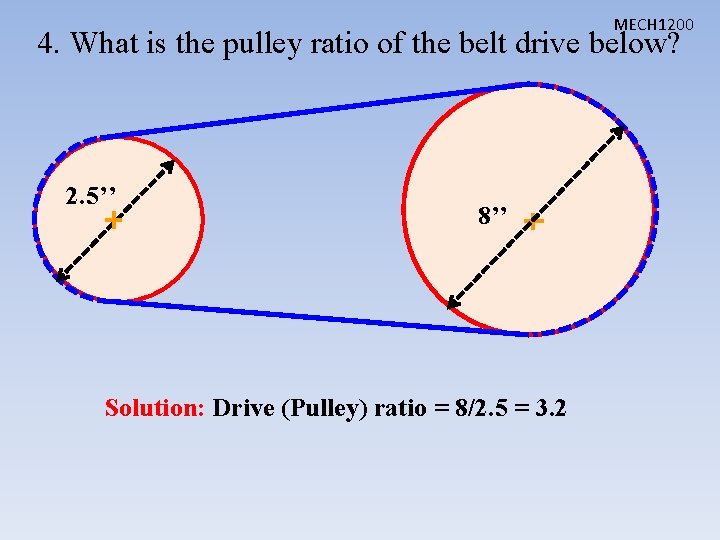
MECH 1200 4. What is the pulley ratio of the belt drive below? 2. 5’’ 8’’ Solution: Drive (Pulley) ratio = 8/2. 5 = 3. 2
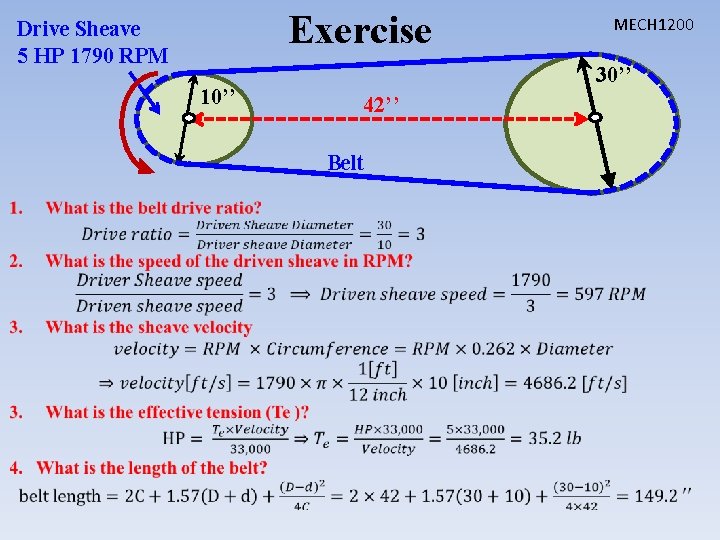
Exercise Drive Sheave 5 HP 1790 RPM 10’’ MECH 1200 30’’ 42’’ Belt
- Slides: 20