
Topics Instruction count for statements Methods Examples Computing
![for loop body 1. for (i=0; i < n; i++) 2. A[i] = i](https://slidetodoc.com/presentation_image_h/d6dfa179103de5b97bcefc35329395c8/image-6.jpg "for loop body 1. for (i=0; i < n; i++) 2. A[i] = i")
![while loop control 2. while (i < n){ 3. A[i] = i 4. i](https://slidetodoc.com/presentation_image_h/d6dfa179103de5b97bcefc35329395c8/image-9.jpg "while loop control 2. while (i < n){ 3. A[i] = i 4. i")
![while loop control 2. while (i < n){ 3. A[i] = i 4. i](https://slidetodoc.com/presentation_image_h/d6dfa179103de5b97bcefc35329395c8/image-10.jpg "while loop control 2. while (i < n){ 3. A[i] = i 4. i")
![Example 1 1. 2. for (i=0; i<n; A[i] = i • Method 1 count](https://slidetodoc.com/presentation_image_h/d6dfa179103de5b97bcefc35329395c8/image-14.jpg "Example 1 1. 2. for (i=0; i<n; A[i] = i • Method 1 count")
![Example 1 continued • Method 2 1. 2. for (i=0; i<n; A[i] = i](https://slidetodoc.com/presentation_image_h/d6dfa179103de5b97bcefc35329395c8/image-15.jpg "Example 1 continued • Method 2 1. 2. for (i=0; i<n; A[i] = i")
![Example 2: What is count 1(2)? 2. A[i] = i Line 1 i=1 1.](https://slidetodoc.com/presentation_image_h/d6dfa179103de5b97bcefc35329395c8/image-16.jpg "Example 2: What is count 1(2)? 2. A[i] = i Line 1 i=1 1.")
![Example 2: What is count 1(2)? 2. A[i] = i For simplicity, n =](https://slidetodoc.com/presentation_image_h/d6dfa179103de5b97bcefc35329395c8/image-17.jpg "Example 2: What is count 1(2)? 2. A[i] = i For simplicity, n =")
![Example 3: Sequential Search 1. location=0 2. while (location<=n-1 3. && L[location]! = x)](https://slidetodoc.com/presentation_image_h/d6dfa179103de5b97bcefc35329395c8/image-18.jpg "Example 3: Sequential Search 1. location=0 2. while (location<=n-1 3. && L[location]! = x)")
- Slides: 27
Topics • Instruction count for statements • Methods • Examples
Computing Instruction Counts • Given a (non-recursive) algorithm expressed in pseudo code we explain how to: – Assign counts to high level statements – Describe methods for deriving an instruction count – Compute counts for several examples
Counts for High Level Statements • Assignment • loop condition • for loop – for loop body – for loop control • while loop – while loop control – while loop body • if Note: The counts we use are not accurate; The goal is to derive a correct growth function
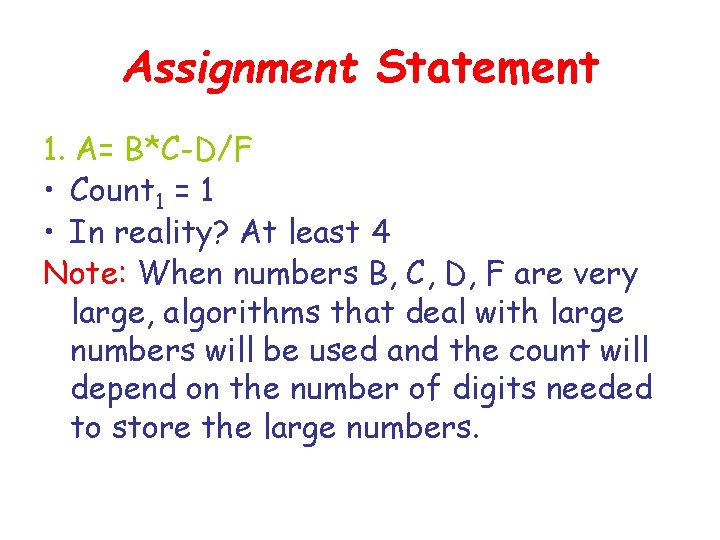
Assignment Statement 1. A= B*C-D/F • Count 1 = 1 • In reality? At least 4 Note: When numbers B, C, D, F are very large, algorithms that deal with large numbers will be used and the count will depend on the number of digits needed to store the large numbers.
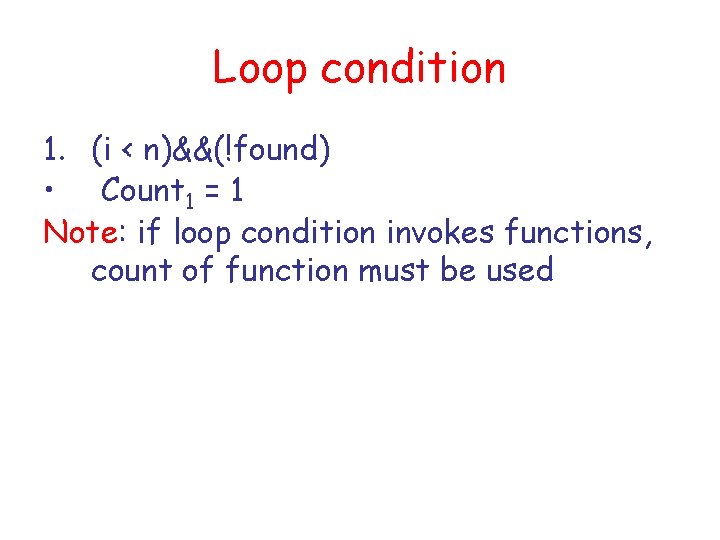
Loop condition 1. (i < n)&&(!found) • Count 1 = 1 Note: if loop condition invokes functions, count of function must be used
for loop body 1. for (i=0; i < n; i++) 2. A[i] = i Count 2 = 1 Count 1(2) = i=0 i<n false true A[i] = i i=i+1 stop
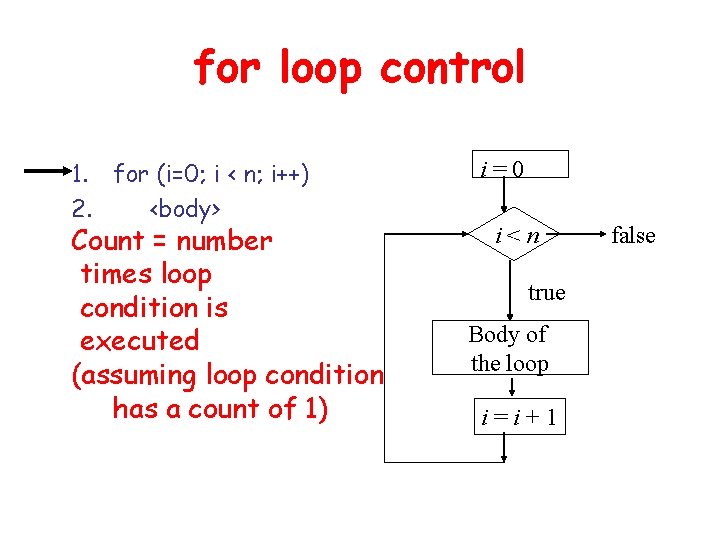
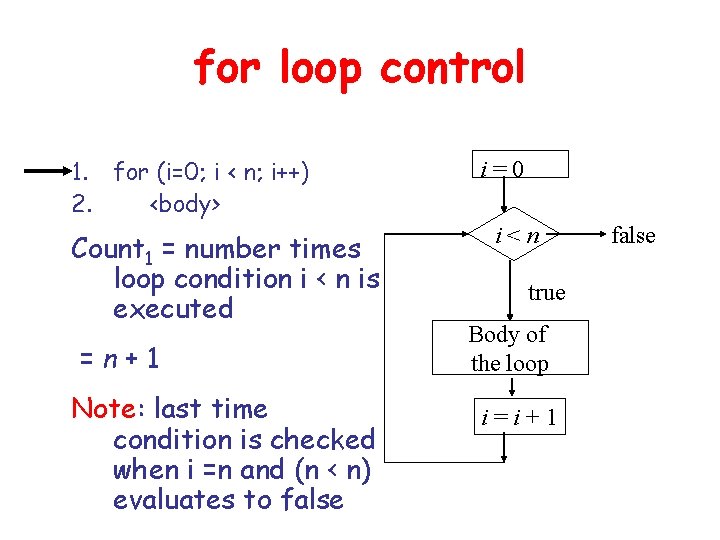
for loop control 1. for (i=0; i < n; i++) 2. <body> Count = number times loop condition is executed (assuming loop condition has a count of 1) i=0 i<n true Body of the loop i=i+1 false
for loop control 1. for (i=0; i < n; i++) 2. <body> Count 1 = number times loop condition i < n is executed =n+1 Note: last time condition is checked when i =n and (n < n) evaluates to false i=0 i<n true Body of the loop i=i+1 false
while loop control 2. while (i < n){ 3. A[i] = i 4. i = i + 1} Count = number of times loop condition is executed (assuming loop condition has a count of 1) Line 1 i=0 1. i = 0 Line 2 i<n false true A[i] = i i=i+1 Line 3 Line 4
while loop control 2. while (i < n){ 3. A[i] = i 4. i = i + 1} Count 2 = number times loop condition (i < n) is executed =n+1 Line 1 i=0 1. i = 0 Line 2 i<n false true A[i] = i i=i+1 Line 3 Line 4
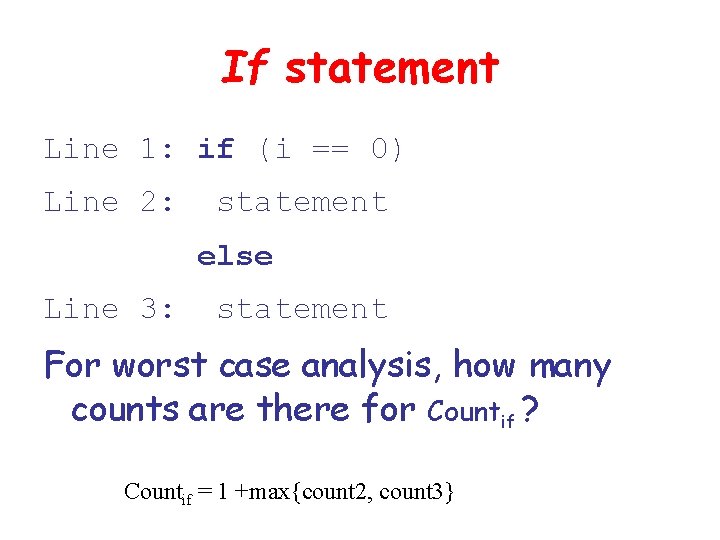
If statement Line 1: if (i == 0) Line 2: statement else Line 3: statement For worst case analysis, how many counts are there for Countif ? Countif = 1 +max{count 2, count 3}
Method 1: Sum Line Counts • Derive a count for each line of code taking into account of all nested loops • Compute total by adding line counts
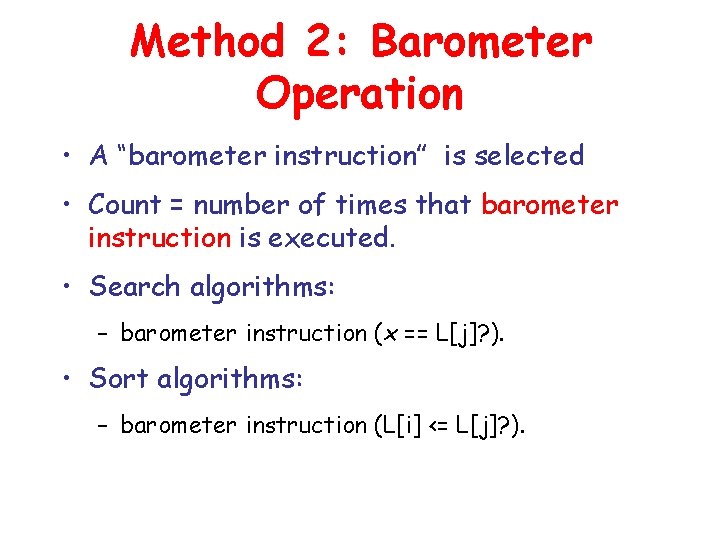
Method 2: Barometer Operation • A “barometer instruction” is selected • Count = number of times that barometer instruction is executed. • Search algorithms: – barometer instruction (x == L[j]? ). • Sort algorithms: – barometer instruction (L[i] <= L[j]? ).
Example 1 1. 2. for (i=0; i<n; A[i] = i • Method 1 count 1= n+1 count 1(2) = n*1 = n _________ Total = (n+1)+n = 2 n+1 i++ )
Example 1 continued • Method 2 1. 2. for (i=0; i<n; A[i] = i + 1 i++ ) • Barometer operation = + in body of loop • count 1(+) = n
Example 2: What is count 1(2)? 2. A[i] = i Line 1 i=1 1. for (i=1; i<=n; i=3*i) Line 1 i <= n no yes A[i] = i Line 2 i = 3* i Line 1
Example 2: What is count 1(2)? 2. A[i] = i For simplicity, n = 3 k for some Line 1 i=1 1. for(i=1; i<=n; i=3*i) Line 1 positive integer k. Body of the loop executed for i = 1(=30), 31, 32, …, 3 k. So count 1(2)= Since k = log 3 n, it is executed log 3 n + 1 times. i <= n no yes A[i] = i Line 2 i = 3* i Line 1
Example 3: Sequential Search 1. location=0 2. while (location<=n-1 3. && L[location]! = x) 4. location++ 5. return location • Barometer operation = (L[location]! = x? ) • Best case analysis x == L[0] and the count is 1 • Worst case analysis x = L[n-1] or x not in the list. Count is n.
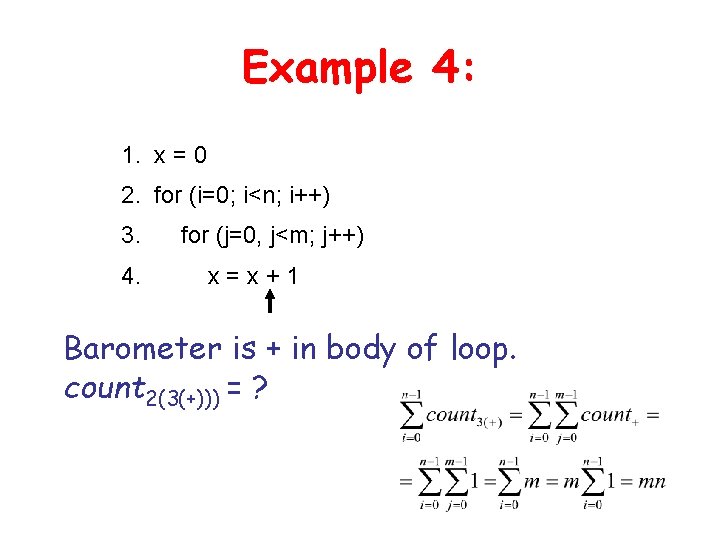
Example 4: 1. x = 0 2. for (i=0; i<n; i++) 3. 4. for (j=0, j<m; j++) x=x+1 Barometer is + in body of loop. count 2(3(+))) = ?
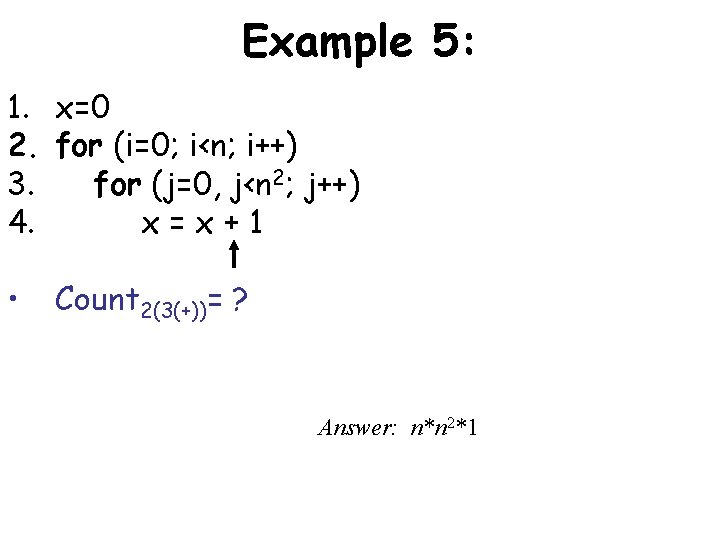
Example 5: 1. x=0 2. for (i=0; i<n; i++) 3. for (j=0, j<n 2; j++) 4. x=x+1 • Count 2(3(+))= ? Answer: n*n 2*1
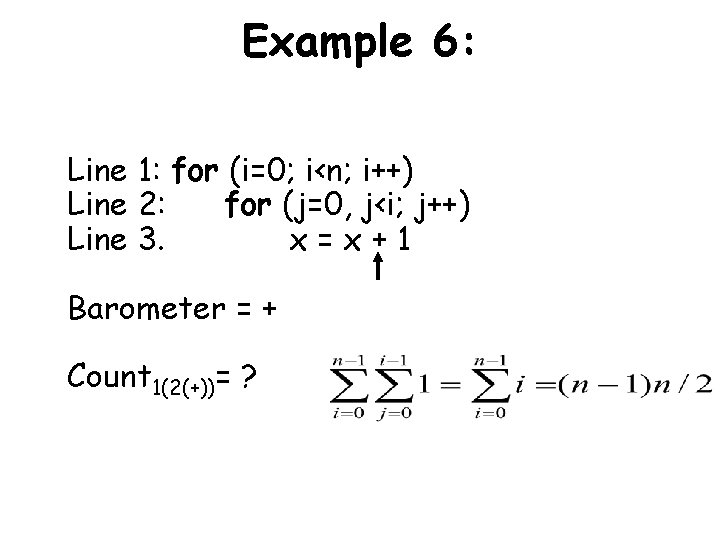
Example 6: Line 1: for (i=0; i<n; i++) Line 2: for (j=0, j<i; j++) Line 3. x=x+1 Barometer = + Count 1(2(+))= ?
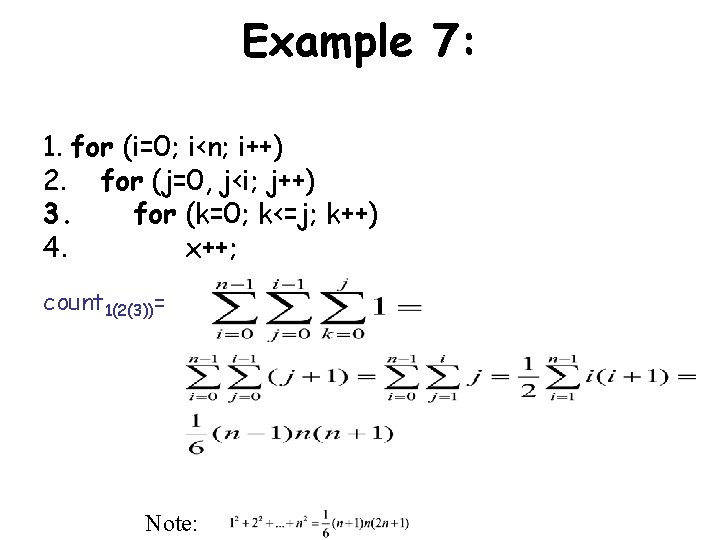
Example 7: 1. for (i=0; i<n; i++) 2. for (j=0, j<i; j++) 3. for (k=0; k<=j; k++) 4. x++; count 1(2(3))= Note:
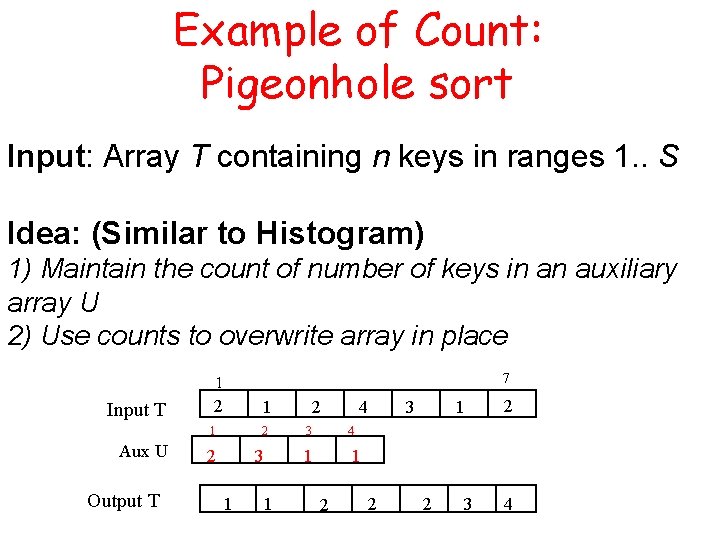
Example of Count: Pigeonhole sort Input: Array T containing n keys in ranges 1. . S Idea: (Similar to Histogram) 1) Maintain the count of number of keys in an auxiliary array U 2) Use counts to overwrite array in place 7 1 Input T 2 1 1 Aux U Output T 2 2 3 1 1 4 2 3 3 1 2 4 1 1 2 2 2 3 4
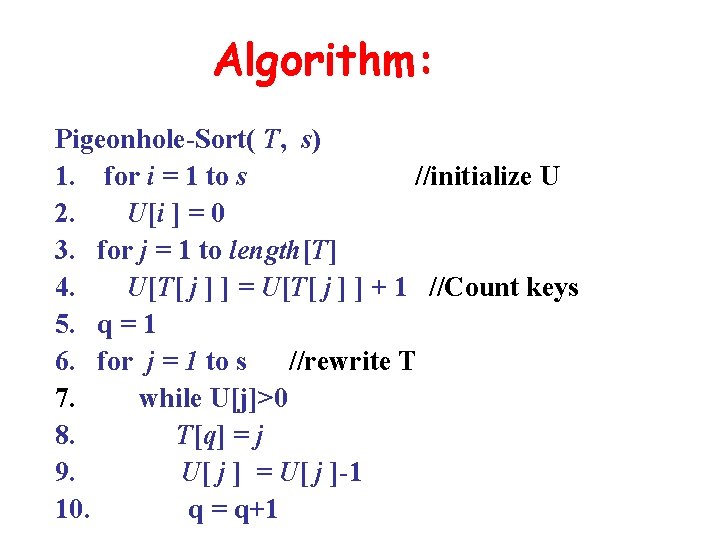
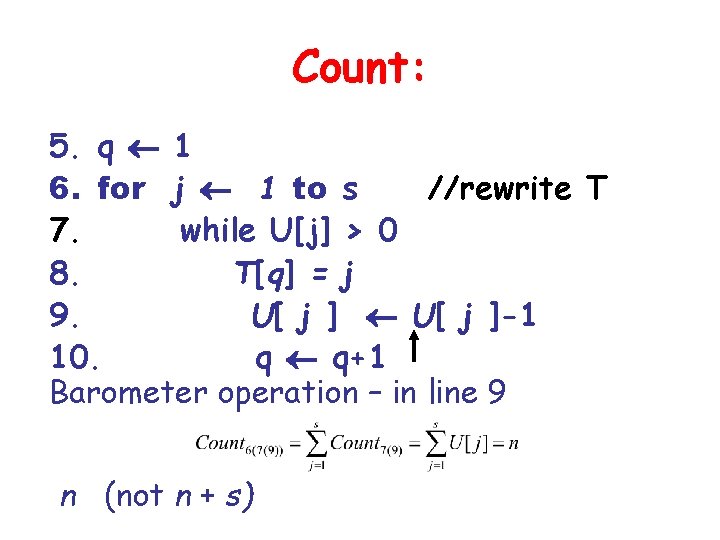
Algorithm: Pigeonhole-Sort( T, s) 1. for i = 1 to s //initialize U 2. U[i ] = 0 3. for j = 1 to length[T] 4. U[T[ j ] ] = U[T[ j ] ] + 1 //Count keys 5. q = 1 6. for j = 1 to s //rewrite T 7. while U[j]>0 8. T[q] = j 9. U[ j ] = U[ j ]-1 10. q = q+1
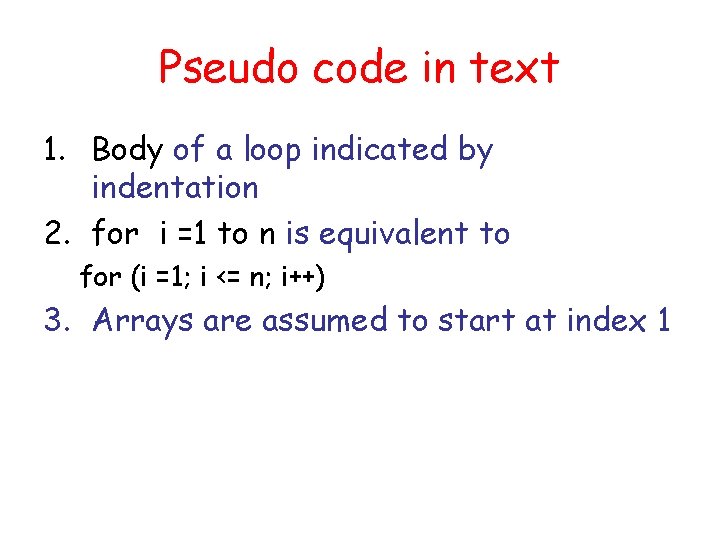
Pseudo code in text 1. Body of a loop indicated by indentation 2. for i =1 to n is equivalent to for (i =1; i <= n; i++) 3. Arrays are assumed to start at index 1
Count: 5. q 1 6. for j 1 to s //rewrite T 7. while U[j] > 0 8. T[q] = j 9. U[ j ]-1 10. q q+1 Barometer operation – in line 9 n (not n + s)
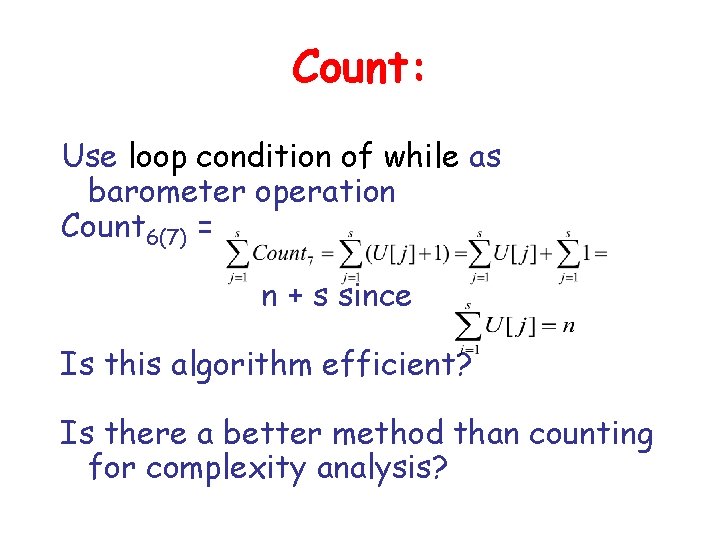
Count: Use loop condition of while as barometer operation Count 6(7) = n + s since Is this algorithm efficient? Is there a better method than counting for complexity analysis?