
TOPICS IN RESEARCH Dr John Corbett USPCAPES International

TOPICS IN RESEARCH Dr John Corbett USP-CAPES International Fellow
INTRODUCING VISUAL RESEARCH METHODS 1. Review of this week’s reading 2. What can we steal? 3. Tasks for the coming week
THIS WEEK’S READING * A wide-ranging survey of methods of doing visual research * Not all of it is relevant * What did you find most useful? 1. Discuss in small groups 2. Class feedback 3. What can we steal?
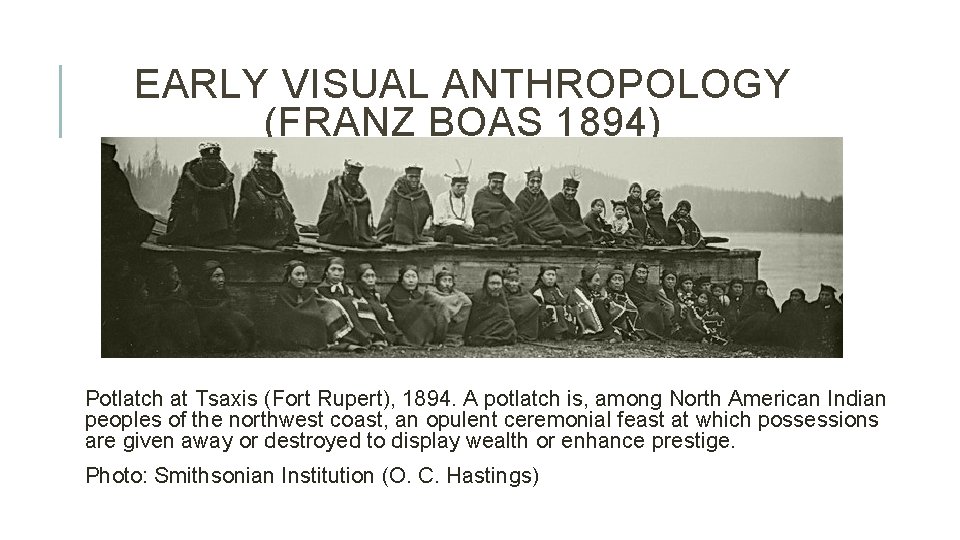
EARLY VISUAL ANTHROPOLOGY (FRANZ BOAS 1894) Potlatch at Tsaxis (Fort Rupert), 1894. A potlatch is, among North American Indian peoples of the northwest coast, an opulent ceremonial feast at which possessions are given away or destroyed to display wealth or enhance prestige. Photo: Smithsonian Institution (O. C. Hastings)

EARLY VISUAL ANTHROPOLOGY (BRONISLAW MALINOWSKI 1918) Malinowski in the Trobriand Islands (1918)
[. . . ] using still photography as an adjunct to his diary, [Malinowski] recorded panoramic, close-up, middle-distance images objects and events from different angles as well as contextual images (Ball and Smith, 1992). Nonetheless, the images produced were used to illustrate his text rather than to generate theoretical insights. -- Prosser & Loxley (2008: 4)
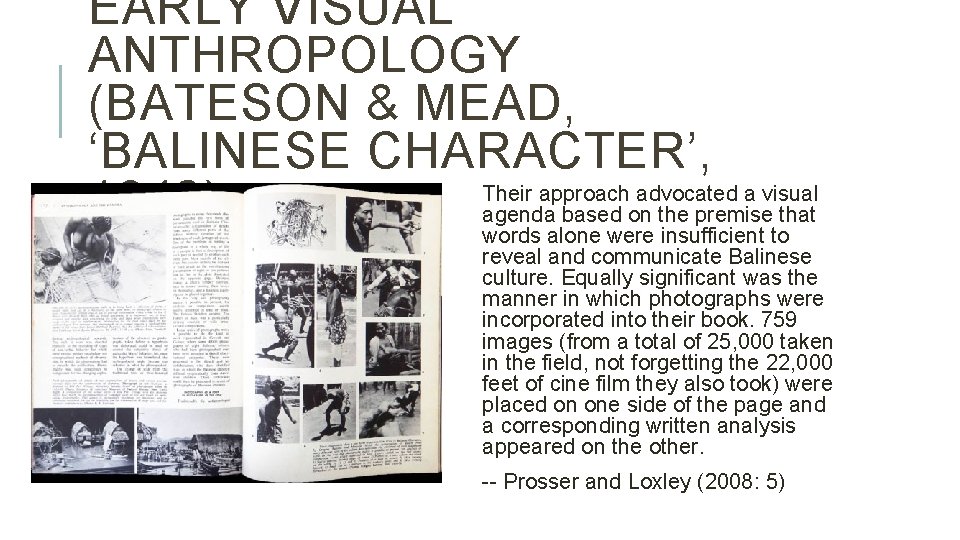
EARLY VISUAL ANTHROPOLOGY (BATESON & MEAD, ‘BALINESE CHARACTER’, Their approach advocated a visual 1942) agenda based on the premise that words alone were insufficient to reveal and communicate Balinese culture. Equally significant was the manner in which photographs were incorporated into their book. 759 images (from a total of 25, 000 taken in the field, not forgetting the 22, 000 feet of cine film they also took) were placed on one side of the page and a corresponding written analysis appeared on the other. -- Prosser and Loxley (2008: 5)
LATER TRENDS IN VISUAL ANTHROPOLOGY (EVIDENT FROM THE 1980 S ON) * A move towards multiple representations (eg over time) * A shift in focus from the creation of images by the researcher to the meanings of images ‘found’ by the researcher * A shift in methods from structuralism (a study of elements and their combinations) to a ‘viewer response’ approach, valuing interpretation in context
RESEARCHER-CREATED VISUAL DATA Documentary photographers involved in fieldwork are increasingly recording personal and procedural reflexivity, usually in a field diary, as a way of building trustworthiness into their empirical data. […] [The photographer, Caldarola] was a profuse recorder of the process of photographic documentation and recounted in his diary the specific context in which the images were taken, reflected on the significance or meaning of the photograph(s), and described the social relationship between the image maker and the subject(s) of the image. -- Prosser & Loxley (2008: 13) What would you record in a field diary?
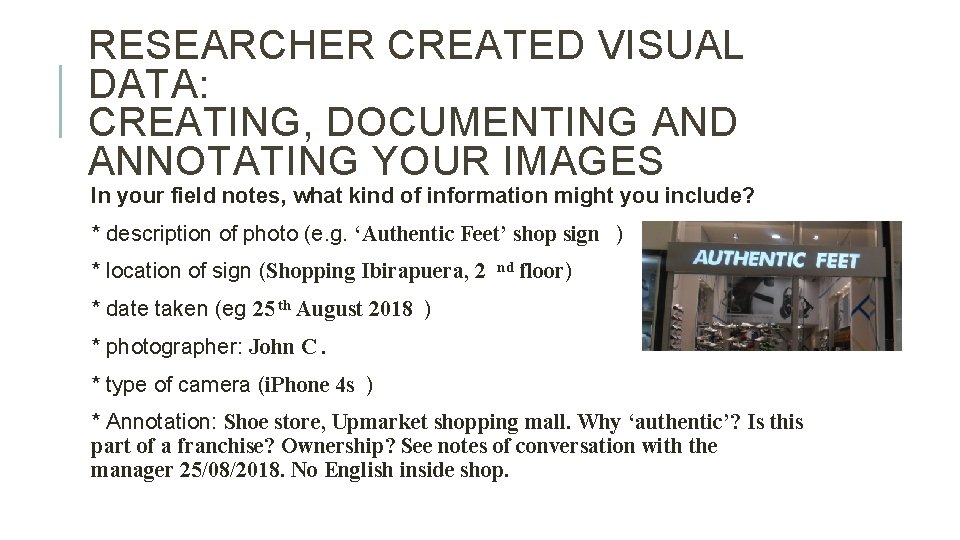
RESEARCHER CREATED VISUAL DATA: CREATING, DOCUMENTING AND ANNOTATING YOUR IMAGES In your field notes, what kind of information might you include? * description of photo (e. g. ‘Authentic Feet’ shop sign ) * location of sign (Shopping Ibirapuera, 2 nd floor) * date taken (eg 25 th August 2018 ) * photographer: John C. * type of camera (i. Phone 4 s ) * Annotation: Shoe store, Upmarket shopping mall. Why ‘authentic’? Is this part of a franchise? Ownership? See notes of conversation with the manager 25/08/2018. No English inside shop.
RESPONDENT-GENERATED VISUAL DATA If you do not generate the visual data, who should? What would be the advantages/disadvantages of devolving this task? What research questions would you now be asking? What ethical issues are raised by this research strategy? “Empirical researchers involved with human subjects are powerful and make key decisions throughout a study that impact on the quality of the data generated. No matter how empowering or inclusive researchers are, the primary agency and responsibility for the conduct of a study remains with them. ” -- Prosser & Loxley, (2008: 19)
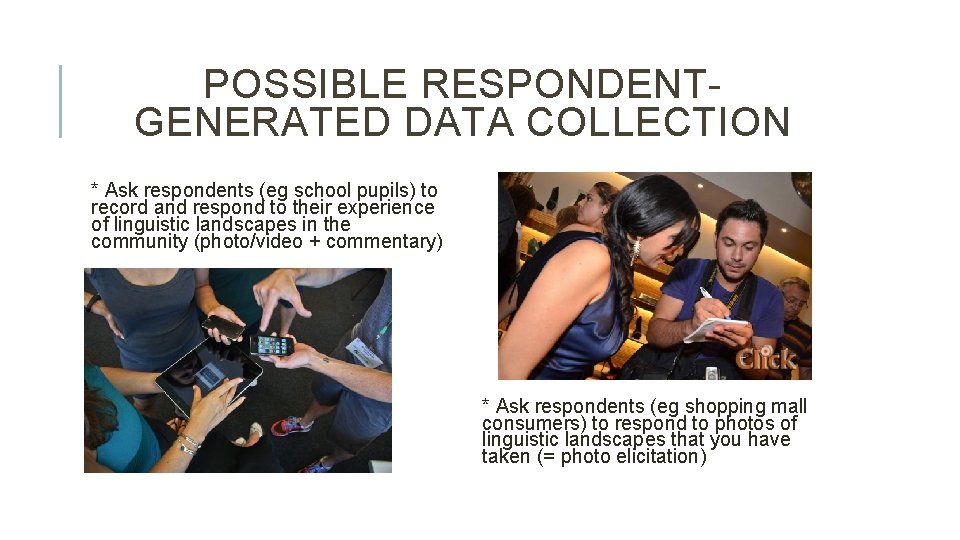
POSSIBLE RESPONDENTGENERATED DATA COLLECTION * Ask respondents (eg school pupils) to record and respond to their experience of linguistic landscapes in the community (photo/video + commentary) * Ask respondents (eg shopping mall consumers) to respond to photos of linguistic landscapes that you have taken (= photo elicitation)
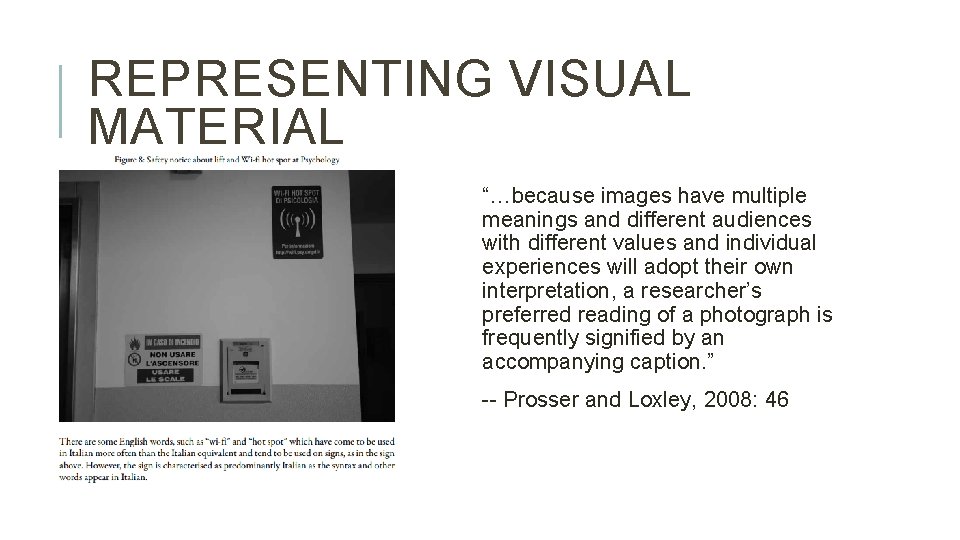
REPRESENTING VISUAL MATERIAL “…because images have multiple meanings and different audiences with different values and individual experiences will adopt their own interpretation, a researcher’s preferred reading of a photograph is frequently signified by an accompanying caption. ” -- Prosser and Loxley, 2008: 46
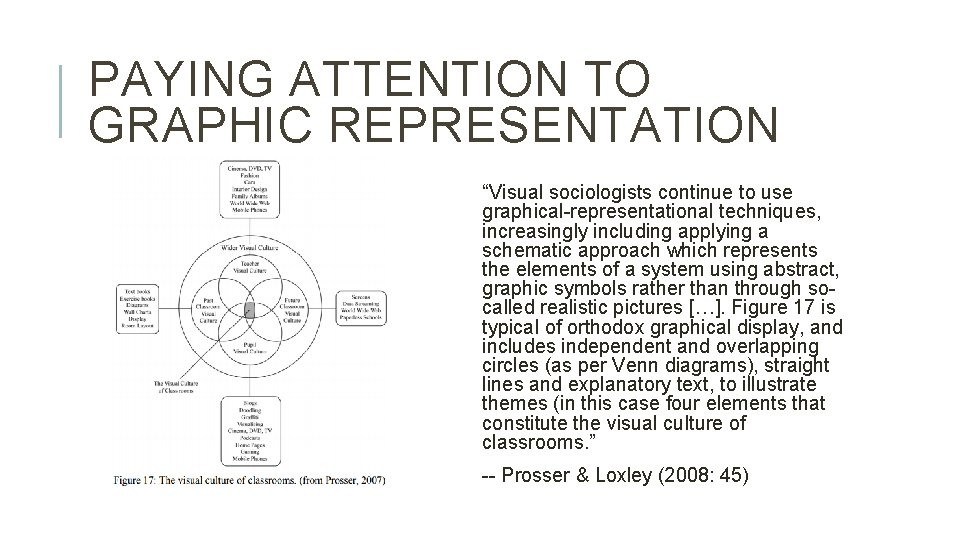
PAYING ATTENTION TO GRAPHIC REPRESENTATION “Visual sociologists continue to use graphical-representational techniques, increasingly including applying a schematic approach which represents the elements of a system using abstract, graphic symbols rather than through socalled realistic pictures […]. Figure 17 is typical of orthodox graphical display, and includes independent and overlapping circles (as per Venn diagrams), straight lines and explanatory text, to illustrate themes (in this case four elements that constitute the visual culture of classrooms. ” -- Prosser & Loxley (2008: 45)
SUMMARY OF KEY POINTS (FOR US) * The photos you take are not just illustrations of your research. They are a constructed representation of the linguistic landscape. How you use them is important. * Keep a record of your photos in your field diary. Be systematic. * Think about how to create/use your photos. Who gathers the data? Who interprets, or responds to it? * How are you going to represent your photos in your final project (will the captions be ‘neutrally descriptive’ or ‘subjectively interpretive’? ) * How might you use graphic means to give a sense of the wider linguistic landscape in your setting?

REPORT ON YOUR OWN RESEARCH PROJECT * In small groups, discuss your own progress towards a research topic. * What concerns/issues do you have? * What has this session contributed to your developing thoughts on the subject?

TASKS FOR THE COMING WEEK 1. Reflect on this week’s session in your learning blog. 2. Read the article by Rebecca Todd Garvin on moodle 4. Read it and be prepared to talk about it in class next week. The articles we are reading will become the basis of our literature review. The topic of a literature review will be covered in more detail shortly. How do we synthesize the articles that we read?
- Slides: 17