
Topics in Electrical and Computer Engineering Phasors Douglas


- Slides: 47
Topics in Electrical and Computer Engineering Phasors Douglas Wilhelm Harder Department of Electrical and Computer Engineering University of Waterloo Copyright © 2008 -10 by Douglas Wilhelm Harder. All rights reserved.
Phasors Outline In this topic, we will look at – – – – The necessary background Sums of sinusoidal functions The trigonometry involved Phasor representation of sinusoids Phasor addition Why phasors work Phasor multiplication and inverses Phasors for circuits
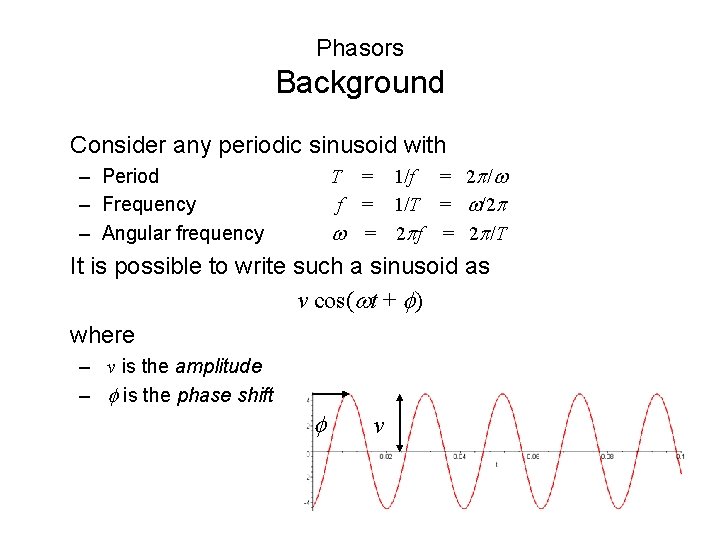
Phasors Background Consider any periodic sinusoid with T = 1/f = 2 p/w f = 1/T = w/2 p w = 2 pf = 2 p/T – Period – Frequency – Angular frequency It is possible to write such a sinusoid as v cos(wt + f) where – v is the amplitude – f is the phase shift f v
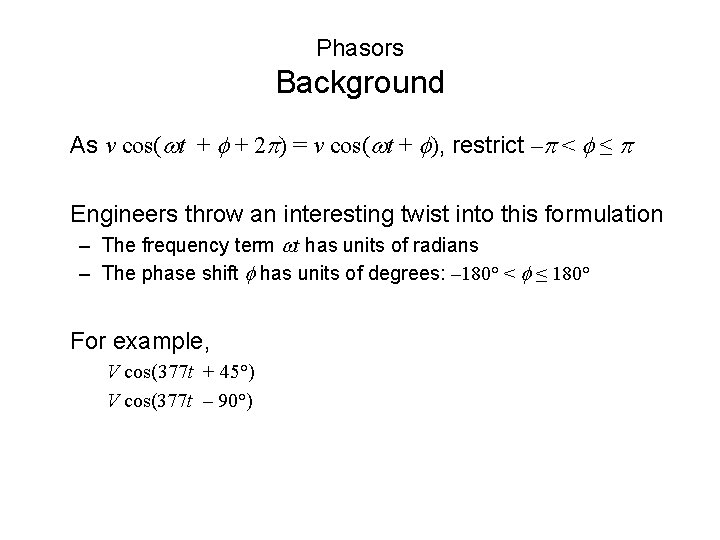
Phasors Background As v cos(wt + f + 2 p) = v cos(wt + f), restrict –p < f ≤ p Engineers throw an interesting twist into this formulation – The frequency term wt has units of radians – The phase shift f has units of degrees: – 180° < f ≤ 180° For example, V cos(377 t + 45°) V cos(377 t – 90°)
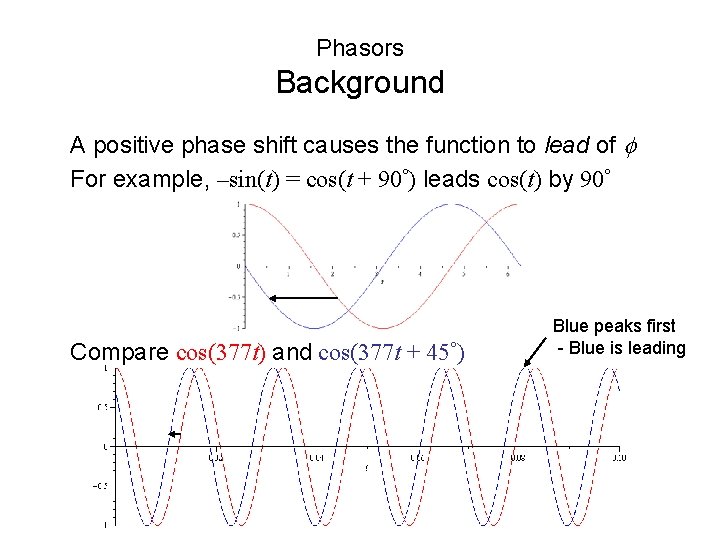
Phasors Background A positive phase shift causes the function to lead of f For example, –sin(t) = cos(t + 90°) leads cos(t) by 90° Compare cos(377 t) and cos(377 t + 45°) Blue peaks first - Blue is leading
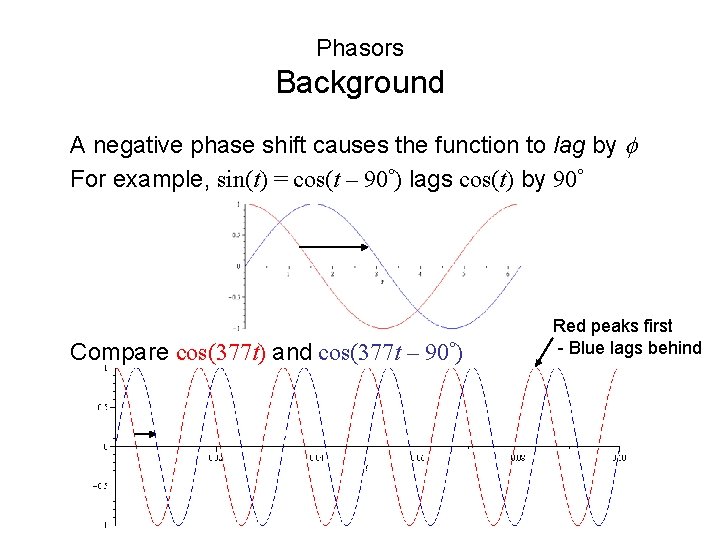
Phasors Background A negative phase shift causes the function to lag by f For example, sin(t) = cos(t – 90°) lags cos(t) by 90° Compare cos(377 t) and cos(377 t – 90°) Red peaks first - Blue lags behind
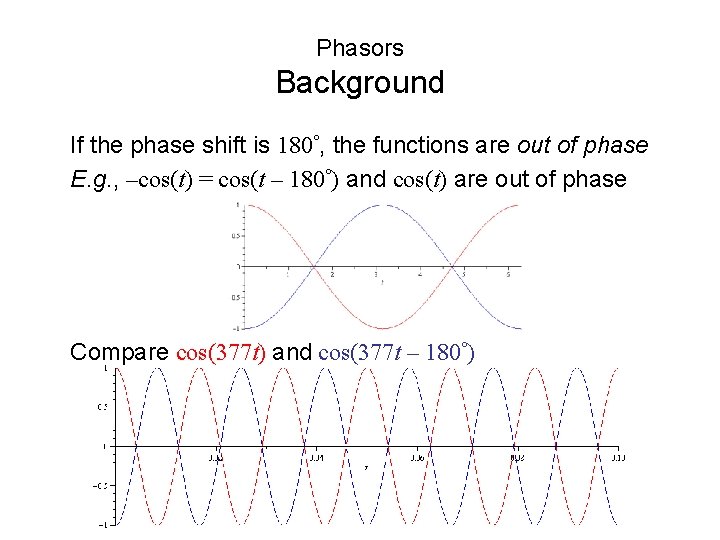
Phasors Background If the phase shift is 180°, the functions are out of phase E. g. , –cos(t) = cos(t – 180°) and cos(t) are out of phase Compare cos(377 t) and cos(377 t – 180°)
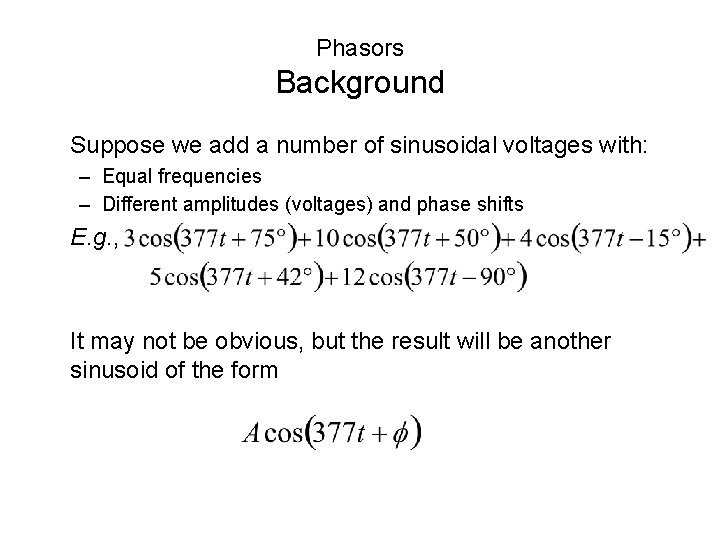
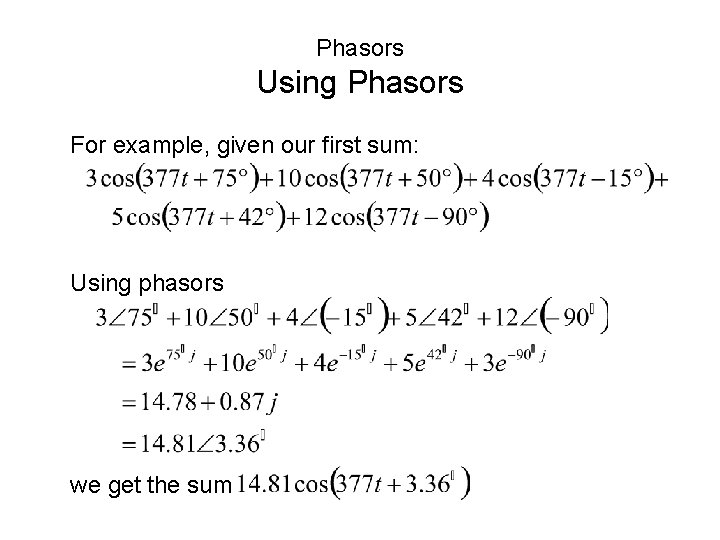
Phasors Background Suppose we add a number of sinusoidal voltages with: – Equal frequencies – Different amplitudes (voltages) and phase shifts E. g. , It may not be obvious, but the result will be another sinusoid of the form
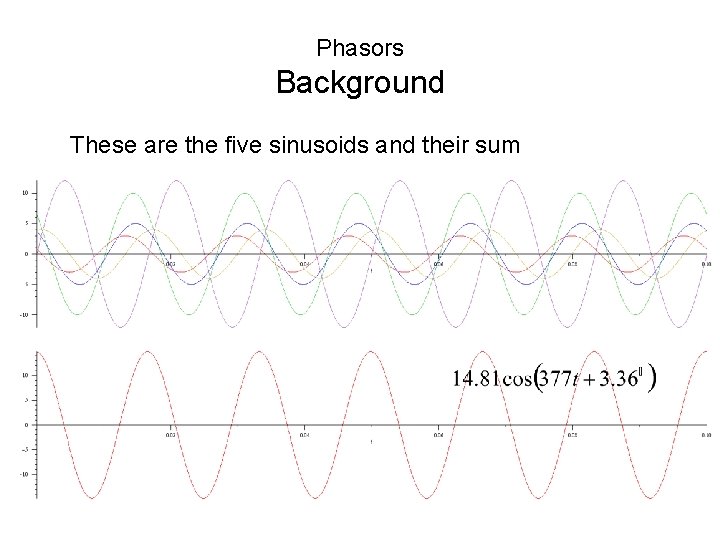
Phasors Background These are the five sinusoids and their sum
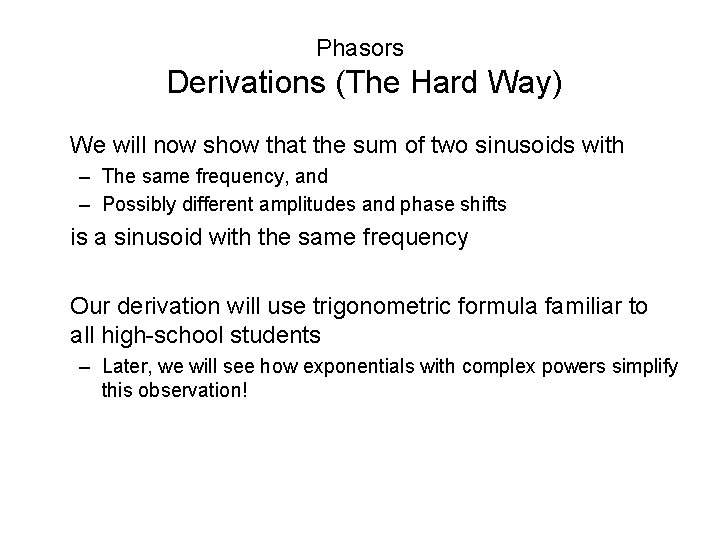
Phasors Derivations (The Hard Way) We will now show that the sum of two sinusoids with – The same frequency, and – Possibly different amplitudes and phase shifts is a sinusoid with the same frequency Our derivation will use trigonometric formula familiar to all high-school students – Later, we will see how exponentials with complex powers simplify this observation!
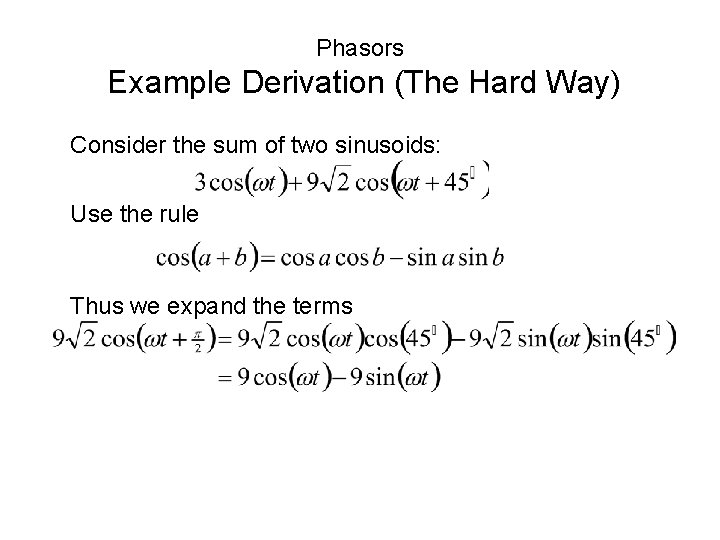
Phasors Example Derivation (The Hard Way) Consider the sum of two sinusoids: Use the rule Thus we expand the terms
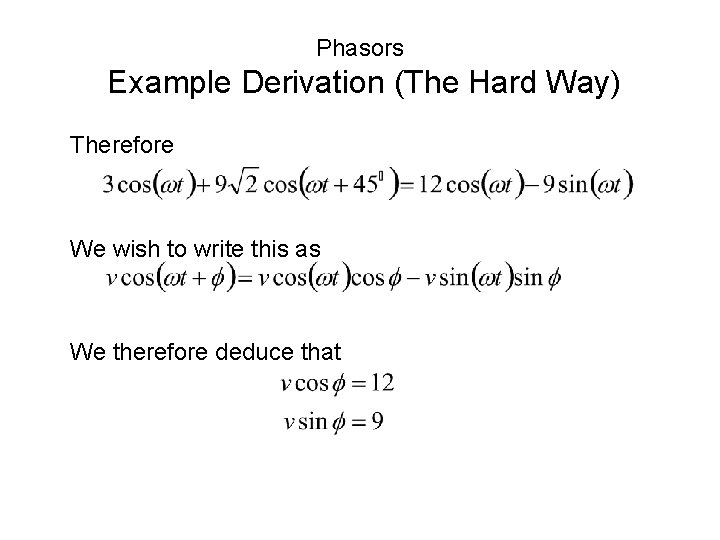
Phasors Example Derivation (The Hard Way) Therefore We wish to write this as We therefore deduce that
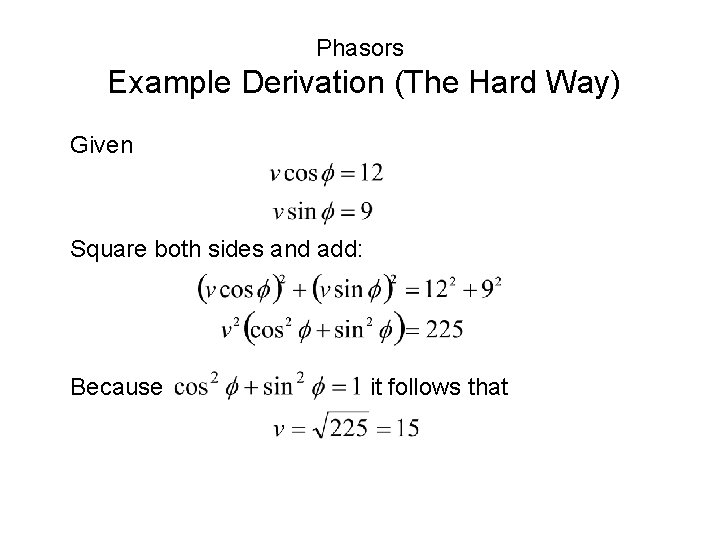
Phasors Example Derivation (The Hard Way) Given Square both sides and add: Because it follows that
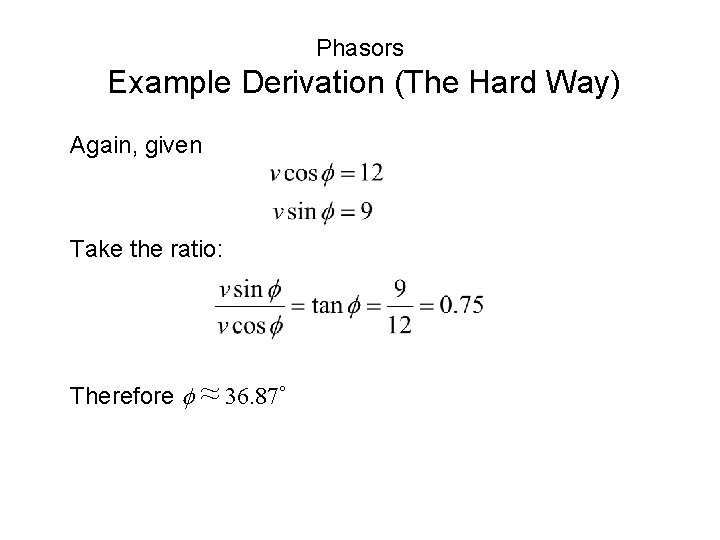
Phasors Example Derivation (The Hard Way) Again, given Take the ratio: Therefore f ≈ 36. 87°
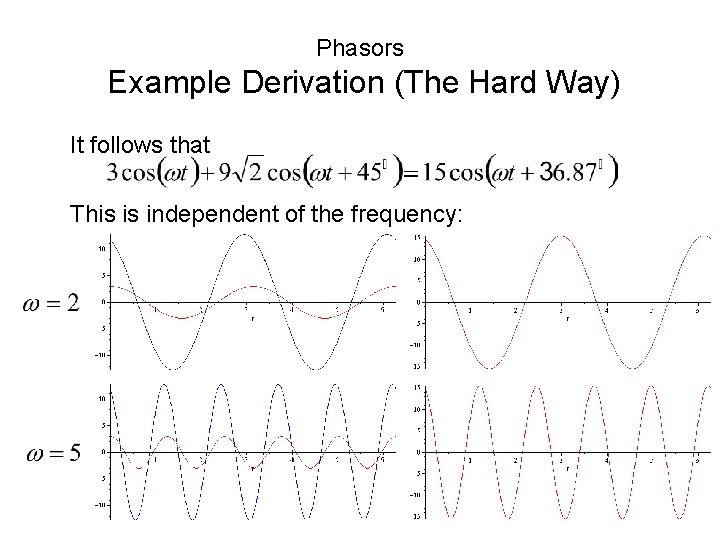
Phasors Example Derivation (The Hard Way) It follows that This is independent of the frequency:
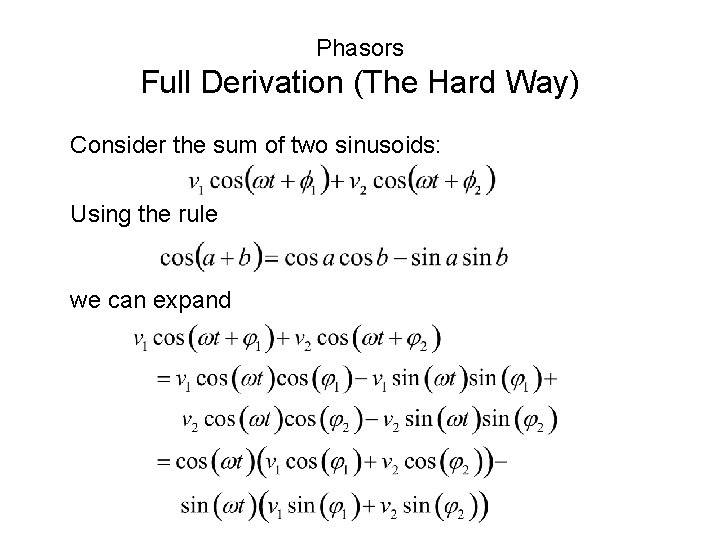
Phasors Full Derivation (The Hard Way) Consider the sum of two sinusoids: Using the rule we can expand
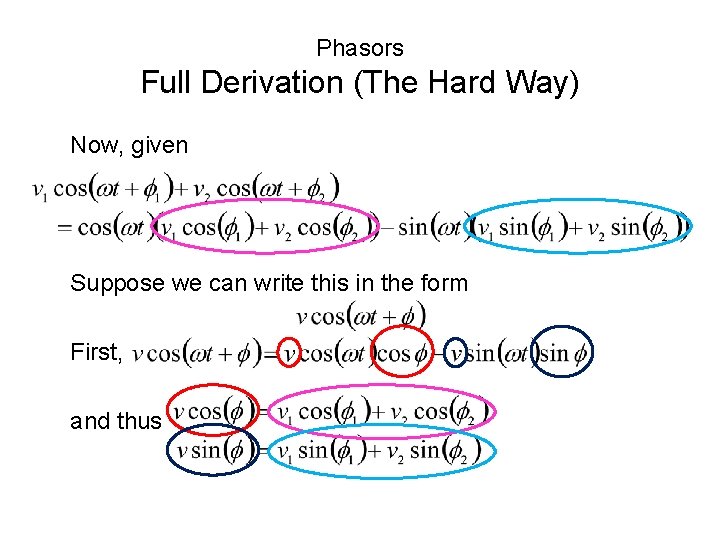
Phasors Full Derivation (The Hard Way) Now, given Suppose we can write this in the form First, and thus
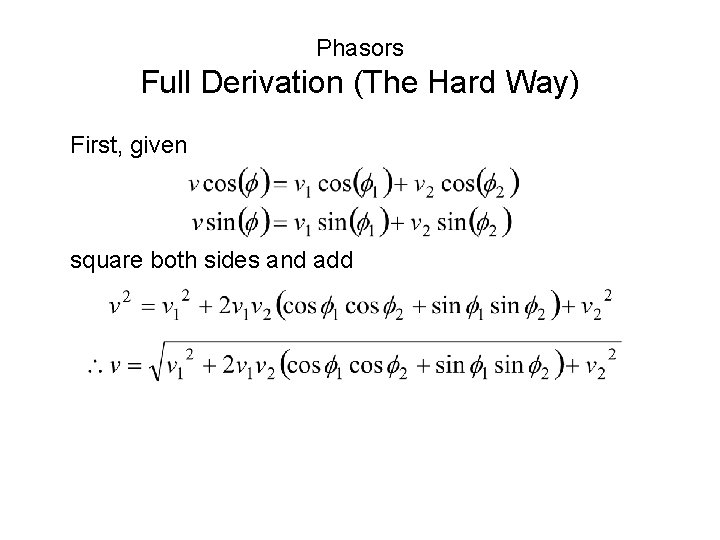
Phasors Full Derivation (The Hard Way) First, given square both sides and add
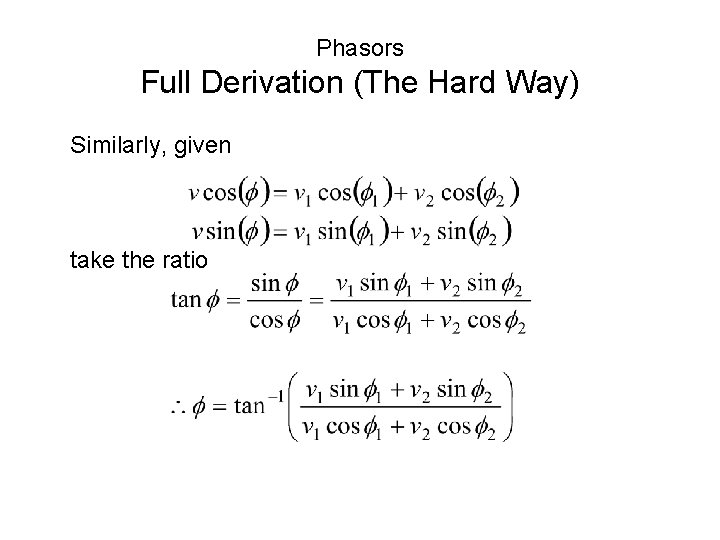
Phasors Full Derivation (The Hard Way) Similarly, given take the ratio
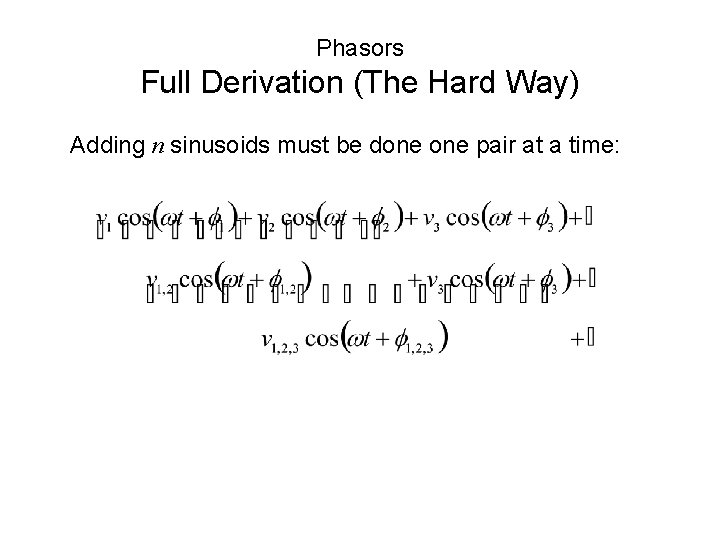
Phasors Full Derivation (The Hard Way) Adding n sinusoids must be done pair at a time:
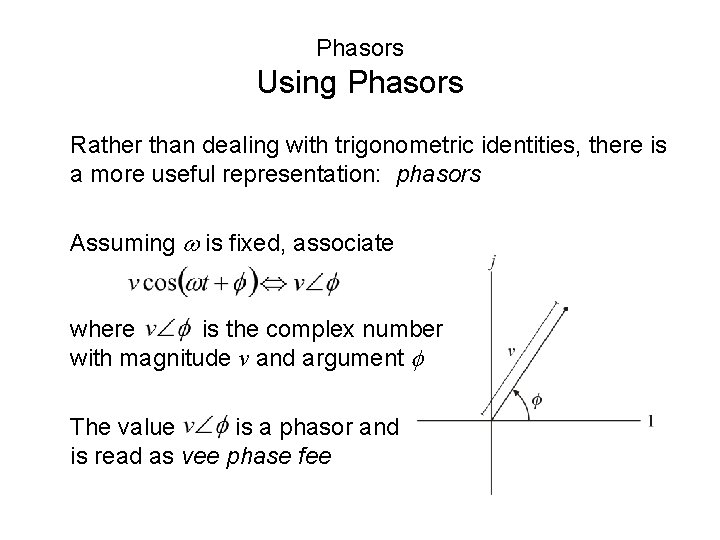
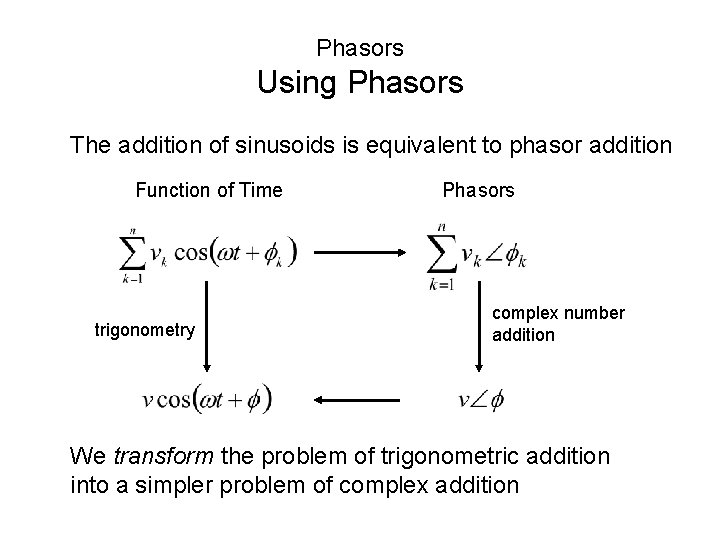
Phasors Using Phasors Rather than dealing with trigonometric identities, there is a more useful representation: phasors Assuming w is fixed, associate where is the complex number with magnitude v and argument f The value is a phasor and is read as vee phase fee
Phasors Using Phasors The addition of sinusoids is equivalent to phasor addition Function of Time trigonometry Phasors complex number addition We transform the problem of trigonometric addition into a simpler problem of complex addition
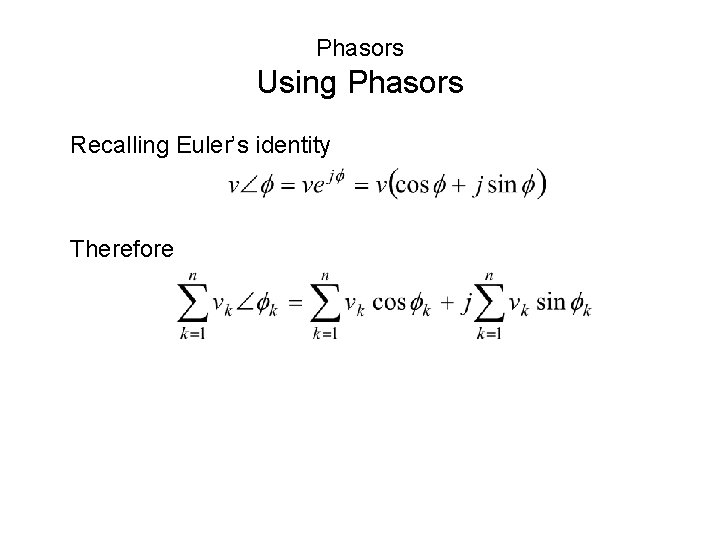
Phasors Using Phasors Recalling Euler’s identity Therefore
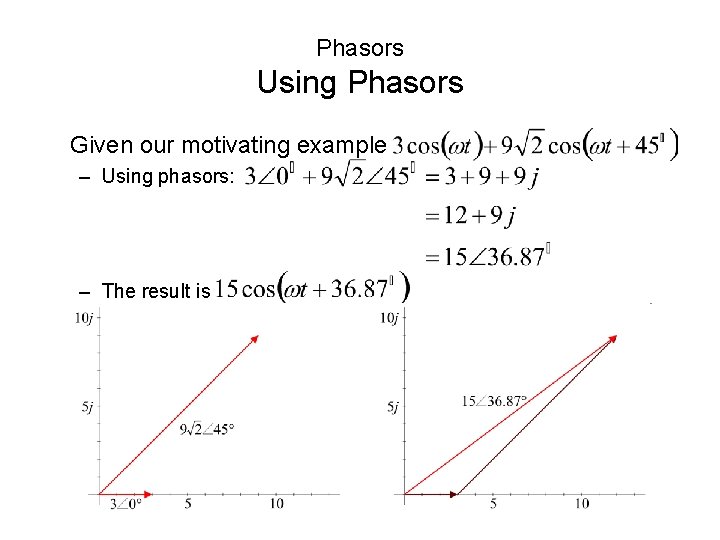
Phasors Using Phasors Given our motivating example – Using phasors: – The result is
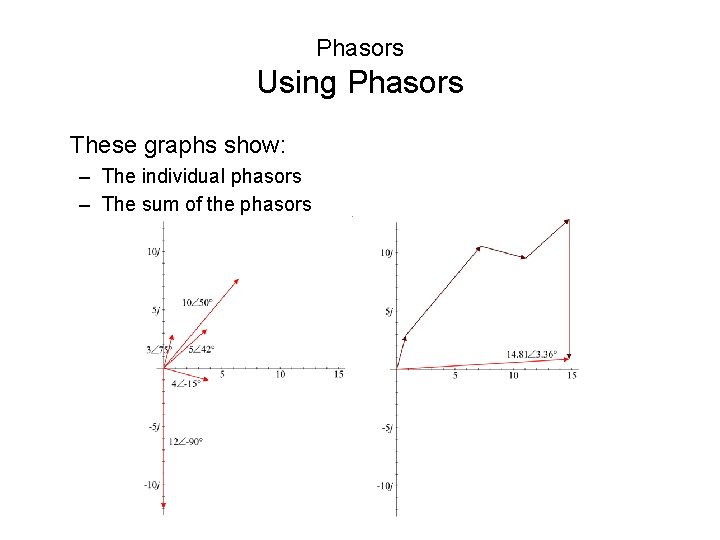
Phasors Using Phasors For example, given our first sum: Using phasors we get the sum
Phasors Using Phasors These graphs show: – The individual phasors – The sum of the phasors
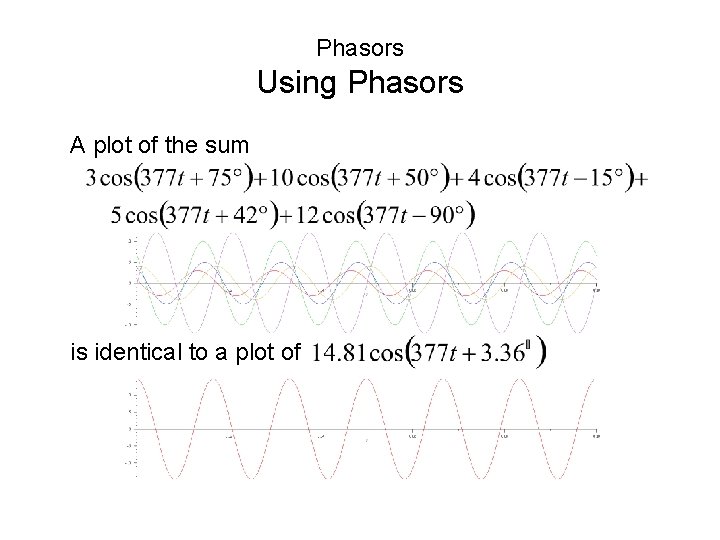
Phasors Using Phasors A plot of the sum is identical to a plot of
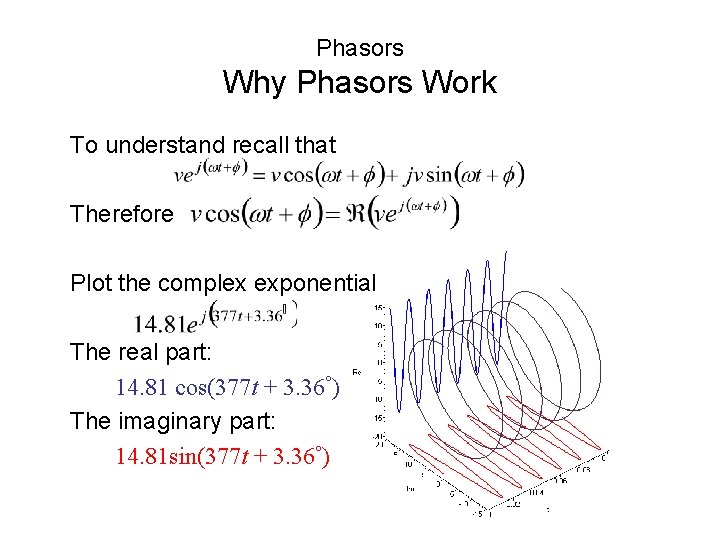
Phasors Why Phasors Work To understand recall that Therefore Plot the complex exponential The real part: 14. 81 cos(377 t + 3. 36°) The imaginary part: 14. 81 sin(377 t + 3. 36°)
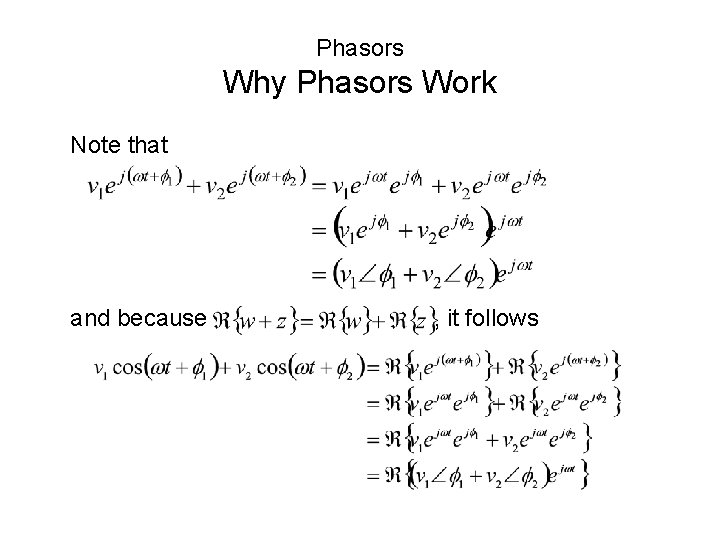
Phasors Why Phasors Work Note that and because , it follows
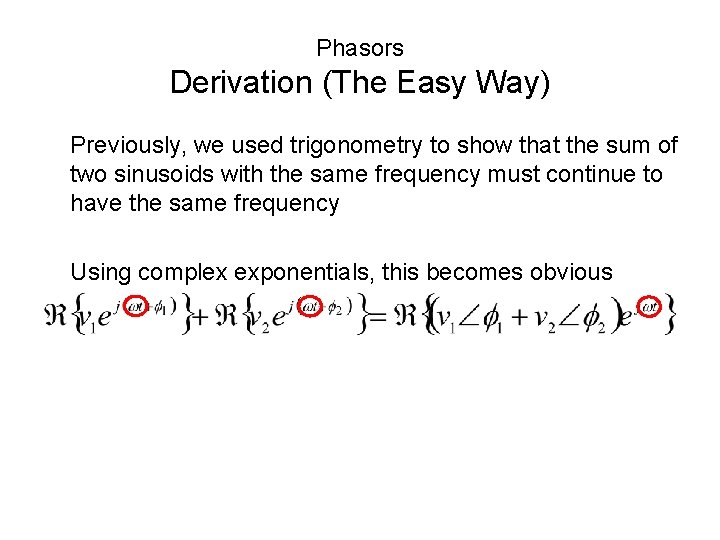
Phasors Derivation (The Easy Way) Previously, we used trigonometry to show that the sum of two sinusoids with the same frequency must continue to have the same frequency Using complex exponentials, this becomes obvious
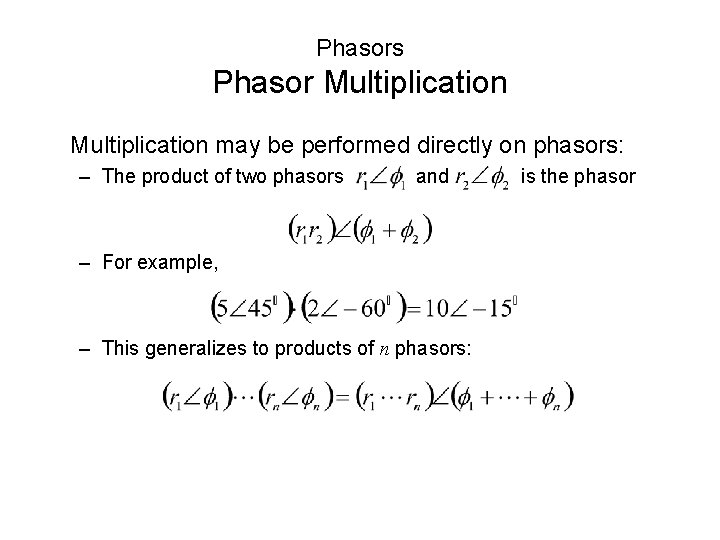
Phasors Phasor Multiplication may be performed directly on phasors: – The product of two phasors and – For example, – This generalizes to products of n phasors: is the phasor
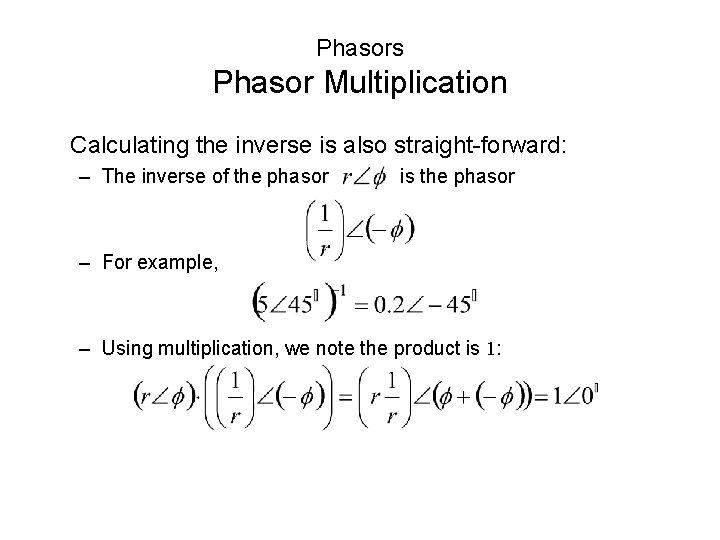
Phasors Phasor Multiplication Calculating the inverse is also straight-forward: – The inverse of the phasor is the phasor – For example, – Using multiplication, we note the product is 1:
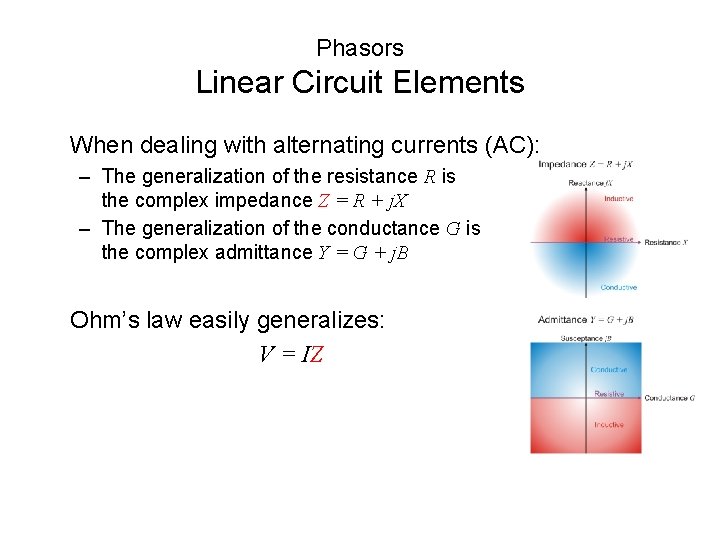
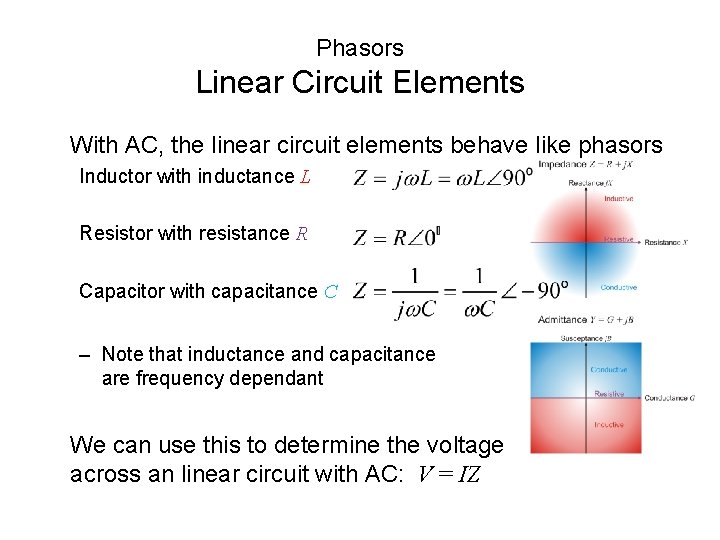
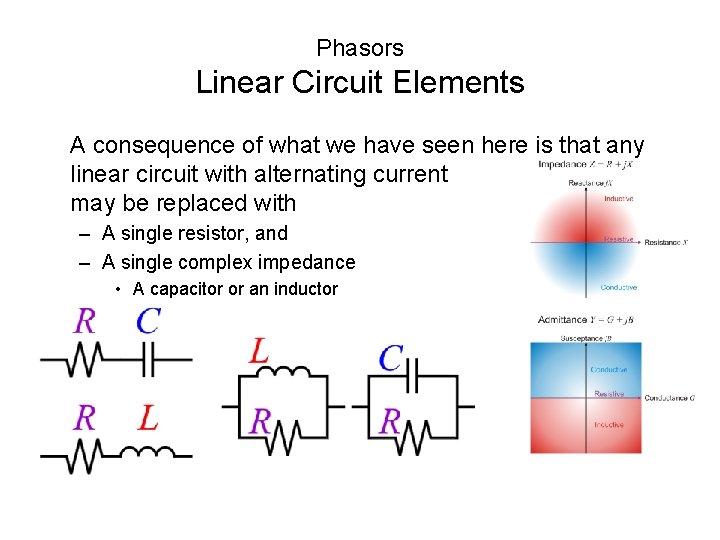
Phasors Linear Circuit Elements When dealing with alternating currents (AC): – The generalization of the resistance R is the complex impedance Z = R + j. X – The generalization of the conductance G is the complex admittance Y = G + j. B Ohm’s law easily generalizes: V = IZ
Phasors Linear Circuit Elements With AC, the linear circuit elements behave like phasors Inductor with inductance L Resistor with resistance R Capacitor with capacitance C – Note that inductance and capacitance are frequency dependant We can use this to determine the voltage across an linear circuit with AC: V = IZ
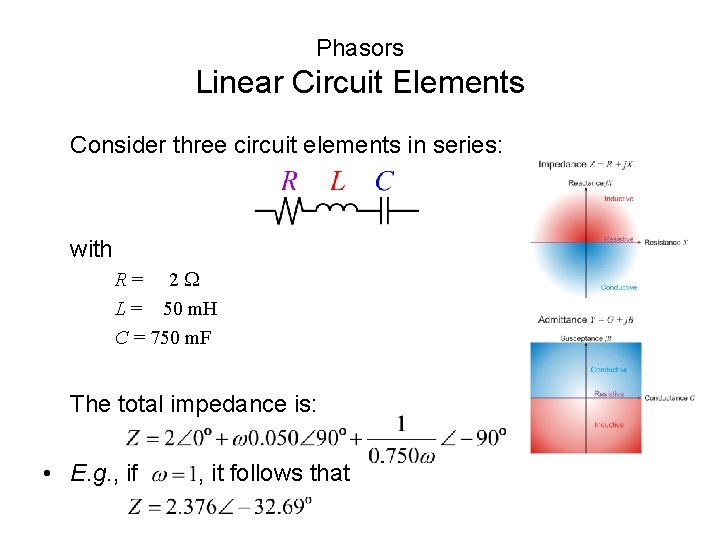
Phasors Linear Circuit Elements Consider three circuit elements in series: with R= 2 W L = 50 m. H C = 750 m. F The total impedance is: • E. g. , if , it follows that
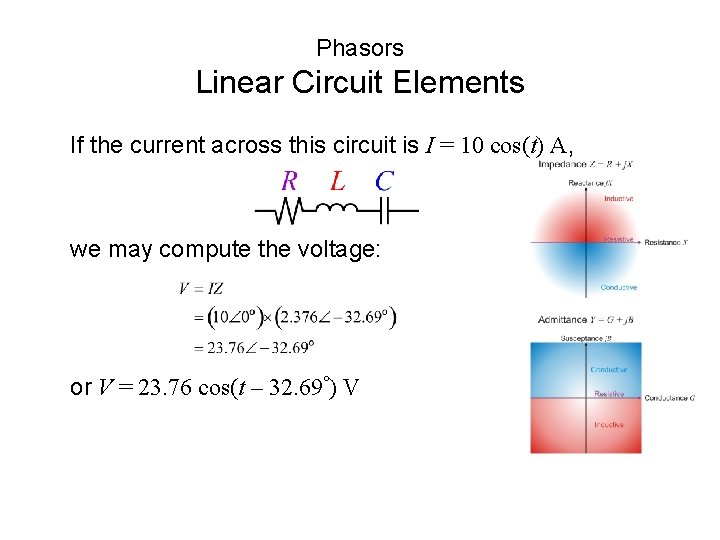
Phasors Linear Circuit Elements If the current across this circuit is I = 10 cos(t) A, we may compute the voltage: or V = 23. 76 cos(t – 32. 69°) V
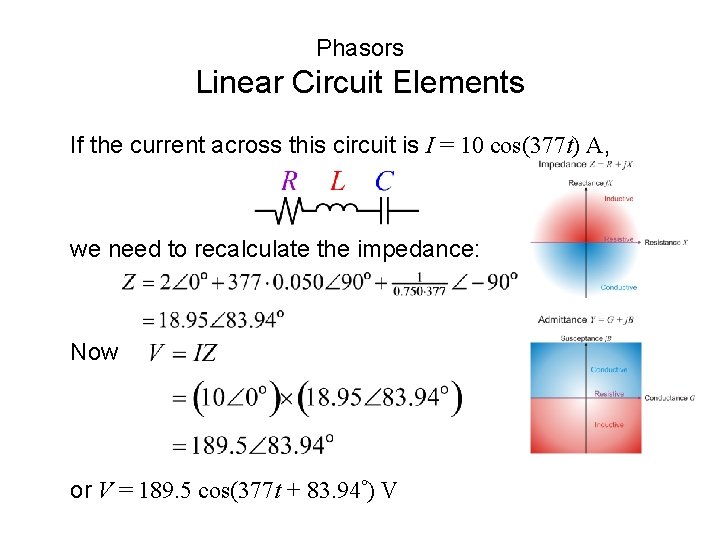
Phasors Linear Circuit Elements If the current across this circuit is I = 10 cos(377 t) A, we need to recalculate the impedance: Now or V = 189. 5 cos(377 t + 83. 94°) V
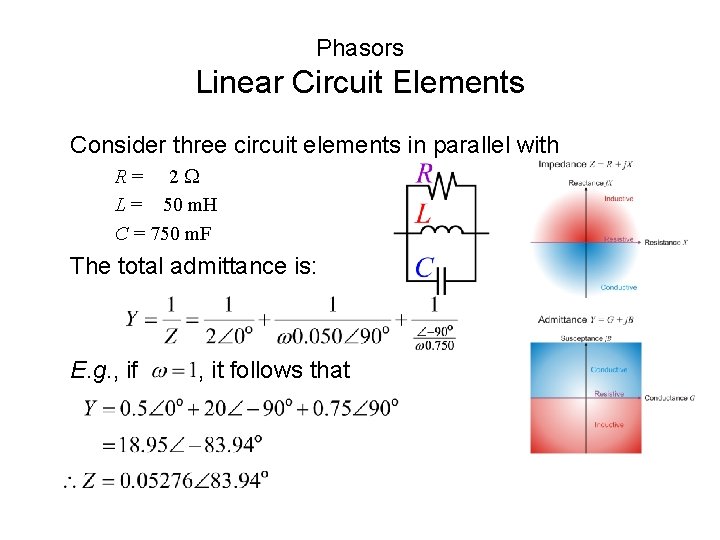
Phasors Linear Circuit Elements Consider three circuit elements in parallel with R= 2 W L = 50 m. H C = 750 m. F The total admittance is: E. g. , if , it follows that
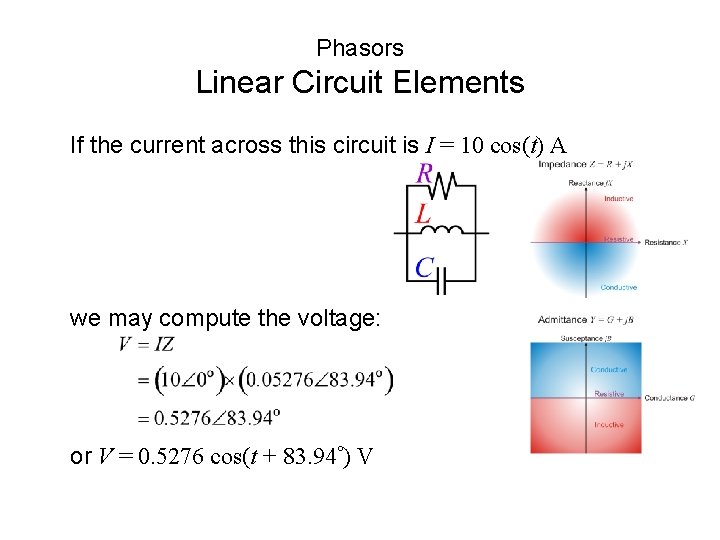
Phasors Linear Circuit Elements If the current across this circuit is I = 10 cos(t) A we may compute the voltage: or V = 0. 5276 cos(t + 83. 94°) V
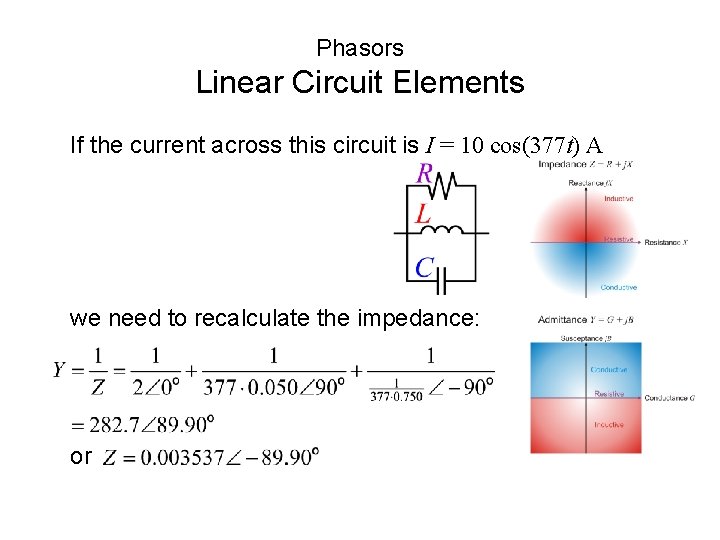
Phasors Linear Circuit Elements If the current across this circuit is I = 10 cos(377 t) A we need to recalculate the impedance: or
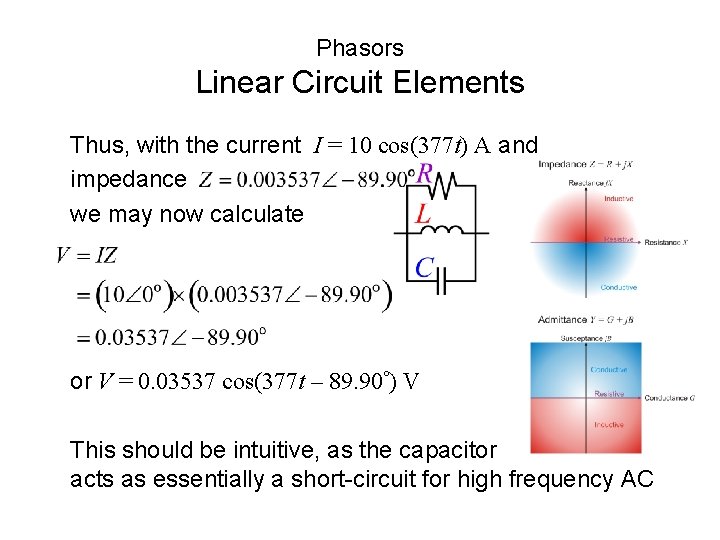
Phasors Linear Circuit Elements Thus, with the current I = 10 cos(377 t) A and impedance we may now calculate or V = 0. 03537 cos(377 t – 89. 90°) V This should be intuitive, as the capacitor acts as essentially a short-circuit for high frequency AC
Phasors Linear Circuit Elements A consequence of what we have seen here is that any linear circuit with alternating current may be replaced with – A single resistor, and – A single complex impedance • A capacitor or an inductor
Phasors Final Observations These techniques do not work if the frequencies differ The choice of 377 in the examples is deliberate: – North American power is supplied at 60 Hz: 2 p 60 ≈ 376. 99111843 – Relative error: 0. 0023% – European power is supplied at 50 Hz: 2 p 50 = 100 p ≈ 314. 159265358
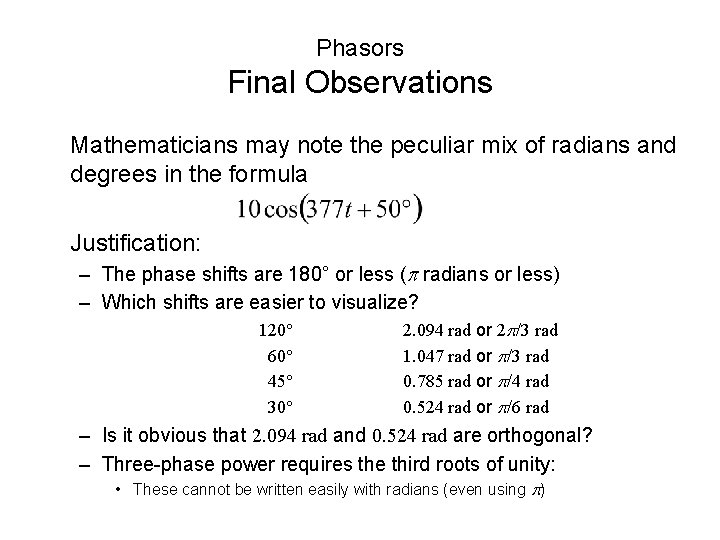
Phasors Final Observations Mathematicians may note the peculiar mix of radians and degrees in the formula Justification: – The phase shifts are 180° or less (p radians or less) – Which shifts are easier to visualize? 120° 60° 45° 30° 2. 094 rad or 2 p/3 rad 1. 047 rad or p/3 rad 0. 785 rad or p/4 rad 0. 524 rad or p/6 rad – Is it obvious that 2. 094 rad and 0. 524 rad are orthogonal? – Three-phase power requires the third roots of unity: • These cannot be written easily with radians (even using p)
Phasors Summary In this topic, we will look at – – Sum of sinusoidal functions The trigonometry is exceptionally tedious The phasor representation The parallel between phasor addition and trigonometric summations – Phasor multiplication and inverses – Use of phasors with linear circuit elements
Phasors Acknowledgments • I would like to thank Prof. David Nairn for assistance in answering questions and Hua Qiang Cheng for pointing out errors in a previous version of these slides
Usage Notes • These slides are made publicly available on the web for anyone to use • If you choose to use them, or a part thereof, for a course at another institution, I ask only three things: – that you inform me that you are using the slides, – that you acknowledge my work, and – that you alert me of any mistakes which I made or changes which you make, and allow me the option of incorporating such changes (with an acknowledgment) in my set of slides Sincerely, Douglas Wilhelm Harder, MMath dwharder@alumni. uwaterloo. ca