
Topics Correlation The road map Examining bivariate relationships
Topics: Correlation • The road map • Examining “bi-variate” relationships through pictures • Examining “bi-variate” relationships through numbers
Correlational Research • Exploration of relationships between variables for better understanding • Exploration of relationships between variables as a means of predicting future behavior.
Correlation: Bi-Variate Relationships • A correlation describes a relationship between two variables • Correlation tries to answer the following questions: – What is the relationship between variable X and variable Y? – How are the scores on one measure associated with scores on another measure? – To what extent do the high scores on one variable go with the high scores on the second variable?
Types of Correlation Studies • Measures of same individuals on two or more different variables • Measures of different individuals on the “same” variable • Measures of the same individuals on the “same” variable(s) measured at different times

Representations of Relationships • Tabular Representation: arrangement of scores in a joint distribution table • Graphical Representation: a picture of the joint distribution • Numerical Represenation: a number summarizing the relationship

Scatter Plot: SAT/GPA (Overachievement Study)
Creating a Scatter Plot • Construct a joint distribution table • Draw the axis of the graph – Label the abscissa with name of units of the X variable – Label the ordinate with the name of the units of the Y variable • Plot one point for each subject representing their scores on each variable • Draw a perimeter line (“fence”) around the full set of data points trying to get as tight a fit as possible. • Examine the shape: – The “tilt” – The “thickness”
Reading the Nature of Relationship • Tilt: The slope (or slant) of the scatter as represented by an imaginary line. – Positive relationship: The estimated line goes from lower-left to upper right (high-high, low-low situation) – Negative relationship: The estimated line goes from upper left to lower right (high-low, low-high situation) – No relationship: The line is horizontal or vertical because the points have no slant
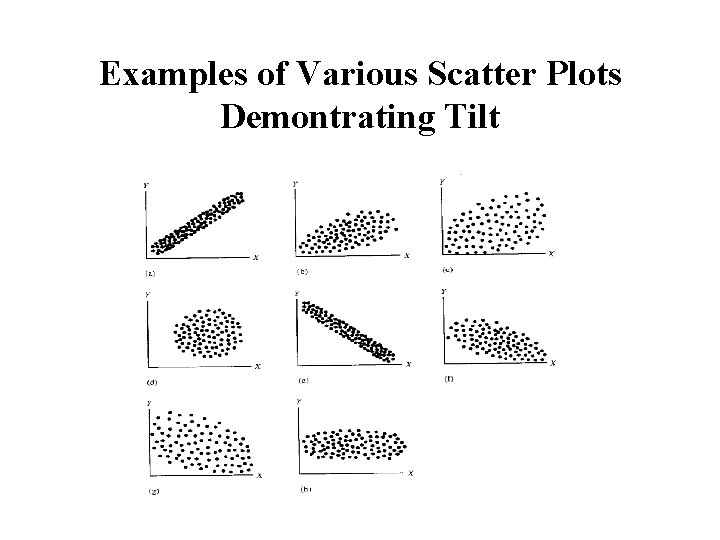
Examples of Various Scatter Plots Demontrating Tilt
Reading the Strength of Relationship • Shape: the degree to which the points in the scatter plot cluster around the imaginary line that represents the slope. – Strong relationship: If oval is elongated and thin. – Weak relationship: If oval is not much longer than it is wide. – Moderate relationship: Somewhere in between.
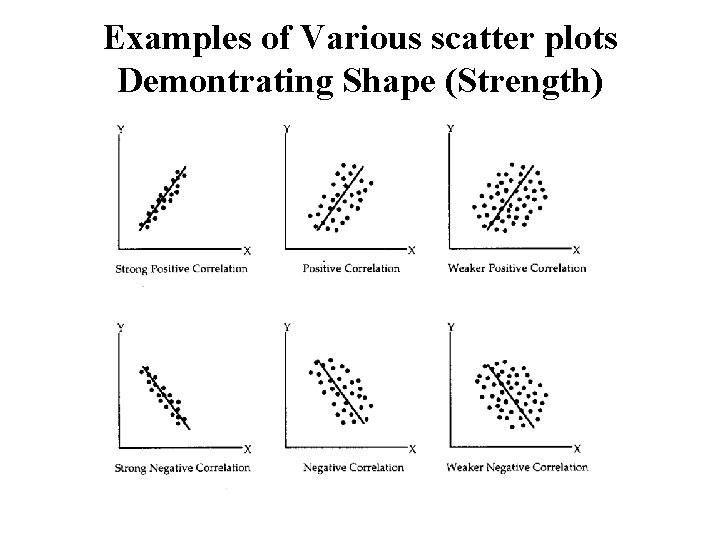
Examples of Various scatter plots Demontrating Shape (Strength)
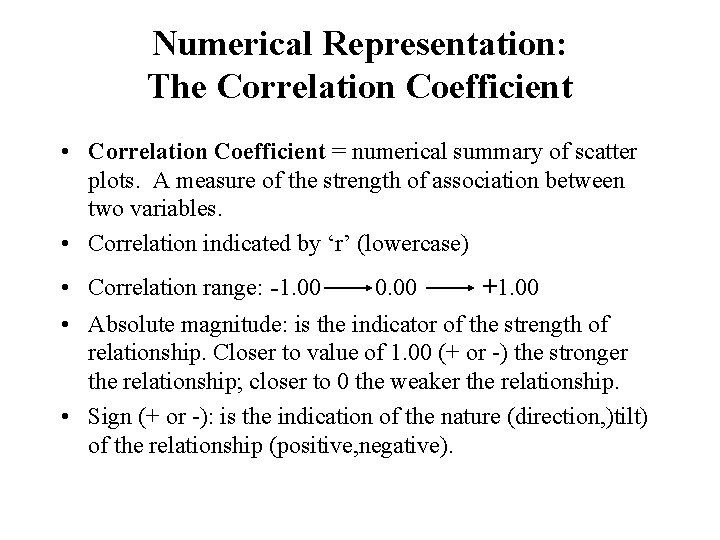
Numerical Representation: The Correlation Coefficient • Correlation Coefficient = numerical summary of scatter plots. A measure of the strength of association between two variables. • Correlation indicated by ‘r’ (lowercase) • Correlation range: -1. 00 0. 00 +1. 00 • Absolute magnitude: is the indicator of the strength of relationship. Closer to value of 1. 00 (+ or -) the stronger the relationship; closer to 0 the weaker the relationship. • Sign (+ or -): is the indication of the nature (direction, )tilt) of the relationship (positive, negative).
Types of Correlation Coefficients
Influences on Correlation Coefficients • • Restriction of range Use of extreme groups Combining groups Outliers (extreme scores) Curvilinear relationships Sample size Reliability of measures
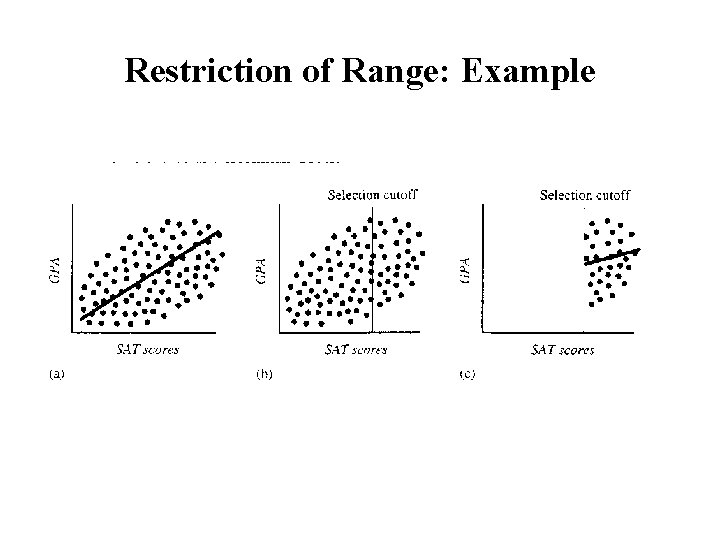
Restriction of Range: Example
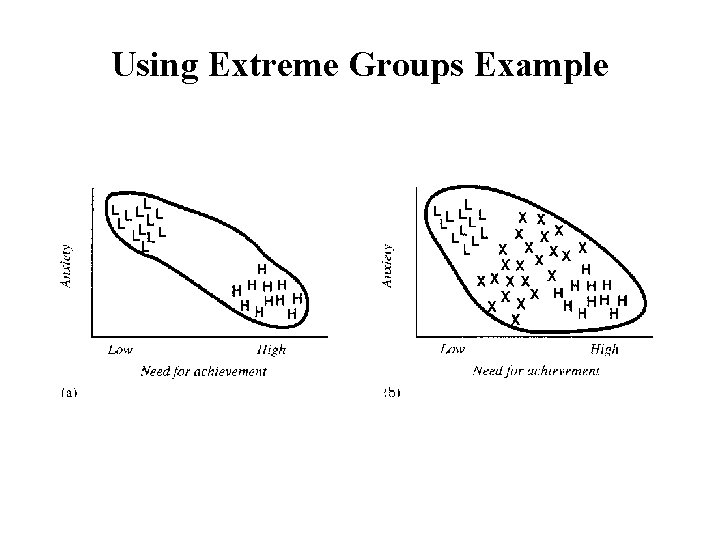
Using Extreme Groups Example
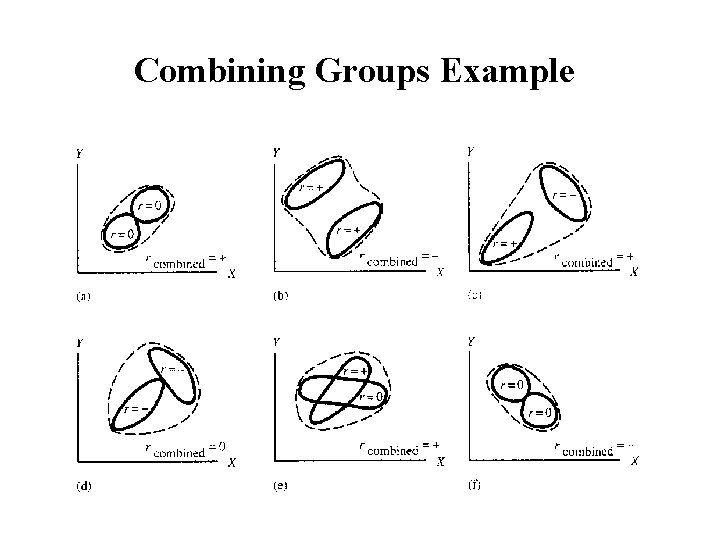
Combining Groups Example
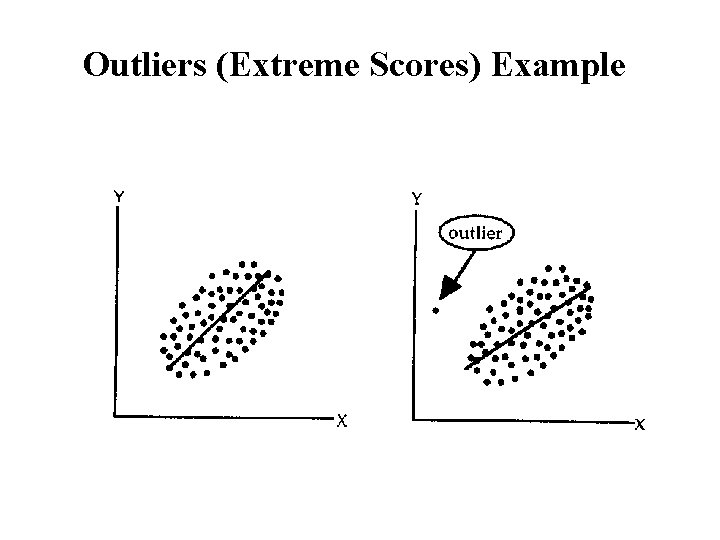
Outliers (Extreme Scores) Example

Curvilinear Examples
Coefficient of Determination • Coefficient of Determination: the squared correlation coefficient • The proportion of variability in Y that can be explained (accounted for) by knowing X • Lies between 0 and +1. 00 • r 2 will always be lower than r • Often converted to a percentage
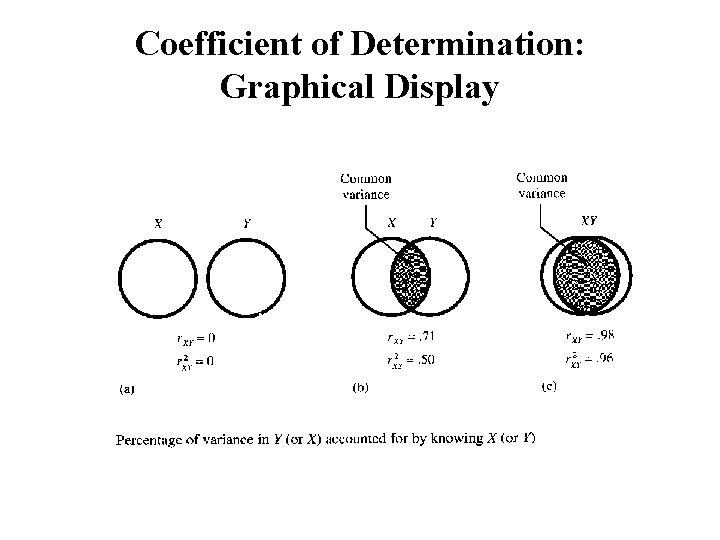
Coefficient of Determination: Graphical Display
Some Warnings • Correlation does not address issue of cause and effect: correlation ≠ causation • Correlation is a way to establish independence of measures • No rules about what is “strong”, “moderate”, “weak” relationship
- Slides: 22