
Topics Block placement n Global routing n Switchbox
Topics Block placement. n Global routing. n Switchbox routing. n Modern VLSI Design 2 e: Chapter 7 Copyright 1998 Prentice Hall PTR

Floorplanning strategies Floorplanning must take into account blocks of varying function, size, shape. n Must design: n – space allocation; – signal routing; – power supply routing; – clock distribution. Modern VLSI Design 2 e: Chapter 7 Copyright 1998 Prentice Hall PTR
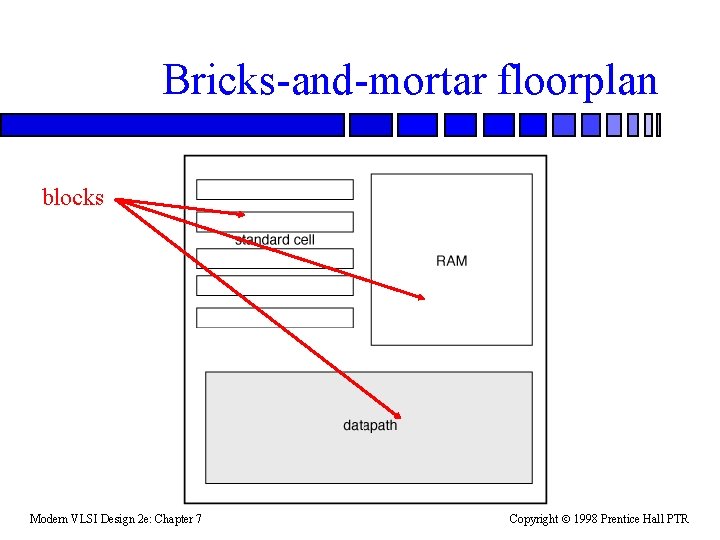
Bricks-and-mortar floorplan blocks Modern VLSI Design 2 e: Chapter 7 Copyright 1998 Prentice Hall PTR
Purposes of floorplanning n Early in design: – Prepare a floorplan to budget area, wire area/delay. Tradeoffs between blocks can be negotiated. n Late in design: – Make sure the pieces fit together as planned. – Implement the global layout. Modern VLSI Design 2 e: Chapter 7 Copyright 1998 Prentice Hall PTR
Types of routing n Channel routing: – channel may grow in one dimension to accommodate wires; – pins generally on only two sides. n Switchbox routing: – cannot grow in any dimension; – pins are on all four sides, fixing dimensions of the box. Modern VLSI Design 2 e: Chapter 7 Copyright 1998 Prentice Hall PTR
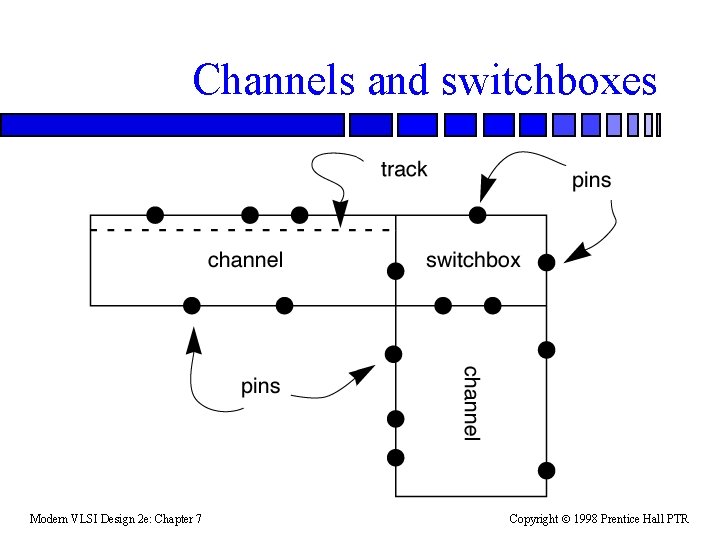
Channels and switchboxes Modern VLSI Design 2 e: Chapter 7 Copyright 1998 Prentice Hall PTR
Block placement n Blocks have: – area; – aspect ratio. Blocks may be placed at different rotations and reflections. n Uniform size blocks are easier to interchange. n Modern VLSI Design 2 e: Chapter 7 Copyright 1998 Prentice Hall PTR
Blocks and wiring Cannot ignore wiring during block placement - large wiring areas may force rearrangement of blocks. n Wiring plan must consider area and delay of critical signals. n Blocks divide wiring area into routing channels. n Modern VLSI Design 2 e: Chapter 7 Copyright 1998 Prentice Hall PTR

Channel definition Channels end at block boundaries. n Several alternate channel definitions are possible: n Modern VLSI Design 2 e: Chapter 7 Copyright 1998 Prentice Hall PTR
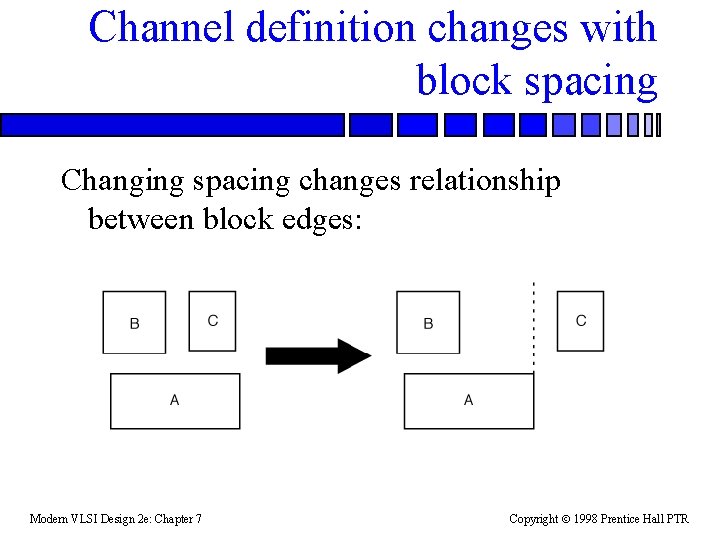
Channel definition changes with block spacing Changing spacing changes relationship between block edges: Modern VLSI Design 2 e: Chapter 7 Copyright 1998 Prentice Hall PTR
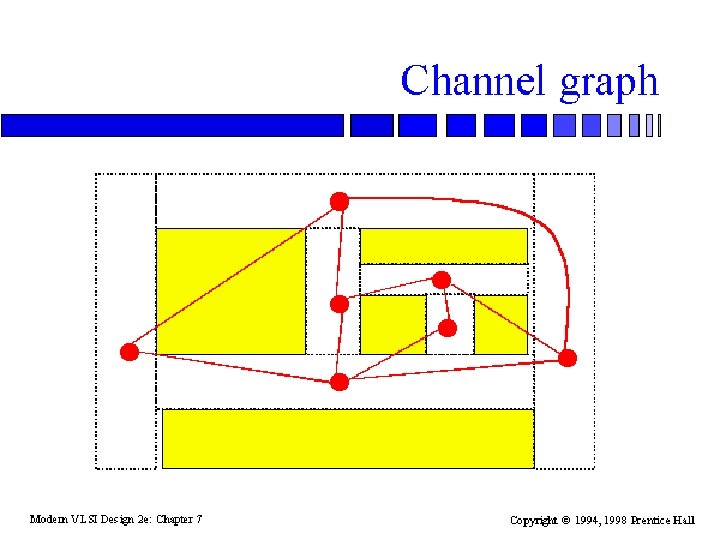
Modern VLSI Design 2 e: Chapter 7 Copyright 1998 Prentice Hall PTR
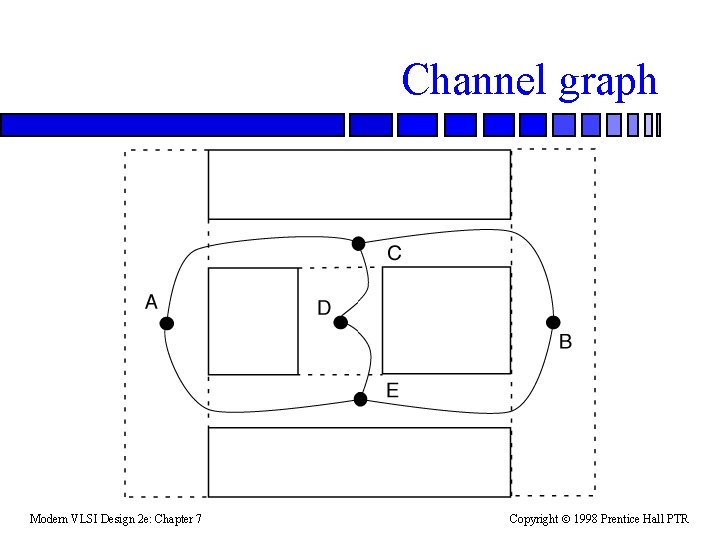
Channel graph Modern VLSI Design 2 e: Chapter 7 Copyright 1998 Prentice Hall PTR
Channel graph usage Nodes are channels, edges placed between two channels that touch. n Channel graph shows paths between channels. n Channel graph can be used to guide global routing. n Modern VLSI Design 2 e: Chapter 7 Copyright 1998 Prentice Hall PTR
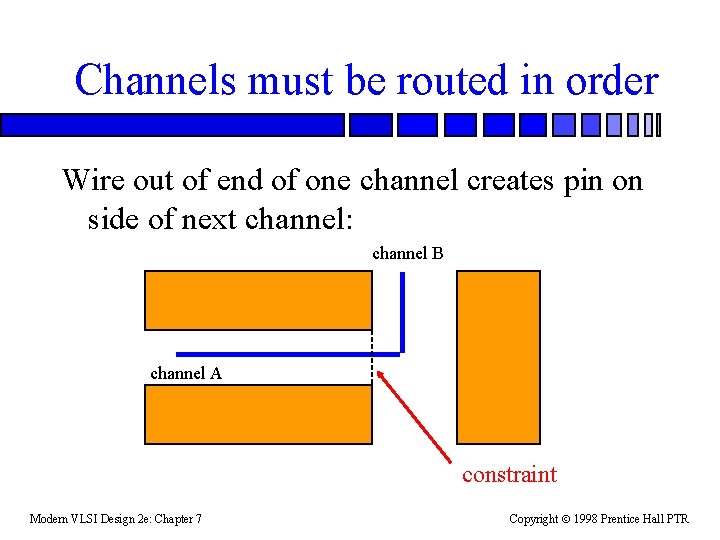
Channels must be routed in order Wire out of end of one channel creates pin on side of next channel: channel B channel A constraint Modern VLSI Design 2 e: Chapter 7 Copyright 1998 Prentice Hall PTR
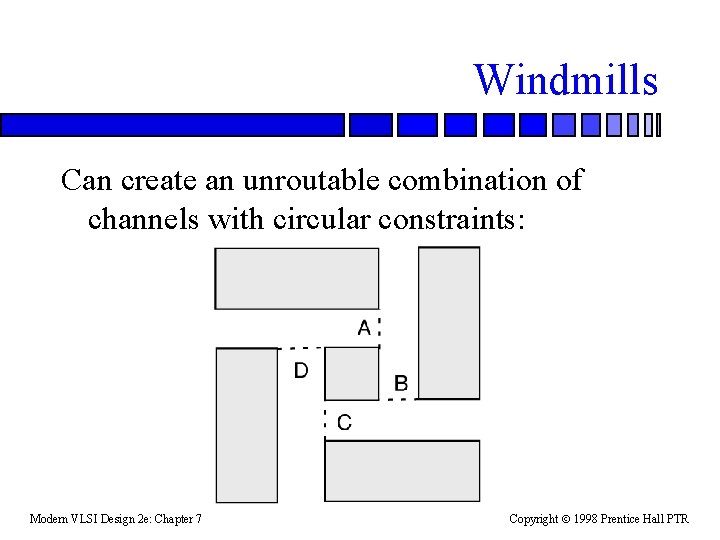
Windmills Can create an unroutable combination of channels with circular constraints: Modern VLSI Design 2 e: Chapter 7 Copyright 1998 Prentice Hall PTR
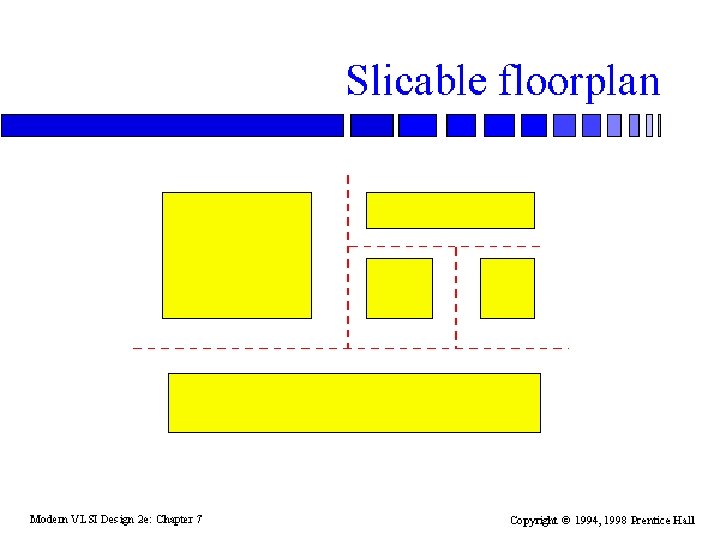
Modern VLSI Design 2 e: Chapter 7 Copyright 1998 Prentice Hall PTR
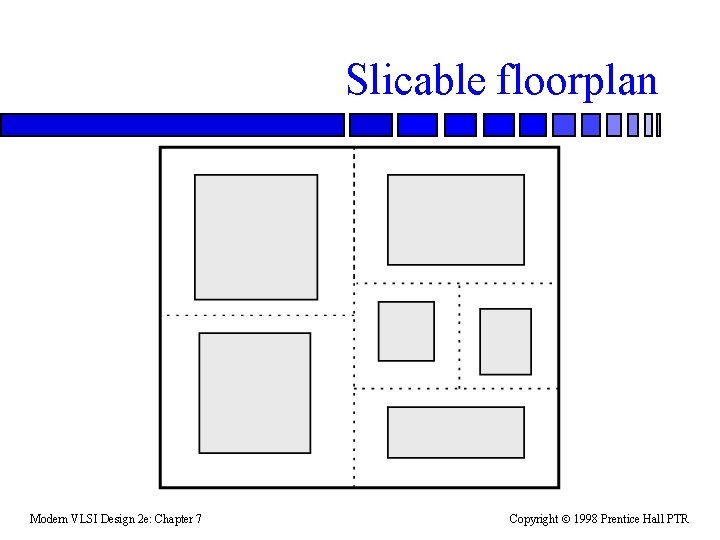
Slicable floorplan Modern VLSI Design 2 e: Chapter 7 Copyright 1998 Prentice Hall PTR
Slicability property A slicable floorplan can be recursively cut in two without cutting any blocks. n A slicable floorplan is guaranteed to have no windmills, therefore guaranteed to have a feasible order of routing for the channels. n Slicability is a desirable property for floorplans. n Modern VLSI Design 2 e: Chapter 7 Copyright 1998 Prentice Hall PTR
Global routing Goal: assign wires to paths through channels. n Don’t worry about exact routing of wires within channel. n Can estimate channel height from global routing using congestion. n Modern VLSI Design 2 e: Chapter 7 Copyright 1998 Prentice Hall PTR
Line probe routing Heuristic method for finding a short route. n Works with arbitrary combination of obstacles. n Does not explore all possible paths - not optimal. n Modern VLSI Design 2 e: Chapter 7 Copyright 1998 Prentice Hall PTR
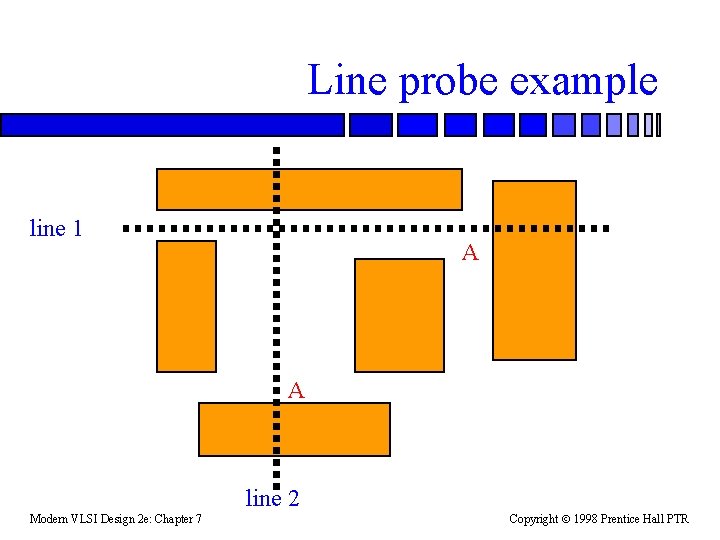
Line probe example line 1 A A line 2 Modern VLSI Design 2 e: Chapter 7 Copyright 1998 Prentice Hall PTR
Channel utilization Want to keep all channels about equally full to minimize wasted area. n Important to route time-critical signals first. n Shortest path may not be best for global wiring. n In general, may need to rip-up wires and reroute to improve the global routing. n Modern VLSI Design 2 e: Chapter 7 Copyright 1998 Prentice Hall PTR
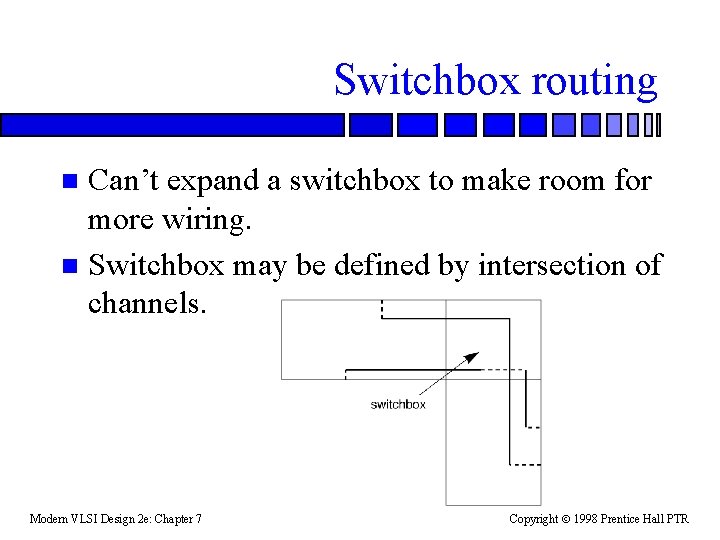
Switchbox routing Can’t expand a switchbox to make room for more wiring. n Switchbox may be defined by intersection of channels. n Modern VLSI Design 2 e: Chapter 7 Copyright 1998 Prentice Hall PTR
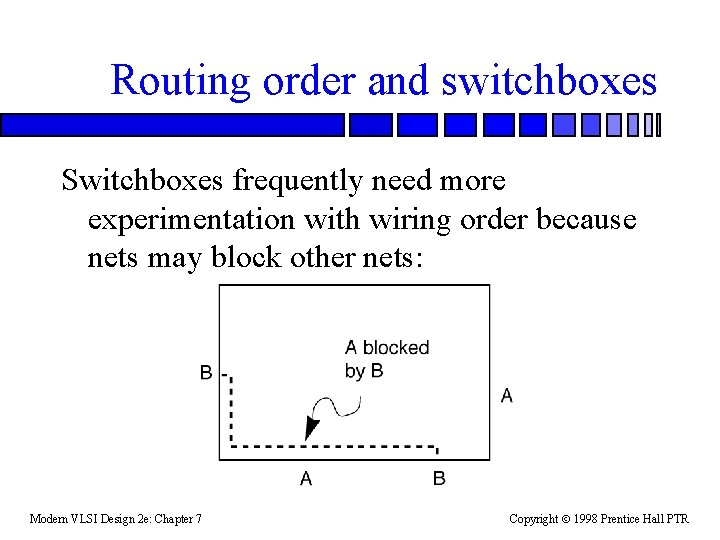
Routing order and switchboxes Switchboxes frequently need more experimentation with wiring order because nets may block other nets: Modern VLSI Design 2 e: Chapter 7 Copyright 1998 Prentice Hall PTR
- Slides: 24