
Topics 1 4 1 5 Angle Relationships ANGLES
- Slides: 8
Topics 1 -4 & 1 -5 Angle Relationships
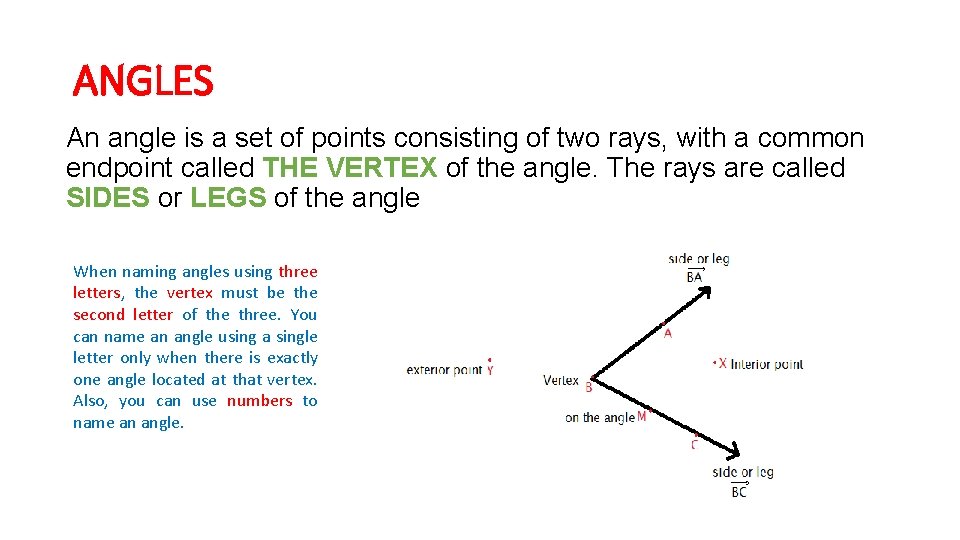
ANGLES An angle is a set of points consisting of two rays, with a common endpoint called THE VERTEX of the angle. The rays are called SIDES or LEGS of the angle When naming angles using three letters, the vertex must be the second letter of the three. You can name an angle using a single letter only when there is exactly one angle located at that vertex. Also, you can use numbers to name an angle.
ANGLES An angle is a set of points consisting of two rays, with a common endpoint called THE VERTEX of the angle. The rays are callled SIDES or LEGS of the angle An angle can be classified according its measurement: Ø Acute angle: Measure between 0 to 90 degrees Ø Right angle: Measure 90 degrees Ø Obtuse angle: Measure between 90 to 180 degrees Ø Straight angle: Measure 180 degrees Ø Reflex angle: Measure between 180 to 360 degrees
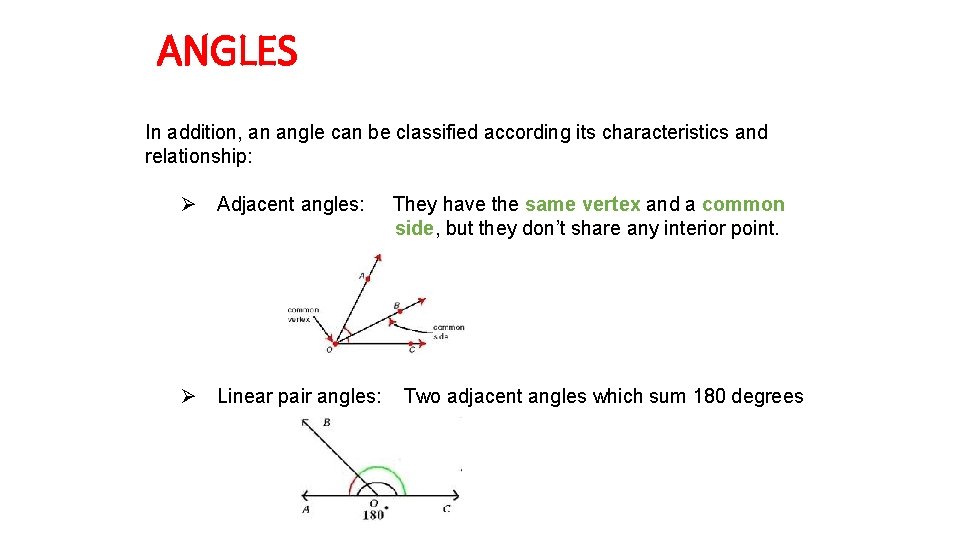
ANGLES In addition, an angle can be classified according its characteristics and relationship: Ø Adjacent angles: Ø Linear pair angles: They have the same vertex and a common side, but they don’t share any interior point. Two adjacent angles which sum 180 degrees
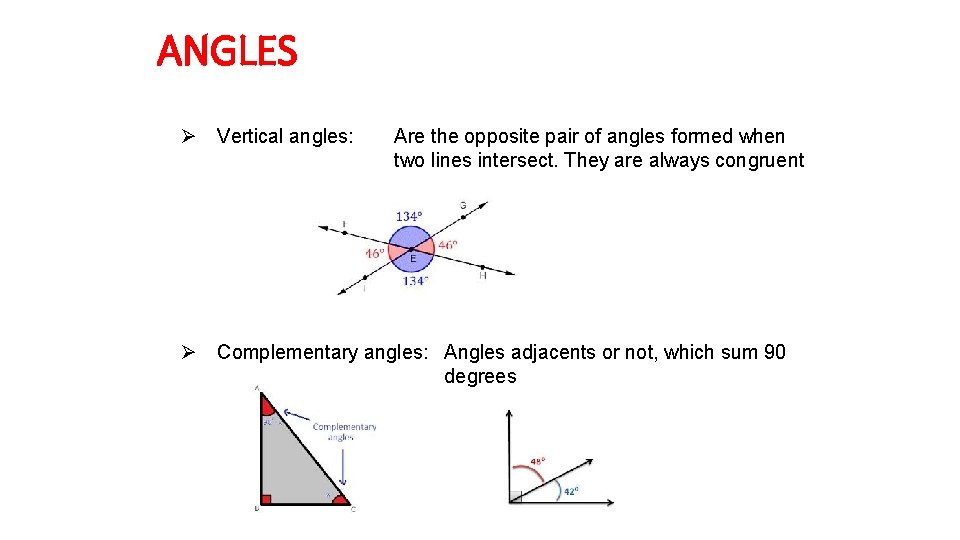
ANGLES Ø Vertical angles: Are the opposite pair of angles formed when two lines intersect. They are always congruent Ø Complementary angles: Angles adjacents or not, which sum 90 degrees
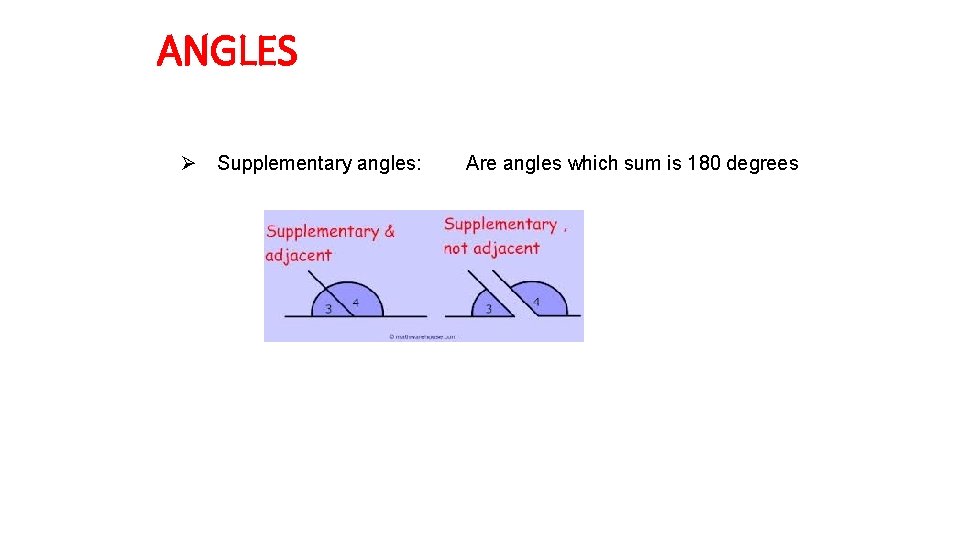
ANGLES Ø Supplementary angles: Are angles which sum is 180 degrees
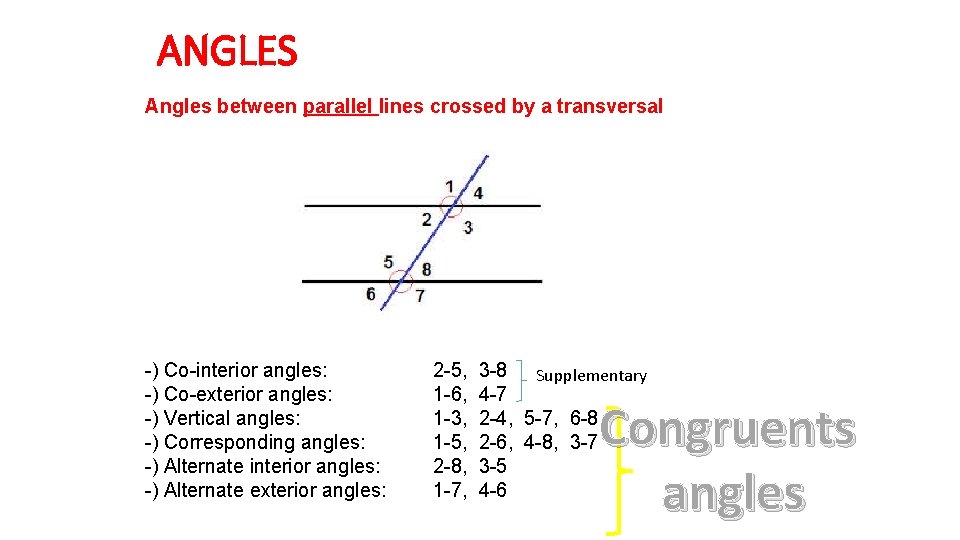
ANGLES Angles between parallel lines crossed by a transversal -) Co-interior angles: -) Co-exterior angles: -) Vertical angles: -) Corresponding angles: -) Alternate interior angles: -) Alternate exterior angles: 2 -5, 1 -6, 1 -3, 1 -5, 2 -8, 1 -7, 3 -8 Supplementary 4 -7 2 -4, 5 -7, 6 -8 2 -6, 4 -8, 3 -7 3 -5 4 -6 Congruents angles
Converse If two lines are intersected by a transversal, then alternate interior angles, alternate exterior angles, and corresponding angles are congruent. The converse of theorem is true as well. If two corresponding angles are congruent, then the two lines cut by the transversal must be parallel. Similarly, if two alternate interior or alternate exterior angles are congruent, the lines are parallel.