
Topical Agents Definition Topical Place the use of








- Slides: 20
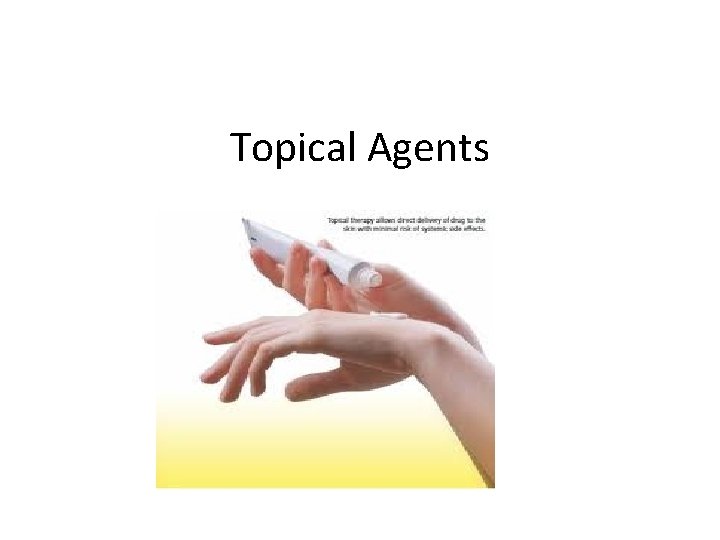
Topical Agents
Definition • Topical : Place the use of these drugs or compounds on the surface • Ex: Antiseptic • Systemic: The drugs are absorbed into circulatory system and distributed to various organs or tissues.
Types of inorganic topical agents • The compounds used topically will be divided into broad categories based on their usual action or uses. • There are TWO types: • 1 - Protective agents. • 2 - Antimicrobial agents.
Protective agents • Are substances which may be applied to skin to protect certain areas from irritation. • Properties of protective agents are insoluble in water ( H 2 O), and chemically inert ( unreactive), in order to prevent interactions between the protective substance and the tissue. • Also, small fine partials(large surface area).
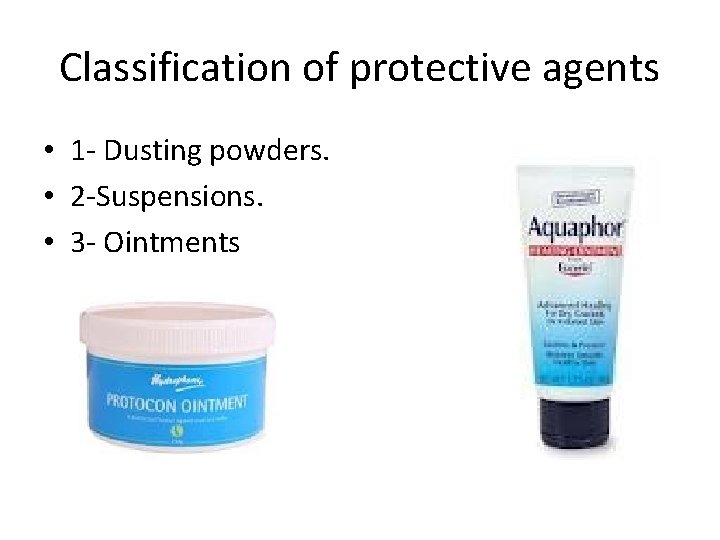
Classification of protective agents • 1 - Dusting powders. • 2 -Suspensions. • 3 - Ointments
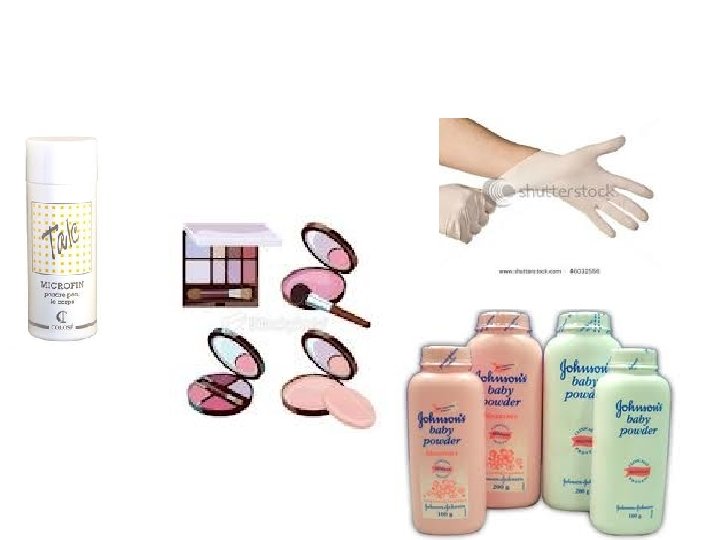
Talc • Mg. O. 4 Si. O 2. H 2 O • Hydrous magnesium silicate, very fine white powder, smoothly, greasy feeling to the touch( soapstone). • Talc is characterized as fine powder ( 80/100) mesh particle size, odorless, insoluble in water , dil HCl, bases.
Uses of Talc • 1 - It is useful in lubricating, protective dusting, • Can be prevent any friction. • 2 -Used for wound & surgical incision because can produce sterile abscesses • 3 - Used in medical gloves. ( plastic disposable) • 4 - Used in cosmetic may be perfumed • Medical Talc by mixing boric acid with talc as antimicrobial agents.
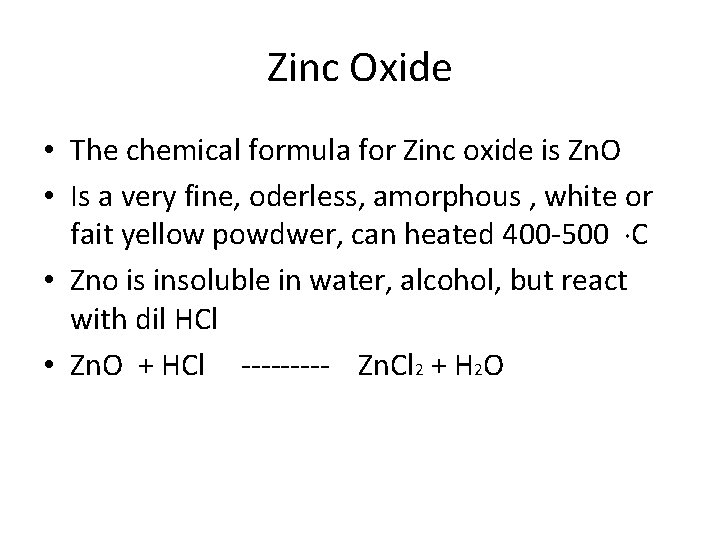
Zinc Oxide • The chemical formula for Zinc oxide is Zn. O • Is a very fine, oderless, amorphous , white or fait yellow powdwer, can heated 400 -500 ∙C • Zno is insoluble in water, alcohol, but react with dil HCl • Zn. O + HCl ----- Zn. Cl 2 + H 2 O
• Preparation • Zinc oxide is prepared on a large scale by burning zinc metal in a current of air. – Zn + O 2 = 2 Zn. O In this method, Zinc carbonate is prepared first by reacting zinc sulphate with a boiling solution of sodium carbonate. The precipitated basic carbonate of zinc is collected, washed to remove sulphate, dried and finally gently ignited. It loses carbon dioxide and water, leaving zinc oxide as the residue 2 Zn. CO 3, 2 Zn(OH)2= 4 Zn. O + 2 CO 2 + 2 H 2 O
Uses of Zinc Oxide • 1 - Is a mild astringent and weak antimicrobial agents. Used as powder, ointments to protect the skin. • 2 - Dusting powder used in the treatment of skin ulceration & other dermatological problems. • Medicated zinc oxide by mixing with boric acid as antimicrobial agents.
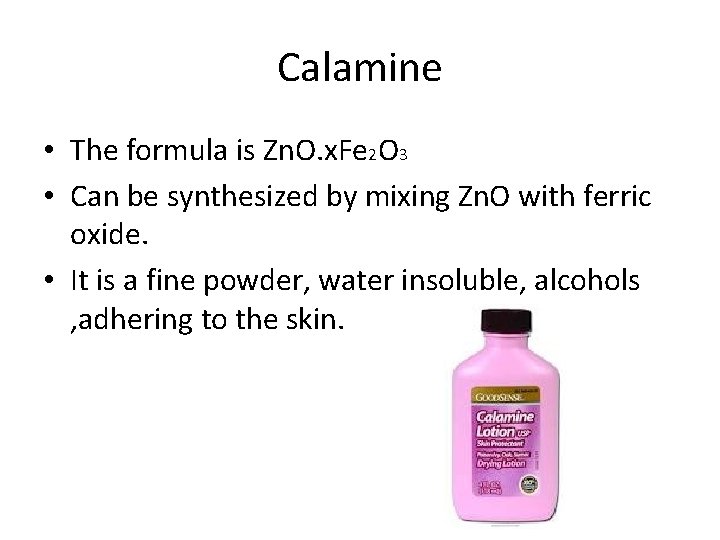
Calamine • The formula is Zn. O. x. Fe 2 O 3 • Can be synthesized by mixing Zn. O with ferric oxide. • It is a fine powder, water insoluble, alcohols , adhering to the skin.
Uses of Calamine • Calamine can be used as topical protective agent. • 1 - It is USP product used as dust powder, calamine lotion ( applied to skin )pink color. • Calamine is applied to the skin for its adsorbent, protective properties, used in dermatological problems.
• The calamine lotion contain Zn. O and ferric oxide equally mixed Bentonite magma in the solution of Calcium hydroxide. • Phenolated calamine lotion( USP ) contains 1% liquid which provide a local anesthetic and anti- itching action.
Titanium Dioxide(titania) • Ti. O 2 as topical protective agent, it is characterized by off white powder color, tasteless, odorless. A 1 to 10 aqueous suspension of the solution is neutral to litmus paper. • It is insoluble in water , HCl. HNO 3, dil H 2 SO 4. • It is soluble in HF, Conc. H 2 SO 4. Also, in H 2 O 2 • Ti. O 2 + H 2 O 2 ------- • Tritium dioxide Ti. O 3 Titanium trioxide
Preparation: Titanium dioxide heating Fe. Ti. O 3 with and chlorine. is prepared by hydrogen chloride 2 Fe. Ti. O 3 + 4 HCl + Cl 2 = 2 Fe. Cl 3 + 2 Ti. O 2 +2 H 2 O.
Uses of Ti. O 2 • Ti. O 2 is a protective agent, topically, used as Sun screen light ( UV light radiation) due to its highly refractive index. • Many pharmaceutical preparation as Ti. O 2 cream, 5, 10, . . 25% ointments. • Other organic sun screen agent p- aminobenzoic acid ( PABA). • Ti. O 2 used in cosmetic and paints.
Aluminum • Aluminum ( Al ) is a silver- white metal as protective agents , highly affinity to O 2 forming Al 2 O 3 as protective layer. • It is insoluble in water, alcohols, and uncreative towards HNO 3, H 2 SO 4 • It react rapidly with dil HCl • HCl + Al ------ Al. Cl 3. 6 H 2 O • Aluminum, paste ( Zn. O with base ) used for prevent irritation.
Silicon Polymer • There are inert protective substances occurring in liquid form known as Silicon oils; e. g. dimethyl silicon ( Dimethicon, or Simethicone ) • CH 3 • -Si-O- ( - Si - O ) ------Si –O • CH 3 • Very well adhere to skin, but not wound, be avoided contact to the eyes.