
TOPIC17 BLOCK DIAGRAM of USFD BLOCK DIAGRAM OF

TOPIC-17 BLOCK DIAGRAM of USFD
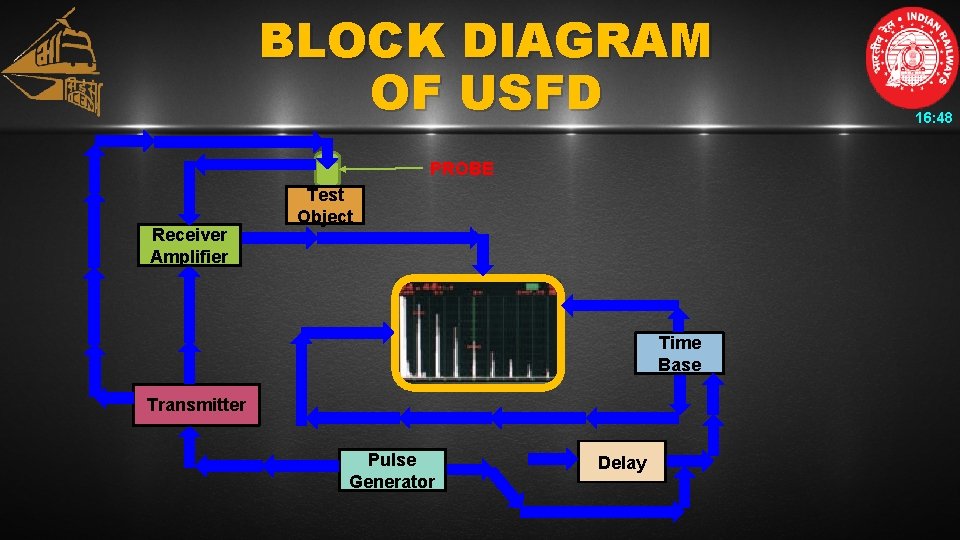
BLOCK DIAGRAM OF USFD PROBE Receiver Amplifier Test Object Time Base Transmitter Pulse Generator Delay 16: 48

BLOCK DIAGRAM OF USFD § The following are the main parts of an Ultrasonic Flaw Detector: • Time base • Pulse generator • Pulse transmitter • Display unit • Receiver amplifier 16: 48

Time Base 16: 48 § Time base circuit is required to provide a linear transverse from left to right across the cathode ray tube. § On this horizontal sweep is ultimately displayed in a vertical place, the transmitter pulse and the various reflected echoes in succession.
Time Base 16: 48 § The circuit must thus provide a sweep which is reasonably, linear so that equal distances along with the trace represent equal unit of time and hence for a given material, equal distances through the sample.
Pulse Generator 16: 48 § This may be regarded as the prime mover in the sequence of events loading to the visual presentation on the cathode ray tube screen. § Its function is to generate the pulse at intervals. § The frequency at which this triggering action take place is the pulse repetition frequency which ranges from 50 -1000 pulses (cycles) per second depending upon particular instrument.
Pulse Transmitter 16: 48 § In addition to operating the tube trace, the generator also triggers the transmitter driver. § It performs this duty a short time after the spot starts to move across the face of the cathode ray tube. § By causing a thyratron ‘valve to fired’ this pulse ensures that a higher voltage pulse is delivered to the transmitter probe.
Pulse Transmitter 16: 48 § This short pulse or burst of ultrasonic communicated to the object under test. is § But the same moment as the transducer is excited some energy is communicated to the receiver.
Display Unit 16: 48 § In the diagram, a cathode-ray tube is shown as the display device and such tubes gives a bright trace on the fluorescent screen. § The trace is produced by electrically defecting beam of electrons which in absence of such deflection would merely excite a stationary bright spot on the screen.
Receiver Amplifier 16: 48 § The receiver amplifier accepts the minutes signals from the receiving crystal and amplifies them suitably for display on the cathode ray tube. § The amplifier should have a rapid recovery time so that strong signals do not ‘block’ it temporarily hindering it inoperative for the detection of small echoes following closely on lager ones.
- Slides: 10