
Topic VI Evolution Origins of Life Bellringer THINKPAIRSHARE
Topic VI: Evolution Origins of Life
Bellringer THINK-PAIR-SHARE What do you think the difference is between a THEORY and a LAW? Think, for example, theory of evolution and the law of gravity. What’s the difference?
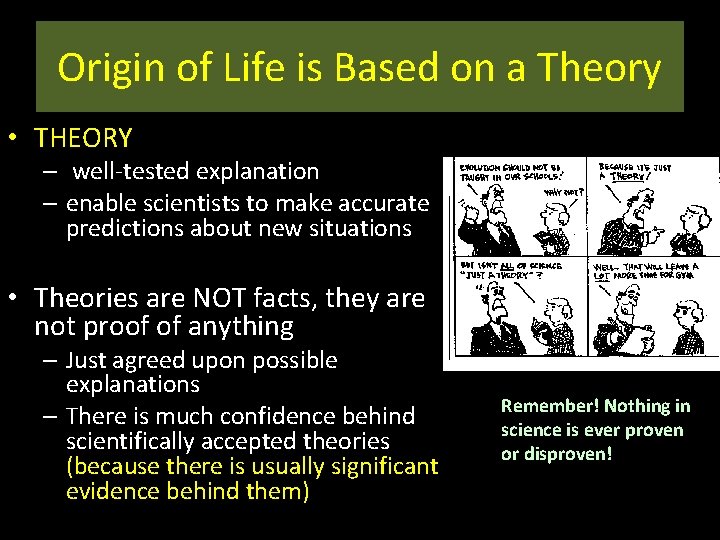
Origin of Life is Based on a Theory • THEORY – well-tested explanation – enable scientists to make accurate predictions about new situations • Theories are NOT facts, they are not proof of anything – Just agreed upon possible explanations – There is much confidence behind scientifically accepted theories (because there is usually significant evidence behind them) Remember! Nothing in science is ever proven or disproven!
Theory vs. Law • Laws are different from theories • Scientific LAW is a statement that is based on repeated observations, given the same experimental conditions • EX. The Law of Gravity. • Theories do not become laws and laws do not become theories! – Laws help explain theories
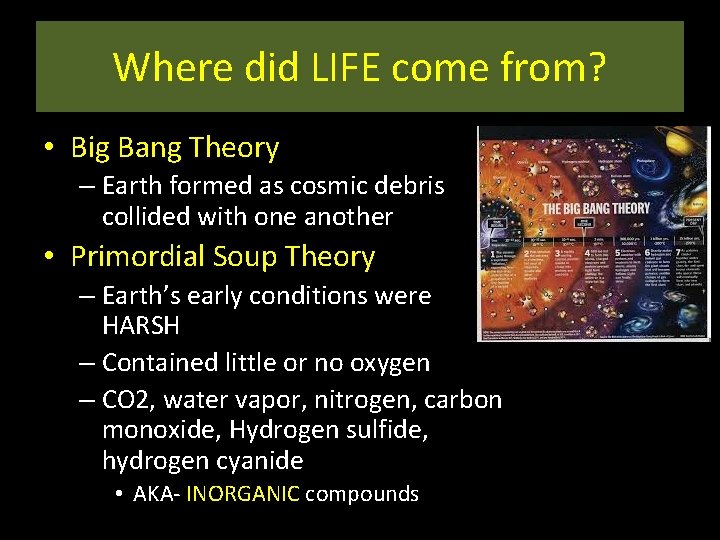
Where did LIFE come from? • Big Bang Theory – Earth formed as cosmic debris collided with one another • Primordial Soup Theory – Earth’s early conditions were HARSH – Contained little or no oxygen – CO 2, water vapor, nitrogen, carbon monoxide, Hydrogen sulfide, hydrogen cyanide • AKA- INORGANIC compounds

Primordial Soup Theory- Alexander Oparin • Early Earth was a harsh environment of non-living inorganic molecules • Torrential rains, lighting, hurricanes, monsoons, tornados • Why do we think this is a possible explanation? • Hydrothermal Vents
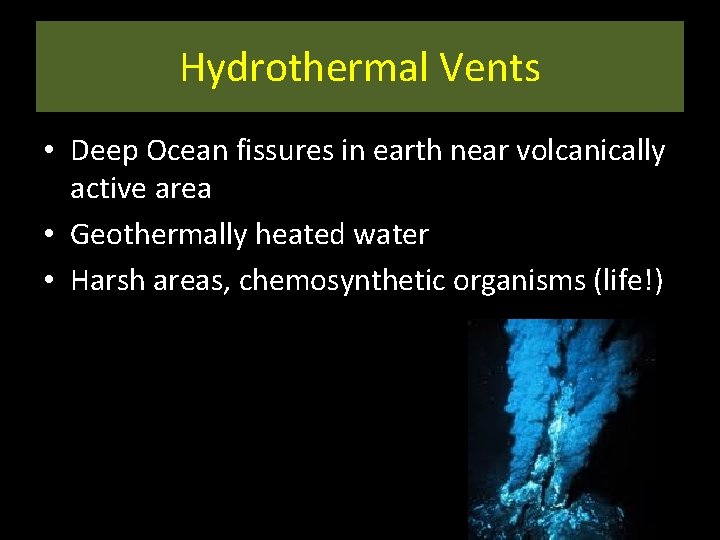
Hydrothermal Vents • Deep Ocean fissures in earth near volcanically active area • Geothermally heated water • Harsh areas, chemosynthetic organisms (life!)
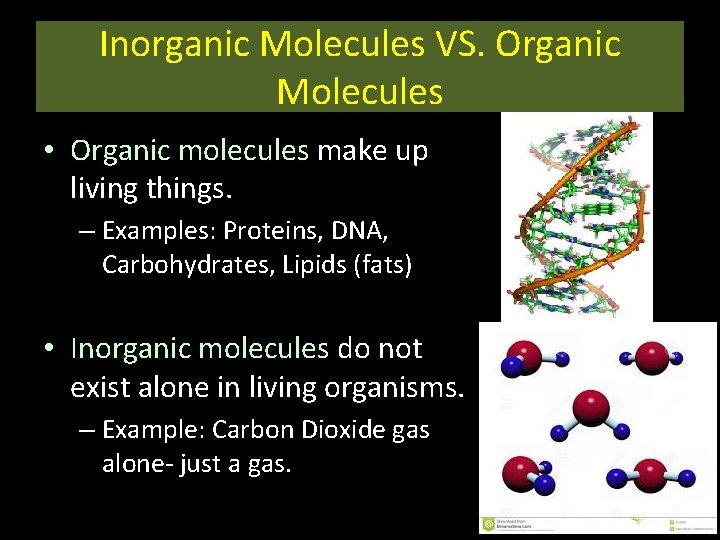
Inorganic Molecules VS. Organic Molecules • Organic molecules make up living things. – Examples: Proteins, DNA, Carbohydrates, Lipids (fats) • Inorganic molecules do not exist alone in living organisms. – Example: Carbon Dioxide gas alone- just a gas.
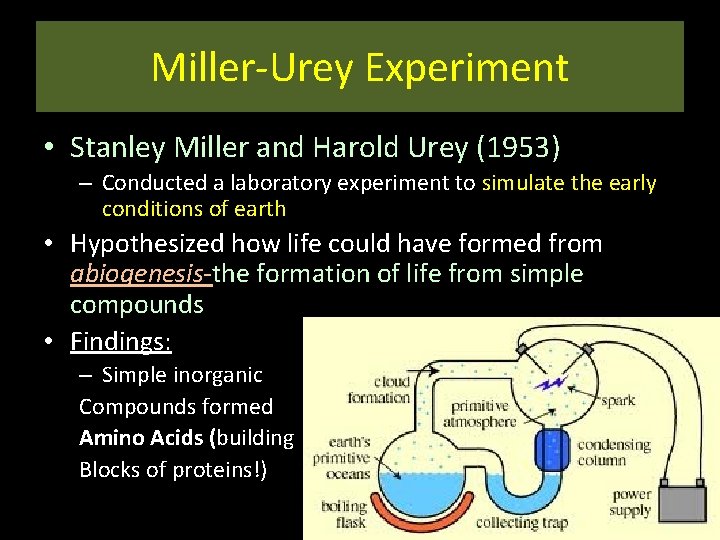
Miller-Urey Experiment • Stanley Miller and Harold Urey (1953) – Conducted a laboratory experiment to simulate the early conditions of earth • Hypothesized how life could have formed from abiogenesis-the formation of life from simple compounds • Findings: – Simple inorganic Compounds formed Amino Acids (building Blocks of proteins!)
Watch -Miller Urey Experiment http: //highered. mheducation. com/sites/9834092339/student_view 0/chapter 26/animation__miller-urey_experiment. html -Revealing the Origins of Life http: //www. pbs. org/wgbh/nova/evolution/origins-life. html
Day 2 - Origins of Life • Agenda: – Bellringer: answer knowledge review check questions – Ppt lesson w/ guided notes – Scientist video informative: take notes – “Advertise Your Scientist” Activity
Do you Remember? • Answer the following questions on your notes 1. The Miller & Urey Experiment was a design that simulated the conditions of early Earth. What did the experiment result in? a) That complex compounds are broken down b) That organic compounds can be produced from simpler inorganic compounds c) That life can be produced in the laboratory d) That amino acids are formed from water vapor and CO 2
2. Alexander Oparin described the conditions of early earth as a hot ocean mixture of inorganic simple compounds. He also said the earth was a harsh environment at the time and had little to no oxygen in the atmosphere. His theory was named a) Big Bang Theory b) Theory of Evolution c) Primordial Soup Theory d) Law of Gravity
3. What are hydrothermal vents?
What conditions make Earth unique? q q Only planet known to sustain life. Several conditions make Earth able to sustain life as we know it. q presence of liquid water q moderate temperature range q free oxygen in the atmosphere q adequate sunlight q no toxic substances in the atmosphere q absence of lethal radiation
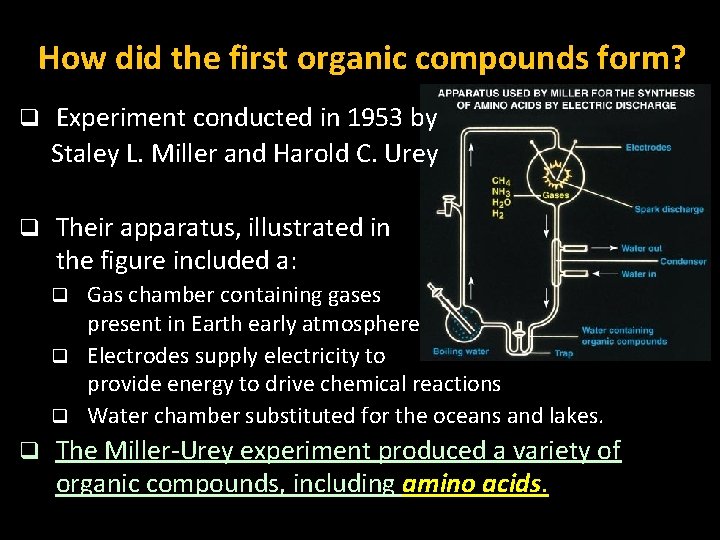
How did the first organic compounds form? q Experiment conducted in 1953 by Staley L. Miller and Harold C. Urey q Their apparatus, illustrated in the figure included a: Gas chamber containing gases present in Earth early atmosphere q Electrodes supply electricity to provide energy to drive chemical reactions q Water chamber substituted for the oceans and lakes. q q The Miller-Urey experiment produced a variety of organic compounds, including amino acids.
How Long has Earth Been Around? • Earth is estimated to be about 4 billion years old – No life until some billion years later – Probably because conditions were not supportive of life – No free oxygen • After time and energy catalysts, the simple compounds had undergone chemical reactions • Fossil Record suggests the first life-forms evolved 3. 5 billion years ago – Still no free oxygen, organisms could live in harsh environments – Most likely microscopic bacteria
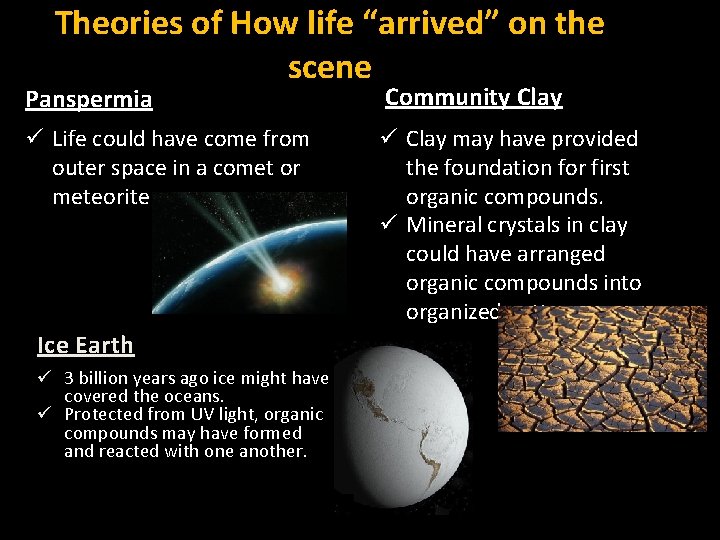
Theories of How life “arrived” on the scene Panspermia Community Clay ü Life could have come from outer space in a comet or meteorite. ü Clay may have provided the foundation for first organic compounds. ü Mineral crystals in clay could have arranged organic compounds into organized patterns. Ice Earth ü 3 billion years ago ice might have covered the oceans. ü Protected from UV light, organic compounds may have formed and reacted with one another.
Abiogenesis vs. Biogenesis ü Biogenesis states that every living ü Abiogenesis or thing came from a pre-existing living spontaneous generation thing. states that life can arise ü In 1668 Francesco Redi, proved from nonliving things that no maggots appeared in meat ü Oparin proposed that when flies were prevented from the "spontaneous laying eggs. generation of life" did in ü In 1861, Louis Pasteur performed fact occur once, but was a series of experiments which now impossible because demonstrated that organisms the conditions found on such as bacteria and fungi do not the early Earth had spontaneously appear in sterile, changed nutrient-rich media.
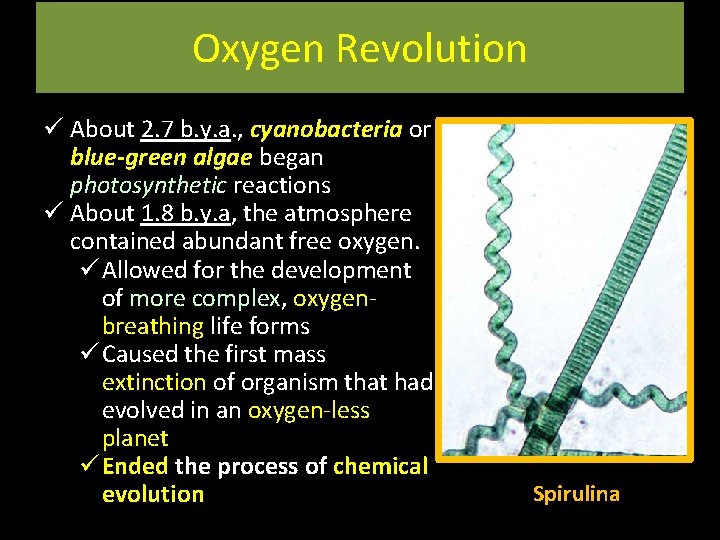
Oxygen Revolution ü About 2. 7 b. y. a. , cyanobacteria or blue-green algae began photosynthetic reactions ü About 1. 8 b. y. a, the atmosphere contained abundant free oxygen. ü Allowed for the development of more complex, oxygenbreathing life forms ü Caused the first mass extinction of organism that had evolved in an oxygen-less planet ü Ended the process of chemical evolution Spirulina
How did cells form? Sidney Fox and other scientists have done extensive research on the physical structures that may have given rise to the first cells. q microspheres and coacervates q q q q Cell-like structures (but NOT true cells) form spontaneously in certain kinds of solutions. Coacervates and microspheres like cells can take up certain substances from their surroundings. Coacervates can grow Do not have all the properties required for life Unlike cells, microspheres and coacervates do not have hereditary material. Evolution of DNA first living cells q Simple Prokaryotic cells- no organelles yet
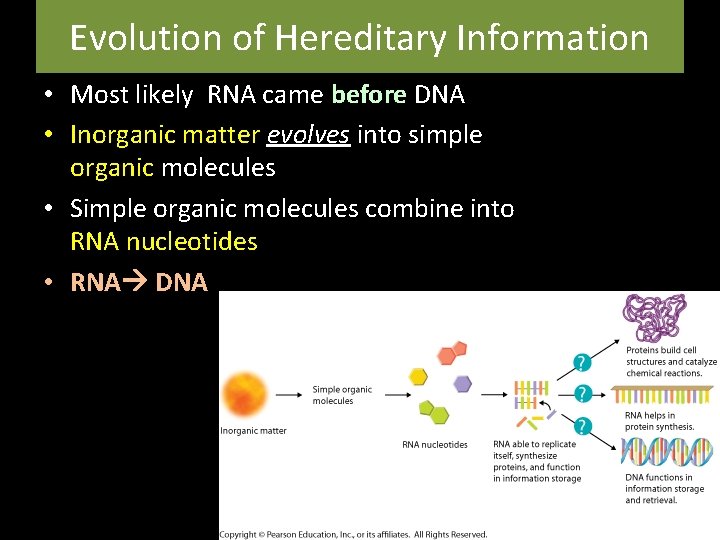
Evolution of Hereditary Information • Most likely RNA came before DNA • Inorganic matter evolves into simple organic molecules • Simple organic molecules combine into RNA nucleotides • RNA DNA
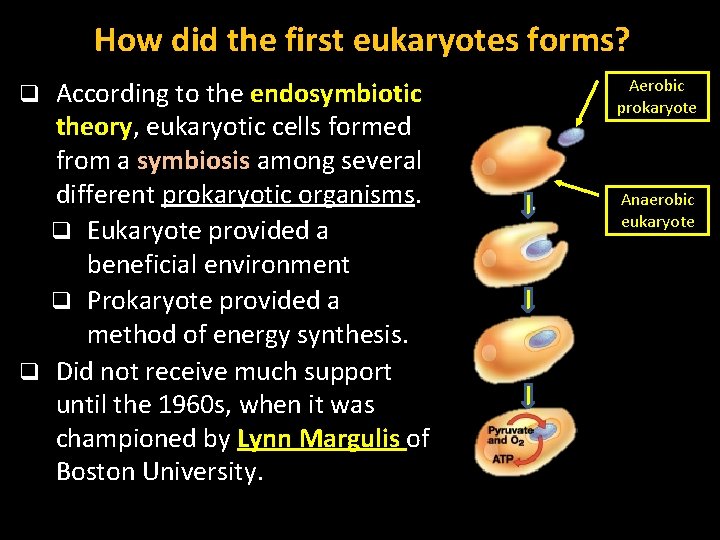
How did the first eukaryotes forms? According to the endosymbiotic theory, eukaryotic cells formed from a symbiosis among several different prokaryotic organisms. q Eukaryote provided a beneficial environment q Prokaryote provided a method of energy synthesis. q Did not receive much support until the 1960 s, when it was championed by Lynn Margulis of Boston University. q Aerobic prokaryote Anaerobic eukaryote
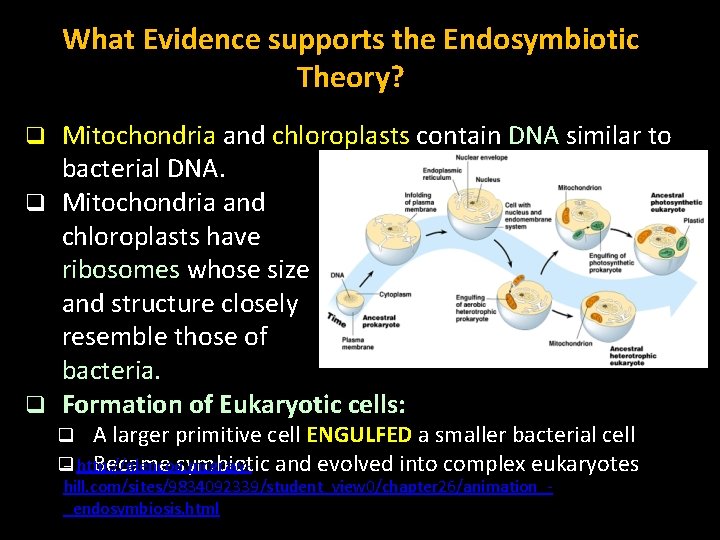
What Evidence supports the Endosymbiotic Theory? Mitochondria and chloroplasts contain DNA similar to bacterial DNA. q Mitochondria and chloroplasts have ribosomes whose size and structure closely resemble those of bacteria. q Formation of Eukaryotic cells: q q A larger primitive cell ENGULFED a smaller bacterial cell – http: //glencoe. mcgrawq Became symbiotic and evolved into complex eukaryotes hill. com/sites/9834092339/student_view 0/chapter 26/animation__endosymbiosis. html
Video Notes • Take notes for each scientists in the space provided • Include major contributions to science, their theories, and any life history • http: //www. biograp hy. com/people/loui s-pasteur-9434402
Advertise A Scientist! • With your partner, design a social media advertisement for either Miller-Urey, Louis Pasteur, Francesco Redi, or Lynn Margulis. – Dating ad, help-wanted ad, instagram post, blog entry, etc…. Be creative! – Must advertise their contributions to science – Present your ad for an extra credit A • Be enthusiastic and have something to show! Or something creative to read aloud
- Slides: 26