
Topic The Classification of Substances Metals and NonMetals
Topic • : The Classification of Substances: Metals and Non-Metals, Making a Classification Key • Teaching Points: • (i) Metals • (ii) Non-Metals • (iii) making a Classification Key
Specific Aim • Specific Aim : • (i) To appreciate how the classification is done based on Metals and Non-Metals • (ii) To know the differences in properties between Metals and Non. Metals • (iii) To understand the uses of metals and Non-Metals. • (iv) To study the benefits of making a Classification Key.
PREVIOUS KNOWLEDGE TEST • • • • Question: Name a material used for making ornaments. Answer: Gold is used to make ornaments. Question: Can you list few qualities of Gold? Answer: Gold in non-corrosive, can be shaped into different forms etc. Question: Name few materials used for making electric wires. Answer: Copper, Aluminium are used in making electric wires. Question: What are the advantages of classification? Answer: Classification helps us to study objects.
INTRODUCTION • You know cadets; • Solids are classified into Metals and Non-metals. • Metals and Non-metals have different properties as well as uses. • Classification helps us to study objects in an effective way! • Today, we shall discuss about Metals and Non-metals and Classification Key.
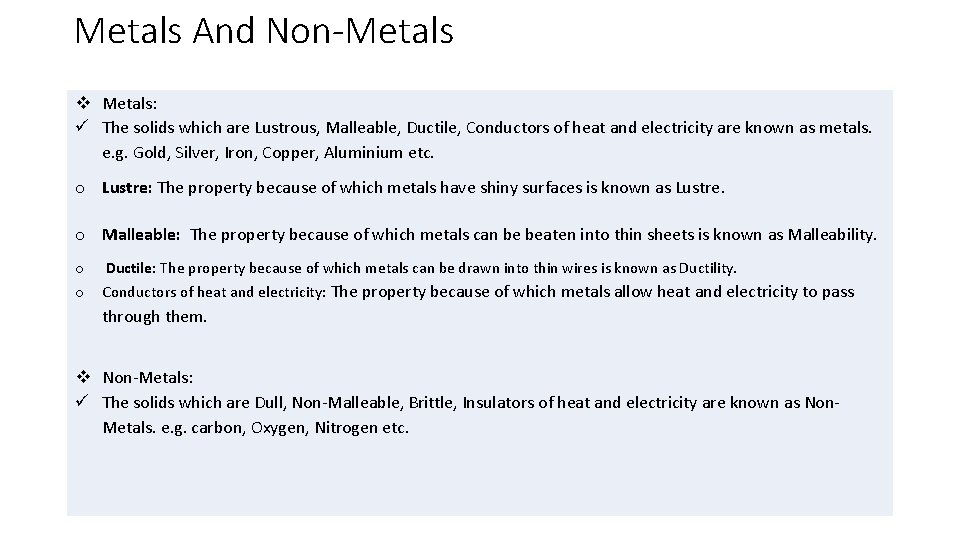
Metals And Non-Metals Metals: The solids which are Lustrous, Malleable, Ductile, Conductors of heat and electricity are known as metals. e. g. Gold, Silver, Iron, Copper, Aluminium etc. o Lustre: The property because of which metals have shiny surfaces is known as Lustre. o Malleable: The property because of which metals can be beaten into thin sheets is known as Malleability. o o Ductile: The property because of which metals can be drawn into thin wires is known as Ductility. Conductors of heat and electricity: The property because of which metals allow heat and electricity to pass through them. Non-Metals: The solids which are Dull, Non-Malleable, Brittle, Insulators of heat and electricity are known as Non. Metals. e. g. carbon, Oxygen, Nitrogen etc.
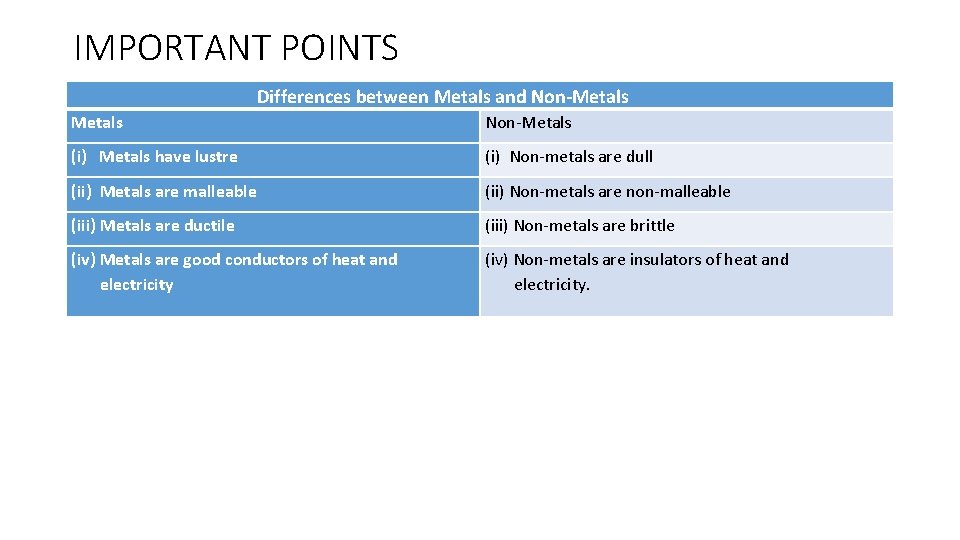
IMPORTANT POINTS Differences between Metals and Non-Metals (i) Metals have lustre (i) Non-metals are dull (ii) Metals are malleable (ii) Non-metals are non-malleable (iii) Metals are ductile (iii) Non-metals are brittle (iv) Metals are good conductors of heat and electricity (iv) Non-metals are insulators of heat and electricity.
Making a Classification Key: Classification has many advantages, It makes it easy for us to arrange and find things. It helps us to study objects. It also helps us to decide which thing or material to use for a particular job.
Some Questions And Answers • • • • • Question: Define: Metals Answer: The solids which are Lustrous, Malleable, Ductile, Conductors of heat and electricity are known as metals. e. g. Gold, Silver, Iron, Copper, Aluminium etc. Question: What do you mean by the term, Malleability? Answer: The property because of which metals can be beaten into thin sheets is known as Malleability. Question: What is the meaning of the term Ductility? Answer: The property because of which metals can be drawn into wires is known as Ductility. Question: Differentiate between Metals and Non-Metals. Answer: Already written in previous slide.
Question? • Question: Mention the advantages of making a classification key • Answer: Classification has many advantages, • It makes it easy for us to arrange and find things. • It helps us to study objects. • It also helps us to decide which thing or material to use for a particular job.
- Slides: 9