
Topic Telephone manner Grammar Word order Prepared by
Topic: Telephone manner Grammar: Word order Prepared by the teacher of the department of “Foreign languages”: Nurmukhamedova D. T.
Aims of the Lesson � to learn telephone manners and etiquette � to plan a call � sounding friendly and polite while answering the call � leaving messages
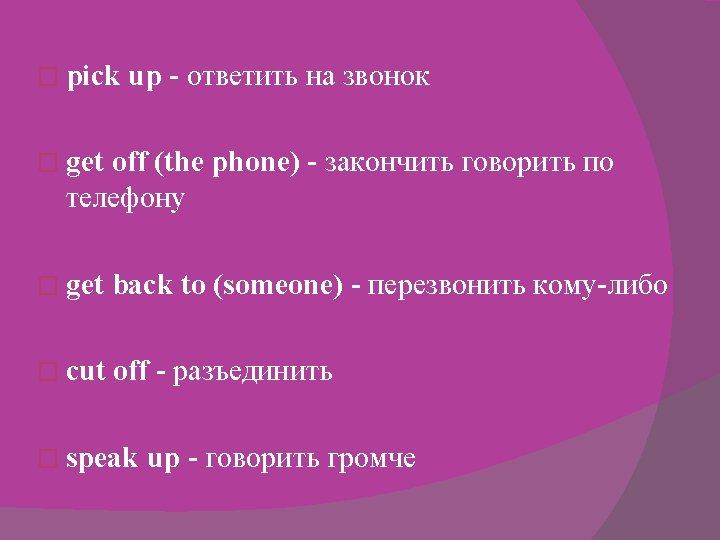
Lesson plan � Active vocabulary � How many ways to say “HELLO” � Video: General tips � Listening : Reasons for calling � Reading: Planning a call � Speaking: Negotiating a Compromise Role Play � Grammar “Word order” � Writing: Grammar exercises
How many ways to say “HELLO”
How many ways to say “Hello” When two people meet in Tokyo they say korwichiha which means hello. But if they answer the phone, they say moshi. Japan isn’t the only country to have its own special ‘telephone language’. The Spanish say /70/a for hello but on the phone they answer digame. Literally translated digame means ‘tell me’ – but this sounds very rude in English. Similarly, if a caller heard the words: I’m ready in London or New York, they’d think this was very strange. They’d ask ‘ready for what? ’. But in Italy the word pronto! means exactly this. The rules for answering the phone in the international workplace seem to be more universal. Phone a business number and the receptionist is likely to say the name of the company and answer more politely or formally. For example, in English you make the polite offer of help with How can I help you? But even this isn’t quite as polite as the very formal Norwegian response: vaers o god literally meaning ‘be so good. ’
Statements true (T) or false (F)? � Many nationalities greet people differently on the phone than they do face-to-face. T / F � The Spanish are impolite. T / F � When an Italian meets you in the street he greets you with the words ‘I’m ready’. T / F � At work, different nationalities use a similar approach to answering the phone. T / F

Answers � True � False � True
General tips � Plan your call. Make notes on what you want to say and write out important phrases or questions. � Practice what you are going to say before you call. Do you need to speak more slowly? � As you make calls, write down any new expressions you hear and add them to the phrase bank. � If the speaker talks too quickly, don’t be afraid to ask them to slow down. � At the end of a call, summarize what you have agreed so that you can confirm you both understand.
Reasons for calling � Apply for a job � Make a complaint � Place an order � Query and invoice � Arrange a course � Request a catalogue
Answers: � Request a catalogue – call 1 � Query and invoice – call 2 � Make a complaint – call 3 � Apply for a job – call 4 � Arrange a course – call 5 � Place an order – call 6
Match headings 1 -7 with paragraphs a-g � What questions might the other person ask? . . . � When is a good time to call ? . . . . � Who do you need to speak to? . . . . � What are your objectives? ……………. � What phrases will help you? . . � What will you say if you can’t get through? . . . � What will you say if you get an answer machine or voicemail? . . . .
Negotiating a Compromise Role Play � Choose a role play from one of the following scenarios. Write it up with your partner, and perform it for your classmates. Writing will be checked for grammar, punctuation, spelling, etc. , as will your participation, pronunciation, and interaction in the role play. The role play should last at least 2 minutes.
� You are a student at an English University in the US or the UK. You’d like your parents to send you some more spending money. Telephone your father (your partner in the role play) and ask for more money. Your father feels that you are spending too much money. Come to a compromise.

� You are a student who has improved at school, but your mother/father (your partner) doesn’t feel that you have done enough. Discuss together what you can do to improve your grades, but also recognize your increased efforts.

� You are a technological wizard and have a new idea for a great start-up on the internet. Try to convince your father to fund your business with a $100, 000 loan. Your partner will be your father who is very skeptical about your idea because he thinks you should be a doctor.
� You would like to get married to a man / woman your parents do not approve of. Have a discussion with your mother / father (your partner) about your plans. Try to break the news gently, while still maintaining your desire to get married.
� You are a sales manager. The company wants your staff to have English lessons. You have ten staff but they are very busy and some don’t want English lessons. The only time for lessons would be after work at 6 pm but no-one wants to stay late. Talk to the training manager and try to find a solution.
Answer these questions to check your understanding of how to improve your telephone English Ø It's best to practice telephone calls with friends together in a room. True or False? It's a good idea to: a) turn your chairs back to back and practice b) record yourself and practice conversations c) try to use real life situations to practice d) all of these Ø
� True or False? You have to remember to use a real telephone to practice telephone English. � Fill in the gap: Could you _____ let her know that I telephoned?
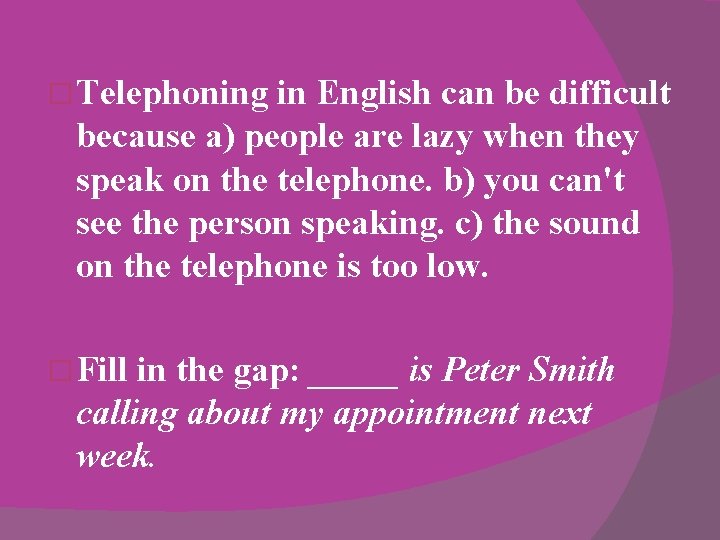
� Telephoning in English can be difficult because a) people are lazy when they speak on the telephone. b) you can't see the person speaking. c) the sound on the telephone is too low. � Fill in the gap: _____ is Peter Smith calling about my appointment next week.
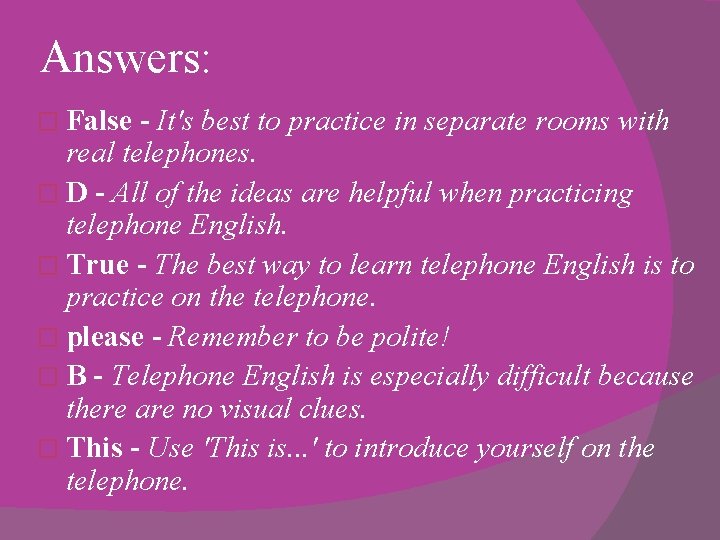
Answers: � False - It's best to practice in separate rooms with real telephones. � D - All of the ideas are helpful when practicing telephone English. � True - The best way to learn telephone English is to practice on the telephone. � please - Remember to be polite! � B - Telephone English is especially difficult because there are no visual clues. � This - Use 'This is. . . ' to introduce yourself on the telephone.
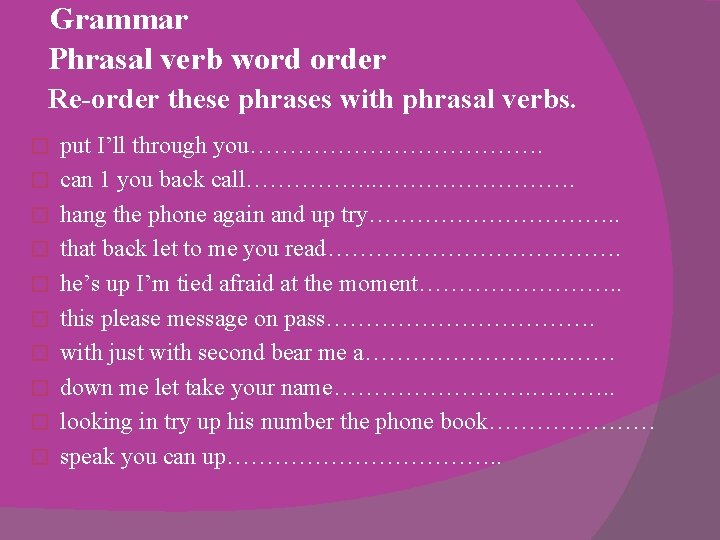
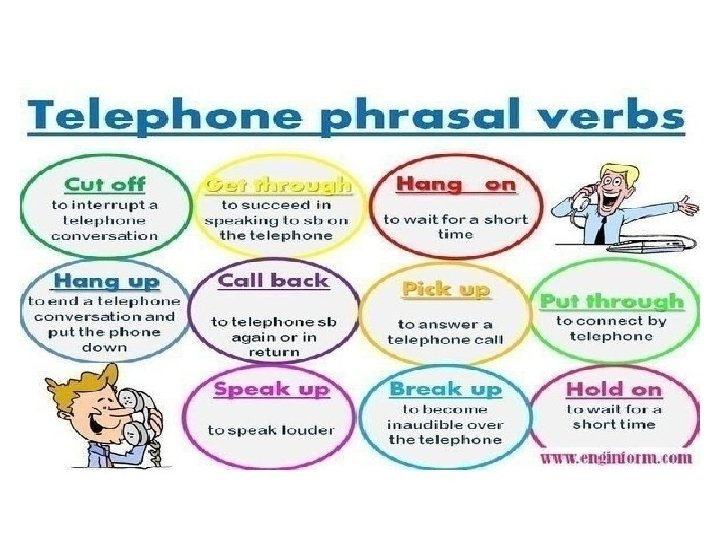
Grammar Phrasal verb word order Re-order these phrases with phrasal verbs. � � � � � put I’ll through you………………. can 1 you back call……………. hang the phone again and up try……………. . that back let to me you read………………. he’s up I’m tied afraid at the moment…………. . this please message on pass………………. with just with second bear me a…………. . …… down me let take your name…………. . looking in try up his number the phone book………………… speak you can up………………. .
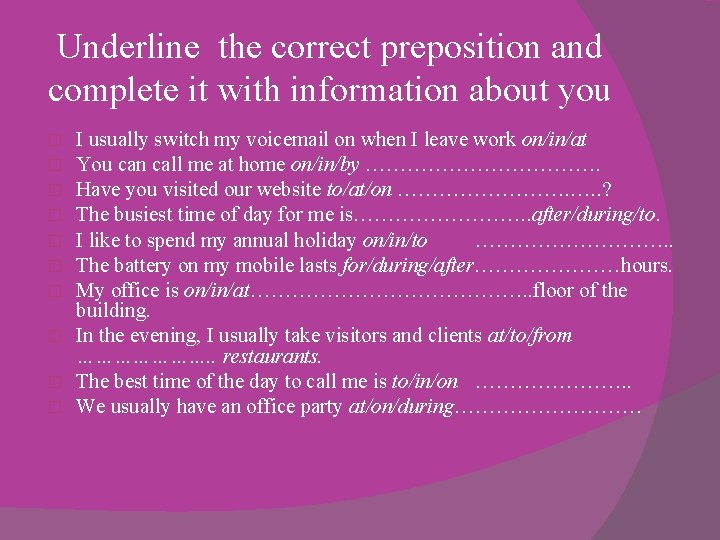
Underline the correct preposition and complete it with information about you I usually switch my voicemail on when I leave work on/in/at You can call me at home on/in/by ………………. Have you visited our website to/at/on …………. …. . ? The busiest time of day for me is…………. . after/during/to. I like to spend my annual holiday on/in/to ……………. . The battery on my mobile lasts for/during/after…………………hours. My office is on/in/at…………………. . floor of the building. � In the evening, I usually take visitors and clients at/to/from …………………. . restaurants. � The best time of the day to call me is to/in/on …………………. . � We usually have an office party at/on/during…………… � � � �
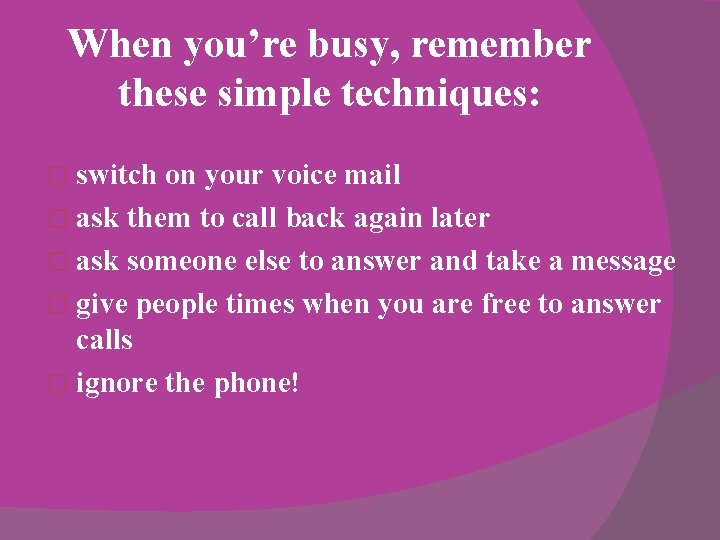
When you’re busy, remember these simple techniques: � switch on your voice mail � ask them to call back again later � ask someone else to answer and take a message � give people times when you are free to answer calls � ignore the phone!
- Slides: 28