
Topic Physics 2 a Vector Components Key words
- Slides: 19
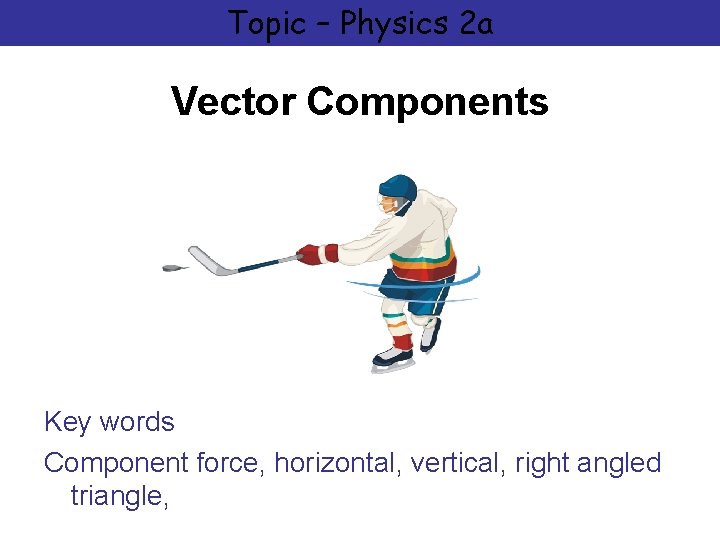
Topic – Physics 2 a Vector Components Key words Component force, horizontal, vertical, right angled triangle,
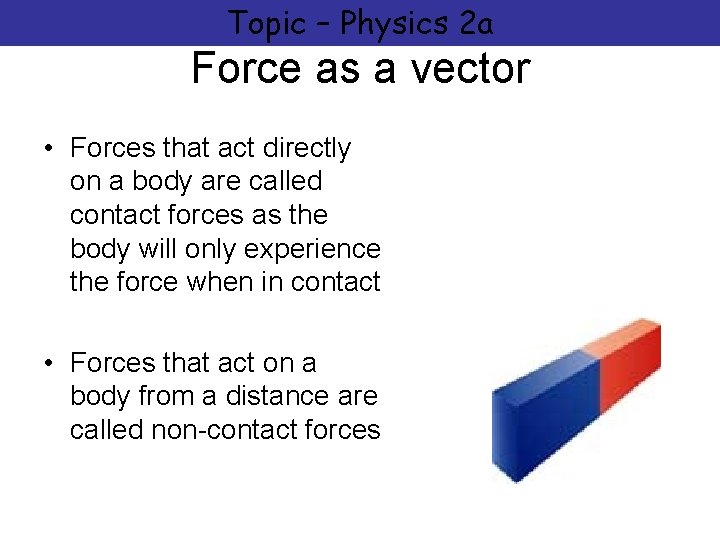
Topic – Physics 2 a Force as a vector • Forces that act directly on a body are called contact forces as the body will only experience the force when in contact • Forces that act on a body from a distance are called non-contact forces
Topic – Physics 2 a Examples of contact forces • Bouncing ball • Adhesion – sellotape and paper • Cohesion – attraction between particles of the same material – water droplets • Surface tension –across molecules of a liquid • Any force that occurs when 2 or more bodies touch
Topic – Physics 2 a Forces make objects …. . • Change shape • Change speed • Change direction of motion
Topic – Physics 2 a Forces • Measured in Newtons (N) • A force of 1 N is the force required to hold 100 g of mass against the force of gravity
Topic – Physics 2 a Force as a vector quantity • Magnitude and direction of a force is needed if effect of force is to be determined • Force is therefore a VECTOR quantity = magntude + direction. • Force symbol = F
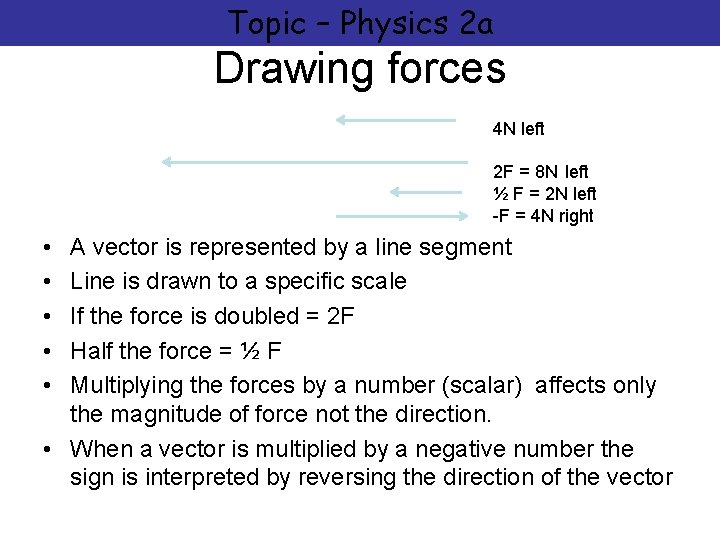
Topic – Physics 2 a Drawing forces 4 N left 2 F = 8 N left ½ F = 2 N left -F = 4 N right • • • A vector is represented by a line segment Line is drawn to a specific scale If the force is doubled = 2 F Half the force = ½ F Multiplying the forces by a number (scalar) affects only the magnitude of force not the direction. • When a vector is multiplied by a negative number the sign is interpreted by reversing the direction of the vector
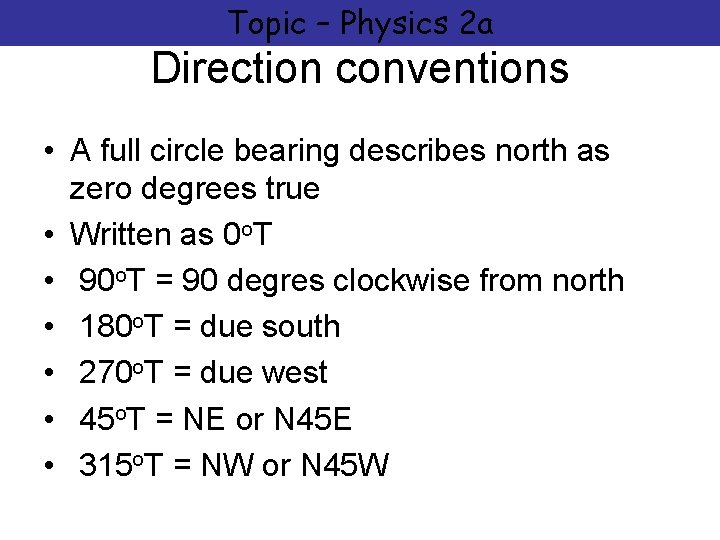
Topic – Physics 2 a Direction conventions • A full circle bearing describes north as zero degrees true • Written as 0 o. T • 90 o. T = 90 degres clockwise from north • 180 o. T = due south • 270 o. T = due west • 45 o. T = NE or N 45 E • 315 o. T = NW or N 45 W
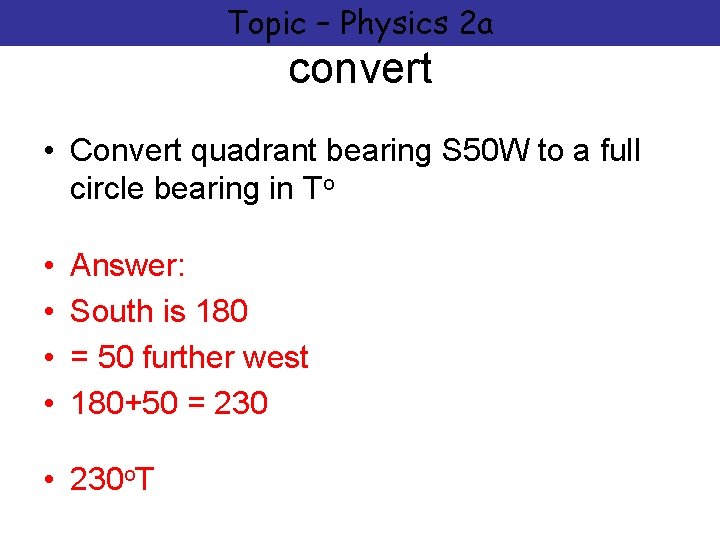
Topic – Physics 2 a convert • Convert quadrant bearing S 50 W to a full circle bearing in To
Topic – Physics 2 a convert • Convert quadrant bearing S 50 W to a full circle bearing in To • • Answer: South is 180 = 50 further west 180+50 = 230 • 230 o. T
Topic – Physics 2 a Notes – Vector techniques Forces • Copy summary notes 3. 2 vector techniques page 96
Topic – Physics 2 a Vector techniques • If only one force acts upon a body at rest the body has no alternative than to move in the direction of that force – e. g. golf ball being hit by a golf club • If more than one force acts on a body the body behaves as if only one force is acting – the vector sum • This is called the resultant or the net force • €F
Topic – Physics 2 a Adding vectors • Because force is a vector adding numbers must take direction into account • 2 N + 3 N in the same direction would be 5 N in that direction. • However 2 N left + 3 N right = 1 N right • When at an angle to each other the magntude will be somewhere between 1 and 5
Topic – Physics 2 a Adding vectors graphically • A vector diagram is drawn • Either to scale = resultant vector can be measured • Or • Sketched and use mathematical equations
Topic – Physics 2 a • • Adding vectors graphically = page 96 Steps: Draw ref grid of direction NSEW Determine scale Write vector equation – EF (net) Draw first vector to scale From head of arrow draw second vector to be added Resultant vector will be the direct line from tail of first vector to head of second vector • Magnitude will be the length • Direction is direction of the vector
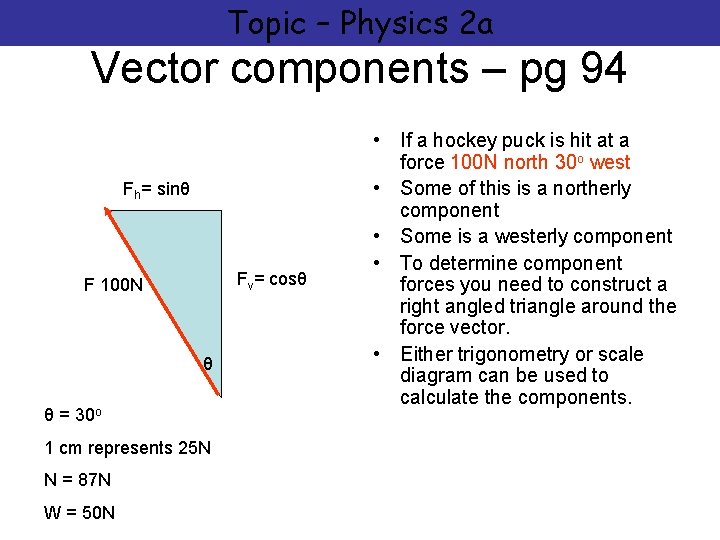
Topic – Physics 2 a Vector components – pg 94 Fh= sinθ Fv= cosθ F 100 N θ θ = 30 o 1 cm represents 25 N N = 87 N W = 50 N • If a hockey puck is hit at a force 100 N north 30 o west • Some of this is a northerly component • Some is a westerly component • To determine component forces you need to construct a right angled triangle around the force vector. • Either trigonometry or scale diagram can be used to calculate the components.
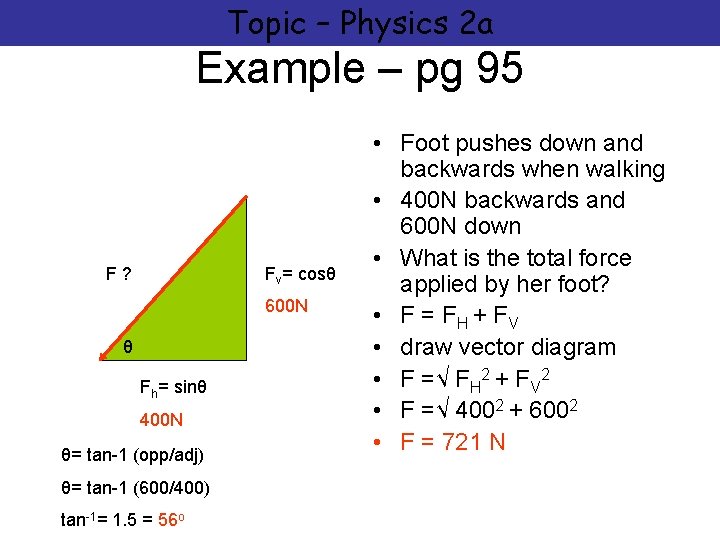
Topic – Physics 2 a Example – pg 95 F? Fv= cosθ 600 N θ Fh= sinθ 400 N θ= tan-1 (opp/adj) θ= tan-1 (600/400) tan-1= 1. 5 = 56 o • Foot pushes down and backwards when walking • 400 N backwards and 600 N down • What is the total force applied by her foot? • F = F H + FV • draw vector diagram • F =√ FH 2 + FV 2 • F =√ 4002 + 6002 • F = 721 N
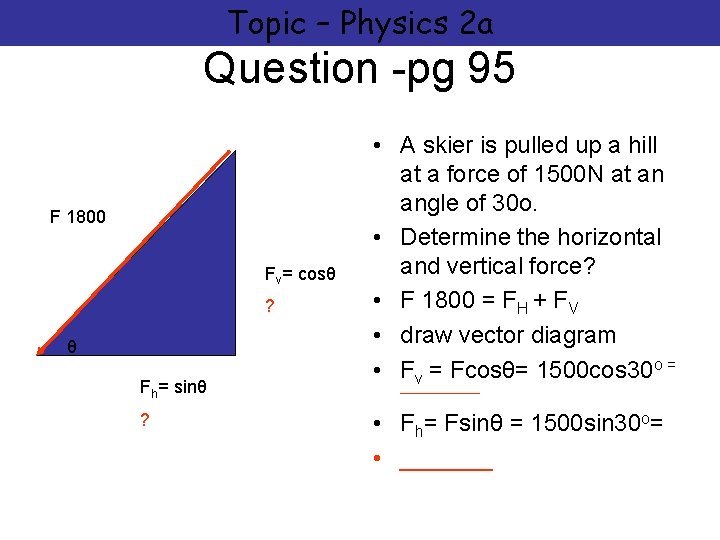
Topic – Physics 2 a Question -pg 95 F 1800 Fv= cosθ ? θ Fh= sinθ ? • A skier is pulled up a hill at a force of 1500 N at an angle of 30 o. • Determine the horizontal and vertical force? • F 1800 = FH + FV • draw vector diagram • Fv = Fcosθ= 1500 cos 30 o = _____ • Fh= Fsinθ = 1500 sin 30 o= • _______
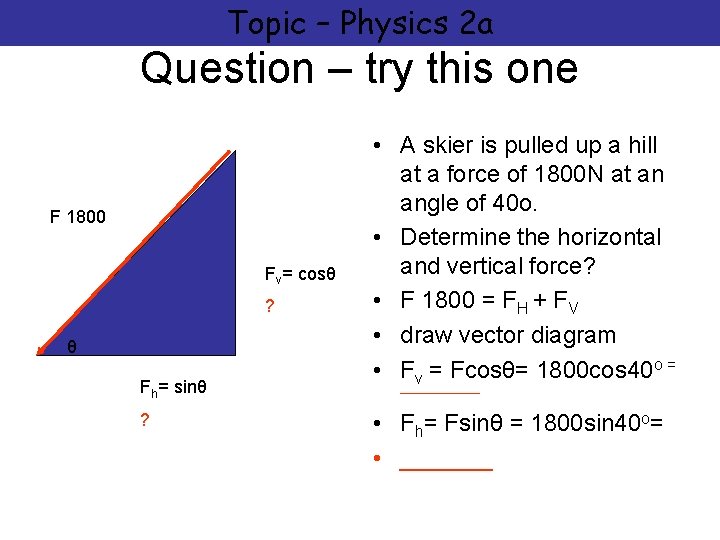
Topic – Physics 2 a Question – try this one F 1800 Fv= cosθ ? θ Fh= sinθ ? • A skier is pulled up a hill at a force of 1800 N at an angle of 40 o. • Determine the horizontal and vertical force? • F 1800 = FH + FV • draw vector diagram • Fv = Fcosθ= 1800 cos 40 o = _____ • Fh= Fsinθ = 1800 sin 40 o= • _______