
Topic Neutralisation and using universal indicator Outcomes Carry

- Slides: 4
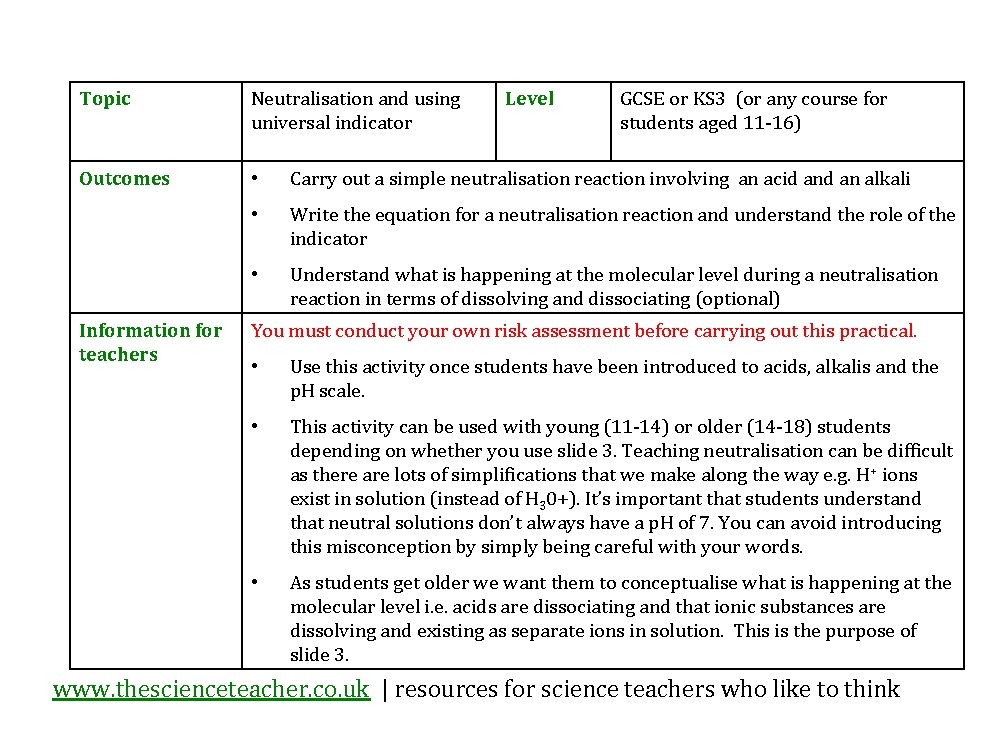
Topic Neutralisation and using universal indicator Outcomes • Carry out a simple neutralisation reaction involving an acid an alkali • Write the equation for a neutralisation reaction and understand the role of the indicator • Understand what is happening at the molecular level during a neutralisation reaction in terms of dissolving and dissociating (optional) Information for teachers Level GCSE or KS 3 (or any course for students aged 11 -16) You must conduct your own risk assessment before carrying out this practical. • Use this activity once students have been introduced to acids, alkalis and the p. H scale. • This activity can be used with young (11 -14) or older (14 -18) students depending on whether you use slide 3. Teaching neutralisation can be difficult as there are lots of simplifications that we make along the way e. g. H + ions exist in solution (instead of H 30+). It’s important that students understand that neutral solutions don’t always have a p. H of 7. You can avoid introducing this misconception by simply being careful with your words. • As students get older we want them to conceptualise what is happening at the molecular level i. e. acids are dissociating and that ionic substances are dissolving and existing as separate ions in solution. This is the purpose of slide 3. www. thescienceteacher. co. uk | resources for science teachers who like to think
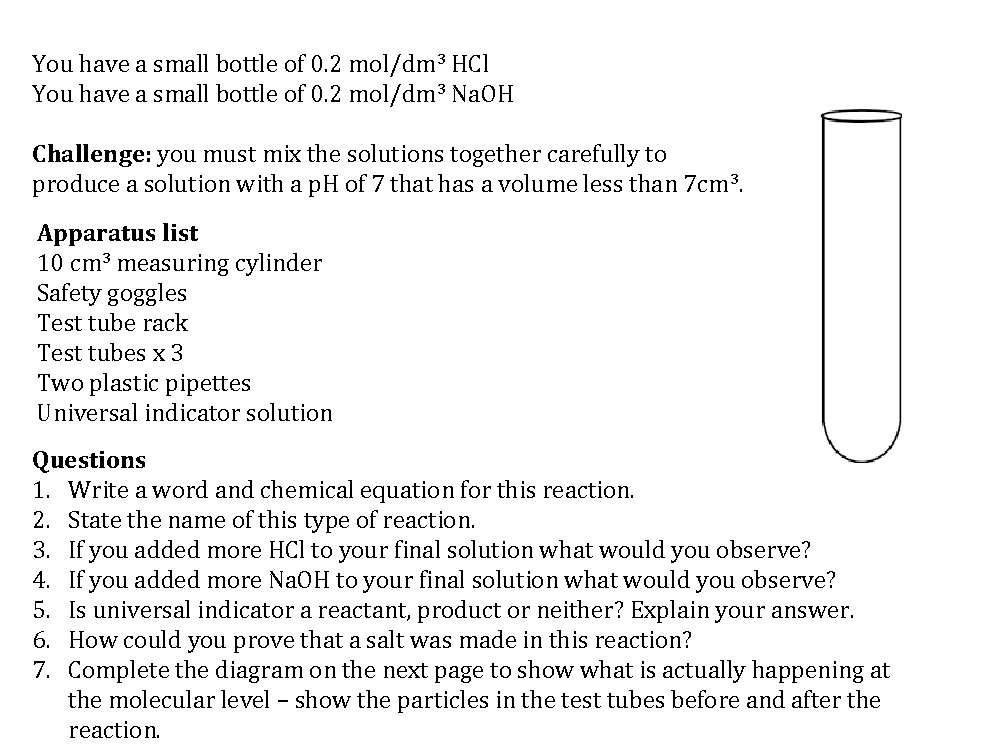
You have a small bottle of 0. 2 mol/dm 3 HCl You have a small bottle of 0. 2 mol/dm 3 Na. OH Challenge: you must mix the solutions together carefully to produce a solution with a p. H of 7 that has a volume less than 7 cm 3. Apparatus list 10 cm 3 measuring cylinder Safety goggles Test tube rack Test tubes x 3 Two plastic pipettes Universal indicator solution Questions 1. Write a word and chemical equation for this reaction. 2. State the name of this type of reaction. 3. If you added more HCl to your final solution what would you observe? 4. If you added more Na. OH to your final solution what would you observe? 5. Is universal indicator a reactant, product or neither? Explain your answer. 6. How could you prove that a salt was made in this reaction? 7. Complete the diagram on the next page to show what is actually happening at the molecular level – show the particles in the test tubes before and after the reaction.
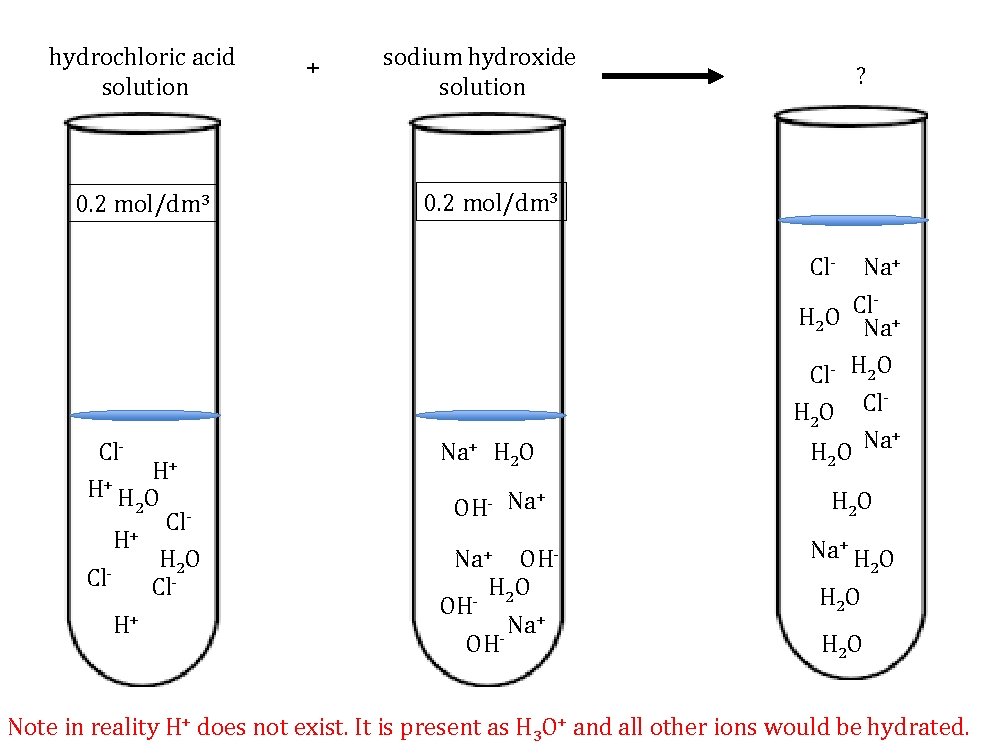
hydrochloric acid solution 0. 2 mol/dm 3 + sodium hydroxide solution 0. 2 mol/dm 3 Show the molecules and ions that are in each test tube ?
hydrochloric acid solution 0. 2 mol/dm 3 + sodium hydroxide solution ? 0. 2 mol/dm 3 Cl- Na+ Cl H 2 O Na+ Cl- H 2 O Cl HO 2 Cl- H+ H+ H O 2 H+ Cl- H 2 O Cl- Na+ H 2 O OHNa+ OH- H 2 O OH + Na - + Na H 2 O Na+ H O 2 H 2 O Note in reality H+ does not exist. It is present as H 3 O+ and all other ions would be hydrated.