
Topic Models in Text Processing IR Group Meeting
- Slides: 15
Topic Models in Text Processing IR Group Meeting Presented by Qiaozhu Mei
Topic Models in Text Processing • Introduction • Basic Topic Models – Probabilistic Latent Semantic Indexing – Latent Dirichlet Allocation – Correlated Topic Models • Variations and Applications
Overview • Motivation: – Model the topic/subtopics in text collections • Basic Assumptions: – There are k topics in the whole collection – Each topic is represented by a multinomial distribution over the vocabulary (language model) – Each document can cover multiple topics • Applications – Summarizing topics – Predict topic coverage for documents – Model the topic correlations
Basic Topic Models • • • Unigram model Mixture of unigrams Probabilistic LSI LDA Correlated Topic Models
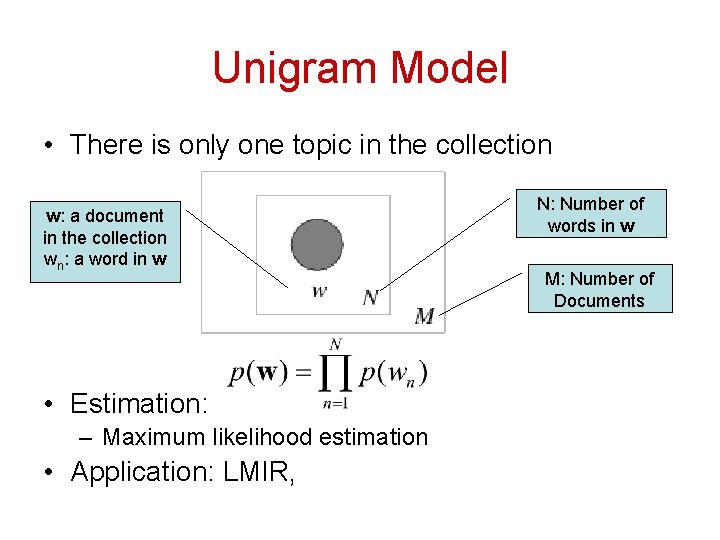
Unigram Model • There is only one topic in the collection w: a document in the collection wn: a word in w • Estimation: – Maximum likelihood estimation • Application: LMIR, N: Number of words in w M: Number of Documents
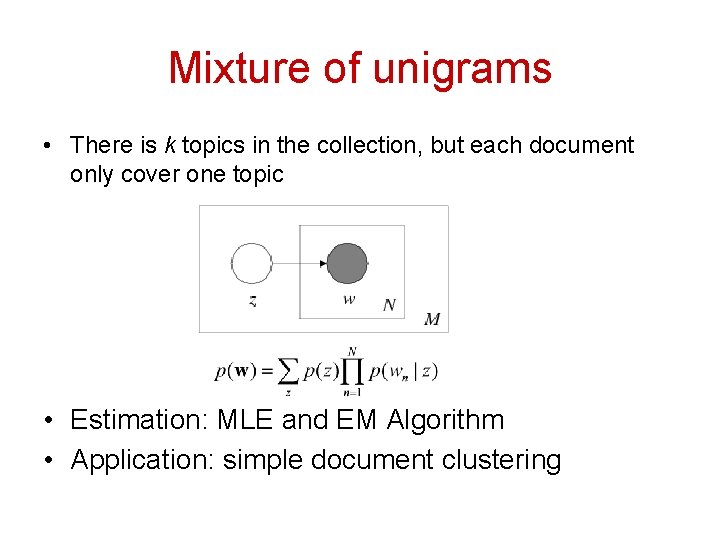
Mixture of unigrams • There is k topics in the collection, but each document only cover one topic • Estimation: MLE and EM Algorithm • Application: simple document clustering
Probabilistic Latent Semantic Indexing • (Thomas Hofmann ’ 99): each document is generated from more than one topics, with a set of document specific mixture weights {p(z|d)} over k topics. • These mixture weights are considered as fixed parameters to be estimated. • Also known as aspect model. • No prior knowledge about topics required, context and term co-occurrences are exploited
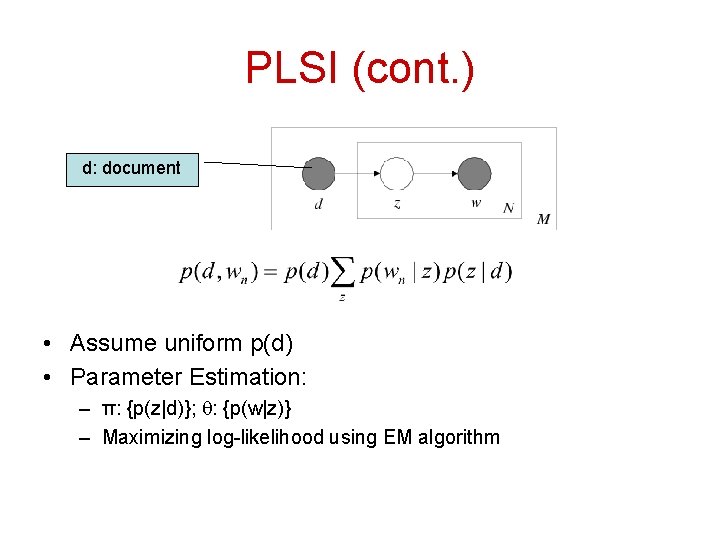
PLSI (cont. ) d: document • Assume uniform p(d) • Parameter Estimation: – π: {p(z|d)}; : {p(w|z)} – Maximizing log-likelihood using EM algorithm
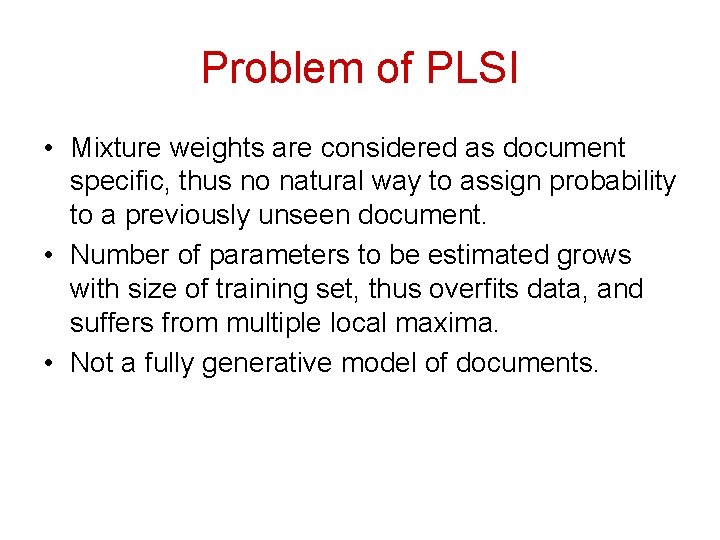
Problem of PLSI • Mixture weights are considered as document specific, thus no natural way to assign probability to a previously unseen document. • Number of parameters to be estimated grows with size of training set, thus overfits data, and suffers from multiple local maxima. • Not a fully generative model of documents.
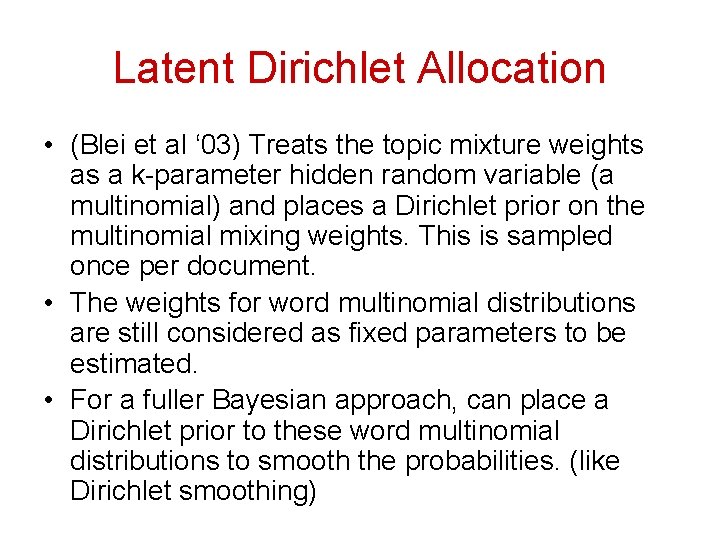
Latent Dirichlet Allocation • (Blei et al ‘ 03) Treats the topic mixture weights as a k-parameter hidden random variable (a multinomial) and places a Dirichlet prior on the multinomial mixing weights. This is sampled once per document. • The weights for word multinomial distributions are still considered as fixed parameters to be estimated. • For a fuller Bayesian approach, can place a Dirichlet prior to these word multinomial distributions to smooth the probabilities. (like Dirichlet smoothing)
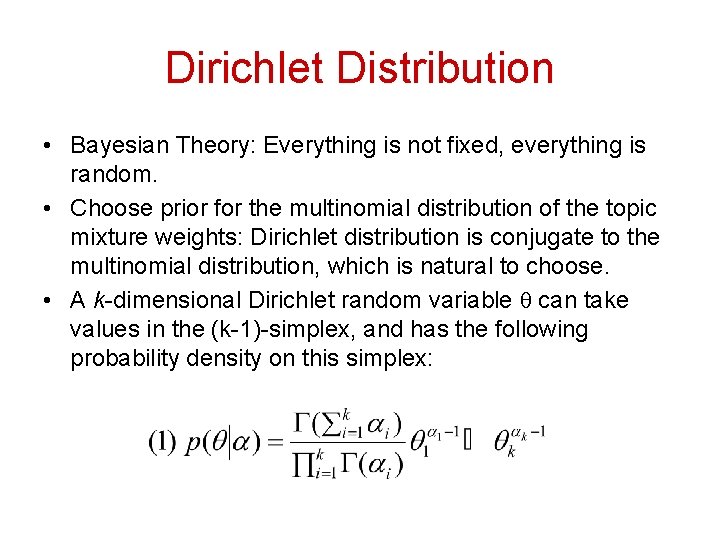
Dirichlet Distribution • Bayesian Theory: Everything is not fixed, everything is random. • Choose prior for the multinomial distribution of the topic mixture weights: Dirichlet distribution is conjugate to the multinomial distribution, which is natural to choose. • A k-dimensional Dirichlet random variable can take values in the (k-1)-simplex, and has the following probability density on this simplex:
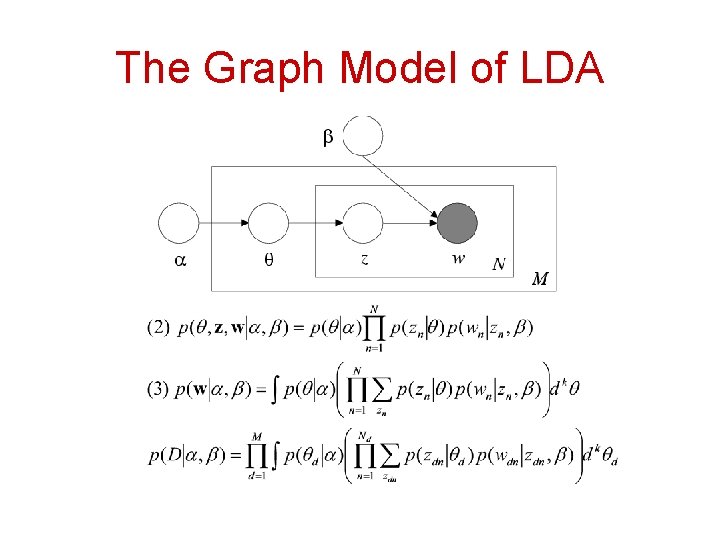
The Graph Model of LDA
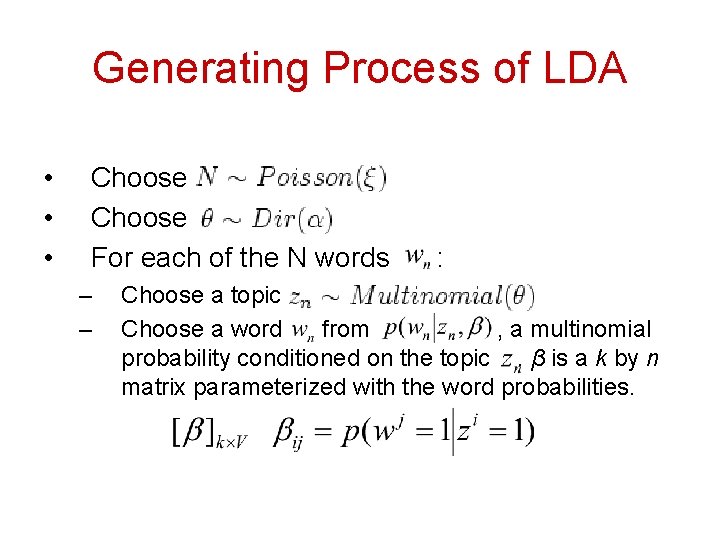
Generating Process of LDA • • • Choose For each of the N words – – : Choose a topic Choose a word from , a multinomial probability conditioned on the topic. β is a k by n matrix parameterized with the word probabilities.
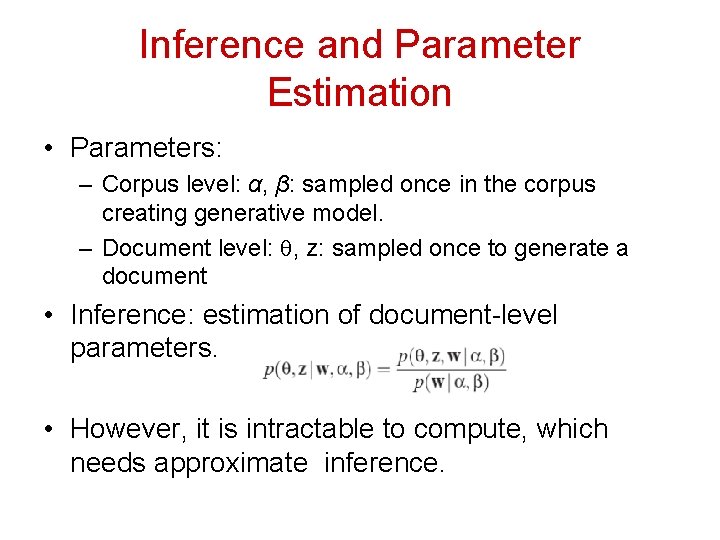
Inference and Parameter Estimation • Parameters: – Corpus level: α, β: sampled once in the corpus creating generative model. – Document level: , z: sampled once to generate a document • Inference: estimation of document-level parameters. • However, it is intractable to compute, which needs approximate inference.
Variantional Inference