
Topic Measurement units and scientific notation Objective Identify
Topic: Measurement units and scientific notation Objective: Identify units used in physics and understand how to make computations using scientific notation. Date: 9/7/11 Activity: Notes and discussion Your Vocab: metric units, exponents, e
UNITS IN SCIENCE -When taking measurements ALWAYS record the UNITS -The UNITS define what is being MEASURED -Scientist all around the world ONLY use SI units
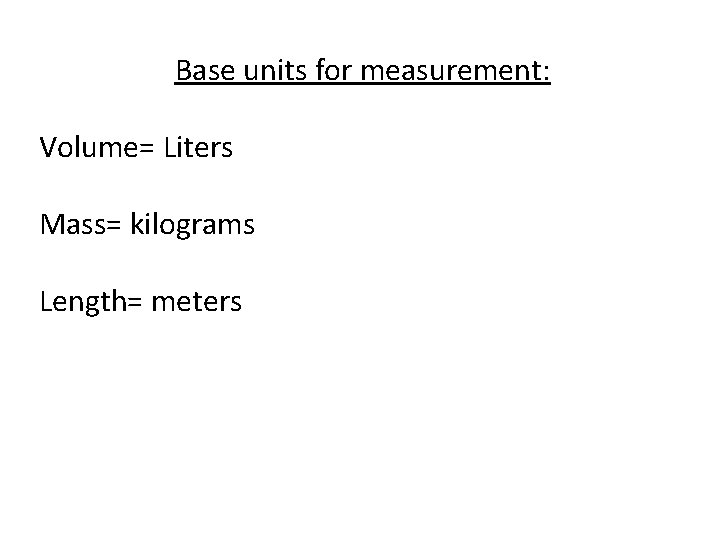
Base units for measurement: Volume= Liters Mass= kilograms Length= meters

-BIGGER measurements require BIGGER units ex: T –tera. G- giga. M- megak- kiloh- hectoda-deka- terameter (Tm)= (1012) gigameter (Gm)= (109) megameter (Mm) = (106) kilometer (km)= (103) hectometer (hm)= (102) decameter (dam)= (101) 1, 000, 000 m 1, 000 m 100 m 10 m
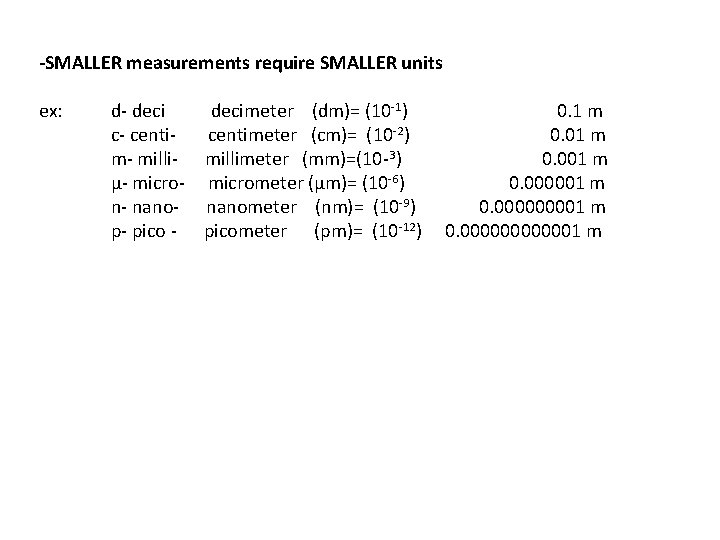
-SMALLER measurements require SMALLER units ex: d- decimeter (dm)= (10 -1) c- centimeter (cm)= (10 -2) m- millimeter (mm)=(10 -3) μ- micrometer (μm)= (10 -6) n- nanometer (nm)= (10 -9) p- picometer (pm)= (10 -12) 0. 1 m 0. 001 m 0. 000000001 m 0. 0000001 m
In order to be the most accurate, you must estimate one place beyond what the tool measures. -If your measurement tool measures to the ones place then you ESTIMATE the TENTHS position 5 ----> 5. 0 -If your tool measures to the tenths position, then you ESTIMATE the HUNDREDTHS positon. 5. 5 ------> 5. 50
- Slides: 6