
Topic Language Diversity EndangeredExtinct Languages and Language Preservation


- Slides: 27
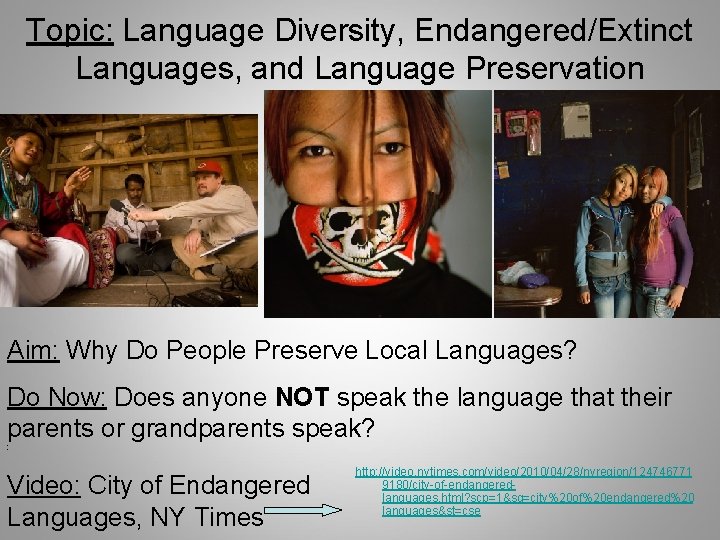
Topic: Language Diversity, Endangered/Extinct Languages, and Language Preservation Aim: Why Do People Preserve Local Languages? Do Now: Does anyone NOT speak the language that their parents or grandparents speak? 8 8 Video: City of Endangered Languages, NY Times http: //video. nytimes. com/video/2010/04/28/nyregion/124746771 9180/city-of-endangeredlanguages. html? scp=1&sq=city%20 of%20 endangered%20 languages&st=cse
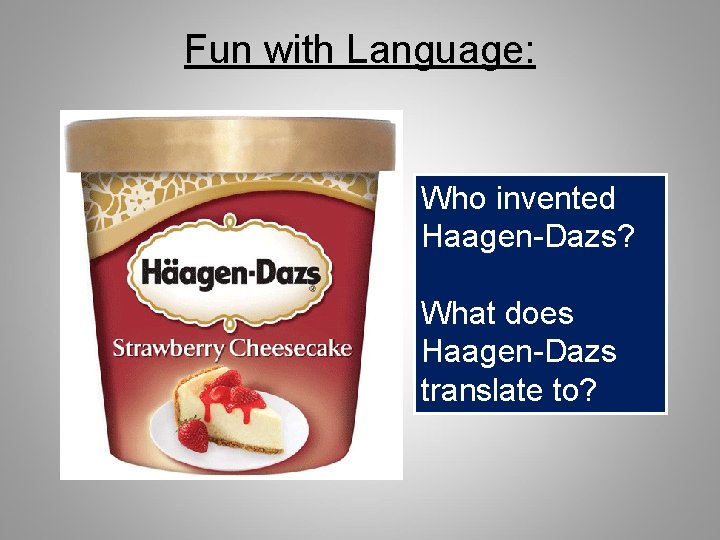
Fun with Language: Who invented Haagen-Dazs? What does Haagen-Dazs translate to?
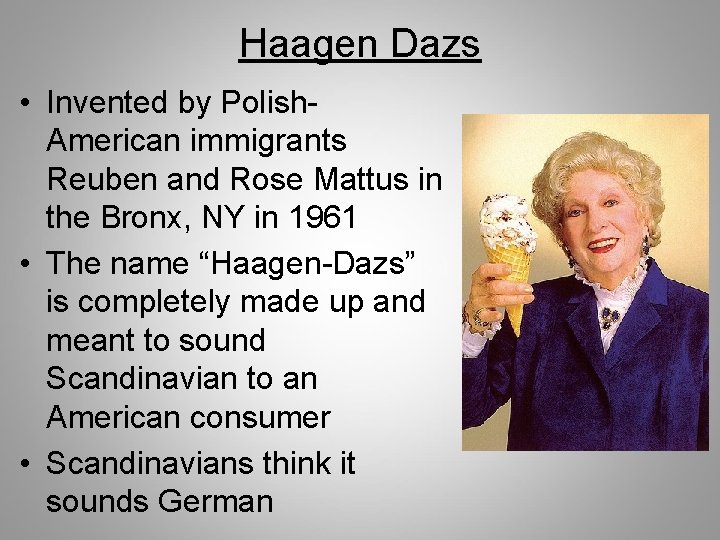
Haagen Dazs • Invented by Polish. American immigrants Reuben and Rose Mattus in the Bronx, NY in 1961 • The name “Haagen-Dazs” is completely made up and meant to sound Scandinavian to an American consumer • Scandinavians think it sounds German
Language Diversity (Polyglot States: Countries with multiple languages spoken) Question: For what reason might multiple spoken languages be both positive and/or negative for a
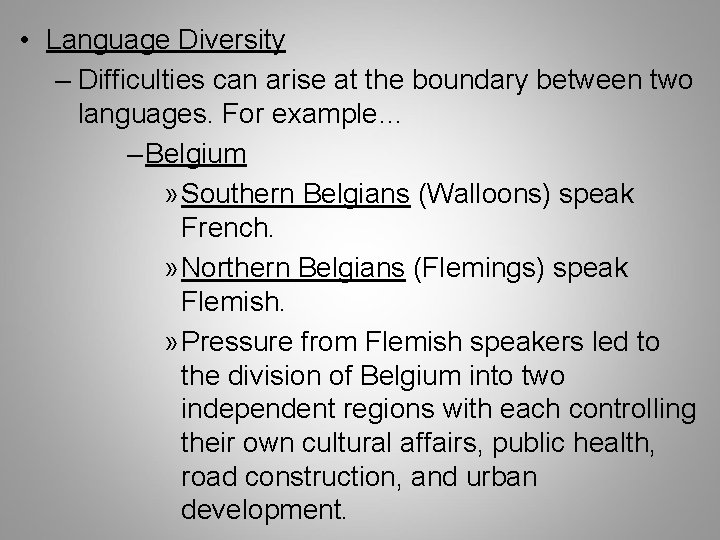
• Language Diversity – Difficulties can arise at the boundary between two languages. For example… – Belgium » Southern Belgians (Walloons) speak French. » Northern Belgians (Flemings) speak Flemish. » Pressure from Flemish speakers led to the division of Belgium into two independent regions with each controlling their own cultural affairs, public health, road construction, and urban development.
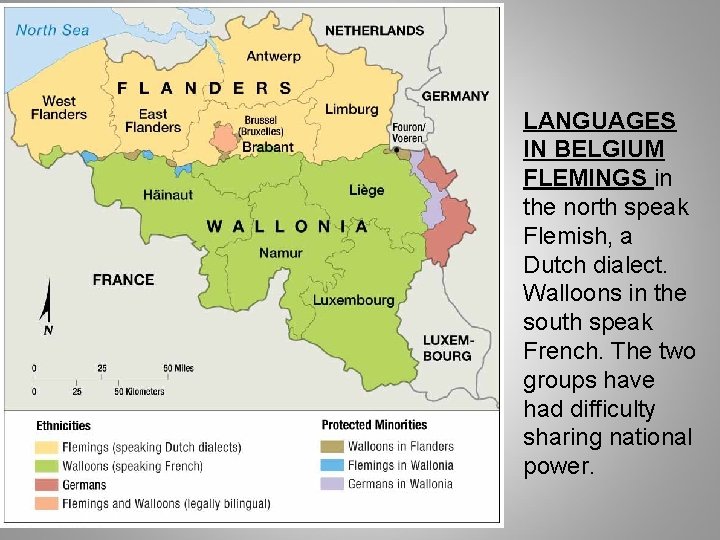
LANGUAGES IN BELGIUM FLEMINGS in the north speak Flemish, a Dutch dialect. Walloons in the south speak French. The two groups have had difficulty sharing national power.
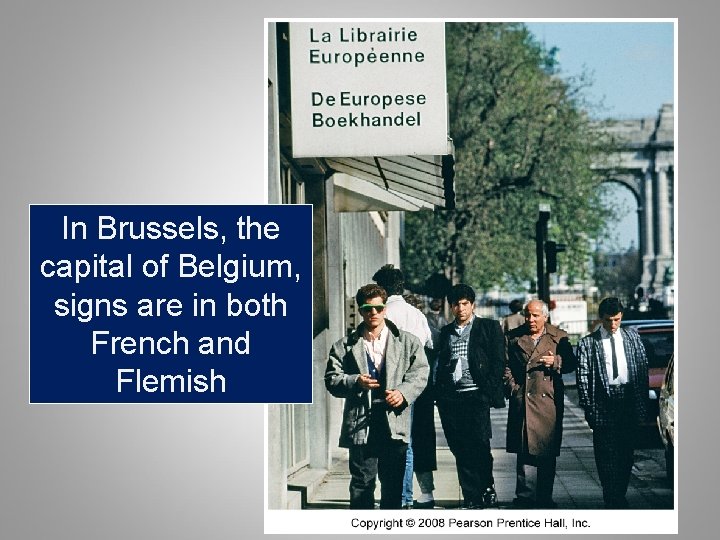
In Brussels, the capital of Belgium, signs are in both French and Flemish
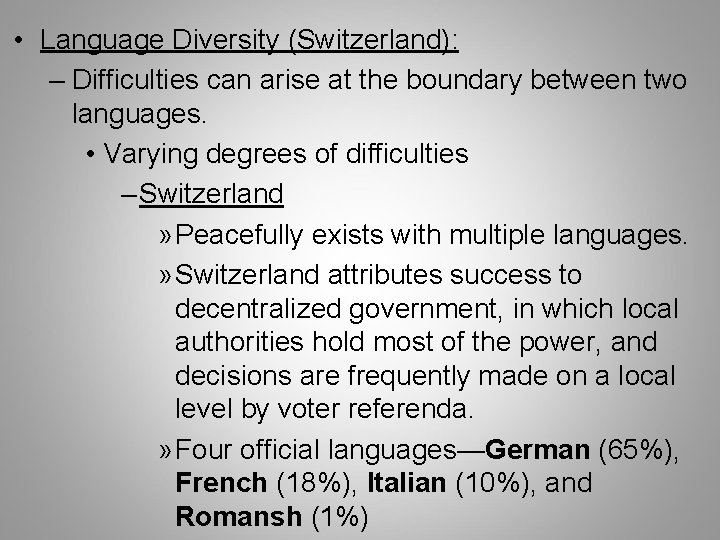
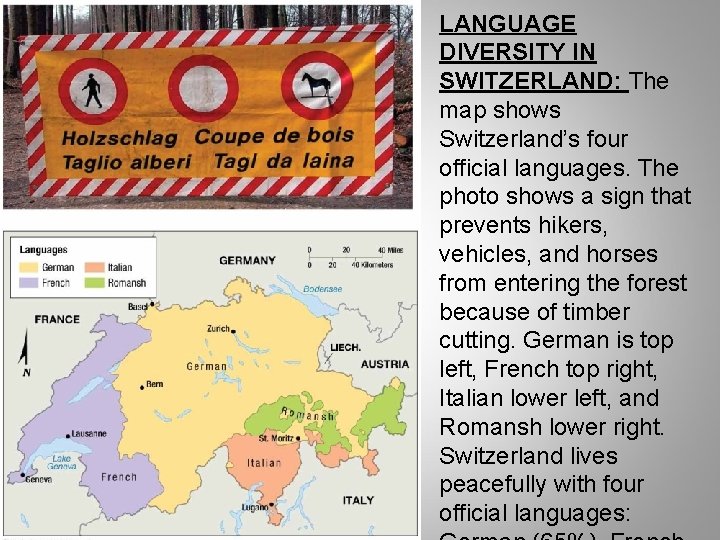
• Language Diversity (Switzerland): – Difficulties can arise at the boundary between two languages. • Varying degrees of difficulties – Switzerland » Peacefully exists with multiple languages. » Switzerland attributes success to decentralized government, in which local authorities hold most of the power, and decisions are frequently made on a local level by voter referenda. » Four official languages—German (65%), French (18%), Italian (10%), and Romansh (1%)
LANGUAGE DIVERSITY IN SWITZERLAND: The map shows Switzerland’s four official languages. The photo shows a sign that prevents hikers, vehicles, and horses from entering the forest because of timber cutting. German is top left, French top right, Italian lower left, and Romansh lower right. Switzerland lives peacefully with four official languages:
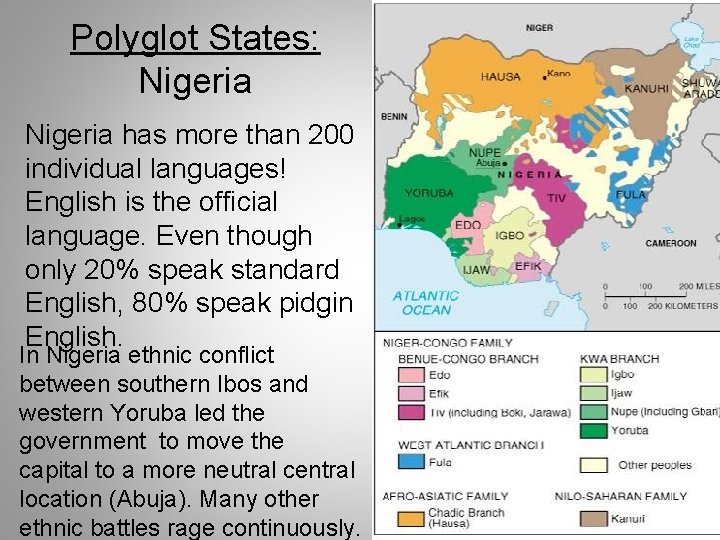
Polyglot States: Nigeria has more than 200 individual languages! English is the official language. Even though only 20% speak standard English, 80% speak pidgin English. In Nigeria ethnic conflict between southern Ibos and western Yoruba led the government to move the capital to a more neutral central location (Abuja). Many other ethnic battles rage continuously.
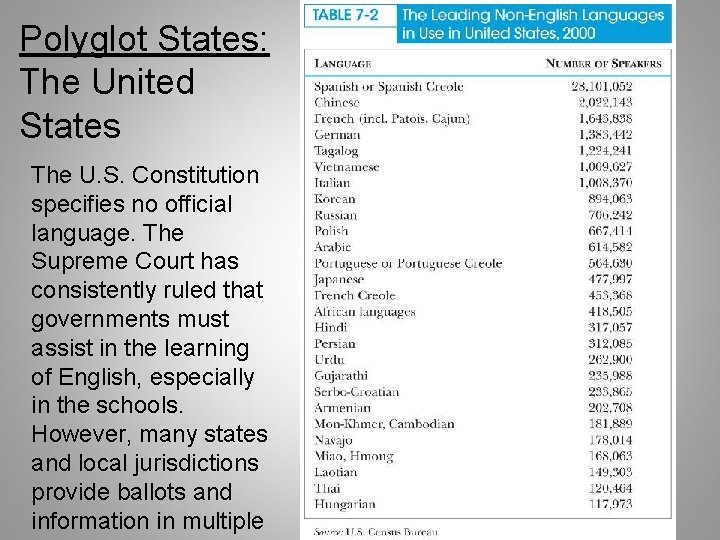
Polyglot States: The United States The U. S. Constitution specifies no official language. The Supreme Court has consistently ruled that governments must assist in the learning of English, especially in the schools. However, many states and local jurisdictions provide ballots and information in multiple
• Should the United States (a polyglot state itself) issue official documents (or anything else) in multiple languages such as Spanish? Why or why not?
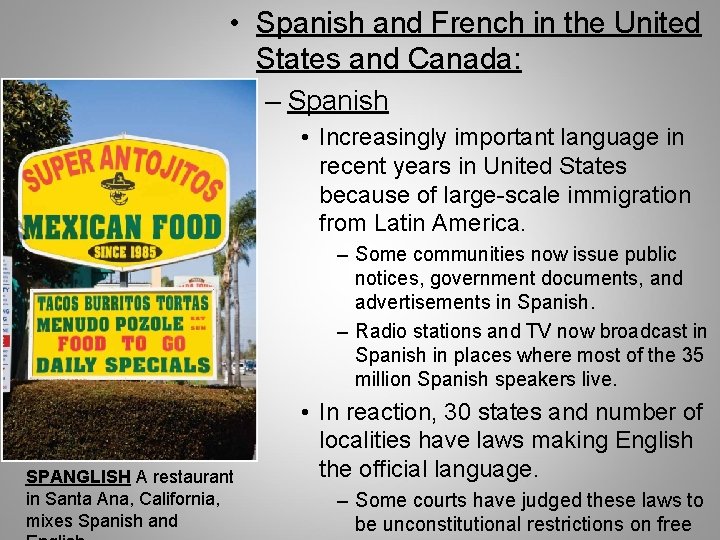
• Spanish and French in the United States and Canada: – Spanish • Increasingly important language in recent years in United States because of large-scale immigration from Latin America. – Some communities now issue public notices, government documents, and advertisements in Spanish. – Radio stations and TV now broadcast in Spanish in places where most of the 35 million Spanish speakers live. SPANGLISH A restaurant in Santa Ana, California, mixes Spanish and • In reaction, 30 states and number of localities have laws making English the official language. – Some courts have judged these laws to be unconstitutional restrictions on free
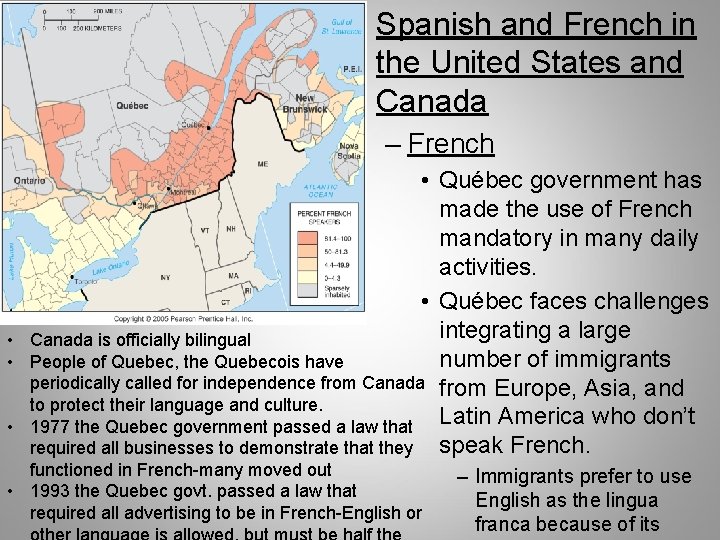
• Spanish and French in the United States and Canada – French • • Québec government has made the use of French mandatory in many daily activities. • Québec faces challenges integrating a large Canada is officially bilingual number of immigrants People of Quebec, the Quebecois have periodically called for independence from Canada from Europe, Asia, and to protect their language and culture. 1977 the Quebec government passed a law that Latin America who don’t required all businesses to demonstrate that they speak French. functioned in French-many moved out • 1993 the Quebec govt. passed a law that required all advertising to be in French-English or – Immigrants prefer to use English as the lingua franca because of its
Anthony Bourdain: “Parts Unknown” • http: //www. youtube. com/watch? v=m 78 k hj. HNcyc (6: 00 forward)
Isolated and Minority Languages:
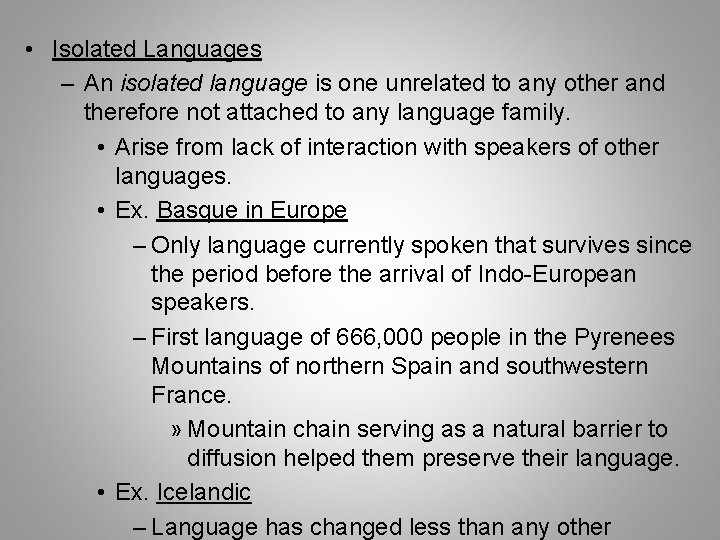
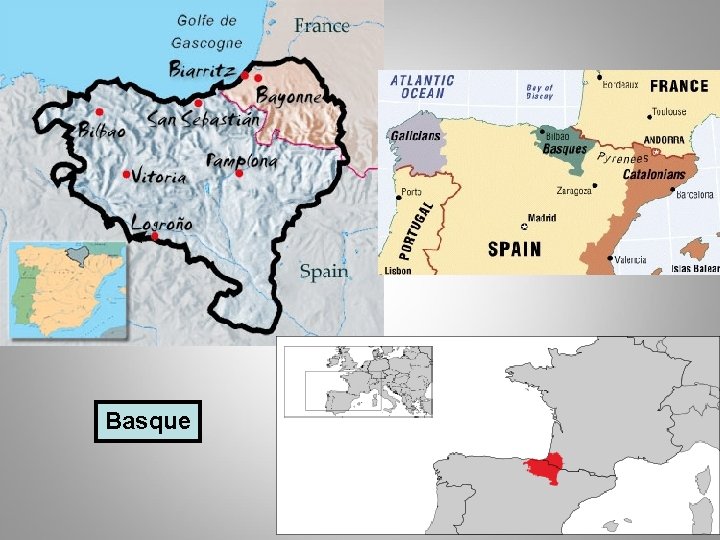
• Isolated Languages – An isolated language is one unrelated to any other and therefore not attached to any language family. • Arise from lack of interaction with speakers of other languages. • Ex. Basque in Europe – Only language currently spoken that survives since the period before the arrival of Indo-European speakers. – First language of 666, 000 people in the Pyrenees Mountains of northern Spain and southwestern France. » Mountain chain serving as a natural barrier to diffusion helped them preserve their language. • Ex. Icelandic – Language has changed less than any other
Basque
Endangered and Extinct Languages What does it mean if something (an animal species, for example) is endangered or extinct?
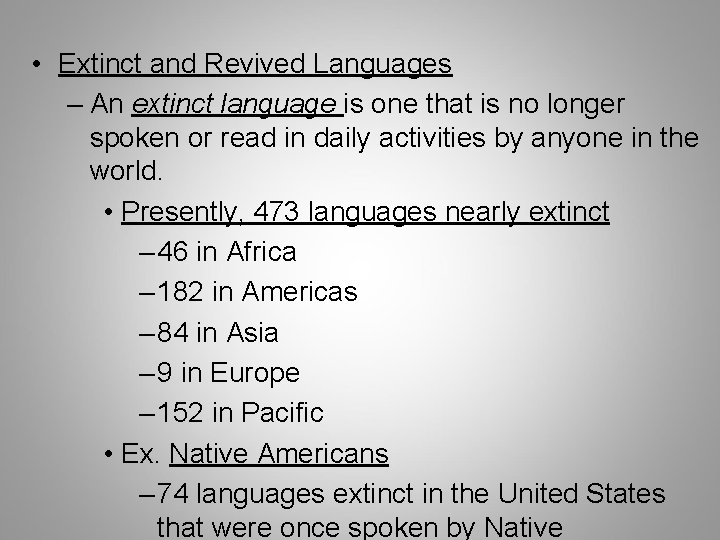
• Extinct and Revived Languages – An extinct language is one that is no longer spoken or read in daily activities by anyone in the world. • Presently, 473 languages nearly extinct – 46 in Africa – 182 in Americas – 84 in Asia – 9 in Europe – 152 in Pacific • Ex. Native Americans – 74 languages extinct in the United States that were once spoken by Native
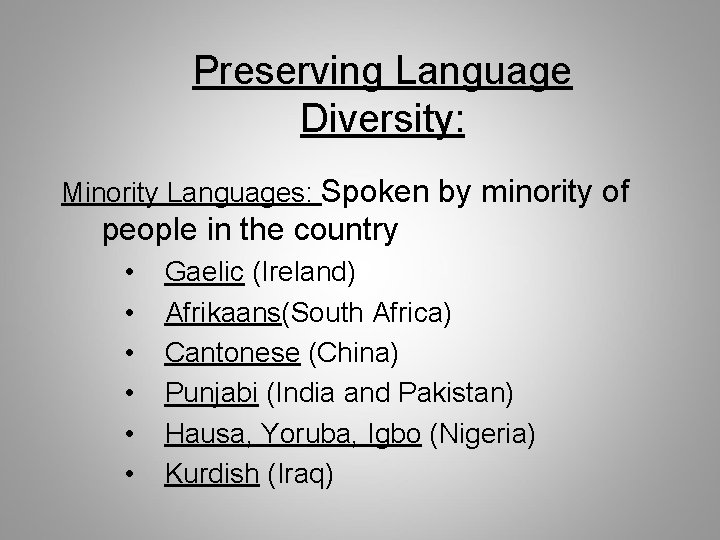
Preserving Language Diversity: Minority Languages: Spoken by minority of people in the country • • • Gaelic (Ireland) Afrikaans(South Africa) Cantonese (China) Punjabi (India and Pakistan) Hausa, Yoruba, Igbo (Nigeria) Kurdish (Iraq)
Language Revival & Preservation: *Think back to the video “City of Endangered Languages” - what were some of the techniques used to preserve
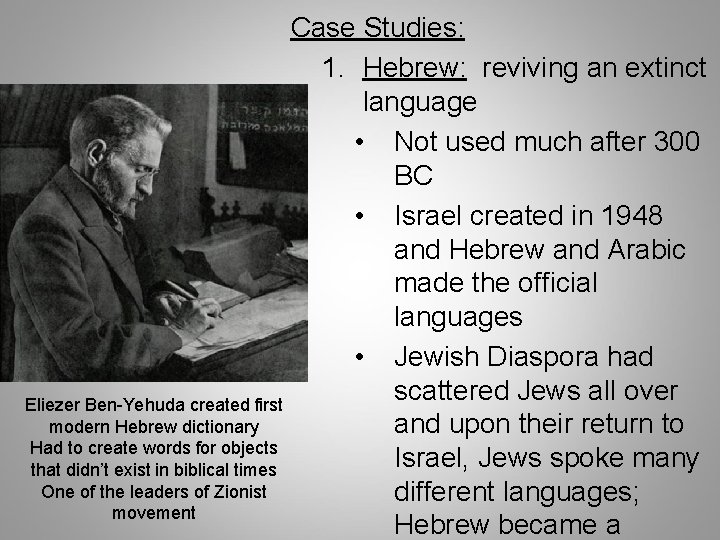
Case Studies: 1. Hebrew: reviving an extinct language • Not used much after 300 BC • Israel created in 1948 and Hebrew and Arabic made the official languages • Jewish Diaspora had scattered Jews all over Eliezer Ben-Yehuda created first modern Hebrew dictionary and upon their return to Had to create words for objects Israel, Jews spoke many that didn’t exist in biblical times One of the leaders of Zionist different languages; movement Hebrew became a
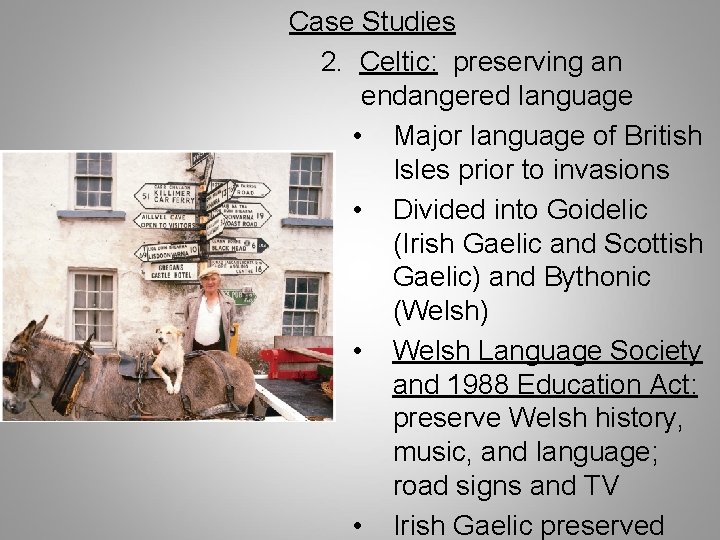
Case Studies 2. Celtic: preserving an endangered language • Major language of British Isles prior to invasions • Divided into Goidelic (Irish Gaelic and Scottish Gaelic) and Bythonic (Welsh) • Welsh Language Society and 1988 Education Act: preserve Welsh history, music, and language; road signs and TV • Irish Gaelic preserved
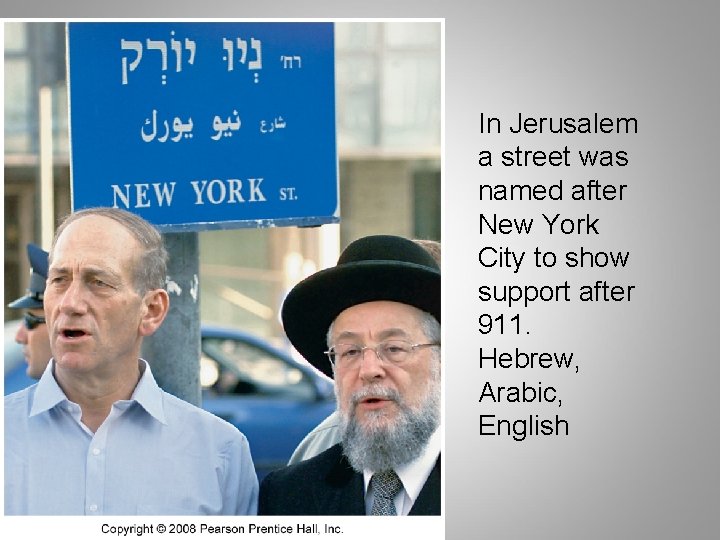
In Jerusalem a street was named after New York City to show support after 911. Hebrew, Arabic, English
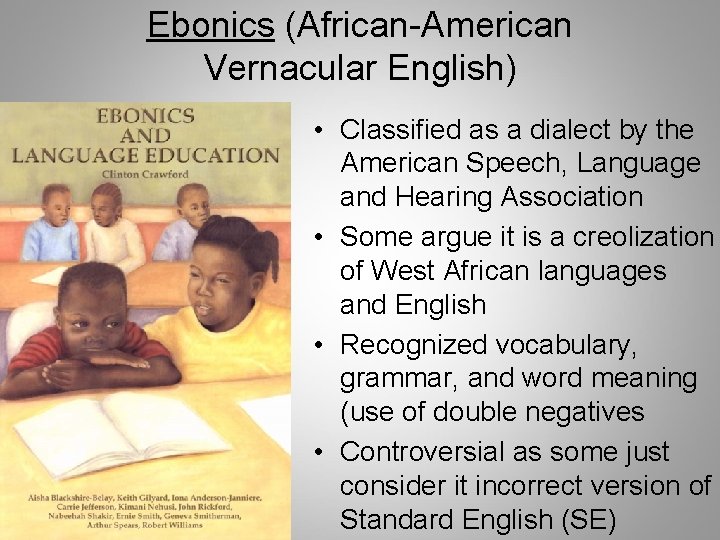
Ebonics (African-American Vernacular English) • Classified as a dialect by the American Speech, Language and Hearing Association • Some argue it is a creolization of West African languages and English • Recognized vocabulary, grammar, and word meaning (use of double negatives • Controversial as some just consider it incorrect version of Standard English (SE)