
TOPIC INFLUENCE GRAPH BASED ANALYSIS OF SEMINAL PAPERS
TOPIC INFLUENCE GRAPH BASED ANALYSIS OF SEMINAL PAPERS Abhirut Gupta (IBM Research AI) Sandipan Sikdar (RWTH Aachen University) Prateeti Mohapatra (IBM Research AI) Niloy Ganguly (IIT Kharagpur)

OUTLINE Introduction Data Topic Influence Graph Construction Analysis
INTRODUCTION
DATA ACL Anthology Network (AAN) 2014 dataset Stats 22, 484 papers Spread across 1965 to 2014 ~18, 000 unique authors ~300 venues ~122, 000 citations Dataset includes full text of the papers along with metadata and citations
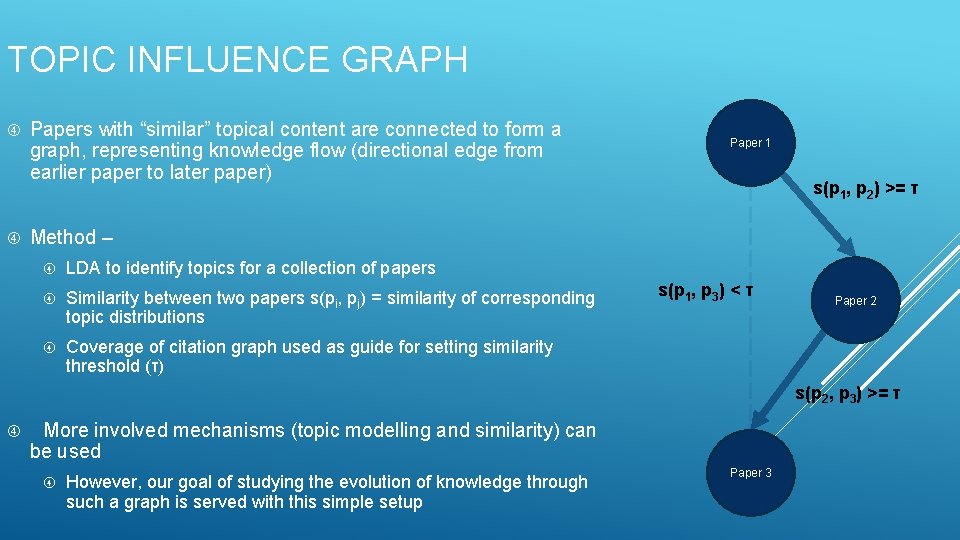
TOPIC INFLUENCE GRAPH Papers with “similar” topical content are connected to form a graph, representing knowledge flow (directional edge from earlier paper to later paper) Paper 1 s(p 1, p 2) >= τ Method – LDA to identify topics for a collection of papers Similarity between two papers s(pi, pj) = similarity of corresponding topic distributions Coverage of citation graph used as guide for setting similarity threshold (τ) s(p 1, p 3) < τ Paper 2 s(p 2, p 3) >= τ More involved mechanisms (topic modelling and similarity) can be used However, our goal of studying the evolution of knowledge through such a graph is served with this simple setup Paper 3
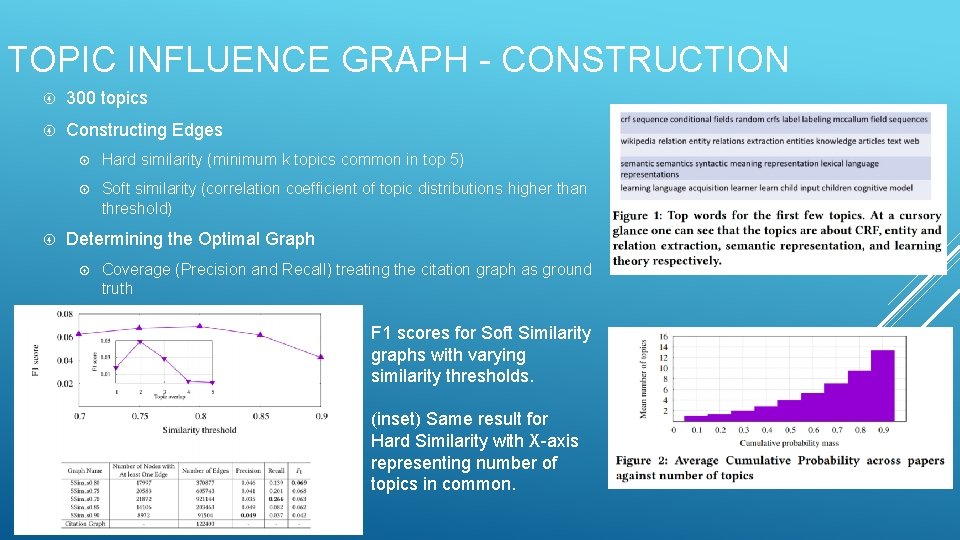
TOPIC INFLUENCE GRAPH - CONSTRUCTION 300 topics Constructing Edges Hard similarity (minimum k topics common in top 5) Soft similarity (correlation coefficient of topic distributions higher than threshold) Determining the Optimal Graph Coverage (Precision and Recall) treating the citation graph as ground truth F 1 scores for Soft Similarity graphs with varying similarity thresholds. (inset) Same result for Hard Similarity with X-axis representing number of topics in common.
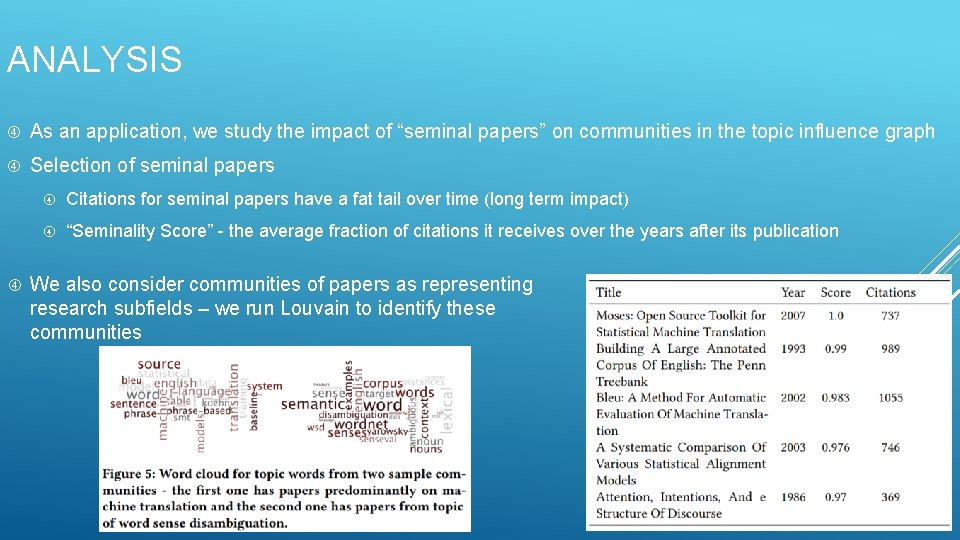
ANALYSIS As an application, we study the impact of “seminal papers” on communities in the topic influence graph Selection of seminal papers Citations for seminal papers have a fat tail over time (long term impact) “Seminality Score” - the average fraction of citations it receives over the years after its publication We also consider communities of papers as representing research subfields – we run Louvain to identify these communities
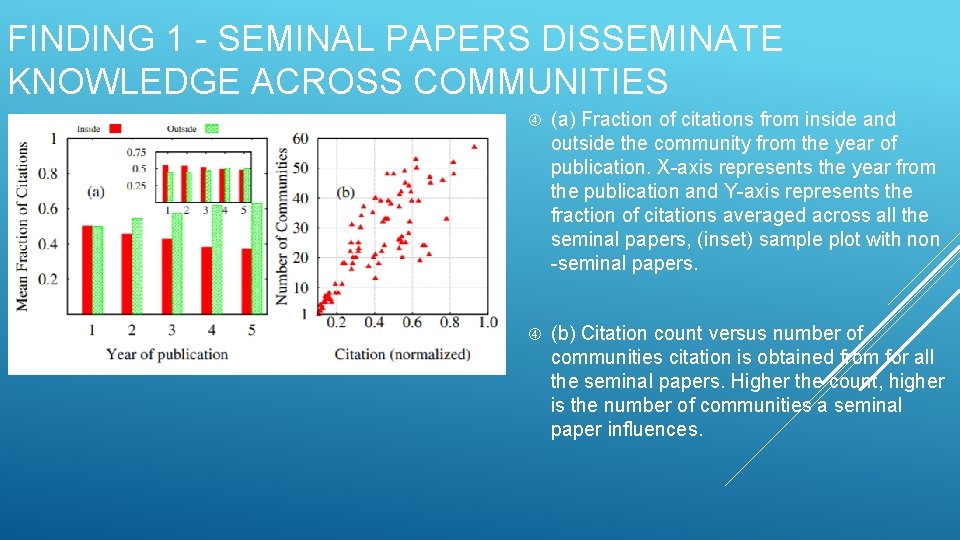
FINDING 1 - SEMINAL PAPERS DISSEMINATE KNOWLEDGE ACROSS COMMUNITIES (a) Fraction of citations from inside and outside the community from the year of publication. X-axis represents the year from the publication and Y-axis represents the fraction of citations averaged across all the seminal papers, (inset) sample plot with non -seminal papers. (b) Citation count versus number of communities citation is obtained from for all the seminal papers. Higher the count, higher is the number of communities a seminal paper influences.
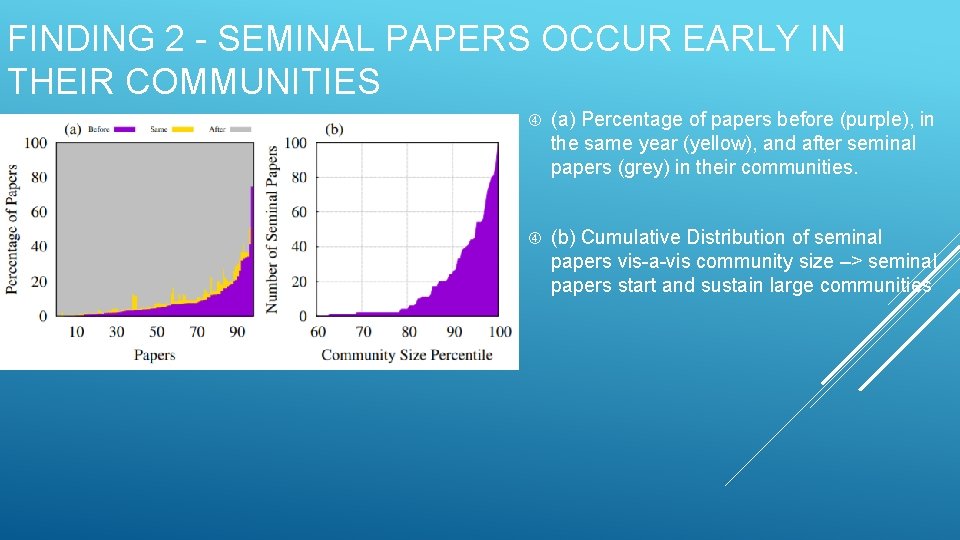
FINDING 2 - SEMINAL PAPERS OCCUR EARLY IN THEIR COMMUNITIES (a) Percentage of papers before (purple), in the same year (yellow), and after seminal papers (grey) in their communities. (b) Cumulative Distribution of seminal papers vis-a-vis community size –> seminal papers start and sustain large communities
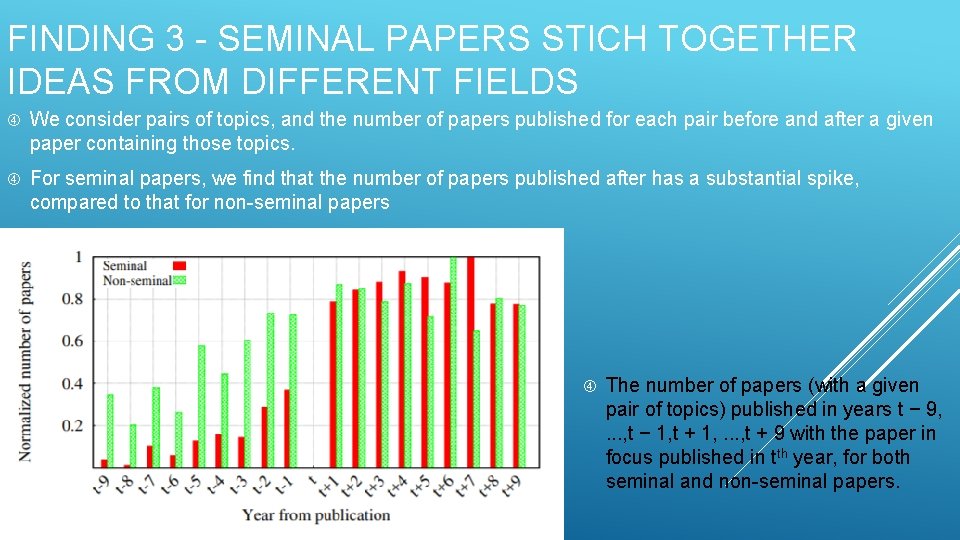
FINDING 3 - SEMINAL PAPERS STICH TOGETHER IDEAS FROM DIFFERENT FIELDS We consider pairs of topics, and the number of papers published for each pair before and after a given paper containing those topics. For seminal papers, we find that the number of papers published after has a substantial spike, compared to that for non-seminal papers The number of papers (with a given pair of topics) published in years t − 9, . . . , t − 1, t + 1, . . . , t + 9 with the paper in focus published in tth year, for both seminal and non-seminal papers.
SUMMARY 1. We propose a Topic Influence Graph to encode the flow of knowledge in scientific articles 2. We demonstrate a method to construct such a graph given the citation graph and the whole text of articles 3. We demonstrate the usefulness of this graph, by exploring properties of seminal papers
- Slides: 11