
Topic Forces Lesson 4 Water Resistance Success Criteria
- Slides: 12
Topic: Forces Lesson 4: Water Resistance Success Criteria - To be able identify the effects of water resistance - To understand what water resistance is - To research and conduct an experiment exploring water resistance The answer is water. What is the question?
Last week you were exploring air resistance. This week we are looking at what water resistance is and further experiments to explore the impact it has on the world around us. Task 1: Draw a table like the one below. As you move through the slides copy the key vocabulary (in blue and bold) into this table and complete the definition and sentence column. For the sentence column you must use the word in a sentence. Word Definition Sentence
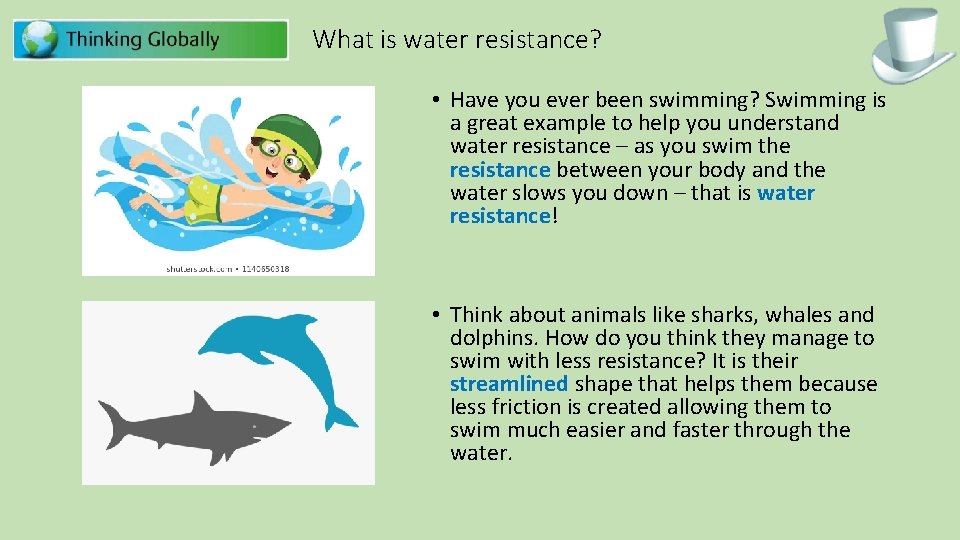
What is water resistance? • Have you ever been swimming? Swimming is a great example to help you understand water resistance – as you swim the resistance between your body and the water slows you down – that is water resistance! • Think about animals like sharks, whales and dolphins. How do you think they manage to swim with less resistance? It is their streamlined shape that helps them because less friction is created allowing them to swim much easier and faster through the water.
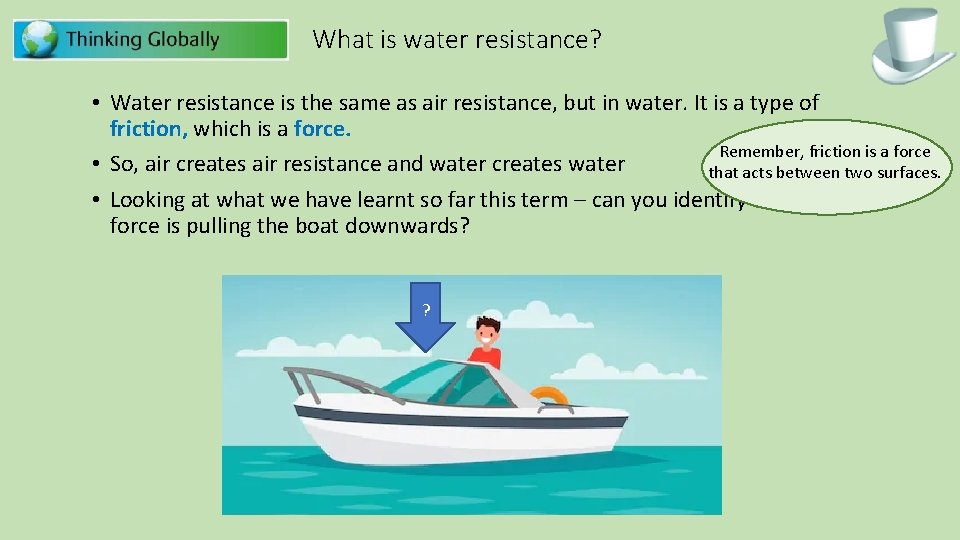
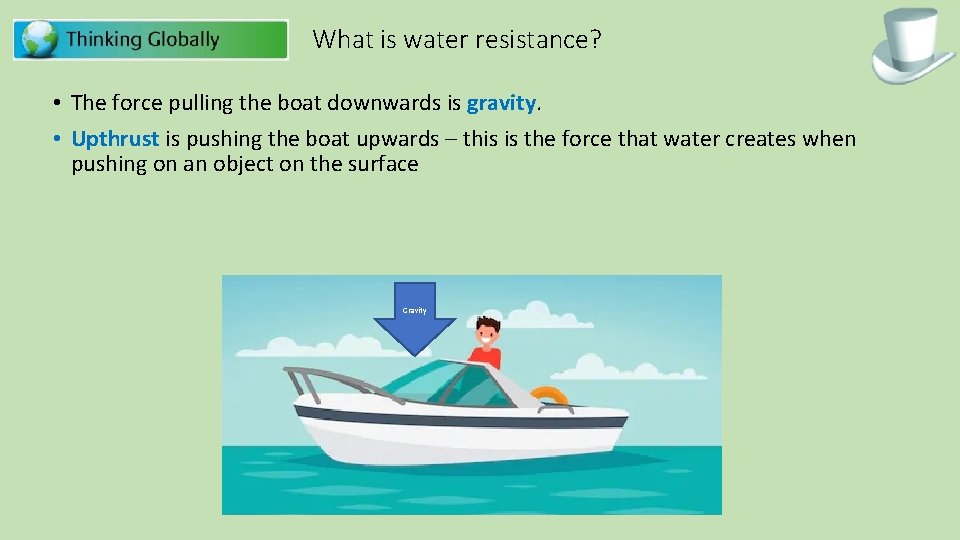
What is water resistance? • Water resistance is the same as air resistance, but in water. It is a type of friction, which is a force. Remember, friction is a force • So, air creates air resistance and water creates water resistance. that acts between two surfaces. • Looking at what we have learnt so far this term – can you identify which force is pulling the boat downwards? ?
What is water resistance? • The force pulling the boat downwards is gravity. • Upthrust is pushing the boat upwards – this is the force that water creates when pushing on an object on the surface Gravity
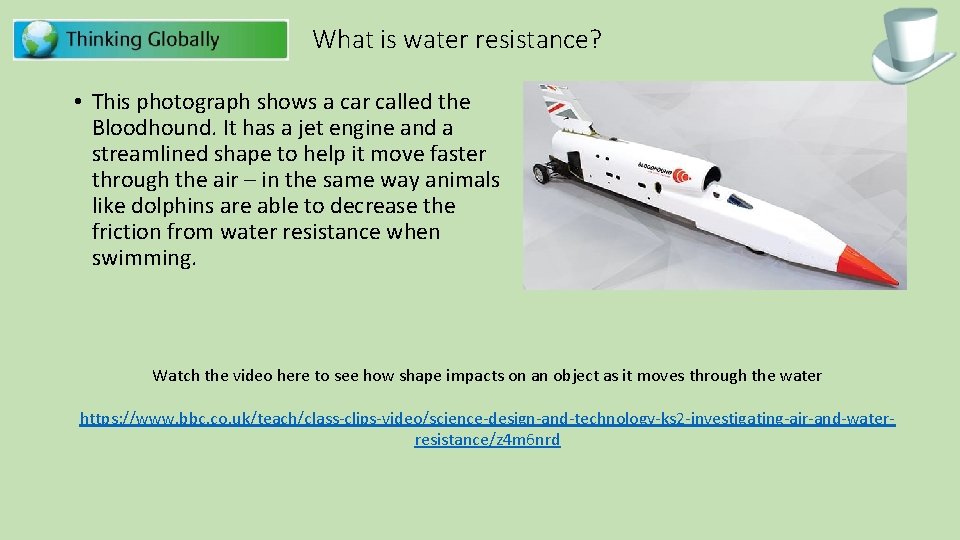
What is water resistance? • This photograph shows a car called the Bloodhound. It has a jet engine and a streamlined shape to help it move faster through the air – in the same way animals like dolphins are able to decrease the friction from water resistance when swimming. Watch the video here to see how shape impacts on an object as it moves through the water https: //www. bbc. co. uk/teach/class-clips-video/science-design-and-technology-ks 2 -investigating-air-and-waterresistance/z 4 m 6 nrd
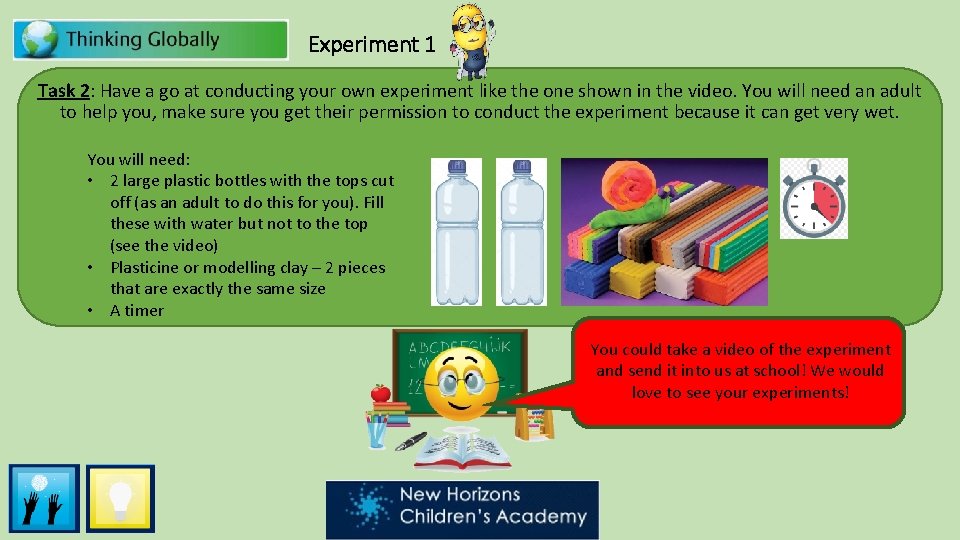
Experiment 1 Task 2: Have a go at conducting your own experiment like the one shown in the video. You will need an adult to help you, make sure you get their permission to conduct the experiment because it can get very wet. You will need: • 2 large plastic bottles with the tops cut off (as an adult to do this for you). Fill these with water but not to the top (see the video) • Plasticine or modelling clay – 2 pieces that are exactly the same size • A timer You could take a video of the experiment and send it into us at school! We would love to see your experiments!
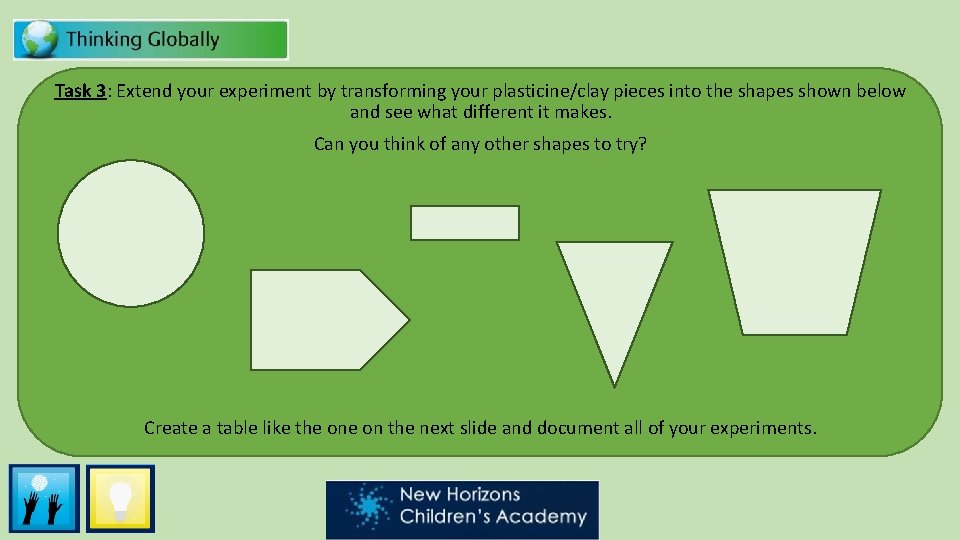
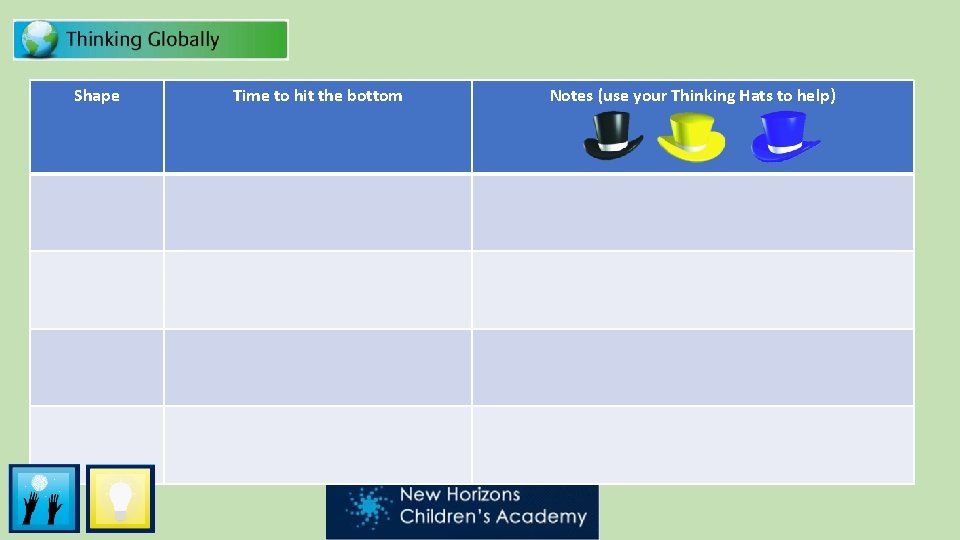
Task 3: Extend your experiment by transforming your plasticine/clay pieces into the shapes shown below and see what different it makes. Can you think of any other shapes to try? Create a table like the on the next slide and document all of your experiments.
Shape Time to hit the bottom Notes (use your Thinking Hats to help)
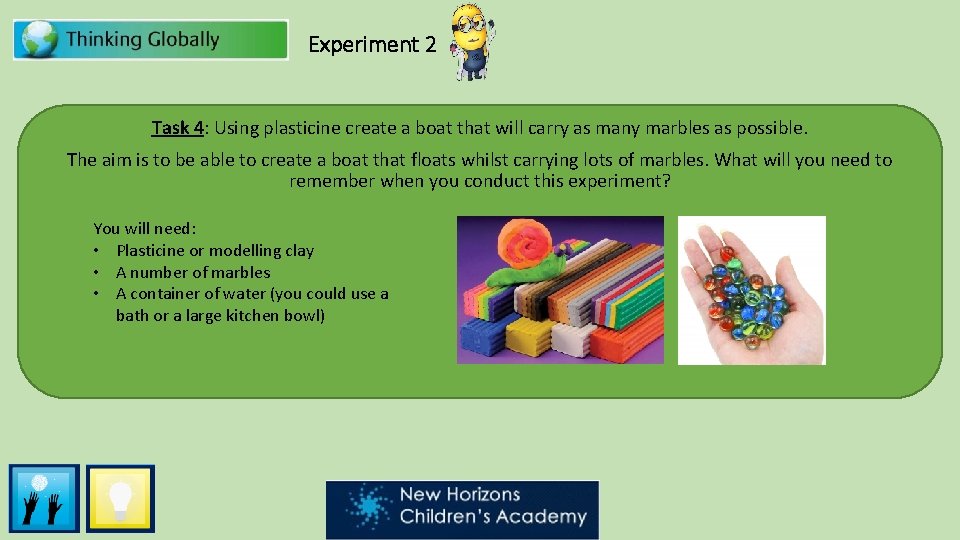
Experiment 2 Task 4: Using plasticine create a boat that will carry as many marbles as possible. The aim is to be able to create a boat that floats whilst carrying lots of marbles. What will you need to remember when you conduct this experiment? You will need: • Plasticine or modelling clay • A number of marbles • A container of water (you could use a bath or a large kitchen bowl)
Summary – what can you remember? Well done for your effort this week. We hope you have had fun experimenting with the plasticine and water. Can you answer these questions: 1) What force pulls a boat downwards? 2) What is the name of the force that acts upwards on a boat on the surface of water? 3) Complete this sentence - Water resistance is a type of……………? 4) How many examples can you write down that demonstrate water resistance? For example, a submarine moving through the water exploring new depths.
Time to reflect on this week’s learning What did you do well in this lesson? What do you need to work on? What is the most interesting fact you have learned this lesson?