
Topic Classifying Matter Which of the following is

- Slides: 22
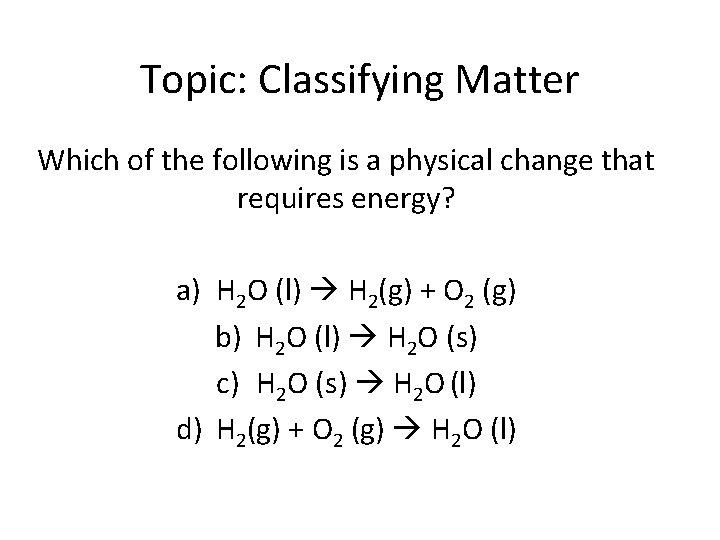
Topic: Classifying Matter Which of the following is a physical change that requires energy? a) H 2 O (l) H 2(g) + O 2 (g) b) H 2 O (l) H 2 O (s) c) H 2 O (s) H 2 O (l) d) H 2(g) + O 2 (g) H 2 O (l)
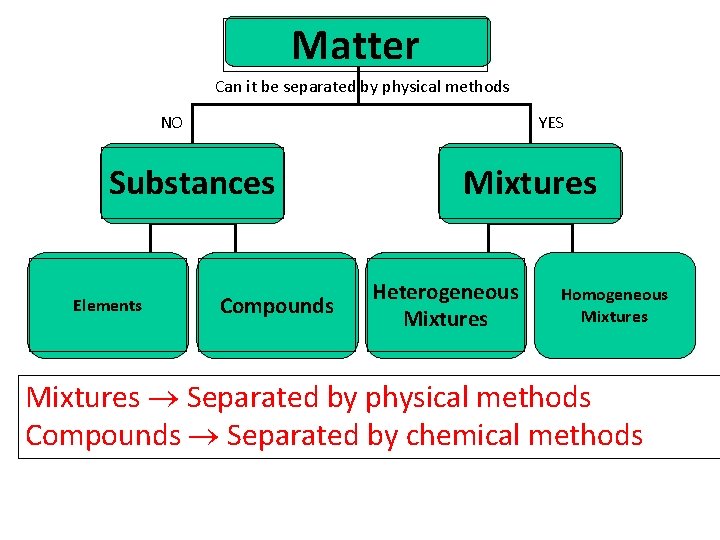
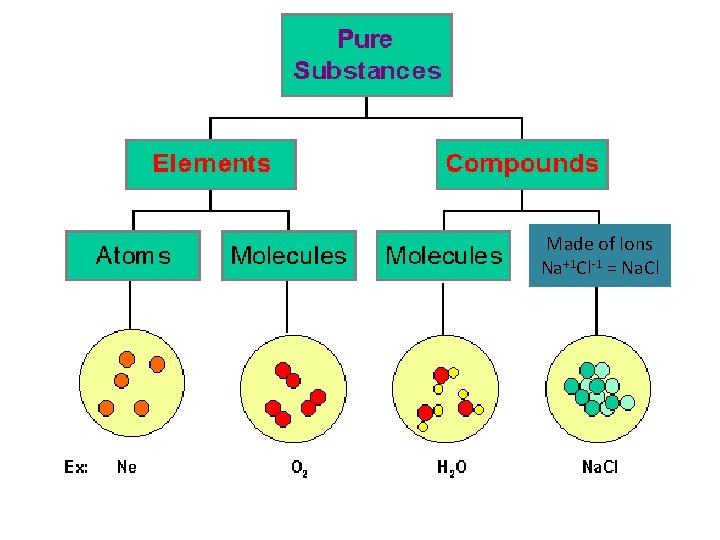
Matter Can it be separated by physical methods NO YES Substances Elements Compounds Mixtures Heterogeneous Mixtures Homogeneous Mixtures Separated by physical methods Compounds Separated by chemical methods
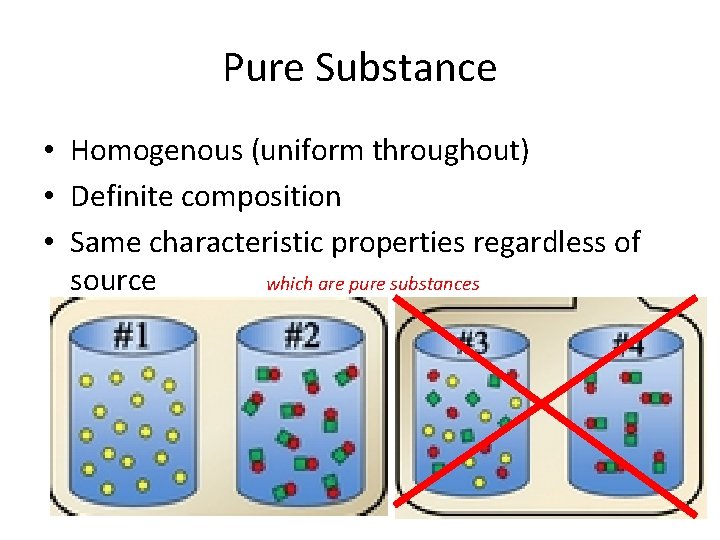
Pure Substance • Homogenous (uniform throughout) • Definite composition • Same characteristic properties regardless of source which are pure substances
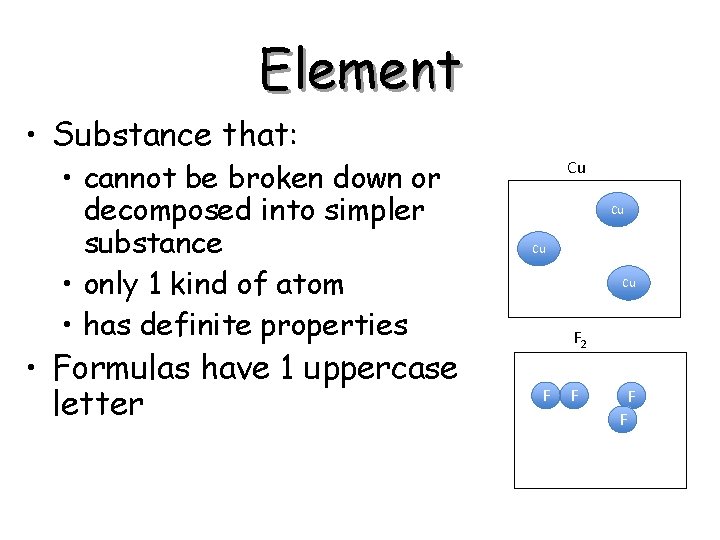
Element • Substance that: • cannot be broken down or decomposed into simpler substance • only 1 kind of atom • has definite properties • Formulas have 1 uppercase letter Cu Cu F 2 F F
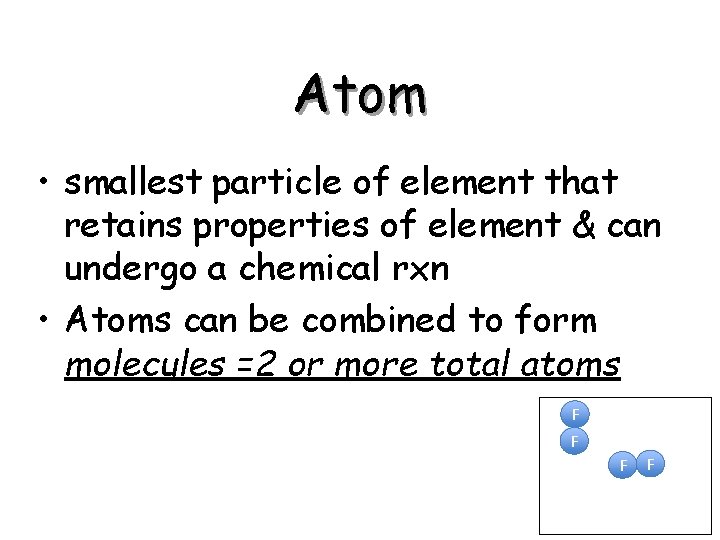
Atom • smallest particle of element that retains properties of element & can undergo a chemical rxn • Atoms can be combined to form molecules =2 or more total atoms F F
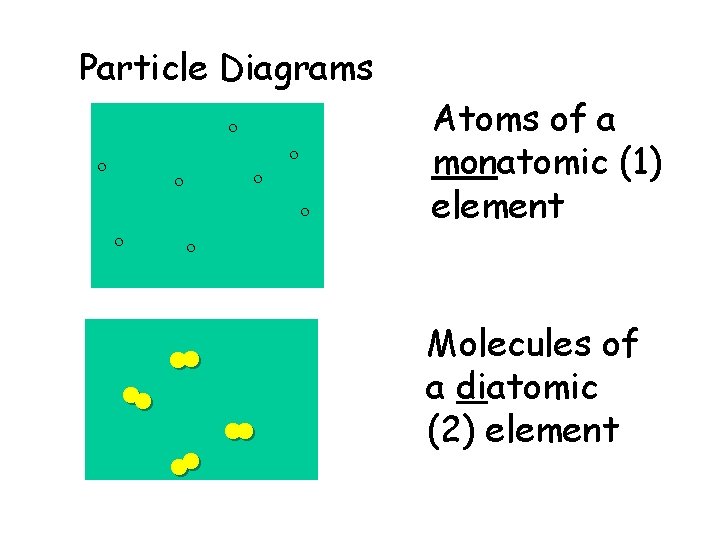
Particle Diagrams Atoms of a monatomic (1) element Molecules of a diatomic (2) element
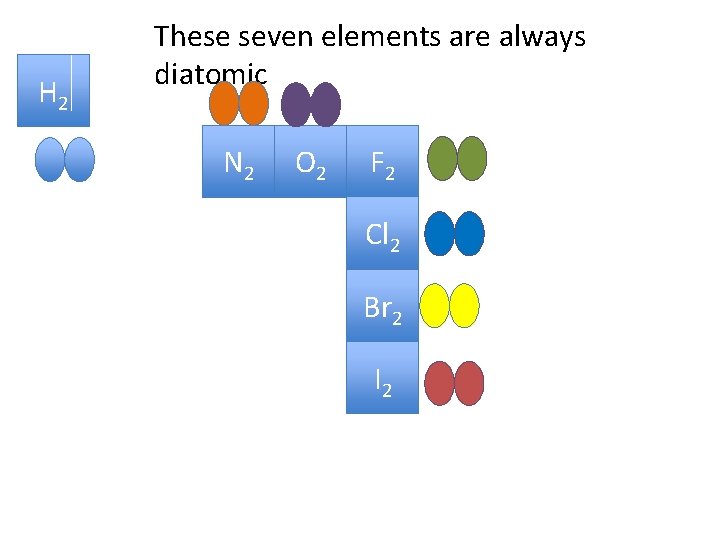
HH 2 These seven elements are always diatomic NN 2 OO 2 FF 2 Cl Cl 2 Br Br 2 II 2
Element Song Big Bang Version sung by Sheldon
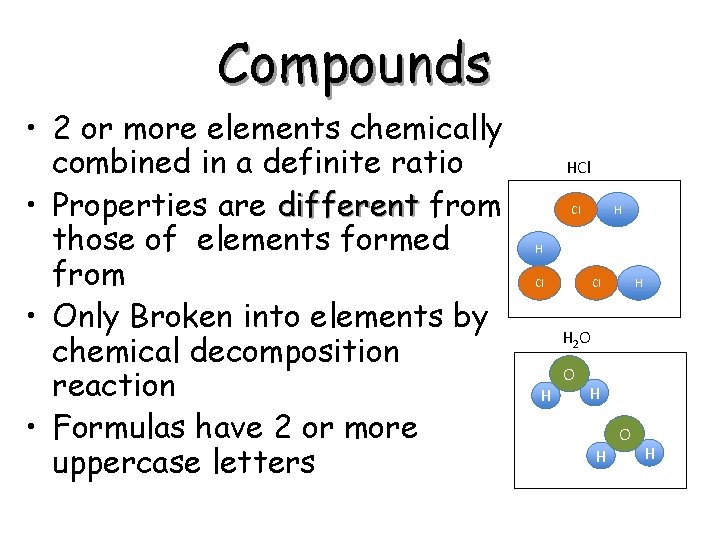
Compounds • 2 or more elements chemically combined in a definite ratio • Properties are different from those of elements formed from • Only Broken into elements by chemical decomposition reaction • Formulas have 2 or more uppercase letters HCl Cl H H 2 O H H O H
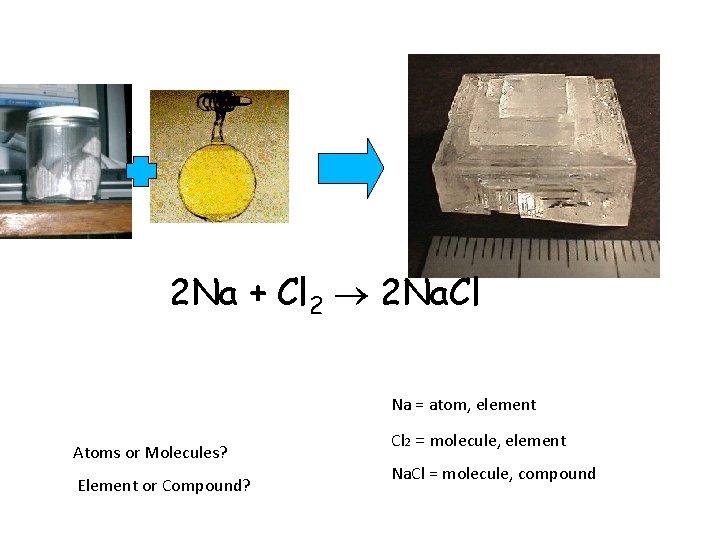
2 Na + Cl 2 2 Na. Cl Na = atom, element Atoms or Molecules? Element or Compound? Cl 2 = molecule, element Na. Cl = molecule, compound
Particle Diagrams Molecules of a triatomic (3) compound Mixture: monatomic element, diatomic element, triatomic compound
Made of Ions Na+1 Cl-1 = Na. Cl
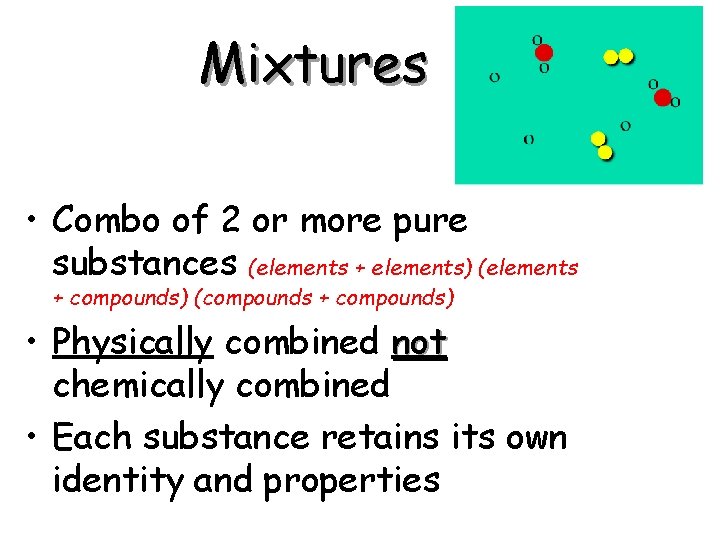
Mixtures • Combo of 2 or more pure substances (elements + elements) (elements + compounds) (compounds + compounds) • Physically combined not chemically combined • Each substance retains its own identity and properties
Mixtures • Variable composition • No unique properties (Think of sugar and salt mixed together) • Separated by physical methods • May be homogeneous or heterogeneous
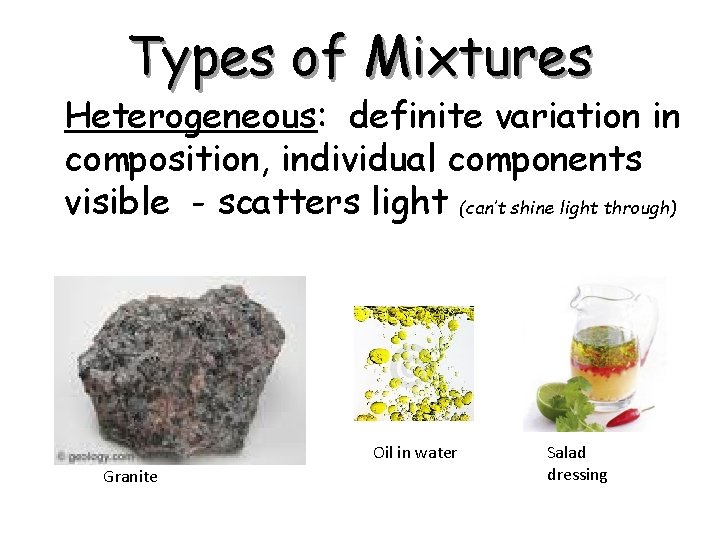
Types of Mixtures • Heterogeneous: definite variation in composition, individual components visible - scatters light (can’t shine light through) Oil in water Granite Salad dressing
Colloids (type of heterogeneous mix. ) • Particles are suspended- they are too small to see Aerosols: solid or liquid particles in gas – Ex: Smoke/Fog: solid in a gas Gas in liquid: – Ex: whipped cream Emulsion: liquid in liquid – Ex: mayonnaise (oil suspended in water – use egg yolk to Sols: solid particles in a liquid – Ex: Milk of Magnesia (solid magnesium hydroxide in water) Gels: Liquid in solid – Ex: Quicksand: sand in water
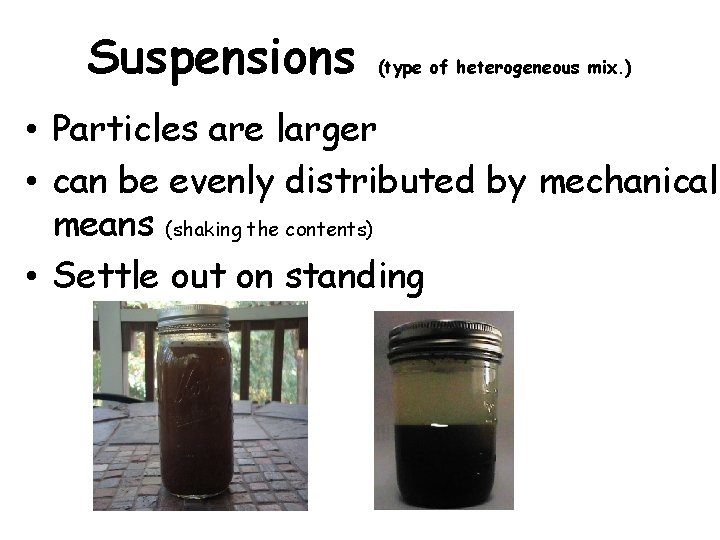
Suspensions (type of heterogeneous mix. ) • Particles are larger • can be evenly distributed by mechanical means (shaking the contents) • Settle out on standing
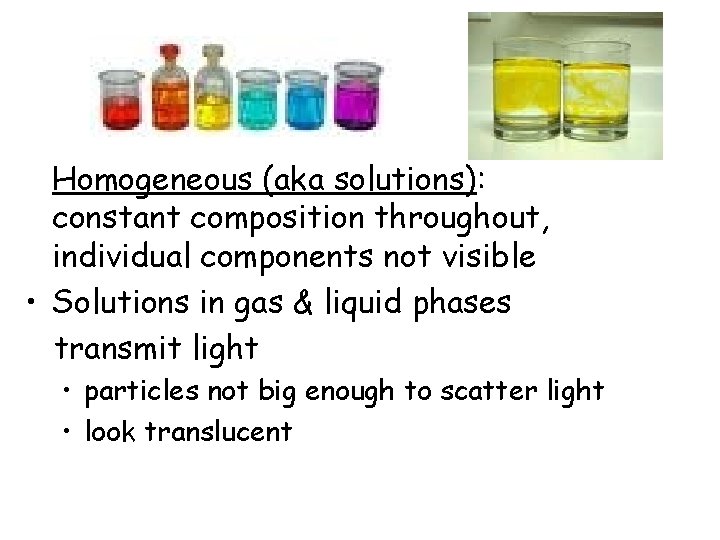
• Homogeneous (aka solutions): constant composition throughout, individual components not visible • Solutions in gas & liquid phases transmit light • particles not big enough to scatter light • look translucent
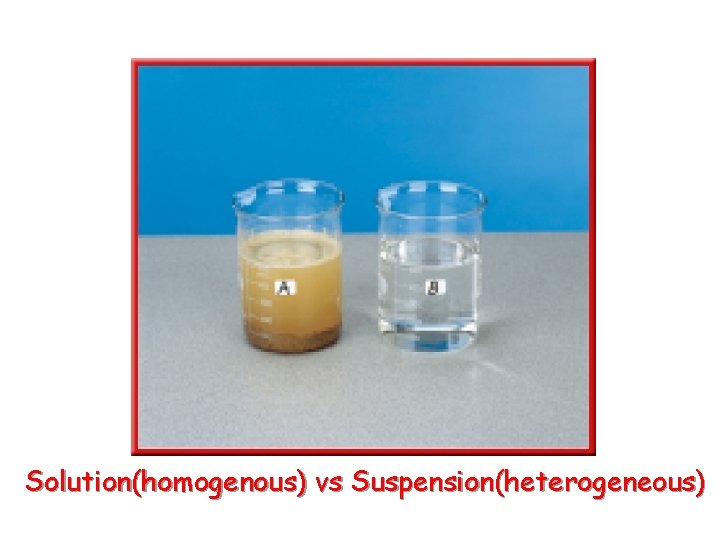
RECAP: Solution vs Suspension • Solutions in gas & liquid phases transmit light • particles not big enough to scatter light • look translucent • Suspensions look cloudy • particles big enough to scatter light • settle on standing
Solution(homogenous) vs Suspension(heterogeneous)
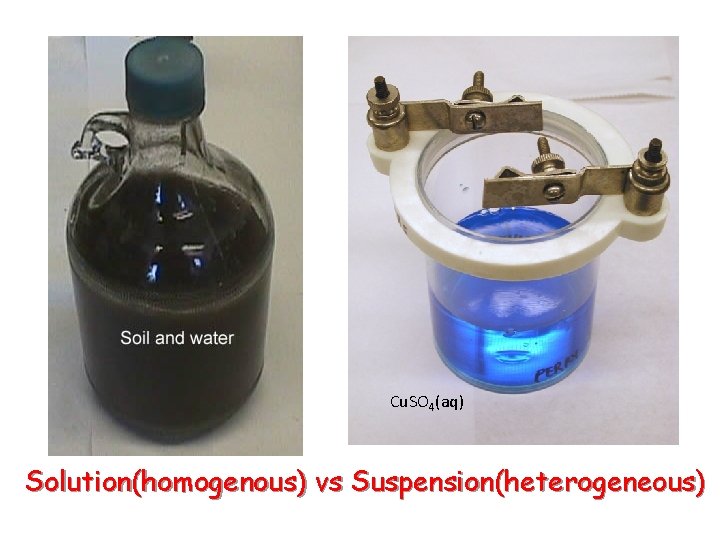
Cu. SO 4(aq) Solution(homogenous) vs Suspension(heterogeneous)
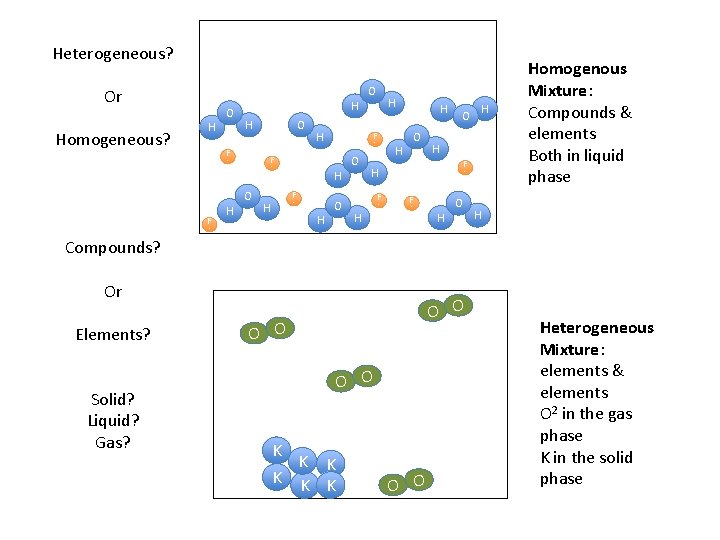
Heterogeneous? Or Homogeneous? H O H H F F - O - H F - H H - H F - H O O H F - H - F - H H O Homogenous Mixture: Compounds & elements Both in liquid phase H Compounds? Or Elements? Solid? Liquid? Gas? O O O K K K O O Heterogeneous Mixture: elements & elements O 2 in the gas phase K in the solid phase