
Topic A Dataflow Model of Computation Guang R
- Slides: 52
Topic A Dataflow Model of Computation Guang R. Gao ACM Fellow and IEEE Fellow Endowed Distinguished Professor Electrical & Computer Engineering University of Delaware ggao@capsl. udel. edu 09/07/2011 CPEG 867 -2011 -F-Topic-A-Dataflow-Part 1 1
Outline • • Parallel Program Execution Models Dataflow Models of Computation Dataflow Graphs and Properties Three Dataflow Models Static Recursive Program Graph Dynamic • Dataflow Architectures 09/07/2011 CPEG 867 -2011 -F-Topic-A-Dataflow-Part 1 2
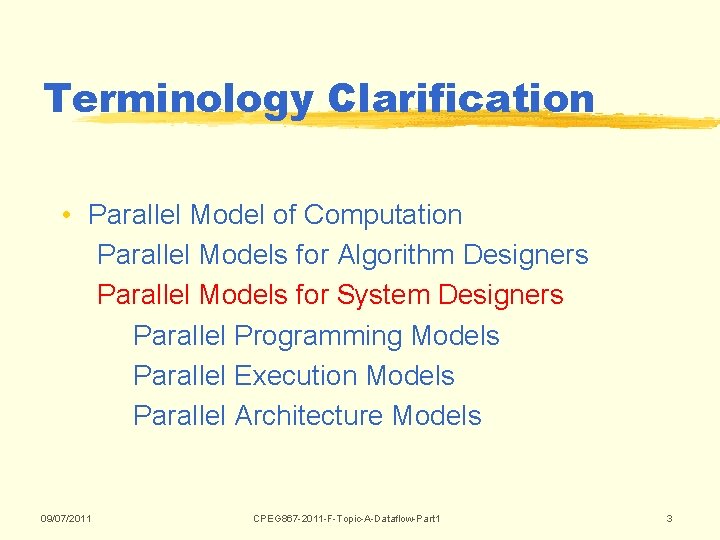
Terminology Clarification • Parallel Model of Computation Parallel Models for Algorithm Designers Parallel Models for System Designers Parallel Programming Models Parallel Execution Models Parallel Architecture Models 09/07/2011 CPEG 867 -2011 -F-Topic-A-Dataflow-Part 1 3
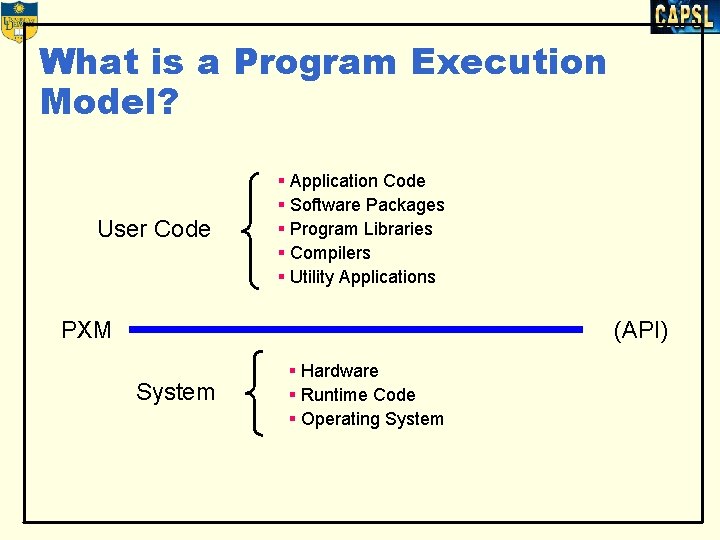
What is a Program Execution Model? User Code § Application Code § Software Packages § Program Libraries § Compilers § Utility Applications PXM (API) System § Hardware § Runtime Code § Operating System
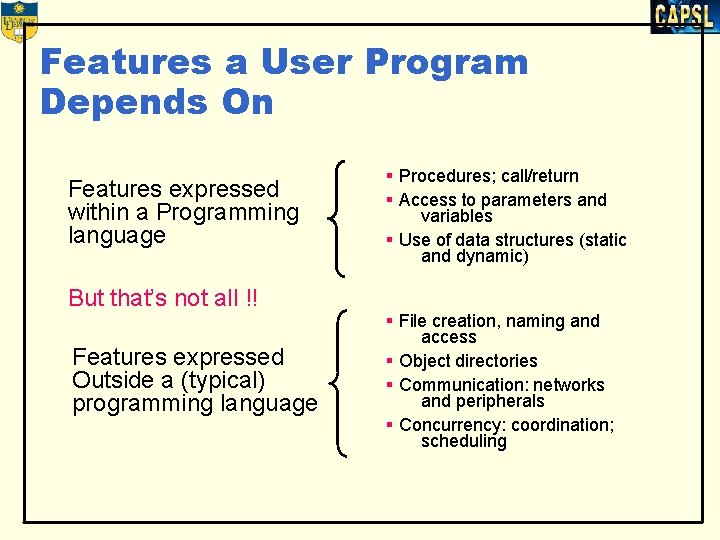
Features a User Program Depends On Features expressed within a Programming language But that’s not all !! Features expressed Outside a (typical) programming language § Procedures; call/return § Access to parameters and variables § Use of data structures (static and dynamic) § File creation, naming and access § Object directories § Communication: networks and peripherals § Concurrency: coordination; scheduling
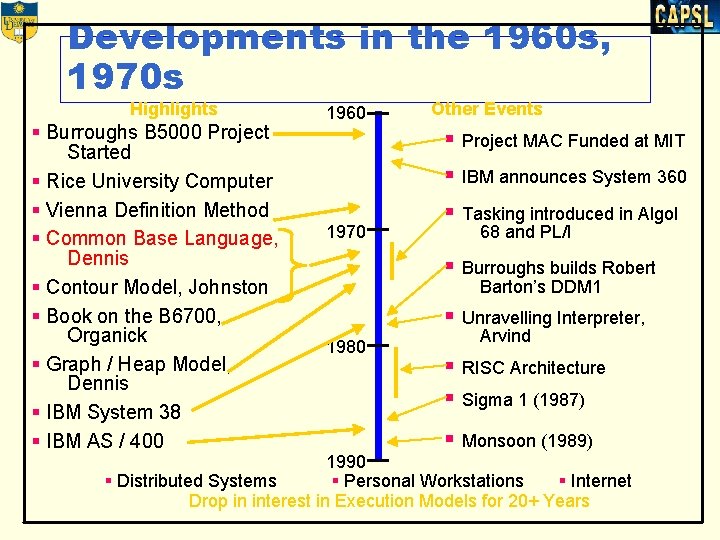
Developments in the 1960 s, 1970 s Highlights § Burroughs B 5000 Project Started § Rice University Computer § Vienna Definition Method § Common Base Language, Dennis § Contour Model, Johnston § Book on the B 6700, Organick § Graph / Heap Model, Dennis § IBM System 38 § IBM AS / 400 1960 1970 Other Events § Project MAC Funded at MIT § IBM announces System 360 § Tasking introduced in Algol 68 and PL/I § Burroughs builds Robert Barton’s DDM 1 § Unravelling Interpreter, 1980 Arvind § RISC Architecture § Sigma 1 (1987) § Monsoon (1989) 1990 § Distributed Systems § Personal Workstations § Internet Drop in interest in Execution Models for 20+ Years
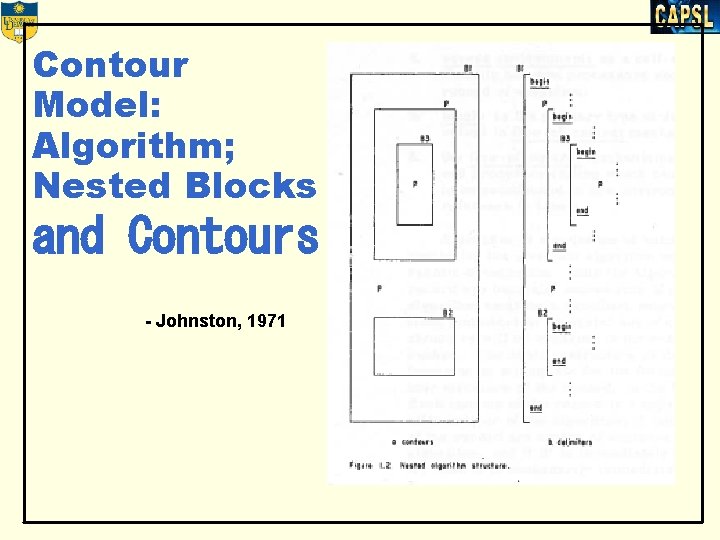
Contour Model: Algorithm; Nested Blocks and Contours - Johnston, 1971
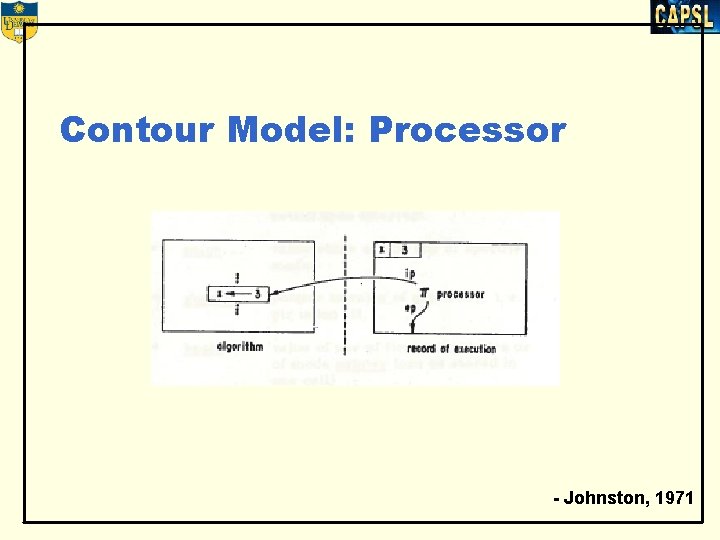
Contour Model: Processor - Johnston, 1971
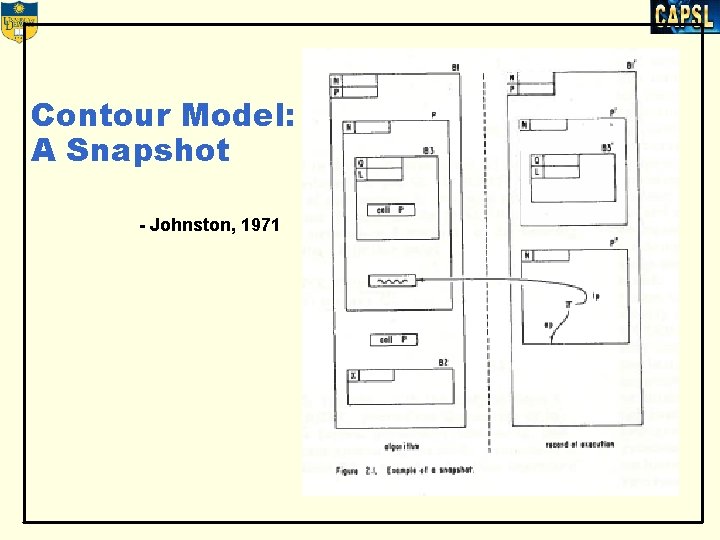
Contour Model: A Snapshot - Johnston, 1971
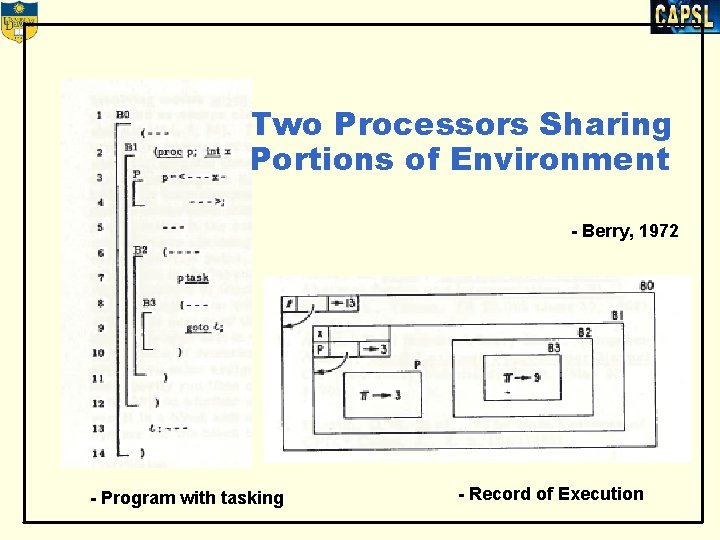
Two Processors Sharing Portions of Environment - Berry, 1972 - Program with tasking - Record of Execution
Idea: A Common Base Language This is a report on the work of the Computation Structures Group of Project MAC toward the design of a common base language for programs and information structures. We envision that the meanings of programs expressed in practical source languages will be defined by rules of translation into the base language. The meanings of programs in the base language is fixed by rules of interpretation which constitute a transition system called the interpreter for the base language. We view the base language as the functional specification of a computer system in which emphasis is placed on programming generality -- the ability of users to build complex programs by combining independently written program modules. - Dennis, 1972
What Does Program Xecution Model (PXM) Mean ? • The notion of PXM The program execution model (PXM) is the basic low-level abstraction of the underlying system architecture upon which our programming model, compilation strategy, runtime system, and other software components are developed. • The PXM (and its API) serves as an interface between the architecture and the software. 09/07/2011 CPEG 867 -2011 -F-Topic-A-Dataflow-Part 1 12
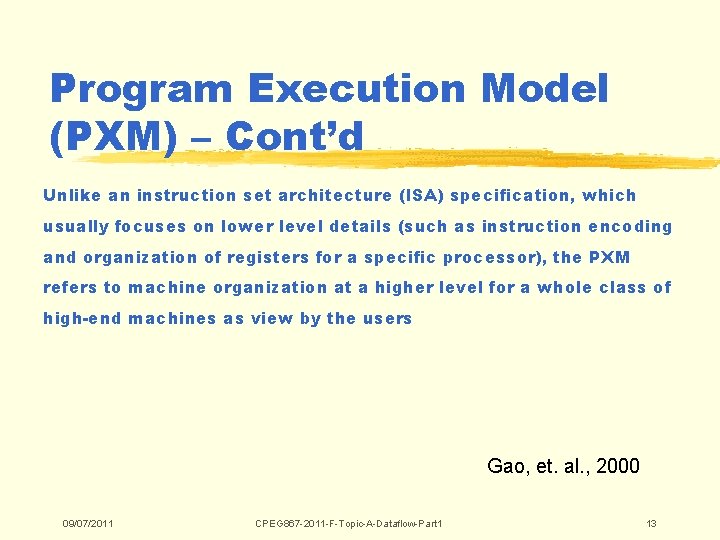
Program Execution Model (PXM) – Cont’d Unlike an instruction set architecture (ISA) specification, which usually focuses on lower level details (such as instruction encoding and organization of registers for a specific processor), the PXM refers to machine organization at a higher level for a whole class of high-end machines as view by the users Gao, et. al. , 2000 09/07/2011 CPEG 867 -2011 -F-Topic-A-Dataflow-Part 1 13
What is your “Favorite” Program Execution Model? 09/07/2011 CPEG 867 -2011 -F-Topic-A-Dataflow-Part 1 14
Outline • • Parallel Program Execution Models Dataflow Models of Computation Dataflow Graphs and Properties Three Dataflow Models Static Recursive Program Graph Dynamic • Dataflow Architectures 09/07/2011 CPEG 867 -2011 -F-Topic-A-Dataflow-Part 1 15
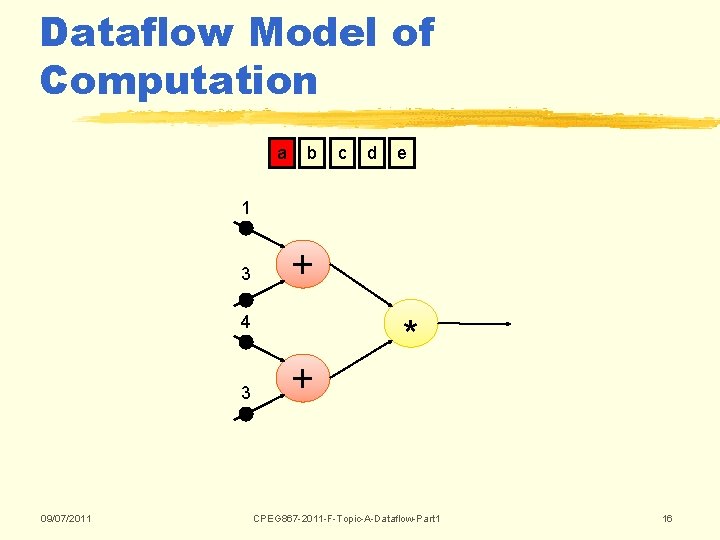
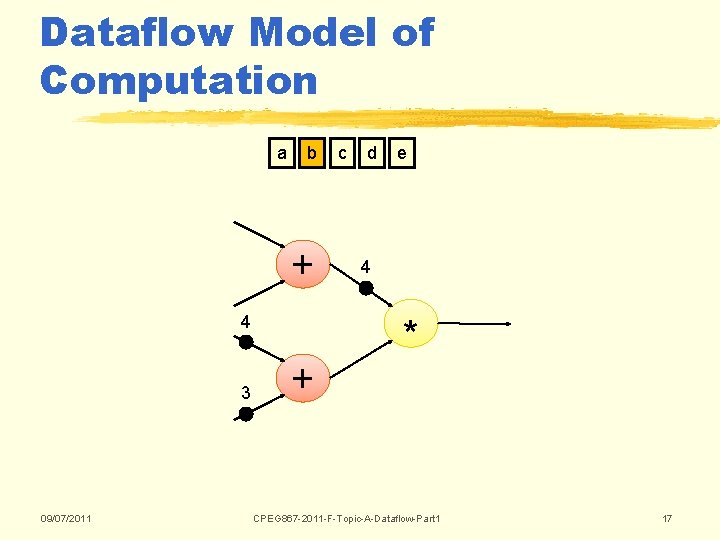
Dataflow Model of Computation a b c d e 1 3 + 4 3 09/07/2011 + * CPEG 867 -2011 -F-Topic-A-Dataflow-Part 1 16
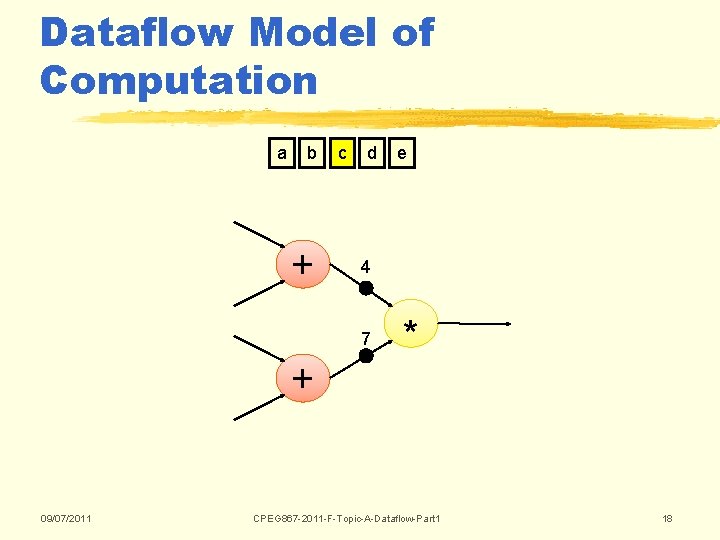
Dataflow Model of Computation a b + 4 3 09/07/2011 + c d e 4 * CPEG 867 -2011 -F-Topic-A-Dataflow-Part 1 17
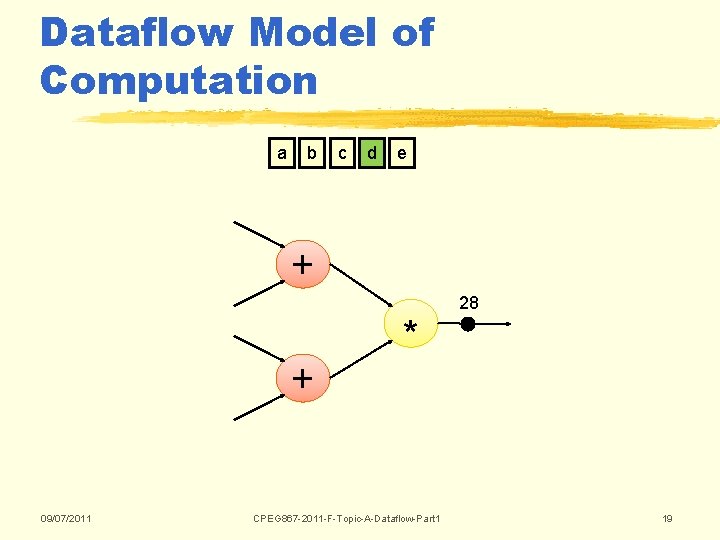
Dataflow Model of Computation a b + c d 4 7 + 09/07/2011 e * CPEG 867 -2011 -F-Topic-A-Dataflow-Part 1 18
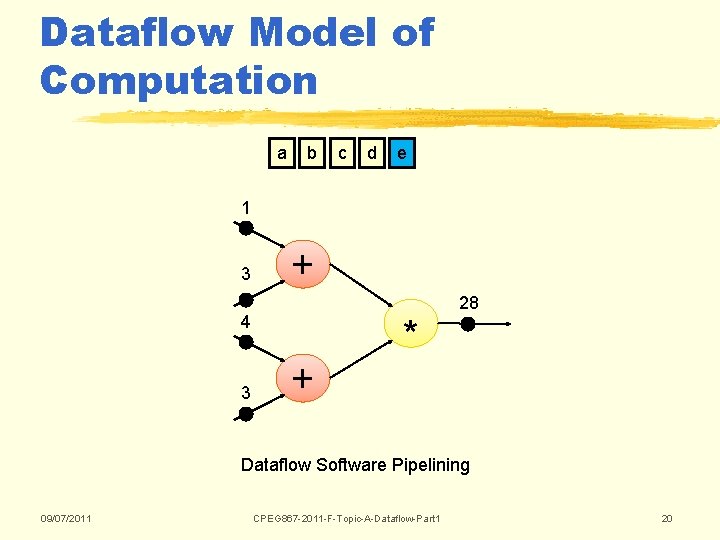
Dataflow Model of Computation a b c d e + + 09/07/2011 * CPEG 867 -2011 -F-Topic-A-Dataflow-Part 1 28 19
Dataflow Model of Computation a b c d e 1 3 + 4 3 + * 28 Dataflow Software Pipelining 09/07/2011 CPEG 867 -2011 -F-Topic-A-Dataflow-Part 1 20
A Base-Language ~ Data Flow Graphs ~ To serve as an intermediate-level language for high-level languages To serve as a machine language for parallel machines - J. B. Dennis 09/07/2011 CPEG 867 -2011 -F-Topic-A-Dataflow-Part 1 21
Jac MIT -1964 IBM announces System 360. Project Mac selects GE 645 for Multics. I decide to pursue research on relation of program structure to computer architecture. “Machine Structures Group formed. ” By Jack B. Dennis 09/07/2011 CPEG 867 -2011 -F-Topic-A-Dataflow-Part 1 22
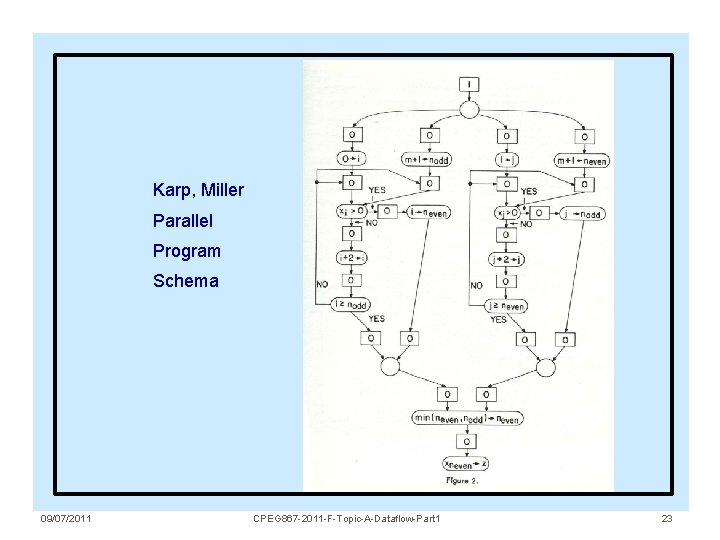
Karp, Miller Parallel Program Schema 09/07/2011 CPEG 867 -2011 -F-Topic-A-Dataflow-Part 1 23
Data Flow Years at MIT 1974 – 1975 • �� April 1974: Symposium on Programming, Paris. Dennis: “First Version of a Data Flow Procedure Language”. • �� January 1975: Second Annual Symposium on Computer Architecture, Houston. Dennis and Misunas: “A Preliminary Architecture for a Basic Data-Flow Processor”. • �� August 1975: 1975 Sagamore Computer Conference on Parallel Processing: • �� Rumbaugh: “Data Flow Languages” • �� Rumbaugh: “A Data Flow Multiprocessor” • �� Dennis: “Packet Communication Architecture” • �� Misunas: “Structure Processing in a Data-Flow Computer”. 09/07/2011 CPEG 867 -2011 -F-Topic-A-Dataflow-Part 1 24
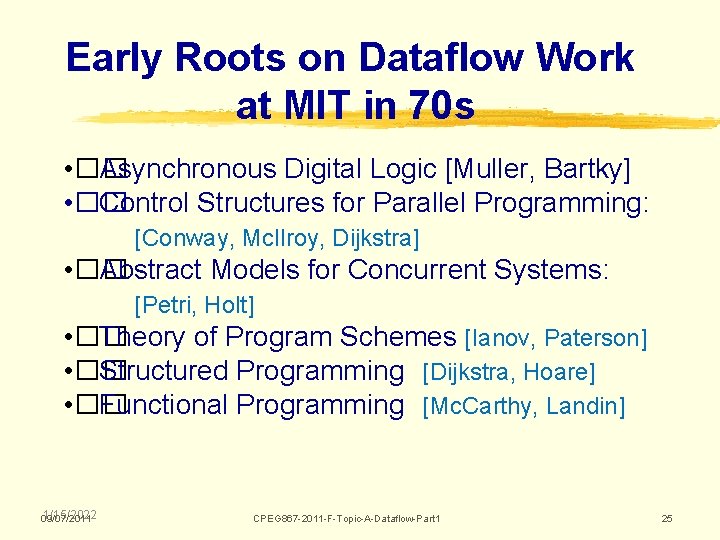
Early Roots on Dataflow Work at MIT in 70 s • �� Asynchronous Digital Logic [Muller, Bartky] • �� Control Structures for Parallel Programming: [Conway, Mc. Ilroy, Dijkstra] • �� Abstract Models for Concurrent Systems: [Petri, Holt] • �� Theory of Program Schemes [Ianov, Paterson] • �� Structured Programming [Dijkstra, Hoare] • �� Functional Programming [Mc. Carthy, Landin] 1/15/2022 09/07/2011 CPEG 867 -2011 -F-Topic-A-Dataflow-Part 1 25
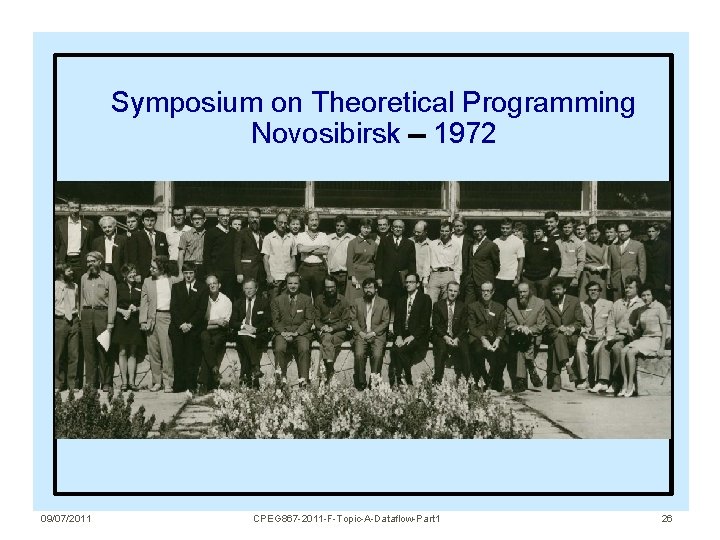
Symposium on Theoretical Programming Novosibirsk 1972 09/07/2011 CPEG 867 -2011 -F-Topic-A-Dataflow-Part 1 26
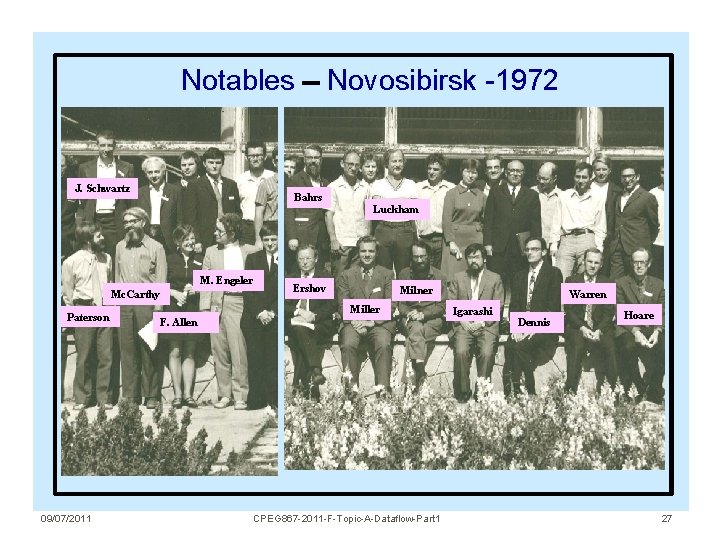
Notables J. Schwartz Bahrs M. Engeler Mc. Carthy Paterson 09/07/2011 Novosibirsk -1972 Luckham Ershov Milner Miller F. Allen CPEG 867 -2011 -F-Topic-A-Dataflow-Part 1 Warren Igarashi Dennis Hoare 27
Outline • • Parallel Program Execution Models Dataflow Models of Computation Dataflow Graphs and Properties Three Dataflow Models Static Recursive Program Graph Dynamic • Dataflow Architectures 09/07/2011 CPEG 867 -2011 -F-Topic-A-Dataflow-Part 1 28
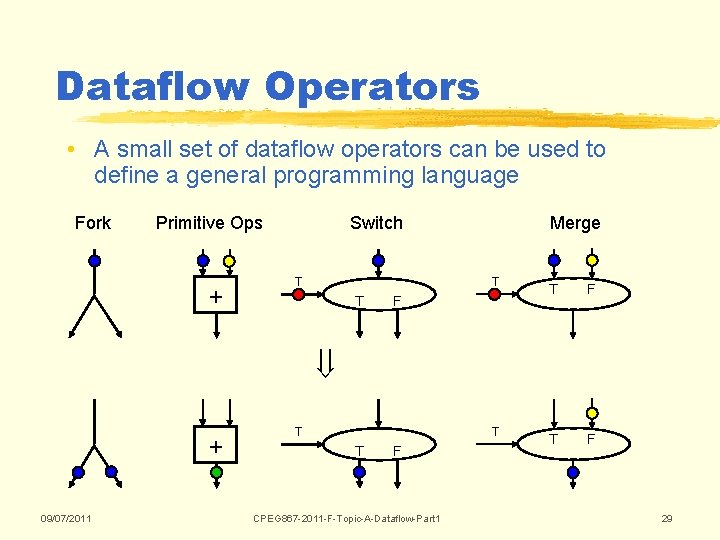
Dataflow Operators • A small set of dataflow operators can be used to define a general programming language Fork Primitive Ops + Switch T T Merge T T F F + 09/07/2011 T T F CPEG 867 -2011 -F-Topic-A-Dataflow-Part 1 29
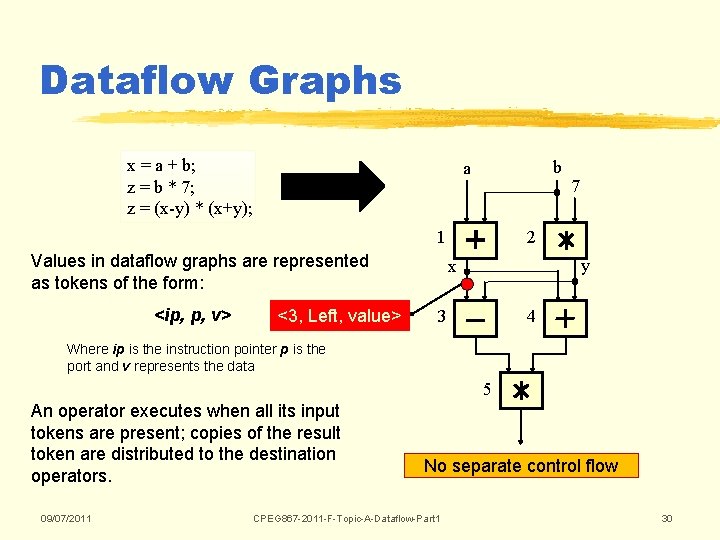
Dataflow Graphs x = a + b; z = b * 7; z = (x-y) * (x+y); b a 1 Values in dataflow graphs are represented as tokens of the form: <ip, p, v> <3, Left, value> 7 2 y x 3 4 Where ip is the instruction pointer p is the port and v represents the data 5 An operator executes when all its input tokens are present; copies of the result token are distributed to the destination operators. 09/07/2011 No separate control flow CPEG 867 -2011 -F-Topic-A-Dataflow-Part 1 30
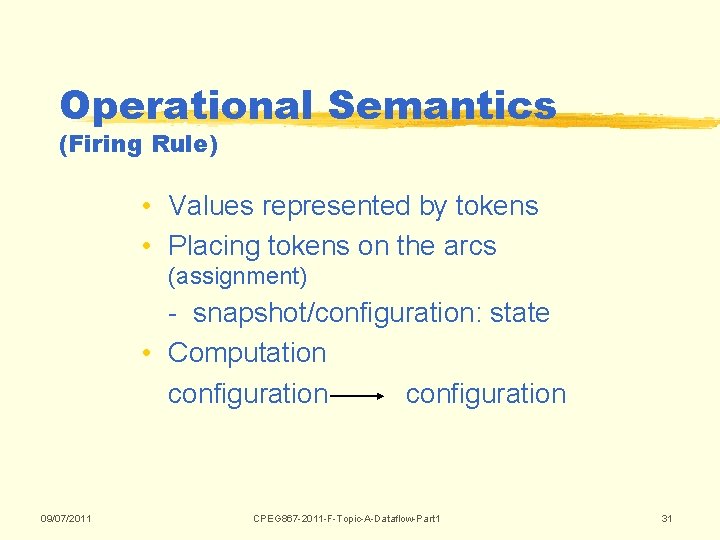
Operational Semantics (Firing Rule) • Values represented by tokens • Placing tokens on the arcs (assignment) - snapshot/configuration: state • Computation configuration 09/07/2011 CPEG 867 -2011 -F-Topic-A-Dataflow-Part 1 31
Operational Semantics Firing Rule • Tokens Data • Assignment Placing a token in the output arc • Snapshot / configuration: state • Computation The intermediate step between snapshots / configurations • An actor of a dataflow graph is enabled if there is a token on each of its input arcs 09/07/2011 CPEG 867 -2011 -F-Topic-A-Dataflow-Part 1 32
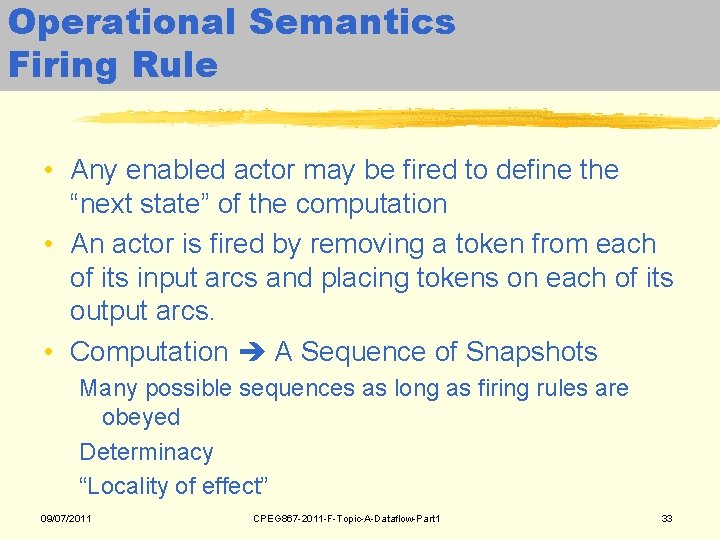
Operational Semantics Firing Rule • Any enabled actor may be fired to define the “next state” of the computation • An actor is fired by removing a token from each of its input arcs and placing tokens on each of its output arcs. • Computation A Sequence of Snapshots Many possible sequences as long as firing rules are obeyed Determinacy “Locality of effect” 09/07/2011 CPEG 867 -2011 -F-Topic-A-Dataflow-Part 1 33
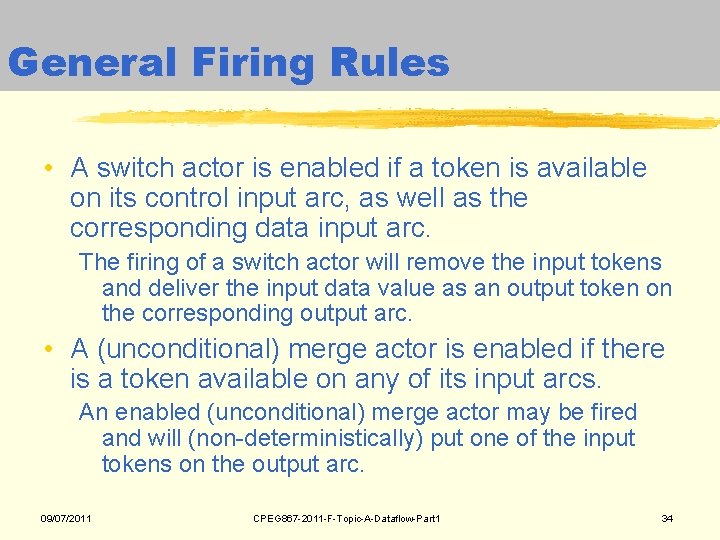
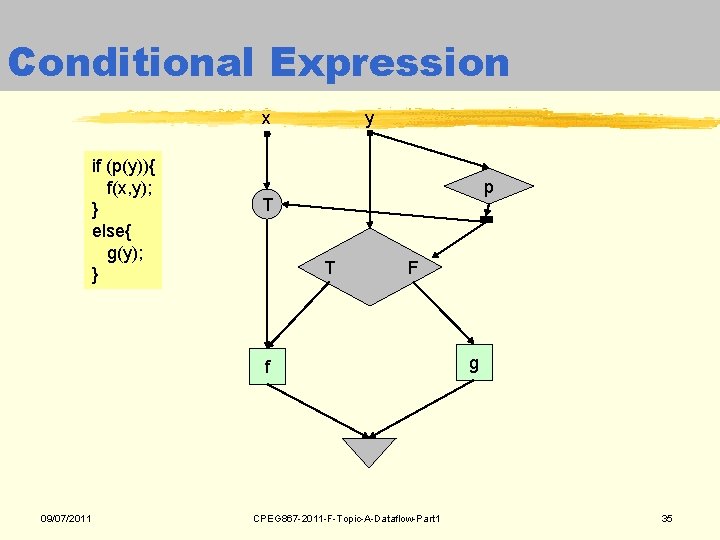
General Firing Rules • A switch actor is enabled if a token is available on its control input arc, as well as the corresponding data input arc. The firing of a switch actor will remove the input tokens and deliver the input data value as an output token on the corresponding output arc. • A (unconditional) merge actor is enabled if there is a token available on any of its input arcs. An enabled (unconditional) merge actor may be fired and will (non-deterministically) put one of the input tokens on the output arc. 09/07/2011 CPEG 867 -2011 -F-Topic-A-Dataflow-Part 1 34
Conditional Expression x if (p(y)){ f(x, y); } else{ g(y); } y p T T F f 09/07/2011 CPEG 867 -2011 -F-Topic-A-Dataflow-Part 1 g 35
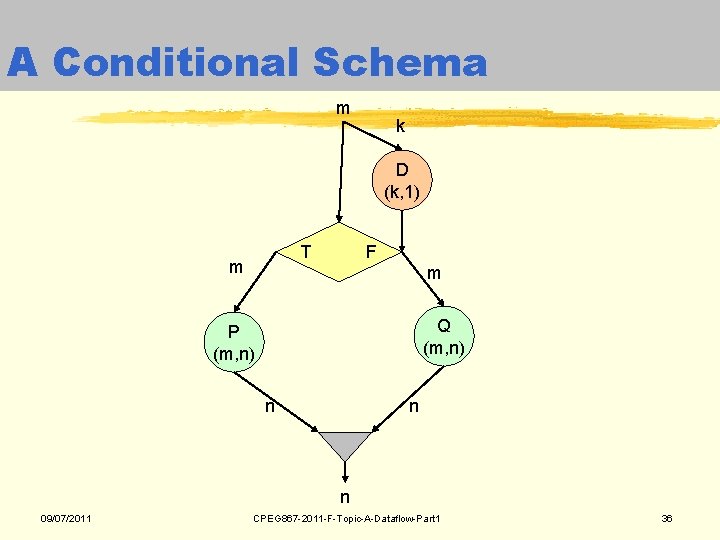
A Conditional Schema m k D (k, 1) T m F m Q (m, n) P (m, n) n n n 09/07/2011 CPEG 867 -2011 -F-Topic-A-Dataflow-Part 1 36
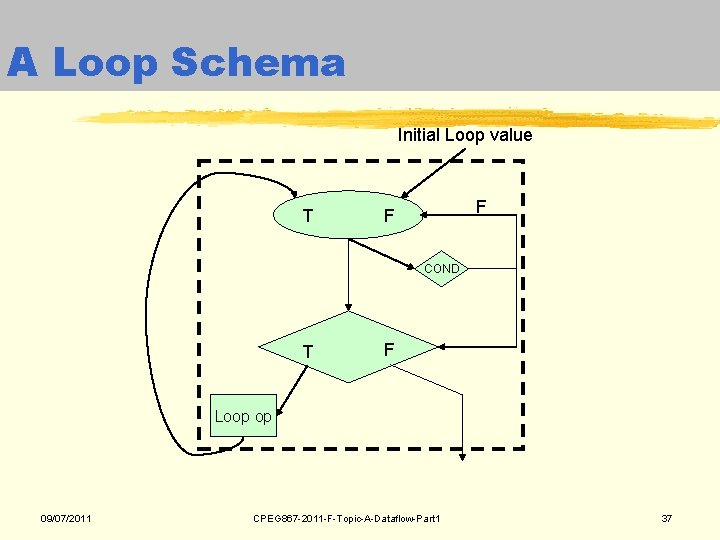
A Loop Schema Initial Loop value T F F COND T F Loop op 09/07/2011 CPEG 867 -2011 -F-Topic-A-Dataflow-Part 1 37
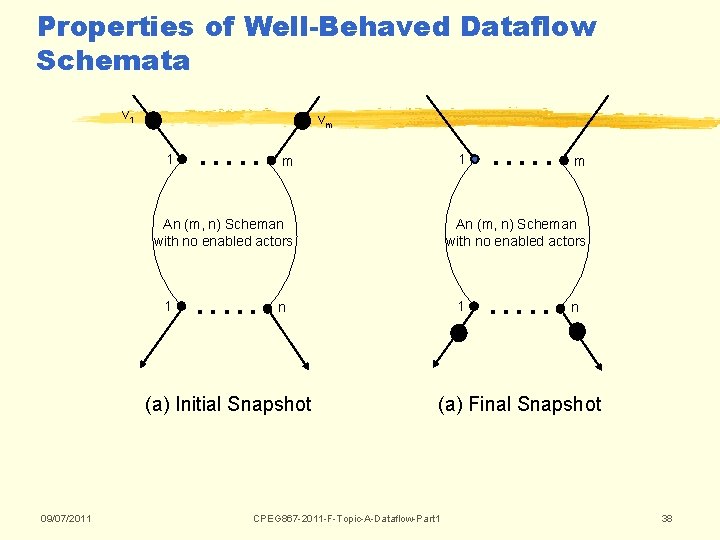
Properties of Well-Behaved Dataflow Schemata v 1 1 . . . vm 1 m An (m, n) Scheman with no enabled actors 1 . . . 09/07/2011 m An (m, n) Scheman with no enabled actors 1 n (a) Initial Snapshot . . n (a) Final Snapshot CPEG 867 -2011 -F-Topic-A-Dataflow-Part 1 38
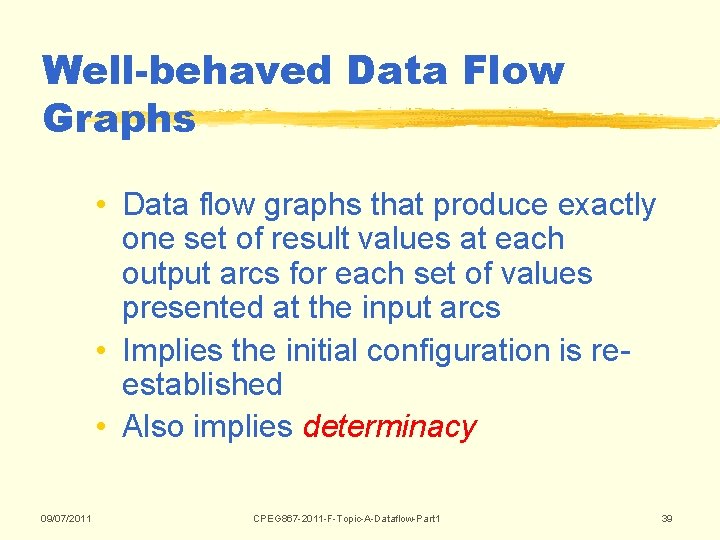
Well-behaved Data Flow Graphs • Data flow graphs that produce exactly one set of result values at each output arcs for each set of values presented at the input arcs • Implies the initial configuration is reestablished • Also implies determinacy 09/07/2011 CPEG 867 -2011 -F-Topic-A-Dataflow-Part 1 39
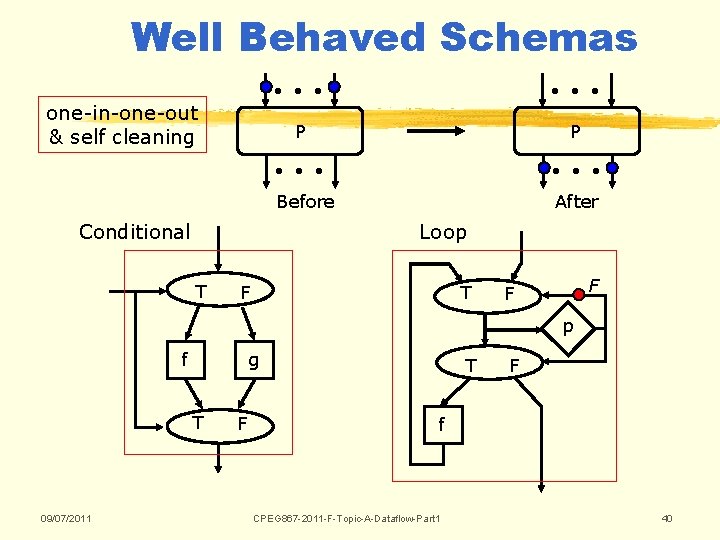
Well Behaved Schemas one-in-one-out & self cleaning Conditional • • • P P • • • Before After Loop T F F p f g T 09/07/2011 F T F f CPEG 867 -2011 -F-Topic-A-Dataflow-Part 1 40
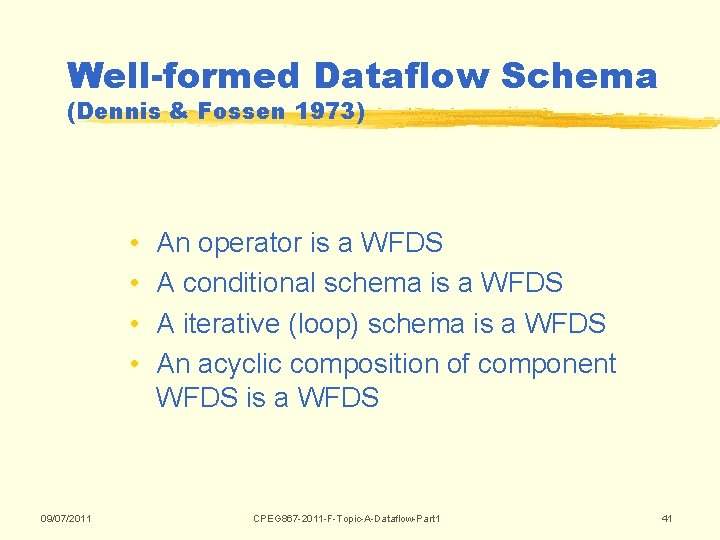
Well-formed Dataflow Schema (Dennis & Fossen 1973) • • 09/07/2011 An operator is a WFDS A conditional schema is a WFDS A iterative (loop) schema is a WFDS An acyclic composition of component WFDS is a WFDS CPEG 867 -2011 -F-Topic-A-Dataflow-Part 1 41
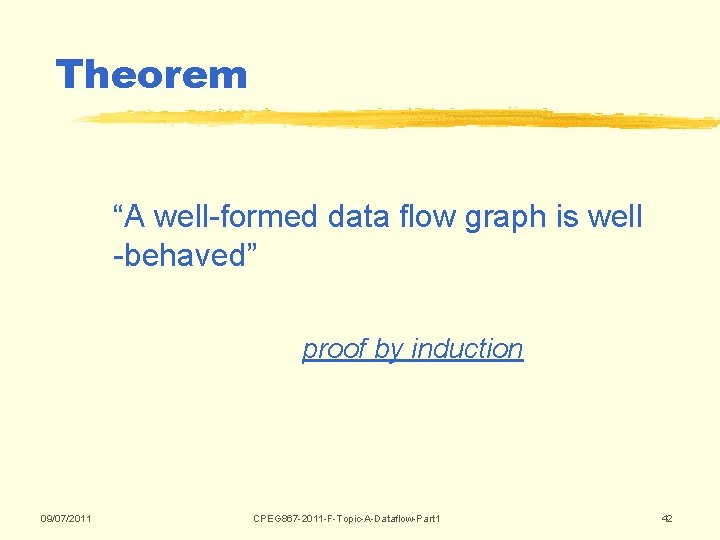
Theorem “A well-formed data flow graph is well -behaved” proof by induction 09/07/2011 CPEG 867 -2011 -F-Topic-A-Dataflow-Part 1 42
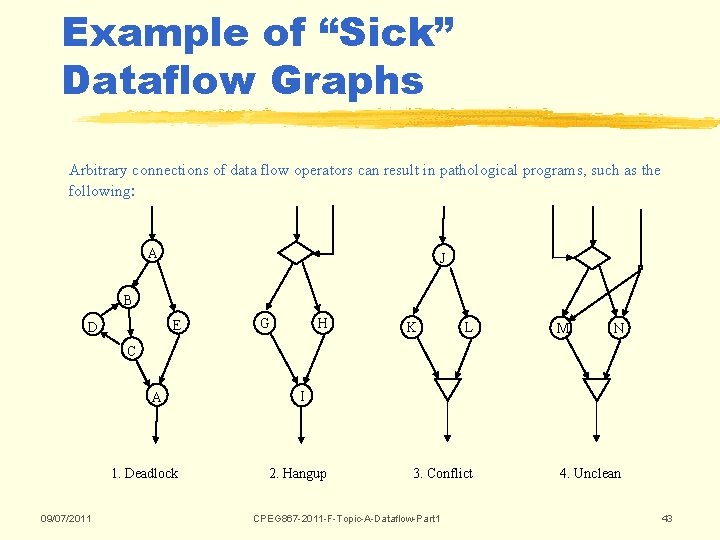
Example of “Sick” Dataflow Graphs Arbitrary connections of data flow operators can result in pathological programs, such as the following: A J B E D G H K L M N C A 1. Deadlock 09/07/2011 I 2. Hangup 3. Conflict CPEG 867 -2011 -F-Topic-A-Dataflow-Part 1 4. Unclean 43
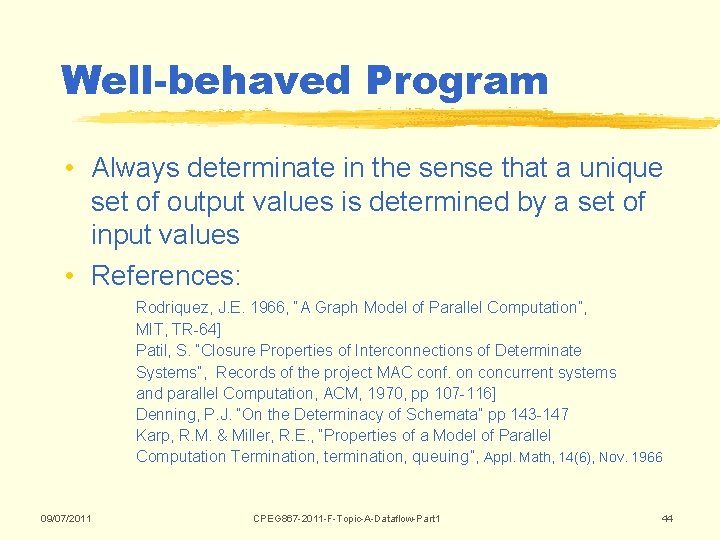
Well-behaved Program • Always determinate in the sense that a unique set of output values is determined by a set of input values • References: Rodriquez, J. E. 1966, “A Graph Model of Parallel Computation”, MIT, TR-64] Patil, S. “Closure Properties of Interconnections of Determinate Systems”, Records of the project MAC conf. on concurrent systems and parallel Computation, ACM, 1970, pp 107 -116] Denning, P. J. “On the Determinacy of Schemata” pp 143 -147 Karp, R. M. & Miller, R. E. , “Properties of a Model of Parallel Computation Termination, termination, queuing”, Appl. Math, 14(6), Nov. 1966 09/07/2011 CPEG 867 -2011 -F-Topic-A-Dataflow-Part 1 44
Remarks on Dataflow Models • A fundamentally sound and simple parallel model of computation (features very few other parallel models can claim) • Few dataflow architecture projects survived passing early 1990 s. But the ideas and models live on. . • In the new multi-core age: we have many reasons to re-examine and explore the original dataflow models and learn from the past 09/07/2011 CPEG 867 -2011 -F-Topic-A-Dataflow-Part 1 45
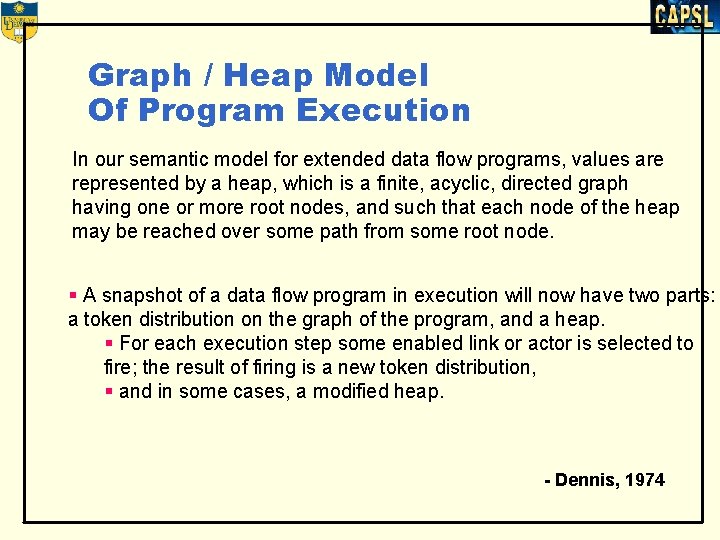
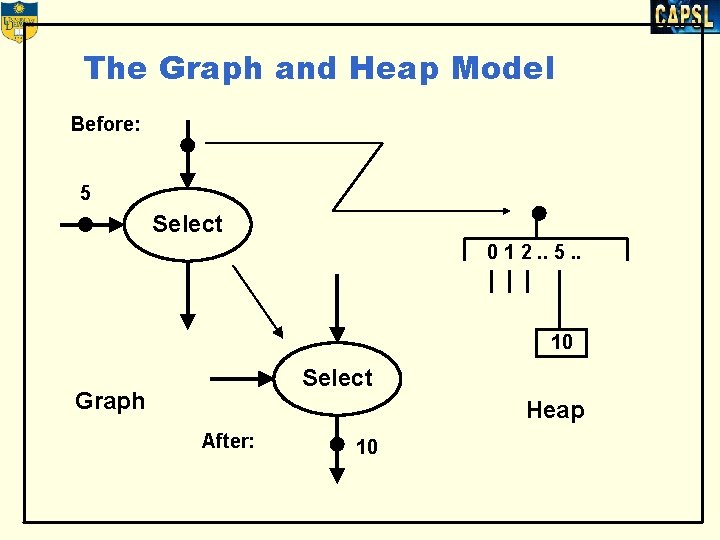
Graph / Heap Model Of Program Execution In our semantic model for extended data flow programs, values are represented by a heap, which is a finite, acyclic, directed graph having one or more root nodes, and such that each node of the heap may be reached over some path from some root node. § A snapshot of a data flow program in execution will now have two parts: a token distribution on the graph of the program, and a heap. § For each execution step some enabled link or actor is selected to fire; the result of firing is a new token distribution, § and in some cases, a modified heap. - Dennis, 1974
The Graph and Heap Model Before: 5 Select 0 1 2. . 5. . 10 Select Graph Heap After: 10
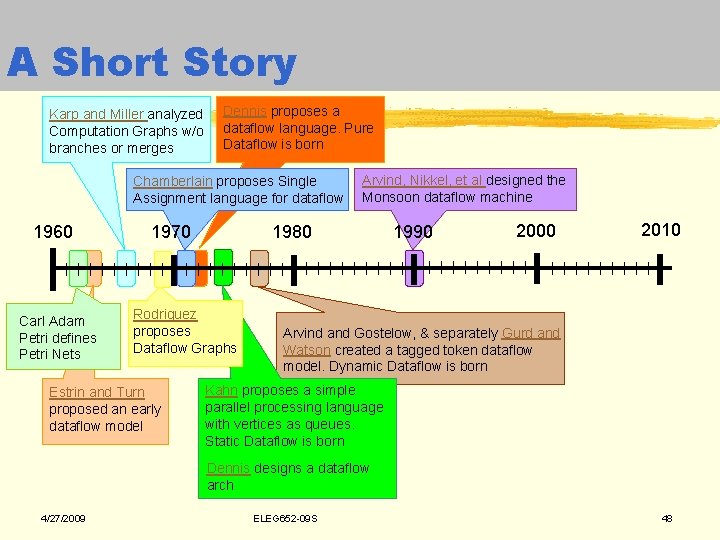
A Short Story Karp and Miller analyzed Computation Graphs w/o branches or merges Dennis proposes a dataflow language. Pure Dataflow is born Chamberlain proposes Single Assignment language for dataflow 1960 Carl Adam Petri defines Petri Nets 1970 1980 Rodriguez proposes Dataflow Graphs Estrin and Turn proposed an early dataflow model Arvind, Nikkel, et al designed the Monsoon dataflow machine 1990 2000 2010 Arvind and Gostelow, & separately Gurd and Watson created a tagged token dataflow model. Dynamic Dataflow is born Kahn proposes a simple parallel processing language with vertices as queues. Static Dataflow is born Dennis designs a dataflow arch 4/27/2009 ELEG 652 -09 S 48
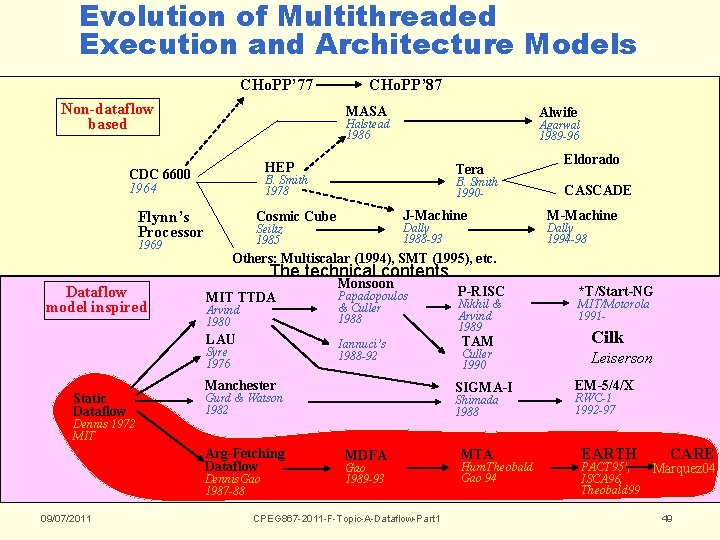
Evolution of Multithreaded Execution and Architecture Models CHo. PP’ 77 Non-dataflow based CHo. PP’ 87 MASA Alwife Halstead 1986 Agarwal 1989 -96 HEP CDC 6600 1964 Tera B. Smith 1978 Flynn’s Processor B. Smith 1990 - J-Machine Cosmic Cube Dally 1988 -93 Seiltz 1985 1969 Eldorado CASCADE M-Machine Dally 1994 -98 Others: Multiscalar (1994), SMT (1995), etc. The technical contents Dataflow model inspired MIT TTDA Arvind 1980 LAU Syre 1976 Static Dataflow Monsoon Papadopoulos & Culler 1988 P-RISC Iannuci’s 1988 -92 TAM Manchester Shimada 1988 Dennis 1972 MIT Dennis. Gao 1987 -88 09/07/2011 Culler 1990 SIGMA-I Gurd & Watson 1982 Arg-Fetching Dataflow Nikhil & Arvind 1989 MDFA Gao 1989 -93 CPEG 867 -2011 -F-Topic-A-Dataflow-Part 1 MTA Hum. Theobald Gao 94 *T/Start-NG MIT/Motorola 1991 - Cilk Leiserson EM-5/4/X RWC-1 1992 -97 EARTH PACT 95’, ISCA 96, Theobald 99 CARE Marquez 04 49
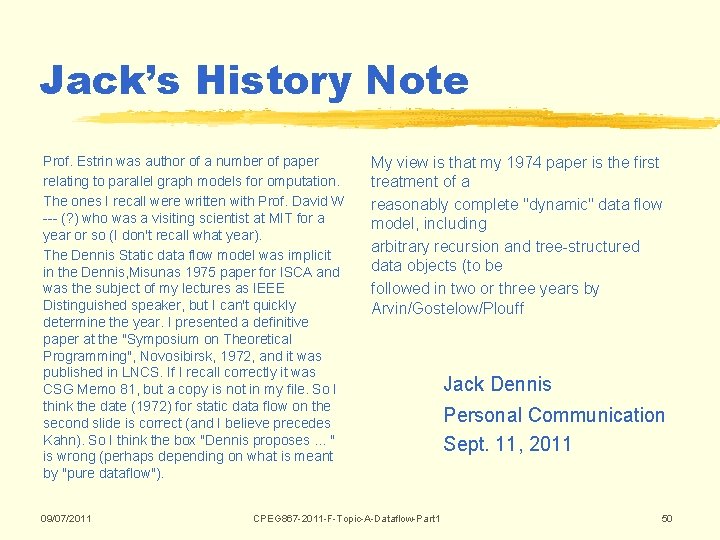
Jack’s History Note Prof. Estrin was author of a number of paper relating to parallel graph models for omputation. The ones I recall were written with Prof. David W --- (? ) who was a visiting scientist at MIT for a year or so (I don't recall what year). The Dennis Static data flow model was implicit in the Dennis, Misunas 1975 paper for ISCA and was the subject of my lectures as IEEE Distinguished speaker, but I can't quickly determine the year. I presented a definitive paper at the "Symposium on Theoretical Programming", Novosibirsk, 1972, and it was published in LNCS. If I recall correctly it was CSG Memo 81, but a copy is not in my file. So I think the date (1972) for static data flow on the second slide is correct (and I believe precedes Kahn). So I think the box "Dennis proposes. . . " is wrong (perhaps depending on what is meant by "pure dataflow"). 09/07/2011 My view is that my 1974 paper is the first treatment of a reasonably complete "dynamic" data flow model, including arbitrary recursion and tree-structured data objects (to be followed in two or three years by Arvin/Gostelow/Plouff CPEG 867 -2011 -F-Topic-A-Dataflow-Part 1 Jack Dennis Personal Communication Sept. 11, 2011 50
Some Note on History 09/07/2011 CPEG 867 -2011 -F-Topic-A-Dataflow-Part 1 51
Some History on Dataflow 09/07/2011 CPEG 867 -2011 -F-Topic-A-Dataflow-Part 1 52