
Topic 9 Procedures CSE 30 Computer Organization and
![Basic Structure of a Function Prologue entry_label: ADD sp, -framesize STR lr, [sp, #framesize-4]](https://slidetodoc.com/presentation_image_h2/876853966b7311c96b3955a8476d9dc2/image-23.jpg "Basic Structure of a Function Prologue entry_label: ADD sp, -framesize STR lr, [sp, #framesize-4]")
- Slides: 30
Topic 9: Procedures CSE 30: Computer Organization and Systems Programming Winter 2011 Prof. Ryan Kastner Dept. of Computer Science and Engineering University of California, San Diego
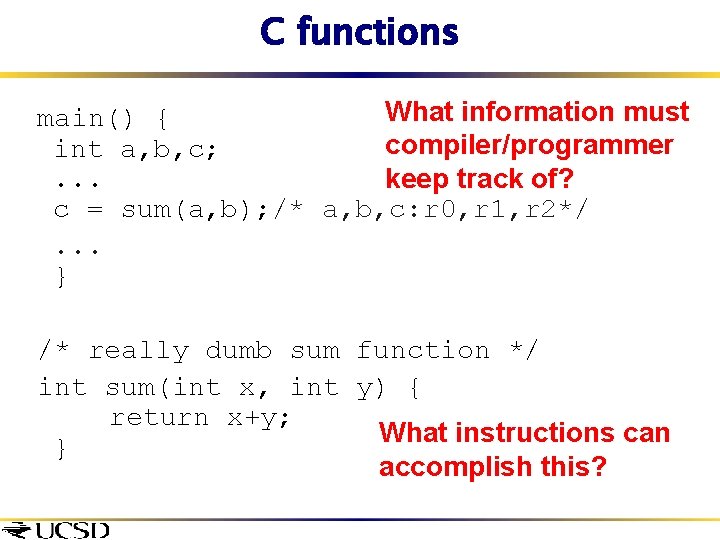
C functions What information must main() { compiler/programmer int a, b, c; . . . keep track of? c = sum(a, b); /* a, b, c: r 0, r 1, r 2*/. . . } /* really dumb sum function */ int sum(int x, int y) { return x+y; What instructions can } accomplish this?
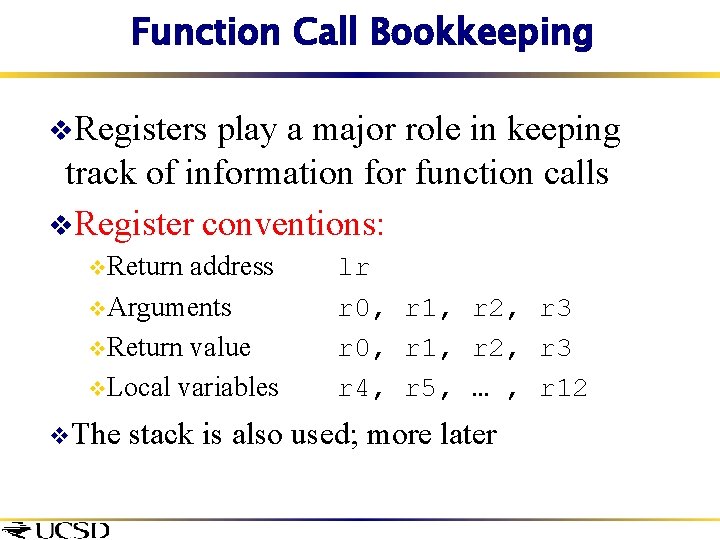
Function Call Bookkeeping v. Registers play a major role in keeping track of information for function calls v. Register conventions: v. Return address v. Arguments v. Return value v. Local variables v. The lr r 0, r 1, r 2, r 3 r 4, r 5, … , r 12 stack is also used; more later
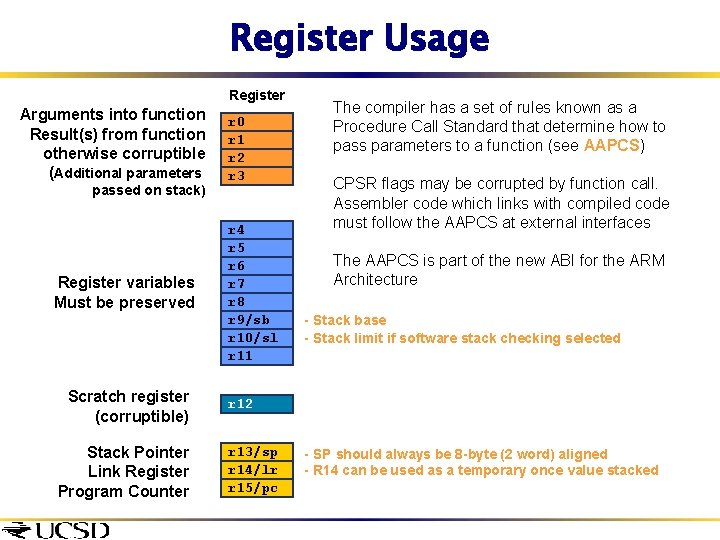
Register Usage Register Arguments into function Result(s) from function otherwise corruptible (Additional parameters passed on stack) Register variables Must be preserved Scratch register (corruptible) Stack Pointer Link Register Program Counter r 0 r 1 r 2 r 3 r 4 r 5 r 6 r 7 r 8 r 9/sb r 10/sl r 11 The compiler has a set of rules known as a Procedure Call Standard that determine how to pass parameters to a function (see AAPCS) CPSR flags may be corrupted by function call. Assembler code which links with compiled code must follow the AAPCS at external interfaces The AAPCS is part of the new ABI for the ARM Architecture - Stack base - Stack limit if software stack checking selected r 12 r 13/sp r 14/lr r 15/pc - SP should always be 8 -byte (2 word) aligned - R 14 can be used as a temporary once value stacked
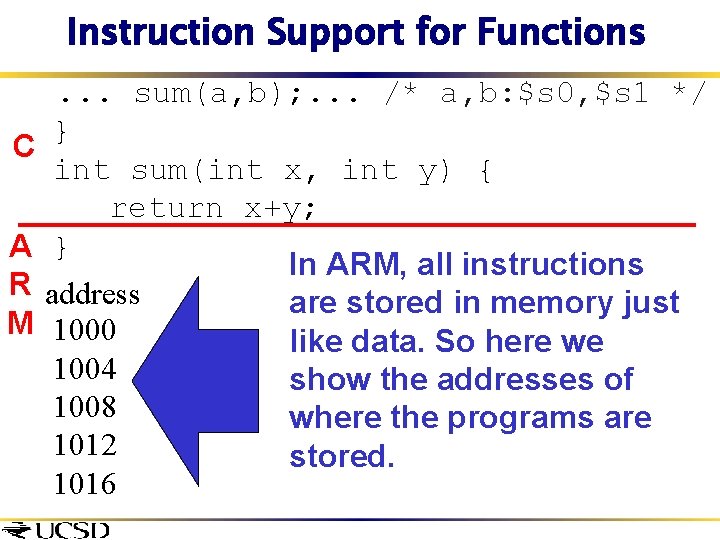
Instruction Support for Functions. . . sum(a, b); . . . /* a, b: $s 0, $s 1 */ } C int sum(int x, int y) { return x+y; A } In ARM, all instructions R address are stored in memory just M 1000 like data. So here we 1004 show the addresses of 1008 where the programs are 1012 stored. 1016
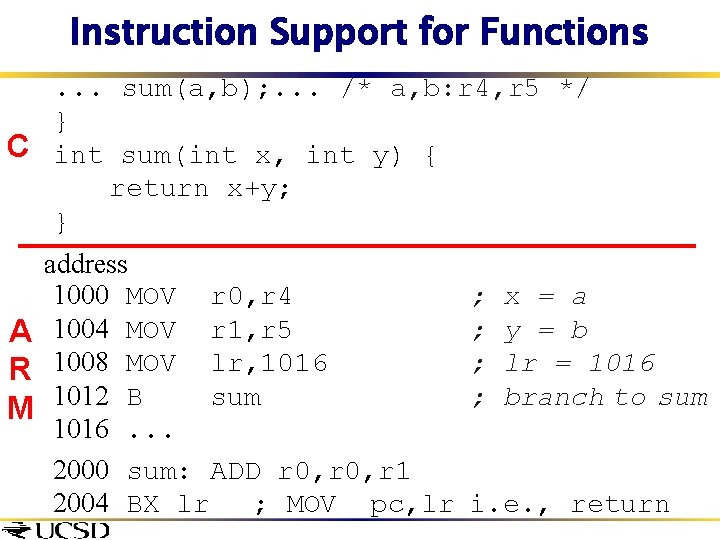
Instruction Support for Functions. . . sum(a, b); . . . /* a, b: r 4, r 5 */ } C int sum(int x, int y) { return x+y; } address 1000 MOV r 0, r 4 A 1004 MOV r 1, r 5 R 1008 MOV lr, 1016 sum M 1012 B 1016. . . 2000 sum: ADD r 0, r 1 2004 BX lr ; MOV pc, lr ; ; x = a y = b lr = 1016 branch to sum i. e. , return
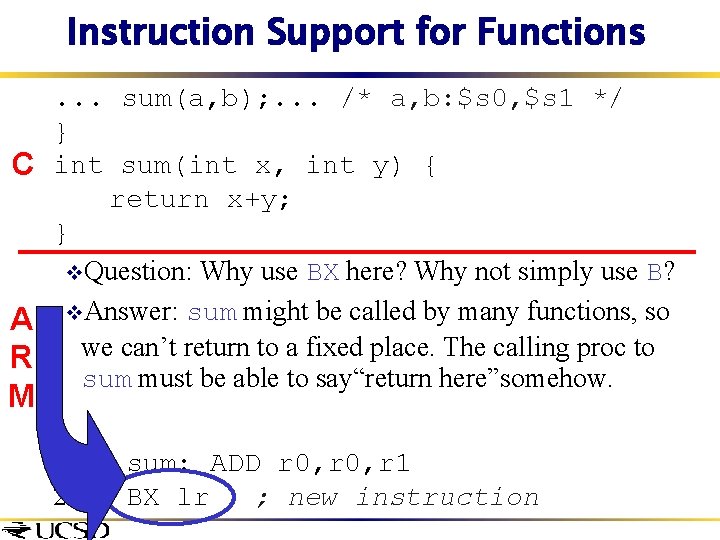
Instruction Support for Functions. . . sum(a, b); . . . /* a, b: $s 0, $s 1 */ } C int sum(int x, int y) { return x+y; } v. Question: Why use BX here? Why not simply use B? A v. Answer: sum might be called by many functions, so we can’t return to a fixed place. The calling proc to R sum must be able to say“return here”somehow. M 2000 sum: ADD r 0, r 1 2004 BX lr ; new instruction
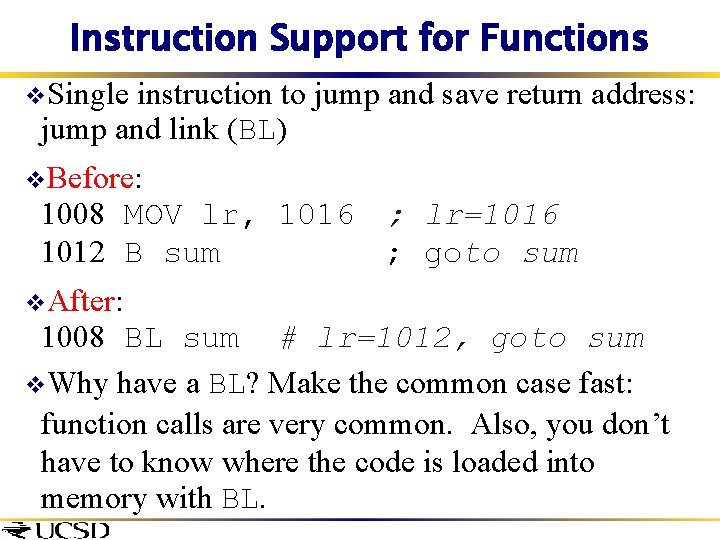
Instruction Support for Functions v. Single instruction to jump and save return address: jump and link (BL) v. Before: 1008 MOV lr, 1016 ; lr=1016 1012 B sum ; goto sum v. After: 1008 BL sum # lr=1012, goto sum v. Why have a BL? Make the common case fast: function calls are very common. Also, you don’t have to know where the code is loaded into memory with BL.
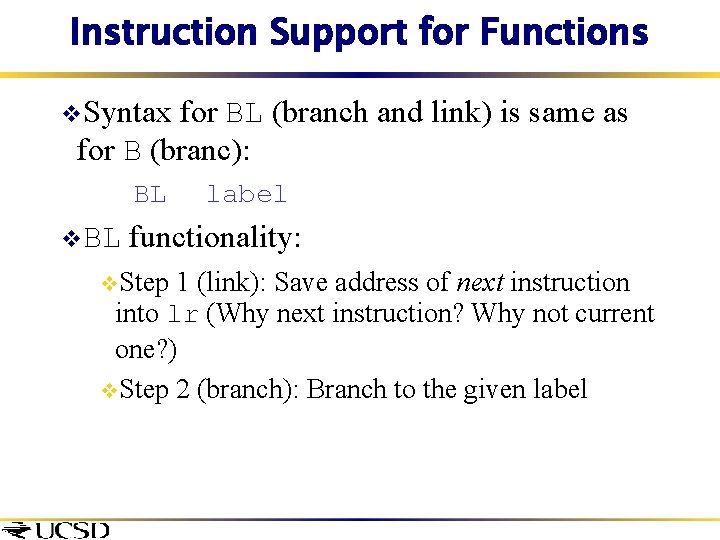
Instruction Support for Functions v. Syntax for BL (branch and link) is same as for B (branc): BL v. BL label functionality: v. Step 1 (link): Save address of next instruction into lr (Why next instruction? Why not current one? ) v. Step 2 (branch): Branch to the given label
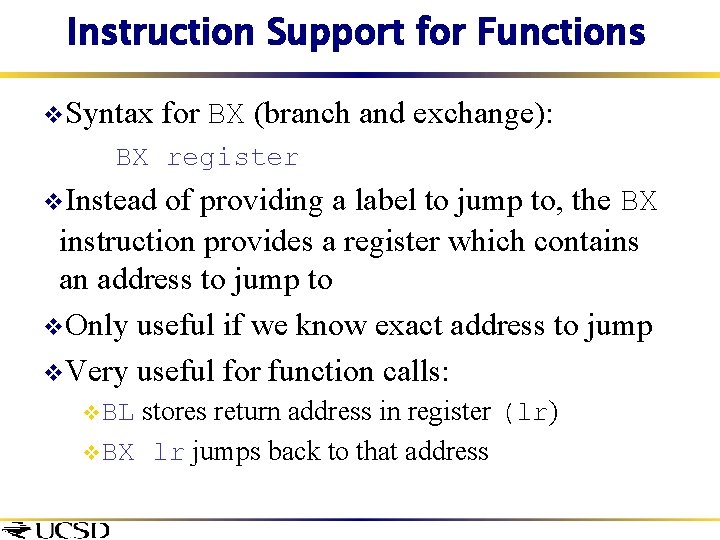
Instruction Support for Functions v. Syntax for BX (branch and exchange): BX register v. Instead of providing a label to jump to, the BX instruction provides a register which contains an address to jump to v. Only useful if we know exact address to jump v. Very useful for function calls: stores return address in register (lr) v. BX lr jumps back to that address v. BL
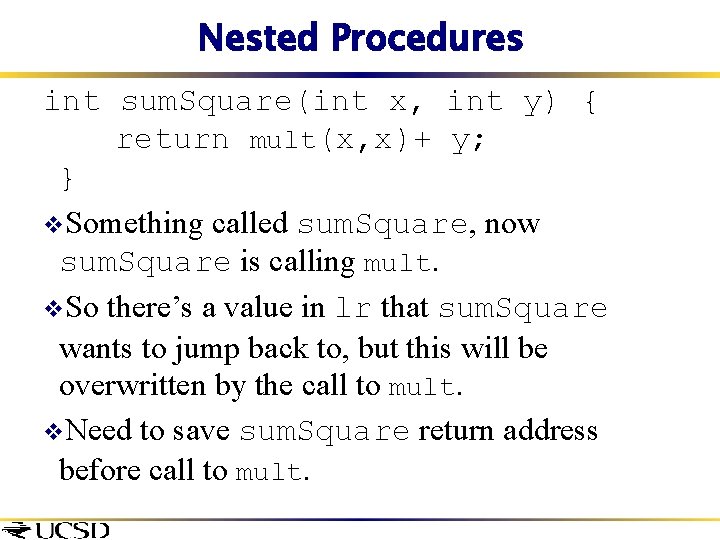
Nested Procedures int sum. Square(int x, int y) { return mult(x, x)+ y; } v. Something called sum. Square, now sum. Square is calling mult. v. So there’s a value in lr that sum. Square wants to jump back to, but this will be overwritten by the call to mult. v. Need to save sum. Square return address before call to mult.
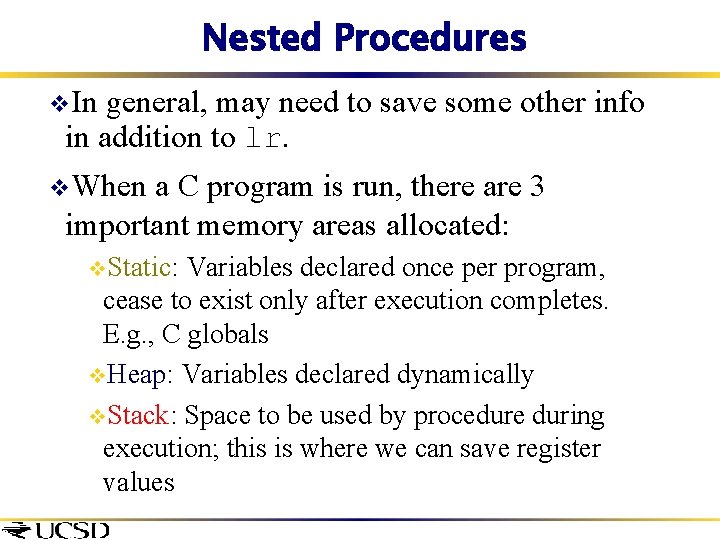
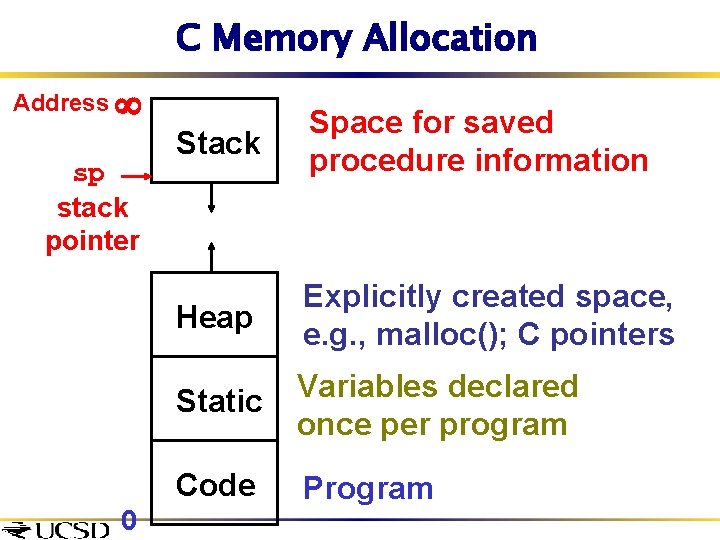
Nested Procedures v. In general, may need to save some other info in addition to lr. v. When a C program is run, there are 3 important memory areas allocated: v. Static: Variables declared once per program, cease to exist only after execution completes. E. g. , C globals v. Heap: Variables declared dynamically v. Stack: Space to be used by procedure during execution; this is where we can save register values
C Memory Allocation Address ¥ sp stack pointer 0 Stack Space for saved procedure information Heap Explicitly created space, e. g. , malloc(); C pointers Static Variables declared once per program Code Program
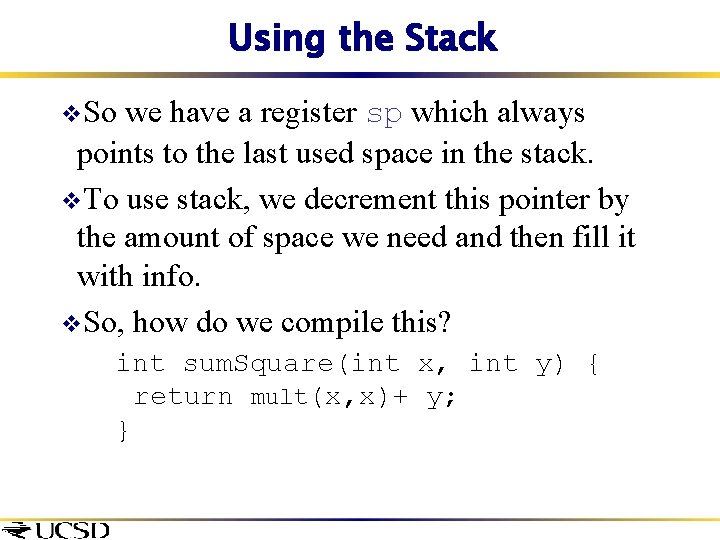
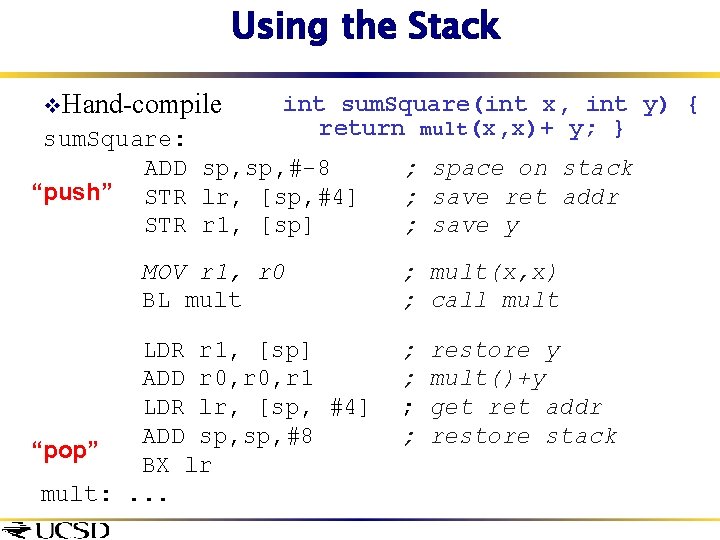
Using the Stack v. So we have a register sp which always points to the last used space in the stack. v. To use stack, we decrement this pointer by the amount of space we need and then fill it with info. v. So, how do we compile this? int sum. Square(int x, int y) { return mult(x, x)+ y; }
Using the Stack v. Hand-compile int sum. Square(int x, int y) { return mult(x, x)+ y; } sum. Square: ADD sp, #-8 “push” STR lr, [sp, #4] STR r 1, [sp] MOV r 1, r 0 BL mult LDR r 1, [sp] ADD r 0, r 1 LDR lr, [sp, #4] ADD sp, #8 “pop” BX lr mult: . . . ; space on stack ; save ret addr ; save y ; mult(x, x) ; call mult ; ; restore y mult()+y get ret addr restore stack
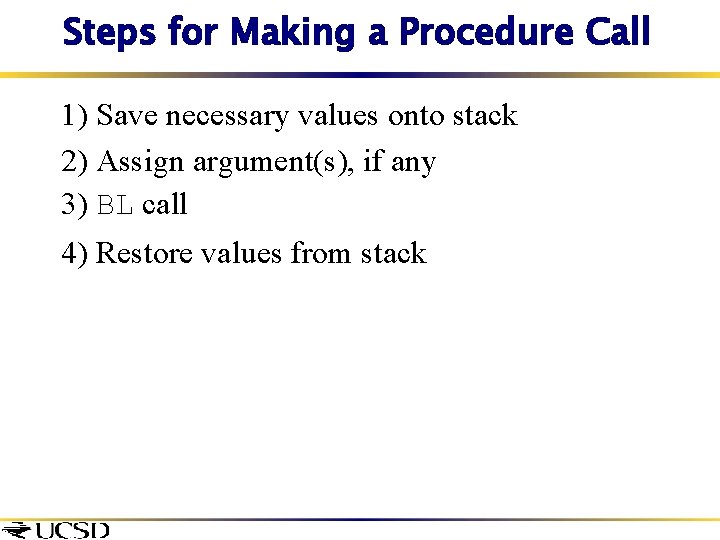
Steps for Making a Procedure Call 1) Save necessary values onto stack 2) Assign argument(s), if any 3) BL call 4) Restore values from stack
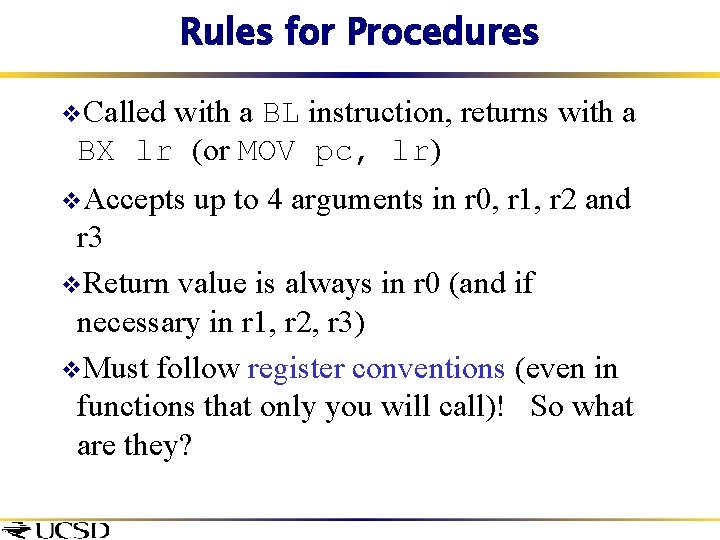
Rules for Procedures v. Called with a BL instruction, returns with a BX lr (or MOV pc, lr) v. Accepts up to 4 arguments in r 0, r 1, r 2 and r 3 v. Return value is always in r 0 (and if necessary in r 1, r 2, r 3) v. Must follow register conventions (even in functions that only you will call)! So what are they?
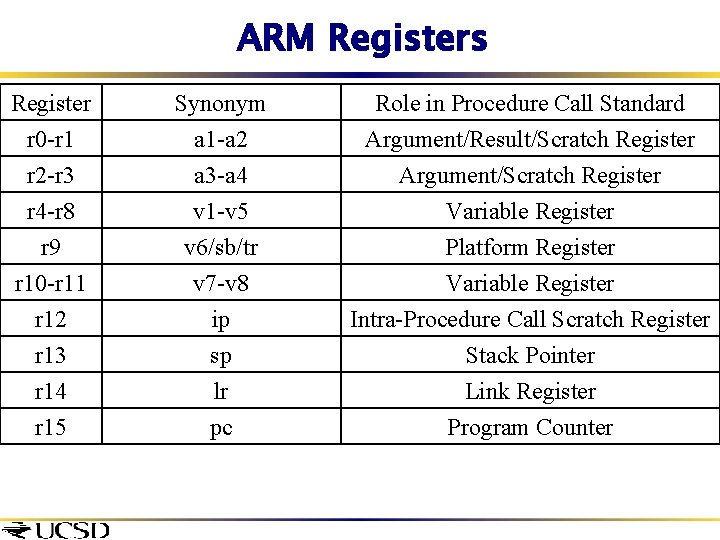
ARM Registers Register r 0 -r 1 r 2 -r 3 r 4 -r 8 Synonym a 1 -a 2 a 3 -a 4 v 1 -v 5 Role in Procedure Call Standard Argument/Result/Scratch Register Argument/Scratch Register Variable Register r 9 r 10 -r 11 r 12 r 13 r 14 r 15 v 6/sb/tr v 7 -v 8 ip sp lr pc Platform Register Variable Register Intra-Procedure Call Scratch Register Stack Pointer Link Register Program Counter
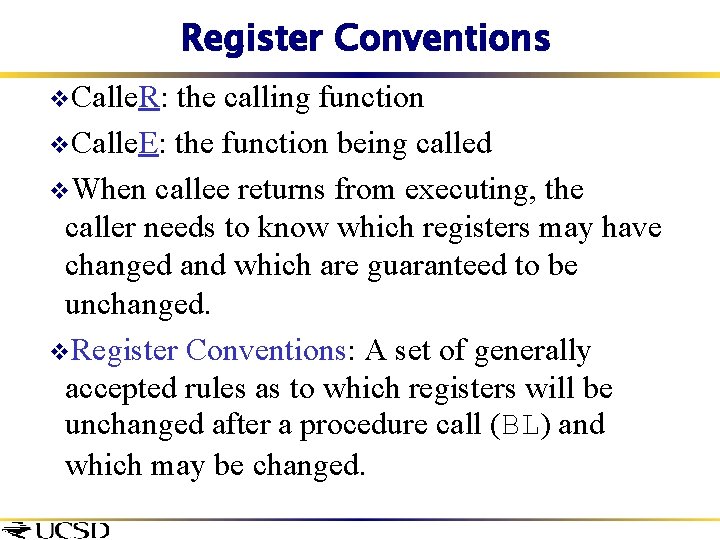
Register Conventions v. Calle. R: the calling function v. Calle. E: the function being called v. When callee returns from executing, the caller needs to know which registers may have changed and which are guaranteed to be unchanged. v. Register Conventions: A set of generally accepted rules as to which registers will be unchanged after a procedure call (BL) and which may be changed.
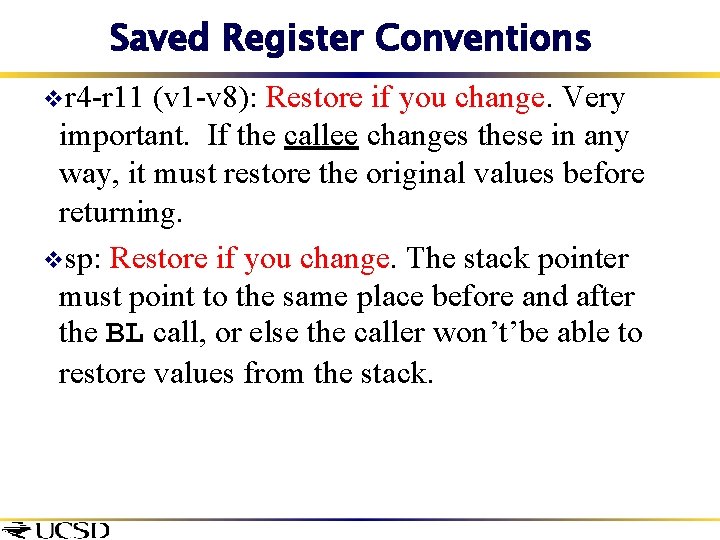
Saved Register Conventions vr 4 -r 11 (v 1 -v 8): Restore if you change. Very important. If the callee changes these in any way, it must restore the original values before returning. vsp: Restore if you change. The stack pointer must point to the same place before and after the BL call, or else the caller won’t’be able to restore values from the stack.
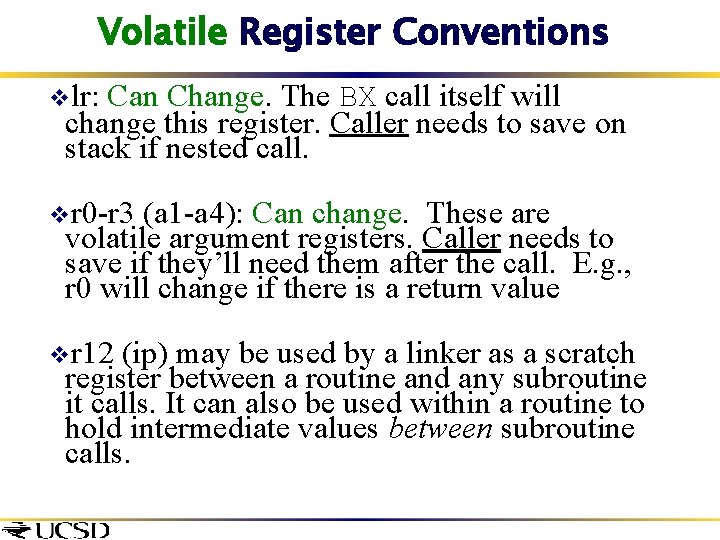
Volatile Register Conventions vlr: Can Change. The BX call itself will change this register. Caller needs to save on stack if nested call. vr 0 -r 3 (a 1 -a 4): Can change. These are volatile argument registers. Caller needs to save if they’ll need them after the call. E. g. , r 0 will change if there is a return value vr 12 (ip) may be used by a linker as a scratch register between a routine and any subroutine it calls. It can also be used within a routine to hold intermediate values between subroutine calls.
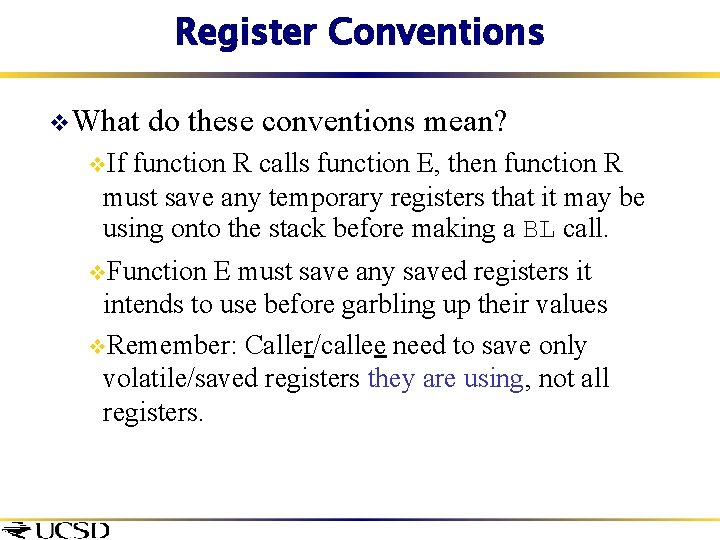
Register Conventions v. What do these conventions mean? v. If function R calls function E, then function R must save any temporary registers that it may be using onto the stack before making a BL call. v. Function E must save any saved registers it intends to use before garbling up their values v. Remember: Caller/callee need to save only volatile/saved registers they are using, not all registers.
Basic Structure of a Function Prologue entry_label: ADD sp, -framesize STR lr, [sp, #framesize-4] ; save lr save other regs if need be ra Body. . . (call other functions…) Epilogue restore other regs if need be memory LDR lr, [$sp, framesize-4] ; restore lr ADD sp, #framesize BX lr
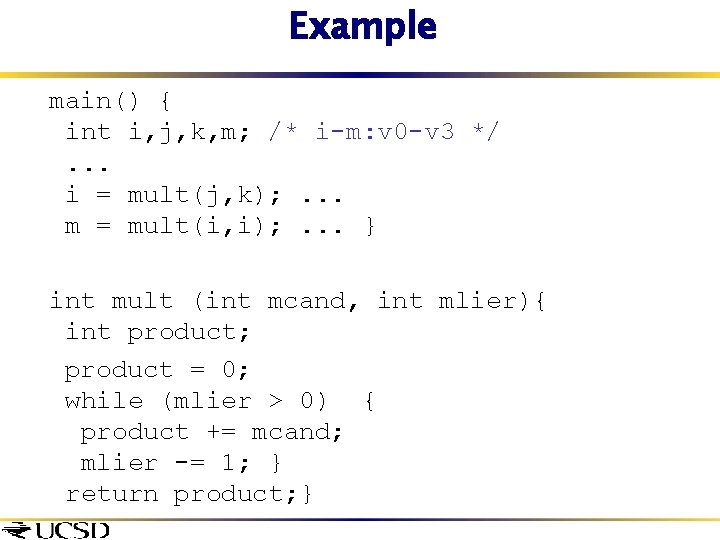
Example main() { int i, j, k, m; /* i-m: v 0 -v 3 */. . . i = mult(j, k); . . . m = mult(i, i); . . . } int mult (int mcand, int mlier){ int product; product = 0; while (mlier > 0) { product += mcand; mlier -= 1; } return product; }
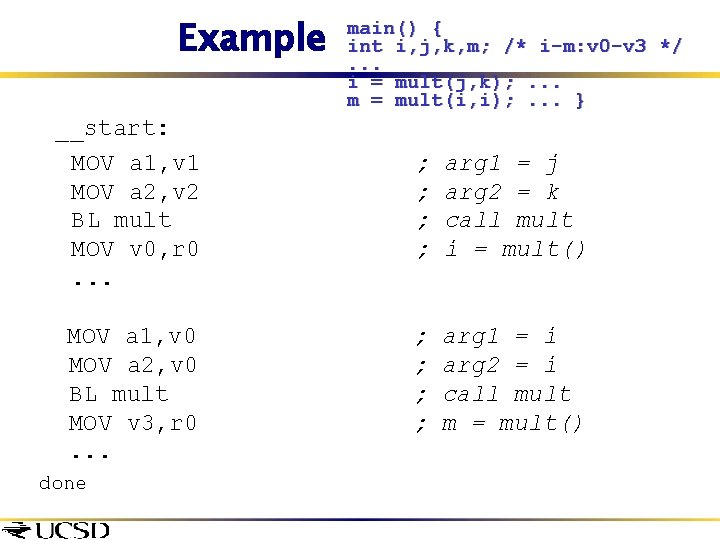
Example __start: MOV a 1, v 1 MOV a 2, v 2 BL mult MOV v 0, r 0. . . MOV a 1, v 0 MOV a 2, v 0 BL mult MOV v 3, r 0. . . done main() { int i, j, k, m; /* i-m: v 0 -v 3 */. . . i = mult(j, k); . . . m = mult(i, i); . . . } ; ; arg 1 = j arg 2 = k call mult i = mult() ; ; arg 1 = i arg 2 = i call mult m = mult()
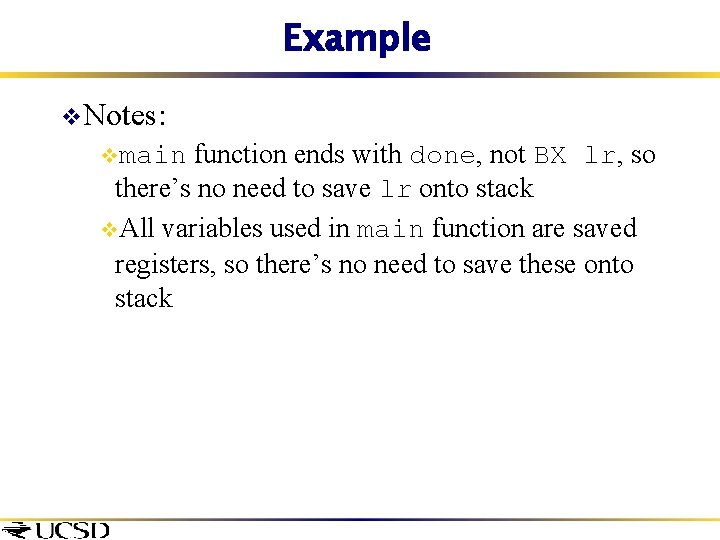
Example v. Notes: function ends with done, not BX lr, so there’s no need to save lr onto stack v. All variables used in main function are saved registers, so there’s no need to save these onto stack vmain
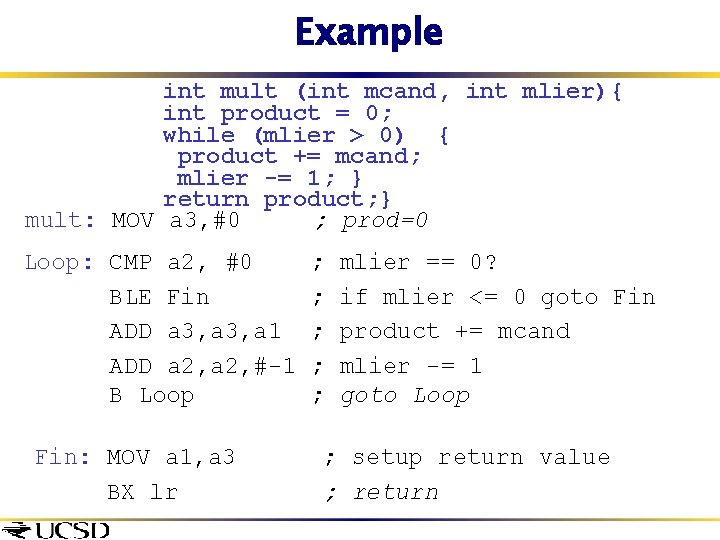
Example int mult (int mcand, int mlier){ int product = 0; while (mlier > 0) { product += mcand; mlier -= 1; } return product; } mult: MOV a 3, #0 ; prod=0 Loop: CMP a 2, #0 BLE Fin ADD a 3, a 1 ADD a 2, #-1 B Loop Fin: MOV a 1, a 3 BX lr ; ; ; mlier == 0? if mlier <= 0 goto Fin product += mcand mlier -= 1 goto Loop ; setup return value ; return
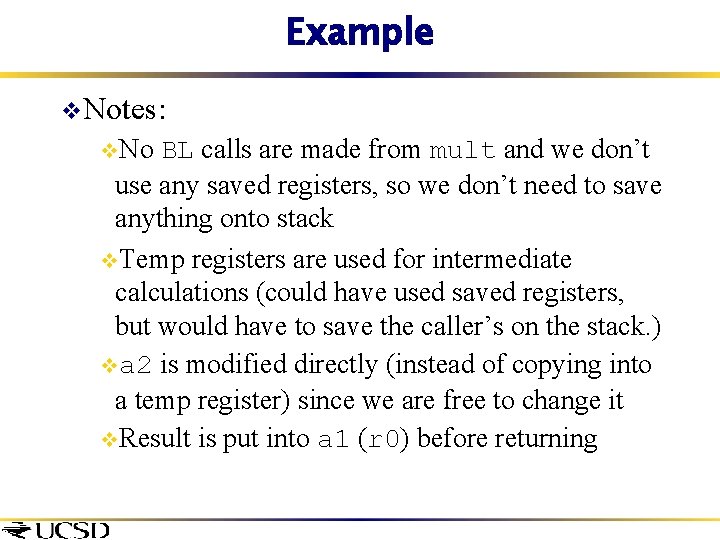
Example v. Notes: v. No BL calls are made from mult and we don’t use any saved registers, so we don’t need to save anything onto stack v. Temp registers are used for intermediate calculations (could have used saved registers, but would have to save the caller’s on the stack. ) va 2 is modified directly (instead of copying into a temp register) since we are free to change it v. Result is put into a 1 (r 0) before returning
Conclusion v. Functions are called with BL, and return with BX lr. v. The stack is your friend: Use it to save anything you need. Just be sure to leave it the way you found it. v. Register Conventions: Each register has a purpose and limits to its usage. Learn these and follow them, even if you’re writing all the code yourself.
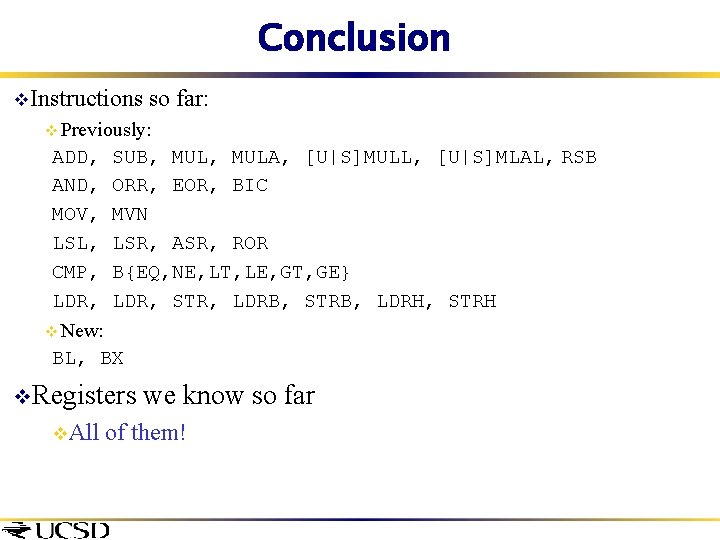
Conclusion v. Instructions so far: v Previously: ADD, AND, MOV, LSL, CMP, LDR, SUB, MULA, [U|S]MULL, [U|S]MLAL, RSB ORR, EOR, BIC MVN LSR, ASR, ROR B{EQ, NE, LT, LE, GT, GE} LDR, STR, LDRB, STRB, LDRH, STRH v New: BL, BX v. Registers v. All we know so far of them!