
Topic 9 Plant Science 9 1 Plant Structure
- Slides: 17
Topic 9: Plant Science 9. 1 Plant Structure & Growth
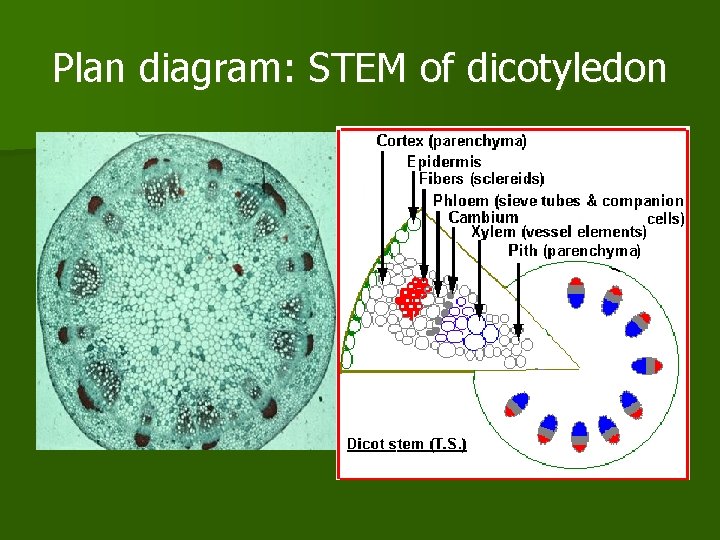
Plan diagram: STEM of dicotyledon
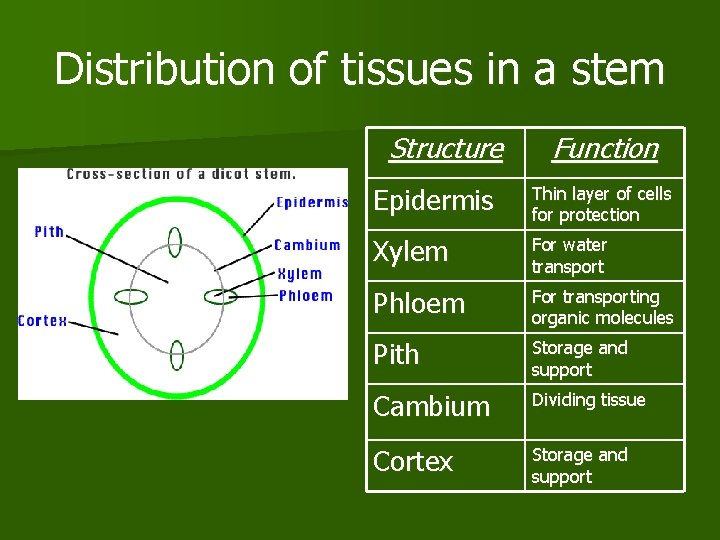
Distribution of tissues in a stem Structure Function Epidermis Thin layer of cells for protection Xylem For water transport Phloem For transporting organic molecules Pith Storage and support Cambium Dividing tissue Cortex Storage and support
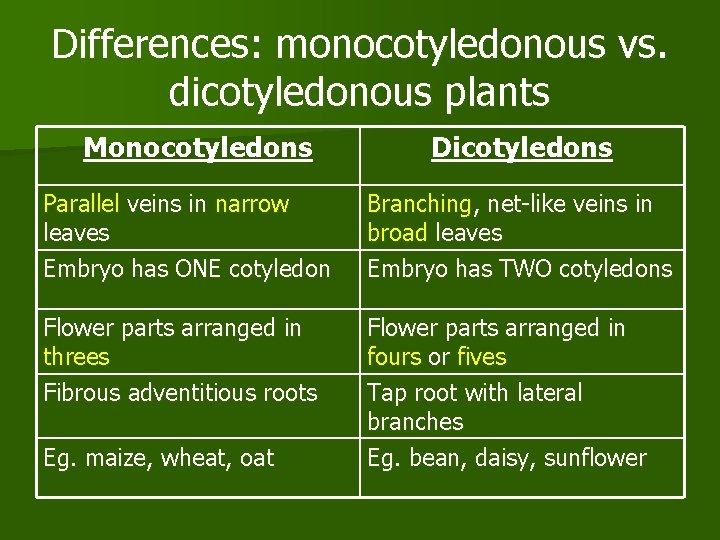
Differences: monocotyledonous vs. dicotyledonous plants Monocotyledons Dicotyledons Parallel veins in narrow leaves Embryo has ONE cotyledon Branching, net-like veins in broad leaves Embryo has TWO cotyledons Flower parts arranged in threes Fibrous adventitious roots Flower parts arranged in fours or fives Tap root with lateral branches Eg. bean, daisy, sunflower Eg. maize, wheat, oat
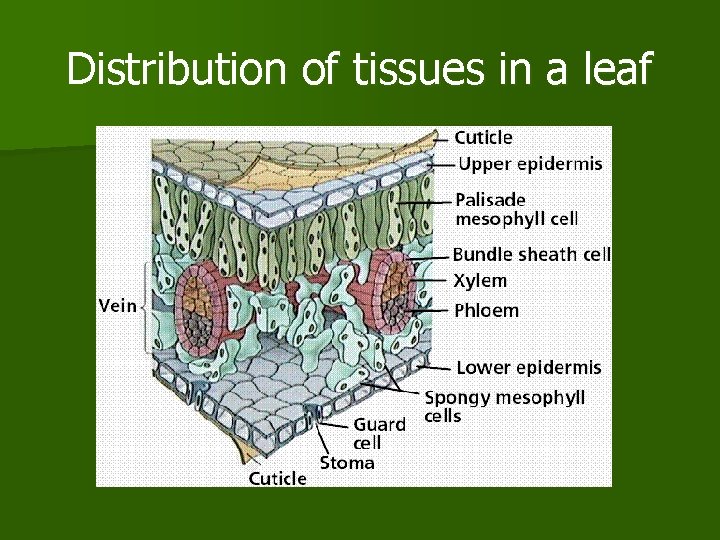
Distribution of tissues in a leaf
Relationship between tissue distribution in a leaf and function n Palisade cells contain lots of chloroplasts for absorbing light. n Palisade cells arranged “end-on” to ensure each cell receives maximum strength light. n No chloroplasts in upper epidermis to ensure light reaches palisade layer. n Chloroplasts present in spongy mesophyll cells to ‘mop up’ any unused light.
Relationship between tissue distribution in a leaf and function n n Waxy cuticle to prevent water loss from epidermal cells by evaporation. Air spaces in spongy mesophyll layer to ensure adequate supply of CO 2 to photosynthesizing cells and ease of removal of O 2. Stomata located on leaf lower surface to allow gases in and out of leaf. Presence of vascular bundle to supply water from roots and method for removal of products of photosynthesis.
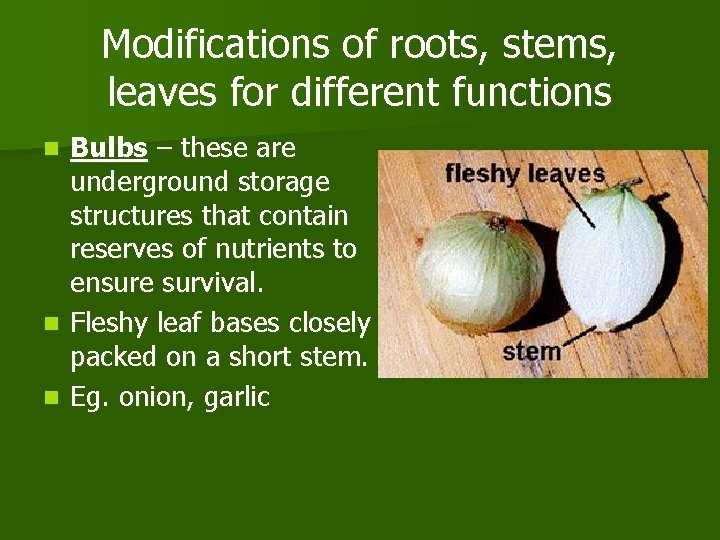
Modifications of roots, stems, leaves for different functions Bulbs – these are underground storage structures that contain reserves of nutrients to ensure survival. n Fleshy leaf bases closely packed on a short stem. n Eg. onion, garlic n
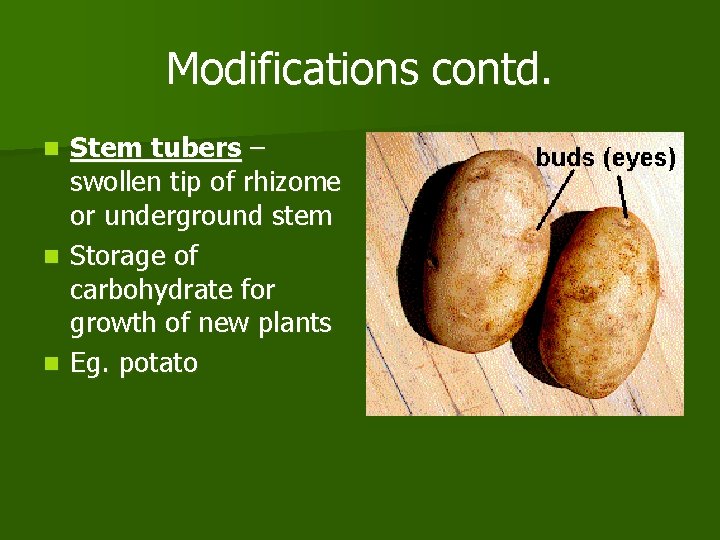
Modifications contd. Stem tubers – swollen tip of rhizome or underground stem n Storage of carbohydrate for growth of new plants n Eg. potato n
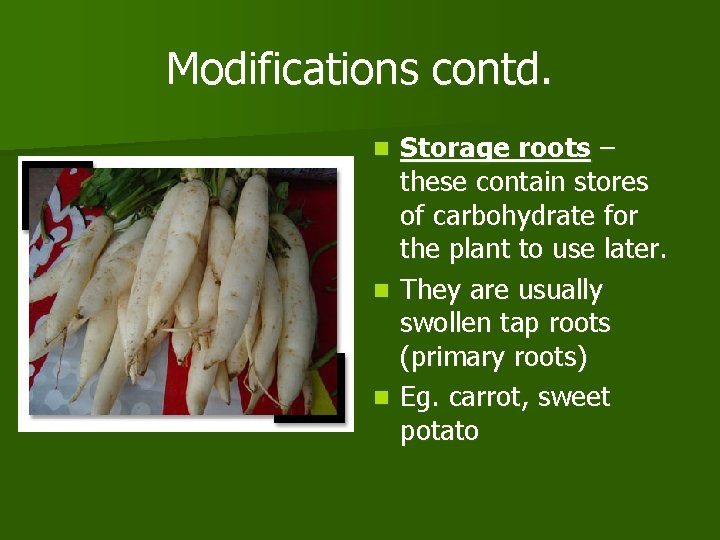
Modifications contd. Storage roots – these contain stores of carbohydrate for the plant to use later. n They are usually swollen tap roots (primary roots) n Eg. carrot, sweet potato n
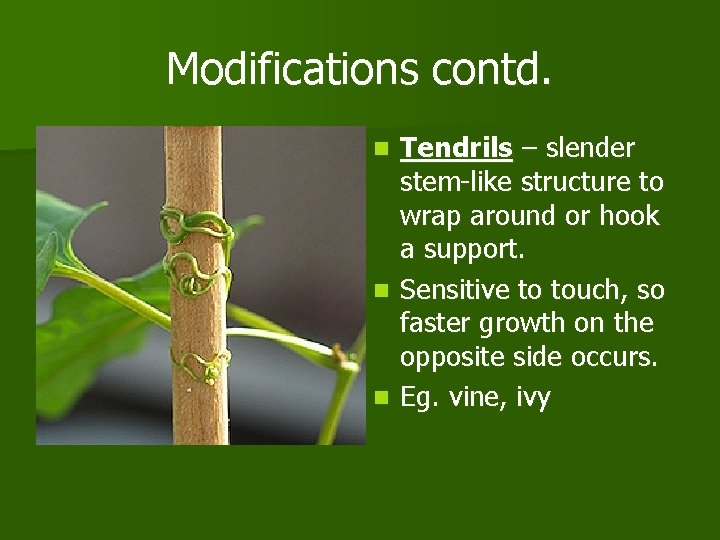
Modifications contd. Tendrils – slender stem-like structure to wrap around or hook a support. n Sensitive to touch, so faster growth on the opposite side occurs. n Eg. vine, ivy n
Apical v Lateral Meristems Dicotyledonous plants have apical (primary) and lateral (cambium) meristems. n Meristems generate new cells for growth of the plant. n Apical meristems found at the tips of stems and roots increase the length of these sections. n Stems and roots may also grow in thickness or in diameter through cell divisions in lateral, or secondary, meristems, found just under the surface along the length of the stem or root. n
Phototropism n Phototropism is generally described as a plant's response to light. n There are two kinds of phototropism: positive phototropism, or the growth of a plant stem towards light, and negative phototropism, or the growth of a plant's roots away from light. n Phototropic responses are caused by auxins, which modify cell walls.
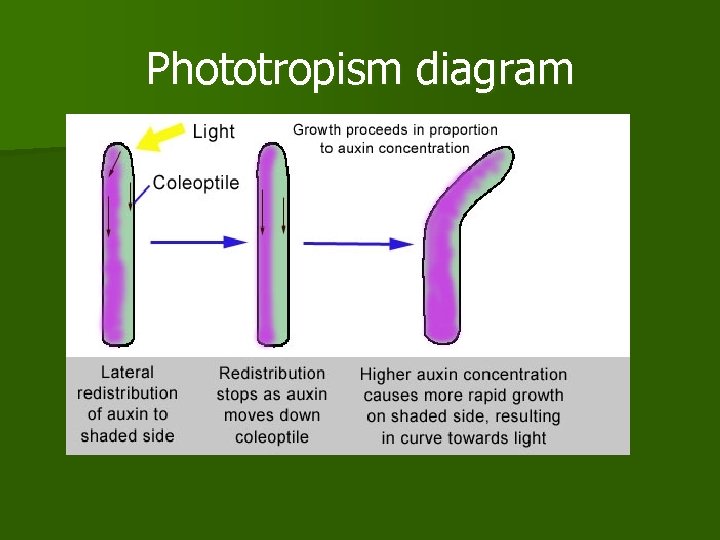
More on phototropism n Auxins concentrate on the side of a plant stem away from light, in order to stretch rigid plant cell walls into growth toward light. n Auxin is produced in the tips of shoots and roots.
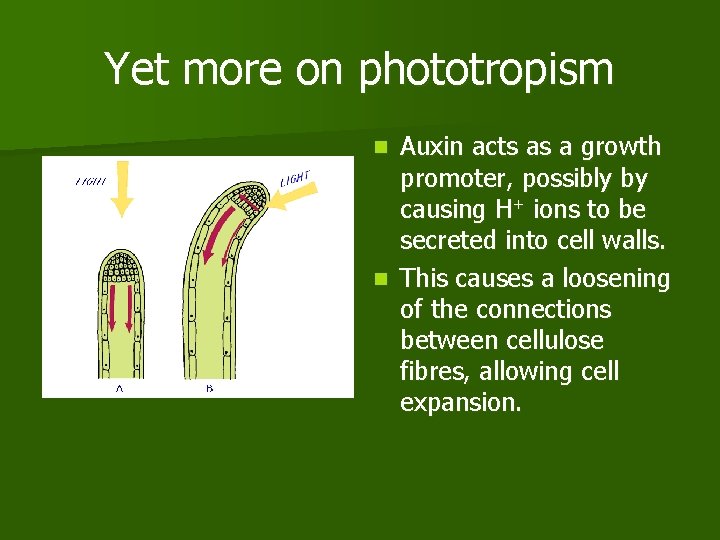
Yet more on phototropism Auxin acts as a growth promoter, possibly by causing H+ ions to be secreted into cell walls. n This causes a loosening of the connections between cellulose fibres, allowing cell expansion. n
Phototropism diagram
n http: //www. biology- online. org/3/7_meristems. htm n http: //www. biologyonline. org/3/5_plant_hormones. htm