
Topic 8 Parameters and Methods Were flooding people
![Parameterized figure 8 This code parameterizes the lines of stars: public static void main(String[]](https://slidetodoc.com/presentation_image_h2/a52037f7520fe90926b4732209c28034/image-12.jpg "Parameterized figure 8 This code parameterizes the lines of stars: public static void main(String[]")
- Slides: 22
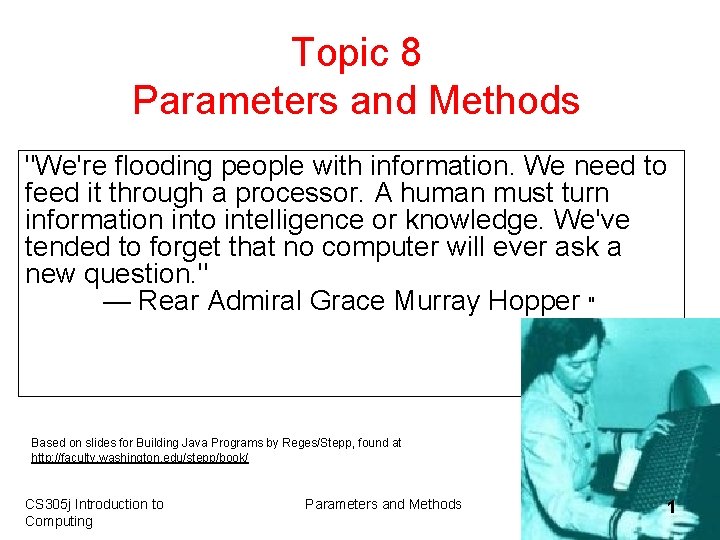
Topic 8 Parameters and Methods "We're flooding people with information. We need to feed it through a processor. A human must turn information into intelligence or knowledge. We've tended to forget that no computer will ever ask a new question. " — Rear Admiral Grace Murray Hopper " Based on slides for Building Java Programs by Reges/Stepp, found at http: //faculty. washington. edu/stepp/book/ CS 305 j Introduction to Computing Parameters and Methods 1
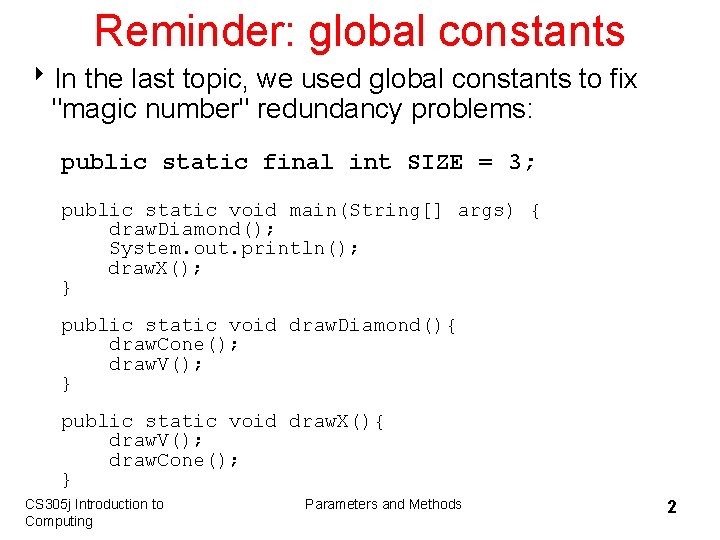
Reminder: global constants 8 In the last topic, we used global constants to fix "magic number" redundancy problems: public static final int SIZE = 3; public static void main(String[] args) { draw. Diamond(); System. out. println(); draw. X(); } public static void draw. Diamond(){ draw. Cone(); draw. V(); } public static void draw. X(){ draw. V(); draw. Cone(); } CS 305 j Introduction to Computing Parameters and Methods 2
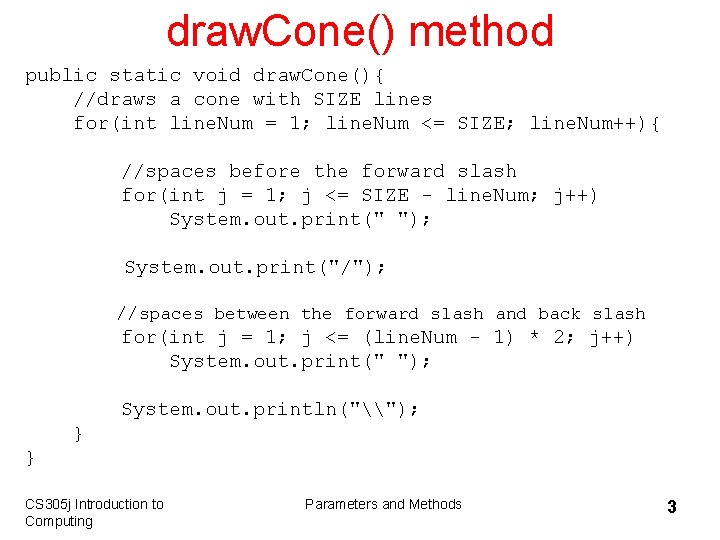
draw. Cone() method public static void draw. Cone(){ //draws a cone with SIZE lines for(int line. Num = 1; line. Num <= SIZE; line. Num++){ //spaces before the forward slash for(int j = 1; j <= SIZE - line. Num; j++) System. out. print(" "); System. out. print("/"); //spaces between the forward slash and back slash for(int j = 1; j <= (line. Num - 1) * 2; j++) System. out. print(" "); System. out. println("\"); } } CS 305 j Introduction to Computing Parameters and Methods 3
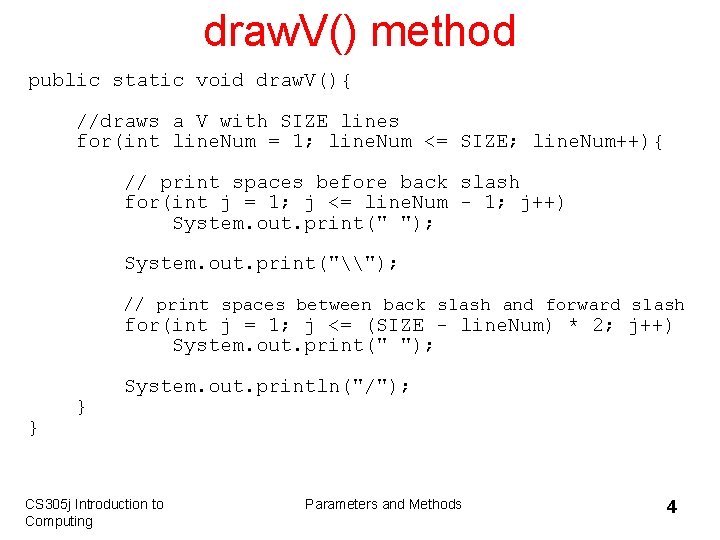
draw. V() method public static void draw. V(){ //draws a V with SIZE lines for(int line. Num = 1; line. Num <= SIZE; line. Num++){ // print spaces before back slash for(int j = 1; j <= line. Num - 1; j++) System. out. print(" "); System. out. print("\"); // print spaces between back slash and forward slash for(int j = 1; j <= (SIZE - line. Num) * 2; j++) System. out. print(" "); } } System. out. println("/"); CS 305 j Introduction to Computing Parameters and Methods 4
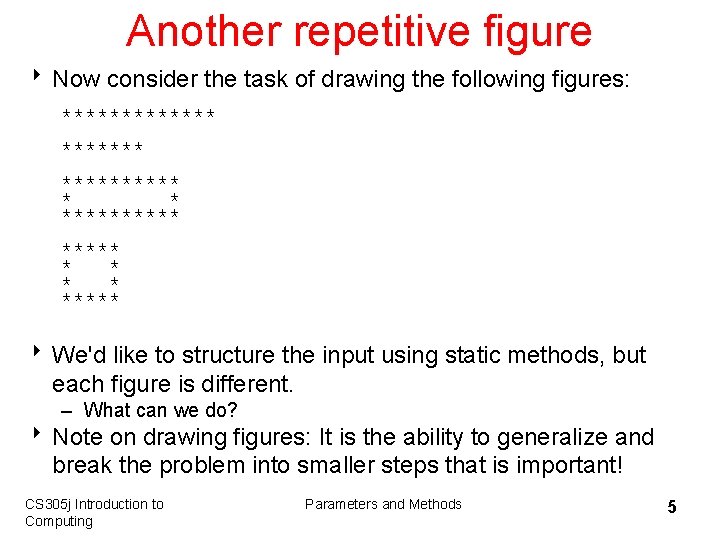
Another repetitive figure 8 Now consider the task of drawing the following figures: ********** * * ***** * * ***** 8 We'd like to structure the input using static methods, but each figure is different. – What can we do? 8 Note on drawing figures: It is the ability to generalize and break the problem into smaller steps that is important! CS 305 j Introduction to Computing Parameters and Methods 5
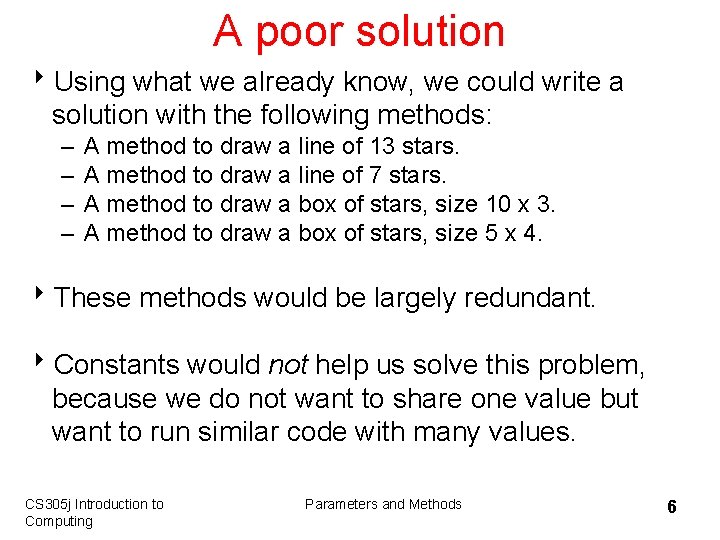
A poor solution 8 Using what we already know, we could write a solution with the following methods: – – A method to draw a line of 13 stars. A method to draw a line of 7 stars. A method to draw a box of stars, size 10 x 3. A method to draw a box of stars, size 5 x 4. 8 These methods would be largely redundant. 8 Constants would not help us solve this problem, because we do not want to share one value but want to run similar code with many values. CS 305 j Introduction to Computing Parameters and Methods 6
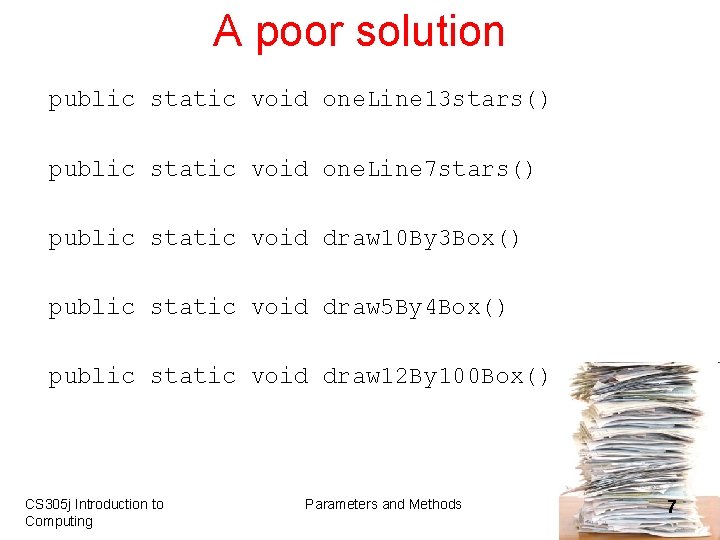
A poor solution public static void one. Line 13 stars() public static void one. Line 7 stars() public static void draw 10 By 3 Box() public static void draw 5 By 4 Box() public static void draw 12 By 100 Box() CS 305 j Introduction to Computing Parameters and Methods 7
A better solution 8 A better solution would look something like this: – A method to draw a line of any number of stars. – A method to draw a box of stars of any size. 8 It is possible to write parameterized methods; methods that are passed information when they are called which affects their behavior. – Example: A parameterized method to draw a line of stars might ask us to specify how many stars to draw. 8 parameter: A value given to a method by its caller, which takes the form of a variable inside the method's code. The method can use the value of this variable to adjust its behavior. CS 305 j Introduction to Computing Parameters and Methods 8
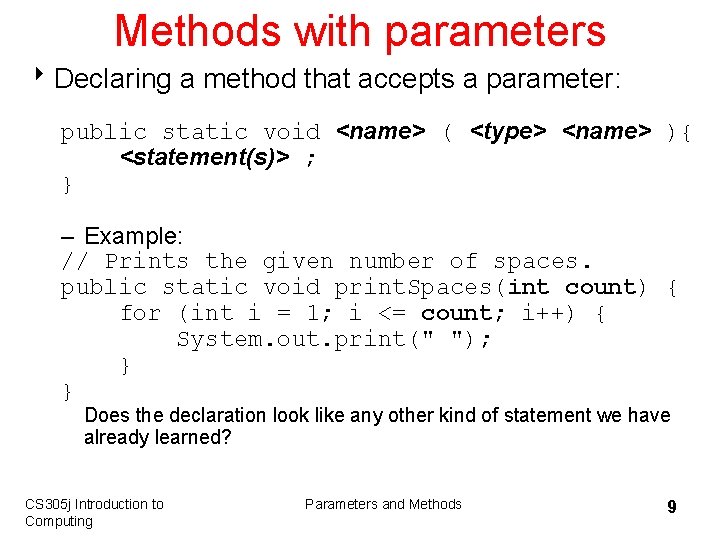
Methods with parameters 8 Declaring a method that accepts a parameter: public static void <name> ( <type> <name> ){ <statement(s)> ; } – Example: // Prints the given number of spaces. public static void print. Spaces(int count) { for (int i = 1; i <= count; i++) { System. out. print(" "); } } Does the declaration look like any other kind of statement we have already learned? CS 305 j Introduction to Computing Parameters and Methods 9
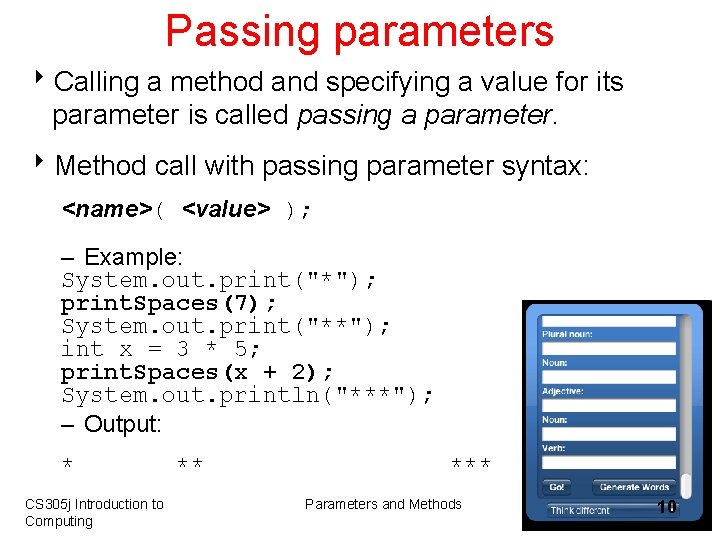
Passing parameters 8 Calling a method and specifying a value for its parameter is called passing a parameter. 8 Method call with passing parameter syntax: <name>( <value> ); – Example: System. out. print("*"); print. Spaces(7); System. out. print("**"); int x = 3 * 5; print. Spaces(x + 2); System. out. println("***"); – Output: * CS 305 j Introduction to Computing ** *** Parameters and Methods 10
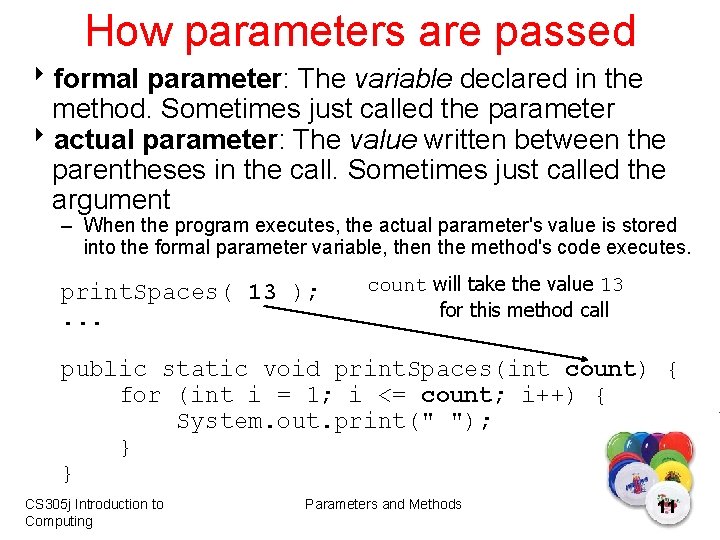
How parameters are passed 8 formal parameter: The variable declared in the method. Sometimes just called the parameter 8 actual parameter: The value written between the parentheses in the call. Sometimes just called the argument – When the program executes, the actual parameter's value is stored into the formal parameter variable, then the method's code executes. print. Spaces( 13 ); . . . count will take the value 13 for this method call public static void print. Spaces(int count) { for (int i = 1; i <= count; i++) { System. out. print(" "); } } CS 305 j Introduction to Computing Parameters and Methods 11
Parameterized figure 8 This code parameterizes the lines of stars: public static void main(String[] args) { draw. Line. Of. Stars(13); System. out. println(); draw. Line. Of. Stars(7); } public static void draw. Line. Of. Stars(int length) { for (int i = 1; i <= length; i++) { System. out. print("*"); Output: } System. out. println(); ******* } ******* CS 305 j Introduction to Computing Parameters and Methods 12
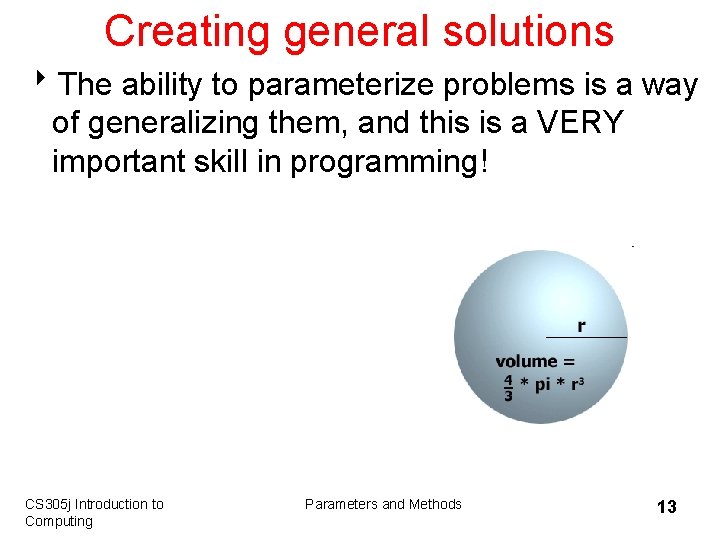
Creating general solutions 8 The ability to parameterize problems is a way of generalizing them, and this is a VERY important skill in programming! CS 305 j Introduction to Computing Parameters and Methods 13
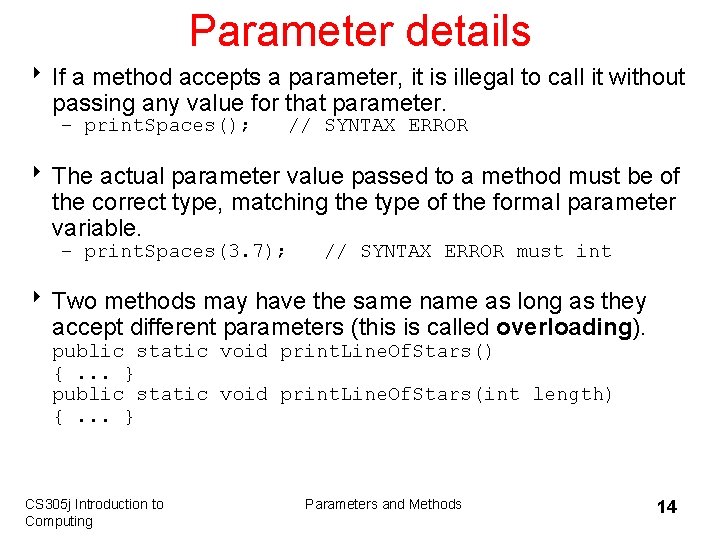
Parameter details 8 If a method accepts a parameter, it is illegal to call it without passing any value for that parameter. – print. Spaces(); // SYNTAX ERROR 8 The actual parameter value passed to a method must be of the correct type, matching the type of the formal parameter variable. – print. Spaces(3. 7); // SYNTAX ERROR must int 8 Two methods may have the same name as long as they accept different parameters (this is called overloading). public static void print. Line. Of. Stars() {. . . } public static void print. Line. Of. Stars(int length) {. . . } CS 305 j Introduction to Computing Parameters and Methods 14
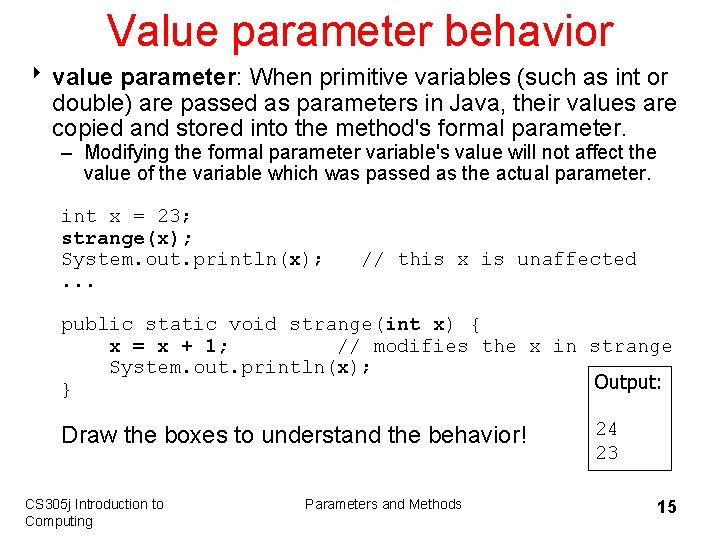
Value parameter behavior 8 value parameter: When primitive variables (such as int or double) are passed as parameters in Java, their values are copied and stored into the method's formal parameter. – Modifying the formal parameter variable's value will not affect the value of the variable which was passed as the actual parameter. int x = 23; strange(x); System. out. println(x); . . . // this x is unaffected public static void strange(int x) { x = x + 1; // modifies the x in strange System. out. println(x); Output: } Draw the boxes to understand the behavior! CS 305 j Introduction to Computing Parameters and Methods 24 23 15
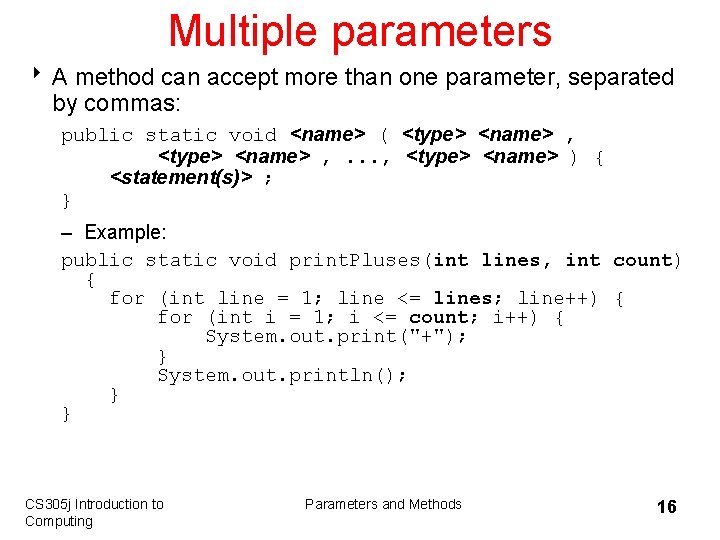
Multiple parameters 8 A method can accept more than one parameter, separated by commas: public static void <name> ( <type> <name> , . . . , <type> <name> ) { <statement(s)> ; } – Example: public static void print. Pluses(int lines, int count) { for (int line = 1; line <= lines; line++) { for (int i = 1; i <= count; i++) { System. out. print("+"); } System. out. println(); } } CS 305 j Introduction to Computing Parameters and Methods 16
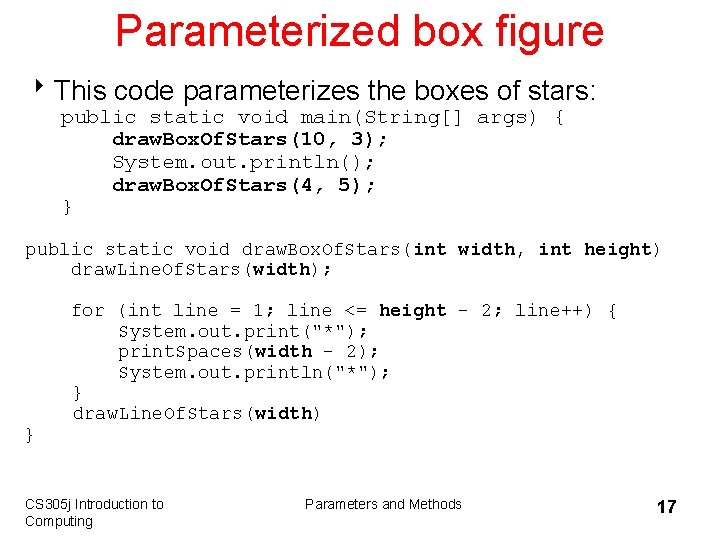
Parameterized box figure 8 This code parameterizes the boxes of stars: public static void main(String[] args) { draw. Box. Of. Stars(10, 3); System. out. println(); draw. Box. Of. Stars(4, 5); } public static void draw. Box. Of. Stars(int width, int height) draw. Line. Of. Stars(width); } for (int line = 1; line <= height - 2; line++) { System. out. print("*"); print. Spaces(width - 2); System. out. println("*"); } draw. Line. Of. Stars(width) CS 305 j Introduction to Computing Parameters and Methods 17
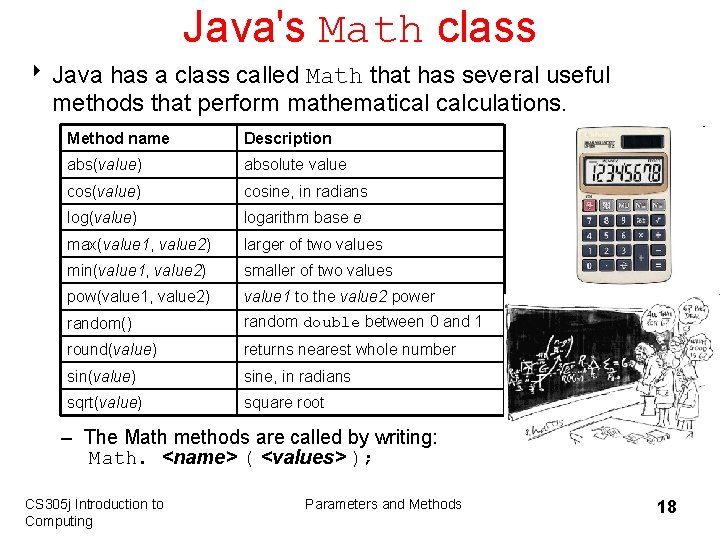
Java's Math class 8 Java has a class called Math that has several useful methods that perform mathematical calculations. Method name Description abs(value) absolute value cos(value) cosine, in radians log(value) logarithm base e max(value 1, value 2) larger of two values min(value 1, value 2) smaller of two values pow(value 1, value 2) value 1 to the value 2 power random() random double between 0 and 1 round(value) returns nearest whole number sin(value) sine, in radians sqrt(value) square root – The Math methods are called by writing: Math. <name> ( <values> ); CS 305 j Introduction to Computing Parameters and Methods 18
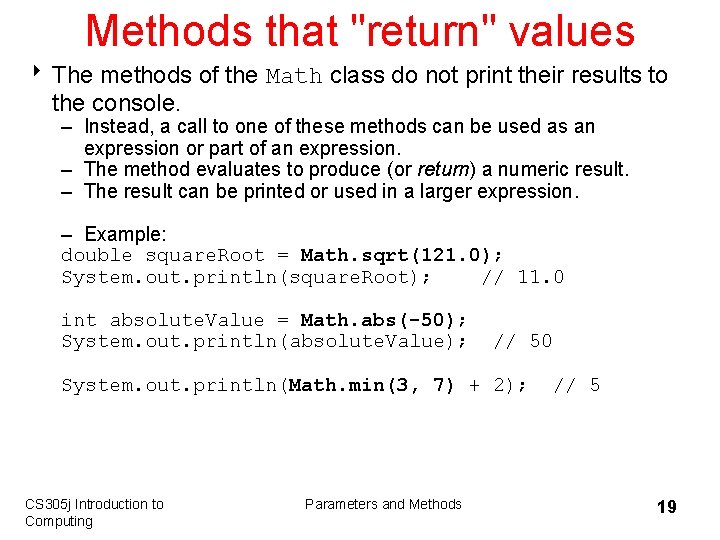
Methods that "return" values 8 The methods of the Math class do not print their results to the console. – Instead, a call to one of these methods can be used as an expression or part of an expression. – The method evaluates to produce (or return) a numeric result. – The result can be printed or used in a larger expression. – Example: double square. Root = Math. sqrt(121. 0); System. out. println(square. Root); // 11. 0 int absolute. Value = Math. abs(-50); System. out. println(absolute. Value); // 50 System. out. println(Math. min(3, 7) + 2); CS 305 j Introduction to Computing Parameters and Methods // 5 19
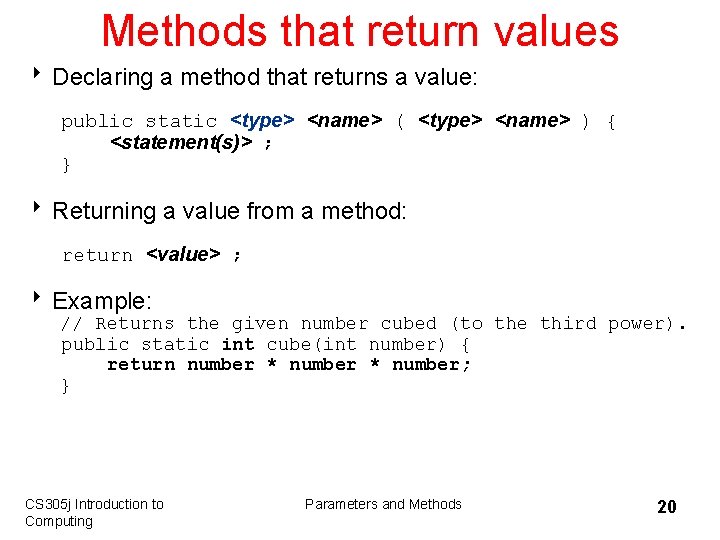
Methods that return values 8 Declaring a method that returns a value: public static <type> <name> ( <type> <name> ) { <statement(s)> ; } 8 Returning a value from a method: return <value> ; 8 Example: // Returns the given number cubed (to the third power). public static int cube(int number) { return number * number; } CS 305 j Introduction to Computing Parameters and Methods 20
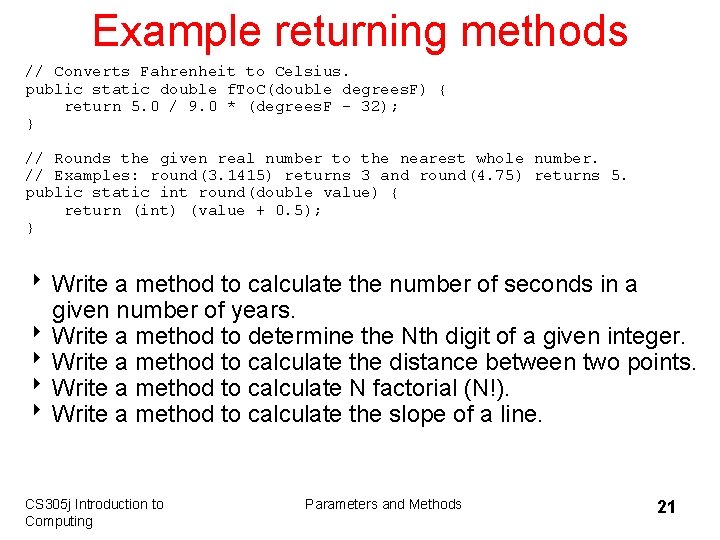
Example returning methods // Converts Fahrenheit to Celsius. public static double f. To. C(double degrees. F) { return 5. 0 / 9. 0 * (degrees. F - 32); } // Rounds the given real number to the nearest whole number. // Examples: round(3. 1415) returns 3 and round(4. 75) returns 5. public static int round(double value) { return (int) (value + 0. 5); } 8 Write a method to calculate the number of seconds in a given number of years. 8 Write a method to determine the Nth digit of a given integer. 8 Write a method to calculate the distance between two points. 8 Write a method to calculate N factorial (N!). 8 Write a method to calculate the slope of a line. CS 305 j Introduction to Computing Parameters and Methods 21
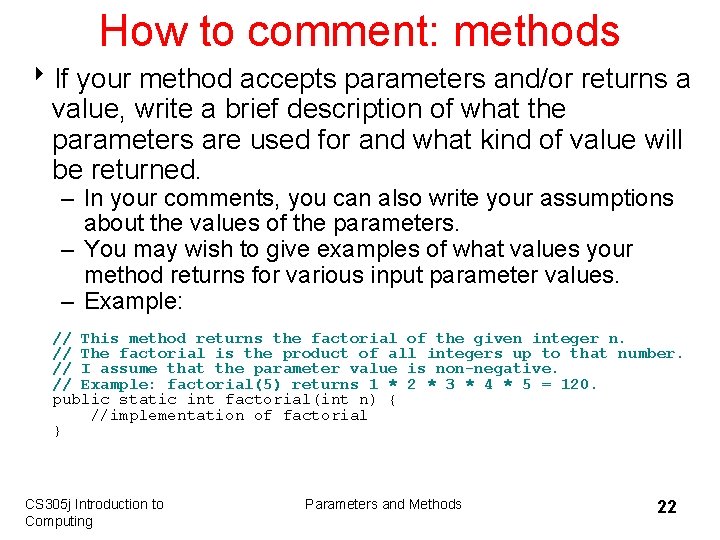
How to comment: methods 8 If your method accepts parameters and/or returns a value, write a brief description of what the parameters are used for and what kind of value will be returned. – In your comments, you can also write your assumptions about the values of the parameters. – You may wish to give examples of what values your method returns for various input parameter values. – Example: // This method returns the factorial of the given integer n. // The factorial is the product of all integers up to that number. // I assume that the parameter value is non-negative. // Example: factorial(5) returns 1 * 2 * 3 * 4 * 5 = 120. public static int factorial(int n) { //implementation of factorial } CS 305 j Introduction to Computing Parameters and Methods 22