
Topic 8 Energetics 1 Bond Enthalpies 04 March
Topic 8 Energetics 1 Bond Enthalpies 04 March 2021
Bond Enthalpies Objective: to know what bond enthalpies are and how to use them to calculate enthalpy changes of reactions Success criteria: • know what is meant by the terms ‘bond enthalpy’ and ‘mean bond enthalpy’ • be able to calculate an enthalpy change of reaction using mean bond enthalpies and explain the limitations of this method of calculation • be able to calculate mean bond enthalpies from enthalpy changes of reaction
Bond Enthalpy • Energy is stored in chemical bonds. • It takes energy to break a chemical bond • Energy is released when we form a chemical bond.
Bond Enthalpy • It takes energy to break bonds so breaking bonds is ______ endothermic • Energy is given out when making bonds so making bonds is _____ exothermic • e. g. H-H(g) 2 H(g) ΔH = +436 k. J. mol-1
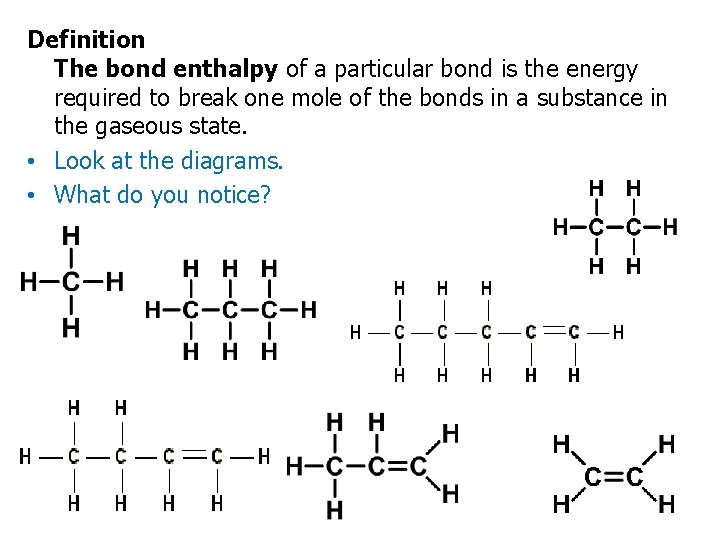
Definition The bond enthalpy of a particular bond is the energy required to break one mole of the bonds in a substance in the gaseous state. • Look at the diagrams. • What do you notice?
Mean Bond Enthalpy • H-H and H-Cl occur only in H 2 and HCl molecules respectively. • However, most bonds can occur in different molecules. E. g. The C-H bond can occur in a huge variety of different molecules. • The bond strength (enthalpy) will vary depending on what else is attached, and where the bond is in the molecule. • For this reason we usually report mean bond enthalpy. • The mean bond enthalpy of the X – Y bond is the mean value of the bond enthalpy values for the X – Y bond averaged across a wide range of compounds.
What happens in chemical reactions? • In a chemical reaction we must first break bonds and then make some different ones. • This is an endothermic process followed by an exothermic process. • So how can we describe a reaction as exothermic or endothermic?
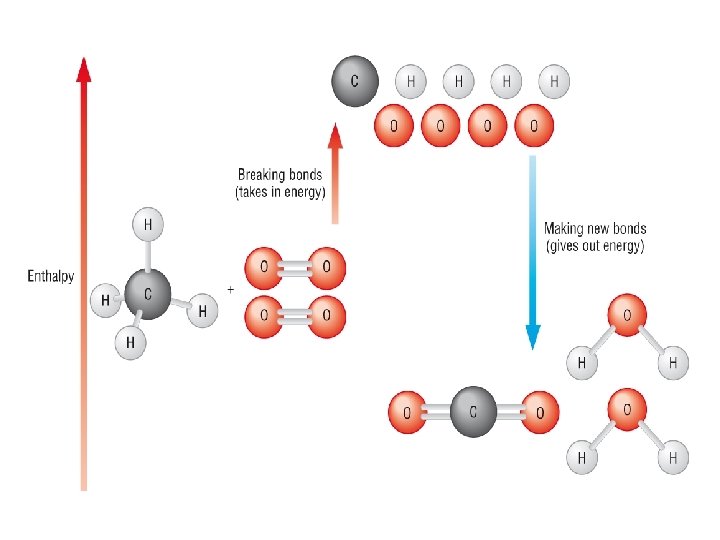
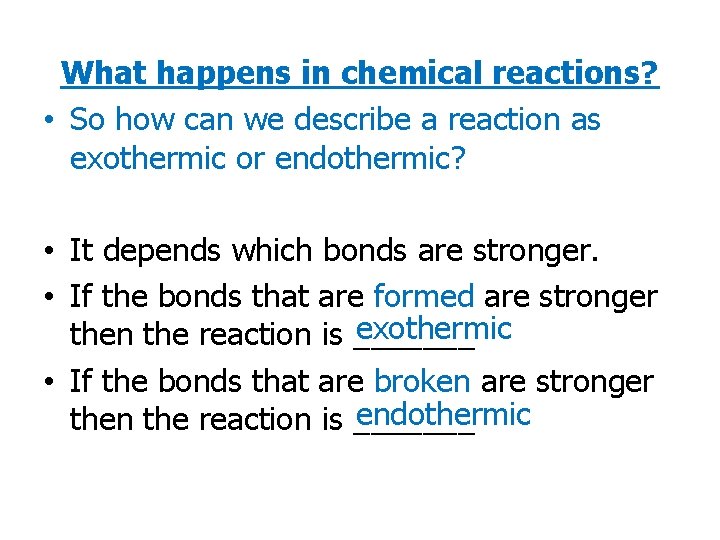
What happens in chemical reactions? • So how can we describe a reaction as exothermic or endothermic? • It depends which bonds are stronger. • If the bonds that are formed are stronger exothermic then the reaction is _______ • If the bonds that are broken are stronger endothermic then the reaction is _______
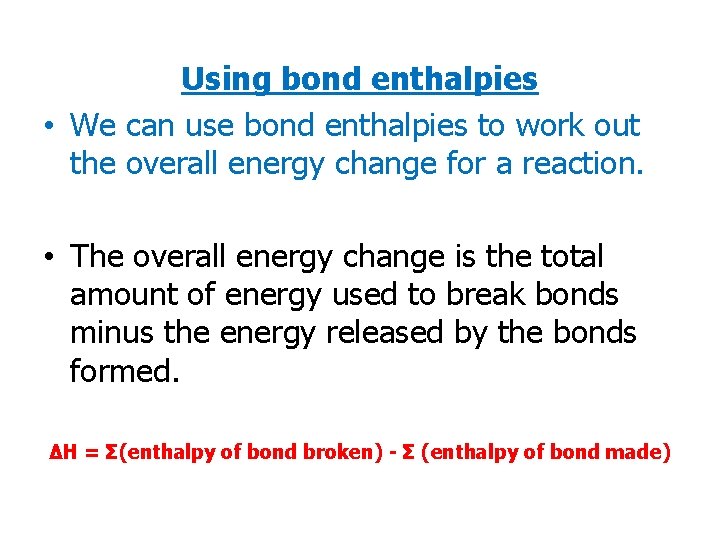
Using bond enthalpies • We can use bond enthalpies to work out the overall energy change for a reaction. • The overall energy change is the total amount of energy used to break bonds minus the energy released by the bonds formed. ΔH = Σ(enthalpy of bond broken) - Σ (enthalpy of bond made)
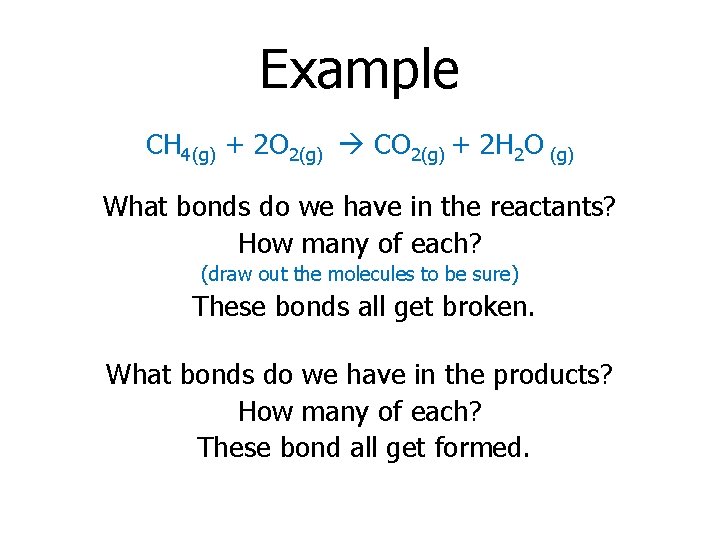
Example CH 4(g) + 2 O 2(g) CO 2(g) + 2 H 2 O (g) What bonds do we have in the reactants? How many of each? (draw out the molecules to be sure) These bonds all get broken. What bonds do we have in the products? How many of each? These bond all get formed.
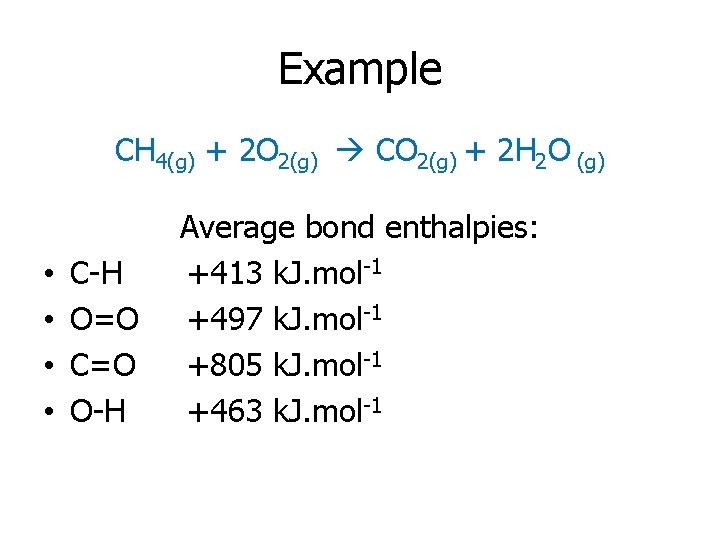
Example CH 4(g) + 2 O 2(g) CO 2(g) + 2 H 2 O (g) • • C-H O=O C=O O-H Average bond enthalpies: +413 k. J. mol-1 +497 k. J. mol-1 +805 k. J. mol-1 +463 k. J. mol-1
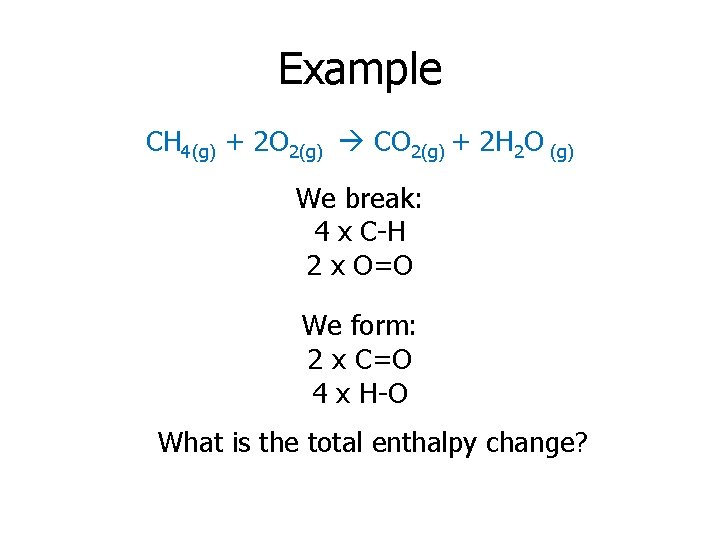
Example CH 4(g) + 2 O 2(g) CO 2(g) + 2 H 2 O (g) We break: 4 x C-H 2 x O=O We form: 2 x C=O 4 x H-O What is the total enthalpy change?
Calculating unknown bond enthalpies Unknown bond enthalpies can be calculated from the enthalpy change of reaction and the other relevant bond enthalpies (page 257 in text book)
Practice • Complete “using bond energy data practice” on the worksheet. • This is broken down into the different stages • Follow the instructions • Don’t forget to complete the extension
More practice questions • Answer the rest of the questions on the worksheet • Edexcel exam questions • Follow the same steps from the worked example and the previous question – Draw the molecules out. – Include units – Include +/- sign
Bond Enthalpies Objective: to know what bond enthalpies are and how to use them to calculate enthalpy changes of reactions Success criteria: • know what is meant by the terms ‘bond enthalpy’ and ‘mean bond enthalpy’ • be able to calculate an enthalpy change of reaction using mean bond enthalpies and explain the limitations of this method of calculation • be able to calculate mean bond enthalpies from enthalpy changes of reaction
- Slides: 17