
Topic 8 2 Photosynthesis Electron micrograph of chloroplast
- Slides: 27
Topic 8. 2 Photosynthesis
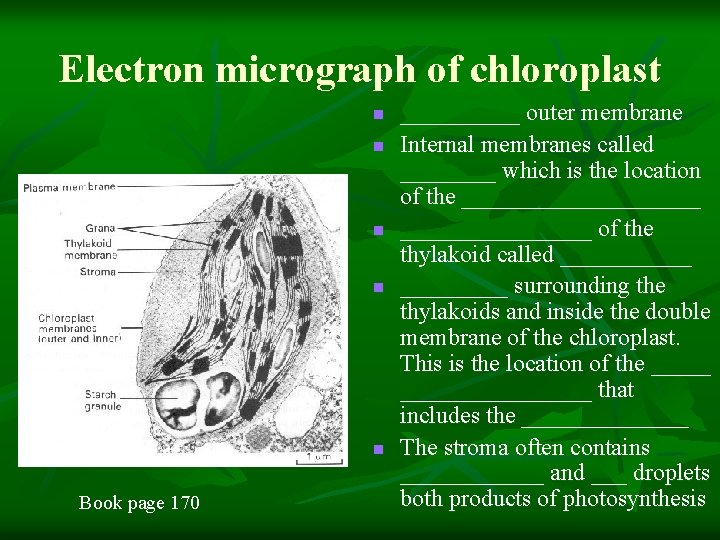
Electron micrograph of chloroplast n n n Book page 170 _____ outer membrane Internal membranes called ____ which is the location of the __________ of the thylakoid called ______ surrounding the thylakoids and inside the double membrane of the chloroplast. This is the location of the ___________ that includes the _______ The stroma often contains ______ and ___ droplets both products of photosynthesis
2 parts of photosynthesis Light Dependent Reaction in which n Must have ______ n Energy of sun is trapped by _____ molecules (oxidation) n _____ is reduced to ____ and ____ reduced to _____ n This reaction takes place __________ membranes. The Light Independent Reaction which n uses the __________ from the LDR to fix _________ into organic molecules such as ____ n The process does not ________ and can occur in both the ____ and _______ periods. n This reaction takes place in the _____
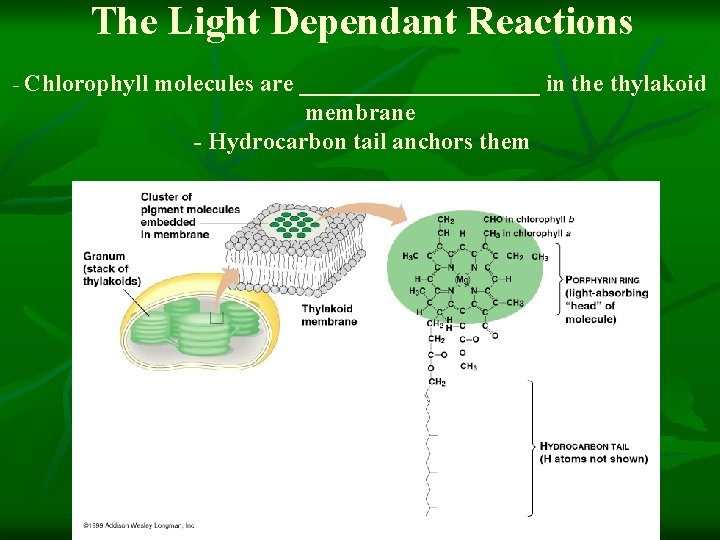
The Light Dependant Reactions - Chlorophyll molecules are __________ in the thylakoid membrane - Hydrocarbon tail anchors them
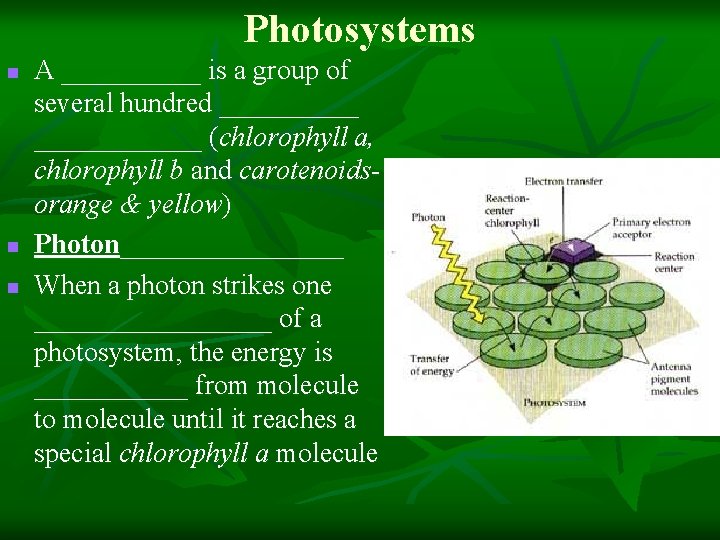
Photosystems n n n A _____ is a group of several hundred ____________ (chlorophyll a, chlorophyll b and carotenoidsorange & yellow) Photon________ When a photon strikes one _________ of a photosystem, the energy is ______ from molecule to molecule until it reaches a special chlorophyll a molecule
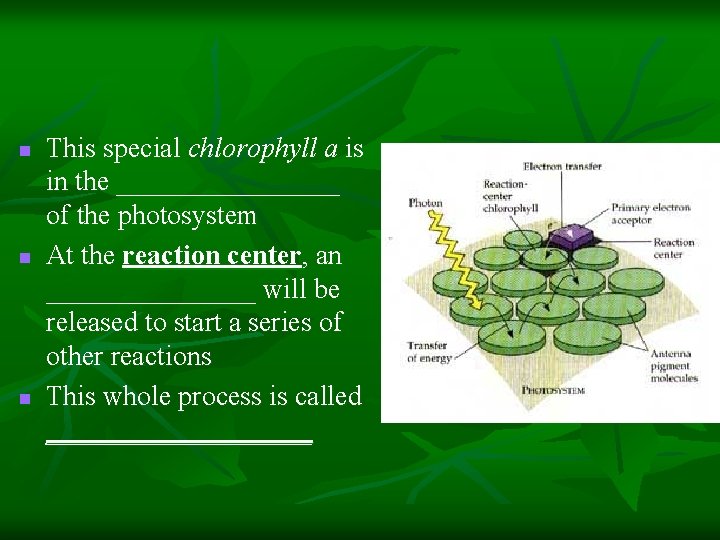
n n n This special chlorophyll a is in the ________ of the photosystem At the reaction center, an ________ will be released to start a series of other reactions This whole process is called __________
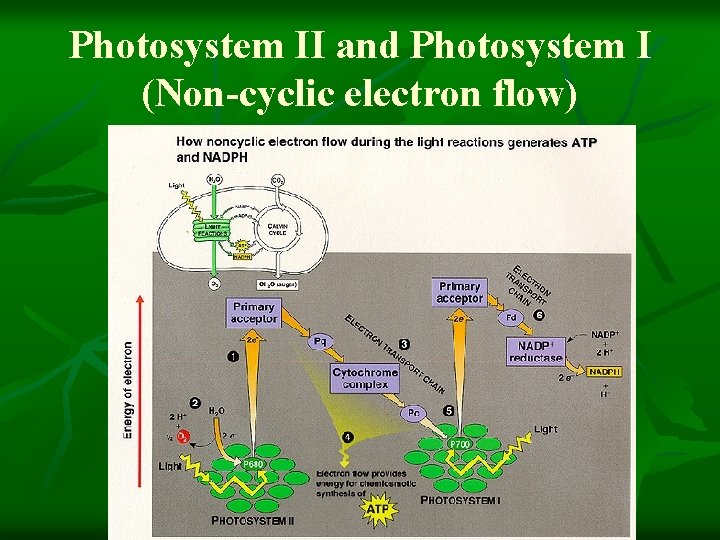
Photosystem II and Photosystem I (Non-cyclic electron flow)
Non-cyclic electron flow is the ________ 1. When light is absorbed by _______, an electron is excited to a ________ in the reaction center and is captured by the ________ in thylakoid membrane. This creates a “______” that must be filled in Photosystem II 2. An enzyme extracts electrons from ______ in order to _______ the electron in Photosystem II. This splits the water molecule (_____) into 2 H+ atoms and a oxygen molecule, (which immediately combines with another oxygen molecule and released as O 2. )
3. 4. Each _______ electron passes from the primary electron acceptor of Photosystem II to _______ via an __________ located in the thylakoid membrane. This is a system of carrier molecules. As the electrons _________, their “____” to a lower energy level is harnessed to pump ______ into the chloroplast. Eventually an ATP will be made during _______. This ATP synthesis is called photophosphorylation because it is adding a high energy _______ to an ADP by using ______. ATP is used as energy to fuel the ______ of the light independent reactions
5. 6. When an electron reaches the _____ of the electron transport chain, it fills a “hole” in Photosystem I that exists because an ____________had left it in the same manner as Photosystem II. Primary _________of Photosystem I passes electrons to 2 nd electron chain. The electron, eventually, is used to _____ a molecule of ____into ____. This molecule then provides ______for the synthesis of sugar in the _______.
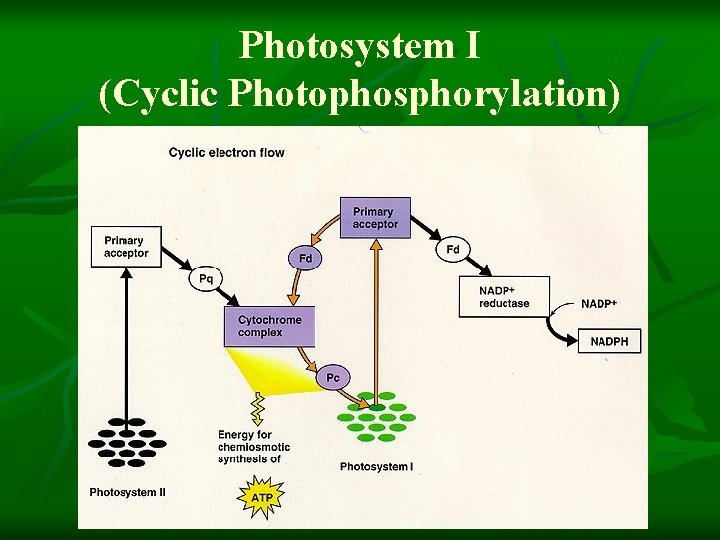
Photosystem I (Cyclic Photophosphorylation)
n n 1. 2. Under certain conditions, excited electrons take an ______which uses only Photosystem I. When the primary electron acceptor of Photosystem I delivers the _______to one of the carrier molecules in the _____ (Fd), it has two choices. It can send it down the 2 nd electron chain to produce ______(as in non-cyclic PP) OR can place back in the 1 st electron chain to work its way back to ______. (cyclic PP)
n n n A greater amount of _____ than ____is needed to run the light independent reactions. Non-cyclic Photo. Phos, basically, produces ______of both, so cyclic Photo. Phos kicks in to _______ the amount of H+ pumped in, which leads to more ____ production. It may be that high amounts of _______ actually dictate when cyclic PP takes place.
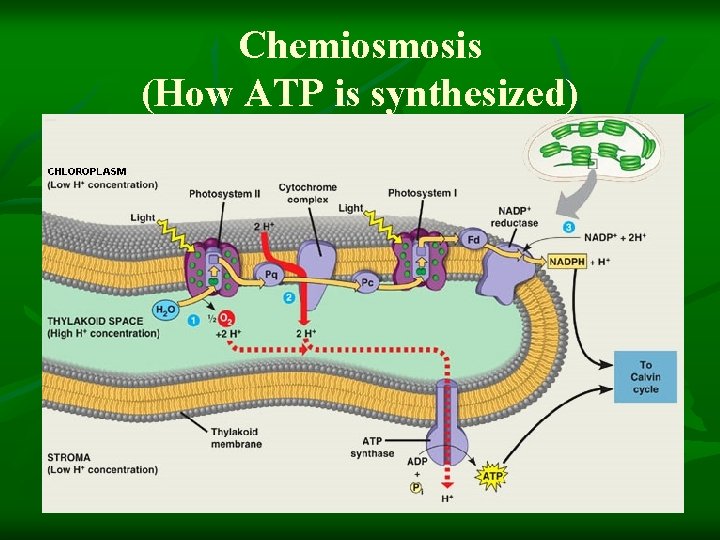
Chemiosmosis (How ATP is synthesized)
Chemiosmosis cont. n n n Water molecules are _____ on the inside surface of the __________(position 1) The _____ molecules are released to leave, ____ molecules build up in the thylakoid space The electron transport chains of _________ also pump in ___ molecules (position 2) Both of these steps build up a high _____ inside thylakoid space By ________the H+ ions travel across the concentration gradient
Chemiosmosis cont. n n This movement is harnessed by ______ (enzyme) which ______ ADP (adds a phosphate bond) to make an ATP ____are now available in the _______, that are coupled with the e- from the 2 nd ETC, to reduce _____ into ____
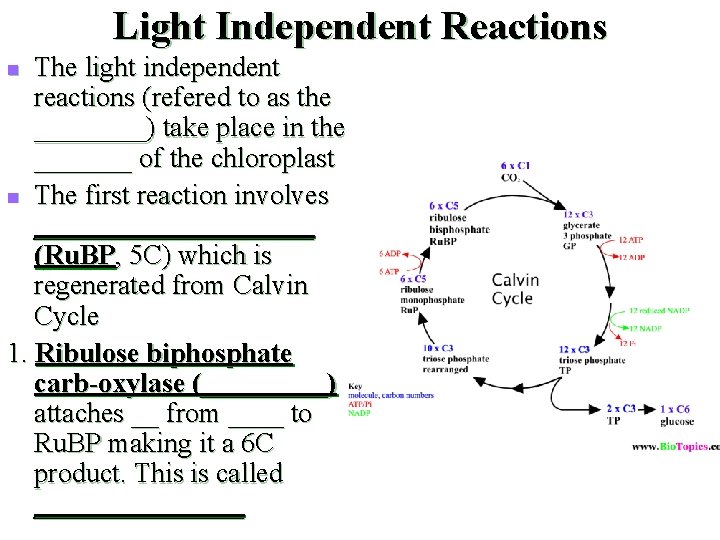
Light Independent Reactions The light independent reactions (refered to as the ____) take place in the _______ of the chloroplast n The first reaction involves __________ (Ru. BP, 5 C) which is regenerated from Calvin Cycle 1. Ribulose biphosphate carb-oxylase (_____) attaches __ from ____ to Ru. BP making it a 6 C product. This is called ________ n
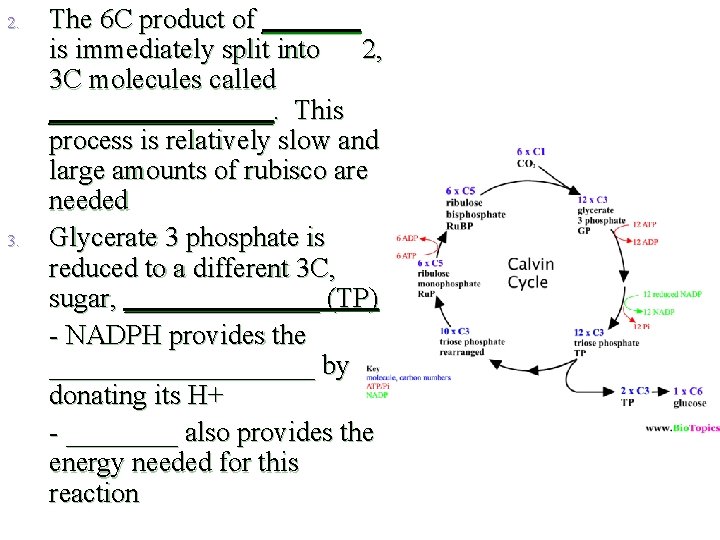
2. 3. The 6 C product of _______ is immediately split into 2, 3 C molecules called ________. This process is relatively slow and large amounts of rubisco are needed Glycerate 3 phosphate is reduced to a different 3 C, sugar, _______ (TP) - NADPH provides the __________ by donating its H+ - ____ also provides the energy needed for this reaction
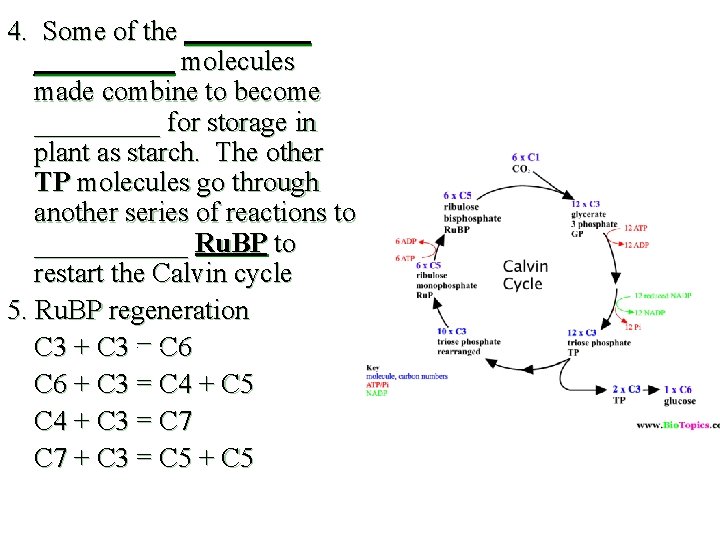
4. Some of the __________ molecules made combine to become _____ for storage in plant as starch. The other TP molecules go through another series of reactions to ______ Ru. BP to restart the Calvin cycle 5. Ru. BP regeneration C 3 + C 3 = C 6 + C 3 = C 4 + C 5 C 4 + C 3 = C 7 + C 3 = C 5 + C 5
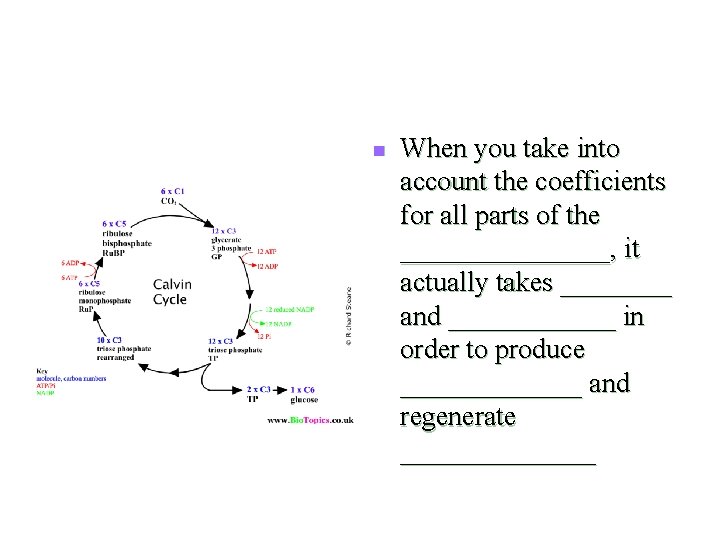
n When you take into account the coefficients for all parts of the ________, it actually takes ____ and ______ in order to produce _______ and regenerate _______
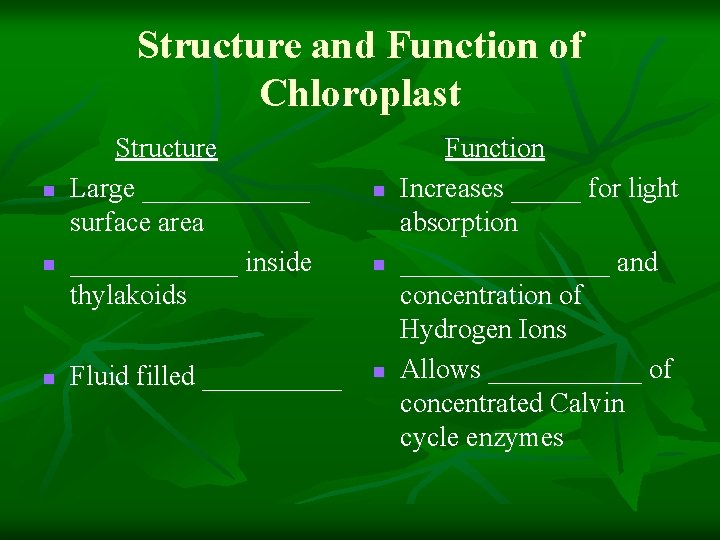
Structure and Function of Chloroplast n n n Structure Large ______ surface area ______ inside thylakoids Fluid filled _____ n n n Function Increases _____ for light absorption ________ and concentration of Hydrogen Ions Allows ______ of concentrated Calvin cycle enzymes
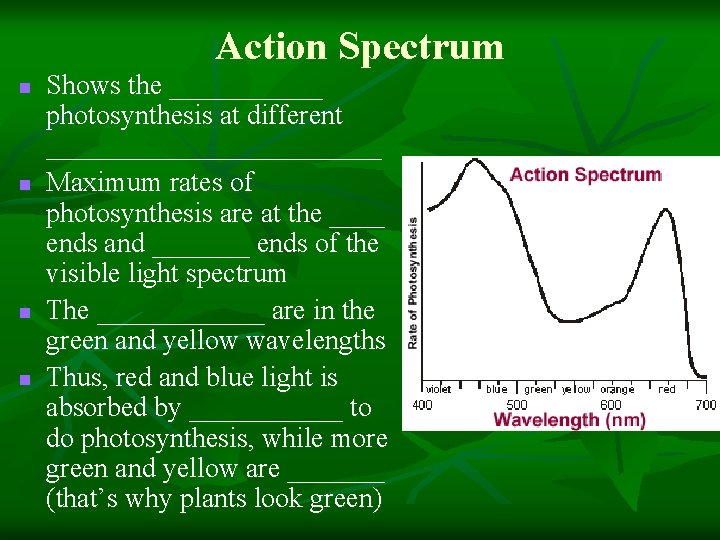
Action Spectrum n n Shows the ______ photosynthesis at different ____________ Maximum rates of photosynthesis are at the ____ ends and _______ ends of the visible light spectrum The ______ are in the green and yellow wavelengths Thus, red and blue light is absorbed by ______ to do photosynthesis, while more green and yellow are _______ (that’s why plants look green)
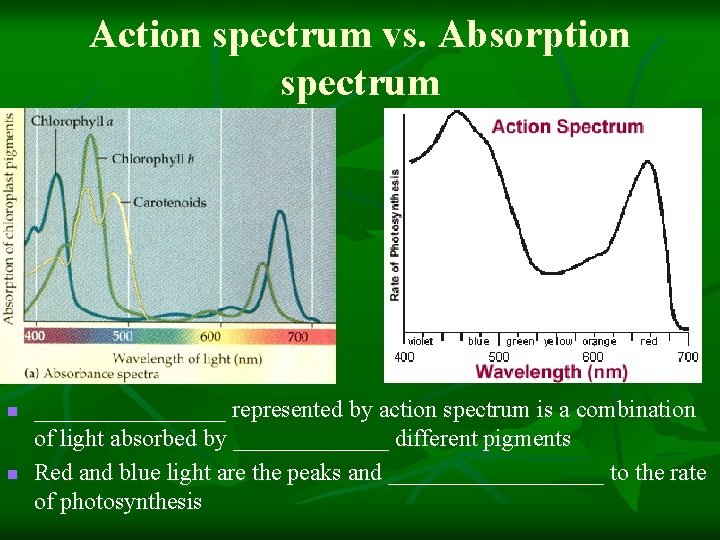
Action spectrum vs. Absorption spectrum n n ________ represented by action spectrum is a combination of light absorbed by _______ different pigments Red and blue light are the peaks and _________ to the rate of photosynthesis
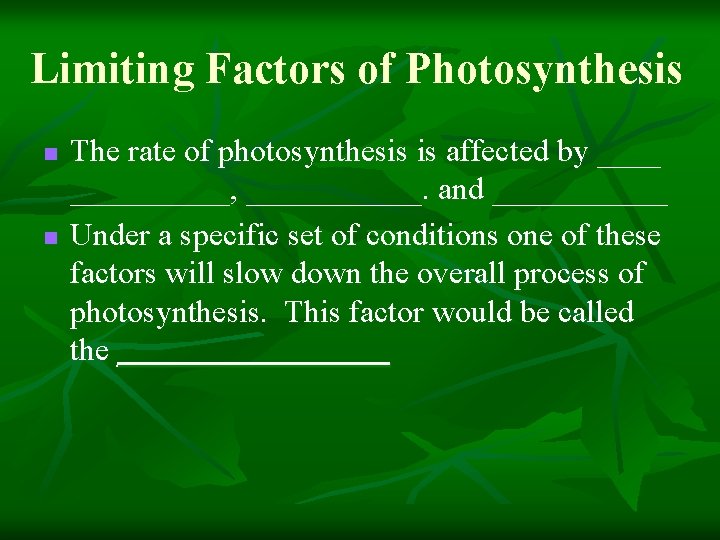
Limiting Factors of Photosynthesis n n The rate of photosynthesis is affected by __________, ______. and ______ Under a specific set of conditions one of these factors will slow down the overall process of photosynthesis. This factor would be called the _________
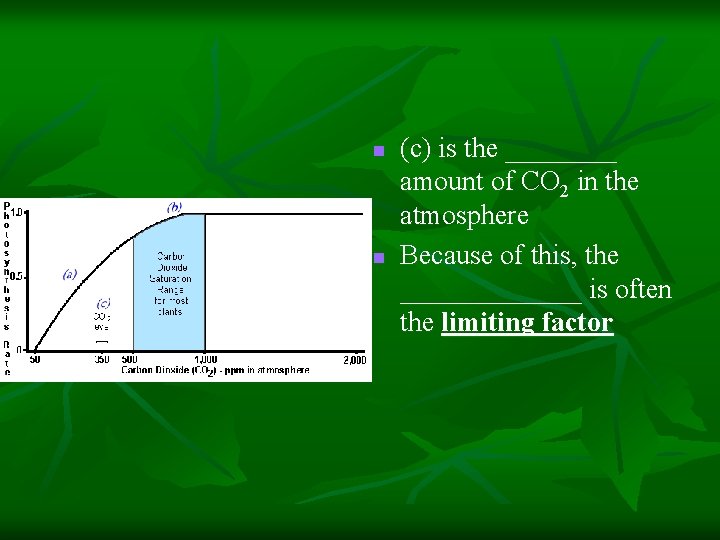
n n (c) is the ____ amount of CO 2 in the atmosphere Because of this, the _______ is often the limiting factor
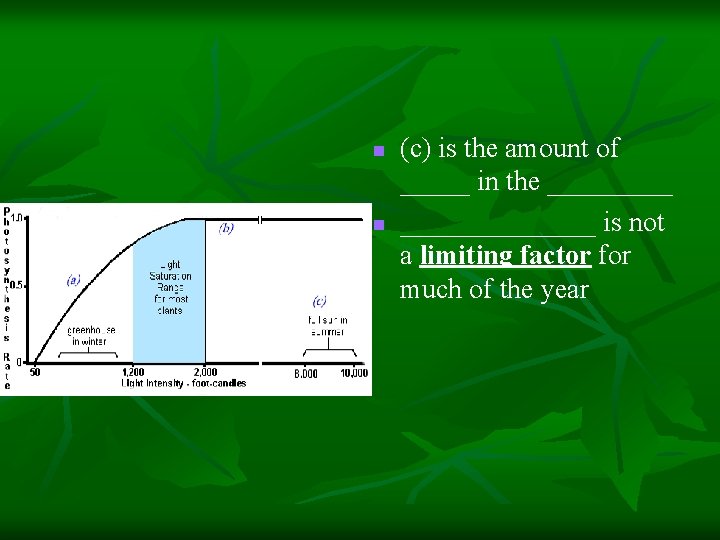
n n (c) is the amount of _____ in the ______________ is not a limiting factor for much of the year
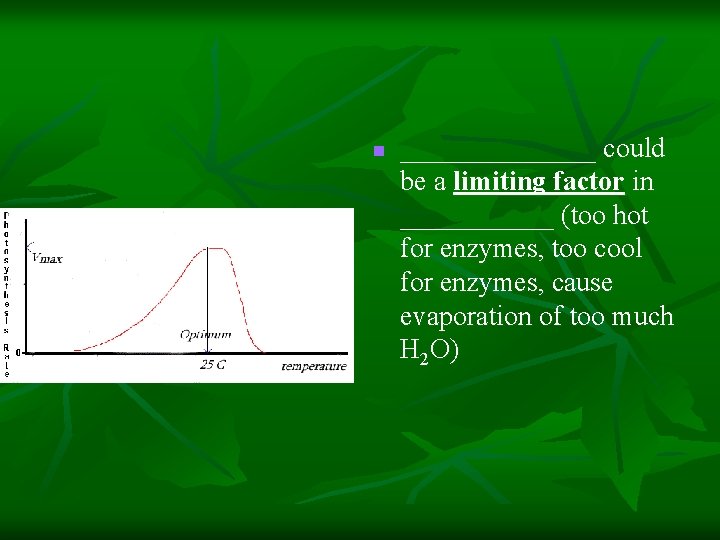
n _______ could be a limiting factor in ______ (too hot for enzymes, too cool for enzymes, cause evaporation of too much H 2 O)