
Topic 6 NonAssessable Income Sylvia Villios Topic 6
Topic 6 – Non-Assessable Income Sylvia Villios
Topic 6 – Non-Assessable Income (follows Australian Taxation 2015 Chapter 7) Main concepts: • Exempt income • Non-assessable non-exempt income University of Adelaide 2
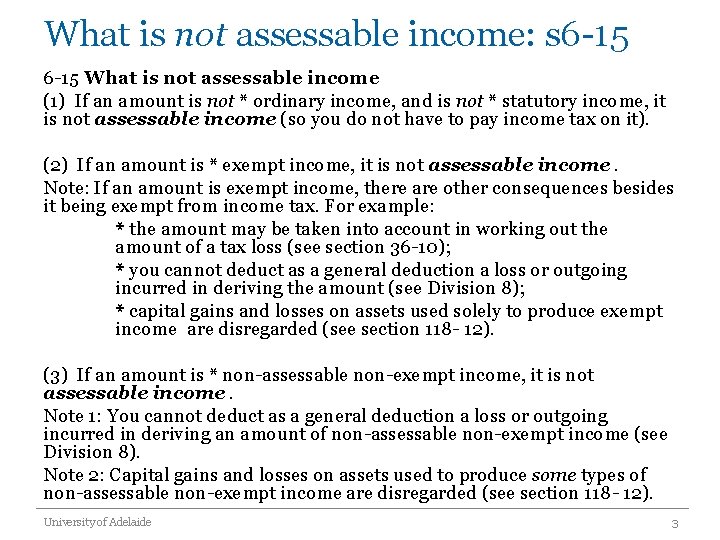
What is not assessable income: s 6 -15 What is not assessable income (1) If an amount is not * ordinary income, and is not * statutory income, it is not assessable income (so you do not have to pay income tax on it). (2) If an amount is * exempt income, it is not assessable income. Note: If an amount is exempt income, there are other consequences besides it being exempt from income tax. For example: * the amount may be taken into account in working out the amount of a tax loss (see section 36 -10); * you cannot deduct as a general deduction a loss or outgoing incurred in deriving the amount (see Division 8); * capital gains and losses on assets used solely to produce exempt income are disregarded (see section 118 - 12). (3) If an amount is * non-assessable non-exempt income, it is not assessable income. Note 1: You cannot deduct as a general deduction a loss or outgoing incurred in deriving an amount of non-assessable non-exempt income (see Division 8). Note 2: Capital gains and losses on assets used to produce some types of non-assessable non-exempt income are disregarded (see section 118 - 12). University of Adelaide 3
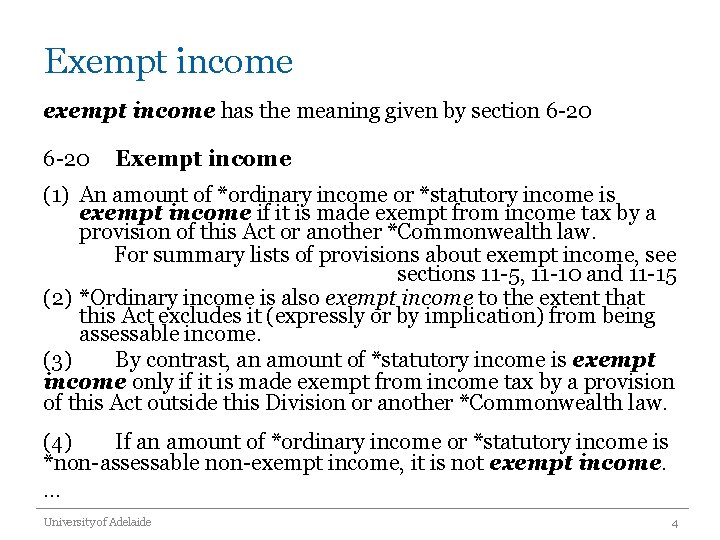
Exempt income exempt income has the meaning given by section 6 -20 Exempt income (1) An amount of *ordinary income or *statutory income is exempt income if it is made exempt from income tax by a provision of this Act or another *Commonwealth law. For summary lists of provisions about exempt income, see sections 11 -5, 11 -10 and 11 -15 (2) *Ordinary income is also exempt income to the extent that this Act excludes it (expressly or by implication) from being assessable income. (3) By contrast, an amount of *statutory income is exempt income only if it is made exempt from income tax by a provision of this Act outside this Division or another *Commonwealth law. (4) If an amount of *ordinary income or *statutory income is *non-assessable non-exempt income, it is not exempt income. … University of Adelaide 4
Exempt income can be divided into two main classes listed in ITAA 1997 s 11 -1. These are: • income of particular entities that are exempt from income tax, no matter what kind of ordinary or statutory income they have; and • income of a particular type that is exempt, including income that is exempt only if it is derived by certain entities. University of Adelaide 5
Exempt entities: ss 11 -5 and 50 -1 Income of particular entities that are exempt from income tax, no matter what kind of ordinary or statutory income they have. The organisations that may obtain exemption include the following ITAA 1997 exempt entities: • charitable, public educational, scientific and religious institutions: s 505 • non-profit organisations established for community service purposes: s 50 -10 • trade unions and employer associations: s 50 -15 • local government, municipal corporations or Commonwealth Public Authorities: s 50 -25 • public and non-profit hospitals and organisations: s 50 -30 • non-profit organisations to promote: the development of primary and secondary resources and tourism; and to promote the development of information and technology resources in Australia: s 50 -40 • non-profit organisations to promote the development of animal racing, art, games, sport, culture, literature, music and film: s 50 -45 and • HIH claims support trust: s 322 -10 University of Adelaide 6
Exempt entities Aid/Watch Inc v FCT (2010) 241 CLR 539 Facts: Aid/Watch promotes the effectiveness of Australian and multinational aid, investment programmes, projects and policies and is not a government body. It analyses and campaigns for the delivery of overseas aid, although it does not furnish aid. Also, its objectives and practices combine the charitable objects of relief of poverty and advancement of education. The issue concerned whether it is a charitable institution for tax purposes. The Full Federal Court found that it was not a charitable institution for tax purposes because the court considered its main purpose was of a political nature. High Court held: The majority (5: 2) found that Aid/Watch was a charity. The terms ‘charitable’ and ‘charitable institution’ in ITAA 1997 s 50 -5, item 1. 1 were to be understood by reference to its source in the general law as it is developed in Australia from time to time. The court asserted that the generation by lawful means of public debate concerning the way foreign aid was directed to the relief of poverty was a purpose beneficial to the community. There was no general rule excluding political objects from charitable purposes. Since Aid/Watch’s conduct contributed to public welfare, it was a charitable institution. University of Adelaide 7
Exempt entities FCT v Word Investments Ltd 2006 ATC 4715 Facts: In a test case, a voluntary Christian organisation, Australian Bible Translators, sought to be endorsed as an exempt charitable institution under ITAA 1997 s 50 -5. Previously, the taxpayer conducted a housing development and a funeral business. It also had an investment activity that held $2. 7 million. The taxpayer’s activities were carried on for Christian purposes. The Commissioner declined to endorse the taxpayer as a charity. High Court held: The taxpayer was entitled to be endorsed as a charity for the entire period including when it was conducting the funeral business. The High Court found that where an organisation raises funds exclusively for a charitable purpose, the fact that it does so through a commercial enterprise does not preclude it from being a charity. There was no justification then for distinguishing between active and passive investments where the overall activities of the taxpayer remained charitable. Section 5050(a) does not require the money to be spent in Australia. To overcome FCT v Word Investments Ltd 2006 ATC 4715 and address the concerns about the application of the principally ‘in Australia’ or deductible gift recipient tests, a new consolidated and standardised provision clearly sets out the ‘in Australia’ special conditions. University of Adelaide 8
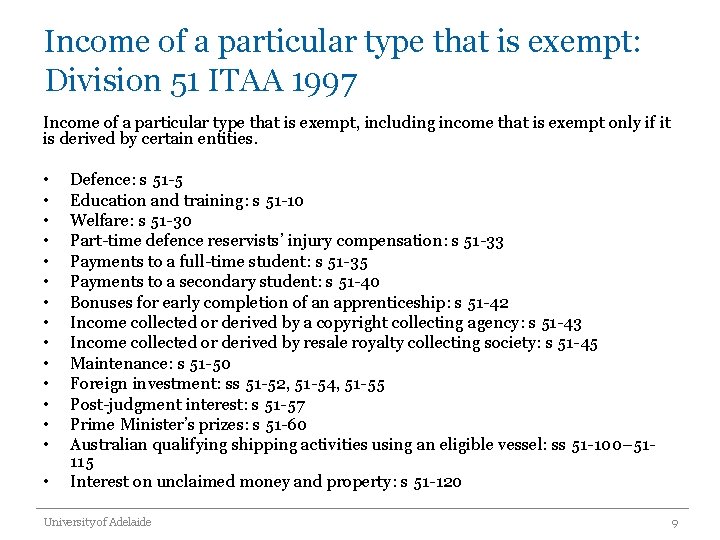
Income of a particular type that is exempt: Division 51 ITAA 1997 Income of a particular type that is exempt, including income that is exempt only if it is derived by certain entities. • • • • Defence: s 51 -5 Education and training: s 51 -10 Welfare: s 51 -30 Part-time defence reservists’ injury compensation: s 51 -33 Payments to a full-time student: s 51 -35 Payments to a secondary student: s 51 -40 Bonuses for early completion of an apprenticeship: s 51 -42 Income collected or derived by a copyright collecting agency: s 51 -43 Income collected or derived by resale royalty collecting society: s 51 -45 Maintenance: s 51 -50 Foreign investment: ss 51 -52, 51 -54, 51 -55 Post-judgment interest: s 51 -57 Prime Minister’s prizes: s 51 -60 Australian qualifying shipping activities using an eligible vessel: ss 51 -100– 51115 Interest on unclaimed money and property: s 51 -120 University of Adelaide 9
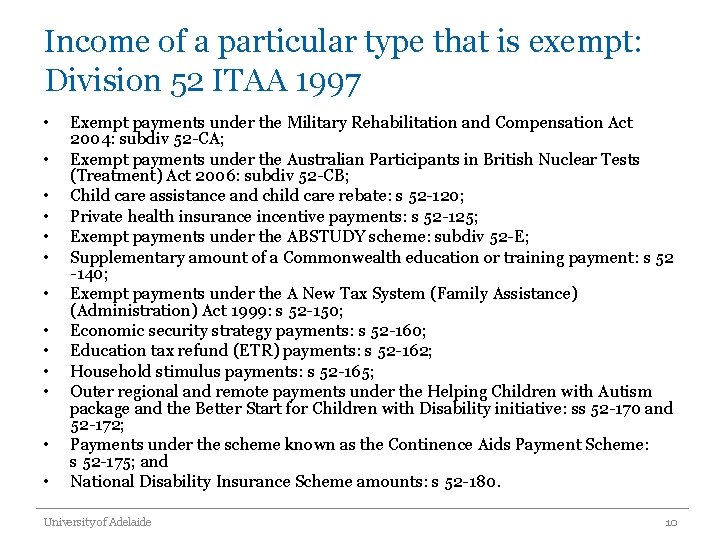
Income of a particular type that is exempt: Division 52 ITAA 1997 • • • • Exempt payments under the Military Rehabilitation and Compensation Act 2004: subdiv 52 -CA; Exempt payments under the Australian Participants in British Nuclear Tests (Treatment) Act 2006: subdiv 52 -CB; Child care assistance and child care rebate: s 52 -120; Private health insurance incentive payments: s 52 -125; Exempt payments under the ABSTUDY scheme: subdiv 52 -E; Supplementary amount of a Commonwealth education or training payment: s 52 -140; Exempt payments under the A New Tax System (Family Assistance) (Administration) Act 1999: s 52 -150; Economic security strategy payments: s 52 -160; Education tax refund (ETR) payments: s 52 -162; Household stimulus payments: s 52 -165; Outer regional and remote payments under the Helping Children with Autism package and the Better Start for Children with Disability initiative: ss 52 -170 and 52 -172; Payments under the scheme known as the Continence Aids Payment Scheme: s 52 -175; and National Disability Insurance Scheme amounts: s 52 -180. University of Adelaide 10
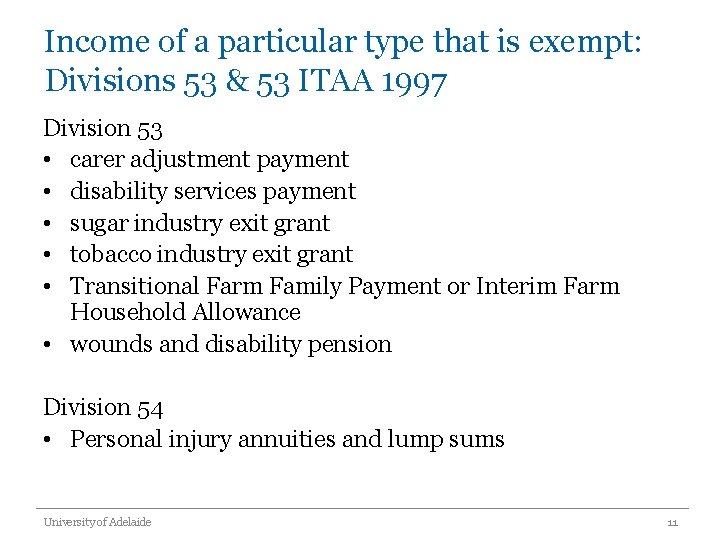
Income of a particular type that is exempt: Divisions 53 & 53 ITAA 1997 Division 53 • carer adjustment payment • disability services payment • sugar industry exit grant • tobacco industry exit grant • Transitional Farm Family Payment or Interim Farm Household Allowance • wounds and disability pension Division 54 • Personal injury annuities and lump sums University of Adelaide 11
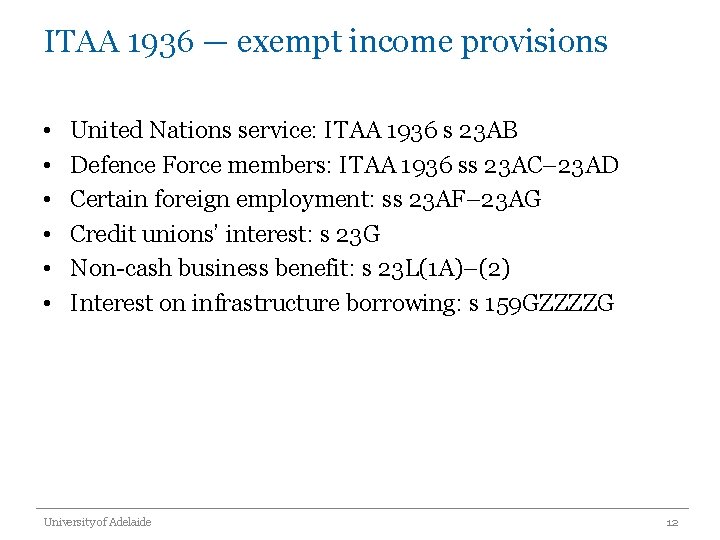
ITAA 1936 — exempt income provisions • • • United Nations service: ITAA 1936 s 23 AB Defence Force members: ITAA 1936 ss 23 AC– 23 AD Certain foreign employment: ss 23 AF– 23 AG Credit unions’ interest: s 23 G Non-cash business benefit: s 23 L(1 A)–(2) Interest on infrastructure borrowing: s 159 GZZZZG University of Adelaide 12
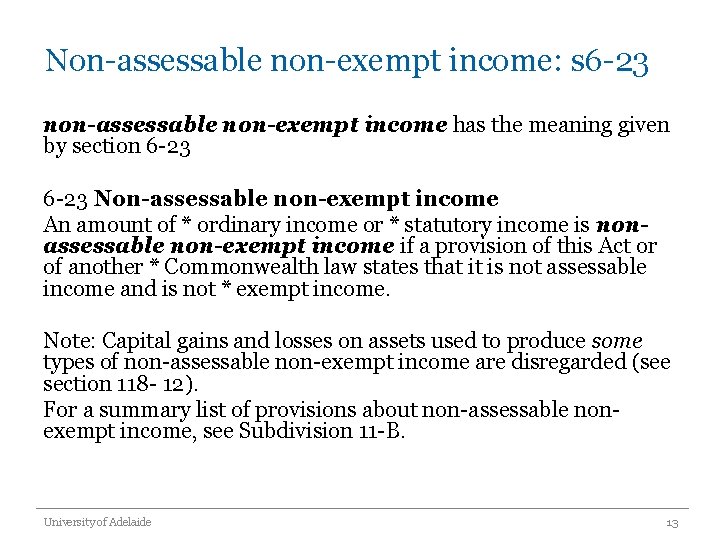
Non-assessable non-exempt income: s 6 -23 non-assessable non-exempt income has the meaning given by section 6 -23 Non-assessable non-exempt income An amount of * ordinary income or * statutory income is nonassessable non-exempt income if a provision of this Act or of another * Commonwealth law states that it is not assessable income and is not * exempt income. Note: Capital gains and losses on assets used to produce some types of non-assessable non-exempt income are disregarded (see section 118 - 12). For a summary list of provisions about non-assessable nonexempt income, see Subdivision 11 -B. University of Adelaide 13
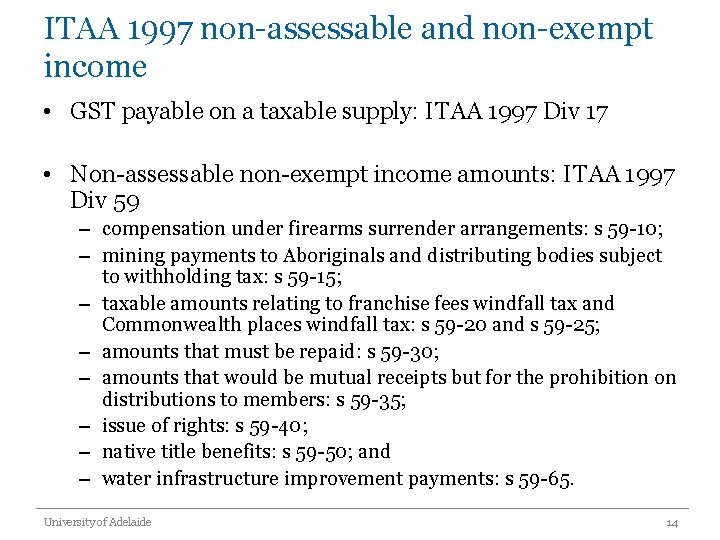
ITAA 1997 non-assessable and non-exempt income • GST payable on a taxable supply: ITAA 1997 Div 17 • Non-assessable non-exempt income amounts: ITAA 1997 Div 59 – compensation under firearms surrender arrangements: s 59 -10; – mining payments to Aboriginals and distributing bodies subject to withholding tax: s 59 -15; – taxable amounts relating to franchise fees windfall tax and Commonwealth places windfall tax: s 59 -20 and s 59 -25; – amounts that must be repaid: s 59 -30; – amounts that would be mutual receipts but for the prohibition on distributions to members: s 59 -35; – issue of rights: s 59 -40; – native title benefits: s 59 -50; and – water infrastructure improvement payments: s 59 -65. University of Adelaide 14
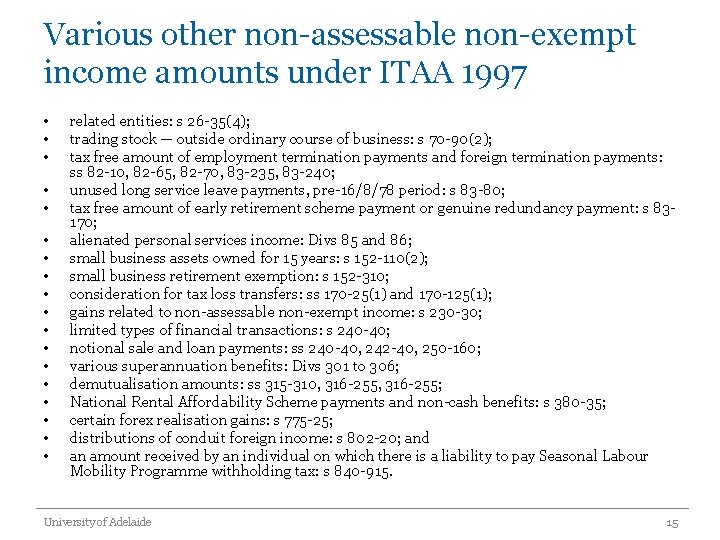
Various other non-assessable non-exempt income amounts under ITAA 1997 • • • • • related entities: s 26 -35(4); trading stock — outside ordinary course of business: s 70 -90(2); tax free amount of employment termination payments and foreign termination payments: ss 82 -10, 82 -65, 82 -70, 83 -235, 83 -240; unused long service leave payments, pre-16/8/78 period: s 83 -80; tax free amount of early retirement scheme payment or genuine redundancy payment: s 83170; alienated personal services income: Divs 85 and 86; small business assets owned for 15 years: s 152 -110(2); small business retirement exemption: s 152 -310; consideration for tax loss transfers: ss 170 -25(1) and 170 -125(1); gains related to non-assessable non-exempt income: s 230 -30; limited types of financial transactions: s 240 -40; notional sale and loan payments: ss 240 -40, 242 -40, 250 -160; various superannuation benefits: Divs 301 to 306; demutualisation amounts: ss 315 -310, 316 -255; National Rental Affordability Scheme payments and non-cash benefits: s 380 -35; certain forex realisation gains: s 775 -25; distributions of conduit foreign income: s 802 -20; and an amount received by an individual on which there is a liability to pay Seasonal Labour Mobility Programme withholding tax: s 840 -915. University of Adelaide 15
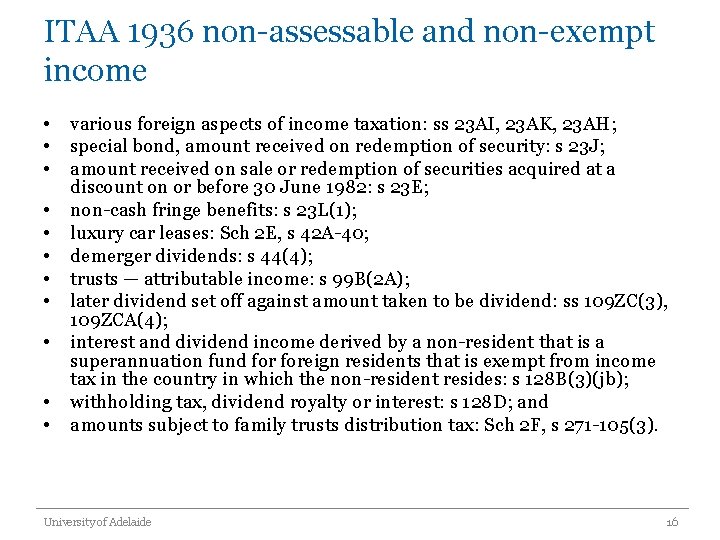
ITAA 1936 non-assessable and non-exempt income • • • various foreign aspects of income taxation: ss 23 AI, 23 AK, 23 AH; special bond, amount received on redemption of security: s 23 J; amount received on sale or redemption of securities acquired at a discount on or before 30 June 1982: s 23 E; non-cash fringe benefits: s 23 L(1); luxury car leases: Sch 2 E, s 42 A-40; demerger dividends: s 44(4); trusts — attributable income: s 99 B(2 A); later dividend set off against amount taken to be dividend: ss 109 ZC(3), 109 ZCA(4); interest and dividend income derived by a non-resident that is a superannuation fund foreign residents that is exempt from income tax in the country in which the non-resident resides: s 128 B(3)(jb); withholding tax, dividend royalty or interest: s 128 D; and amounts subject to family trusts distribution tax: Sch 2 F, s 271 -105(3). University of Adelaide 16
- Slides: 16