
Topic 6 Growth Reproduction of Bacteria Prokaryotic Life
Topic 6 Growth & Reproduction of Bacteria Prokaryotic Life Part 2
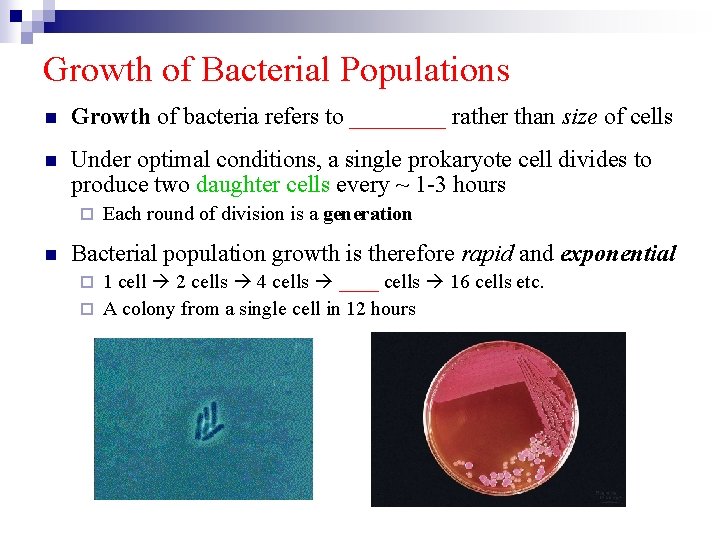
Growth of Bacterial Populations n Growth of bacteria refers to ____ rather than size of cells n Under optimal conditions, a single prokaryote cell divides to produce two daughter cells every ~ 1 -3 hours ¨ n Each round of division is a generation Bacterial population growth is therefore rapid and exponential 1 cell 2 cells 4 cells ____ cells 16 cells etc. ¨ A colony from a single cell in 12 hours ¨
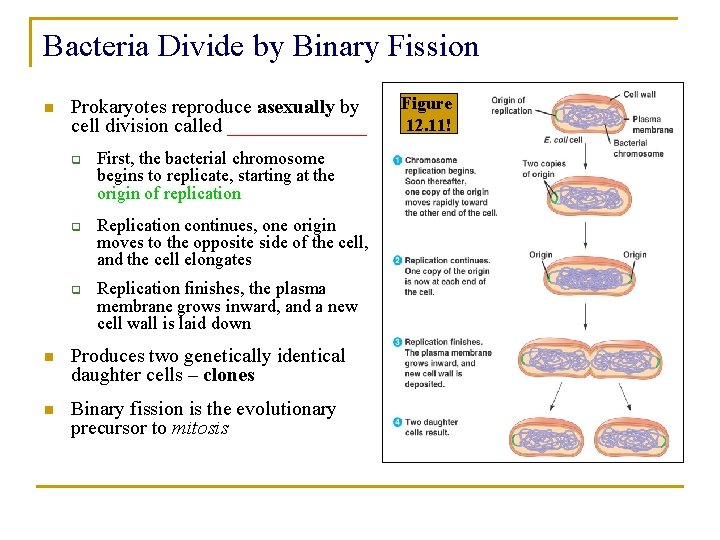
Bacteria Divide by Binary Fission n Prokaryotes reproduce asexually by cell division called _______ q q q First, the bacterial chromosome begins to replicate, starting at the origin of replication Replication continues, one origin moves to the opposite side of the cell, and the cell elongates Replication finishes, the plasma membrane grows inward, and a new cell wall is laid down n Produces two genetically identical daughter cells – clones n Binary fission is the evolutionary precursor to mitosis Figure 12. 11!

Mechanisms That Produce Variation o If binary fission produces clonal offspring, why are bacteria so genetically diverse? ? ? o Two factors contribute to genetic diversity among and within bacterial species n _______ n Recombination
Mutation o A ______ is a change in the DNA of a gene, ultimately leading to genetic diversity o Mutations can be spontaneous or caused by mutagens n Spontaneous - Errors during DNA replication n Mutagens - Chemical or physical factors that damage DNA o Spontaneous mutations are extremely rare, occurring on average only once in 10 million cell divisions, per gene o Because bacteria divide rapidly & exponentially, mutation is a relevant factor generating genetic diversity
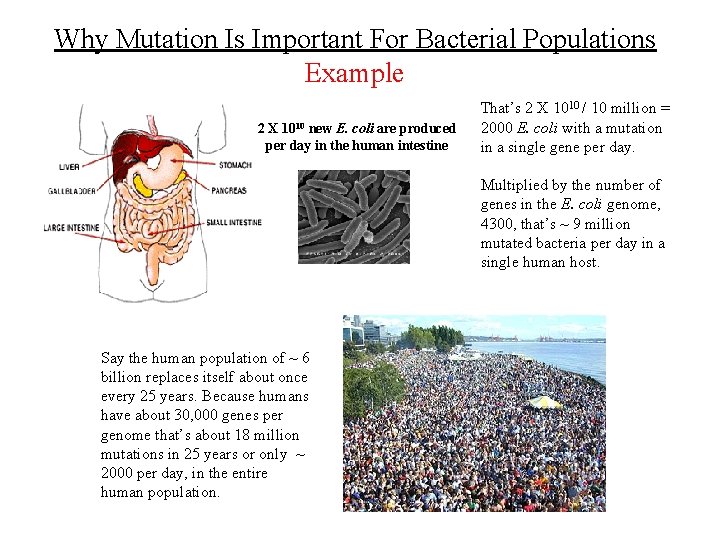
Why Mutation Is Important For Bacterial Populations Example 2 X 10¹⁰ new E. coli are produced per day in the human intestine That’s 2 X 10¹⁰ / 10 million = 2000 E. coli with a mutation in a single gene per day. Multiplied by the number of genes in the E. coli genome, 4300, that’s ~ 9 million mutated bacteria per day in a single human host. Say the human population of ~ 6 billion replaces itself about once every 25 years. Because humans have about 30, 000 genes per genome that’s about 18 million mutations in 25 years or only ~ 2000 per day, in the entire human population.
Genetic Recombination n The combining of DNA from two sources n In sexually reproducing organisms this is the main way genetic variation is produced n In eukaryotes, it involves the sexual processes of meiosis and fertilization n In prokaryotes three other processes are used – transformation, transduction, and conjugation (= bacterial “sex”) n Results in horizontal gene transfer – the transfer of genetic material within a generation, instead of from one generation to the next – a major force in the long-term evolution of bacteria
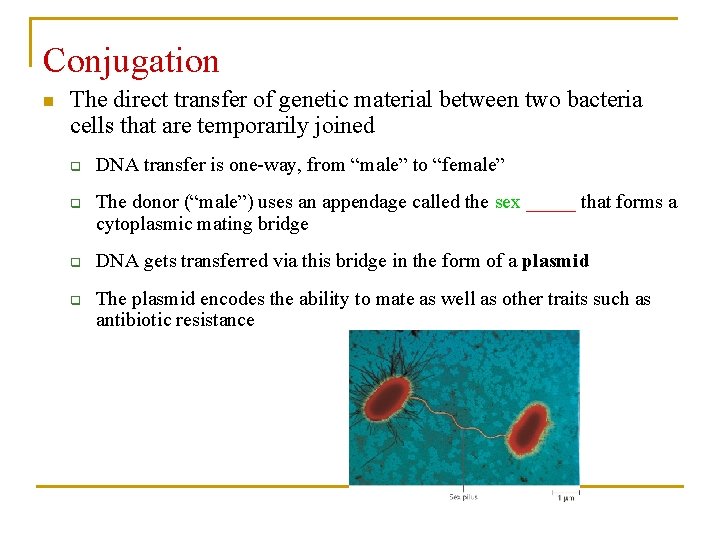
Conjugation n The direct transfer of genetic material between two bacteria cells that are temporarily joined q q DNA transfer is one-way, from “male” to “female” The donor (“male”) uses an appendage called the sex _____ that forms a cytoplasmic mating bridge DNA gets transferred via this bridge in the form of a plasmid The plasmid encodes the ability to mate as well as other traits such as antibiotic resistance
Bacterial Populations Evolve Rapidly n Natural selection operates on genetic (heritable) variation, such as is generated readily by mutation in bacteria n A mutation that confers a reproductive advantage increases in frequency in subsequent generations, and eventually becomes fixed in the population n Bacteria reproduce quickly and therefore have a short generation time relative to most other organisms n The rapid evolution of _________in bacteria is a medically important example of natural selection at work
- Slides: 9