
TOPIC 6 ELECTROCHEMISTRY By Chemistry Lecturer School of
TOPIC 6 ELECTROCHEMISTRY By: Chemistry Lecturer School of Allied Health Sciences City University College of Science and Technology
Electrolytes and Non-electrolytes Electrolytes: Chemical compound that can conduct electricity in the molten state or in aqueous solution ◦ Electricity conducted by free moving ions Non electrolytes: Chemical compound that cannot conduct electricity in any state
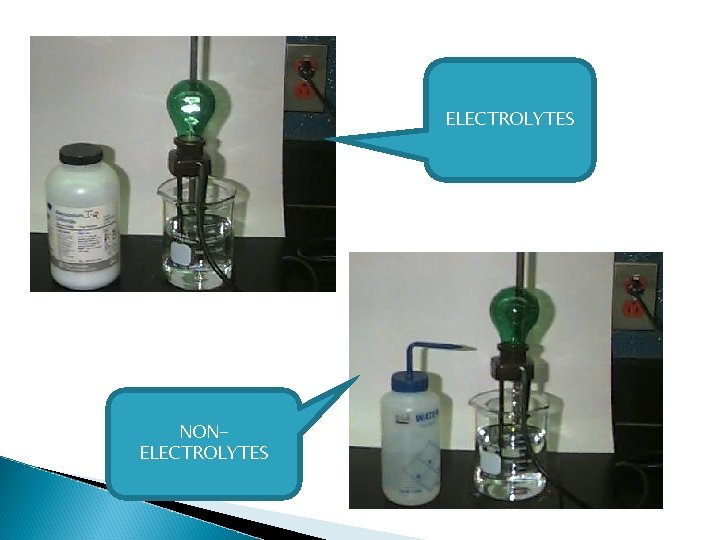
ELECTROLYTES NONELECTROLYTES
Electrolytic of a molten compound • • Electrolysis is a process whereby a compound is decomposed by electric current Electrolytic cell consists of two electrodes i. ü Anode – Positive terminal Anions (-ve charged ions) attracted to anode ii. ü Cathode – Negative terminal Cations (+ve charged ions) attracted to cathode


Electrolytic process • Generally a molten compound electrolytes An. Bm produces Am+ cations and Bn- anions An. Bm Am+ Bn- • i. ii. Examples: Pb. Br 2 Pb 2+ + 2 Br. Na. Cl Na+ + Cl-
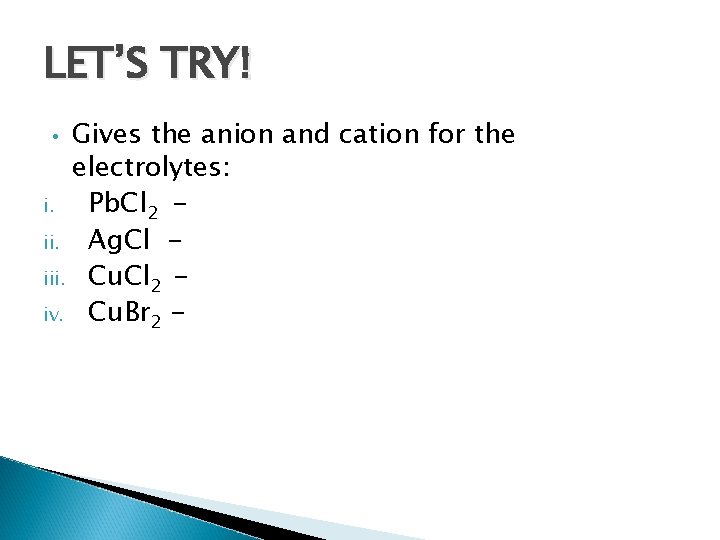
LET’S TRY! Gives the anion and cation for the electrolytes: i. Pb. Cl 2 ii. Ag. Cl iii. Cu. Cl 2 iv. Cu. Br 2 •
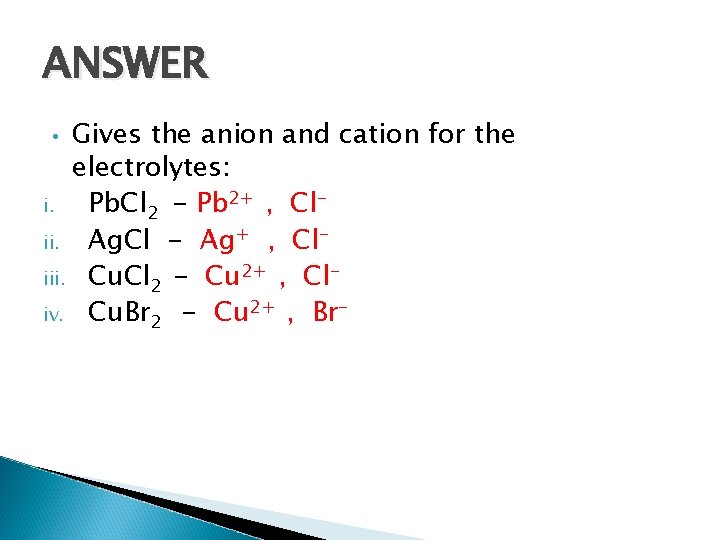
ANSWER Gives the anion and cation for the electrolytes: i. Pb. Cl 2 - Pb 2+ , Clii. Ag. Cl - Ag+ , Cliii. Cu. Cl 2 - Cu 2+ , Cliv. Cu. Br 2 - Cu 2+ , Br •
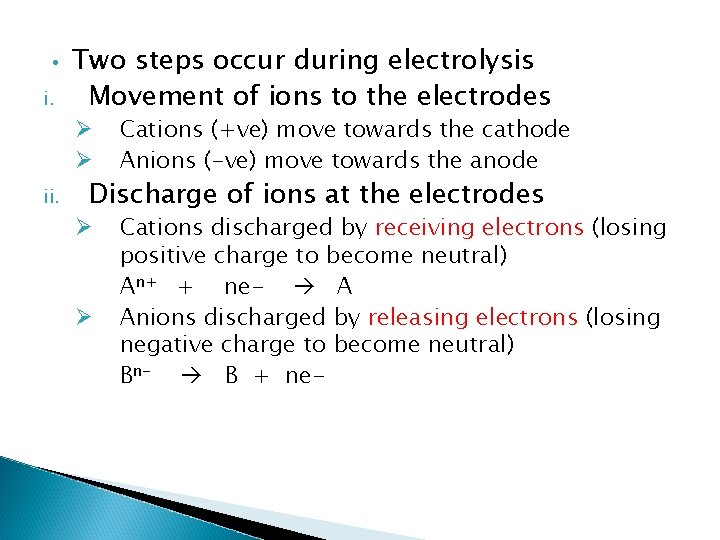
• i. Two steps occur during electrolysis Movement of ions to the electrodes Ø Ø ii. Cations (+ve) move towards the cathode Anions (-ve) move towards the anode Discharge of ions at the electrodes Ø Ø Cations discharged by receiving electrons (losing positive charge to become neutral) An+ + ne- A Anions discharged by releasing electrons (losing negative charge to become neutral) Bn- B + ne-
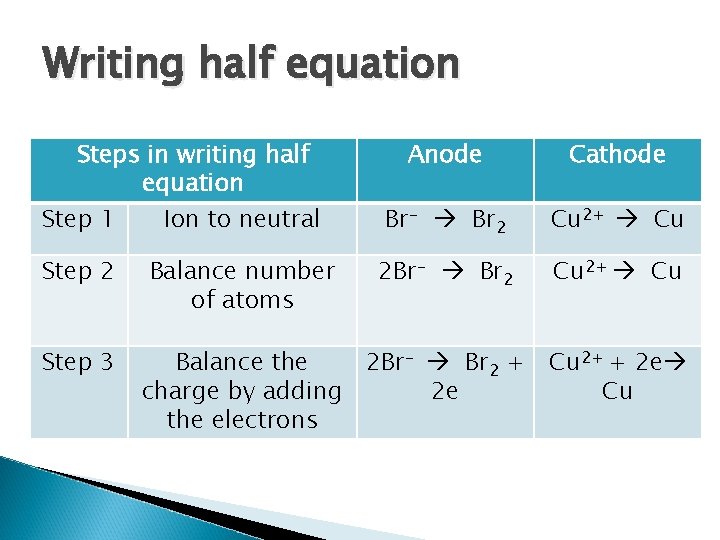
Writing half equation Steps in writing half equation Anode Cathode Step 1 Ion to neutral Br- Br 2 Cu 2+ Cu Step 2 Balance number of atoms 2 Br- Br 2 Cu 2+ Cu Step 3 Balance the 2 Br- Br 2 + Cu 2+ + 2 e charge by adding 2 e Cu the electrons
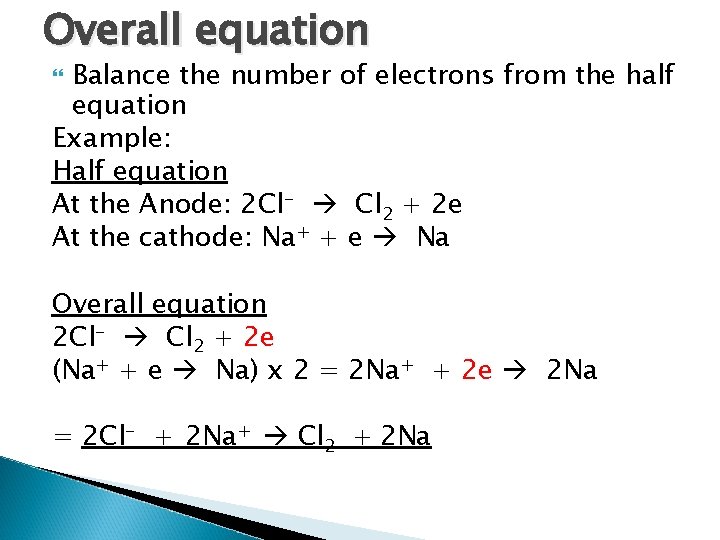
Overall equation Balance the number of electrons from the half equation Example: Half equation At the Anode: 2 Cl- Cl 2 + 2 e At the cathode: Na+ + e Na Overall equation 2 Cl- Cl 2 + 2 e (Na+ + e Na) x 2 = 2 Na+ + 2 e 2 Na = 2 Cl- + 2 Na+ Cl 2 + 2 Na
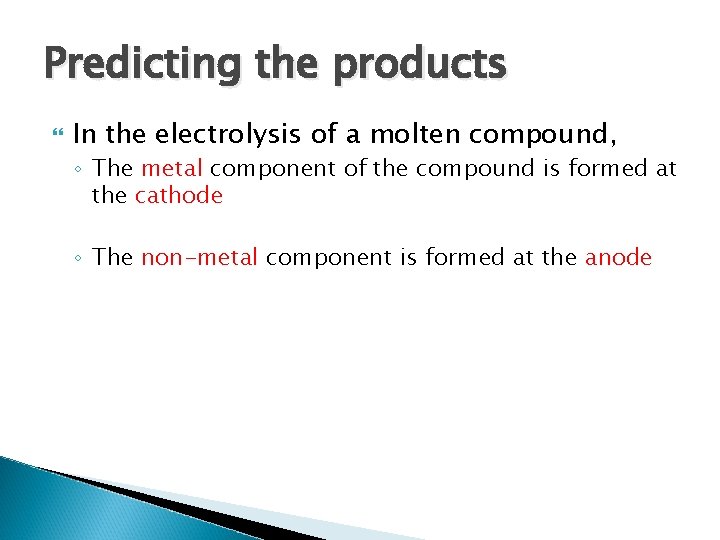
Predicting the products In the electrolysis of a molten compound, ◦ The metal component of the compound is formed at the cathode ◦ The non-metal component is formed at the anode
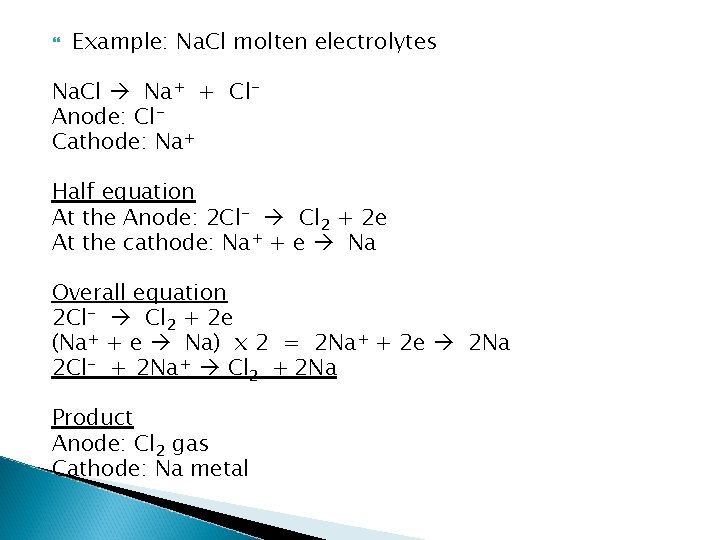
Example: Na. Cl molten electrolytes Na. Cl Na+ + Cl. Anode: Cl. Cathode: Na+ Half equation At the Anode: 2 Cl- Cl 2 + 2 e At the cathode: Na+ + e Na Overall equation 2 Cl- Cl 2 + 2 e (Na+ + e Na) x 2 = 2 Na+ + 2 e 2 Na 2 Cl- + 2 Na+ Cl 2 + 2 Na Product Anode: Cl 2 gas Cathode: Na metal
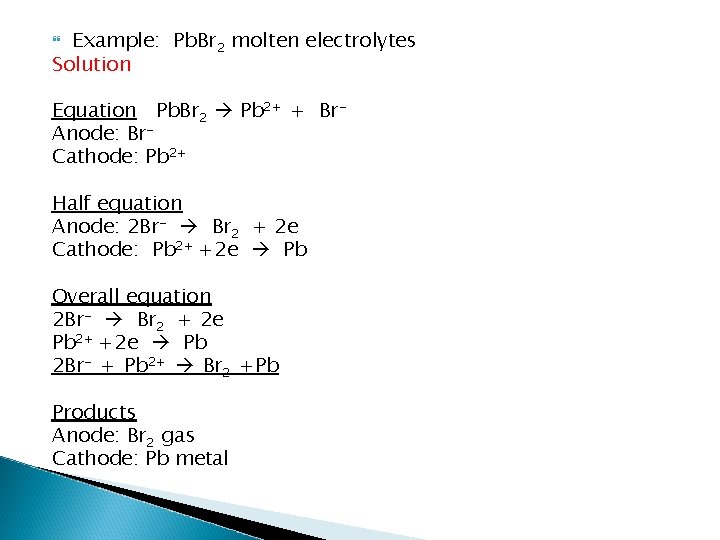
Example: Pb. Br 2 molten electrolytes Solution Equation Pb. Br 2 Pb 2+ + Br. Anode: Br. Cathode: Pb 2+ Half equation Anode: 2 Br- Br 2 + 2 e Cathode: Pb 2+ +2 e Pb Overall equation 2 Br- Br 2 + 2 e Pb 2+ +2 e Pb 2 Br- + Pb 2+ Br 2 +Pb Products Anode: Br 2 gas Cathode: Pb metal
Electrolysis of aqueos solution Aqueos solution consists of TWO types of cations and anions; H+ and OHExample: Aqueos sodium chloride (Na. Cl) solution Cations: Na+ and H+ Anions: Cl- and OH- v However only ONE type of cation and anion will be discharged at each electrode
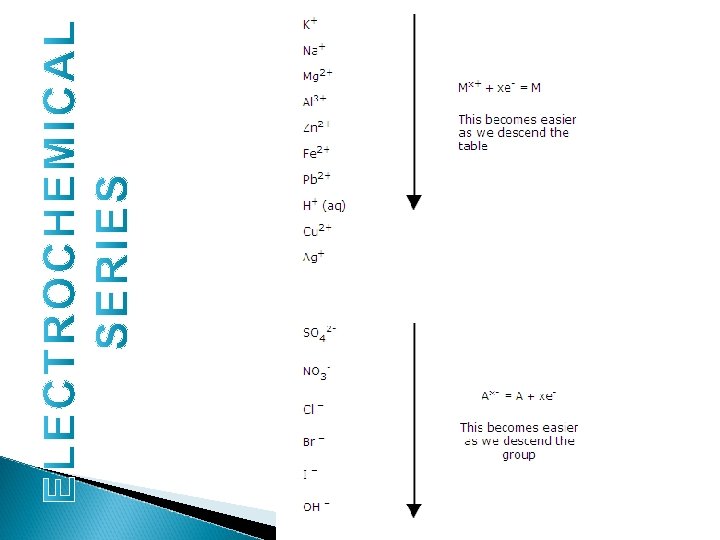
Factors that determine the products formed 1. Positions of ions in the electrochemical series The tendency of ions to be selectively discharged depends on their positions in a series known as electrochemical series (ES). The lower the position of the ion in the ES, the easier the ion will be discharged.
Example: Aqueos sodium chloride (Na. Cl) solution electrolytes Cations: Na+ and H+ Anions: Cl- and OHHalf equation Anode: 4 OH- 2 H 2 O + O 2 + 4 e Cathode: 2 H+ + 2 e H 2 Overall equation 4 OH- 2 H 2 O + O 2 + 4 e (2 H+ + 2 e H 2 ) x 2 = 4 H+ + 4 e 2 H 2 4 OH- + 4 H+ 2 H 2 O + O 2 + 2 H 2 Products Anode: oxygen gas Cathode: hydrogen gas
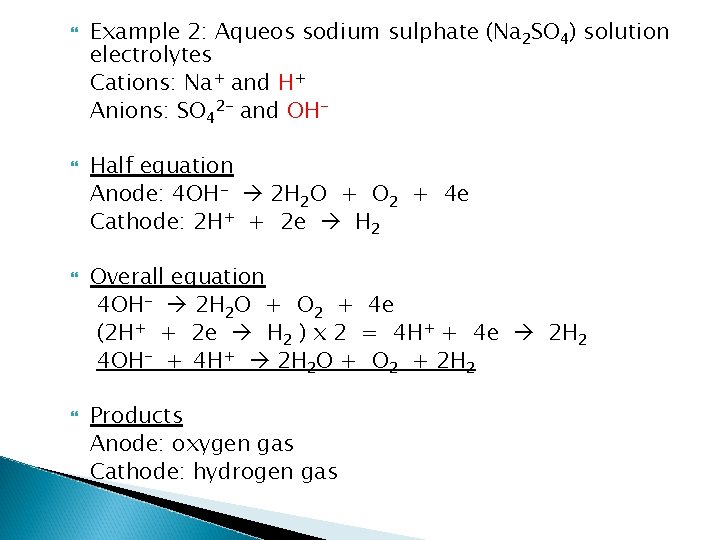
Example 2: Aqueos sodium sulphate (Na 2 SO 4) solution electrolytes Cations: Na+ and H+ Anions: SO 42 - and OHHalf equation Anode: 4 OH- 2 H 2 O + O 2 + 4 e Cathode: 2 H+ + 2 e H 2 Overall equation 4 OH- 2 H 2 O + O 2 + 4 e (2 H+ + 2 e H 2 ) x 2 = 4 H+ + 4 e 2 H 2 4 OH- + 4 H+ 2 H 2 O + O 2 + 2 H 2 Products Anode: oxygen gas Cathode: hydrogen gas
Factors that determine the products formed 2. Effect of ion concentration When the concentration of a particular type of ion is higher, ion will more likely to be discharged in electrolysis Usually concentrated halide (Cl- / Br- / Iions)
Factors that determine the products formed 3. Effect of types of electrodes used The types of electrodes used can determined the type of ions discharged in electrolysis Using metal electrodes at anode, ions are not discharged instead the metal dissolves by releasing electrons to form metal ions. Example: using copper (Cu) electrodes. Cu 2+ + 2 e Hence mass of anode decrease.
Let’s Try!! 1. Gives the diagram, anion, cation, half equation, overall equation, products and observation using electrolytes i. Pb. Br 2 molten ii. Pb. Cl 2 molten iii. Cu. SO 4 solution

THANK YOU…
- Slides: 23