
Topic 6 Decisionmaking and problemsolving the value of
Topic 6 Decision-making and problem-solving: the value of interpersonal skills
Topic 5 Decision-making and problem-solving: the value of interpersonal skills Small and large decisions: the problem of acceptance in the team Effective decision-making Implementing a solution and feedback
What do we mean by decision-making? is regarded as the cognitive process resulting in the selection of a belief or a course of action among several possible alternative options, it could be either rational or irrational Decisionmaking is the process of making choices by identifying a decision, gathering information, and assessing alternative resolutions involves the selection of a course of action from among two or more possible alternatives in order to arrive at a solution for a given problem
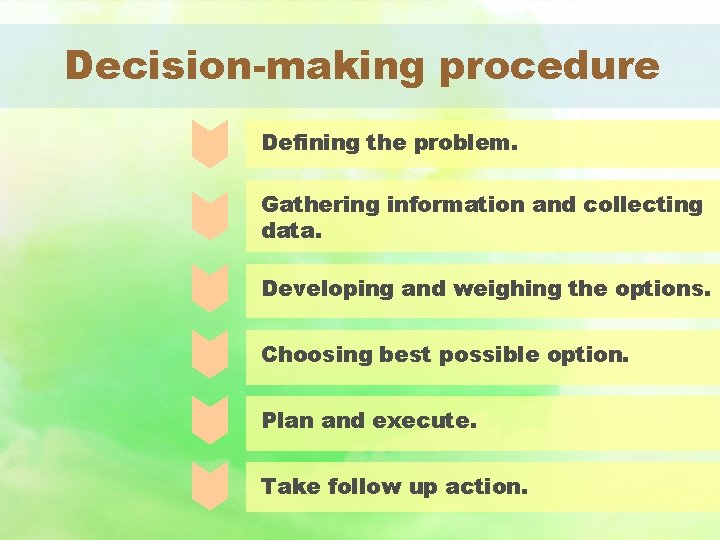
Decision-making procedure Defining the problem. Gathering information and collecting data. Developing and weighing the options. Choosing best possible option. Plan and execute. Take follow up action.
Defining the problem Defining or identifying the problem it is the most difficult and the most important of all the steps. It involves diagnosing the situation so that the focus on the real problem and not on its symptoms.

Importance of problem definition Frequently finding or identifying a problem is more important than the solution. Sometimes problem definition may be nothing more than the art of asking the right questions at the right time. .
Mistakes of the asker Ask a question that already contains an answer. Ask a closed question. Pretend to understand the answer, although it is not. To put pressure on the responder. Ask a whole series of questions.
Good ideas for the right questions It makes sense to prepare in advance: determine the essence of the problem and the purpose of the conversation, sketch out a list of questions. Formulate the question in one sentence – you personally will better understand the essence of the problem. Formulate several options for the question – this will allow you to look at the problem from different angles. Begin questions with “why” – “why” is very good at mitigating directive questions. Ask clarifying questions – several consecutively asked questions, each of which develops and clarifies the previous one, allow you to get deeper and more useful answers.
Ways to make better decisions: Don’t fear the consequences. Don’t cry over spilt milk. Go with your gut instincts. Look at it another way. Consider your emotions. Beware social pressure. Play the devil’s advocate. Limit your options. Keep your eye on the ball. Have someone else choose.
Don’t fear the consequences Almost every decision we make entails predicting the future. In each case we imagine how the outcomes of our choices will make us feel, and what the emotional or “hedonic” consequences of our actions will be. Sensibly, we usually plump for the option that we think will make us the happiest overall. People routinely overestimate the impact of decision outcomes and life events, both good and bad. We tend to think that winning the lottery will make us happier than it actually will, and that life would be completely unbearable if we were to lose the use of our legs. A major factor leading us to make bad predictions is “loss aversion” – the belief that a loss will hurt more than a corresponding gain will please.
Go with your gut instincts It is tempting to think that to make good decisions you need time to systematically weigh up all the pros and cons of various alternatives, but sometimes a snap judgement or instinctive choice is just as good, if not better. In our everyday lives, we make fast and competent decisions about who to trust and interact with. We make judgements about a person’s trustworthiness, competence, aggressiveness, likeability and attractiveness within the first 100 milliseconds of seeing a new face. Of course, as you get to know someone better you refine your first impressions. It stands to reason that extra information can help you make well-informed, rational decisions. Yet paradoxically, sometimes the more information you have the better off you may be going with your instincts. Information overload can be a problem in all sorts of situations, from choosing a school for your child to picking a holiday destination.
Consider your emotions Our most basic emotions evolved to enable us to make rapid and unconscious choices in situations that threaten our survival. Fear leads to flight or fight, disgust leads to avoidance. Yet the role of emotions in decision-making goes way deeper than these knee-jerk responses. Emotions are clearly a crucial component in the neurobiology of choice, but whether they always allow us to make the right decisions is another matter. If you try to make choices under the influence of an emotion it can seriously affect the outcome. All emotions affect our thinking and motivation, so it may be best to avoid making important decisions under their influence. Yet strangely there is one emotion that seems to help us make good choices. In fact many studies show that depressed people have the most realistic take on the world.
Play the devil’s advocate The confirmation bias is a problem if we believe we are making a decision by rationally weighing up alternatives, when in fact we already have a favoured option that we simply want to justify. Our tendency to overestimate the extent to which other people’s judgement is affected by the confirmation bias, while denying it in ourselves, makes matters worse. If you want to make good choices, you need to do more than latch on to facts and figures that support the option you already suspect is the best. Admittedly, actively searching for evidence that could prove you wrong is a painful process, and requires self-discipline. That may be too much to ask of many people much of the time. Perhaps it’s enough to realise that we’re unlikely to be truly objective. Just recognising that this bias exists, and that we’re all subject to it, is probably a good thing. At the very least, we might hold our views a little less dogmatically and choose with a bit more humility.
Keep your eye on the ball Our decisions and judgements have a strange and disconcerting habit of becoming attached to arbitrary or irrelevant facts and figures. With little to go on, we seem more prone to latch onto irrelevancies and let them sway our judgement. It can also take a more concrete form, however. We are all in danger of falling foul of the anchoring effect every time we walk into a shop and see a nice shirt or dress marked “reduced”.
Thanks for your attention and good work!
- Slides: 15